TITLE PAGE
Title
‘First-Year Osteopathic Students’ Use and Perceptions of Complementary
Video-Based Learning’
Author
Full Name: Nicholas Tripodi (Corresponding Author)
Address: College of Health and Biomedicine, Victoria University, 301 Flinders Lane
Melbourne, Victoria, Australia, 3000.
ABSTRACT
Objectives: To examine first year osteopathic students’ use and perceptions of
complementary video-based learning in an osteopathic examination and
management unit.
Design: Mixed-method sequential explanatory design
Setting: Tertiary education facility Melbourne, Victoria, Australia
Participants: First year osteopathy students
Main outcome measures: Questionnaire-based surveys and focus groups were used
to examine use of video resources and student perceptions. Surveys were analysed
based on the frequency of responses made on a 4-point likert scale. Thematic
analysis was performed on long-answer survey and focus group transcripts.
Results: Seventy-four (n=74) students completed the surveys and 12 students took
part in the focus groups. Participants reported the online videos had a positive effect
on their learning experience in the unit (100%). Themes that emerged from the focus
groups included improved understanding, increased exam study and performance,
increased exam confidence, decreased exam anxiety, and minor technical
difficulties.
Conclusion: Video-based learning appears to be an effective approach in decreasing
first year osteopathy students’ perceived exam anxiety, and increasing perceived
exam confidence and performance. These perceptions are thought to be due to the
IMPLICATIONS FOR PRACTICE
VBL appears to be effective in improving osteopathic students study practices
VBL can increase practical exam confidence and decreased exam anxiety
Evidence supports the implementation of VBL into osteopathic education
Future research should investigate VBLs effect on other health science
KEY WORDS
INTRODUCTION
Most current tertiary students are seen as ‘digital natives’ [1-2]. This term implies
that, unlike any other previous generation of tertiary students, the current generation
have spent their entire life surrounded by computers, mobile phones, video games
and other technological devices [1]. Higher education curriculum designers should
make the most of the ‘web 2.0 tools’ that are now accessible because of their
adaptability, accessibility, and varied content [3] through blended learning. A major
challenge for modern tertiary education institutions is how to best design and
integrate the e-learning environments and ‘web 2.0’ learning tools from which this
digital generation of students are learning from [3]. Higher education curriculum
designers should make the most of these ‘web 2.0 tools’ that are now accessible
because of their adaptability, accessibility, and varied content [3-4].
Most tertiary institutions are implementing modern digital learning approaches in the
form of blended learning. Blended learning is a way of improving student
experiences and outcomes by combining the use of information and communicative
technologies, and the effective parts of face-to-face communication [5]. Blended
learning is said to be an essential component of modern teaching and learning
because it is easily accessible, attractive and engaging, makes collaboration easier
and assists students and teachers to be life-long learners [6].
Video-based learning (VBL) is a popular form of blended learning [7-10]. Research
evaluating the effectiveness of VBL in tertiary health and medical teaching settings
preparedness, self-efficacy, enjoyment and overall understanding [8, 11-13].
Furthermore, VBL appears to improve student engagement with the curriculum and
discussion of content [3], and also encourages and fosters active and deep learning,
especially when it comes to problem solving [13-15].
First year students face many challenges when assimilating into the higher education
system. Pre-test anxiety can be one of these challenges. Generally, the cognitive
component of pre-test anxiety is the factor most closely related to declines in
academic performance [16]. Thoughts commonly exhibited by individuals dealing
with high levels of cognitive test anxiety can include: comparing self-performance to
peers, considering the consequences of failure, low levels of confidence in
performance, excessive worry over evaluation, feeling unprepared for tests, and a
loss of self-worth [16]. Fear of failure in particular, has been implicated with a surface
learning approach [17]. The negatives associated with a surface approach to
learning can be offset by promoting a structured learning approach [17] or a deep
and active approach [14-15]. Furthermore, practical exams can add an additional
layer of anxiety [18] because of their unpredictability and unique examiner-student
interaction. This creates a challenge for first year osteopathy students, given the
substantial practical and ‘hands-on’ component in the first year of a teaching
program. Theoretically, blended learning approaches should create an environment
where students exhibit decreased exam anxiety, and increased confidence
undertaking an exam, due to its ability to help students learn in a deeper and more
Despite current tertiary students being thought of as ‘digital natives’, this term does
not necessarily indicate they are willing, or able, to use digital technologies such as
VBL [19]. Most tertiary students have access to basic information technology
(computers, mobiles, etc.), but an individual student’s use of these for learning
purposes is highly varied [19]. There is also evidence to show that there is an
emerging ‘digital divide’ between tertiary students of different demographics [20]. In
this context, the ‘digital divide’ refers to the potential social inequality between those
who have enhanced digital access and literacy and those who do not [20]. Therefore,
we cannot assume that all tertiary students are able to make the use of modern
blended learning tools [20]. Some students also feel that the information technology
used in their teaching and learning activities is inadequate [21]. This highlights the
need for targeted evaluation of blended learning approaches (including VBL) to
ensure the students are both capable and willing to use the new technology, and if
they are having positive effects on student learning.
Currently, there is only a small amount of literature pertaining to the use and
effectiveness of VBL in the teaching of practical and psychomotor skills in health
science education [10,15,22-24]. The present study is designed to evaluate the
student usage of VBL, and their perceptions of VBL on their learning approaches
and assessment performance in an osteopathic teaching program. This information
METHOD
Ethical approval to conduct the study was obtained from the VU Human Research
Ethics Committee (Approval Number: HRE 15-186).
Participants and Setting
First year osteopathy students enrolled in the Osteopathic Science 1 and 2 (n=114)
in the Bachelor of Science program at Victoria University (Melbourne, Australia) were
invited to participate in the survey and focus groups. The students had access to
complementary VBL material through the university learning management system
(LMS). The LMS is an online system that allows students to access all the available
content for their units, including resources such as lecture recordings, lecture
materials and videos. The Osteopathic Science 1 and 2 units are predominately
practical, where students are taught musculoskeletal examination and manual
therapy skills, including articulation and soft tissue techniques for the spine and
extremities. The unit is designed around students having 5-hours of face-to-face
practical skill sessions each week, over a 12-week semester. Students are expected
to review the supplementary material on the LMS (including the VBL content)
equivalent to 50-100% of their face-to face contact hours.
There were a total of 135 videos available to the students throughout the two
semesters. The videos ran for 2-3 minutes each and demonstrated a single or group
orthopedic tests of the shoulder. The unit coordinators both demonstrated and filmed
the technique videos in a medium shot frame. They were filmed in the clinical setting,
with a senior student as the model. The videos were narrated either during filming or
dubbed post-production.
The students were informed of the present study through an information session at
the beginning of the unit, including the fact that the researcher was one of their
educators. They were also provided with an information to participants form and
paper version of the questionnaire. Students who wished to participate in the study
could complete the consent form and questionnaire at a time of their choosing and
return it to a drop-box. Responses to the questionnaire were anonymous. Students
who were interested in participating in the focus groups were asked to contact the
researcher via email. Consent for the focus groups was gained via a separate
section on the questionnaire consent form.
Evaluation
A three-part mixed-method sequential explanatory design was used. Part one
involved retrieving student video access data from the LMS. It was discovered that
the LMS was inaccurate when describing total views, so percentage of total videos
viewed was the only variable reported. Access data from the LMS was extracted by
the author and data were anonymous. Part two was a questionnaire that evaluated
the students’ usage and perceptions of the VBL resources for the subjects (Figure
1). The survey consisted of demographic questions including age, gender, previous
were developed from analogous research in medical education [12-13]. Students
rated each item on a 4-point Likert-type scale ranging from strongly disagree to
strongly agree. The questionnaire also contained five open-ended questions
exploring similar themes to the items. These additional questions were designed to
increase the volume of qualitative data, and provide the students not participating in
the focus groups with an opportunity to comment on the VBL resources. Part three
involved a focus group. The focus group interview was conducted by the study
author and guided by a set of questions (Figure 2) that were developed from
analogous research in medical education [12-13]. These questions were largely an
extension of the questionnaire as to enrich the data received from the entire study.
Data Analysis
Quantitative data was entered into Microsoft Excel for analysis, and descriptive
statistics were generated for each questionnaire item. Questionnaire responses were
categorised as positive (often, very often, agree, strongly agree) and negative
responses (never, sometimes, disagree, strongly disagree). Focus groups were
recorded on an electronic recording device then transcribed and manually analysed,
along with the long-answer survey questions. The researcher identified the total
number of common and emerging themes using methods from previous research
[27]. To negate the potential for bias the researcher asked two colleagues to analyse
the quantitative data individually. The researcher and colleagues then came to a
RESULTS
Student Demographic
One-hundred-and-fourteen (N=114) students were enrolled in the Osteopathic
Science 1 and 2 units and had access to the online videos through the LMS.
Seventy-four (n=74) students (40 M, 34 F) completed the survey, representing a
65% response rate. Twelve (n=12) students (7 M, 5F) took part in the focus groups
(11%). The mean was age 21.2 years old. Thirty-nine participants had completed
other post-Year 12 study, while 35 had not.
Video access and usage in the Learning Management System
In semester one, students accessed an average of 74.7% of the total available
videos (59 available). In semester two, students accessed an average of 76.3% of
the total available videos (76 available). Students on average accessed the video
collection a total of 21 times throughout the year.
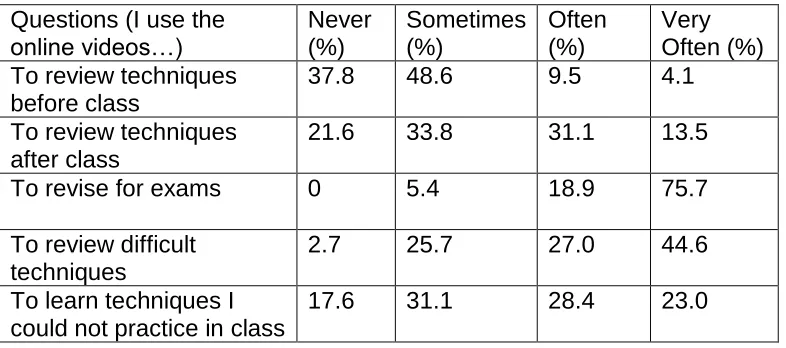
Survey – Section 1 use of online videos (Table 1)
Students appeared to access the online videos the most when preparing for exams
videos before class and after class. Students differed on whether they used the
videos to learn techniques they could not practice in class.
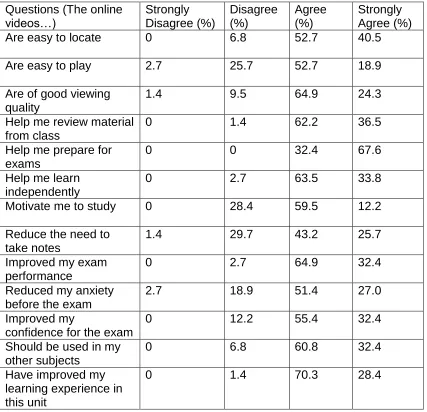
Survey – Section 2: perception of online videos (Table 2)
Most students appeared to find the online videos easy to locate, easy to play and of
good viewing quality. The students reported the online videos strongly helped them
review material from class, prepare for exams and learn independently. Students
also found the online videos beneficial to their study motivation, and reduced the
need to take notes during class time. The students appeared to find the online
videos very beneficial for their practical exam performance, for reducing their
pre-exam anxiety and for their pre-exam confidence. Students also thought that online
videos should be used in their other subjects. The students were unanimous in their
response that the online videos improved their learning experience in the unit.
Focus group and long-answer survey question findings
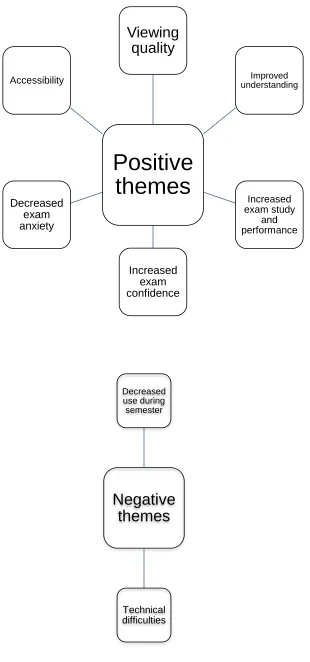
The focus group interviews were split into two main themes: positive and negative.
Within the two main themes, multiple sub-themes were identified: Positive – (1)
Good viewing quality; (2) Improved understanding; (3) Increased exam study and
performance; (4) Increased exam confidence; (5) Decreased exam anxiety; (6) Good
accessibility; and Negative – (7) Decreased use during semester and (8) Minor
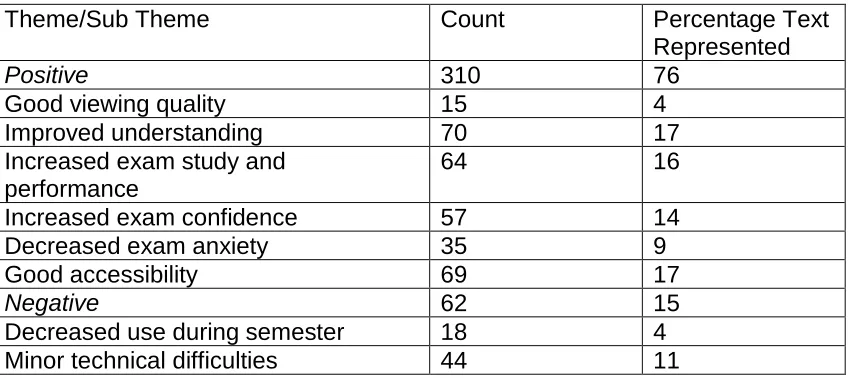
A content analysis of the themes and subthemes was then conducted (Table 3). The
majority of responses were positive impressions of the online videos, whilst negative
impressions totalled 14% of the coded responses. Of the positive sub-themes,
improved understanding and good accessibility were the most common responses,
followed by increased exam study and performance, increased exam confidence,
decreased exam anxiety and good viewing quality. Of the negative sub-themes,
minor technical difficulties ranked the highest, followed by decreased use during the
semester.
Sub-theme 1: Viewing quality
Some students were quite happy with the viewing quality and production value, in
particular the videos’ resemblance to what was taught in class. They also
appreciated the short duration of the videos for ease of study.
“I liked the videos because they were very similar to the way we were shown
techniques in class.”
“The camera angles [of the online videos] were really good, because they were able
Sub-theme 2: Improved understanding
The students almost unanimously responded positively when asked if the online
videos had improved their understanding of the unit. Students reported that they
improved their familiarity with the content, believed they were a good study tool and
that they allowed them to both revise material before and after class.
“[The videos] were a good general overview available before class, so that the
content was not so new during class.”
“[The online videos] helped me review what content we had already covered and
helped me review difficult techniques.”
Sub-theme 3: Increased exam study and performance
Students reported the online videos increased the amount and quality of exam study
they undertook and thus had a positive effect on their overall exam performance.
Students particularly enjoyed the ease of study that the videos allowed for, and the
fact that they could easily review difficult content and content in which they were less
familiar with.
“I used the videos mainly for exam study, they definitely improved my exam
“They [the videos] greatly helped me prepare for my exam, I was quite happy with
my performance.”
Sub-theme 4: Increased exam confidence
Students identified the online videos increased their confidence for the practical
exam in the unit. Students reported the main reasons for this were increased
revision, and the confidence that they were performing the techniques properly
because they were doing exactly what was on the videos.
“I was able to gather more confidence for the exam when I did watch the videos.”
“[The videos] improved my exam confidence as I was sure I was using the right
technique and performing in the correct way.”
Sub-theme 5: Decreased exam anxiety
Some students also commented that the online videos decreased their anxiety levels
for the practical exams. Despite this not being reported as often as increased
confidence, students mostly said that they were less anxious because the videos
“The videos relieved my stress and lowered my anxiety because they gave simple
and clear instructions.”
“I was still a bit anxious, but the extra revision from the videos definitely helped
reduce my anxiety somewhat.”
Sub-theme 6: Accessibility
Students almost unanimously reported the videos were very easy to access. They
also liked the instruction and encouragement they were given on how to access the
online videos throughout the semester.
“[The videos] once you knew how to log-in and navigate through [VU] collaborate the
videos where easy as to find.”
“[The videos] are really easy to find and play especially as they are short and
specific.”
Sub-theme 7: Decreased use during semester
Despite some students using the online videos significantly throughout the semester,
semester. Students said that time constraints were a major issue in not watching the
online videos, and also that the videos were quite similar to what was taught in class.
“I only watched the videos during the exam period because I didn’t have enough time
during the semester.”
“I only used the videos to study before exams.”
Sub-theme 8: Technical difficulties
Although students found the online videos easy to access, some students reported
that there were minor technical difficulties when trying to play the videos. Students
commonly said they sometimes had trouble loading the videos, and that occasionally
all the videos on a given page would play simultaneously.
“[The videos] were easy to find, but it was annoying because sometimes they played
all at once.”
Quantitative and qualitative data comparison
When comparing positive and negative responses between the surveys and
interviews, the data showed that students answered Survey 1 slightly more positive
(55.1%) than negative (44.9%). There was an increase in positive responses for
Survey 2 (88.1%). The total positive responses for the focus groups made up 76% of
DISCUSSION
The aim of the current study was to evaluate first year osteopathic students’ use and
perceptions of the practical video demonstrations available to them in the
Osteopathic Science 1 and 2 units. The videos were designed as a tool to
supplement the classroom teaching and provide students with an opportunity to
prepare for class, and revise the content pre and post-class, thus aiming to promote
an active approach to learning. The students’ use of the videos varied throughout the
study period. However, the results from the study illustrate the majority of the
students who participated in the project perceived VBL to have a positive impact on
their learning. This finding is consistent with other authors [13-14, 28].
An active and deep approach to learning is generally promoted in the higher
education context, as it allows students to actively engage and think deeper about
the content, relate it to real-life situations and improve overall student understanding
and assessment performance [14, 29-30]. VBL has been shown to assist in the
promotion of active and deep learning [14-15], and also higher level learning and
thinking [31]. Despite this, the findings from the present study do not appear to
indicate the adoption of an active and deep learning approach, but rather a shift
away from a surface learning approach and the adoption of a strategic learning
approach. A strategic approach to learning occurs when the student focus is on
doing well academically and avoiding factors that may harm their academic
performance [32]. The strategic model is based on four key tenants: study
organisation, time management, alertness to assessment demands and intention to
class during the semester; rather they used it mainly for exam preparation. This
finding closely aligns to a strategic model of study, where the student focus is on
alertness to assessment demands and intention to excel, rather than a deep
approach, where the intention is to fully understand content and relate it to previous
ideas and concepts [17].
Practical exams are associated with high anxiety levels amongst students [18], and
high anxiety levels can impact negatively on exam performance [16]. Pre-test anxiety
leads to feelings of low confidence, poor self-worth and a fear of failure. Student fear
of failure has been shown to be associated with a surface learning approach [17].
Students in the present study reported that access to VBL decreased their exam
anxiety and increased their exam confidence. The reported decrease in pre-exam
anxiety, and thus decreased fear of assessment failure, through using the VBL
resources appears to be a factor in facilitating the shift away from a surface
approach to a structured one. It is likely that the aforementioned shift is a key
component in the reported positive perceptions on student practical assessment
performance.
Lack of good access to computer-based learning has been shown to be a hurdle in
the use of class material from students who are considered ‘digital natives’ [19] and
is thought to be a factor in the potential for a ‘ digital divide’ between students [20].
Despite the students’ heavy use of the online videos during the exam period, the
present study found that a number of students were not accessing the videos often,
or at all, during the semester. Reasons that were highlighted by the participants
there were no reported widespread major accessibility hurdles. Taking this into
account, in addition to the high survey response rate and the large proportion of
positive survey responses, fortunately there appears to be no major ‘digital divide’
emerging between this cohort of students. Adult students better comprehend course
content when understanding the reasons underpinning a curriculum structure [33].
Given that the use of blended learning (including VBL) in higher education is rapidly
increasing and evolving [15, 22], designers of modern tertiary curriculum should look
at all aspects in improving student access to and engagement in blended learning
material. Perhaps by placing a greater emphasis on the benefits of accessing the
videos before class via the flipped classroom model [34], it could result in an
increased use of VBL during the semester.
It appears that overall, VBL facilitated a positive learning environment for the
students because it promoted effective and increased exam revision, allowing
students to focus on the finer, deeper details of the practical components,
predominately during the exam study period. These findings indicate that VBL, and
more broadly blended learning, is an important part of current and future pedagogical
practices in Osteopathic clinical education. Students overwhelmingly reported that
they would like to see VBL used more across their course. Future research should
investigate the learning effects of VBL across other units, courses and institutions, in
different locations and demographics. It should also evaluate and correlate the effect
LIMITATIONS
Despite the positive findings of the study, there were several research limitations
found. There was no comparison between the students’ exam results and their use
of the online videos. This was not possible however, given the surveys were
confidential and because the students only receive a pass or fail grade for the
subject and exam. In addition, the self-reported log data was used due to the
inaccuracies in the LMS log data reporting. There was also no post-analysis review
of the qualitative analysis of the focus groups to confirm its accuracy, however this
was negated by having peers independently review the qualitative data. Finally, the
researcher was also a part of the Osteopathic Science teaching team at the time of
data collection and perhaps a social desirability scale to correct for socially desirable
response bias could have been used [35]. However, given the results of the study
are in-line with similar research [13-14, 28], the author’s feels their involvement did
not have a major impact on the study findings and therefore a social desirability
CONCLUSION
This study indicates that complementary VBL in a first year osteopathic practical
skills based subject is effective in promoting a structured approach to learning. The
present study also illustrates, via a shift away from a surface approach to learning,
that complementary VBL can help reduce exam anxiety, improve exam confidence
and thus lead to an improvement in perceived exam performance. Overall, most
students reported that VBL had a positive effect on their learning in the unit. Future
research should evaluate the effectiveness of VBL across different units, courses
and institutions and aim to directly correlate student use and perceptions to
STATEMENT OF COMPETEING INTEREST
ETHICAL APPROVAL
Ethical approval to conduct the study was obtained from the VU Human Research
FUNDING
REFERENCES
1. Prensky M. Digital natives, digital immigrants part 1. On the horizon. 2001
Sep 1;9(5):1-6. https://doi.org/10.1108/10748120110424816
2. Bennett S, Maton K, Kervin L. The ‘digital natives’ debate: A critical review of
the evidence. British journal of educational technology. 2008 Sep
1;39(5):775-86. https://doi.org/10.1111/j.1467-8535.2007.00793.x
3. Sherer P, Shea T. Using online video to support student learning and
engagement. College Teaching. 2011 Apr 4;59(2):56-9.
https://doi.org/10.1080/87567555.2010.511313
4. Ivanova A, Smrikarov A. The new generations of students and the future of
e-learning in higher education. Proceedings of e-Learning. 2009;9:17-25.
5. Griffith University 2010, Getting Started with Blended Learning. Griffith
University, Griffith.
6. de Jong N, Savin-Baden M, Cunningham AM, Verstegen DM. Blended
learning in health education: three case studies. Perspectives on medical
education. 2014 Sep 1;3(4):278-88.
7. Gedik, Nuray, Ercan Kiraz, and M. Yasar Ozden. "Design of a blended
learning environment: Considerations and implementation issues."
Australasian Journal of Educational Technology 29.1 (2013).
https://doi.org/10.14742/ajet.6
8. Sever S, Oguz-Unver A, Yurumezoglu K. The effective presentation of
inquiry-based classroom experiments using teaching strategies that employ video
and demonstration methods. Australasian Journal of Educational Technology.
2013 Jan 1;29(3):450-63. https://doi.org/10.14742/ajet.229
9. Stebbings S, Bagheri N, Perrie K, Blyth P, McDonald J. Blended learning and
curriculum renewal across three medical schools: The rheumatology module
at the University of Otago. Australasian Journal of Educational Technology.
2012 Nov 1;28(7). https://doi.org/10.14742/ajet.795
10. Pesina J, Beaumont TJ, Parkes A. In-House Creation of Video in Higher
Education: A Worthwhile Endeavor?. International Journal of Learning and
Media. 2014 Jun 11.
11. Ilic D, Nordin RB, Glasziou P, Tilson JK, Villanueva E. A randomised
controlled trial of a blended learning education intervention for teaching
evidence-based medicine. BMC medical education. 2015 Mar 10;15(1):1.
12. Jang HW, Kim KJ. Use of online clinical videos for clinical skills training for
medical students: benefits and challenges. BMC medical education. 2014 Mar
21;14(1):1. https://doi.org/10.1186/1472-6920-14-56
13. Weeks BK, Horan SA. A video-based learning activity is effective for
preparing physiotherapy students for practical examinations. Physiotherapy.
2013 Dec 31;99(4):292-7. https://doi.org/10.1016/j.physio.2013.02.002
14. Mitra B, Lewin‐ Jones J, Barrett H, Williamson S. The use of video to enable
deep learning. Research in Post‐Compulsory Education. 2010 Dec
1;15(4):405-14. https://doi.org/10.1080/13596748.2010.526802
15. Mącznik AK, Ribeiro DC, Baxter GD. Online technology use in physiotherapy
teaching and learning: a systematic review of effectiveness and users’
perceptions. BMC medical education. 2015 Sep 28;15(1):160.
https://doi.org/10.1186/s12909-015-0429-8
16. Cassady JC, Johnson RE. Cognitive test anxiety and academic performance.
Contemporary educational psychology. 2002 Apr 30;27(2):270-95.
https://doi.org/10.1006/ceps.2001.1094
17. Cassidy S. Learning styles: An overview of theories, models, and measures.
Educational psychology. 2004 Aug 1;24(4):419-44.
18. Rae G, McCambridge K. Correlates of performance anxiety in practical music
exams. Psychology of Music. 2004 Oct;32(4):432-9.
https://doi.org/10.1177/0305735604046100
19. Kennedy GE, Judd TS, Churchward A, Gray K, Krause KL. First year
students’ experiences with technology: Are they really digital natives.
Australasian journal of educational technology. 2008 Nov;24(1):108-22.
https://doi.org/10.14742/ajet.1233
20. Hargittai E. Digital na (t) ives? Variation in internet skills and uses among
members of the “net generation”. Sociological inquiry. 2010 Feb
1;80(1):92-113. https://doi.org/10.1111/j.1475-682X.2009.00317.x
21. Thorell M, Fridorff-Jens PK, Lassen P, Lange T, Kayser L. Transforming
students into digital academics: a challenge at both the individual and the
institutional level. BMC medical education. 2015 Mar 14;15(1):1.
https://doi.org/10.1186/s12909-015-0330-5
22. Giannakos MN. Exploring the video‐based learning research: A review of the
literature. British Journal of Educational Technology. 2013 Nov
1;44(6):E191-5. https://doi.org/10.1111/bjet.12070
23. Veneri D. The role and effectiveness of computer-assisted learning in physical
therapy education: a systematic review. Physiotherapy Theory and Practice.
24. Chipchase L. Physiotherapy education in a digital era: blending and flipping.
Phys Ther Rev. 2013 Dec 1;18(6):405-6. DOI:
10.1179/1083319613Z.000000000153
25. Ramsden, P 2003, Learning to Teach in Higher Education, Routledge,
London, United Kingdom.
26. Davies, M, Hirschberg, J, Lye, J & Johnston, J 2010, ‘A Systematic Analysis
of Quality Teaching Surveys’, Assessment & Evaluation in Higher Education,
vol. 35, no. 1, pp. 83-96. https://doi.org/10.1080/02602930802565362
27. Vaismoradi M, Turunen H, Bondas T. Content analysis and thematic
analysis: Implications for conducting a qualitative descriptive study. Nursing &
health sciences. 2013 Sep 1;15(3):398-405. https://doi.org/10.1111/nhs.12048
28. Choi HJ, Johnson SD. The effect of context-based video instruction on
learning and motivation in online courses. The American Journal of Distance
Education. 2005 Dec 1;19(4):215-27.
https://doi.org/10.1207/s15389286ajde1904_3
29. Prince M. Does active learning work? A review of the research. Journal of
engineering education. 2004 Jul 1;93(3):223-31.
30. Freeman S, Eddy SL, McDonough M, Smith MK, Okoroafor N, Jordt H,
Wenderoth MP. Active learning increases student performance in science,
engineering, and mathematics. Proceedings of the National Academy of
Sciences. 2014 Jun 10;111(23):8410-5.
https://doi.org/10.1073/pnas.1319030111
31. So WW. Quality of learning outcomes in an online video-based learning
community: Potential and challenges for student teachers. Asia-Pacific
Journal of Teacher Education. 2012 May 1;40(2):143-58.
https://doi.org/10.1080/1359866X.2012.669828
32. Piccoli G, Rodriguez JA, Palese B, Bartosiak M. The Dark Side of Digital
Transformation: The case of Information Systems Education.
33. Swanwick, T 2013 Understanding Medical Education: Evidence, Theory and
Practice, John Wiley & Sons, New York.
34. Roehl A, Reddy SL, Shannon GJ. The flipped classroom: An opportunity to
engage millennial students through active learning. Journal of Family and
Consumer Sciences. 2013 Apr 1;105(2):44.
35. Van de Mortel TF. Faking it: social desirability response bias in self-report
TABLES AND FIGURES
Figure 1: Likert and open-ended question survey
First-year osteopathic students’ use and perceptions of online video-based learning
This survey has been designed to assess your use and perceptions of the online practical technique video demonstrations available on VU Collaborate for Osteopathic Science 1 & 2.
How old are you? ________ Gender: Male Female
Year of Year-12 Completion:
Can you please list any post year-12 study you have undertook (both completed and uncompleted):
How many times would you say you have accessed the online videos this year?
I use the online videos…
To review techniques before class Never Sometimes Often Very often
To review techniques after class Never Sometimes Often Very often
To revise for exams Never Sometimes Often Very often
To review difficult techniques Never Sometimes Often Very often
To learn techniques that I could not practice in
class Never Sometimes Often Very often
The online videos…
Are easy to locate Strongly disagree Disagree Agree Strongly agree
Are easy to play Strongly disagree Disagree Agree Strongly agree
Are of good viewing quality Strongly disagree Disagree Agree Strongly agree
Help me review material from class Strongly disagree Disagree Agree Strongly agree
Help me prepare for exams Strongly disagree Disagree Agree Strongly agree
Allow me to learn independently Strongly disagree Disagree Agree Strongly agree
Reduce the need to take notes Strongly disagree Disagree Agree Strongly agree
Improved my exam performance Strongly disagree Disagree Agree Strongly agree
Reduced my anxiety before the exam Strongly disagree Disagree Agree Strongly agree
Improved my confidence for the exam Strongly disagree Disagree Agree Strongly agree
Should be used in my other subjects Strongly disagree Disagree Agree Strongly agree
Have improved my learning experience in this unit
Strongly disagree Disagree Agree Strongly agree
Open-Ended Section
If you need more room for you responses please use the page over and indicate what question are answering.
1. How did the online videos influence your study during the semester?
2. What effect did the online videos have on your exam study and performance?
3. What impact did the online videos have on your anxiety and confidence levels for the practical exam?
4. How easy were the online videos to find and play?
5. In what ways would you suggest that the online videos could be improved?
Figure 2: Focus Group Questions
Research Project: ‘First-Year Osteopathic Students use and perceptions of online video-based learning.’
Focus Group Questions
1. When were you most likely to view the online videos?
2. What did you like best about the online videos?
3. How did the online videos influence your study during the semester?
4. What effect did the online videos have on your exam study?
5. What Influence did the online videos have on your exam performance?
6. What Impact did the online videos have on your anxiety levels for the exam?
7. What Impact did the online videos have on your confidence for the exam?
8. How easy were the online videos to find and play?
9. What were (if any) you reasons for not watching the online videos?
10. What ways would you suggest that the online videos could be improved?
Figure 3: Thematic map including sub-themes
Negative
themes
Decreased use during semester
Technical difficulties
Positive
themes
Viewing
quality
Improved understanding
Increased exam study
and performance
Increased exam confidence Decreased
exam anxiety
Table 1: Survey – Section 1 (use of online videos)
Questions (I use the
online videos…) Never (%)
Sometimes (%)
Often (%)
Very Often (%) To review techniques
before class
37.8 48.6 9.5 4.1
To review techniques after class
21.6 33.8 31.1 13.5
To revise for exams 0 5.4 18.9 75.7
To review difficult techniques
2.7 25.7 27.0 44.6
To learn techniques I could not practice in class
Table 2: Survey – Section 2 (perception of online videos)
Questions (The online videos…) Strongly Disagree (%) Disagree (%) Agree (%) Strongly Agree (%)
Are easy to locate 0 6.8 52.7 40.5
Are easy to play 2.7 25.7 52.7 18.9
Are of good viewing quality
1.4 9.5 64.9 24.3
Help me review material from class
0 1.4 62.2 36.5
Help me prepare for exams
0 0 32.4 67.6
Help me learn independently
0 2.7 63.5 33.8
Motivate me to study 0 28.4 59.5 12.2
Reduce the need to take notes
1.4 29.7 43.2 25.7
Improved my exam performance
0 2.7 64.9 32.4
Reduced my anxiety before the exam
2.7 18.9 51.4 27.0
Improved my
confidence for the exam
0 12.2 55.4 32.4
Should be used in my other subjects
0 6.8 60.8 32.4
Have improved my learning experience in this unit
Table 3: Content analysis of identified themes from the focus group and long-answer survey question responses
Theme/Sub Theme Count Percentage Text
Represented
Positive 310 76
Good viewing quality 15 4
Improved understanding 70 17
Increased exam study and performance
64 16
Increased exam confidence 57 14
Decreased exam anxiety 35 9
Good accessibility 69 17
Negative 62 15
Decreased use during semester 18 4