Video Publishing and Authoring Services
Based on Cloud Computing
Mayur P. Band
1, N. D. Kale
2P.G. Student, Department of Computer Engineering, TSSM’s, PVPIT, Bavdhan, Pune, Maharashtra, India1
Assistant Professor, Department of Computer Engineering, TSSM’s, PVPIT, Bavdhan, Pune, Maharashtra, India2
ABSTRACT: In the recent year’s we see that Mobile Multimedia is a broadcast an rapidly growing segment and almost every mobile user would have a perceived need for a multimedia base entertainment application. Mobile cloud computing usually consists of front-end user who possess mobile devices and back-end cloud server. This paradigm allow user to pervasively access a large volume of storage resources with portable devices in a distributed and cooperative way. In this project video publishing and Authoring Services will offering a service based on cloud computing concept using windows SharePoint technology. It will provide the facility to store the video files into the cloud via SharePoint mobile application and will allow user to access them using mobile application. Service application will allow user to upload the video files to the cloud and will allow the owner of the site to accept the video or reject through authoring. Accepted videos will be published and will be available for watching them on Mobile Application. Also it will provide the dashboard of the accepted and rejected videos by the Administrator or owner.
KEYWORDS: mobile computing, cloud computing, multimedia, mobile application, service application.
I. INTRODUCTION
Today Mobile devices are increasingly becoming an essential part of human life as the most effective and convenient communication tools from mobile applications which run on the devices and on remote servers via wireless network. The rapid progress of mobile computing becomes a powerful trend in the development of recent IT technology as well as commerces and industry fields the mobile devices are facing many challenges in their resources (e.g.battery life ,storage).
Cloud computing has widely recognized as the next generation computing infrastructure. Cloud computing offer some advantages by allowing user to use infrastructure like as servers, networks, and storages, and software provided by cloud providers at low cost. The explosion of mobile application and the support of cloud computing for a variety of services for mobile user. This paper presents a mobile cloud computing in this we offering services base cloud computing facilitate to store video file into the cloud via sharepoint Mobile Application.
Mobile Cloud Computing:
A concept of Mobile Cloud Computing at its simplest refers to an infrastructure where both the data storage and the data processing happen outside of the mobile device. The mobile cloud computing can be described as a new paradigm for mobile application whereby the data processing and storage are moved from the mobile devices to powerful and centralized computing platforms located in clouds. Mobile cloud applications move the computing power and data storage away from mobile phones and in the cloud , bringing applications and mobile computing to not just smart phone users but much broader range of mobile subscribers.
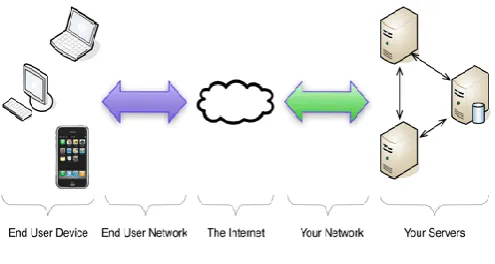
The figure shows the basic architecture of mobile cloud computing.
Cloud Mobile Media:
serving millions of internet or mobile user at the same time. In the cloud base multimedia computing paradigm, user store and retrieve there data in the cloud in distributed manner.
Fig.1: Basic architecture of Mobile Cloud Computing
Cloud Storage Services:
In the storage services Mobile Cloud Storage is the most commonly used category of Cloud Mobile Media application. This services provide diverse capabilities, including storing document, photo, video, audio in the cloud, accessing media from anywhere or an any platform used to generate the media, and synchronizing data or media across multiple devices a typical user owns.
In this Paper, we describe MCC, CMM, CSS also we use SharePoint technology this technology provides an extensible solution platform for the professional .net developer and offer a wide array of built-in features and scope of application hosting .net
Share point technology offers these benefits as follows:
A familiar environment for developer.
Built-in features that developer can be extend.
For office application creating an server.
And foundation for internet application.
The remaining paper is organized as given below:
Section 3 defines interested problems and pros and cons. Basic ideas of video publishing are presented in section 4 and details of algorithms with how they can be implemented are describe. In section 5 and in section 6 we describe propose work and concluded in section 7.
II. RELATED WORK
1. Author Kumar K and Lu YH [7] implied that offloading has gained big attention in cloud computing research, because it has similar aim as the emerging mobile cloud computing paradigm, i.e. to surmount mobile devices’ shortcomings by augmenting their capabilities with external resources. Two sample applications illustrate the benefits of offloading: chess game and image retrieval which based on gaming.
2. Chun and Maniatis[8] propose an architecture of clone cloud that address these challenges via similarly offloading execution from the cell phone to computational infrastructure where cloned replica of the smartphone’s software is running. This architecture enables newly developed, an exciting modes of augmented execution for applications in diversing environments, and offers intriguing opportunities for research and for practical deployments that marry the convenience of hand-held devices with the power of cloud computing. The concept use mainly is clonecloud.
3. Author Satyanarayanan et al[9] using similar approach of virtual machine(VM), this architecture a mobile
user exploits VM to rapidly instantiate customized service software on a nearby cloudlet and uses the service over WLAN, server uses virtual machine called as private agent.
4. Dejan Kovachev et al [10] developed i5CLoud, a hybrid cloud architecture, which use as various aspects
serves as a substrate for scalable and fast time-to-market mobile multimedia services. Which demonstrates the applicability of emerging cloud computing concepts for mobile multimedia.
5. Shaoxuan Wang and Sujit Dey [2] analyse the mobile cloud computing approach with respect to some challenges that need to be addressed to make Cloud Mobile Multimedia applications viable and including response time, user experience, cloud computing cost, mobile network bandwidth, and scalability to large number of users, besides other important cloud computing issues like energy consumption, privacy, and security. Probable use for multi-gaming system.
6. And the next of cloud computing the author Yu Wu et al[11] developed a new video streaming framework,
dubbed AMES-Cloud, has two main parts:
1) Adaptive mobile video streaming (AMoV) and
2) Efficient social video sharing (ESoV).
AMoV and ESoV construct a private agent to provide video streaming services efficiently for each mobile user. For a given user, AMoV lets her private agent adaptively adjust her streaming flow with a scalable video coding technique based on the feedback of link quality. AMES cloud reduce the buffering experience and provide video without any loss of data.
In this paper, focus is on zero buffering experience, and proposing the Real time data service using cloud and SharePoint integration publishing video by using authorize services. Publish video, accepted video will be publish and will be available for watching them on mobile application. For making experience rice using SharePoint technology, also for security we us dashboard.
III.IMPLEMENTATION DETAILS
In this paper, we propose a model which used cloud resources for mobile multimedia application. Use to reduce delay timing the system provides functions as Add videos, Publish videos, Play online videos, Delete videos. Single part of model use or consist of cloud server, used to stored multimedia contents. In this model we considering video data as a multimedia content. The another part of model consist of android client which will be installed of android device.Our propose model use SharePoint technology, today Mobile Cloud Storage is most commonly use category of CMM application service.
As shown in below diagram, our system will use cloud concept integrated with Windows SharePoint 2010 mobile interface. Application will be using SharePoint services for mobile to generate the mobile interface site.
Fig. 2: Mobile Interface Application
It will have both the interfaces computer and mobile, PC Mobile and Cell will act as end user which will send html request. Window SharePoint Services will do cloud computing .And data will be stored into the back end in SQL server.
PROPOSED ARCHICTECTURE
In propose project architecture will have Logical and Physical architecture shown in below :
Logical Architecture
Fig. 3: Logical Architecture
As shown in above diagram propose system is three tier system having following component
1) Presentation Tier: This component will show the web pages to end user.
2) Logical Tier: All the business logic will go in this tier.
3) Database Tire: Component will be responsible for storing data and manipulating data.
Physical Component
The following figure shows physical architecture of system which involves below functions:
1. The system provides functions as:
a. Add Videos
c. Play online videos
d. Delete videos.
In this paper, system architecture is beneficial for the use to construct the application on the mobile devices. Mobile application for storing and retrieve video over cloud on authorizing services.
Fig.4: Physical Architecture
We are making system which propose the Real time data service using cloud and SharePoint integration. In this system we are adding video file and play video calculating delay time also user have to add video and publish them.
IV.PROPOSE ALGORITHM
Application will be created only in SharePoint.It will have both the interfaces computer and mobile will act as end user which will send html request.
It is an approach that enable rich multiplayer internet videos or games on mobile devices where computes intensive task like graphic rendering are executed on cloud server in response to video commands on a mobile device and the resulting video has to be streamed backed to the mobile device in real time making it one of the most changing CMM application. CMM-Cloud Mobile Media
CMG-Cloud Mobile Gaming MEBR-Minimum Encoding Bit Rate MCRL- Maximum CommC Rendering Level CommC- Communication Complexity CompC- Computational Complexity
JREA- Joint Rendering and Encoding bit rate Adaptive Algorithm
ALGORITHM:
Joint Rendering and Encoding bit rate Adaptive Algorithm
1. Select video or image from the available path/address on the given node.
2. Determine the parameters like geometry, view point, lighting, shading by using graphic rendering process. Image I= { texture lighting viewpoints shading geometry
3. Measure CommC in given video scenario.
4. Measure CompC from given scenario.
5. Determine minimum parameter for each rendering level.
6. Derive MEBR for each rendering level and MCRL for each encoding bit rate.
9. Update thr rendering information in the system.
10. Get the result of the system considering seek time, return time. 11. Compare the result through graphs and bar charts.
In this we analyzed algorithms try to solve problem with our algorithm. We are expecting the results in our experiments.
MATHEMATICAL MODEL:
Let,
I-Is the image selected through video
I= {texture, lighting, viewpoint, shading, geometry}
CommC- Communication Complexity
CompC- Computational Complexity
Image I will consist of following parameters
min(CompC) ʊ min(CompC) = I
Where, I is the selected image/video after determination of CompC & CompC parameters.
V. EXPERIMENTAL ANALYSIS
Performing uploading and downloading video we are calculating total transaction time with a different section of timing from time to first byte. Also calculating content time and size.
We formulate total transaction time, time to first byte, then forming load content time and content size. The result is shown in below figure 6.
(c) (d)
Fig. 6 Experimental result (a) total transaction time (b) time to first byte (c) content time (d) content size
Proposed system is applicable for all type of media devices like Smart phones, Desktops, Laptops which can be connected to the internet easily.
We are making system which proposing the Real time data service using cloud and SharePoint integration.This is proposed keeping in mind that when we will be having the strongest network facility, Network capability to transfer data fast and with increased limit, and the increased capability of the devices used to watch the videos then the proposed system is expected to work faster than the existing system. Though existing system we could see the delay in data transfer,our system is expected to give the result without delay if we have in place the above mentioned system changes.
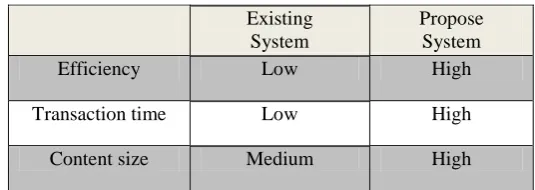
TABLE 1 :comparison between existing system and propose system.
Existing System
Propose System
Efficiency Low High
Transaction time Low High
Content size Medium High
As we compare the existing system and propose system the result shown in the above table.
VI. CONCLUSION
Our research suggests video publishing system is designed in such a way that it uses the real time data transferring from cloud. Videos are stored into the site on a cloud. Application provides feature to upload the videos to the cloud and to delete already uploaded videos interactively from the same page from where users upload the videos to the cloud. Users can play the videos without delay.
VII. ACKNOWLEDGMENT
We would like to express our gratitude and sincere regards to the following people to whom we are grateful for their support and help. We would like to thank Dr. Y. V. Chavan, Principal, P.V.P.I.T. for providing us with excellent facilities and valuable guidance. We would like to express my profound and sincere gratitude to Prof. N. D. Kale HOD, Computer Engineering Department who has given all co-operation and help to complete this paper. We would like to express my profound and sincere gratitude to Prof. V. S. Nandedkar, PG Coordinator, Computer Department who has given all her cooperation and help to complete this paper.
VIII.FUTURE SCOPE
In future, the system can be enhanced by providing search functionality to search the videos and play them. Dashboard view of the published and not published videos. Also provide large size, an automated notification after video is uploaded for reviewing and publishing. Creating platform independent system for multi-purpose with high speed.
REFERENCES
[1] Gartner report, Market Trends: Worldwide, the State of Mobile Video, 2012.
[2] Shaoxuan Wang and Sujit Dey, “Adaptive Mobile Cloud Computing to Enable Rich Mobile Multimed Applications”, IEEE Transactions on Multimedia, Vol. 15 No. 4, June 2013
[3] MarketsAndMarkets, World Mobile Applications Market-Advanced Technologies, Available: http://www.marketsandmarkets.com/ Global Forecast (2010-2015), Aug. 2010 [Online].
[4] Mobile Cloud Computing Forum, Available: http://www.mobilecloudcomputingforum.com/ July 2012[Online].
[5] Niroshinie Fernando, Seng W. Loke, Wenny Rahayu,”Mobile cloud computing: A survey”, Future Generation Computer Systems 29 (2013) 84–106
[6] Dejan Kovachev et al,” Mobile Cloud Computing: A Comparison of Application Models”, Information Systems & Database Technologies, RWTH Aachen University
[7] Kumar K, Lu YH (2010),” Cloud computing for mobile users: can offloading computation save energy?” IEEE Computer, Vol. 43, No. 4, April 2010
[8] Chun BG, Maniatis P , “Augmented smartphone applications through clone cloud execution”, Proceedings of the 12th workshop on hot topics in operating systems (HotOS XII). USENIX, Monte Verita, Switzerland.(2009)
[9] Satyanarayanan M et al, ”The case for VM-based cloudlets in mobile computing”, IEEE Pervasive Computing, Vol. 8, No. 4, pp. 14–23, 2009 [10] Dejan Kovachev et al,” Building mobile multimedia services: a hybrid cloud computing approach”, Springer Sc ience Business Media, LLC
2012