Time-Based Direct Revocable
Ciphertext-Policy Attribute-Based Encryption
with Short Revocation List
?Joseph K. Liu1, Tsz Hon Yuen2, Peng Zhang3, Kaitai Liang4
1
Faculty of Information Technology, Monash University, Australia Email:[email protected]
2 Huawei, Singapore 3
Shenzhen University, China 4 University of Surrey, UK
Abstract. In this paper, we propose an efficient revocable Ciphertext-Policy Attribute-Based Encryption (CP-ABE) scheme. We base on the direct revocation approach, by embedding the revocation list into cipher-text. However, since the revocation list will grow longer as time goes by, we further leverage this by proposing a secret key time validation technique so that users will have their keys expired on a date and the revocation list only needs to include those user keys revoked before their intended expired date (e.g. those user keys which have been stolen before expiry). These keys can be removed from the revocation list after their expiry date in order to keep the revocation list short, as these keys can no longer be used to decrypt ciphertext generated after their expiry time. This technique is derived from Hierarchical Identity-based Encryption (HIBE) mechanism and thus time periods are in hierarchical structure: year, month, day. Users with validity of the whole year can decrypt any ciphertext associated with time period of any month or any day within the year. By using this technique, the size of public parameters and user secret key can be greatly reduced. A bonus advantage of this technique is the support of discontinuity of user validity (e.g. taking no-paid leave).
1
Introduction
Attribute-Based Encryption (ABE) is a generalization of Identity-Based Encryp-tion (IBE) [13,7,6,15,14,49]. It provides flexibility of data sharing for system users in the sense that a data encryptor is allowed to specify some descriptive values
xfor an encryption and thus, the encryption can be decrypted successfully by a secret key associated with some descriptive values y matching x. ABE has many network applications, such as cloud computing [25,36], cloud storage sys-tems [22,23,35,51] and medical e-healthcare syssys-tems [39,24,19,8] etc. ABE can be classified into two different types: one is Key-Policy ABE (KP-ABE), and the other is Ciphertext-Policy ABE (CP-ABE). In a KP-ABE system, ciphertexts
?
are associated with attribute sets and secret keys are associated with access poli-cies. On the opposite side, in a CP-ABE scheme ciphertexts are related to access policies, and attribute sets are tagged with secret keys.
Before deploying ABE into any practical scenarios, one has to solve for the user revocation problem. No organization will be happy to see that any of its revoked users can still be able to decrypt the document designated for its users. When we talk about revocability in ABE, there are different levels of revo-cation:
1. Attribute Revocation. In this case, the user has changed his/her
at-tributes. For example, the original attributes for Alice are{Physics,Student,
University A}. Now she has changed to{Chemistry, Student,University A}. Therefore, the originalPhysicsattribute should be revoked (but notStudent
orUniversity A).
2. User Revocation. In this case, the user has left the organization. That
is, all attributes have to be revoked. In the previous example of Attribute Revocation, Alice has left University A and therefore the user Alice should be revoked.
3. Key Revocation.In this case, the secret key of the user is revoked. This is the most generalized level of revocation. This can be happened in different scenarios. For example, the user has left the organization (case (2)). Or if the user has lost his secret key (and got a replacement key), the old one has to be revoked. It can also cover case (1): If Alice changes her attribute from
PhysicstoChemistry, her old key is revoked while she has been issued with a new key associated with her new attribute.
Usually in this case the key is also associated with an identity or a serial number, which is used in the revocation process by the authority. The encryptor does not need to know this identity or number. In the rest of this paper, we refer torevocation as this case (key revocation).
1.1 Different Approaches for Revocable ABE
There are several approaches to tackle the problem of revocability in ABE:
1. Key Update for Non-Revoked Users. This is also called the Indirect
Approach. In this approach, every user has a secret key with a state. The authority will execute a key update algorithm for every non-revoked users. The keys for revoked users will not be updated. Upon the update, a new state will be issued to the secret key. Ciphertext is generated according to the current state. Therefore those revoked users who only have the secret keys of previous state(s) cannot decrypt the ciphertext which is associated with the new state.
state. In this way, revoked users (whose secret keys are associated with an old state) can no longer decrypt any old ciphertext from the cloud as it has been updated to the current state which is only decryptable by a secret key with the new state.
Nevertheless we only regard the ciphertext update as an optional fea-ture, as we have no way to prevent a revoked user from downloading the ciphertext (and thus decrypting the ciphertext) before he has been revoked. The main issue of the key update approach is the inability of instant user revocation.Suppose Alice is revoked now and the next key update algorithm is scheduled at the 1st of coming month. Alice is still able to decrypt any newly generated ciphertext from now to the end of this month. (Even if the cloud is equipped with ciphertext update, Alice cannot decrypt only those old ciphertext but still can decrypt those newly generated one.) One may try to argue that the authority may execute the key update algorithm once there is any revoked user. In the point of view of security, this action can block the loophole of inability instant user revocation. Nevertheless, it is definitely not practical especially if there are a large number of non-revoked users. In a large organization, there may be a new revoked user in every hour or even every minute. It is impossible to ask every non-revoked user to update their key every minute! If we schedule a longer key update period, the instant user revocation problem will be worse then.
2. Embedding Revocation List into Ciphertext. This is also called the
Di-rect Approach. In this approach, there is a public revocation list. The encryp-tor embeds the latest revocation list into the ciphertext so that only those users not in the revocation list and satisfying the predicate (attributes-policy matching) can decrypt the ciphertext. This approach can provide instant user revocation (and thus solve the problem from the indirect approach). No key update is required in this approach.
However, there is another practical problem with this approach. The revocation list will grow longer as time goes by. If the organization is large, the revocation list will become an efficiency bottleneck for the encryption and decryption as it will continue to grow all the time. There is no way to reduce or delete the revocation list, unless the revoked user re-joins the organization in the future. This is not likely to happen in most of the scenarios though. 3. Cloud-Assisted. Another approach is to make use of the cloud assistance.
In this approach, the decryption ability is split into two halves. The first half is owned by the user while another half is owned by the cloud. The cloud needs to partially decrypt the ciphertext into an intermediate data first, which is then sent to the user for the second level decryption. If the user is revoked, the cloud refuses to execute the first level decryption. Then the revoked user cannot decrypt the ciphertext without the assistance from the cloud.
This is the simplest way to achieve user revocation for ABE. In spite of that, the cloud will be very busy if the number of users is large, as the decryption of every user requires the assistance from the cloud.
1.2 A Na¨ıve Approach
One may immediately think of a na¨ıve approach by combining the indirect and direct approaches together in order to possess the merits from both sides. Intu-itively the simple combination is to use a key update ABE (the indirect revocable ABE) to encrypt the plaintext first into the first-level ciphertext. Then the re-sulting ciphertext is further encrypted using another ABE with revocation list embedded into the ciphertext (the direct revocable ABE) as the second-level. If a user is revoked before the next key update period, since his identity has been put into the revocation list embedded into the second-level ciphertext (generated by the direct revocable ABE), he cannot decrypt it. On the other side, if the revoked user’s key has been expired (that is, not being updated as it has been revoked), his identity is not needed to be put into the revocation list by the di-rect revocable ABE as the revoked key cannot be used to decrypt the first-level ciphertext (generated by the indirect revocable ABE) even though it can still decrypt the second level ciphertext. In this way, the revocation list can be kept short while instant revocation can be achieved and thus no frequent key update is required.
This na¨ıve approach seems working fine, if we do not consider collusion at-tack. Simply speaking, collusion attack in ABE refers to two different users who both cannot decrypt the ciphertext individually but they can succeed to do so if they are colluding with each other. Suppose Alice is revoked just right now (before the next key update period) and therefore her identityAliceis in the re-vocation list embedded into the second-level ciphertext. Bob is another revoked user who was revoked in the previous time period. Thus his key has not been updated in the current time period and his identityBobis not in the revocation list embedded into the second-level ciphertext. It is obviously that both Alice and Bob cannot decrypt the combined ciphertext individually. However, if they are working together, they can successfully decrypt it: Bob can use his secret key to decrypt the second-level ciphertext (as his identity is not in the revoca-tion list) and he can pass the resulting intermediate data (which has become the first-level ciphertext) to Alice. Alice can use her secret key to decrypt this first-level ciphertext as her key is the most updated one. As a result, Alice and Bob can get the final plaintext if they are working together.
We definitely have to avoid this kind of collusion attack in any circumstance.
1.3 Our Contribution
In this paper, we propose an efficient and practical revocable CP-ABE scheme. Our scheme is motivated from the (non-revocable) CP-ABE given in [37] and incorporates the merit from all existing approaches for revocation, yet we do not have the emerged trade-off and we are immune to the collusion attack mentioned above in the naive approach. Namely,
for non-revoked users at a reasonable interval (e.g. once every two years). The revocation list only contains those revoked users whose keys are not expired yet. If their keys are expired (they are not allowed to update their keys as they are revoked), they should not be able to decrypt any ciphertext generated after their expiry date even though they are not included in the revocation list. In other words, they can be removed from the revocation list after the expiry date of their keys and thus the revocation list can be kept short.
• Although we still require a key update process for all non-revoked users, we do not need to execute it frequently in order to provide instant key revo-cation. We argue that most organizations will require their users to renew their contracts at a reasonable time interval (e.g. once every two years). It is practical to renew their secret keys at the time they are renewing their contracts. This time does not need to be synchronized. Every user may have his own time for expiry and renewal.
• We do not need the cloud in our basic system (a cloud-free system). Exten-sion can be made to provide ciphertext update in the cloud (e.g. using the ciphertext update technique in [48,32]) so that revoked users are no longer able to decrypt any ciphertext generated in the past.
• We are immune to the collusion attack mentioned in the na¨ıve approach. Suppose there is a set of users. Anyone in this set cannot decrypt the ci-phertext individually. They cannot succeed to do so even if they are working together, or by someone who has the secret keys for all users in this set.
• We use Hierarchical Identity-based Encryption (HIBE) technique to further shorten the size of user secret key. Our time period ishierarchical. That is, we have year, month and day. A user with secret key valid for the whole year can derive the key with validity for the underlying months of that year. A user with secret key valid for the whole month can derive the key with validity for the underlying days of that month. With this technique, we can further support discontinuity of user validity, which is believed as a common scenario in the practical world (e.g. no-paid leave).
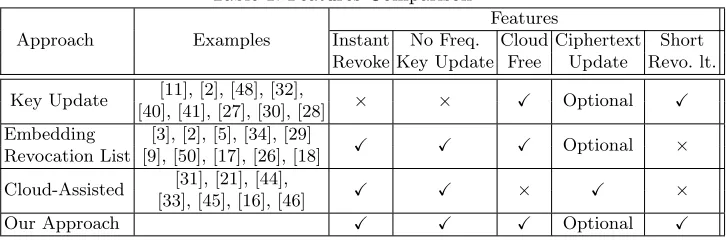
We provide a concrete construction for our proposed scheme. The size of the ciphertext only depends on the embedded policy (access structure) but NOT the revocation list, though the size of the secret key is linear with the maximum length of the revocation list and the number of attributes of the user. In the decryption, the number of pairing operations only depends on the access struc-ture but NOT the number of users in the revocation list or the total number of users in the system. The performance of our construction enjoys a significant improvement over other similar schemes.
Table 1: Features Comparison
Approach Examples
Features
Instant No Freq. Cloud Ciphertext Short Revoke Key Update Free Update Revo. lt. Key Update [40], [41], [27], [30], [28][11], [2], [48], [32], × × X Optional X
Embedding [3], [2], [5], [34], [29]
X X X Optional ×
Revocation List [9], [50], [17], [26], [18]
Cloud-Assisted [31], [21], [44], X X × X ×
[33], [45], [16], [46]
Our Approach X X X Optional X
2
Related Works
There are several schemes in the literature addressing the problem of revocation in ABE. We briefly describe them using the classification in Section 1.1
1. Key Update for Non-Revoked Users (Indirect) approach. The first
revocable ABE was proposed by Boldyreva et al. [11]. It is a KP-ABE. Re-vocation list is stored in the authority which executes key update algorithm with each non-revoked users (those users not in the revocation list) during a regular time interval. Revoked users (without having their keys updated) cannot decrypt any newly generated ciphertext. Yu et al. [48] proposed an-other revocable ABE in the context of CP-ABE using key update approach. In addition, they provide a mechanism to update ciphertext so that revoked users cannot decrypt the updated ciphertext in the cloud. Nevertheless, they support policies with logical AND only. A more promising construction was given by Sahai et al. [32]. They provided constructions for both KP-ABE and CP-ABE. There are key update and ciphertext update algorithms. Ci-phertext is decryptable only if the encryption timet < t0 wheret0 is the key expiry time. If the user is revoked, ciphertext will be updated so that the newly revoked users cannot decrypt those old ciphertext (those ciphertext generated before the user is revoked). All other users will then run the key update algorithm except the revoked user.
Later on, Xie et al. [40] (the full version of [41]), proposed a revocable CP-ABE. In their construction, each user has two keys. There is an individual key and also a group key. A group is defined as a set of users with the same attributes. Decryption requires to have the group key and the individual user secret key. Revocation is done by updating the keys of non-revoked users. 1
Ciphertext update is also allowed as in [48]. Naruse et al. [27] proposed another CP-ABE with attribute update by the cloud server. The cloud re-encrypts the ciphertext and re-generates new secret key for users, who have updated their attributes. Similar approach has also been suggested in [30,28].
2. Embedding Revocation List into Ciphertext (Direct) approach.
An-other approach is called direct approach, which requires the encryptor to in-corporate the revocation list in the ciphertext. In this way, users in the revo-cation list cannot decrypt the ciphertext even though their attributes/policy satisfy the policy/attributes associated with the ciphertext. No key update is required using this approach. Attrapadung and Imai [3] proposed a re-vocable ABE by incorporating the revocation information into the cipher-text. Their approach is to use broadcast encryption. That is, the encryptor needs to know the identities of thoseunrevoked users. They provide a KP-ABE constructions. Later, Attrapadung et al. [5] proposed another revocable KP-ABE. Different from the previous one, this construction only requires the encryptor to know the identities of revoked users (instead of unrevoked users). Wang et al. [34] proposed another revocable KP-ABE using broad-cast encryption which requires the encryptor to know the list of unrevoked users. Nieto et al. [29] generalize the revocability technique to Predicate En-cryption. They require the encryptor to embed the revocation list into the ciphertext. They use dual pairing vector space as the primitive and thus the number of pairing operations in the decryption is very large (linear with the number of users in the system). Balu et al. [9] proposed a revocable CP-ABE by incorporating the revocation list. Encryptor only needs to know the iden-tities of revoked users. However, their model is very weak. They only allow the adversary to query secret key that does not satisfy the challenge access structure AND not in the revocation list. In other words, it does not allow adversary to query a secret key that satisfies the access structure but in the revocation list. (This models the case for revoked users.) Zhang [50] proposed another revocable CP-ABE scheme using similar approach. In addition, the scheme also supports leakage resilient. But the construction only supports attribute-level revocation (the basic level of revocation). Datta et al. [17] proposed a KP-ABE construction using similar approach using multilinear maps. Liu and Wong [26] proposed a CP-ABE construction. Again they de-ploy similar approach but using matrix representation for users. Thus the size of ciphertext is of sizeO(√N), whereN is the total number of users in the system. Recently, Datta et al. [18] proposed another KP-ABE that sup-ports revocability with this approach. This time they use subset difference technique to achieve the purpose.
There is also a construction using either direct and indirect approach. Attrapadung and Imai [2] proposed a KP-ABE which allows the encryptor to use whether direct or indirect mode (but not both).
3. Cloud-Assisted approach. With the assistance of cloud, revocation
decryp the ciphertext in the cloud. Later on, other cloud-assisted schemes require all decryption must go through the cloud as a partial process. The cloud has the control to refuse the assistance of decryption for revoked users. Without the help from the cloud, no one can decrypt the ciphertext. Hur and Noh [21] proposed a revocable CP-ABE scheme. The data owner first out-sourced the data into the cloud. The cloud then re-encrypts (using a double-encryption technique) according the set of authenticated (valid) membership. The revocation is easy. The cloud just deletes the revoked user from the mem-bership (which is a binary tree). Decryption requires the cloud to process first. It then sends the partially decrypt data to the user. Yang et al. [44] and Shi et al. [33] proposed another cloud-assisted scheme independently. In their schemes, the decryption is split into two halves. The cloud stores the first half and the user stores another half. A complete decryption requires both parts. Yang et al. [45] use similar approach. They further reduce the trust on cloud by increasing the risk of collusion with users. Recently, Cui et al. [16] reduced the trust to the cloud server by letting the cloud server to use a kind of proxy re-encryption key only.
3
Definition
3.1 Time Period
A time period can be a day, a month or a year.2 For example, we use “2016-Jun-15” to represent a day; “2016-Dec” to represent a month etc. Our scheme can also support some special case for non-continuity. For example, if the user is going to take no-paid leave from 01 August 2016 to 29 November 2016, then we can just assign the valid period from 15 June 2016 to 31 July 2016 and from 30 November 2016 to 31 December 2016. (Assume today is 15 June 2016 and the user expiries at the end of 2016.)
A decryptable time period is a time period set by the encryptor such that only users with validity completely covered the period can decrypt. (A specific setting is to let the encrypting time to be the decryptable time period.) For example, suppose the decryptable time period is December 2016 and the validity of user secret key is only limited to 31 December 2016. This is not a complete cover and thus this secret key is not able to decrypt. On the opposite, if the decryptable time period is 01 December 2016 and the validity of user secret key is December 2016, then it is able to decrypt as it has a complete cover for the decryptable time period (provided that other conditions are also satisfied).
3.2 Definition of Revocable Ciphertext-Policy Attribute-Based
Encryption
A revocable ciphertext-policy attribute based encryption scheme consists of four algorithms:Setup, KeyGen, Encrypt, Decrypt.
2
• Setup(1κ, U, R,
T). Take as input the security parameter κ, the number of attributes in the system U, the maximum number of revoked users in the revocation list R and the depth of the time tree T. It outputs the public parametersP K and a master keyM K. We omit the description ofκin the rest of this paper.
• KeyGen(M K, ID, S,T). Take as input the master keyM K, a user’s identity
ID3, a set of attributesS and a range of validity time periodsT. It outputs
a private keySK(ID,S,T).
• Encrypt(P K, m,Tc,R,A). Take as input the public parametersP K, a
mes-sagem, a decryptable time periodTc, a revoked setRand an access structure
Aover the universe of attributes. It outputs a ciphertextCT.
• Decrypt(P K, CT,R,A,Tc, SK(ID,S,T)). Take as input the public parameters
P K, a ciphertextCT, along with a description of a revoked setR, an access policyA and a decryptable time period Tc, and a private key SK(ID,S,T),
which is a private key for the user’s identityID, attributes set S and the range of validity time periodsT. If the user’s identityIDis not in the revoked setR, the setS of attributes satisfies the access structureAand the range of validity time periods T completely covers the decryptable time period Tc, then the algorithm will decrypt the ciphertext and return a messagem. Otherwise it outputs⊥.
Note that we do not explicitlly define the key update algorithm as its function can be implicitly covered by the KeyGen algorithm with the new validity time period.
3.3 Security Model
We now describe a selective security model for the revocable ciphertext-policy ABE scheme. The security model is described by the following game between a challenger C and an adversaryA. In the game, Aneeds to submit an access structureA∗, a revocation listR∗ and a decryptable time periodT∗
c toCbefore seeing the public parameterP K. At any timeAcan query for any private keys that cannot be used to decrypt the challenge ciphertext.
• Init.Aneeds to submit the challenge access structureA∗, the challenge
revo-cation listR∗and the challenge decryptable time periodT∗
cto the Challenger
C.
• Setup.C runs theSetupalgorithm and gives the public parametersP K to the adversary.
• Phase 1. AdversaryAmakes repeated private key queries corresponding to the identity ID, the attribute setS and the range of validity time periodsT such that for any single returned secret keySK(ID,S,T), at least one of the
following conditions must be fulfilled: 3
• S does not satisfy the access structureA∗.
• ID∈ R∗.
• T∗c is not completely covered inT.
• Challenge. Adversary A submits two equal length messages m0 and m1.
Challenger C flips a random coin β ∈ {0,1} and encrypts mβ under the access structure A∗, the revoked set R∗ and the time T∗
c. The ciphertext
CT∗ is given to adversaryA.
• Phase 2. It is the same as inPhase 1.
• Guess. The adversary outputs a guessβ0 forβ.
The advantage of adversaryAin the above game is defined asAdvA=P r[β0=
β]−1/2.
Definition 3.1. A revocable ciphertext-policy attribute-based encryption scheme is secure if all polynomial time adversaries have at most a negligible advantage in the above game.
Other mathematical background is provided in the appendix.
4
Our Scheme
4.1 Overview
Our scheme is motivated by the (non-revocable) CP-ABE scheme in [37]. We first add a revocation list in the ciphertext so that users in the revocation list cannot decrypt. We then add time validity to user secret key and a decryptable time period in the ciphertext. Users without having a complete cover of validity for the decryptable time period cannot decrypt. (Readers may refer to Section 3.1 for more details.)
Observe that the valid time always have the “AND” relation with the user attributes. Therefore, we have to attach the time validity tightly to the secret key in order to avoid the collusion attack. A na¨ıve approach is to treat each time period as an attribute. In the policy, we just need to add the “AND” relation with all valid time periods (that is, time-attributes) together with the original policy. It works fine, if the number of valid time periods in the system is small. Otherwise, the size of public parameters and user secret key will be very large as they grow linear with the number of attributes (that is, number of time periods in this na¨ıve approach). For example, if the system supports up to 10 years and the smallest unit of time period is day, then there will be more than 3000 time-attributes in the system!
If the user is revoked before the normal expiry time, the user ID will be put into the revocation list until his expiry time has passed. Anyone whose ID is in the revocation list will not be able to decrypt any ciphertext, regardless of his attributes. The idea of the revocation approach is motived from [4,5].
be used in at most one row in the ciphertext access matrixM (the functionρ(·) is injective). This can be thought of as an attribute appearing in at most one node in a formula. However, this limitation can be easily mitigated by assigning a different string for each time an attribute is associated with a row in an access structure.
4.2 Technical Construction
We borrow the idea from the Boneh-Boyen-Goh Hierarchical Identity-based En-cryption (HIBE) scheme [12] to apply in our time validity control. We take advantage of the fact that the validity period of a user’s key or ciphertext is usu-ally represented as some time interval (e.g. from January to December), instead of some discrete time segments (e.g. January and March and July and Decem-ber). Therefore, we use a tree-based approach to further improve the efficiency for continuous time interval. The advantage is two-fold. Firstly, the size of the user secret key is reduced. Secondly, if the encryptor wants to encrypt the mes-sage for some time interval, then only the user with keys valid in the complete time interval can decrypt. At the same time, the size of the ciphertext is still independent of the length of the time interval.
We use the set-cover approach to select the minimum number of nodes that can represent all the valid time periods. A node (except the root node) in the tree represents a time period. By using HIBE, the user obtains the keys corresponding to these nodes only. Consider the following example:
Root
2015 Jan 1 ... 31
... Dec
2016 Jan ... Dec
1 ... 31
The first level represents theyear. The second level represents themonth. The third level represents theday.
Suppose an employee joins the company on 29 November 2015 and his con-tract ends on 31 December 2016. He should obtain keys for the nodes of “2015-Nov-29”, “2015-Nov-30”, “2015-Dec” and “2016”. For the encryptor, he can choose to encrypt a message for a specific day, for a whole month or whole year. The employee who is authorized for the whole month can decrypt the ciphertext for the whole month. On the other hand, if the ciphertext is specified for a single day only, the employee can derive the decryption key from the corresponding month or year key using the HIBE approach.
1. Setup(U, R,T):U is the number of attributes in the system. Time is repre-sented as az-ary string{1, z}T−1. The maximum number of revoked users is
R−1. Choose a bilinear groupGof prime orderpwith a random generator
gandU random elementsh1, . . . , hU,∈G. Randomly chooseα, α0∈Zpand α= (α1, . . . , αR)> ∈RZpR,V0, V1, . . . , VT∈RG, set
F=gα= (gα1,· · ·, gαR)>= (f
1, . . . , fR)>. OutputP K=ng, gα0, e(g, g)α, h
1, . . . , hU, V0, V1, . . . , VT,F o
andM K=α. 2. KeyGen(M K, ID, S,T):Sis the set of attributes of a user with identityID.T is the range of validity time periods for the userID. DenoteTas the set-cover
representingT which consists of some time elementsτ = (τ1, τ2, . . . , τkτ)∈ {1, z}kτ where k
τ <Tfor anyτ ∈T.4. Randomly chooseu, t, vτ ∈RZp for allτ ∈Tand compute
D0=gt, D00=g
u, nD00
0,τ =g vτo
τ∈T
,
n
D1,τ =gαgα0tgα1u(V0
kτ
Y
j=1
Vτj
j ) vτo
τ∈T
, {Lj,τ =Vjvτ}j=kτ+1,...,T,τ∈T,
{Kx=htx}x∈S, n
Fi= (f−ID
i−1
1 ·fi)u o
i=2,···,R.
Output
SK(ID,S,T)=
n
D0, D00,{D 00
0,τ, D1,τ, Lkτ+1,τ, . . . , LT,τ}τ∈T,{Kx}x∈S,{Fi}i=2,···,R o
as the user secret key for the user with identityID, attribute setSand time validity periodT.
3. Encrypt(P K, m,Tc,R,A = (M, ρ)): R = (ID1, . . . , IDr) is the revocation list withrrevoked users andr < R. m∈GT is the plaintext message and Tc is the decryptable time period of this ciphertext. Letτc= (τ1, . . . , τk)∈
{1, z}k be the z-ary representation of Tc, where k <
T. 5 Take as input an LSSS access structure A = (M, ρ). The function ρ associates rows of
M to attributes. Let M be an`×n matrix. The algorithm first chooses a random vectorv = (s, y2, . . . , yn)∈Znp. These values will be used to share the encryption exponents. Fori= 1 to`, it calculatesλi=hv, Mii, where
Mi is the vector corresponding to theith row ofM. Also let
FR(Z) = (Z−ID1)· · ·(Z−IDr) =y1+y2Z+· · ·+yrZr−1+yr+1Zr. (1)
4
For example, if the user is valid from 2015-Nov-29 to 2016-Dec-31, T =
{(2015, N ov,29),(2015, N ov,30),(2015, Dec),(2016)}. 5
Ifr+ 1< R, the coefficientsyr+2,· · ·, yR are set to 0. Compute
C0=m·e(g, g)αs, C 0 0=g
s
, C000= (f
y1
1 · · ·f
yR
R ) s
, C0000 = (V0
k Y
j=1
Vτj
j ) s
,
C1=gα0λ1h−ρ(1)s , . . . , C`=gα0λ`h−ρ(s`). Output a ciphertext CT = {C0, C
0 0, C
00 0, C
000
0 , C1, . . ., C`} along with a description ofTc,(M, ρ) and the revoked setR.
4. Decrypt(CT,R, SK(ID,S,T)): First define X= (1, ID, · · ·, IDR−1) from the
identity ID and Y = (y1,· · · , yR) from the revoked setR (where yi, i = 1, . . . , Rare defined as in equation (1)). Note that
hX,Yi=y1+y2ID+. . .+yrIDr−1+yr+1IDr=FR(ID),
and ifr+1< R, the coefficientsyr+2,· · ·, yRare 0. If any one of the following conditions occurs, output⊥:
• S does not satisfy the access structure (M, ρ).
• ID∈ R. That is,hX,Yi=FR(ID) = 0.
• Tc is not completely covered inT. That is,τcand all its prefixes are not in T, whereτc is the z-ary representation forTc and Tis the set-cover
forT.
Otherwise, now we haveID /∈ R(that is, hX,Yi 6= 0). First compute
F=
R Y
i=2
Fyi
i =
f1−hX,Yi·
R Y
i=1
fyi
i u
andς1=
e(F, C0
0)
e(D00, C000) hX−,1Yi
=e(g, g)α1su.
Further let I ⊂ {1,2, . . . , `} be defined as I = {i : ρ(i) ∈ S}. Then, let
{ωi ∈Zp}i∈I be a set of constants such that if {λi} are valid shares of any secretsaccording toM, thenP
i∈Iωiλi=s. Compute
ς2=
Y
i∈I
(e(Ci, D0)·e(C 0
0, Kρ(i)))ωi =e(g, g)α0st.
If τc = (τ1, . . . , τk) ∈ T, D1,τc should be one of the components in the
secret key. Otherwise, let its prefix τc0 = (τ1, . . . , τk0), where k0 < k, such
that τc0 ∈ T. Then derive the key from the secret key with respect to τc0 as follows: D1,τc = D1,τc0
Qk j=k0+1L
τj
j,τ0
c, and set τc = τ
0
c. Finally, compute
m=C0·ς1·ς2·e(D
00
0,τc,C 000
0 ) e(D1,τc,C00)
.
We provide the correctness and security analysis in the appendix.
4.3 Future Enhancements
• To lift the restriction for repeated attributes while keeping simple or standard assumption. We note that [38] provided a construction for non-revocable CP-ABE that has removed this restriction. Yet they use a non-standard assumption (decisional parallel BDHE assumption). Theoretically speaking, we can build up a system based on this scheme. However, the resulting system will also rely on the decisional parallel BDHE assumption.
• To add ciphertext update for revoked users (so that they cannot decrypt those ciphertext generated in the past). We can use the technique of proxy re-encryption to achieve this. But we believe this is not the most essential feature of a revocable ABE since revoked users can anyway decrypt the past ciphertext before they are revoked. If they have done so, it has no use to re-encrypt the ciphertext unless the system is fully based (e.g. cloud-assisted approach).
5
Performance Analysis
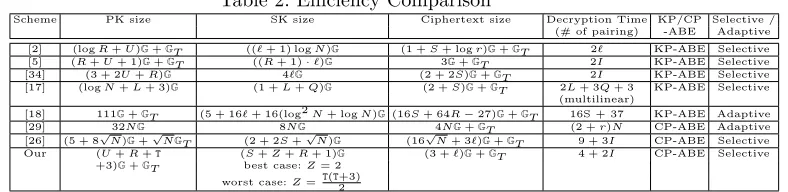
We first compare the efficiency of our scheme with other revocable ABE schemes. We present our comparison in Table 2. We use the following symbols in our comparison table:
Table 2: Efficiency Comparison
Scheme PK size SK size Ciphertext size Decryption Time KP/CP Selective / (# of pairing) -ABE Adaptive [2] (logR+U)G+GT ((`+ 1) logN)G (1 +S+ logr)G+GT 2` KP-ABE Selective
[5] (R+U+ 1)G+GT ((R+ 1)·`)G 3G+GT 2I KP-ABE Selective [34] (3 + 2U+R)G 4`G (2 + 2S)G+GT 2I KP-ABE Selective [17] (logN+L+ 3)G (1 +L+Q)G (2 +S)G+GT 2L+ 3Q+ 3 KP-ABE Selective
(multilinear)
[18] 111G+GT (5 + 16`+ 16(log2N+ logN)G(16S+ 64R−27)G+GT 16S + 37 KP-ABE Adaptive [29] 32NG 8NG 4NG+GT (2 +r)N CP-ABE Adaptive [26] (5 + 8√N)G+√NGT (2 + 2S+√N)G (16√N+ 3`)G+GT 9 + 3I CP-ABE Selective Our (U+R+T (S+Z+R+ 1)G (3 +`)G+GT 4 + 2I CP-ABE Selective
+3)G+GT best case:Z= 2 worst case:Z=T(T+3)2
• R: max number of revoked users;U: max number of attributes in the system
• T: number of time period level (depth of time tree)
• N: max number of users in the system;S: number of attributes of the user
• r: number of revoked users in the revocation list
• `: number of rows of the access structure matrix
• I: number of attributes used in the decryption
• L: max number of length of input wires (exclusive for [17] only)
• Q: max number of gates (exclusive for [17] only)
• GT: numberGT elements;G: numberGelements
• Using indirect approach and cloud-assisted approach (such as those listed in Section 2), as they cannot support instant revocation or require a cloud server to assist decryption.
• Using broadcast encryption technique (such as [3,34]) as they require the encryptor to know the identity of all possible decryptors, which is not exactly an ABE but more or less similar to a broadcast encryption in nature.
• Weak security model [9]. Their model is very week. They only allow the ad-versary to query secret key that does not satisfy the challenge access struc-ture AND not in the revocation list. Under this model, the collusion attack we mentioned in Section 1.2 is NOT considered as a valid attack. That means their model cannot capture such a low-level attack.
• Attribute-level revocation only [50]. They only support attribute-level revo-cation, instead of the more generalized user-level or key-level revocation. From the comparison, we can see that our scheme is the most efficient CP-ABE using direct approach for revocation. In practice, T can be very small. For example, if we only consider year, month and day, T = 3. Our space and computation complexity do not depend onN, the total number of users in the system, which is supposed to be a very large number.
6
Conclusion
In this paper, we proposed a revocable CP-ABE scheme based on the direct revoke approach. That is, the revocation list is embedded into the ciphertext so that instant revocation can be achieved. In order to shorten the revocation list, we further propose a time validity technique so that expired users cannot decrypt ciphertext associated with a decryptable time period not completely covered under their validity period. We deploy a tree-based structure and HIBE technique to construct the time validity part. The efficiency analysis also shows that our scheme is practical enough to be deployed.
Acknowledgement
This work was supported by Australian Research Council (ARC) Grant DP180102199, the National Natural Science Foundation of China (61702342), the Science and Technology Innovation Projects of Shenzhen (JCYJ20160307150216309, JCYJ20170302151321095) and Tencent ”Rhinoceros Birds” -Scientific Research Foundation for Young Teachers of Shenzhen University.
References
2. N. Attrapadung and H. Imai. Attribute-based encryption supporting di-rect/indirect revocation modes. In IMA, volume 5921 of LNCS, pages 278–300. Springer, 2009.
3. N. Attrapadung and H. Imai. Conjunctive broadcast and attribute-based encryp-tion. InPairing, volume 5671 ofLNCS, pages 248–265. Springer, 2009.
4. N. Attrapadung and B. Libert. Functional encryption for inner product: Achieving constant-size ciphertexts with adaptive security or support for negation. InPKC, volume 6056 ofLNCS, pages 384–402. Springer, 2010.
5. N. Attrapadung, B. Libert, and E. de Panafieu. Expressive key-policy attribute-based encryption with constant-size ciphertexts. InPKC, volume 6571 ofLNCS, pages 90–108. Springer, 2011.
6. M. H. Au, Q. Huang, J. K. Liu, W. Susilo, D. S. Wong, and G. Yang. Traceable and retrievable identity-based encryption. InACNS, volume 5037 ofLNCS, pages 94–110. Springer, 2008.
7. M. H. Au, J. K. Liu, T. H. Yuen, and D. S. Wong. Practical hierarchical identity based encryption and signature schemes without random oracles.IACR Cryptology ePrint Archive, 2006:368, 2006.
8. M. H. Au, T. H. Yuen, J. K. Liu, W. Susilo, X. Huang, Y. Xiang, and Z. L. Jiang. A general framework for secure sharing of personal health records in cloud system. J. Comput. Syst. Sci., 90:46–62, 2017.
9. A. Balu and K. Kuppusamy. Ciphertext-policy attribute-based encryption with user revocation support. InQShine, volume 115 ofLecture Notes of the Institute for Computer Sciences, Social Informatics and Telecommunications Engineering, pages 696–705. Springer, 2013.
10. A. Beimel. Secure Schemes for Secret Sharing and Key Distribution. PhD thesis, Israel Institute of Technology, Technion, Haifa, Israel, 1996.
11. A. Boldyreva, V. Goyal, and V. Kumar. Identity-based encryption with efficient revocation. InCCS, pages 417–426. ACM, 2008.
12. D. Boneh, X. Boyen, and E.-J. Goh. Hierarchical identity based encryption with constant size ciphertext. InEUROCRYPT, volume 3494 ofLNCS, pages 440–456. Springer, 2005.
13. D. Boneh and M. K. Franklin. Identity-based encryption from the weil pairing. In CRYPTO, volume 2139 ofLNCS, pages 213–229. Springer, 2001.
14. S. S. M. Chow, J. K. Liu, and J. Zhou. Identity-based online/offline key encapsu-lation and encryption. InASIACCS, pages 52–60. ACM, 2011.
15. C. Chu, J. K. Liu, J. Zhou, F. Bao, and R. H. Deng. Practical id-based encryption for wireless sensor network. InASIACCS, pages 337–340. ACM, 2010.
16. H. Cui, R. H. Deng, Y. Li, and B. Qin. Server-aided revocable attribute-based encryption. InESORICS Part II, volume 9879 ofLNCS, pages 570–587. Springer, 2016.
17. P. Datta, R. Dutta, and S. Mukhopadhyay. General circuit realizing compact revocable attribute-based encryption from multilinear maps. InISC, volume 9290 ofLNCS, pages 336–354. Springer, 2015.
18. P. Datta, R. Dutta, and S. Mukhopadhyay. Adaptively secure unrestricted attribute-based encryption with subset difference revocation in bilinear groups of prime order. InAFRICACRYPT, volume 9646 ofLNCS, pages 325–345. Springer, 2016.
20. J. Hong, K. Xue, and W. Li. Comments on ”DAC-MACS: Effective Data Ac-cess Control for Multiauthority Cloud Storage Systems” / Security Analysis of Attribute Revocation in Multiauthority Data Access Control for Cloud Storage Systems.IEEE Trans. Information Forensics and Security, 10(6):1315–1317, 2015. 21. J. Hur and D. K. Noh. Attribute-based access control with efficient revocation in data outsourcing systems. IEEE Trans. Parallel Distrib. Syst., 22(7):1214–1221, 2011.
22. K. Liang, M. H. Au, J. K. Liu, W. Susilo, D. S. Wong, G. Yang, T. V. X. Phuong, and Q. Xie. A dfa-based functional proxy re-encryption scheme for secure public cloud data sharing. IEEE Trans. Information Forensics and Security, 9(10):1667– 1680, 2014.
23. K. Liang, M. H. Au, J. K. Liu, W. Susilo, D. S. Wong, G. Yang, Y. Yu, and A. Yang. A secure and efficient ciphertext-policy attribute-based proxy re-encryption for cloud data sharing. Future Generation Comp. Syst., 52:95–108, 2015.
24. J. Liu, X. Huang, and J. K. Liu. Secure sharing of personal health records in cloud computing: Ciphertext-policy attribute-based signcryption. Future Genera-tion Comp. Syst., 52:67–76, 2015.
25. J. K. Liu, M. H. Au, X. Huang, R. Lu, and J. Li. Fine-grained two-factor ac-cess control for web-based cloud computing services. IEEE Trans. Information Forensics and Security, 11(3):484–497, 2016.
26. Z. Liu and D. S. Wong. Practical ciphertext-policy attribute-based encryption: Traitor tracing, revocation, and large universe. InACNS, volume 9092 ofLNCS, pages 127–146. Springer, 2015.
27. T. Naruse, M. Mohri, , and Y. Shiraishi. Attribute-based encryption with at-tribute revocation and grant function using proxy re-encryption and atat-tribute key for updating. InFuture Information Technology, volume 276 of Lecture Notes in Electrical Engineering, pages 119–125. Springer, 2014.
28. T. Naruse, M. Mohri, and Y. Shiraishi. Provably secure attribute-based encryp-tion with attribute revocaencryp-tion and grant funcencryp-tion using proxy re-encrypencryp-tion and attribute key for updating. Human-centric Computing and Information Sciences, 5(1):1–13, 2015.
29. J. M. G. Nieto, M. Manulis, and D. Sun. Fully private revocable predicate encryp-tion. InACISP, volume 7372 ofLNCS, pages 350–363. Springer, 2012.
30. H. Qian, J. Li, Y. Zhang, and J. Han. Privacy-preserving personal health record using multi-authority attribute-based encryption with revocation.Int. J. Inf. Sec., 14(6):487–497, 2015.
31. S. Ruj, A. Nayak, and I. Stojmenovic. DACC: distributed access control in clouds. InTrustCom 2011, pages 91–98. IEEE Computer Society, 2011.
32. A. Sahai, H. Seyalioglu, and B. Waters. Dynamic credentials and ciphertext dele-gation for attribute-based encryption. InCRYPTO, volume 7417 ofLNCS, pages 199–217. Springer, 2012.
33. J. Shi, C. Huang, J. Wang, K. He, and J. Wang. An access control scheme with di-rect cloud-aided attribute revocation using version key. InICA3PP Part I, volume 8630 ofLNCS, pages 429–442. Springer, 2014.
34. P. Wang, D. Feng, and L. Zhang. Towards attribute revocation in key-policy attribute based encryption. In CANS, volume 7092 of LNCS, pages 272–291. Springer, 2011.
36. S. Wang, J. Zhou, J. K. Liu, J. Yu, J. Chen, and W. Xie. An efficient file hierarchy attribute-based encryption scheme in cloud computing. IEEE Trans. Information Forensics and Security, 11(6):1265–1277, 2016.
37. B. Waters. Ciphertext-Policy Attribute-Based Encryption: An Expressive, Ef-ficient, and Provably Secure Realization. Cryptology ePrint Archive, Report 2008/290, 2008. http://eprint.iacr.org/.
38. B. Waters. Ciphertext-policy attribute-based encryption: An expressive, efficient, and provably secure realization. In PKC, volume 6571 of LNCS, pages 53–70. Springer, 2011.
39. F. Xhafa, J. Wang, X. Chen, J. K. Liu, J. Li, and P. Krause. An efficient PHR service system supporting fuzzy keyword search and fine-grained access control. Soft Comput., 18(9):1795–1802, 2014.
40. X. Xie, H. Ma, J. Li, and X. Chen. An efficient ciphertext-policy attribute-based access control towards revocation in cloud computing. J. UCS, 19(16):2349–2367, 2013.
41. X. Xie, H. Ma, J. Li, and X. Chen. New ciphertext-policy attribute-based access control with efficient revocation. In ICT-EurAsia, volume 7804 of LNCS, pages 373–382. Springer, 2013.
42. K. Yang, X. Jia, K. Ren, and B. Zhang. DAC-MACS: effective data access control for multi-authority cloud storage systems. InINFOCOM, pages 2895–2903. IEEE, 2013.
43. K. Yang, X. Jia, K. Ren, B. Zhang, and R. Xie. DAC-MACS: effective data access control for multiauthority cloud storage systems. IEEE Trans. Information Forensics and Security, 8(11):1790–1801, 2013.
44. Y. Yang, X. Ding, H. Lu, Z. Wan, and J. Zhou. Achieving revocable fine-grained cryptographic access control over cloud data. InISC, volume 7807 ofLNCS, pages 293–308. Springer, 2015.
45. Y. Yang, J. K. Liu, K. Liang, K. R. Choo, and J. Zhou. Extended proxy-assisted approach: Achieving revocable fine-grained encryption of cloud data. InESORICS Part II, volume 9327 ofLNCS, pages 146–166. Springer, 2015.
46. Y. Yang, J. K. Liu, Z. Wei, and X. Huang. Towards revocable fine-grained encryp-tion of cloud data: Reducing trust upon cloud. InACISP Part I, volume 10342 of LNCS, pages 127–144. Springer, 2017.
47. J. Ye, W. Zhang, S. Wu, Y. Gao, and J. Qiu. Attribute-based fine-grained access control with user revocation. InICT-EurAsia, volume 8407 ofLNCS, pages 586– 595. Springer, 2014.
48. S. Yu, C. Wang, K. Ren, and W. Lou. Attribute based data sharing with attribute revocation. InASIACCS, pages 261–270. ACM, 2010.
49. T. H. Yuen, Y. Zhang, S. Yiu, and J. K. Liu. Identity-based encryption with post-challenge auxiliary inputs for secure cloud applications and sensor networks. In ESORICS Part I, volume 8712 ofLNCS, pages 130–147. Springer, 2014.
50. M. Zhang. New model and construction of ABE: achieving key resilient-leakage and attribute direct-revocation. InACISP, volume 8544 ofLNCS, pages 192–208. Springer, 2014.
A
Mathematical Background
A.1 Vector
We use α = (α1,· · ·, αn)> ∈ Znp and g
α = (ga1,· · · , gan)> ∈
Gn to denote
column vectors. Fora,z∈Zn
p,ha,zi=a>z= Pn
i=1aizi and (ga)z=gha,zi.
A.2 Bilinear Groups
G is an algorithm, which takes as input a security parameterκ and outputs a tuple (p,G,GT, e), whereGandGT are multiplicative cyclic groups with prime orderp, ande:G×G→GT is a map, which has the following properties:
• Bilinearity:e(ga, hb) =e(g, h)abfor∀g, h∈
Gand∀a, b∈Zp.
• Non-degeneracy:There exists g, h∈Gsuch thate(g, h)6= 1G.
• Computability:There exists an efficient algorithm to computee(g, h) for
∀g, h∈G.
A.3 Access Structure
Let{P1, P2,· · ·, Pn}be a set of parties. A collectionA⊆2{P1,P2,···,Pn}is
mono-tone if∀B, C: ifB∈AandB⊆CthenC∈A. An access structure is a collection A of non-empty subsets of {P1, P2,· · · , Pn}, i.e., A ⊆2{P1,P2,···,Pn}\{Ø}. The
sets in A are called the authorized sets, and the sets not in A are called the
unauthorized sets.
A.4 Linear Secret Sharing Schemes
We adapt our definition from those given in [10]. A secret-sharing scheme Π
over a set of partiesP is called linear (overZp) if
• The shares of the parties form a vector overZp.
• There exists a matrix M with ` rows and n columns called the share-generating matrix for Π. There exists a function ρ which maps each row of the matrix to an associated party. That is fori= 1,· · ·, `the valueρ(i) is the party associated with row i. When we consider the column vector
v= (s, r2, . . . , rn), wheres∈Zpis the secret to be shared, andr2,· · ·, rn∈
Zp are randomly chosen, then Mv is the vector of ` shares of the secret s according toΠ. The share (Mv)i belongs to partyρ(i).
Every linear secret sharing scheme according to the above definition also enjoys the linear reconstruction property which defined as follows: Suppose thatΠ is an LSSS for the access structureA. LetS ∈Abe any authorized set, and letI ⊂ {1,2,· · · , `} be defined asI ={i :ρ(i)∈S}. Then, there exist constants{ωi∈Zp}i∈I such that, if{λi}are valid shares of any secret
saccording toΠ, thenP
A.5 Decisional q-Bilinear Diffie-Hellman Exponent (BDHE) Problem
The Decisionalq-BDHE problem is defined as given
(g, gs, ga,· · · , g(aq), g(a(q+2)),· · ·, g(a2q), T) where s, a∈ Zp, g ∈ Gand T ∈ GT, to decide if T = e(e, g)sa
q+1
or if T is a random element ofGT.
B
Security Analysis
The correctness of the scheme in Section 4.2 can be seen from the following equations.
F=
R Y
i=2
Fyi
i
= R Y
i=2
(f1−IDi−1fi)yiu
= (f−(IDy2+ID2y3+···+IDR−1yR)
1 g
PR i=2αiyi)u
=f1−hX,Yi+y1
R Y
i=2
fyi
i u
=f1−hX,Yi·
R Y
i=1
fyi
i u
. (2)
ς1=
e(F, C00)
e(D00, C000) hX−,1Yi
= e (f −hX,Yi
1 ·
QR i=1f
yi
i )u, gs
e gu,(fy1
1 · · ·f
yR
R )s
!hX−,1Yi
=e(g, g)α1su. (3)
ς2=
Y
i∈I
e(Ci, D0)·e(C00, Kρ(i))
ωi
=Y
i∈I
e(gα0λih−s
ρ(i), g
t)
·e(gs, htρ(i)) ωi
=Y
i∈I
e(g, g)tα0λiωi
m= C0·ς1·ς2·e(D
00 0, C
000 0 )
e(D1,τc, C
0
0)
= m·e(g, g)
αs·e(g, g)α1su·e(g, g)stα0·e(gvτc,(V0Qk
j=1V
τj
j )s)
e(gαgα0tgα1u(V0Qk j=1V
τj
j )vτc, gs)
. (5)
We prove the following theorem.
Theorem B.1. Suppose the decisional q-BDHE assumption holds. Then no
probabilistic polynomial time adversary can selectively break our system in with a challenge matrix of size `∗ ×n∗, where `∗, n∗ ≤ q, a challenge revocation list R∗ where |R∗| ≤ q−2 and a challenge time T∗
c with z-ary representation
τ∗= (τ1∗, . . . , τk∗∗) for somek∗<Tsuch thatT≤q.
Proof. Suppose there exists an adversaryAwith non-negligible advantage against our construction. Then challengerCcan resolve the decisionalq-BDHE problem with non-negligible probability.
• Init. ChallengerC receives
y= (g, gs, ga,· · ·, gaq, gaq+2,· · ·, ga2q)∈G2q+1, T ∈ GT,
and decides if T = e(g, g)saq+1 using the adversary A. A first gives the challenge access structure (M∗, ρ∗) where M∗ hasn∗ ≤q columns. A also givesC the challenge time T∗c with z-ary representation τ∗ = (τ1∗, . . . , τk∗∗)
for somek∗ ≤T and the challenge revocation list R∗, where |R∗| ≤q−2. That is, the maximum number of revoked users allowed in the systemR−1 is set toq−2. In other words, we haveR=q−1.
• Setup. ChallengerCchooses randomα0, δ0, ξ0, ξ1, . . . , ξT∈Zpand implicitly setsα=α0+δ
0aq+1 by letting
e(g, g)α=e(ga, gaq)δ0e(g, g)α0.
Letgα0 =ga. For each xfor 1≤x≤U begin by choosing a random value
zx. LetI denote the set of indicesi, such thatρ∗(i) =x.C programshxas:
hx=gzxgaM
∗ i,1·ga
2M∗ i,2· · ·ga
n∗M∗
i,n∗. (6)
Note that ifI = Ø then we have hx =gzx. Also note that the parameters are distributed randomly due to thegzx value.
Let|R∗|=r. Note thatr≤q−2. LetX1,· · · ,Xrbe the corresponding vec-tors for the revoked setR={ID1,· · ·, IDr}. That is,Xk= (1, IDk,· · · , ID
q−2
k ) fork∈[1, r].
• For eachk∈[1, r], let
MXk= −ID
k −IDk2 · · · −ID q−2
k
Iq−2
where Iq−2 is a (q−2)×(q−2) identity matrix. C selectsbk ∈R Zqp−1 such that
bk·MXk=0. (7)
The simplest candidate consists of the vectorbk = (1, IDk,· · · , ID q−2
k ).
• Fork∈[r+ 1, q−1],bk=0. Define a (q−1)×(q−1) matrix
B = (b1| · · · |br|0| · · · |0)
where thekth column consists ofbkfork∈[1, r] and the remainingq−1−r columns are0.
ChallengerC definesVj=gξja
q−j+1
forj ∈[1,T] andV0=
Qk∗ j=1V
−τj∗ j g
ξ0. Challenger C defines ν = (ν1,· · · , νq−1)> such that νi = aq+1−i and sets
gν = (gν1, . . . , gνq−1)>= (gaq, . . . , ga2)>. It then implicitly sets
α= B·ν+δ (8)
by randomly choosingδ∈Zq−1
p . ChallengerC defines the last public param-eter
F=gB·ν·gδ =gα= (gα1,· · · , gαR)>= (f
1, . . . , fR)>.
• Phase 1. Adversary A makes repeated private keys queries corresponding
to the tuple of identity, attributes and time and identity (ID, S,T), such that at least one of the following conditions must be satisfied:
1. the attribute setS does not satisfy the access structureA∗;
2. ID∈ R∗;
3. τ∗ and all its prefixes are not inT, the set-cover ofT.
We separate into three cases.
Case 1:Sdoes not satisfyA∗. ChallengerCfirst chooses a randomϕ∈Zp. Then it finds a vectorw= (w1,· · ·, wn∗)∈Zn
∗
p such thatw1=−1 and for
alliwhereρ∗(i)∈Swe have thatw·Mi∗= 0. By our definition of an LSSS, such a vector must exist sinceS does not satisfyM∗.Cimplicitly defines
t=ϕ+δ0(w1aq+w2aq−1+. . .+wn∗aq−n ∗+1
).
It performs this by setting
D0=gϕ
n∗ Y
i=1
C then randomly chooses u ∈ Zp and sets D00 = gu. Then for all τ =
(τ1, . . . , τkτ)∈T,C randomly choosesvτ ∈Zp and setsD 00
0,τ =gvτ and:
D1,τ =gα
0
gaϕ
n∗ Y
i=2
gaq+2−iwiδ0gα1u(V0
kτ
Y
j=1
Vτj
j ) vτ
=gα0gδ0aq+1gaϕg−δ0aq+1 n∗ Y
i=2
gaq+2−iwiδ0
gα1u(V
0
kτ
Y
j=1
Vτj
j ) vτ
=gαgaϕgw1δ0aq+1 n∗ Y
i=2
gaq+2−iwiδ0 gα1u(V
0
kτ
Y
j=1
Vτj
j )
vτ (∵w
1=−1)
=gαgaϕ
n∗ Y
i=1
gaq+2−iwiδ0gα1u(V0
kτ
Y
j=1
Vτj
j ) vτ
=gα gϕ
n∗
Y
i=1
gaq+1−iwiδ0 !a
gα1u(V
0
kτ
Y
j=1
Vτj
j ) vτ
=gαgatgα1u(V0
kτ
Y
j=1
Vτj
j ) vτ
=gαgα0tgα1u(V
0
kτ
Y
j=1
Vτj
j ) vτ.
Now we set Kx ∀x ∈ S. First, we consider x ∈ S for which there is no i such thatρ∗(i) =x. For those we can simply letKx=Dz0x. Then we create
keys for attributesxwherexis used in the access structure. We follow the heuristic from [37].
For these keys we have to make sure no terms are of the formgaq+1
which cannot be simulated. In calculating htx all terms of this form come from M∗
i,jajwjaq+1−j for some j, where ρ∗(i) =x. However, we have thatMi∗w= 0. Therefore everything with an exponentaq+1
cancels when combined.
S createsKx in this case as follows. Supposeρ∗(i) =x, it sets
Kx=Dz0x·
n∗ Y
j=1
gajϕ
n∗ Y
µ=1,µ6=j
gaq+1+j−µwµδ0
!Mi,j∗ .
Finally C computes Fi = (f−ID
i−1
1 ·fi)u for i = 2, . . . , R and {Lj,τ =
Vvτ
j }j=kτ+1,...,T,τ∈T.
Case 2:ID∈ R∗. We follow the heuristic in [1]. In this case, letID k∈ R∗ be the identity of the secret key thatAqueries, wherek∈[1, r]. Challenger
equation (8), the first coordinate ofαequals
α1=δ1+
r X
j=1
νj=δ1+
r X
j=1
aq+1−j. (9)
Now challenger C computes D00 = guk(ga k
)−δ0 = gu˜k. Next, C randomly
selects t ∈ Zp and computes D0 = gt. For all τ = (τ1, . . . , τkτ) ∈ T, C
randomly selectsvτ ∈Zp and computesD
00
0,τ =gvτ and
D1,τ =gα
0
fuk 1
gakδ1 r Y
j=1,j6=k
gaq+1−j+k
−δ0
(ga)t(V0
kτ
Y
j=1
Vτj
j ) vτ
=gα0gα1ukgaq+1δ0
gδ1 r Y
j=1
gaq+1−j
−δ0ak
(gα0)t(V
0
kτ
Y
j=1
Vτj
j ) vτ
=gαgα1uk(gα1)−δ0akgα0t(V 0
kτ
Y
j=1
Vτj
j )
vτ ( from equation (9) )
=gαgα1uk−α1δ0akgα0t(V 0
kτ
Y
j=1
Vτj
j ) vτ
=gαgα1u˜kgα0t(V
0
kτ
Y
j=1
Vτj
j ) vτ.
We defineFk = (F2, . . . , FR)> which is the secret key component forIDk. First recallν= (ν1,· · ·, νq−1)>whereνi=aq+1−iandgν= (gν1, . . . , gνq−1)> = (gaq, . . . , ga2)>.C computes
Fk as follow:
Fk=gukM
>
Xkα·g−δ0a
kM>
XkBν·g−δ0a
kM>
Xkδ
(C is able to computegakMX>kBν because
thekth column ofMX>
kB is0, from equation (7) )
=gukMX>kα·g−δ0akMX>kα ( from equation (8) ) =g(uk−δ0ak)MX>kα
=gu˜kMX>kα.
That is, fori= 2, . . . , R(recall thatR=q−1), we have
Fi =g
˜
ukMX>k ,i−1α
(whereMX>k,i−1 denotes the (i−1)th row ofMX>k) =gu˜k(−IDki−1α1+αi)
= (f−ID i−1
k
FinallyC computes{Kx=htx}x∈S and{Lj,τ =Vjvτ}j=k+1,...,T,τ∈T.
Case 3:τ∗ and all its prefixes are not inT. For allτ= (τ1, . . . , τkτ)∈T,
first defineτkτ+1 =. . . =τq = 0 andτ
∗
k∗+1 =. . . =τq∗ = 0. There exists a
smallest indexk0≤k∗ such thatτk0 6=τ∗
k0.
ChallengerCrandomly selectsvτ ∈Zpand implicitly defines ˜vτ = δ0a
k0
ξk0(τ∗ k0−τk0)+ vτ. It performs this by setting:
D000,τ =g δ0ak0 ξk0(τ∗
k0 −τk0)+vτ.
C then randomly chooses t, u ∈ Zp and sets D0 = gt, D00 = gu. For all τ,
compute:
D1,τ =gα
0+α
0t+α1u+vτξ0(gaq−k
0+1
)vτξk0(τk0−τk∗0)(gak 0
)
ξ0δ0
ξk0(τ∗ k0 −τk0)
·
kτ−k0+1
Y
j=1
(gaq−j+1)
ξj+k0τ∗ j+k0δ0 ξk0(τ∗
k0 −τk0)
kτ+1
Y
j=k0+1
(gaq−j+1)ξjτj∗vτ
=gα0gα0tgα1ugvτ(ξ0+ξk0a q−k0+1(τ
k0−τ ∗ k0))g
ξ0δ0ak0 ξk0(τ∗
k0 −τk0)
·
kτ+1
Y
j=k0+1
g
ξj aq−j+1+k0τj∗δ0
ξk0(τ∗ k0 −τk0)
kτ+1
Y
j=k0+1
gξjaq−j+1τj∗vτ
=gα0+δ0aq+1gα0tgα1ug(ξ0+ξk0a q−k0+1(τ
k0−τ ∗ k0))(
δ0ak0 ξk0(τ∗
k0 −τk0) +vτ)
·
kτ+1
Y
j=k0+1
gξja q−j+1τ∗
j( δ0ak0 ξk0(τ∗
k0 −τk0)+vτ)
=gαgα0tgα1ug(ξ0+ξk0aq −k0+1(τ
k0−τ ∗ k0)) ˜vτ
kτ+1
Y
j=k0+1
gξjaq−j+1τj∗v˜τ
=gαgα0tgα1u(V
0
k0 Y
j=1
Vτj
j )
˜
vτ
kτ+1
Y
j=k0+1
Vτjv˜τ
j (∵τj =τj∗ ifj < k0)
=gαgα0tgα1u(V0
kτ+1
Y
j=1
Vτj
j )
˜
vτ
=gαgα0tgα1u(V
0
kτ
Y
j=1
Vτj
j )
˜
vτ (∵τ
C also computes {Kx = htx}x∈S,{Fi = (f−ID
i−1
1 ·fi)u}i=2,···,R. For j =
kτ+ 1, . . . ,T, τ ∈T, compute
Lj,τ =g
δ0ξj aq+1+k0 −j ξk0(τ∗
k0 −τk0) +vτξjaq−j+1
= (gξjaq−j+1) δ0ak0 ξk0(τ∗
k0 −τk0)+vτ
=Vv˜τ
j .
• Challenge. Adversary A submits two equal length messages m0 and m1.
ChallengerCflips a random coinβ and encryptsmβunder the access struc-tureA∗, revocation listR∗ and timeT∗c withz-ary representationτ∗. It first creates
C0=mβ·Tδ0·e(gs, gα
0
), C00 =gs.
For C000, we follow the technique from [1]. Let R∗ = (ID
1, . . . , IDr) and
FR∗(Z) = (Z−ID1)· · ·(Z−IDr) =y1+y2Z+· · ·+yrZr−1+yr+1Zr. If
r+ 1< R, the coefficientsyr+2,· · ·, yR are set to 0. LetY= (y1,· · ·, yR)> satisfyhXk,Yi= 0 for k∈[1, r]. We claim that Y>·B·ν = 0. Therefore, it comes thathY,αi=hY,δi.C sets
C000= (gs)hY,δi.
ForC0000, observe that since the challenge time is (τ1∗, . . . , τk∗∗), thega i
terms inVi are cancelled out.C sets
C0000= (gs)ξ0.
For Ci, we follow the technique from [38]. Since the term hsρ∗(i) contains
terms of the formgajs that cannot be simulated, we need to use the secret splitting technique such that these terms can be cancelled out. C chooses
y02, . . . , yn0∗∈Zp and then share the secret using the vector
v∗= (s, sa+y20, sa2+y30, . . . , san ∗−1
+yn0∗)∈Zn ∗
p .
This allows the termsh−ρ∗s(i)cancel out with the termsg
aλi. Fori= 1, . . . , n∗, Cgenerates
Ci= n∗
Y
j=2
(ga)Mi,j∗ y0j
(gs)−zρ∗(i).
To see the simulation correctness ofCi, we first define
λ∗i =hv∗, Mi∗i
The correct distribution ofCi should be
Ci=gaλ
∗ ih−s
ρ∗(i)
=gsaMi,∗1g(sa+y
0
2)aM
∗
i,2g(sa2+y
0
3)aM
∗
i,3· · ·g(san
∗ −1+y0 n∗)aM
∗ i,n∗
·g−szρ∗(i)
g−saMi,∗1·g−sa2M
∗
i,2· · ·g−san
∗
Mi,n∗ ∗ ( from equation (6) )
=gaMi,∗2y
0
2gaM
∗ i,3y
0
3. . . gaM
∗ i,n∗y
0
n∗(gs)−zρ∗(i) =
n∗ Y
j=2
(ga)Mi,j∗ y 0 j
(gs)−zρ∗(i).
• Phase 2. It is the same as inPhase 1.
• Guess. Adversary A will eventually output a guess β0 of β. Challenger C then outputs 0 to guess thatT =e(g, g)aq+1s
ifβ =β0; otherwise, it outputs 1 to indicate that it believesT is a random group elementΨ ∈GT.
WhenT is a tuple, the challenger C gives a perfect simulation so we have that the advantage of the challengerC is the same as the advantage of the adversary
A. WhenT is a random group element Ψ ∈GT, the messagemβ is completely hidden from the adversary and we have Pr[C(y, T =Ψ) = 0] = 1/2. Therefore, the challenger C can win the decisional q-BDHE game with non-negligible