Mobility Aware QoS Framework for
Mobile Cloud Computing
A.Sheik Ali
1, Dr.K.Baskaran
2Research Scholar, Dept. of CSE., Karpagam University, Coimbatore, Tamilnadu, India1
Associate Professor, Dept. of EEE., Government College of Technology, Coimbatore, Tamilnadu, India2
ABSTRACT: The usage of mobile phones in current scenarios is in increasing rate. Common people use mobile phones such as iphones, Smart phones, Apple iPad, etc to access internet services. Today‟s the emerging growth in mobile applications along with cloud computing concepts; Mobile Cloud Computing (MCC) has been introduced as a potential technology for mobile services. MCC is an integration of cloud computing in the mobile environment, which improves the overall performance of the mobile devices such as battery life, storage, etc. MCC still faces a number of challenges in both mobile and computing side, one of which is providing Quality-of-Service (QoS), which means how a service provider can ensure QoS of its cloud services. The provision of QoS in mobile cloud computing is a challenging task. This is because of the dynamic characteristic of mobile networks and limited resources of mobile devices such as bandwidth, delay, packet loss ratio, battery life, storage capacity, computational power, security, etc. To overcome this problem, Mobility Aware QoS Framework for Mobile Cloud Computing (MAQFMCC) and Mobility Aware QoS Analysis Algorithm (MAQAA) are implemented in addition to this an Artificial Neural Network is used for modelling the framework.
KEYWORDS: QoS, Mobile Cloud Computing, quality service, mobile services. I. INTRODUCTION
Now-a-days, mobile devices such as cell phones, Smart phones, Tablet PCs, etc are rapidly becoming an important part of human life as the most effective and convenient communication tools, which are not restricted by time and place. Mobile users get various services from mobile applications (e.g., iphone apps, Google apps, Android apps etc.) which run on the devices. After the invention of Mobile Cloud Computing (MCC), the mobile devices from remote servers (cloud servers) via wireless networks can access these applications. The rapid progress of mobile computing (MC) [1] becomes a powerful trend in the development of IT technology as well as commerce and industrial fields. However, the mobile devices are facing many challenges in their resources (e.g.: battery life, storage and bandwidth) and communications (e.g.: mobility and security) [2]. The limited resource significantly reduces quality of the services. Mobile Cloud Computing faces a number of challenges both at mobile side and computing side, one of which is Quality-of-Service (QoS) i.e., how a service provider can ensure QoS for its cloud services.
Mobile Cloud Computing (MCC) has been recognized as the next generations computing infrastructure where both the data storage and the data processing happen outside of the mobile device. Mobile cloud applications move the computing power and data storage away from mobile phones and into the cloud. Cloud Services can be accessed through mobile devices such as smart phones, iphones, etc. It brings new types of services and facilities for mobile users to take full advantages of cloud computing.
10.15680/ijircce.2014.0212023
II. RELATEDWORK
The research work on cloud computing falls in various aspects such as cloud computing architecture, cloud services, cloud security, cloud service and research management. Peng et al [3] proposed on QoS aware system for mobile cloud services. The system provides a QoS framework to monitor the status of QoS in each mobile cloud service terminal. The system also considers other factors influences on different cloud service modes with regard to QoS, e.g., availability, stability, etc.
Some of existing work focuses on QoS aware web service. Lodi et al [4] proposed a middle-ware architecture for enabling service level agreement (SLA)- driven clustering of QoS- aware application servers. Some work focus on QoS architecture design for cloud computing, Wang et al [5] proposed on adaptive QoS management framework for VOD (Video on Demand) cloud service centres. Ye et al [6] proposed a framework for QoS and power management in a service cloud environment with mobile devices. Some work focus on mechanisms for QoS management in cloud computing. Li [7] proposed on adaptive management of virtualized resources in cloud computing using feedback control. Xiao [8] proposed a reputation based QoS provisioning in cloud computing via Dirichlet multinomial model.
The existing work comprehensively and flexibly supports using both QoS properties and QoS service modes as key parameters for run time QoS adaptive assurance. Yan [9] proposed an adaptive trust control model to evaluate, establish, specify and ensure the trust relationships among system entities. All the existing work only concentrate on static mobile cloud computing framework, where all the nodes considers as static nodes.
III.MOBILITYAWAREQOSANALYSISALGORITHM
In this section the system architecture of the framework, its modelling and the proposed algorithm has been discussed in detail.
A. System Architecture:
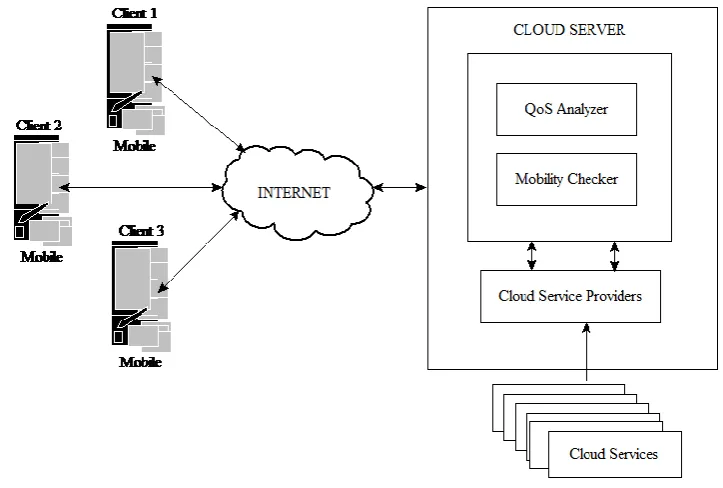
Fig. 1. Mobility Aware QoS Framework Architecture
calculates the QoS requirement of the client and analyses the requirement against the cloud service modes running on cloud side using Mobility Aware QoS Analysis Algorithm. It also thoroughly monitors the mobility of each service modes and coverage of client with each cloud service provider using mobility checker. As per the client‟s requirements, the QoS manager dynamically adjusts the resources to meet QoS requirements of each cloud services.
B. Framework Modeling:
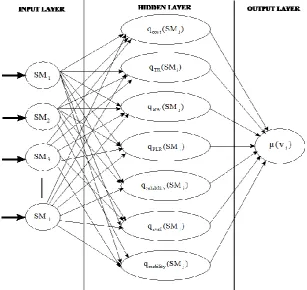
An Artificial Neural Network (ANN) has been used to modelling the framework. The ANN model includes three layers of nodes such as input layer, hidden layer and output layer. The input layer consists of set of cloud service modes (SMj). The hidden layer represents the training algorithm. We have proposed a training algorithm called Mobility Aware QoS Analysis Algorithm (MAQAA) to analyses and select quality service mode according to the client‟s requirement. The output layer represents QoS value of each service modes (SMj). Fig.2 shows the framework modelling based on ANN.
Fig. 2. Framework Modeling based on ANN
C. Mobility Aware QoS Analysis Algorithm (MAQAA):
Aim of the proposed algorithm is to analyse the cloud service modes (SMj) provided by various cloud service
providers based of various QoS parameters and select the QoS guaranteed service modes for delivering services to its clients. The algorithm uses seven QoS parameters such as transmission rate, packet loss ratio, cost, bandwidth, reliability, availability and mobility to analyze the client‟s requirement for providing quality service. The varies QoS parameters are discussed below.
Mobility Aware QoS Analysis Algorithm calculates QoS value [µ (SMj)] for each cloud service modes (SMj) based
on the seven QoS parameter. For calculating the QoS value, the algorithm defines quality vector for service mode SMj that is defined as,
q(SMj) = { qTR(SMj), qPLR(SMj), qBW (SMj), qCost(SMj), qreliability(SMj), qavail(SMj), qmobility(SMj) } e.q (1)
10.15680/ijircce.2014.0212023
MAQAA Algorithm
Step 1: Obtain the QoS parameters such as transmission rate qTR, Packet Loss Ration qPLR, Bandwidth qBW, Cost qcost,
Reliability qreliability, and Availability qavail for all service modes SMj.
Step 2: Detect the fading effect of signal strength and hand off of the mobile device to measure the mobility of the each service modes SMj.
Step 3: Calculate the distance between client and each service modes SMj based on the mobility.
Step 4: Construct a quality vector q(SMj) using the values obtained from step 1-3 for each QoS parameters for each
service modes SMj.
q(SMj) = { qTR(SMj), qPLR(SMj), qBW (SMj), qCost(SMj), qreliability(SMj), qavail(SMj), qmobility(SMj) }
Step 5: Construct a quality matrix Q using the service modes SMj.
Step 6: Scale the quality matrix to make the QoS parameter value in an common representation using the formula,
, e.q (2) For negative QoS parameters such as cost, packet loss ratio, mobility.
, e.q. (3) For positive QoS parameters bandwidth, transmission rate.
Step 7: Compute the quality vector value using quality matrix for the positive (g) and negative(b) QoS parameters of
each service modes SMj. Quality vector of the positive QoS parameters denoted by „g(SMj)‟ in Qn×7 is defined as
g(SMj)={ g1(SM1), g2(SM2), g3(SM3), g4(SM4), g5(SM5), g6(SM6), g7(SM7), g8(SM8)}
= { Max(vi1), Max(vi2), Max(vi3), Max(vi4), Max(vi5), Max(vi6), Max(vi7), Max(vi8) }
Quality vector for the negative QoS parameters denoted by „b(SMj)‟ in Qn×7 is defined as,
b(SMj)= { b1(SM1), b2(SM2), b3(SM3), b4(SM4), b5(SM5), b6(SM6), b7(SM7), b8(SM8)}
= { Min(vi1), Min(vi2), Min(vi3), Min(vi4), Min(vi5), Min(vi6), Min(vi7), Min(vi8) }
Step 8: Compute the weighted Euclidean distance for both positive and negative QoS parameters of each service modes
SMj using the formula, Weighted Euclidean distance between service modes (SMj) and the negative QoS parameters
n i 1 , )) SM ( b v ( w ) SM (
d j 2
7 1 j ij j j
neg
e.q. (4)
Weighted Euclidean distance between service modes (SMj) and the positive QoS parameter is defined as dpos(SMj).
n i 1 , ) v ) SM ( g ( w ) SM (
d j ij 2
7
1 j
j j
pos
e.q. (5)
Step 9: Calculate the QoS value of each service modes SMj. using the formula, The QoS value of service mode denoted
by µ(vi) is defined as,
n j 1 , ) SM ( d ) SM ( d 1 1 ) SM ( 2 j neg j pos
j
e.q. (6)
Where, n is the number of service modes (SMj),
7
1 j
j
w and wj represents the weight of the jth quality criterion
Step 10: Choose the service modes SMj as the QoS guaranteed service mode which has maximum QoS value.
QoSµ= max (µ(SMj) e.q (7)
IV.RESULTANALYSIS
In this section we discussed the numerical and simulation result analysis of the proposed algorithm.
A. Numerical Results:
We tested the proposed algorithm with 8 service modes and 7 QoS parameters such as Transmission Rate (TR), Packet Loss Ratio (PLR), Bandwidth (BW), Cost, Reliability, Availability and Mobility. We take the data in Table 1 as an example to illustrate the algorithm numerically in detail.
The proposed algorithm MAQAA has mathematically worked out with the sample data given in Table 1. In this example the unit of QoS parameters for all service modes is same. The weighted vector used in this example is w = (0.3, 0.1, 0.1, 0.1, 0.1, 0.1, 0.2). The quality vector Q has constructed using Table 1. Using Step 6 of the algorithm stated in section III, the quality vector has scaled for a common representation which simplifies the mathematical process. The scaled quality matrix has given in Fig.3.
Table 1. Sample Data
QoS Parameters
Service Modes (SMj)
SM1 SM2 SM3 SM4 SM5 SM6 SM7 SM8
TR 10 15 12 20 15 10 10 15
PLR 30 20 25 10 15 20 25 30
BW 50 60 50 100 70 100 20 25
Cost 60 62 64 40 63 54 56 58
Reliability 90 85 92 96 91 92 86 88
Availability 85 82 90 94 88 86 85 88
10.15680/ijircce.2014.0212023
According to the definitions of positive and negative QoS parameters discussed in the algorithm, quality vector g and b are calculated and the values are obtained given below.
78 . 0 51 . 0 22 . 0 33 . 0 89 . 0 44 . 0 11 . 0 56 . 0 5 . 0 48 . 0 49 . 0 50 . 0 53 . 0 51 . 0 47 . 0 48 . 0 49 . 0 48 . 0 51 . 0 51 . 0 53 . 0 51 . 0 47 . 0 50 . 0 25 . 0 38 . 0 50 . 0 63 . 0 75 . 0 38 . 0 50 . 0 25 . 0 21 . 0 17 . 0 83 . 0 58 . 0 83 . 0 42 . 0 50 . 0 42 . 0 50 . 0 33 . 0 33 . 0 50 . 0 67 . 0 40 . 0 50 . 0 33 . 0 49 . 0 51 . 0 53 . 0 45 . 0 56 . 0 44 . 0 46 . 0 47 . 0 ) ( ' SMj Q
Fig. 3. Scaled quality matrix
g(SMj) = { 0.56,0.5,0.51,0.89,0.63,0.83,0.51,0.78}
b(SMj) = { 0.25,0.11,0.38,0.53,0.33,0.22,0.17,0.2}
According to the definition of µ(SMj) the QoS value for each service modes are calculated. For our example the QoS
values are,
µ(SMj) = { 0.48, 0.47,0.56,0.77,0.17,0.38,0.73,0.75}.
Based on the proposed algorithm the service mode which has maximum QoS value is selected as a QoS guaranteed service modes. So the mobility aware QoS framework selects the service mode SM4as QoS guaranteed service mode
and let the service mode SM4 to deliver the services to the clients. B. Simulation Results:
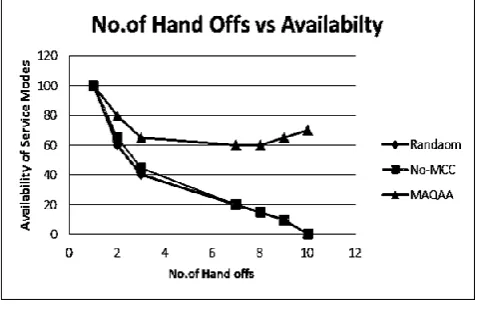
We simulated our proposed algorithm MAQAA using NS2 simulator with an arbitrary wireless topology having 20 nodes and 40 edges. The purpose of simulation is to compare the performance of our algorithm against the other service mode selection approaches such as Random Approach (RA) and No-MCC. The following graphs illustrate the performance analysis of the proposed algorithm MAQAA and other approaches.
Fig.4. No.of Hand offs Vs Availability of Service modes
Fig.5. Service Utilization Percentage
Fig.5 shows that the service utilization level of the MAQAA algorithm is better than other two approaches, since MAQAA algorithm consider the mobility and other QoS parameters of each service modes and choose the QoS guaranteed service mode. So the cloud service accessed by clients can be highly reliable and its leads higher utilization of service that other approaches.
V. CONCLUSIONANDFUTUREWORK
This paper has proposed a Mobility Aware QoS Framework for mobile Cloud Computing and proposed a Mobility Aware QoS Analysis Algorithm. This algorithm analysed the QoS guaranteed service modes out of „n‟ number of services modes provided by various cloud service providers and allow the selected provider to provide cloud services to its clients. The framework used seven QoS parameters for analysing the service modes including mobility. This way the proposed algorithm leads the other algorithm by considering the mobility factor of each service modes and choose the QoS guaranteed services modes. The results show that the proposed algorithm increases the availability and utilization of cloud services compare to other similar service selection approaches.
REFERENCES
1. M. Armbrust, “Above the Clouds: A Berkeley View of Cloud”, University of California, Berkeley, February 2009.
2. S. Perez. Why Cloud Computing is the Future of Mobile, “http://www.readwriteweb.com/archi ves/why_cloud_computing_is_the_future_of
mobile.php”, August 2009.
3. Peng Zhang and Zheng Yan, "A QoS-aware system for mobile cloud computing", IEEE International Conference on Cloud Computing and Intelligence Systems (CCIS), Pp: 518 - 522, Sept 2011.
4. G. Lodi, F. Panzieri, D. Rossi, E. Turrini, “SLA-Driven Clustering of QoS-Aware Application Servers”, IEEE Transactions on Software
Engineering, VOL. 33, NO. 3, pp. 186-197, March 2007.
5. X. Wang, Z. Du, X. Liu, H. Xie, X. Jia, “An adaptive QoS management framework for VoD cloud service centers. 2010”, International
Conference on Computer Application and System Modeling (ICCASM), Volume: 1, pp. 527-532, 2010.
6. Y. Ye, N. Jain, L. Xia, S. Joshi, I-L. Yen, F. Bastani, K. L. Cureton, M. K. Bowler, “A Framework for QoS and Power Management in a Service Cloud Environment with Mobile Devices” Fifth IEEE International Symposium on Service Oriented System Engineering (SOSE), pp. 236 – 243, 2010.
7. Q. Li, Q. Hao, L. Xiao, Z. Li, “Adaptive Management of Virtualized Resources in Cloud Computing Using Feedback Control”, 1st
International Conference on Information Science and Engineering (ICISE), pp. 99 - 102, 2009.
8. Y. Xiao, C. Lin, Y. Jiang, X Chu, X. Shen, “Reputation-Based QoS Provisioning in Cloud Computing via Dirichlet Multinomial Model”, IEEE
International Conference on Communications (ICC), pp. 1 - 5, 2010.
9. Z. Yan, C. Prehofer, “Autonomic Trust Management for a Component Based Software System”, IEEE Transactions on Dependable and Secure
Computing, doi. 10.1109/TDSC.2010.47, pp. 810 - 823, September 2010.
10. Chen S J, “Fuzzy multiple attribute decision making: methods and applications”, Berlin: Springer-Verlag, ISBN: 978-3-540-54998-7, vol.375,
Pages 289-486, 1992.
10.15680/ijircce.2014.0212023 BIOGRAPHY
A.Sheik ali is a Research Scholar in the Computer Science and Engineering Department, Karpagam University, Coimbatore, Tamil Nadu, India. He received Master of Engineering (ME) degree in 2009 from Sri Ramakrishna Engineering College, Afflicted to Anna University, Coimbatore, Tamil Nadu, India. His research interests are Computer Networks, Cloud Computing, Mobile Cloud Computing, etc.