ISSN(Online): 2319-8753 ISSN (Print): 2347-6710
I
nternational
J
ournal of
I
nnovative
R
esearch in
S
cience,
E
ngineering and
T
echnology
(A High Impact Factor, Monthly, Peer Reviewed Journal)
Visit: www.ijirset.com
Vol. 8, Issue 9, September 2019
MIMO-OFDM System based on Spectrum
Sensing Cognitive Radio Networks for
5G System
Syed Shafaque
1, Dr. Vikas Gupta
2M. Tech. Scholar, Department of Electronics and Communication, TIT, Bhopal, India1
Head of Dept., Department of Electronics and Communication, TIT, Bhopal, India 2
ABSTRACT: Error free transmission and increase in multimedia applications is one of the main aims of wireless communication. MIMO-OFDM is the system to improve the reliability of the WiMAX system.The fundamental tasks that are used in the cognitive radio (CR) networks are spectrum shaping capability and multi carrier systems. In these structures activation of fundamental (primary) users will generate a defined number of sub carriers in the secondary users.
In this paper, the design of MIMO-OFDM system using Matched Filter Detection Spectrum Sensing Cognitive Radio Network is presented.A matched filter is a spectrum-sensing method that detects the free portions of the primary user’s spectrum and allocates it to secondary users. It derives from cross-correlating an unknown signal with known ones to detect the unknown signal’s presence based on the basis of its SNR.Accordingly, an efficient scheme is developed here that is having better SNR vs BER against a different MIMO-OFDM system.
KEYWORDS: WiMAX, MIMO-OFDM, Cognitive Radio, Matched Filter
I. INTRODUCTION
ISSN(Online): 2319-8753 ISSN (Print): 2347-6710
I
nternational
J
ournal of
I
nnovative
R
esearch in
S
cience,
E
ngineering and
T
echnology
(A High Impact Factor, Monthly, Peer Reviewed Journal)
Visit: www.ijirset.com
Vol. 8, Issue 9, September 2019
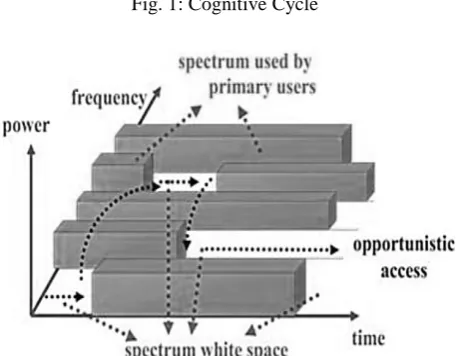
Fig. 1: Cognitive Cycle
Fig. 2: Opportunistic Usage of Spectrum Holes
Therefore, a CR enabled node in the network adapts dynamically to re configure several parameters such as the operating frequency (to take advantage of detected spectrum holes on different frequency bands), modulation and channel coding (to adapt to the requirements of application and the instantaneous conditions of channel quality), transmission power (to control the possible generated interference), and communication technology (to adapt to specific communication needs). Depending on the characteristics of the detected spectrum holes, as shown in Figure 1 and Figure 2, the CR enables to switch to different spectrum bands opportunistically [4], while the transmitter and receiver parameters are reconfigured accordingly.
II. CR NETWORK ARCHITECTURE
ISSN(Online): 2319-8753 ISSN (Print): 2347-6710
I
nternational
J
ournal of
I
nnovative
R
esearch in
S
cience,
E
ngineering and
T
echnology
(A High Impact Factor, Monthly, Peer Reviewed Journal)
Visit: www.ijirset.com
Vol. 8, Issue 9, September 2019
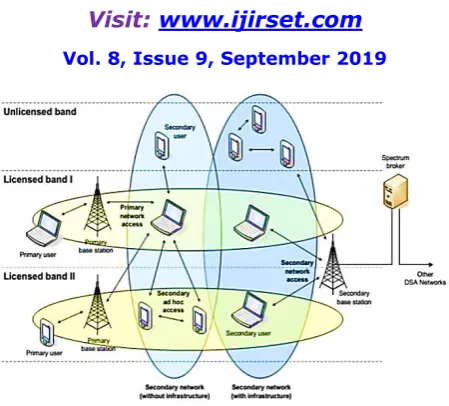
Fig. 3: Cognitive Radio Network Architecture
Optional system: An auxiliary or unlicensed system is eluded to a system, with fixed foundation or dependent on specially appointed correspondence guideline, without permit to work in an ideal authorized band. Subsequently, to share the authorized range band with essential systems, the extra functionalities are utilized by the hubs called CR clients/auxiliary clients (SUs). The foundation based optional systems are outfitted with a focal element called CR base station, which executes a solitary bounce association with SUs. Then again, the optional specially appointed systems have no framework spine and a SU can speak with different SUs through the impromptu association on both authorized and unlicensed range groups. Besides, optional systems may incorporate range dealers, which can assume a job in sharing range assets among various auxiliary systems [5, 6].
With regards to organize design, the range the executives functionalities are actualized by various elements. For example, in foundation based engineering, the range merchant is in charge of organizing the undertakings of range detecting, choice and the executives (sharing and versatility), while in specially appointed design; CR hubs themselves are in charge of range detecting, choice and the executives. The previous requires a committed control direct though in framework less designs utilization of devoted control channel is discretionary [7, 8].
III. PROPOSED METHODOLOGY
Based on the spectrum sensing schemes, the cognitive radio is proposed to reduce the computational complexity in MIMO-OFDM system. On the one hand, apply thematching filter algorithm in a different antenna, and employ the linear property of Inverse Fast Fourier transform (IFFT) to increase the number of candidate sequences so as to achieve better SNRand lower MSE performance.
ISSN(Online): 2319-8753 ISSN (Print): 2347-6710
I
nternational
J
ournal of
I
nnovative
R
esearch in
S
cience,
E
ngineering and
T
echnology
(A High Impact Factor, Monthly, Peer Reviewed Journal)
Visit: www.ijirset.com
Vol. 8, Issue 9, September 2019
Fig. 4: Design of MIMO-OFDM System using Matched Filter Spectrum Sensing Cognitive Radio Network
This sign is then gone through an Additive White Gaussian Noise (AWGN) channel. At the collector end, the CP is expelled and the sign is changed over from sequential to parallel to get the first, with FFT connected to every image for investigation in the recurrence area. After demodulation, the sign is cross corresponded with that of a period moved neighborhood oscillator.
We executed our circuit (Figure 4) in MATLAB programming, with the primary parameters depicted underneath. We produced an irregular double signal in a sequential way. To examinations a sign in the time space, we apply IFFT (Inverse Fast Fourier Transform) and convert it from parallel to sequential OFDM sign to
Include a cyclic prefix (CP), which maintains a strategic distance from obstruction between OFDM images. We at that point feed this sign through an Additive White Gaussian Noise (AWGN) channel. At the collector end, the CP is expelled and the sign changed over from sequential to parallel to get the first, with FFT connected to every image for examination in the recurrence space. After demodulation, the sign is cross corresponded with that of a period moved nearby oscillator.
SNR to decide if the sign is missing or present; if they got sign is more prominent than the limit esteem, there will be a discovery, generally not:
H0: y(t) = n(t) PU is absent
H1: y(t) = h*s(t) + n(t) PU is present
IV. SIMULATION RESULT
ISSN(Online): 2319-8753 ISSN (Print): 2347-6710
I
nternational
J
ournal of
I
nnovative
R
esearch in
S
cience,
E
ngineering and
T
echnology
(A High Impact Factor, Monthly, Peer Reviewed Journal)
Visit: www.ijirset.com
Vol. 8, Issue 9, September 2019
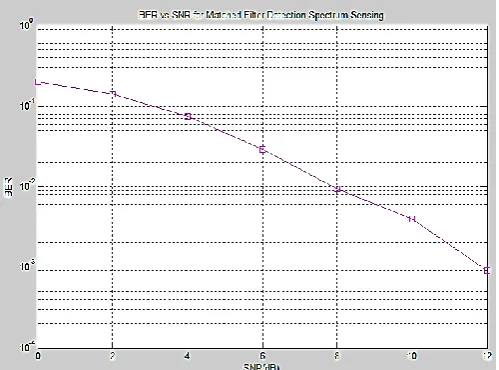
Fig. 5: BER vs SNR for Matched Filter Detection Spectrum Sensing 1×1 System
Simulation experiments are conducted to evaluate the SNR VS BER performance of the proposed matched filter detection spectrum sensing 2×2 system is shown in figure 6. To analysis random binary generator signal, the signal in the frequency domain, an IFFT is applied to the signal and converted from parallel to serial for the addition of the CP, two transmitter antenna and two receiver antenna through an AdditiveWhite Gaussian Noise (AWGN) Channel.
Fig. 6: BER vs SNR for Matched Filter Detection Spectrum Sensing 2×2 System
ISSN(Online): 2319-8753 ISSN (Print): 2347-6710
I
nternational
J
ournal of
I
nnovative
R
esearch in
S
cience,
E
ngineering and
T
echnology
(A High Impact Factor, Monthly, Peer Reviewed Journal)
Visit: www.ijirset.com
Vol. 8, Issue 9, September 2019
Fig. 7: BER vs SNR for Matched Filter Detection Spectrum Sensing 4×4 System
Simulation experiments are conducted to evaluate the SNR VS BER performance of the proposed matched filter detection spectrum sensing different system is shown in figure 8.
Fig. 8: BER vs SNR for Matched Filter Detection Spectrum Sensing Different System
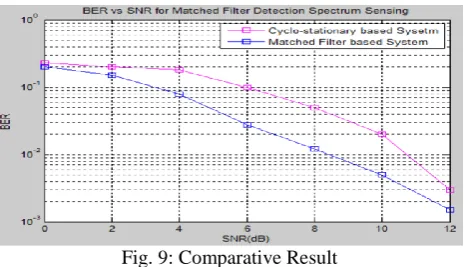
Simulation experiments are conducted to evaluate the SNR VS BER performance of the proposed matched filter detection spectrum sensing and cyclo-stationary detection spectrum sensing is shown in figure 9.
ISSN(Online): 2319-8753 ISSN (Print): 2347-6710
I
nternational
J
ournal of
I
nnovative
R
esearch in
S
cience,
E
ngineering and
T
echnology
(A High Impact Factor, Monthly, Peer Reviewed Journal)
Visit: www.ijirset.com
Vol. 8, Issue 9, September 2019
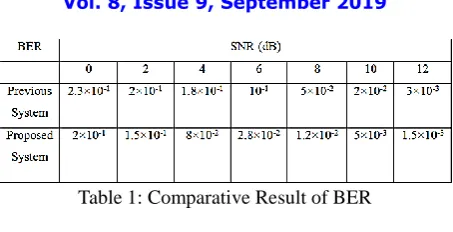
Table 1: Comparative Result of BER
V. CONCLUSION
Coordinated sifting is known as an ideal strategy for discovery of essential clients when the transmitted sign is known. It is a direct channel intended to amplify the yield sign to commotion proportion for given info signal. It is gotten by corresponding a known sign, with an obscure sign to distinguish the nearness of the known sign in the obscure sign. This is proportionate to convolving the obscure sign with a period switched form of the sign. Convolution is at the core of coordinated channels.
Convolution does basically with two capacities that it places one capacity over another capacity and yields a solitary worth proposing a degree of closeness, and after that it moves the primary capacity an imperceptibly little separation and finds another worth. The final product comes as a chart which tops at the point where the two pictures are generally comparative. The coordinated channel is the ideal straight channel for boosting the Signal to Noise Ratio (SNR) within the sight of added substance White Gaussian Noise. The presentation of executed strategy including remote correspondence is better when contrasted with the past system calculation.
The proposed MIMO-OFDM framework utilizing Matched Filter Spectrum Sensing Cognitive Radio Network give a lower BER 0.0015 dB as contrasted and 0.0030 dB for SNR = 12 dB, past MIMO-OFDM framework utilizing Cyclo-stationary Spectrum Sensing Cognitive Radio Network. The proposed technique is half BER improvement for past strategy.
REFERENCES
[1] Arun Kumar and Nandha Kumar P, “OFDM system with cyclostationary feature detection spectrum sensing”, Science Direct, Information Communication Technology, Express, Elsevier 22 January 2018 .
[2] Abdullah Yaqot and Peter Adam Hoeher, “Efficient Resource Allocation in Cognitive Networks”, IEEE Transactions on Vehicular Technology, Vol. 66, No. 07, July 2017.
[3] Danda B. Rawat, “Evaluation Performance of Cognitive Radio Users in MIMO-OFDM based Wireless Networks”, IEEE Transaction of Wireless System, Vol. 32, Issue 07, IEEE 2016.
[4] Shan Jin and Xi Zhang, “Compressive Spectrum Sensing for MIMO-OFDM Based Cognitive Radio Networks”, 2015 IEEE Wireless Communications and Networking Conference (WCNC), Applications, and Business, Vol. 27, No. 2, pp. 567-572, 2015.
[5] Aparna Singh Kushwahand Monika Jain, “MIMO-OFDM System for Wireless Communications based on Cognitive Radio Networks”, InternationalJournal of Innovative Research in Science, Engineering and Technology, Vol. 7, Issue 4, April 2018.
[6] Aparna Singh KushwahandNileshLonare, “A Survey paper on MIMO-OFDM System for WIMAX based on Cognitive Radio Networks”, InternationalJournal of Innovative Research in Science, Engineering and Technology, Vol. 6, Issue 8, August 2017.
[7] Maan Singh and Vijay Kumar, “Investigation of PAPR Reduction in MIMO-OFDM System using PTS and SLM Techniques”, International of Science and Research (IJSR), Vol. 3, No. 03, pp. 524-529, March 2014
[8] Muhammet Nuri Seyman and NecmiTaspmar, "Channel estimation based on neural network in space time block coded MIMO-OFDM system", Digital Signal Processing, Vol. 23, No.1, pp. 275-280, Jan. 2013.
[9] Li Mei, Wang Xiang, Zhang Xiaoming, JiaKe. "RLS and its improved algorithms in MIMO-OFDM System", International Journal of Modelling, Identification and Control, Vol. 16, No. 3, pp. 246-250, Jul. 2012.
[10] P. Mukunthan and, P Dananjayan," PAPR Reduction based on a Modified PTS with Interleaving and Pulse Shaping method for STBC MIMO-OFDM System", IEEE International Conference Coimbatore, July 2012.
[11] Wei Jiang and Daoben Li, “Convolutional Multi-code Multiplexing for OFDM Systems”, Beijing University of Posts and Telecommunications Beijing, pp. 6432-6439, IEEE 2012.