Implicit and Explicit Social Recommendation
Using Machine Learning Framework
Ashvini Chavan
1, Prof.Nita Dimbale
2,Student, Department of Computer Engineering, Flora Institute of Technology, Pune, India1 Professor, Department of Computer Engineering, Flora Institute of Technology, Pune, India2
ABSTRACT
:
Now a day’s recommendation system plays important role. The search for recommendations aims to exploit information to improve the quality of a system of recommendations. It tends to be partitioned into two classes. The explicit recommendation presupposes the existence not only of user ratings in articles, but also explicit social connections between users. The implicit recommendation presupposes the availability only of qualifications, but no social connection between users and attempts to infer implicit social connections between users to promote accuracy of the recommendation. This paper proposes a framework applicable to explicit and implicit recommendation. Author propose an improvement structure to together get familiar with the level of social relationship and the forecast of capability, so these two assignments can commonly upgrade each other's performance. Furthermore, a well-known challenge for the implicit recommendation is it takes a quadratic time to learn the strength of connections. This paper also offers several practical tricks to reduce the complexity of our model must be linear with respect to the observed evaluations. Experiments show that the proposed model, with only two Parameters can significantly exceed state-of-the-art solutions for both explicit and implicit social recommendation systems.KEYWORDS:- Iimplicit feedback, Location recommendation, social network, machine learning.
I. INTRODUCTION
Recommendation frameworks utilize distinctive, however they can be ordered into two classes: shared and content-based separating frameworks. Content-content-based systems inspect the properties of articles and recommend articles like those that the client has favored before. They show the essence of a userby building a user profile dependent on the properties of the components that users like and utilizing the profile to ascertain the likeness with the new components. author prescribe area that are increasingly like the user’s profile. Recommender frameworks, then again, overlook the properties of the articlesand base their suggestions on network inclinations. They prescribe the components that users with comparable tastes and inclinations have preferred before. Two users are viewed as comparable on the off chance that they share numerous components for all intents and purpose.
One of the principle issues of recommendation frameworks is the issue of cold start, i.e. for example at the point when another article or user is brought into the framework. In this examination author concentrated on the issue of delivering effective recommendations for new articles: the cold starting article. Collaborative filtering systems suffer from this problem because they depend on previous user ratings. Content-based methodologies, then again, can at present create suggestions utilizing article portrayals and are the default answer for cold-beginning the article. Notwithstanding, they will in general get less accuracy and, are once in a while the main choice
Along these lines, it is important for any collaborative adviser to reach this state as soon as possible. Having strategies that creating exact proposals for new articles will sufficientlyenable remarks to be gathered in a brief timeframe, Make viable suggestions on joint effort conceivable.
II. RELATEDWORK
This work [1] proposes two user mobility models, ie based on Gauss and distance mobility models, to capture the check-in behaviour of Individual LBSN user, based on location-based propagation the probabilities can be derived respectively. Extensive experiments based on two sets of real LBSN data showed the superior effectiveness of our proposals compared to the existing ones. Static models of propagation probability to truly reflect the propagation of information in LBSN.
In this paper [2], using the Skip gram model, let's learn the latent representation for A place to capture the influence of its context. A loss of ranking for couples considering confidences user preferences observed for locations Therefore it is proposed to learn the latent representations of the users. For personalized recommendations on top-N positioning. On the other hand, we also extend our model of Taking into account temporary influence. Stochastic the optimization algorithms based on the gradient of the gradient are developed to adapt to models. We perform integral Experiments on four sets of real data. Experimental the results show that our approach is significant exceeds the cutting-edge position methods of recommendation.
In this paper [3], propose an LKS framework providing keyword suggestions that are relevant to the user information needs and at the same time can retrieve relevant documents near the user location.
In this work [4], study information on the content in LBSN. W.r.t. Properties of the POI, user interests and sentiment Directions We shape the three types of information under a recommendation framework of the unified PDI with The consideration of your relationship with the check-in actions. Experimental results show the meaning information on the content to explain user behavior, and demonstrate your power to improve the recommendation of POIs Performance in LBSN.
In this paper [5], propose a relaxed ranking-based algorithm for item recommendation with implicit feedback, and designa smooth and scalable optimization method for model’s parameter Estimation.
In this paper [6], propose a sparse Bayesian collaborative filtering algorithm best tailored to implicit feedback, and developed a scalable optimization algorithm for jointly learning latent factors and hyper parameters.
In this paper [7], they have presented a novel ranking predictor Lambda Factorization Machines. Inheriting advantages from both LtR and FM, Lambda FM (i) is capable of optimizing various top-N item ranking metrics in implicit feedback settings; (ii) is very exible to incorporate context information for context-aware recommendations.
In this paper [8], they provide an all-around Evaluation of 12 state-of-the-art POI recommendation models. From the evaluation, we obtain several important findings, based on which we can better understand and utilize POI recommendation Models in various scenarios.
user's listening history complete the listening story of another 1 million people. In particular, we investigate the whole pipeline of recommendations from the definition of appropriate similarity and scoring functions and suggestions on how to add more classification strategies to define the general recommendation. The technique that we are the proposal expands and improves what the MSD has already won I challenged last year.
III.EXISTING SYSTEM
Lot of work has been done in this field because of its extensive usage and applications. In this section, some of the approaches which have been implemented to achieve the same purpose are mentioned. These works are majorly differentiated by the algorithm for recommendation systems.
In another research, general location route planning cannot well meet users’ personal requirements. Personalized recommendation recommends the POIs and routes by mining user’s travel records. The most famous method is location-based matrix factorization. To similar social users are measured based on the location co-occurrence of previously visited POIs. Then POIs are ranked based on similar users’ visiting records. Recently, static topic model is employed to model travel preferences by extracting travel topics from past traveling behaviours which can contribute to similar user identification. However, the travel preferences are not obtained accurately, because static topic model consider all travel histories of a user as one document drawn from a set of static topics, which ignores the evolutions of topics and travel preferences.
As my point of view when I studied the papers the issues are related to recommendation systems. The challenge is to addressing cold start problem from implicit feedback is based on the detection of recommendation between users and location with similar preference.
IV. PROPOSED SYSTEM
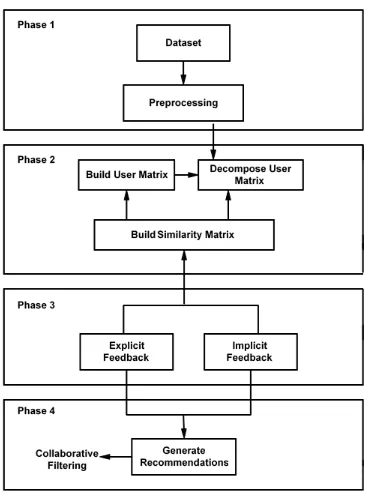
As I studied then I want to propose matrix factorization is propose the integration of implicit and explicit feedback based recommendation, firstly find nearby locations i.e. places, hotels and then to recommend to user based on both feedback and achieve the high accuracy and also remove cold-start problem in recommendation system.
V. CONCLUSION
In this Paper, we propose another system for collaborative filtering based on explicit social feedback and implicit social feedback set of data and develop the coordinates of the offspring for effective learning of parameters. We build up the close relationship of system with factorization and shows that user functions really enhance Similarity between users. So we apply our framework for the recommendation on a large-scale data set. our the results of the experiment indicate that system is greater than five competing baselines, including two leading positions recommendation and factoring algorithms based onthe ranking machine. When comparing different weighting schemes for negative preference, author see that the client situated plan is better than that arranged to the component plot, and that the inadequate design and rank one essentially enhances the execution of the proposal..
REFERENCES
[1] W.-Y. Zhu, W.-C. Peng, L.-J. Chen, K. Zheng, and X. Zhou, “Modelling user mobility for location promotion in location-based social networks,” in Proceedings of KDD’15. ACM, 2015, pp. 1573–1582.
[2] X. Liu, Y. Liu, and X. Li, “Exploring the context of locations for personalized location recommendations,” in Proceedings of IJCAI’16.AAAI, 2016.
[3] Shuyao Qi, Dingming Wu, and Nikos Mamoulis,” Location Aware Keyword Query Suggestion. Based on Document Proximity” VOL. 28, NO. 1, JANUARY 2016
[4] H. Gao, J. Tang, X. Hu, and H. Liu, “Content-aware point of interest recommendation on location-based social networks,” in Proceedings of AAAI’15. AAAI, 2015.
[5] H. Li, R. Hong, D. Lian, Z. Wu, M. Wang, and Y. Ge, “A relaxed ranking-based factor model for recommender system from implicit feedback,” in Proceedings of IJCAI’16, 2016, pp. 1683–1689.
[6] D. Lian, Y. Ge, N. J. Yuan, X. Xie, and H. Xiong, “Sparse Bayesian collaborative filtering for implicit feedback,” inProceedings of IJCAI’16. AAAI, 2016.
[7] F. Yuan, G. Guo, J. M. Jose, L. Chen, H. Yu, and W. Zhang, “Lambdafm: learning optimal ranking with factorization machines using lambda surrogates,” in Proceedings of the 25th ACM International on Conference on Information and Knowledge Management. ACM, 2016, pp. 227– 236.
[8] Yiding Liu1 TuanAnh Nguyen Pham2 Gao Cong3 Quan Yuan,” An Experimental Evaluation of Pointofinterest Recommendation in Location basedSocial Networks-2017”
[9] Zhiwen Yu, Huang Xu, Zhe Yang, and Bin Guo “Personalized Travel PackageWith Multi-Point-of-Interest RecommendationBased on Crowdsourced User Footprints” 2016