Article
Side Attacks on Stegosystems Executing Message
Encryption Previous to Embedding
Valery Korzhik 1, Cuong Nguyen 1, Ivan Fedyanin 1, and Guillermo Morales-Luna 2,*
1 Department of Protected Communication Systems, The Bonch-Bruevich Saint-Petersburg State University of Telecommunications, St. Petersburg, Russia, [email protected], [email protected],
2 Computer Science, CINVESTAV-IPN, Mexico City, Mexico [email protected] * Correspondence: [email protected]; Tel.: +52-555-747-3759
Received: date; Accepted: date; Published: date
Abstract: There are introduced two new steganalytic methods not depending on the statistics of the cover objects, namely side attacks stegosystems. The first one assumes that the plaintext, encrypted before embedding, is known by the attacker. In this case, the stegosystem’s detection is based on the calculation of mutual information between message and extracted encrypted data. For this calculation, a notion of the k-nearest neighbor distance is applied. The second method is applied to HUGO, one of the most efficient steganographic algorithms. In this case the stegosystem’s detection is based on a verification of the NIST tests to the extracted encrypted messages. Moreover, we show that the problem to find a submatrix of the embedding matrix determining a trellis code structure in the HUGO algorithm provides a search of the stegokey of the proposed stegosystem.
Keywords: Stegosystem, mutual information, entropy, relative entropy, encryption, decryption, NIST tests
1. Introduction
Steganalysis (SGA) is an important part of steganography (SG), namely a technology to hide some confidential information into innocent (at a single glance) cover objects (CO), which in turn can be presented as digital motionless and video images, files containing digital audio signals (like speech and music) and so on. The main goal of SG (Information Hiding (IH) in a wider sense) is to provide such transform of CO into SG that a detection of SG against CO is either at all impossible or it entails a very hard procedure even for the case of completely known embedding and extraction algorithms of messages, except perhaps of the stegokey. (Here, the Kerckhoff’s principle is extended from cryptography to steganography.)
There is a great collection of well-known steganographic algorithms and many of them were described in an excellent monograph [1]. For simplicity reasons, we will consider here only motionless gray scale images, although our methods can be applied also to video or audio CO.
It is obvious that SGA is a very important part of IH due to two main reasons.
Firstly, SGA should be taken into account during the design of any steganographic algorithm because such algorithm is useless if it can be easily detected by some enough simple SGA.
Secondly, SGA is very important to prevent a leakage of sensitive information outside of some contour because otherwise it can be arranged by SG with innocent CO. (See for the thing the well-known “Data Leakage Prevention (DLP) system” [2].)
An important aspect of SGA was striked in a special chapter of the monograph [1], and it is a subject of many scientific papers. But not all problems of SGA are already solved. It is obvious that if a stegokey is known or can be found easily ([3,4,5]) then an attacker can be able to detect the SG presence after extraction of meaningful messages if they were not previously encrypted by sufficiently strong cipher. We assume in our paper (as is common in the most scientific papers) that
such previous encryption of messages is used. We consider the attacks that execute some side information about SG and, as a particularity, do not use the statistics of CO for the detection procedure, a situation that is typical for conventional SGA.
In the next section such side information is known as messages before encryption and may be embedded in CO. (Also, we suppose that ciphering used for encryption is not very strong.) In section 3, we have side information as a fact that HUGO algorithm could be used with very strong cipher for message encryption and maybe with an unknown stegokey. Section 4 concludes the paper.
2. Detection of the stegosystem with known messages and encryption previous to embedding
This scenario is comparatively uncommon, however information security is very important even in rare situations. Evenmore, it is very common to consider in cryptography the so called chosen-plaintext attack that tries to break semantic security. In steganography this scenario assumes that the embedded message is encrypted by some block cipher and that the message is known completely but there remains an open problem: to decide whether this message was embedded or not in a given testing object.
In Figure 1 the Heye’s cipher [6] is presented, which is a scheme of this type, and in Table 1 and Table 2 the S-box and the permutation mapping transforms are presented. Although this cipher has 2 ≈ 1.2 ∙ 10 secret keys, hence a brute force attack by key exhaustion is untractable, it can be easily broken, by linear or differential cryptanalysis.
However, sometimes in stegosystems sufficiently simple encryption algorithms can be used. Moreover, we use as well some extension of substitution-permutation cipher (SPC) with block length 32. For the case of substitution-permutation cipher with block length 32 bits, we extend the 16-bit cipher with addition of the second half to the first one and keeping previous transforms in S-boxes. The Table 2 for permutation mapping is changed to Table 3 shown below.
Table 1. S-box transforms for all S-boxes (they are presented in hexadecimal system)
Input 0 1 2 3 4 5 6 7 8 9 10(A) 11(B) 12(C) 13(D) 14(E) 15(F)
Output E 4 D 1 2 F B 8 3 A 6 C 5 9 0 7
Table 2. Permutation mappings for all cipher rounds
Input 0 1 2 3 4 5 6 7 8 9 10 11 12 13 14 15
Output 1 5 9 13 2 6 10 14 3 7 11 15 4 8 12 16
Table 3. Permutation mappings for 32-bit block length cipher for all rounds
Input 1 2 3 4 5 6 7 8 9 10 11 12 13 14 15 16
Output 1 5 9 13 17 21 25 29 2 6 10 14 18 22 26 30
Input 17 18 19 20 21 22 23 24 25 26 27 28 29 30 31 32
Output 3 7 11 15 19 23 27 31 4 8 12 16 20 24 28 32
The inequality for mutual information between plaintext and ciphertext that should be valid for any cryptosystem is well known [7,8]:
( , ) ≥ ( ) − ( ) (1)
where is a sequence of message symbols of the length , is a sequence of ciphertext symbols of length (without loss of generality we may assume that these lengths are equal), and is the binary key string of the length . We transform inequality (1) by dividing both its sides by :
′( , ) ≥ ′( ) − ′( ) (2)
where “ ʹ ” means that we consider normalized values by .
′( , )~ ′( ) > 0 (3)
It follows from inequality (3) that if some message has been encrypted into the ciphertext with any unknown key of the limited length then for very large message length we get nonzero mutual information ′( , ). But this value approaches to zero if is not encrypted as with some key. Hence, we can take a decision about a choice of the message that is encrypted into the given ciphertext just by comparing the value ′( , ) with some threshold.
But the following problem appears – how to calculate a mutual information ′( , )? A solution of this problem, based on “binning” design, is very hard, generally speaking, but recently, in [9], a method based on the notion of k-nearest neighbour distance was used. This approach can be termed as fast mutual information calculation (FMIC) between two N-dimension random vectors and
. It has been proved in [9] that FMIC can be performed by the following algorithm:
( , ) = Ψ(1) − 〈Ψ( + 1) + Ψ + 1 〉 + Ψ( ) (4)
where = { , , . . , } and = { , , . . , } are vectors corresponding to and , Ψ( ) is the digamma function, Ψ( ) = Γ( ) Γ( )/ satisfies the recursion
Ψ( + 1) = Ψ( ) + and Ψ(1) = ,
max ( ( ), ( )). 〈… 〉 is symbol that denotes an averaging over all ∈ [1,2, . . , ] and over all realizations of random samples. But in our case, we average only on all samples of integers ∈ [1,2, . . , ], namely 〈… 〉 = ∑ (… ).
In order to implement the relation (4) to estimate the left side of inequality (3), we map each of the plaintext blocks = ( , , . . , ) into an integer and each of the ciphertext blocks = ( , , . . , ) into an integer according to trivial relations, respectively:
= ∑ 2 ; = ∑ 2 , = 1,2, . . , (5)
where is the block cipher length; , are binary symbols of the plaintext and the ciphertext , respectively. (We assume of course that the block cipher is binary and that it has the same length of input and output blocks).
The experimental investigation of the technique described above can be presented as follows. There are produced two pseudo randomly generated binary sequences and both of length ∙ , where = 16 is the cipher block length and is the number of tested blocks. One of these sequences, say is encrypted by Heye’s block cipher that gives ∙ ciphertext bits. (It is worth to note that in the case of meaningful plaintext, the entropy ′( ) in (2) can be lesser than for truly random binary sequence but it still is not zero. Next, the mutual information ( , ) is calculated by (4) and (5), where the values are integers corresponding to and are integers corresponding to = ( , ), where (. ) is the encryption function for Heye’s 16-bit block cipher with 80-bit key chosen pseudo randomly. After that, it is calculated also by (4) and (5) the mutual information between ciphertext obtained after encryption of plaintext and independent on it another plaintext . The results of such calculations against the number of message bits are presented in Table 4.
Table 4. Mutual information between ciphertext and plaintext corresponding and no corresponding to given ciphertext against the plaintext bit length
102 103 104 2×10⁴ 4×10⁴ 8×10⁴ 3×10⁵ 106 ′( , ) 0.3 1.2 5.52 7.057 8.77 10.3 12.65 14.24 ′( , ) -0.09 0.053 0.03 0.04 0.08 0.13 0.373 0.89
Within this table it can be seen that, in fact, the mutual information ′( , ) for valid plaintext encrypted into increases with and it approaches to a normalized entropy of truly random binary string of length 16. The mutual information ′( , ) between ciphertext (obtained for plaintext ) and the plaintext is close to 0. It is sufficient to select some threshold in order to distinguish between valid and invalid plaintexts for the already given ciphertext, for ≥ 10 .
In Table 5 there are presented the results of calculation for cross correlation ( , ) between sequence and sequences and showing that such criteria cannot be used for a breaking the block cipher semantic security. (This is an obvious consequence of the presence of nonlinear transforms in the algorithm of Heye’s block cipher contained into its S-boxes).
Table 5. Cross correlation between ciphertext and plaintexts , against the plaintext bit length
N
4×10⁴ 8×10⁴ 3×10⁵ 106
( , ) -0.000680 -0.038 0.011 -0.000977
( , ) -0.0019 -0.000556 0.003 -0.00016
Table 6. Mutual information between ciphertext and plaintext corresponding and not given ciphertext against the plaintext bit length for block cipher of the length 32
103 104 2×10⁴ 4×10⁴ 8×10⁴ 3×10⁵ 106
′( , ) -0.065 0.025 0.038 0.078 0.083 0.3626 0.976
′( , ) -0.03 -0.007 0.0025 -0.012 0.0055 0.0014 0.0017
We can see from this table, that despite the fact that mutual information ′( , ) grows much slower with respect to than the similar value for 16-bit block cipher (see Table 4), it is still exceeding the value ′( , ) when ≥ 10 . This means that after a choice of an appropriate threshold, it is possible to distinguish “valid” plaintext from “invalid” one for a given ciphertext. Thus, the proposed approach can break semantic security of at least for block ciphers with limited block length ≤ 32. SGA allows to detect SG if the threshold is exceeded. Otherwise it is CO.
Our experiments with DES block cipher having block length 64 bits showed that this problem is unfortunately rather untractable, at least with the use of currently ordinary PC.
3. Detection of the HUGO stegosystem with side information about encryption with any strong block cipher of the messages previous to embedding
A new stegoanalytic algorithm has been proposed in [10]. It is based on the side information to which the messages are subjected, with encryption using a strong block cipher previous to embedding. Such assumption is not very limiting because otherwise, if the extraction stegoalgorithm is known for an attacker (or somewhat can be found) it is easy to decide whether in a tested object occurs SG, if the extracted message is meaningful (see Algorithm 16.2 in [1]), and it is CO if extracted message is meaningless.
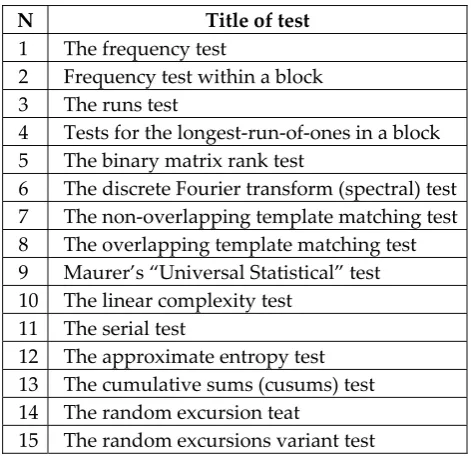
If the extracted messages consist of ciphertext got by strong encryption, then it is very likely to think that they are close to a perfect pseudo-random bit sequence satisfying the so called NIST-Tests [11] listed in Table 7. Otherwise, if the extracted sequence does not pass some of the NIST tests then it is assumed to be a cover object. (In fact, it is unlikely that a clear CO satisfies all NIST tests.) In reality by selecting some threshold, it can be assumed that if the number of NIST tests exceeds this threshold then the testing object is SG, otherwise it is CO.
Similarly to an approach presented in [10] we are going to consider also a method of SVM-based classification with the use of p-values as the results of NIST tests. But in contrast to [10], we consider the most power steganographic algorithm HUGO [12] and include also a search of stego key for it.
Table 7. Titles of NIST tests on pseudo randomness
N Title of test
1 The frequency test
2 Frequency test within a block 3 The runs test
4 Tests for the longest-run-of-ones in a block 5 The binary matrix rank test
6 The discrete Fourier transform (spectral) test 7 The non-overlapping template matching test 8 The overlapping template matching test 9 Maurer’s “Universal Statistical” test 10 The linear complexity test
11 The serial test
12 The approximate entropy test 13 The cumulative sums (cusums) test 14 The random excursion teat
But firstly, let us remember the HUGO SG. The core idea of HUGO’s embedding algorithm (in line with [12]) is the following: for a given bit sequence m, intended to be embedded into CO, and a given sequence of the least significant bits (LSB) , find the LSB sequence after embedding, which satisfies the equation:
H = (6)
with an additional condition to minimize the following value:
∆ = | − | (7)
where , = 1, is the given weight function; , , = 1, are the i-th components of vectors and , respectively; = ∙ , for x sizes of motionless image taken as CO; and H is an x generator matrix of some trellis code.
The matrix H can be presented as a step-matrix obtained by consecutive shifting of a t x submatrix . The weight function can be calculated in line with SPAM-based functionals described in [12]. It has been shown in [12] that the solution of (6) given condition (7) can be obtained with the use of Viterbi algorithm (VA) (in [13] there was proved that Generalised Viterbi Algorithm (GVA) is optimal).
In order to provide the best efficiency of steganalysis it is necessary to select the matrix H (namely the submatrix ) giving a minimum of the error probability = ( + ), where is the probability of SG missing and is the probability of SG false alarm.
But it is an expensive time-consuming method. (We will try to use it is in the sequel only for small sizes of submatrix .)
A very nice idea was proposed by C. Cachin in [14]. It is based on the notion of relative entropy ( // ) (or Kullbach-Leibler Divergence (KLD)). This criterion asserts that for any steganalytic method the following inequality holds:
log
1 − + (1 − ) log 1 −
≤ ( // ) (8)
where
( // ) = ( )log ( )
( ) (9)
is the probability distribution after embedding, is the probability distribution of CO, and X is the set of image luminance.
But the problem is to calculate KLD even for such CO as motionless grey scale images.
Fortunately, it has been proposed in [15] a method for KLD calculation based on the notion of the nearest neighbor distance (NND) for given samples of both SG and CO.
Let us assume that ( , , . . , ) and ( , , . . , ) are vectors of random samples with the probability distributions and , respectively. Then the distance from to the “nearest neighbor”
is:
= min
, − (10)
where ‖ . ‖ is L norm in . In a similar manner, the distance from to the “nearest neighbor”
= min
, − (11)
Then KLD can be estimated as:
It was proved in [15] that under some not very strong conditions, the following asymptotic relation holds:
lim
, → { , ( // )} = (P//Q) (13)
But in any application to stegosystems the above procedure has to be specified to be valid for single testing image [16].
Let us take only one image and divide it into disjoint (L x )-pixel areas arranged as a chess board, where white areas correspond to the set (no embedding) and black areas correspond to the set embedding by HUGO algorithm.
Figure 2. The picture “Underwater World” of the size 12992 x 6080 pixels before embedding
In Figure 2 the selected grey scale image of size 12992 x 6080 pixels is presented for the experiment. The size of disjoint areas was selected as 32. The results of KLD calculations are presented in Table 8 (just for comparison we calculated also KLD for LSB-based embedding algorithm). We note that the parameter for LSB-based SG means the probability of embedding into each pixel, whereas the 1 − is the probability of no embedding (obviously, the SG owner has a stegokey and hence he (she) knows in which pixels were the embeddings). The HUGO algorithm provides the embedding rate determined by its trellis code structure.
Table 8. The results of KLD estimation based on NND for the image “Underwater World” with different embedding rate = for LSB and = 1/ for HUGO
R 0 0.1 0.2 0.3 0.4
HUGO -0.07 7.52 22.46 48.13 83.48
LSB -0.07 32.16 85.22 143.89 199.70
It can have seen from Table 8 that although the values of KLD are very large, hence it is useless for a calculation of the steganalytic efficiency by (8). However, the following qualitative conclusions can be drawn:
- the grater is the embedding rate, the lesser is the SG security, and - the HUGO SG is much more secure than the LSB-based SG.
These facts are well known in steganography but we are able to go further and investigate the best submatrix , that provides the most secure HUGO SG. In fact, let us examine how the structure of submatrix affects on the SG HUGO detectability. We use here an image size 512 x 512 just for simplicity.
Table 9 shows a dependence between structure of the 2 x 2 submatrix and corresponding to them KLD averaged on many images.
Table 9. The dependence between 2 x 2 submatrix and the values KLD
Submatrix 1 11 0 1 00 1 0 11 1 1 10 1 0 11 0 1 01 1
From this table it can be seen that the security of the HUGO-based SG depends on the submatrix structure. In the sequel we are going to confirm these results by the use of a new steganalytic algorithm and execute it also for a stegokey search.
Let us consider firstly a scenario where a stegokey of HUGO-SG (that is a submatrix ) is known exactly for an attacker. This means that he (she) is able to extract the encrypted messages if the testing object was SG. If the testing object was a CO, then we extract also some sequences but we believe that they have more worse pseudo randomness than for the case of SG for the number are passed NIST tests. Next it is possible to select some thresholds and to take a decision that the testing object is SG if this threshold was exceeded, otherwise that it is CO.
We selected for our experiment 1000 grey scale images of the size 512 x 512 pixels from database used in [17]. In order to select optimal threshold were taken 500 both SG and CO. For testing we used 500 other images with or without embedding.
In Table 10 are presented the values of error SG detecting probabilities = ( + ) for different submatrix of HUGO SG and for optimally chosen thresholds. (For a save of simplicity we denote each submatrix by vector, where each integer is representation of columns in binary form).
We can see from Table 10 that the best submatrix
= [11 15] = 1 1 0
1 1 1 1 1
(14)
gives maximal value = 0.388. This fact is very reasonable because it has the smallest D{ // }. In order to improve SG HUGO detecting was used SVM. Such approach has been proposed before in the paper [16] but only against LSB-based SG. We will assume that each of NIST tests is presented by its p-value (A small p-value is an indication that the null hypothesis is false). The vector of p-values corresponding to all 15 NIST tests is used both at the training and detecting stages of SVM. We apply the most effective version of SVM known as nonlinear kernalized weighted one, where the kernel function is Gaussian: ( , ) = exp (− ‖ − ′‖ ) with > 0 being a parameter controlling the kernel width and ‖ ‖ is the Euclidean norm of . After an optimization of both and the penalization coefficient (similar to the same procedure considered more detail in [16]) we get the results presented in Table 11.
Table 10. The probabilities of error of SG detection based on threshold method for different submatrices
№ Ĥ { // } based on
Threshold method
1 [ 1 2] 1/2 57.65 0.291
2 [ 2 1] 1/2 53.68 0.318
3 [ 3 2] 1/2 30.41 0.335
4 [ 1 3] 1/2 30.31 0.336
5 [ 2 3] 1/2 29.30 0.354
6 [ 3 1] 1/2 29.50 0.351
7 [15 6] 1/2 28.63 0.367
8 [15 4] 1/2 25.22 0.368
9 [11 5] 1/2 23.82 0.376
10 [11 15] 1/2 22.33 0.388
Table 11. The error probabilities of SG detection based on an execution of optimized procedure for SVM
It can be seen from Table 11 that the error detecting probability occurs slightly lesser than after the procedure when using the threshold presented in Table 10, but the optimal submatrix is the same. It seems that the error detecting probability occurs still sufficiently large in comparison with the best known cryptanalytic methods [17], where ≈ 0.27, but nevertheless, such approach opens a new direction in a stegokey searching (we remember that for HUGO-SG, a submatrix plays the role of stegokey). Then we assume that some submatrices were used for HUGO embedding procedure but in the detection procedure, the submatrix is unknown.
Let us consider two classification procedures to recognize a stegokey. The first procedure is based on a threshold technique with the use of NIST tests. This means that we use one by one all different submatrices for extraction and we take a decision about those submatrix providing the greatest number of images passing all NIST tests.
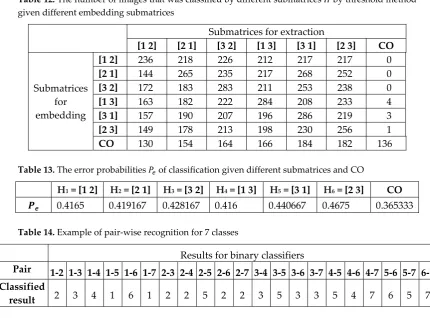
In Table 12 are presented the results of stegokey searching after testing of 500 different images. We note that a decision about CO instead of some SG was taken if the number of passed tests was less than 13. The probabilities of error (a falsification of submatrices) are presented in Table 13. From Table 13 it can be seen that is sufficiently large. In order to make a submatrix recognition more reliable we try to improve the results using multi-class SVM for submatrix recognition. In line with proposal in [17], we execute the so-called Max-Wins algorithm considered in [18]. We explain this idea briefly for the case with 6 submatrices plus one (the 7th class corresponds to CO). The number
of pair-wise combinations taken from 7 outcomes 72 = 21. Each pair out of 21 can be classified by 2
classes SVM as usually. A possible result of such classification is presented in Table 14.
Table 12. The number of images that was classified by different submatrices by threshold method given different embedding submatrices
Submatrices for extraction
[1 2] [2 1] [3 2] [1 3] [3 1] [2 3] CO
Submatrices for embedding
[1 2] 236 218 226 212 217 217 0
[2 1] 144 265 235 217 268 252 0
[3 2] 172 183 283 211 253 238 0
[1 3] 163 182 222 284 208 233 4
[3 1] 157 190 207 196 286 219 3
[2 3] 149 178 213 198 230 256 1
CO 130 154 164 166 184 182 136
Table 13. The error probabilities of classification given different submatrices and CO
H1 = [1 2] H2 = [2 1] H3 = [3 2] H4 = [1 3] H5 = [3 1] H6 = [2 3] CO
0.4165 0.419167 0.428167 0.416 0.440667 0.4675 0.365333
Table 14. Example of pair-wise recognition for 7 classes
Results for binary classifiers
Pair 1-2 1-3 1-4 1-5 1-6 1-7 2-3 2-4 2-5 2-6 2-7 3-4 3-5 3-6 3-7 4-5 4-6 4-7 5-6 5-7 6-7
Classified
result 2 3 4 1 6 1 2 2 5 2 2 3 5 3 3 5 4 7 6 5 7
After a perform of the first step (see above) it is necessary to arrange a “voting procedure”. Namely, to count how many times is presented every element in Table 14. Finally, we take a decision about class with maximal vote. The results of the last procedure are presented in Table 15.
(It is obvious that the above presented algorithm can be extended for any number of classes.)
Table 15. Results of “voting” on the Table 14. The maximal element is shown by hatching
Class 1 2 3 4 5 6 7
Classified quantity 2 5 4 2 4 2 2
Table 16. The number of images that were classified by SVM following “Max-Wins” recognition for different embedding and extracted submatrices
Submatrices for extraction
[1 2] [2 1] [3 2] [1 3] [3 1] [2 3] CO
Submatrices for embedding
[1 2] 257 30 44 56 39 72 2
[2 1] 107 147 63 69 25 89 0
[3 2] 82 49 141 79 60 85 4
[1 3] 96 43 55 187 43 70 6
[3 1] 86 49 70 72 132 80 11
[2 3] 89 53 56 72 52 176 2
CO 70 31 43 66 49 80 161
It can be seen from this table that results of submatrix recognition for Max-Wins method are better than for the case of threshold procedure (See Table 12).
To be more precisely we present in Table 17 the results of such recognition error probabilities for different embedding submatrices.
Table 17. The values of error probabilities for submatrix recognition
H1 = [1 2] H2 = [2 1] H3 = [3 2] H4 = [1 3] H5 = [3 1] H6 = [2 3] CO
0.331333 0.3955 0.414167 0.382 0.412667 0.403333 0.343167
Comparing Table 13 and 17 we can see that SVM-based method is slightly better than threshold-based approach.
4. Conclusion
A very common situation arises when encryption of messages is performed before embedding them into cover objects. We consider two scenarios that are very natural under this condition and can be termed as side attacks on stegosystem because they work only under message encryption. For the first scenario it is assumed that the embedded message is completely known for a steganalyst, but it is unknown whether this message was embedded or not into some cover object. Detection algorithm based on fast calculation of mutual information was investigated in the current paper. Such attack is typical for cryptography as known plaintext attack but although on that context it is used to find the cryptographic key, in stegography it is assumed that the stegokey is known already but it is required to prove a fact of embedding the given message into given encrypted text. We show that this problem can be solved but not for very strong block cipher with large block length. Justification of such scenario may be a fact that in steganography often not very strong ciphers can be used in a hope that messages are hidden already by steganographic algorithm.
The second scenario apply on the contrary to very strong cipher with unknown messages but known (or computable) stegokey. If search of stegokey is visible problem then it be also found by our approach. As an example, we considered search of submatrix of HUGO stegosystem that plays the role of stegokey.
In the near future we aim to investigate an approach with a modification of strong ciphers to such ones that keeping a good protection against cipher breaking but simultaneously does not satisfy to NIST tests on pseudo randomness that allows to protect SG against the proposed attack.
References
1. Fridrich, J. Steganography in Digital Media: Principles, Algorithms and Application; Cambridge University Press, New York, USA, 2009; 9781139192903.
2. Jain, M.; Lenka, S.K. A Review on Data Leakage Prevention using Image Steganography. IJCSE 2016, 5, 56-59.
3. Johnson, N.F.; Jajodia, S. Steganalysis: the investigate of hidden information. Information Technology, Syracuse, NY, USA, 3-3 Sept. 1998; IEEE; 113-116.
4. Liu, J.; Tang, G. Stego Key Estimation in LSB Steganography. Journal of Multimedia 2012, 7, 309-313, DOI:10.4304/jmm.7.4.309-313.
5. Liu, J.; Tian, Y.; Han, T.; Wang, J., Luo, X. Stego key searching for LSB steganography on JPEG decompressed image. Sci China Inf. Sci. 2016, 59, DOI:10.1007/s11432-015-5367-x.
6. Heys, H.M. A Tutorial on Linear and Differential Cryptanalysis. Cryptologia 2002, 26, 189-221, DOI:10.1080/0161-110291890885.
7. Shannon, C.E. Communication theory of secrecy systems. Bell Sys. Tech. Jou. 1949, 28, 656-715, DOI:10.1002/j.1538-7305.1949.tb00928.x.
8. Henk, C.A. van Tilborg. Fundamentals of Cryptography; Kluwer Academic Publishers. Boston/Dordrecht/London, 2000.
9. Kraskov, A.; Stogbauer, H.; Grassberger, P. Estimating mutual information. Physical Review, 2004, 066138, DOI: 10.1103/PhysRevE.69.066138.
10. Korzhik, V.; Fedyanin, I.; Godlewski, A.; Morales Luna, G. Steganalysis based on statistical properties of the encrypted messages. Lecture Notes in Computer Science 2017; 10446, 288-298.
11. Bassham III, L.E.; Rukhin, A.L.; Soto, J.; Nechvatal, J.R.; Smid, M.E.; Barker, E.B.; Leigh, S.D.; Levenson, M.; Vangel, M.; Banks, D.L.; Heckert, N.A.; Dray, J.F.; Vo, S. Spp. 800-22 rev. 1a. A Statistical Test Suite for Random and Pseudorandom Number Generators for Cryptographic Applications. Technical report of National Institute of Standards and Technology (NIST), Gaithersburg, MD, United States, 2010.
12. Pevný, T.; Filler, T.; Bas, P. Using high-dimensional image models to perform highly undetectable steganography. Information Hiding, Calgary, Canada, Jun 2010; Springer, Berlin, Heidelberg; 161-177. 13. Korzhik, V; Morales Luna, G.; Fedyanin, I. Using the Generalised Viterbi Algorithm to Achieve a Highly
Effective Stegosystem for Images. Computer Science and Information Systems (FedCSIS), Lodz, Poland, 13-16 Sept. 2015; IEEE; 855-860.
14. Cachin, C. An Information-Theoretic Model for Steganography. Information and Computation, 2004, 192, 41– 56, DOI: 10.1016/j.ic.2004.02.003.
15. Wang, Q.; Kulkarni, S.R.; Verdu, S. A Nearest-Neighbor Approach to Estimating Divergence between Continuous Random Vectors. Digital Information, Networking, and Wireless Communications (DINWC), Seattle, WA, USA, 9-14 July 2006; IEEE; 242-246.
16. Korzhik, V.; Fedyanin, I. Steganographic Applications of the Nearest-Neighbor Approach to Kullback-Leibler Divergence Estimation. Digital Information, Networking, and Wireless Communications (DINWC), Moscow, Russia, 3-5 Feb. 2015; IEEE; 133-138.
17. Bas, P.; Filler, T.; Pevny, T. “Break Our Steganographic System”: - The Ins and Outs of Organizing BOSS. Information Hiding, Prague, Czech Republic, May 2011; Springer, Berlin, Heidelberg; 59–70.
![Table 2 the S-box and the permutation mapping transforms are presented. Although this cipher has In Figure 1 the Heye’s cipher [6] is presented, which is a scheme of this type, and in Table 1 and 2�� ≈ 1.2 ∙ 10�� secret keys, hence a brute force attack by](https://thumb-us.123doks.com/thumbv2/123dok_us/8009790.1331339/2.595.199.419.352.731/table-permutation-mapping-transforms-presented-figure-presented-attack.webp)