Economics of Carry-over Response
Nitrogen Fertilization of Rangelands
toJOHN P. WORKMAN AND PAUL W. MCCORMICK
Highlight: Prior to the recent increases in nitrogen prices krtilization of a Utah mountain loam range site was found to be profitable when increased forage was harvested as grass hay, However, that evaluation was based only on forage response during the initial growing season. We have since observed signifi- cant carry-over response during the second and third years following fertilizer application. At the original nitrogen and hay prices studied, incorporation of carry-over into the economic analysis increased both optimum application rates and per acre profits from fertilization. ‘Fertilization was found even more profitable at current nitrogen and grass hay prices. Insufficient data were available to determine optimum reapplication schedules, although intuitive indications favor reapplication every 2 years for sites showing profitable initial and second year carry-over re- sponse. Spring application proved superior to fall application on both sites.
Prior to the recent dramatic increases in ammonium nitrate prices, nitrogen fertilization was shown to be a profitable practice for a Utah mountain loam range site (Workman and Quigley 1974). When forage was harvested as hay, application of nitrogen at the optimum rates of 127 lb N per acre for fall application and 144 lb per acre for spring application yielded additional per-acre profits of $3.09 and $5.52, respectively. When increased yields were harvested directly by livestock as leased forage, nitrogen application was not profitable. In both cases, however, the analyses were based on forage response during only the initial growing season following application. From 1972 to 1974 the study was continued to determine carry-over forage production response during the second, third, and fourth growing seasons following application so that any significant carry-over response could be included in the eco- nomic analysis of range fertilization.
Site Description
Range sites studied included a mountain loam site and a semidesert loam site. The mountain loam site is situated at a 4,800-ft elevation about 0.5 mile west of Paradise, Utah. The soil is a silt loam and the vegetation is primarily seeded intermediate wheatgrass (Agropyron intermedium). Annual precipitation averages 16 inches, most of which
Authors are associate professor of range economics, Department of Range Science, Utah State University; Lake County Extension Agent, and assistant professor, Oregon State University.
The report is published with the approval of the Director, Utah Agricultural Experi- ment Station, as Journal Paper No. 2121.
Manuscript received September 20, 1976.
324
is received during the winter. The area is normally grazed by cattle in both spring and fall.
The semidesert loam site is located 11 miles north of Snowville, Utah at an elevation of 4,800 feet, and supports a pure stand of crested wheatgrass (Agropyron cristatum). The soil is a silt loam and average annual precipitation is 11 inches. The area is grazed by cattle on a rotational basis from April through December.
Methods
Six rates of ammonium nitrate were applied to each site during spring and fall on 10 ft X 15 ft-subplots. The statistical design con- sisted of three replications of each application rate and season arranged in a randomized block. Application rates were 0,25,50, 100,200, and 400 lb N/acre on the mountain loam site and 0, 12.5,25,50, 100, and 200 lb N/acre on the semidesert loam site. Spring applications took place in 1971 on both sites. A fall application was made during 1970 on the mountain loam site and during 1972 on the semidesert loam site. Beginning in 1971, each subplot was clipped at the end of the growing season and the harvested forage weighed to determine total air-dry forage production for the initial second, third, and fourth growing season following fertilizer application. Production equations for forage as a function of nitrogen application were estimated by step- wise regression analysis. Independent variables that showed t-test significance 1 90% were retained in the predictive equations.
Statistically significant carry-over production functions were dis- counted back to year of initial application at the current cost of borrowed operating capital (10%) and added to the original forage production functions to form aggregate production functions (Baum et al. 1956). Standard marginal analysis was employed to determine optimum fertilizer rates (Heady and Pezek 1954). Fertilizer appli- cation and forage harvest costs employed in the analysis of the initial growing season production function followed Doane’s Agricultural Report ( 1972), while fertilizer and hay prices came from Christensen and Richards ( 1969).
Results and Discussion Biological Response
The production function tested by stepwise multiple regres- sion analysis for both forage production response during the initial growing season following application and carry-over response during subsequent growing seasons was:
Y=a+bN+c@
where Y = pounds air dry forage per acre and N = pounds nitrogen applied per acre. Statistically significant production functions for initial and carry-over forage response to nitrogen
Table 1. Production functions with independent variables significant at 2 90% probability.
Site
Season and
year of No. of growing seasons
application after application Production function P Semidesert Spring, 1971 Initial (1971)
loam Second ( 1972) Third (1973) Fourth ( 1974) Fall, 1972 Initial (1973) Second ( 1974) Mountain Spring, 1971 Initial (1971) loam Second ( 1972) Third (1973) Fall, 1970 Initial (1971) Second ( 1972) Third (1973)
Y = 1268+ 17.42N-.0623N2.56 Insignificant
Y=489+3.72N .69
Insignificant
Y=544+ 14.94N-.0399N* .83 Insignificant
Y= 1897+29.88N-.0462N* .81 Y= 1822+7.33N .70 Insignificant
Y=2515+26.46N-.0392N* .73
Y=2516+6.05N .67
Insignificant
fertilization appear in Table 1. Carry-over response on the mountain loam site was as might have been expected. Results on the semidesert loam site, however, are more difficult to explain. The absence of second-year carry-over response during 1972 followed by significant carry-over in 1973 can probably be attributed to 1972 being a dry year. Only 8.6 inches of predipita- tion were received as compared to the average of 11 inches. Optimum Application Rates-
Initial Growing Season
Based on production functions for the initial growing season and prices employed in the original study (Workman and Quigley 1974), standard marginal analysis (Heady and Pezek 1954) was used to determine the most profitable nitrogen application rates. For the fall application on the mountain loam site, for example, the nitrogen application rate that would maximize per-acre profit was found by equating
dY
- = 26.46 - .0784N dN
with the ratio of nitrogen price to the net price of forage
PN .1207
-=-*
PY .0073
Nitrogen price was based on the 197 1 price of $82.08 per ton for 34% ammonium nitrate. Forage price represents the 1971 net price of hay after subtracting the variable costs of baling and hauling. Solving for N, we obtain 127 lb N per acre. Optimum application rates for both sites and both application seasons are shown in Table 2, along with calculated per-acre profit at the optimum application rate as compared to per-acre profit without fertilizer. Profit at the optimum application rate was calculated by substituting 127 lb N into the initial production function, valuing the resulting 5,243 lb forage per acre at $.0073 per pound and subtracting the fixed application cost of $1.50 per acre, fixed hay swathing costs of $3.50 per acre, and the Table 2. Per acre profit at optimum nitrogen application rate when analysis is based only on forage response during initial growing season.
Site
Profit at Profit Added profit Optimum optimum without due to Season of rate rate fertilizer fertilizer application (lb N/acre) ($/acre) ($/acre) ($/acre)
SeEazsert S$ng 0 7 4.27 .47 5.76 .47 -1.49 0 Mountain Spring 144 15.87 10.35 5.52
loam Fall 127 17.95 14.86 3.09
variable nitrogen costs of $15.33 per acre (.1207/lb x 127 lb N). The result was an estimated per-acre profit of $17.95. Per- acre profit without fertilizer amounted to 2,5 15 lb forage per acre valued at $.0073 per pound minus fixed hay swathing costs of $3.50 per acre, or $14.86 per acre. Thus, the additional per- acre profit obtained from nitrogen fertilization was $3.09.
Fertilization increased the calculated per acre profit on the mountain loam site but was not economically feasible on the semidesert loam site. Although 7 lb N per acre is the recom- mended rate of fertilization if nitrogen is to be applied, fertili- zation of the semidesert loam site proved impractical since the value of the added forage production would not pay the fixed application costs.
Spring application on the mountain loam site provided more added profit per acre than did fall fertilization (Table 2) due to higher forage response per pound of N applied (Table 1). Forage response per pound of N was also greater with spring than with fall application on the semidesert loam site. In both cases the smaller response to fall application was probably due to nitrogen losses by leaching or volatilization during the 5- month period between application and spring growth.
Forage Carry-Over Response
Both sites exhibited statistically significant carry-over re- sponses during their second or third growth seasons following fertilization (Table 1). Accurate determinations, then, of opti- mum fertilization rates and of expected additional per-acre profit due to applying those rates, must include carry-over responses. Such inclusion involves discounting carry-over re- sponses at the current cost of borrowed operating capital, lo%, back to the initial growing season following application and then summing the discounted carry-over function and the original forage response function to form an aggregate produc- tion function (Baum et al. 1956). Using the mountain loam site fall application response as an example, the second year carry- over response function is
Y = 2,516 + 6.05N.
Discounting the added forage production (6.05N only since the intercept term, 2,516, represents forage yield without fertili- zation) for 1 year at lo%, we obtained 5.5ON, which, when added to the original response function
Y = 2,515 + 24.46N - .0392NZ produced the aggregate production function
Y = 2,515 + 3 1.96N - .0392NL. Setting
dY
dN= 31.96 - .0784N
equal to
PN .1207
-==
PY .0073
and solving for N, we obtained a revised optimum application rate of 195 lb N per acre. Substituting the optimum application rate into the aggregate production function and using the prices and costs listed above for forage, ammonium nitrate, fertilizer application, and hay swathing indicated a $24.44 per-acre profit at the revised optimum (Table 3), as compared to $17.95 for the initial growing season optimum (Table 2). An even more important comparison is between the $9.58 added profit per acre due to fertilizer ($24.444 14.96) when carry-over response was included and the $3.09 added profit per acre when the analysis was based on initial growing season response alone (Table 2). Revised optima and per-acre profitability are shown in Table 3.
Table 3. Revised per acre profit and revised optimum nitrogen application rates including carry-over response-original prices.
Site
Semidesert loam Mountain loam
Season of application Spring Spring Pall
Aggregate production function Y= 1268+20.49N-.0623N* Y=1896+3654N-.0462N2 Y=2515+31.96N-.0392N*
Optimum rate (lb N/acre)
32 217 195
Profit at optimum rate
($/acre) 4.71 24.66 24.44
Profit without Added profit due fertilizer to fertilizer
($/acre) ($/acre) 5.76 -1.05 10.35 14.31
14.86 9.58
In all cases both optimum application rate and added profit per acre due to fertilization were increased by inclusion of carry- over response. Economic analyses of range fertilization that do not include forage response during growing seasons subsequent to initial fertilizer application underestimate application rate optima and also understate fertilization profitability.
With carry-over response included in the analysis, spring application on the mountain loam site showed an even more striking advantage by providing an increased per-acre profit of $14.3 1 versus $9.58 per acre increased profit with fall appli- cation (Table 3).
doubling in both number of sample plots and number of growing Seasons studied. Key comparisons underlying fertilizer re- application decisions when data for both (1) and (2) are available are shown in Table 5.
Table 5. Comparisons underlying fertilizer reapplication decisions for sites showing profitable initial and second year carry-over response.
Our calculations showed nitrogen fertilization to remain unprofitable when increased production was valued at $6 per AUM (U. S. Dep. Agr. 1976) as leased forage to be used directly by livestock.
Optimum application rates and per-acre profits at current prices (Table 4) were calculated using $17 1 per ton of 34% N ammonium nitrate ($.2525/1b N), $31 per ton of hay or $.0155 per lb (net price based on a market price of $45 per ton of grass hay minus $9 per ton for baling minus $5 per ton for hauling), swathing costs of $5 per acre and fertilizer application costs of $2 per acre (Utah Agricultural Statistics 1976). When increased production was valued as harvested hay, fertilization of both
sites studied was more profitable at current than at original prices studied (Table 4). This is due to the increased net price of grass hay which compensated for the recent sharp increase in ammonium nitrate prices.
Initialyear(1971) Second year (1972) Third year ( 1973) (a) Net return to 197 1 (a) Net return to 1972 If no fertilizer
response to 197 1 second year carry- applied in 1972: application and dis- over response and
counted 1972 second discounted 1973 (a) Net return to year carry-over net return when 1973 response to response not fertilized 1973 application
and discounted 1974 second year
Versus Versus carry-over
@I) Net return in 197 1 (b) Net return to
when not fertilized 1972 initial Versus response and
discounted 1973
second year carry- (b) Net return in over response 1973 when not from 1972 fertilized application plus
net return to 1972 second year carry-over response from 197 1 application Table 4. Optimum application rates and per acre profit including carry-
over response-current prices.
Profit at Optimum optimum Season of rate rate Site application (lb N/acre ($/acre)
Sernflsert S$ng 34 13.79
0 3.43
Mountain Spring 220 57.02
loam Pall 201 56.45
Profit Added profit without due to fertilizer fertilizer ($/acre) ($/acre)
14.65 -0.86
3.43 0
24.39 32.63 33.98 22.47
The 1971 decision represents the most simple case. The site in question has either not been fertilized previously or, if prior application has taken place, carry-over response is no longer present. The decision as to whether or not to apply fertilizer would be based simply on a comparison of net returns to initial and discounted 1972 carry-over response from the 197 1 appli- cation versus 197 1 net return in the absence of fertilizer application.
Spring application again proved superior to fall application on both sites. Comparison of Tables 3 and 4 reveals that although calculated per acre profits from fertilization are much higher at current than at the original prices studied, optimum application rates are almost identical.
Optimum Reapplication Schedule
Determination of optimum reapplication schedules for sites showing profitable initial and second year carry-over responses to fertilization requires the following information: (1) initial and second year carry-over response to fertilizer application when the site has not been fertilized previously or when there is no carry-over response still present from previous applications, and (2) initial and second year carry-over response when second year carry-over response from application during the previous year is still present. Our study provides the necessary data for (1) but not for (2), which would have necessitated a
Provided that fertilization was found to be profitable and application was made in 197 1, the 1972 reapplication decision would be more complex. In this case the net return of 1972 second year carry-over response from the 197 1 application plus the discounted net return during 1973 (when not fertilized and with no significant third year carry-over) would be compared to net return to 1972 initial response from 1972 reapplication plus the discounted net return to 1973 second year carry-over from 1972 reapplication plus the net return to 1972 second year carry-over response from the 197 1 application.
If no fertilizer were applied in 1972, the 1973 reapplication decision would be identical to that described for the original application decision of 197 1. In the absence of significant carry- over from the 197 1 application, the 1973 decision would be between the sum of net return to 1973 initial and discounted
1974 second year carry-over response to 1973 reapplication compared to net return in 1973 in the absence of fertilizer.
Our study did not provide sufficient data to make the
comparisons outlined in Table 5. Since forage production response to reapplication in the presence of carry-over from a previous application is an unknown, the optimum reapplication schedule could not be calculated. Due to the quadratic nature (“law of diminishing returns”) of the production functions estimated for the initial growing season after application, re- application would undoubtedly have provided less added forage production than resulted from our initial application. While the diminished response cannot be quantified with the data avail- able, the near certainty that response to reapplication would have been less than response to our initial application leads to an intuitive comment concerning determination of an optimum re- application schedule. It appears that on sites that show profit- able response to fertilization for both the initial growing season and second year carry-over, the optimum reapplication schedule is every 2 years.
Summary and Conclusions
Two Utah range sites that responded significantly to nitrogen application during the initial 1971 growing season also ex- hibited significant second or third year carry-over responses. At the original hay and nitrogen prices studied, incorporation of carry-over into the analysis increased both optimum application rates and per-acre profitability from range fertilization. Eco- nomic studies that do not include carry-over response under- estimate optimum fertilizer rates and also understate profit- ability.
Although ammonium nitrate recently increased from the $82 per ton price tested originally to the current price of $17 1 per ton, the net price of grass hay has gone from $14.69 per ton to
$3 1. As a result, nitrogen fertilization of the mountain loam site for the purpose of increasing grass hay production is even more profitable now than when originally evaluated. At the current Utah price of $6 per AUM, however, fertilization of tangeland to be harvested as leased forage remains unprofitable.
Determination of optimum fertilizer reapplication schedules requires data concerning initial and carry-over responses to nitrogen in the absence of previous fertilizer application as well a measure of initial and carry-over responses in the presence of carry-over from previous fertilization. Although our experiment did not provide the latter data, intuitive indications favor reapplication every 2 years for sites showing profitable initial and second year carry-over response.
Literature Cited
Baum, E. L., E. 0. Heady, and J. Blackmore (Ed.). 1956. Methodological procedures in the economic analysis of fertilizer use data. Iowa State Univ. Press, Ames.
Christensen, R. A., and S. H. Richards. 1969. Price trends for decision making in agriculture-Utah 1969. Utah Agr. Exp. Sta. Resources Series 49. Doane’sAgri<ural Report. 1972. Machinery custom rates. Doane’s Agr.
Rep. 35( 1 l-5):303-306.
Heady, E. O., and J. T. Pesek. 1954. A fertilizer production surface with specification of economic optima for corn grown on calcareous ida silt loam. J. Farm Econ. 36446-482.
U.S. Department of Agriculture. 1976. Farm market real estate develop- ments. Economic Res. Serv. CD-18, July. 37 p.
U.S. Department of Agriculture and Utah Crop and Livestock Reporting Service. 1976. Utah Agricultural Statistics. Salt Lake City, Utah. 106 p. Workmay, John P., and Thomas M. Quigley. 1974. Economics of fertilizer
applicatton on range and meadow sites in Utah. J. Range Manage. 27: 390-393.
Rangeland
Plant Physiology
edited by Ronald A. Sosebee
l 290 pages l illustrated
l soft cover perfect bound l extensive bibliographies l $12.00 postpaid
In nine chapters, RANGELAND PLANT PHYSIOLOGY dis- cusses the characteristic life processes, activities, and func- tions of the rangeland plant.
Of particular interest to all who study, manage, or simply admire plant life, the book is a valuable college text supple- ment and a reference source for range managers and tech- nicians. Each chapter, authored by one or more authorities in the field, examines in considerable depth one aspect of plant physiology. Chapters include:
I. Gas Exchange in Photosynthetic Pathways in Range Plants; II. Carbohydrate Translocation in Range Plants; Ill. Distribution and Utilization of Carbohydrate Reserves in Range Plants; IV. Water
Relations of Range Plants; V. Salinity Effects on Range Plants; VI.
Seed Physiology; VII. Plant Growth Regulators; VIII. Mineral Cycling in Rangeland Ecosystems; IX. Developmental Morphology and Man- agement Implications.
Society for Range Management 2760 West Fifth Ave.
Denver, Colorado 80204
CLYDE ROBIN
NATIVE SEEDS
Castro Valley, California 94546
Soil Nitrogen Levels in a Semiarid Climate
Following Long-term Nitrogen Fertilization
FORREST A. SNEVA
Highlight: Fertilizing crested wheatgrass for 14 years with 34 kg/ha or less did not significantly increase the NOPN concentra- tion in a semiarid soil. Fertilization rates of 56 kg/ha or more resulted in a significant accumulation of NOR-N just above the cemented caliche layer. Total N accumulation in the upper 61 cm of soil from N fertilization levels of less than 56 kg/ha did not exceed 30% of that normally occurring in the profile.
Nitrogen (N) fertilization of semiarid soil to increase forage production is neither widely recommended nor extensively practiced. For this reason, on- or off-site pollution effects have not been of major concern to investigators. However, grazing use of our naturai resource lands is being reduced by land with- drawals, urban sprawl, and administrative edict. Concurrently the cattle industry is attempting to increase the proportion of
acid, and NOs-N was extracted by MgO in the presence of Devardas alloy.
In April of 1974, soil cores by 20.3 cm increments were taken to a 61 cm depth from unfertilized plots and from plots fertilized with 90 kg N/ha. These cores were used to establish bulk density.
During 1957-1966, and in 197 1 and 1972, forage was sampled on May 15 and herbage yield and N concentrations were determined. Following the spring sampling the remaining grass growth on the plot was mowed but not removed. Then, on August 1, the regrowth was sampled and yield and N concentration again determined. During the years 1967-l 970, no direct yield estimates were made. For these years yield estimates were extrapolated from yield and N data of crested wheatgrass plots in an adjacent study, where harvest dates and some fertilizer treatments were the same.
Statistically, the study was a randomized block design with three replications.
grass-fat beef in the market. Thus, despite rising fertilizer cost, its use depends upon fat cattle prices as it is influenced by fed grain prices.
Results
This paper documents residual amounts of total N, NH+N Total N decreased significantly (PcO.05) with each succes- and NO:s-N remaining in the soil following 14 years of fertilizing sive increment in soil depth (Table 1). Fertilizer rates of 22,56, a stand of crested wheatgrass (Agropyron desertorum (Fisch ex
and 90 kg/ha caused a significant (PcO.05) increase in total N Link) Schult.) with several levels of ammonium nitrate. above that of control plots, but N differences among those rates were not significant. Thirty-four kg N/ha did not significantly
Materials and Methods (P>O.O5) increase total N above that of control plots.
The Squaw Butte Experiment Station is located in southeastern Oregon, at an elevation of 1,37 1 meters. It receives approximately 30 cm of precipitation annually, mostly as rain or snow during the winter months.
The soil at the study site is unclassified, but has been described by Eckert (1957) as sandy loams overlying variable sandy-clay-loams to a depth of 48-81 cm. At the study site, the caliche layer began at approximately 61 cm below the soil surface.
In the spring of 1956, plots (about 3 X 4 m) were seeded to crested wheatgrass in rows spaced 30 cm apart. Five levels of ammonium nitrate (0,22,34,56, and 90 kg of N/ha) were broadcast on those plots in the fall of each year from 1956 through 197 1, with the exception of 1966 and 1969, when no fertilizer was applied.
Soil samples were collected in April, 1973, from soil depths of approximately 0 to 20, 2 1 to 41, and 42 to 61 cm. An impervious caliche layer limits water movement below this depth. Samples were air dried, screened, and subsequently analyzed for total N, NO+N and NH+N (A.O.A.C. 1965). Total N was measured as Kjeldahl-N, NH-I-N was obtained by steam distillation in the presence of formic
Table 1. Total N concentration (%) in the soil as influenced by soil depth and rates of N fertilization.
Fertilizer rate (kg N/ha)
Depth (cm) 0 22 34 56 90 Mean
- 0 to 20 .048 .057 .056 .061 .063 .057a 21 to 41 .042 .049 .043 .049 .055 .048b 42 to 61 .039 .045 .038 .043 .049 .043c Mean .043” .051b .045” .051b .056b
G b* c Statistical difference between means denoted by unlike letters (P<O.O5).
Nitrate-N and NH4-N concentrations significantly (IWO.05) interacted with fertilization rate and soil depth (Fig. 1). Nitrate- N concentrations from fertilization levels of 34 kg/ha or were less than 6 ppm at all soil depths. Nitrate-N concentrations increased with depth to 22 and 61 ppm in the 42 to 61 cm soil depth for the 56 and 90 kg N/ha rate, respectively.
The author is range scientist, U.S. Department of Agriculture, Agricultural Research Ammonium-N concentrations in the upper 26 cm of soil
Service. increased from approximately 9 ppm on control plots to 73 ppm
The report represents the cooperative investigations of the U.S. Department of Agricul-
ture, Agricultural Research Service, and Oregon Agricultural Experiment Station, Squaw with 90 kg N/ha (Fig. 1). These amounts declined to less than 25 Butte Experiment Station, Bums, Oregon, OAES Technical Paper No. 4248. ppm in the 2 1 to 4 1 cm depth and below 13 ppm in the lower 4 1
Manuscript received August 2 I, 1976. to 61 cm depth.
0 20 40 60 80 0 20 40 60 60
AMMONIUM-N (PPM) NITRATE- N (PPM)
Fig. 1. Ammonium-N and nitrate-N accumulations in a semiarid soilfollowing long-term nitrogen fertilization.
Soil bulk density was unaffected by N rate, but did signifi- cantly (P<O.O5) increase as soil depth increased. Mean values for the O-20,21-41,42-61 cm increments were 1.26, 1.32, and 1.35 g/cc, respectively.
Based upon the soil bulk density and total N analysis the total soil N yield of unfertilized plots was 1,237, 1,118, and 1,070 kg/ha for O-20, 4 l-6 1, and 42-6 1 cm increments. The greatest increase in residual total N occurred in the upper 20 cm of soil at the 56 and 90 kg/ha fertilization rates and in the 21-41 cm increment at the 90 kg/ha rate (Table 2). A decrease in residual amount occurred at the 42 to 61 cm depth on plots fertilized at the 34 kg/ha rate. For the total 6 1 cm of soil, the least amount of Esidual total N was measured from the 34 kg/ha rate. The residual amounts of total N for the 61 cm of soil sampled represent increases of 15, 6, 18, and 29% above the check plot yield, respectively, for 22, 34, 56, and 90 kg N/ha.
Table 2. Changes in the N-content of the upper 61 cm of soil from 14 years of fertilization with 4 levels of N.
Total N N applied annually (kg/ha) Soil depth (cm) in control plots 22 34 56 90
0 to 20 1,231 +146 +197 +317 +376
21 to 41 1,118 +204 + 27 +196 +357 42 to 61 1,070 +164 - 28 +110 +266
Total 3,425 +514 +196 +623 +999
Total soil nitrogen, N additions and withdrawals, and final N accounting for the study is presented in Figure 2. Nitrogen addition to the soil, in addition to the fertilizer applied, consisted of that received via precipitation and was estimated at 2.2 kg N/ha per year. Recovery of applied fertilizer N through the herbage was 30, 26, 21, and 23%, respectively, for N
TOTAl_- N
in out measured estimated +-
N- FLOW RESIDUAL- N NET DIFF.
18
176
208
Fig. 2. Total soil nitrogen (kg/ha), nitrogen additions and withdrawals (kg/ ha), measured and estimated residual nitrogen (kg/ha) and net differences in accountability (kglha) on a semiarid soil followng long-term nitrogen fertilization.
JOURNAL OF RANGE MANAGEMENT 30(5), September 1977 329
fertilization rates of 22, 34, 56, and 90 kg/ha. Measured residual soil N exceeded estimated residual N at all rates of applied N.
Discussion
Residual NO:+N was significantly increased in the lower depth of this soil only when fertilizer rate exceeded 34 kg/ha. Sneva et al. ( 1958) and Long and Landers (1968) concluded that a fertilizer level of less than 34 kg N/ha was the most efficient for crested wheatgrass production in eastern Oregon and Wyo- ming, respectively. Thus, no residual NO:j-N should accumu- late in these soils if this recommended rate is used. These results are in agreement with those reported by Sommerfeldt and Smith (1973)) Larson et al. ( 197 1 ), Power ( 1970), and Power et al. (1973), who studied the grassland and cultivated soils of the Northern Great Plains.
The buildup of NO:%-N in the deeper depths from nitrogen fertilization in excess of 34 kg/ha suggested that the N-pool has been saturated. Deep drainage or seepage in these soils is un- likely because precipitation is too limited to accomplish leaching, and the presence of an impervious layer would prevent it. Thus, a single, high N application should provide an excess of NO:+N that would be retained with only a small loss from the system. The disadvantages of a single high N application would be the accumulation of NO:+N at a depth below the primary mating zone, which would be an inefficient means of main- taining an adequate supply of N to the plant. There is also a possibility of denitrification whenever an excess of NO:+N accumulates.
Clark ( 1924) suggested that 5.6 to 7.8 kg N/ha was added via precipitation in temperate regions. Recent investigations by Tarrant, et al. (1967), Lodge et al. (1968), Hart et al. (1971), and Fredrikson (1972) suggested much lower N additions via precipitation for the Pacific Northwest and Intermountain areas. Although no measurements were taken, the value of 2.2 kg N/ha was chosen for use in this report, based upon research cited. On plots receiving no fertilizer the amount of N removed through the harvested forage was 2 12 kg/ha, approximately 5 to 6 times the amount of N estimated as received through precipita- tion additions (37 kg/ha). However, the estimate of N removed in the forage is derived from herbage harvested in the spring and again after summer regrowth. Sneva et al. (1958) reported N yields in crested wheatgrass harvested on June 1 to be nearly twice that in mature grass harvested on August 1. Over a 13-year period, crested wheatgrass yields harvested on August 1 con- tained an average of 5.6 kg N/ha (Sneva 1973). Thus, harves’t- ing crested wheatgrass in a mature stage from unfertilized areas removed 2.5 times the amount of N as is received through precipitation (as estimated herein), while harvesting earlier will remove greater amounts of N.
Differences in the total N unaccounted for in Figure 2 between N rates are not likely to be significant in themselves, with the possible exception of the 22 kg/ha rate. Considering that the total N supply in the upper 61 cm of this soil approxi- mates 3,400 kg, these unaccountable N amounts represent 5,
14, 1,5, and 6% of that base amount, respectively, for the 0,22, 34, 56, and 90 kg/ha fertilization rates. Even the 14% figure is not large relative to the normal errors associated with these kinds of samples. Thus, one could conclude that the accounta- bility of applied N has been quite good.
harvest. While the sampled herbage was removed from the area, the remaining grass in the treatment area was closely mowed but retained on that area. Other additions of N could have come by mineralization of soil organic matter, plant adsorption of atmospheric ammonia-N, and biological-N fixation.
The 472 kg N/ha unaccounted for at the 22 kg/ha fertilization late is not large when compared to the soil N base of 3,400 kg/ha. It contrasts sharply, however, with the N amounts remaining at the other nitrogen fertilization rates. This contrast, particularly that between the 22 and 34 kg/ha rates, interests the writer because of previous discrepancies in response between these two fertilizer rates. In the 10 years of herbage yield sampling on these plots, 22 kg of N/ha caused greater yield in 8 years than the 34 kg/ha rate (Sneva and Rittenhouse 1976). In none of those years, nor in the means of the 10 years, were yield differences significant (P>O.O5). Yet, increasing levels of N above 34 kg/ha did cause significant yield increases in some years. Discrete differences due to fertilizer level were evident in herbage crude protein and dry matter concentrations, yet soil moisture depletion curves were sometimes reversed. Thus, the inconsistency seen in the residual amounts of total in this study at the 22 and 34 kg/ha fertilization rates is not inconsistent with previous response fluctuations measured.
It is possible that this discrepancy is real. Three explanations are offered. First, during the years 197 1 and 1972, yield re- sponse to N was being limited by the availability of sulfur (Sneva and Rittenhouse 1976). Li ( 1964) and Williams (1967) have reported on the impact of soil temperature on soil sulfur mobilization. Thus nitrogen fertilization rate, availability of
sulfur, and early spring temperature interactions may explain the discrepancy.
Second, competition for applied N between root systems and the microbial populations on these low organic matter, semiarid soils may also interfere with the plant response to N. Thus, between the 22 and the 34 kg/ha rates, we may be encountering a sensitive, biological threshold that may account for the dis-
crepancy .
Third, rather than being tied up by competitive forces, applied nitrogen can stimulate the production of microbial populations and increase the output of N from a system. This
“priming effect” has been recently studied and discussed by Westerman and Kurtz (1973).
If the estimate of 2.2 kg/ha added annually via precipitation is approximately correct, then the removal of 13.2 kg/ha annually by crested wheatgrass suggests that a depletion of 11 .O kg/ha is occurring annually. Because a yield response to N fertilizer occurs on these soils, it is generally assumed that such grasses deplete soil N. However, declining herbage yield over time occurred both on fertilized and unfertilized plots of this study (Sneva and Rittenhouse 1976). Thus, it is inferred that the 11 .O
kg/ha may be an estimation of unknown N additions, rather than a depletion of soil N.
Most importantly, this study reveals that, should N fertili- zation of crested wheatgrass on semiarid soils become a practice, there is no danger of on- or off-side NO+N pollution when the recommended rates of N are used.
Literature Cited
A.O.A.C. 1965. Official methods of analysis of Ass. Offic. Agr. Chem., Washington, D.C.
Clark, Frank W. 1924. The data of geochemistry. 5th Ed. U.S. Dep. Interior, Geol. Survey, Bull. 770. 841 p.
Eckert, R. E., Jr. 1957. Vegetation-soil relationships in some Artemisiu types in Northern Hamey and Lake counties, Oregon. PhD Thesis. Oregon State Univ., Corvallis. 208 p.
Fredrikson, R. L. 1972. Nutrient budget of a Douglas fir forest on an experi- mental watershed in Western Oregon. In: Proc. Research on Coniferous Forest Ecosystems. p. 115131. Billingham, Wash. Mar. 23-34. Pacific Northwest Forest and Range Exp. Sta., Portland, Ore.
Hart, George, E., A. R. Southard, and J. S. Williams. 1971. Chemistry of precipitation and stream flow in north central Utah. Amer. Geophys. Union Proc. Mimeo. 6 p. San Francisco, Calif.
Lang, Robert, and L. Landers. 1968. Nitrogen fertilization of crested wheat- grass in northeastern Wyoming. Univ. of Wyoming Agr. Exp. Sta. Res. J. 21. 20 p.
Larson, K. L., J. F. Canter, and E. N. Vasey. 1971. Nitrate-nitrogen accu- lation under bromegrass soil fertilized annually at six levels of nitrogen for fifteen year. Agron. J. 63527-528.
Li, Pauline. Y. W. 1964. The oxidation of elemental sulfur in soils. MS Thesis, Univ. of Minnesota, St. Paul. 198 p.
Lodge, J. P., Jr., J. B. Pate, W. Basbergill, G. S. Swanson, K. C. Hill, E. Lorange, and A. L. Lazrus. 1968. Chemistry of United States precipitation. Nat. Center for Atmos. Res., Boulder, Colo. 66 p.
Power, J. F. 1970. Leaching of nitrate-nitrogen under dryland agriculture in the Northern Great Plains. In: Relationship of Agriculture to Soil and Water Pollution. Cornell Univ. Press, Ithaca, N.Y.
Power, J. F., J. Alessi, G. A. Reichman, and D. L. Grunes. 1973. Recovery, residual effects, and fate of nitrogen fertilizer sources in a semi-arid region. Agron. J. 65:765-768.
Sneva, Forrest A. 1973. Crested wheatgrass response to nitrogen and clipping. J. Range Manage. 26:47-50.
Sneva, Forrest A., D. N. Hyder, and C. S. Cooper. 1958. The influence of ammonium nitrate on the growth yield of crested wheatgrass on the Oregon high desert. Agron. J. Vol. 40-44.
Sneva, Forrest A., and L. R. Rittenhouse. 1976. Crested wheatgrass produc- tion: Fertility, row spacing, and stand age impacts. Oregon State Univ. Agr. Exp. Sta. Tech. Bull. 131. In Press.
Sommerfeldt, Theron, G., and A. D. Smith. 1973. Movement of nitrate nitrogen in some grassland soils of southern Alberta. J. Environ. Qua. 2:112-115.
Terrant, R. F., K. C. Lu, C. S. Chen, and W. B. Bollen. 1968. Nitrogen content of precipitation in a coastal forest opening. Tellus XX, 3 p. 554-556. Westerman, R. L., and L. T. Kuntz. 1973. Priming effect of 15n-labeled
fertilizers on soil nitrogen in field experiments. Soil Sci. Sot. Amer. Proc. 37:725-727.
Williams, C. N. 1967. Some factors affecting the mineralization of organic sulfur in soils. Plant and Soils 26:205-222.
Weed Control-Revegetation Systems for Big
Sagebrush-Downy Brome Rangelands
RAYMOND A. EVANS AND JAMES A. YOUNG
Highlight: Chemical weed control systems integrating 2,4-D or picloram spraying for brush control and atrazine fallow for downy brome control were investigated in a series of rangeland com- munities. Application of both weed control techniques greatly enhanced seedling growth and increased yield of perennial grasses seeded the year after the fallow. Added nitrogen either had negligible effects or tended to negate the benefits of the weed control systems on establishment of perennial grasses. The 2,4-D/ atrazine-fallow system also allowed establishment of the browse species, cliffrose, in a big sagebrush/downy brome community. Increased soil moisture available during the growing period of the Eallow and seedling years, because of decreased weed competition, was the major factor for the better stands of grass and browse that resulted from chemical weed control systems.
Downy brome (Bromus tectorum) has invaded millions of hectares of formerly big sagebrush (Artqnisia tridentutu)/ bunchgrass vegetation in the Intermountain portion of western North America (Klemmedson and Smith 1964). Where recur- tent fires have eliminated native shrubs, downy brome has become completely dominant. This alien annual grass is a source of forage but does have definite limitations, such as: slow growth in the spring, short green feed period, high flammability
in the summer, and highly erratic yield among years. Weed control-revegetation techniques have been developed to permit the establishment of desirable perennial grasses in these downy brome areas (Eckert and Evans 1967; Eckert et al. 1974; Evans et al. 1967). On rangelands, the application of the soil-active herbicide atrazine [2-chloro-4-(ethylamino)-6-(isopropylami- no)-s-triazine] to fallow downy brome communities for estab-
lishment of perennial wheatgrass (Agropyron spp.) is registered by the Environmental Protection Agency.
Degraded big sagebrush communities, where downy brome has not invaded, have been successfully converted to productive areas by reducing the brush stand with applications of 2,4,-D [(2,4-dichlorophenoxy)acetic acid] followed by seeding through the standing dead brush with a rangeland drill (Kay and Street 196 1; Asher and Eckert 1973). Rangeland use of 2,4-D is registered by the Environmental Protection Agency. There are extensive areas in the Great Basin that have dense big sagebrush or rabbitbrush overstories with downy brome dominance under
Authors are range scientists, U.S. Department of Agriculture, Agricultural Research Service, Renewable Resource Center, University of Nevada, Reno 895 12.
This paper involved cooperative investigation of the U.S. Dep. Agr., Agr. Res. Serv., ad the Agr. Exp. Sta., University of Nevada. Journal Series No. 338.
Manuscript received September 1, 1976.
the shrubs. The only revegetation technique applicable to these areas has been expensive, environmentally disruptive rangeland plowing.
In this investigation, we have evaluated alternative ap- proaches that integrate existing and registered chemical weed control techniques for the manipulation of both shrub (with 2,4-D) and herbaceous vegetation (with atrazine) for the estab- lishment of desirable species in degraded big sagebrush plant communities. In addition, picloram, an experimental herbicide on rangelands was tested for brush control in the weed-control systems.
Methods
The study areas were located at Medell Flat and surrounding vicinity, 35 km north of Reno, Nevada, in a 20-30 cm precipitation zone at 1,520-l ,800-m elevation. In 1969-70, total precipitation was 30.3 cm, with 9.2 cm occurring in the spring and summer growing season; in 1970-71, precipitation totalled 35.5 cm, with 10.6 cm during the growing season; and in 1971-72, 20.2 cm occurred, with 4.9 cm in the growing season. Soils of these areas belong to the order Aridisols and the group Haplargid or Duragid, depending on the presence of indurate pan development.
Trials were conducted over a 3-year-period in four plant com- munities: (a) green rabbitbrush (Chrysothamnus viscidi&rus)/downy brome in 1969-70 and 197 l-72, (b) big sagebrush/downy brome in 1970-7 1, (c) big sagebrush-rabbitbrush/Sandberg bluegrass (Z%U sundbergii)-downy brome in 1970-7 1 and 197 l-72, and (d) horse- brush (Tetrudymia cunescens)-rabbitbrush/downy brome in 197 l-72. The dates denote years of atrazine application and chemical fallow. Seeding was 1 year later. All of these communities are seral to a big sagebrush/Thurber needlegrass (Stipu Thurberiunu) potential com- munity (Young and Evans 1974). Studies in the four communities were conducted in three adjacent exclosures at Granite Peak, Medell Flat (two communities), and Horsebrush.
Experimental design used in each study area consisted of four replications of 6.2 by 6.2-m plots arranged in a randomized block design.
The basic procedure involved seven herbicide-fertilizer combi- nations and a control (Table 1). We also tested variations of the basic 2,4-D plus atrazine system on separate plots by: applying 2,4-D in May 197 1 and atrazine in October 197 1; applying atrazine with 2,4-D in May 197 1; and applying atrazine in October 197 1 and 2,4-D in May 1972. The latter timing of application of atrazine (fall) and 2,4-D (the next spring) was tested at all locations and in all years. Some of the combinations, or single herbicide treatments, were not meant to be practical systems. For example, 2,4-D alone was included to compare the influence of shrub removal with that of total vegetation control with 2,4-D plus atrazine in terms of competition with perennial grass
Table 1. Herbicide-fertilizer combination evaluated for shrub and annual weed control before seeding of perennial grasses.
Treatment Rate (kg/ha) Time of application
Control - -
Atrazine 1.12 Fall
Atrazine + 2,4-D 1.12 + 3.36 Fall-spring Atrazine + picloram 1.12 + 0.56 Fall-spring Atrazine + 2,4-D + nitrogen’ 1.12 f 3.36 + 56 Fall-spring-fall 2,4-D + nitrogen 3.36 + 56 Spring-fall
2,4-D 3.36 Spring
Picloram 0.56 Spring
’ Nitrogen source was ammonium sulfate 20-0-0.
seedlings. Nitrogen was applied in some comparisons to assess its effect on shrub control and seedling establishment. With the two- application systems, atrazine (wetable powder) was applied in Sep- tember or October and low-volatile esters of 2,4-D or picloram (4-amino-3,5,6-trichloropicolinic acid) as potassium salt in May in 94 liters/ha of water. Herbicides were applied with a backpack sprayer and hand-held boom. Picloram and 2,4-D were applied with 80” flat spray tip nozzles with 1.4 kg/cm2 pressure. Atrazine and the single simultaneous atrazine plus 2,4-D mixture were applied with whirl- chamber 49 by 49 nozzles (Klingman 1964) with 0.7 kg/cm2 pressure.
Plots were seeded in October of the year following application of the atrazine. In one case in 1972, we reseeded part of the plots because of a failure to establish seedlings. In 1970 and 197 1, we used a modified mngeland drill to furrow and seed all plots. In 1972, the plots were fiu-rowed with fixed shovels mounted on a tool bar and seeded by hand. Plots were seeded with intermediate wheatgrass (Agropyron inter-medium) cultivar ‘ ‘Greener’ ’ in 1970 and 197 1. In 1972, the plots were split, with one-half seeded to “Amur” intermediate wheatgrass, and the other to “Nordan” crested wheatgrass (A. desertorum). In the 1970-71 trial at Granite Peak, year-old cliffrose (Cowania mexicana var. Stunsburianu) plants were transplanted in April, 197 1,
into the check and 2,4-D/atrazine-fallow plots. Six plants were transplanted per plot with l-m spacing. These same plots were also seeded with intermediate wheatgrass in October 1970.
Infestations of broadleaf weeds at varying intensities occur the seedling year on atrazine fallows, with resultant competition to seedling perennial grasses (Eckert and Evans 1967). In the spring of 1972, we applied 0.56 kg/ha of 2,4-D to one-half of each plot, over the seedling wheatgrass stands, for control of broadleaf weeds.
Shrub control was determined by counting dead plants the season after the herbicides were applied. Herbaceous weed control was determined by estimating cover of weedy species, on a plot basis, both in fallow and seedling years. Herbaceous weed competition in the seedling year of the perennial grasses was ascertained by clipping four square 0. l-m2 plots located over the drill rows in each treatment. Seedling stand establishment was evaluated at the end of the seedling year by counting and measuring the height of seedlings per meter of mw. Second-year herbage production of the wheatgrass was deter-
mined by clipping four randomly located l-m sections of row in each plot at the maximum stage of herbage production.
Available soil moisture was measured in the profile with gypsum blocks at five depths (7.5, 15, 30, 60, and 112 cm-effective depth of profile) for three treatments (control, 2,4-D, and 2,4-D plus atrazine) periodically during the growing season in 3 years of the study.
Results Weed Control
Shrub Control
Control of green rabbitbrush and sagebrush was excellent with all 2,4-D and picloram treatments (Table 2). Control of horsebrush by these herbicides was variable in one year and at one location; otherwise, it was also consistently good.
The atrazine-alone treatment was not expected to control shrubs. Its inclusion in the systems was designed to obtain a comparison of shrub versus herbaceous weed competition. However, 1.12 kg/ha of atrazine consistently controlled small mbbitbrush plants throughout the study. Even in 1972, at the Horsebrush exclosure where shrub control tended to be lower, atrazine alone killed 65% of the rabbitbrush plants present (Table 2). Atrazine was ineffective in controlling horsebrush or big sagebrush plants.
Among the integrated shrub-herbaceous weed control sys- tems and the shrub control treatments, there were no clear advantages to any one treatment. All treatments produced excellent and almost consistent shrub control (Table 2). It was surprising that picloram alone adequately controlled big sage- brush, a species considered fairly resistant to this herbicide (Tueller and Evans 1969).
Shrub control with 2,4-D was not different when atrazine was applied before, after, simultaneously, or not at all (Table 3). The whirl-chamber nozzles are designed to apply wettable powders with low volumes of carriers, but satisfactory brush control resulted when they were used to apply 2,4-D and atrazine simultaneously (Table 3).
In 1972, in the Horsebrush exclosure, all shrub control treatments gave adequate control of green rabbitbrush, although some produced results lower than the average for the entire experiment. Horsebrush control was unacceptable, except for marginal control with 2,4-D (Table 2). The combination of 2,4-D plus atrazine resulted in significantly (p=O.Ol) less control than 2,4-D alone. The combination of nitrogen with 2,4-D did not significantly affect control. Control of horsebrush with picloram was satisfactory during the course of the experi- ment, except in 1972.
Table 2. Shrub control (%) with herbicides and nitrogen (N) alone and in combination. All dates and locations averaged together with the exception of 1972 at the Horsebrush Exclosure, where shrub control was variable.’
Mean of 3 years and 5 locations2 1972 Horsebrush exclosure3
Treatment Rabbitbrush Horsebrush Big Sagebrush Rabbitbrush Horsebrush
Control 0 0 0 oc Od
Atrazine 59 6 18 64b 4d
Atrazine + 2,4-D 96 98 100 92a 41 c
Atrazine + picloram 93a 49 bc
Atrazine + 2,4-D + N 98 94 100 1OOa 59b
2,4-D + N 94 90 98 80a 75 a
2,4-D 96 94 100 1OOa 84a
Picloram 98 95 96 86a 4oc
’ Means for Horsebrush Exclosure followed by same letter are not significantly different at the 0.05 level of probability as determined by Duncan’s multiple range test. Species compared individually.
’ Not all locations compared each year and not all species present at each location. “No big sagebrush plants were present in the Horsebrush Exclosure.
Table 3. Control (%) of rabbitbrush and big sagebrush with 3.36 kg/ha of 2,4-D applied alone and with 1.12 kg/ha of atrazine in different timing of application combinations.
Treatment Date of application Rabbitbrush Big sagebrush
2,4-D and May 1971 100 100
Atrazine October 197 1
2,4-D and Simultaneous (May 87 86 Atrazine 1971)
Atrazine and October 197 1 96 100 2,4-D May 1972
2,4-D May 1972 98 100
Herbaceous Control
In the fallow year of all the atrazine treatments, the plots were virtually free of downy brome or Sandberg bluegrass. Only under the dense shrub canopies did occasional downy brome plants escape the herbicide.
Even the treatment where 2,4-D and atrazine were applied together gave satisfactory herbaceous weed control. The atrazine had to lie on the shrub canopies and on the soil surface horn June until October without precipitation to move it into the soil.
The pertinent measure of herbaceous weed control is how much competition results from the treatment in the seedling year of the wheatgrass or in the season after the fallow. This competition can be from downy brome or from an alternate flora of broadleaf species, with tumble mustard (Sisymbrium &is- simum) being the most common species.
In the seedling year, downy brome was eliminated or nearly so between shrub canopies by all atrazine treatments, alone or in combination with 2,4-D or picloram (Table 4). Downy brome was only partially controlled under the canopies of the shrubs by the atrazine treatments and enough plants remained, as we shall present later, to reduce establishment of wheatgrass seedlings. Atrazine treatments controlled downy brome under shrub canopies even less when nitrogen was included in the system. Between shrubs, added nitrogen had no adverse effect on control of downy brome.
The major reason that the atrazine-fallow technique works in a pure downy brome stand is that all herbaceous litter disappears during the fallow season. This decreases the number of cary- opses (seeds) of downy brome and also puts the seedbed (bare soil surface) outside the germination potential of downy brome
Table 4. Herbage yield (kg/ha) of downy brome and broadleaf weed species in relation to weed control treatments under and beneath shrubs in the wheatgrass seedling year in a rabbitbrush/downy brome com- munity.’
Location of treatment Undershrubs Between shrubs
Treatment
Downy Broad- brome leaf
Downy brome Broad- leaf Control Atrazine Atrazine + 2,4-D Atrazine + piclorarn Atrazine + 2,4-D + N 2,4-D + N
2,4-D Picloram
340a 40
90b 110
80b 80
IlOb 0
420 a 80
410a 90
470 a 60
390a 0
90 20b
0 310a 0 240 a
10 lob
20 370 a
140 60b
110 40b
60 Ob
’ Means followed by the same letter are not significantly different at the 0.01 level of probability as determined by Duncan’s multiple range test. Columns are compared inde- pendently. Columns without letters have no significantly different means.
in terms of temperature and moisture and, therefore, effective weed control is attained the seedling year of the perennial grasses (Evans and Young 1970, 1972). There are large accumulations of litter under shrubs that contain many viable downy brome seeds (Young and Evans 1975). This litter was not entirely lost during the fallow period in this study and, consequently, downy brome was able to establish and compete with wheatgrass in its seedling year. Subcanopy litter with its favorable microenvironment and its reservoir of downy brome seeds is the major stumbling block in integrating brush and herbaceous weed control methods in these communities.
When the downy brome population was reduced by atrazine treatment, a broadleaf weed infestation usually filled the eco- logic void (Table 4). This was especially evident in the area between shrub canopies because of the more complete control of downy brome. The amount and species composition of this rr=placement vegetation were variable among years and plant communities. Tumble mustard was very abundant on atrazine- fallow plots in the rabbitbrush/downy brome community in the 1972 seedling year (Table 4), but was almost absent from the same treatments repeated in the community in 1973 (data not shown).
Sufficient picloram herbicidal activity carried over in the litter and soil to reduce or eliminate tumble mustard in the seedling year on plots where this herbicide was used for brush control (Table 4).
Seedling Establishment
Stand Density
No herbicide treatment markedly enhanced the establishment of stands of either intermediate or crested wheatgrass (Table 5). If we consider three seedlings per meter of row to be an acceptable density for this environment, the control plots contained adequate wheatgrass plants in five out of seven trials.
Table 5. Seedlings per m of row of intermediate and crested wheatgrasses in relation to weed control treatments.’
Treatment
Intermediate wheatgrass
Crested wheatgrass
Control 4.8 5.0
Atrazine 6.6 5.0
Atrazine + 2,4-D 8.8 6.5
Atrazine + picloram 8.1 5.0
Atrazine + 2,4-D + N 8.0 6.5
2,4-D + N 4.6 4.8
2,4-D 7.0 7.5
Picloram 5.8 5.8
I Seedling numbers expressed as means among various trials in years of study. No statistically significant differences were found among means of different treatments.
Virtually all wheatgrass seedlings were established in the interspaces between shrubs and none under the shrub canopies. This probably was jointly caused by competition from downy brome and failure of the furrow-opener on the rangeland drill to penetrate the woody canopy and litter and, therefore, to provide an adequate furrow in seeding of perennial grasses. The favorable microenvironment created by furrowing is an impor- tant part of seedling establishment in this environment (Evans et al. 1970).
Seedling Vigor
Although stand density was not enhanced by herbicide treat- ment, seedling vigor, as indicated by height of plants at the end of the first growing season, was greatly affected (Table 6).
Heights of perennial grass seedlings were three and one-half times as great on 2,4-D/atrazine-fallow plots where both brush and downy brome had been controlled as they were on check plots.
In general, taller and more vigorous seedlings were found on plots with brush and downy brome control (2.4.D/atrazine-
fallow), the next on atrazine-fallow plots with usually only numeric difference between these two treatments, and the third on plots with brush control but no downy brome control. The latter group were no different than seedlings on check plots. Overall, the influence of added nitrogen was negligible on height and vigor of seedlings.
Second Year Yield
The influence of herbicide treatments on seedling vigor was also measured on plots where we obtained second-year yields of the perennial grasses (Table 7). The atrarine-fallow plots always had significantly higher yields than the control. As was hue for seedling vigor, a trend existed for greater yields on plots where brush and downy brome were both controlled (2,4-D/
atrazine-fallow). Differences were only numerical and not statistical between yields on these plots and on the atrazine- fallow plots. Added nitrogen reduced second-year yields of perennial grasses on atraxine-fallow plots in the rabbitbrush/ downy brome community. In other trials, yields were not affected by nitrogen.
Alternate Flora Interactions
JUNE JULY
APR MAY JUNE JULY AUG
B/L LEpra --- TScm ---- IS cm . . . . . . . - Jocn,
0
J
MAR APR MAY JUNE JULY AUG
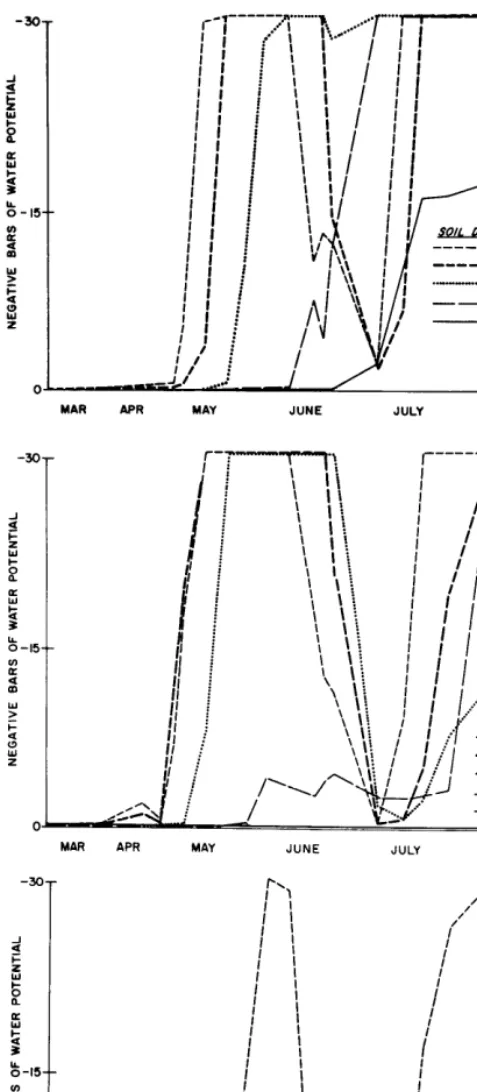
Fig. 2. Soil-moisture depletion at various depths in the profile during the growing period and in relation to treatment in the fallow year: (top) depletion without weed control (check); (middle) with brush control by spraying 2,4-D; and (bottom) with brush control plus atrazine fallow for downy brome control.
Similar trends were apparent in all plots and in all years of the study.
Seedling Year
on one-half of each plot in the rabbitbrush/downy brome community with an application of 0.56 kg/ha of 2,4-D in 1972. Control of tumble mustard in this manner did not markedly
influence seedling establishment even though there were high weed infestations, especially on the atrazine-fallow plots. However, herbage yield of perennial grasses that had been established with atrazine fallow alone and combined with 2,4-D brush spraying, was increased three times by the end of the second year (1973) when mustard was controlled the seedling
The year after chemical control, when seedlings of perennial grasses were growing, soil moisture depletion was delayed until
the end of the growing season on 2,4-D/atrazine-fallow plots at 30 cm and deeper (Fig. 3). No depletion occurred at the 112 cm depth. Recharge from rains during the growing season was more effective (in terms of available water) at the shallow depths on these plots compared to that on check plots. With brush control from 2,4-D, water depletion beyond the available range (- 15 bars) did not occur at 60 cm or deeper. At shallower depths, depletion was similar to that on check plots.
With no weed control, available water was depleted to 30 cm in June, 60 cm in July, and from the entire profile by August. There was some temporary recharge of shallow depths by rains in July.
Control of downy brome was strikingly reflected by soil- moisture retention at all but the shallowest depths in both the
JOURNAL OF RANGE MANAGEMENT 30(5), September 1977 335
Table 8. Cover of tumble mustard during the seedling year and sub- sequent yield (kg/ha) of intermediate wheatgrass in relation to original treatment and with and without mustard control in the seedling year with 0.56 kg/ha of 2,4-D.’
Intermediate wheatgrass yield 1973 (kg/ha/m of row) Tumble mustard Tumble mustard
Treatment cover 1972 (%) control No control
Control 9b 50d 5oc
Atrazine 53 a 390 a l20bc
Atrazine + 2,4-D 43 a 480 a 170b
Atrazine + picloram 4c 390a 410a
Atrazine + 2,4-D + N 32ab 140cd IOObc
2,4-D + N 13b 19Oc 14Obc
2,4-D 14 b 120cd 15Obc
Picloram IC 290b 310a
’ Means followed by same letter are not significantly different at 0.05 level of probability as determined by Duncan’s multiple range test. Each column compared separately.
year (1972) with 2,4-D (Table 8). Picloram used for brush control the previous year controlled tumble mustard in the seedling year on the picloram/atrazine-fallow plots, so no decrease resulted in yield of perennial grasses in the unsprayed portion of the plots. Added nitrogen resulted in decreased yield on 2,4-D/atrazine-fallow plots when mustard was controlled in the seedling year. Without mustard control, yields on these plots were low regardless of nitrogen application.
Shrub Transplants
Cliffrose transplants that were planted in the 2,4-D/atrazine- fallow plots at Granite Peak all survived and were l-m high and flowering by 1975 (Fig. 1). The transplants in the check plots all died.
Available Soil Moisture Fallow Year