The Collision Security of MDC-4
This is the full version of the paper. An extended abstract appeared at Africacrypt’12.
Ewan Fleischmann, Christian Forler, and Stefan Lucks
Bauhaus-University Weimar, Germany.
email:{ewan.fleischmann,christian.forler,stefan.lucks}@uni-weimar.de
Abstract. There are four somewhat classical double length block cipher based com-pression functions known:MDC-2,MDC-4,Abreast-DM, andTandem-DM. They all have been developed over 20 years ago. In recent years, cryptographic research has put a focus on block cipher based hashing and found collision security results for three of them (MDC-2,Abreast-DM,Tandem-DM). In this paper, we addMDC-4,
which is part of the IBM CLiC cryptographic module1
, to that list by showing that – ’instantiated’ using an ideal block cipher with 128 bit key/plaintext/ciphertext size – no adversary asking less than 274.76
queries can find a collision with probability greater than 1/2. This is the first result on the collision security of the hash function
MDC-4.
The compression function MDC-4is created by interconnecting two MDC-2
com-pression functions but only hashing one message block with them instead of two. The developers aim forMDC-4was to offer a higher security margin, when compared to
MDC-2, but still being fast enough for practical purposes.
TheMDC-2collision security proof of Steinberger (EUROCRYPT 2007) cannot be
directly applied toMDC-4due to the structural differences. Although sharing many
commonalities, our proof forMDC-4is much shorter and we claim that our presen-tation is also easier to grasp.
Keywords: MDC-4, cryptographic hash function, block-cipher based, proof of secu-rity, double length, ideal cipher model.
1 Introduction
A cryptographic hash function is a function which maps an input of arbitrary length to an output of fixed length. It should satisfy at least collision-, preimage- and second-preimage resistance and is one of the most important primitives in cryptog-raphy [24]. In recent years, most of the functions in the widely used MD4-family (e.g., MD4 [30], MD5 [31], RIPEMD [12], SHA-1 [28], SHA-2 [29]) have been suc-cessfully attacked in several ways [5, 11, 34, 35] which has stimulated researchers to look for alternatives. Block cipher based constructions seem promising since they are very well known – they even predate the MD4-approach [23]. One can easily create a hash function using,e.g., the Davies-Meyer [36] mode of operation and the Merkle-Damg˚ard transform [4, 25]. Also, many of the proposed SHA-3 designs like Skein [7], SHAvite-3 [1], and SIMD [22] use block cipher based instantiations. Another
1
reason for the resurgence of interest in block cipher based hash functions is due to the rise of resource restricted devices such as RFID tags or smart cards. A hardware designer only needs to implement a block cipher in order to obtain an encryption function as well as a hash function. However, due to the short output length of most practical block ciphers, one is mainly interested in sound design principles fordouble length (DL) hash functions. Such double length hash functions use a block cipher with n-bit output as the building block by which it maps possibly long strings to 2n-bit hash values. DL compression functions can be parted by the type of block cipher they need to operate: The first group,(group-1), uses an internal block cipher with an n-bit plaintext/ciphertext/key, the second group, (group-2), uses a block cipher with an n-bit plaintext/ciphertext and a k-bit key, k > n. DL compression functions in the first group are few. Currently, there are only three known candi-dates in literature: MDC-2, MDC-4 and a most recent variant of MDC-2: MJH
[19]. Group-2 examples areAbreast-DM Tandem-DM,Cyclic-DM[17, 10], etc.
The security of group-2 functions is relatively well understood.
MDC-4 is a acronym for Modification Detection Code with ratio 1/4, and was
developed at IBM in the late eighties by Meyer and Schilling [26]. The ratio indicates the number of block cipher calls that are required to process a single message block.
MDC-4was originally specified for the 64-bit block cipher DES [27].
Our Contribution. In this paper, we give the first collision security bound for the hash function MDC-4, a block cipher based hash function that has been publicly
known for more than 20 years. In our proof, we use many of the techniques that have been applied in the MDC-2 collision security proof [33]. Our proof is in the
ideal cipher model, too. However, we consider MDC-4 using an ideal n-bit block
cipher accepting n-bit keys. Furthermore, as in [33], we also ignore an additional
bit-fixing step that was used back than as an additional security measure to avoid some DES specific key issues.
In this paper we show, assuming a hash output length of 256 bits, that any adversary asking less than 274.76 queries to the block cipher cannot find a collision for the hash function MDC-4 with probability greater than 1/2. Note that the
optimal security bound for collisions for 256 bit hash functions is about 2128. For
MDC-2 (ratio 1/2) and MJH (ratio 1/2), the trivial collision resistance bound is
264, since they both internally use a Davies-Meyer compression function. Although MDC-4 also uses Davies-Meyer type functions inside, even such a trivial bound is
not so easy to see.
Related Work. For group-2 functions, there has been a lot of research in recent years,
Function Security (Collision) Attack (Collision) Attack (Preimage)
MDC-2 274.91
[33] 2121
[14] 22n(time·space) [14, 17] MDC-4 274.76
(this paper) 296
[15] (only CF) 2224 [15] MJH [19] 278.33
(no results known) (no results known)
Table 1.List of known group-1 hash functions, values evaluated for an internal block cipher with 128 bit plaintext/ciphertext/key [Notation: CF = compression function]
Outline. The paper is organized as follows: Section 2 includes formal notations and definitions. In Section 3 we prove that an adversary asking less than 274.76 oracle
queries has the threshold probability 1/2 finding a collision for the MDC-4 hash
function.
2 Preliminaries
2.1 General Notations
An n-bit block cipher is a keyed family of permutations consisting of two paired algorithmsE:{0,1}n×{0,1}n→ {0,1}nandE−1 :{0,1}n×{0,1}n→ {0,1}nboth accepting a key of sizen bits and an input block of size nbits for some n >0. Let Block(n) be the set of alln-bit block ciphers. For any E ∈Block(n) and any fixed key K∈ {0,1}n, decryption EK−1 :=E−1(K,·) is the inverse function of encryption EK :=E(K,·), so that EK−1(EK(X)) =X holds for any input X ∈ {0,1}n. In the ideal cipher modelE is modeled as a family of random permutations{EK}whereas the random permutations are chosen independently for each key K [2, 6, 13], i.e., formally E is selected randomly from Block(n). If Y = EK(X) we call the value Z =X⊕Y theXOR-output of a query (K, X, Y).
We use the convention to write oracles, that are provided to an algorithm, as superscripts. For exampleAE is an algorithmAwith oracle access toE to whichA can request forward and backward queries. For ease of presentation, we identify the sets {0,1}a+b and {0,1}a× {0,1}b. Similarly, forA ∈ {0,1}a and B ∈ {0,1}b, the concatenation of these bit strings is denoted byA||B ∈ {0,1}a+b ={0,1}a× {0,1}b. A compression function is a mapping H :{0,1}m× {0,1}r → {0,1}r for some m, r > 0. A block cipher-based compression function is a mappingHE :{0,1}m× {0,1}r → {0,1}r that, given an r-bit state R and an m-bit message M, computes HE(M, R) using oracle access to someE ∈Block(n).
2.2 The MDC-4 Compression Function
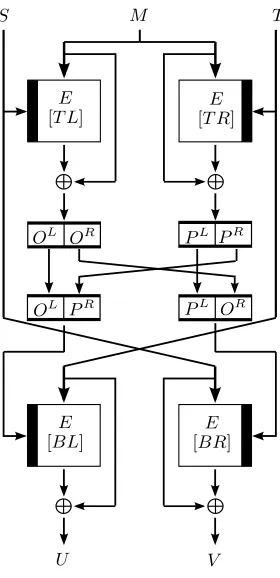
The MDC-4 compression function HE (cf. Figure 1) takes an n-bit message M, a
S M T
OL OR PL PR
OL PR PL OR
U V
E
[T L]
E
[T R]
E
[BL]
E
[BR]
Figure 1.The double-length compression functionHEwhereEis ann-bit block cipher. The black
bar inside the cipher indicates the key input.
2. compute P = (PL||PR) =E
T(M)⊕M, 3. compute U =EOL||PR(T)⊕T,
4. compute V =EPL||OR(S)⊕S,
5. output (U, V).
The superscriptLdenotes the leftn/2 bits of an expression, and the superscript R denotes the right n/2 bits of an expression.
The original MDC-4 specification [26] swaps the right halves ofU and V. But,
since we are in the ideal cipher model, this operation does not change the distribution of the output and neither our collision security analysis. So, for ease of presentation, we omitted this additional step.
Our analysis is for the MDC-4hash functionHE which is obtained by a simple
iteration of the MDC-4 compression function HE in the obvious manner: Given
some n·ℓ-bit message (M1, . . . , Mℓ), Mj ∈ {0,1}n for j = 1, . . . , ℓ and an initial value (S0, T0) ∈ {0,1}2n it works by computing (Si, Hi) = HE(Mi, Si−1, Ti−1) for
2.3 Security of the MDC-4 compression function and the MDC-4 hash function
Generally, insecurity is quantified by the success probability of an optimal resource-bounded adversary. The resource is the number of backward and forward queries to the block cipher E. For a set C, let Y ←$ C represent random sampling from C under the uniform distribution. For a probabilistic algorithm D, let Y ← D$ mean thatY is an output ofD and its distribution is based on the random choices of D. In our case, an adversary is a computationally unbounded collision-finding algo-rithm AE with access to E ∈ Block(n). We assume that AE is deterministic. The adversary may make a forward query (K, X)f to discover the corresponding value Y =EK(X), or the adversary may make a backward query (K, Y)b, so as to learn the corresponding valueX =EK−1(Y) such thatEK(X) =Y. Either way, the result of the query is stored in a triple (Ki, Xi, Yi) := (K, X, Y) and thequery history Qis the tuple (Q1, . . . , Qq) whereQi = (Ki, Xi, Yi) and q is the total number of queries made by the adversary.
Without loss of generality, we assume that AE asks at most only once on a triplet of a key Ki, a plaintextXi and a ciphertextYi obtained by a query and the corresponding reply.
Collision Resistance of the MDC-4 compression function. There is a very simple
attack on the compression function which only requires about 2n/2 invocations of the E oracle: Let the adversary find valuesK, K′, M, M′ ∈ {0,1}n such thatEK(M) = EK′(M′). This requires about 2n/2 E-oracle queries. Then, by
HE(M, K, K) =HE(M′, K′, K′),
a collision for the fullMDC-4compression function has been found. So our analysis
will be for the MDC-4 compression function in the iteration. This attack is only
possible if the the chaining values are equal.
3 Proof of Collision Resistance
3.1 Proof Model
Our analysis is for theMDC-4hash functionHE assuming that the initial chaining
values are different,i.e.,S0 6=T0. The goal of the adversary is to output two messages
M1 ∈ {0,1}n·ℓ and M2 ∈ {0,1}n·ℓ ′
such that H(M1) =H(M2) for some non-zero
integers ℓ, ℓ′.
In our analysis, we dispense the adversary from returning these two messages. Instead we upper bound his success probability by giving the attack to him if
(ii) case (i) is nottruebut he has either found a collision in the compression func-tionHE,i.e., (M, S, T) and (M′, S′, T′), such thatHE(M, S, T) =HE(M′, S′, T′)
or
(iii) cases (i), (ii) are nottruebut he has found values (M, S, T) such that (S0, T0) =
HE(M, S, T). Note that this requirement essentially models the preimage
resis-tance of the MDC-4 compression function.
The proof is simple and straightforward. Assume a collision for HE has been found using two not necessarily equal-length messages Mand M′,i.e.,HE(M) =
HE(M′). Also assume that the collision is the earliest possible. Then the adversary has either found (i) or (ii). For case (iii), we also give the attack to the adversary, particularly for reasons already discussed in Section 2.3.
For our analysis, we impose the reasonable condition that the adversary must have made all queries necessary to compute the results. We determine whether the adversary has been successful or not by examining the query history Q. Formally, we say thatColl(Q) holds if there is such a collision andQcontains all the queries
necessary to compute it.
We now define what we formally mean by a collision of theMDC-4compression
function.
Definition 1. (Collision resistance of the MDC-4 compression function) LetHE be aMDC-4compression function. Fix an adversaryA. Then the advantage
of A in finding collisions for HE is the real number
AdvCollHE (A) = Pr[E $
←Block(n); ((M, S, T),(M′, S′, T′))← A$ E,E
−1 :
((M, S, T) 6= (M′, S′, T′))∧HE(M, S, T) =HE(M′, S′, T′)].
Forq ≥1 we write
AdvCollHE (q) = max
A {Adv
Coll
HE (A)},
where the maximum is taken over all adversaries that ask at mostq oracle queries,
i.e., forward and backward queries toE.
Since our analysis in the next sections is for HE, we informally say that the probability of a collision of HE is upper bounded by using a union bound for the cases (i), (ii) and (iii). This is part of the formalization in Theorem 1.
3.2 Our Results
q AdvColl
HE(q)≤ α β γ
264
7.18·10−7
42 4.0 2·106
268.26
10−4
126 4.0 6·106
272.19
1/100 900 4.0 1.3·107
273.84
1/10 2600 4.0 1.4·107
274.40
1/4 3780 4.0 1.5·107
274.76
1/2 4900 4.0 1.5·107
Table 2.Upper bounds onAdvColl
HE(q) as given by Theorem 1
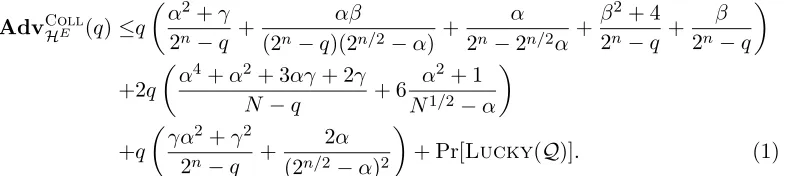
Theorem 1. Fix some initial values S0, T0 ∈ {0,1}n with S0 6=T0 and let HE be the MDC-4hash function as given in Section 2.2. Letα, β, γ be constants such that
eq2n/2/(2n−q) ≤α, eq/(2n−q) ≤ β and let Pr[Lucky(Q)] as in Proposition 8. Then
AdvCollHE (q)≤q
α2+γ 2n−q +
αβ
(2n−q)(2n/2−α) +
α
2n−2n/2α +
β2+ 4 2n−q +
β 2n−q
+2q
α4+α2+ 3αγ+ 2γ
N −q + 6
α2+ 1
N1/2−α
+q
γα2+γ2 2n−q +
2α (2n/2−α)2
+ Pr[Lucky(Q)]. (1)
Proof. The proof follows from the following discussion together with Proposition 1 by adding up the individual results from Propositions 2 - 8. ⊓⊔
As mentioned before, our bound is rather non-transparent, so we discuss it for n = 128. We evaluate the equation above such that the adversary’s advantage is upper bounded by 1/2 – thereby maximizing the value ofqby numerically optimizing the values of α,β andγ. Our result is the following corollary.
Corollary 1. No adversary asking less than 274.76 queries can find a collision for the MDC-4 hash function with probability greater than 1/2.
An overview of the behavior of our upper bound is given in Table 2. Note that for other values of (α, β, γ) the bound stays correct but worsens numerically (as long as the conditions given in Theorem 1 hold).
3.3 Proof Preliminaries
S T S′
T′
M M′
OL OR PL PR
WL WR RL RR
OL PR PL OR
WL RR RL WR
U V U′
V′ E
[1T L]
E
[1T R]
E
[1BL]
E
[1BR]
E
[2T L]
E
[2T R]
E
[2BL]
E
[2BR]
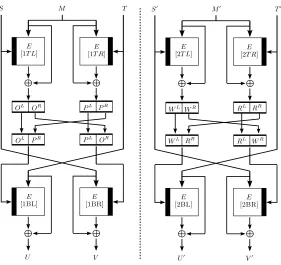
Figure 2.The double-lengthMDC-4compression function HE, whereEis a (n, n)-block cipher.
If (S, M, T)6= (S′ , M′
, T′
) but (U, V) = (U′ , V′
) then the adversary has found a collision forHE.
The black beam inside the cipher indicates the key input. For later reference, the different positions a query can be used in are denoted by 1T L,1T R, . . . ,2BR.
compression function HE. For a collision, there are eight – not necessarily distinct – block cipher queries necessary (cf. Figure 2).
To upper bound the probability of the adversary obtaining queries that can be used for a collision, we upper bound the probability of the adversary making a final query that can be used as the last query to complete such a collision. LetQi denote the set of the firstiqueries (K1, X1, Y1), ...,(Ki, Xi, Yi) (either forward or backward) made by the adversary. Furthermore we denote by the term last query the latest query made by the adversary. This query has always indexi. Therefore, for each i with 1≤i≤q, we upper bound the success probability of an adversary to use the i-th query to complete the collision.
As the probability depends on the first i−1 queries, we have to put some restrictions on these and also upper bound the probability that these restrictions are not met by an adversary. One example of such a restriction is to assume that,
e.g., the adversary has to find too many collisions for the underlying component functionEK(X)⊕X.
adversary ever making a successful i-th query, conditioned on the fact that the adversary does meet our restrictions and has not been successful by its (i− 1)-th query. We use some notations 1)-that are given in Figure 2, e.g., the statement
1BL 6=2BL means that the query used in the bottom left of the ’left’ side is not
the same as the query used in the bottom left of the ’right’ side.
3.4 Details.
We say Coll(Q) if the adversary wins. Note that winning does not necessarily
imply, that the adversary has found a collision. It might be that the adversary got lucky and does not meet our restrictions any more. But in the case of a collision
Coll(Q) always holds.
Proposition 1.
Coll(Q) =⇒
Lucky(Q)∨InternalColl(Q)∨CollTopRows(Q)∨CollLeftColumns(Q)∨ CollRightColumns(Q)∨CollBothColumns(Q)∨Preimage(Q).
We now define the involved predicates of Proposition 1 and then give a proof. The predicates on the ’right’ side are made mutually exclusive meaning that if the left side is true it follows that exactly one of the predicates on the right side is true. By upper bounding separately the probabilities of these predicates on the right side it is easy to see that the union bound can be used to upper bound the probability of
Coll(Q) as follows:
Pr[Coll(Q)]≤Pr[Lucky(Q)] + Pr[InternalColl(Q)] + Pr[CollTopRows(Q)]
+ Pr[CollLeftColumns(Q)] + Pr[CollRightColumns(Q)]
+ Pr[CollBothColumns(Q)] + Pr[Preimage(Q)].
To state the predicateLucky(Q), we give some helper definitions that are also used
as restrictions for the other predicates. Let NumEqual(Q) be a function defined on the query setQ, |Q|=q as follows:
NumEqual(Q) = max
Z∈{0,1}n|{i:EKi(Xi)⊕Xi =Z}|.
It is the maximum size of a set of queries inQwhoseXOR-outputs are all the same. Similarly, we defineNumEqualHalf(Q) as the maximum size of a set of queries whose XOR-outputs either share the same left half or the same right half. Let
NEH-L(Q) = max
Z∈{0,1}n/2|{i: (EKi(Xi)⊕Xi)
L=Z}|,
NEH-R(Q) = max
Z∈{0,1}n/2|{i: (EKi(Xi)⊕Xi)
then NumEqualHalf(Q) = max(NEH-L(Q),NEH-R(Q)). Let NumColl(Q) be also de-fined on a query setQ,|Q|=q, as
NumColl(Q) =|{(i, j)∈ {1, . . . , q}2 :i6=j, EKi(Xi)⊕Xi =EKj(Xj)⊕Xj}|.
It outputs the number of ordered pairs of distinct queries inQwhich have the same XOR-outputs.
We now define the event Lucky(Q) as
Lucky(Q) =(NumEqualHalf(Q)> α) ∨ (NumEqual(Q)> β) ∨ (NumColl(Q)> γ),
where α, β and γ are the constants from Theorem 1. These constants are chosen depending on n and q by a simple numerical optimization process such that the upper bound of the advantage of an adversary is minimized for given values ofn, q.
We now give the definitions of the other predicates.
FitInternalColl(Q). The adversary has found four – not necessarily distinct – queries such that HE(M, S, T) can be computed and HE(M, S, T) = (U, U) holds for some arbitrary U with S6=T.
FitCollLeftColumns(Q). The adversary has found eight – not necessarily distinct – queries such that (U, V) =HE(M, S, T) and (U′, V′) =HE(M′, S′, T′) can be computed with U =U′,1BL6=2BLand 1BR=2BR.
FitCollRightColumns(Q). The adversary has found eight – not necessarily dis-tinct – queries such that (U, V) =HE(M, S, T) and (U′, V′) = HE(M′, S′, T′) can be computed withV =V′,1BR6=2BR and1BL=2BL.
FitCollTopRows(Q). The adversary has found four – not necessarily distinct – queries such that
(ES(M)⊕M, ET(M)⊕M) = (ES′(M′)⊕M′, ET′(M′)⊕M′)
forS 6=T,S′ 6=T′,1BL=2BLand 1BR=2BR.
FitCollBothColumns(Q). In this case we assume ¬FitCollLeftColumns(Q)
and ¬FitCollRightColumns(Q). The adversary has found eight – not
nec-essarily distinct – queries such that (U, V) = HE(M, S, T) and (U′, V′) = HE(M′, S′, T′) can be computed with U = U′, V = V′, 1BL 6= 2BL and 1BR6=2BR.
FitPreimage(Q). This formalizes case (iii). The adversary has found four – not necessarily distinct – queries used in HE in positions 1TL, 1TR, 1BL, 1BR
such that the output of HE is equal to (S
0, T0),i.e., the initial chaining values
For practical purposes we derive our predicates as follows.
InternalColl(Q) =
¬Lucky(Q)∧FitInternalColl(Q) CollLeftColumns(Q) =
¬(Lucky(Q)∨FitInternalColl(Q))∧FitCollLeftColumns(Q) CollRightColumns(Q) =
¬(Lucky(Q)∨FitInternalColl(Q)∨FitCollLeftColumns(Q))
∧FitCollRightColumns(Q) CollTopRows(Q) =
¬(Lucky(Q)∨FitInternalColl(Q)∨FitCollLeftColumns(Q)
∨FitCollRightColumns(Q))∧FitCollTopRows(Q) CollBothColumns(Q) =
¬(Lucky(Q)∨FitInternalColl(Q)∨FitCollLeftColumns(Q)
∨FitCollRightColumns(Q)∨FitCollTopRows(Q))
∧FitCollBothColumns(Q) Preimage(Q) =
¬(Lucky(Q)∨FitInternalColl(Q)∨FitCollLeftColumns(Q)
∨FitCollRightColumns(Q)∨FitCollTopRows(Q)
∨FitCollBothColumns(Q))∧FitPreimage(Q)
Proof of Proposition 1. Assume that the adversary is not lucky, i.e.,¬Lucky(Q).
Then it is easy to see that
FitInternalColl(Q)∨FitCollLeftColumns(Q)∨
FitCollRightColumns(Q)∨FitCollTopRows(Q)∨ FitCollBothColumns(Q)∨FitPreimage(Q)
=⇒
InternalColl(Q)∨CollLeftColumns(Q)∨CollRightColumns(Q)∨ CollTopRows(Q)∨CollBothColumns(Q)∨Preimage(Q)
holds. Therefore it is sufficient to show that
Coll(Q) =⇒FitInternalColl(Q)∨FitCollLeftColumns(Q)
∨FitCollRightColumns(Q)∨FitCollTopRows(Q)
∨FitCollBothColumns(Q)∨FitPreimage(Q).
To ensure that the chaining values are always different, we give the attack to the adversary if these values collide, i.e., U = V or U′ = V′. Note that this is usu-ally not a real collision, but we can exclude this case in our analysis. We call this
InternalColl(Q). This corresponds to case (i) in Section 3.1.
For the case (ii), we assume that a collision for the MDC-4compression
func-tionHE can be constructed from the queries in Q. Then there are inputsM,M′ ∈
{0,1}nand (S, T),(S′, T′)∈ {0,1}2n, (S, T, M)6= (S′, T′, M′), such thatHE(S, T, M) = HE(S′, T′, M′).
For the following analysis we have ¬InternalColl(Q), i.e.,S =6 T, S′ 6=T′.
Our case differentiation is based on the disposal of queries in the bottom row. First assume that1BL=2BLand1BR=2BR. ThenCollTopRows(Q). Now assume
that1BL=2BLand1BR6=2BR. ThenCollRightColumns(Q). Conversely, if 1BL6=2BL and 1BR=2BR, we say CollLeftColumns(Q). The only missing
case,1BL6=2BLand 1BR6=2BR, is denoted by
CollBothColumns(Q).Preimage(Q) formalizes case (iii) of Section 3.1 and
cor-responds toFitPreimage(Q). ⊓⊔
General Remarks. The strategy for the other predicates is to upper bound the probability of the last query being successful conditioned on the fact that the ad-versary has not yet been successful in previous queries. We say that the last query is successful if the output is such that NumEqualHalf(Q) < α, NumEqual(Q) < β, NumColl(Q)< γ and that one of the predicates is true.
Proposition 2 (InternalColl(Q)).
Pr[InternalColl(Q)]≤q
α2+γ 2n−q +
αβ
(2n−q)(2n/2−α) +
α 2n−2n/2α
Proof. The adversary can use the last query Qi either once or twice. When Qi is used three times or more then it must occur twice either in the top- or bottom row. But this would implyS =T.
In the case that the query is used once it can either be used in the top or bottom row. Due to the symmetric structure ofMDC-4, we can assume WLOG that the last
query Qi is either used in positionT L or BL2. The success probability is analyzed in Lemma 1.
In the case that Qi is used twice, it must be used once in the top and once in the bottom row. We again assume that the last query is WLOG used in TL and BLor TL and BR. The success probability is analyzed in Lemma 2. ⊓⊔
Lemma 1. Let S 6= T and Qi−1 the query list not containing the last query Qi.
Assume that Qi is used once in the MDC-4 compression function HE. Then
Pr[(U, U) =HE(S, T, M)]≤q
α2+γ 2n−q
.
Proof.
2
Case 1: Assume first thatQi= (KiL||KiR, Xi, Yi) is used in positionBL. It follows that KL
i must be equal to theXOR-outputZT LL of the query in TL. It follows that there are at most α different candidates for the query in TL in the query
historyQi−i. Similarly, becauseKiRmust be equal to the right half of the XOR-output of TR,ZR
T R, there are at mostα candidates for that can be used in TR. For the query in BR, there are at most α2 possible key inputs, the ciphertext
input of BR is determined by the query used in TL. So the probability that
there is a query in Qi such thatU =V is upper bounded by α2/(2n−q). Forq queries, the total chance of success is ≤qα2/(2n−q).
Case 2: Now assume that Qi is used in position TL. Since S 6=T it follows that
BL 6=BR. So there are at most γ ordered pairs of queries that can be used in BL and BR such that their XOR-output collides. Fixing one of these, it fully
determines the XOR-outputTL. So, for q queries, Qi has at most a chance of
qγ/(2n−q). ⊓⊔
Lemma 2. Let S 6= T and Qi−1 the query list not containing the last query Qi.
Assume that Qi is used twice in the MDC-4 compression functionHE. Then
Pr[(U, U) =HE(S, T, M)]≤q
αβ
(2n−q)(2n/2−α) +
α 2n−2n/2α
.
Proof. By symmetry arguments, we assume WLOG that the last queryQi is used in positionT L. SinceS 6=T, the last query can only appear a second time in position BL, or BR but not inT R.
Case 1: AssumeQi is used in positionT LandBL. This query can be used in these positions if the randomly determined left-side XOR-output ZL
i is equal to the left-side of the key KiL. This event is called PK and its probability of success can be upper bounded for Qi by Pr[PK]≤α/(2n/2−α). We now upper bound the number of queries that can be used in BR conditioned on the fact thatPK
is successful. There are at most α queries that can be used in TR, since now
the key input ofBLis fixed. As the ciphertext input ofBRis now also fixed by TL, there are at most β possibilities for BR. So the chance of success for the
i-th query in this case is ≤ 2nβ−q ·Pr[PK]. So for q queries the bound becomes qαβ
(2n−q)(2n/2−α).
Case 2: AssumeQi is used in positionT Land BR. Then,Ki =Xi. The queryQi can be used in these two positions at the same time if the randomly determined right-half XOR-outputZiR is equal to the right-half of the key,KiR=XiR. This event is called OK and its probability of success can be upper bounded for Qi by Pr[OK]≤ 2n/12.
We now upper bound the number of queries that can be used in TRconditioned
on the fact the OK is successful. There are at mostα queries that can be used in TRsuch that ZL
T R=KiL holds. Hence, there are at mostα queries that can be used in BL. We denote the chance that ZL
Pr[ZiL]. This event can thus be upper bounded by α
2n/2
−α ·Pr[OK]≤ α
2n−2n/2 α. For q queries we can upper bound this case by 2n−qα2n/2
α. ⊓⊔
Proposition 3 (CollTopRows(Q)).
Pr[CollTopRows(Q)]≤ qβ
2n−q
Proof. In this case we consider a collision in the top row, with 1BL = 2BL and 1BR = 2BR. This implies S = S′ and T′ = T. Furthermore it implies M 6= M′,
because otherwise we would have1TL=2TL and 1TR=2TR. Regarding to this
constraints we have to upper bound the probability that thei-th query can be used such that
(ES(M)⊕M, ET(M)⊕M) = (ES′(M′)⊕M′, ET′(M′)⊕M′).
Note, that no internal collision has happened before,i.e.,¬InternalColl(Q), and
therefore the chaining values are always different. First assume that the last query is used twice or more. In order to find a collision in the top-row, the last query must be used in the top-row or otherwise the success probability is zero. The last query cannot be used in 1TL and 2TL or else 1TL= 2TR and M =M′ would follow.
The last query also cannot be used in1TLand2TRor elseS=T′ =S′ =T would
follow.
Now assume that Qi is used once, WLOG in 1TL. Then there are at most β pairs of queries for 1TR,2TR that form a collision. So there are at mostβ queries
that can be used in 2TL that may form a collision with the XOR-output of the
last query used in1TL. The success probability forq queries can therefore be upper
bounded byqβ/(2n−q). ⊓⊔
Proposition 4 (CollLeftColumns(Q)).
Pr[CollLeftColumns(Q)]≤q
α2(α2+ 2γ+ 1) +αγ+α
2n−q +
α3+ 2α2+α
(2n/2−α)2
The proof can be found in Appendix B.
Proposition 5 (CollRightColumns(Q)).
Pr[CollRightColumns(Q)]≤q
α2(α2+ 2γ + 1) +αγ+α 2n−q +
α3+ 2α2+ 1 (2n/2−α)2
Proof. Due to the symmetric structure of MDC-4this proof is essentially the same
as for proposition 4. ⊓⊔
Proposition 6 (CollBothColumns(Q)).
Pr[CollBothColumns(Q)]≤q
γα2+γ2 2n−q +
2α (2n/2−α)2
The proof of Proposition 6 is given in Appendix A.
Proposition 7 (Preimage(Q)).
Pr[Preimage(Q)]≤ q(4 +β 2)
2n−q
Proof. The adversary can use the last query either once or twice. If it is used twice, it is used at least once in the bottom row.
Case 1: Assume first, that the last query is used once and that it is used in the top row. Assume WLOG that it is used in 1TL. Since there are at most β
queries that can be used in1BLand also at mostβ queries for1BR, the success
probability is upper bounded for q queries byqβ2/(2n−q).
Now assume that the last query is used once and that it is used in the bottom row. Whether it is used in1BLor 1BR, the success probability in each case for
one query is≤1/(2n−q).
So the total success probability for q queries for this case is upper bounded by q(2 +β2)/(2n−q).
Case 2: Now, assume that the last query is used twice. So it is used exactly once in the bottom row and the analysis of Case 1 (bottom row) gives an upper bound of 2q/(2n−q).
⊓ ⊔
Proposition 8 (Lucky(Q)).Letn, q ∈N,n≥q. Letα, β, andγ be as in Theorem
1 with eq2n/2/(2n−q) ≤α and eq/(2n−q)≤β. Set τ = α(2q2nn/−2q) and ν =
β(2n−q)
q .
Then
Pr[Lucky(Q)]≤ q 2
γ(2n−q)+ 2q2
n/2eq2n/2
τ(1−lnτ)/(2n−q)
+q2neq2nν(1−lnν)/(2n−q).
A proof can be found in [32, Appendix B].
4 Conclusion
We have derived the first collision security bound for MDC-4, a double length
block cipher based compression function which takes 4 calls to hashing a message block using a (n, n) block-cipher. Although MDC-4 is structurally quite different
from MDC-2, it is somewhat surprising that the result given by Steinberger for MDC-2 (274.91) and our result for MDC-4 (274.76) are numerically quite similar –
although we have applied much more economical proof techniques. This leads to open questions we have not been able to find satisfying answers for as, e.g., why are these results so similar? One possible answer is, that MDC-2and MDC-4are
security-wise very similar. This would lead to the conclusion thatMDC-4is totally
dominated by MDC-2. Another answer might be that the limitations are due to
References
[1] Eli Biham and Orr Dunkelman. The SHAvite-3 Hash Function. Submission to NIST (Round 2), 2009.
[2] John Black, Phillip Rogaway, and Thomas Shrimpton. Black-Box Analysis of the Block-Cipher-Based Hash-Function Constructions from PGV. In Moti Yung, editor, CRYPTO, volume 2442 ofLecture Notes in Computer Science, pages 320–335. Springer, 2002.
[3] Gilles Brassard, editor. Advances in Cryptology - CRYPTO ’89, 9th Annual International Cryptology Conference, Santa Barbara, California, USA, August 20-24, 1989, Proceedings, volume 435 ofLecture Notes in Computer Science. Springer, 1990.
[4] Ivan Damg˚ard. A Design Principle for Hash Functions. In Brassard [3], pages 416–427. [5] Bert den Boer and Antoon Bosselaers. Collisions for the Compressin Function of MD5. In
EUROCRYPT, pages 293–304, 1993.
[6] Shimon Even and Yishay Mansour. A Construction of a Cipher From a Single Pseudoran-dom Permutation. In Hideki Imai, Ronald L. Rivest, and Tsutomu Matsumoto, editors, ASIACRYPT, volume 739 of Lecture Notes in Computer Science, pages 210–224. Springer, 1991.
[7] Niels Ferguson, Stefan Lucks, Bruce Schneier, Doug Whiting, Mihir Bellare, Tadayoshi Kohno, Jon Callas, and Jesse Walker. The Skein Hash Function Family. Submission to NIST (Round 2), 2009.
[8] Ewan Fleischmann, Christian Forler, Michael Gorski, and Stefan Lucks. Collision Resistant Double-Length Hashing. InProvSec, pages 102–118, 2010.
[9] Ewan Fleischmann, Christian Forler, Stefan Lucks, and Jakob Wenzel. The collision security of mdc-4. Cryptology ePrint Archive, Report 2012/096, 2012. http://eprint.iacr.org/. [10] Ewan Fleischmann, Michael Gorski, and Stefan Lucks. Security of Cyclic Double Block Length
Hash Functions, booktitle = IMA Int. Conf. pages 153–175, 2009. [11] H. Dobbertin. The status of MD5 after a recent attack, 1996.
[12] Hans Dobbertin, Anton Bosselaers, Bart Preneel. RIPEMD (RACE integrity primitives eval-uation message digest), 1996.
[13] Joe Kilian and Phillip Rogaway. How to Protect DES Against Exhaustive Key Search. In Neal Koblitz, editor, CRYPTO, volume 1109 of Lecture Notes in Computer Science, pages 252–267. Springer, 1996.
[14] Lars R. Knudsen, Florian Mendel, Christian Rechberger, and Søren S. Thomsen. Cryptanalysis of MDC-2. In Antoine Joux, editor,EUROCRYPT, volume 5479 ofLecture Notes in Computer Science, pages 106–120. Springer, 2009.
[15] Lars R. Knudsen and Bart Preneel. Fast and Secure Hashing Based on Codes. InCRYPTO, pages 485–498, 1997.
[16] Matthias Krause, Frederik Armknecht, and Ewan Fleischmann. Preimage Resistance Beyond the Birthday Bound: Double-Length Hashing Revisited. Cryptology ePrint Archive, Report 2010/519, 2010. http://eprint.iacr.org/.
[17] Xuejia Lai and James L. Massey. Hash Function Based on Block Ciphers. InEUROCRYPT, pages 55–70, 1992.
[18] Jooyoung Lee and Daesung Kwon. The security of abreast-dm in the ideal cipher model. Cryptology ePrint Archive, Report 2009/225, 2009. http://eprint.iacr.org/.
[19] Jooyoung Lee and Martijn Stam. MJH: A Faster Alternative to MDC-2. In Aggelos Kiayias, editor,CT-RSA, volume 6558 ofLecture Notes in Computer Science, pages 213–236. Springer, 2011.
[20] Jooyoung Lee, Martijn Stam, and John Steinberger. The collision security of tandem-dm in the ideal cipher model. Cryptology ePrint Archive, Report 2010/409, 2010. http://eprint. iacr.org/.
[22] Gatan Leurent, Charles Bouillaguet, and Pierre-Alain Fouque. SIMD Is a Message Digest. Submission to NIST (Round 2), 2009.
[23] M. Rabin. Digitalized Signatures.In R. DeMillo, D. Dobkin, A. Jones and R.Lipton, editors, Foundations of Secure Computation, Academic Press, pages 155–168, 1978.
[24] Alfred Menezes, Paul C. van Oorschot, and Scott A. Vanstone. Handbook of Applied Cryp-tography. CRC Press, 1996.
[25] Ralph C. Merkle. One Way Hash Functions and DES. In Brassard [3], pages 428–446. [26] C.H. Meyer and M. Schilling. Secure program load with manipulation detection code. In
SECURICOM’88, pages 111–130, France, 1988. Paris.
[27] National Bureau of Standards. FIPS Publication 46-1: Data Encryption Standard, January 1988.
[28] NIST National Institute of Standards and Technology. FIPS 180-1: Secure Hash Standard. April 1995. See http://csrc.nist.gov.
[29] NIST National Institute of Standards and Technology. FIPS 180-2: Secure Hash Standard. April 1995. See http://csrc.nist.gov.
[30] Ronald L. Rivest. The MD4 Message Digest Algorithm. In Alfred Menezes and Scott A. Vanstone, editors,CRYPTO, volume 537 ofLecture Notes in Computer Science, pages 303– 311. Springer, 1990.
[31] Ronald L. Rivest.RFC 1321: The MD5 Message-Digest Algorithm. Internet Activities Board, April 1992.
[32] John P Steinberger. The Collision Intractability of MDC-2 in the Ideal Cipher Model. Cryp-tology ePrint Archive, Report 2006/294, 2006. http://eprint.iacr.org/.
[33] John P. Steinberger. The Collision Intractability of MDC-2 in the Ideal-Cipher Model. In EUROCRYPT, pages 34–51, 2007.
[34] Xiaoyun Wang, Xuejia Lai, Dengguo Feng, Hui Chen, and Xiuyuan Yu. Cryptanalysis of the Hash Functions MD4 and RIPEMD. In Ronald Cramer, editor,EUROCRYPT, volume 3494 ofLecture Notes in Computer Science, pages 1–18. Springer, 2005.
[35] Xiaoyun Wang, Yiqun Lisa Yin, and Hongbo Yu. Finding Collisions in the Full SHA-1. In Victor Shoup, editor,CRYPTO, volume 3621 ofLecture Notes in Computer Science, pages 17–36. Springer, 2005.
[36] Robert S. Winternitz. A Secure One-Way Hash Function Built from DES. InIEEE Symposium on Security and Privacy, pages 88–90, 1984.
A Proof of Proposition 6
In case 1, we discuss the implication if the last query is only used once, the cases 2-4 give bounds if the last query is used at least twice.
Case 1: The last query is used exactly once. We can WLOG assume the it is either used in 1TLor 1BL.
Subcase 1.1: The last query is used in position 1BL. Since 1BR = 2BR,
there are at most γ pairs of queries in the query history that can be used for position 1BR,2BR. Now, for any one query 2BR, there are at most α
matching queries in position 2TL and at most α matching queries in2TR.
Since the queries in2TLand2TRuniquely determine the query2BL, there
are at most γα2 queries that can be used for 2BL. Therefore the last query
Subcase 1.2: The last query is used in position 1TL. There are at most γ
possible pairs of queries that can be used for1BLand 2BLand there are at
mostγ possible queries that can be used for1BRand 2BR. We now upper
bound the probability that the last query can be used in 1TL assuming a
collision. There are at most γ2 pairs of queries that can be used for 1BL
and 1BR. Therefore the success probability of the last query can be upper
bounded by≤γ2/(2n−q) and for q queries by qγ2/(2n−q).
Case 2: The last query is only used in the bottom row. Then it is used exactly twice, WLOG in positions1BLand2BR. This would implyU =V′ which then
– in the case of success – impliesInternalColl(Q).
Case 3: The last query is only used in the top row. We can WLOG assume it is used in 1TL. We can use the same reasoning as in Subcase 1.2 and therefore
extend Subcase 1.2 to also handle this slightly more general situation here.
Case 4: The last query is used at least once in the bottom row and at least once in the top row. We can WLOG assume that it is used in position 1TL. Using the
same argument as for Case 2, the last query must then appear exactly once in the bottom row. The following four subcases discuss the implications of the last query being also used in 1BL, 1BR, 2BL and 2BR. Note that the adversary
may use it also a second time – apart from 1TL– in the top row but this does
not change our bounds.
Subcase 4.1: The last query is also used in 1BL. The left half of the
XOR-output of 1TL has a chance of being equal to its key input (i.e., the key
input of1BL) of≤1/(2n/2−α). The following analysis is now based on the
fact the the left half of theXOR-output has matched the left half of the key input. Since we now also know the left half of theXOR-output of2BL, there
are at most α queries that can be used in 2BL. The chance that the right
half of theXOR-output of2BLmatches the right half of theXOR-output of 1BLis therefore ≤α/(2n/2−α). So forq queries the total chance of success
is≤qα/(2n/2−α)2.
Subcase 4.2: The last query is also used in 1BR. The same arguing as for
Subcase 4.1 can be used (apart from exchanging ’left’ and ’right’) and the bound forq queries is again≤α/(2n/2−α)2.
Subcase 4.3 The last query is also used in position 2BL. There are at most
γ possible pairs of query in the query history that can be used for the pair
1BR, 2BR that form a collision. The probability that the right half of the
XOR-output of 1TL matches the right half of its key input (i.e., for the
last query being also used in 1BR) is ≤ 1/(2n/2−α). Conditioned on the
fact that the right half of the XOR-output is now fixed there are at most α queries that can be used in1BLsuch that the XOR-outputs of1BL and 2BLcollides. The probability that the left half of the XOR-output of 1TL
is equal to the left half of the key of 1BL is therefore ≤ α/(2n/2−α) and
Subcase 4.4 The last query is also used in 2BR. The same arguing as for
Subcase 4.3 can be used (apart from exchanging ’left’ and ’right’) and the bound forq queries is again≤qα/(2n/2−α)2. ⊓⊔
B Proof of Proposition 4
Proof. Since1TL6=1TRand2TL6=2TRalways, a query can never be used more
than twice in the top row. First assume that a query is used twice in the top row. Then, either 1TL=2TLor 1TR=2TR. If 1TR=2TRand – by precondition – 1BR=2BR, it follows that 1TL=2TL,i.e.the success probability of this case is
zero since this would not lead to a collision (or we would have given the collision to the adversary before). The case 1TL =2TL is upper bounded by Lemma 3. The
remaining case, i.e. all queries used in the top row are pairwise different, is upper bounded by Lemma 4. Since no cases are left, a union bound gives our claim.
⊓ ⊔
Lemma 3. Let S 6= T, S′ 6= T′, 1BL 6= 2BL and 1BR = 2BR. Assume that
1TL=2TL. Then,
Pr[HMDC-4(M, S, T) =HMDC-4(M′, S′, T′)]≤q·
γα+α2
N −q + 2
α2+ 1
N1/2−α
Proof. Since 1TL = 2TL, it follows that 1TR 6= 2TR. It suffices to analyze the
disposition of the last query in in 1TR, 1BL, 2TR, and 2BL since a usage of the
last query in 1TL and 2TL reverts to this case. The same is true for the usage of
the last query in 1BRand 2BR.
Case 1: The last query is used exactly once in either 1TR, 1BL, 2TR, or 2BL;
we WLOG assume that it is used in 1TRor 1BL.
Subcase 1.1 The last query is used in position1TR. There are at mostγqueries
that can be used in1BL,2BLthat form a collision. So there are at mostγα
queries for the pair (1BL,2TR). The output of the last query is completely
determined by that pair so the last query has a chance of success of≤γα/N′ and for q queries≤qγα/(N−q).
Subcase 1.2 The last query is used in position1BL. The key input of the last
query admits at mostα possible queries for 1TR. Since the left half of the
XORoutput of 1TR is equal to the left half of the XORoutput of 2TR,
there are at mostα2 queries that can be used for2TR. Since the last query
together with 2TR uniquely determines the number of possible queries in 2BL, the probability of success of the last query is upper bounded, for q
queries, by≤qα2/(N −q).
Subcase 2.1 The last query is used in positions 1TR and 1BL. The left output
of the query has chance of ≤ 1/(N1/2 −α) of succeeding since it must match
the left half of the key. Conditioned on the success, there are at mostα possible queries in 2BL that share the same left XORoutput. Now, for any query in 2BL, there are at most α queries that can be used in 2TR. Since the left half
of the XORoutput of 2TR must match the left half of the XORoutput of the
last query in 1TR, the left half as a chance≤α2/(N1/2−α) of succeeding. The
total success probability for q queries is ≤(α2+ 1)/(N1/2 −α).
Subcase 2.2 The last query is used in position 1TR and 2BL. There are at most
α possible choices for 2TR given the key input of the last query. Since the left
halves of theXORoutputs of 1TRand 2TRmust be equal, the right half of the
last query has a chance of success of≤q/(N1/2−α). If the left half is successful, there are at mostα possible queries for1BL(with that right halfXORoutput),
so the left half has a chance of success of ≤ α/(N1/2 −α). For q queries, the total probability of success is ≤q(α2+ 1)/(N1/2−α).
Adding up Case 1 and Case 2, the overall chance of success is
≤q·γα/(N −q) +α2/(N −q) + 2(α2+ 1)/(N1/2−α)
⊓ ⊔
Lemma 4. Let S 6= T, S′ 6= T′, 1BL 6= 2BL and 1BR = 2BR. Assume that
1TL6=2TL and 1TR6=2TR. Then,
Pr[HMDC-4(M, S, T) =HMDC-4(M′, S′, T′)]≤q·
α4+ 2αγ+ 2γ N−q + 4
α2+ 1 N1/2−q
.
Proof. Case 1: The last query is only used once, WLOG in either 1BL,1TL, or 1TR.
Subcase 1.1 The last query is used in position1BL. There are at mostαpossible
choices for query in1TL, and at mostαpossible queries for1TR. Then, since 1BR=2BR, there are at mostα2 possible queries for 2TL and at mostα2
possible queries for2TR. So there are at most α4 possible choices for 2BL.
So the probability of success forq queries is ≤qα4/(N −q).
Subcase 1.2 The last query is used in position1TL. There are at mostγpossible
pairs for queries for 1BL and 2BL. For any query in 2BL, there are at
most α queries in 2TL. Since the output of the last query is completely
determined by the queries (1BL,2TL) the probability of success forqqueries
is≤qαγ/(N−q).
Subcase 1.3 The last query is used in position 1TR. The analysis is the same
as for1TLgiving the same bound of ≤qαγ/(N −q).
query is used in 1TL, since the case where it is used in 1TR is essentially the
same (we adjust for this second case by doubling our probabilities of success for the 1TLcase).
Subcase 2.1 The last query is also used in1BL. The left half of theXORoutput
of the last query has chance ≤1/(N1/2 −α) of being successful. If the left
output half is successful, there are at mostαdifferent queries2BLwith that
left XORoutput and for each of them there are at most α possible choices for2TL. So the right output half has a chance of success of≤α2/(N1/2−q).
Forq queries, the chance of success is≤(α2+ 1)/(N1/2−q).
Subcase 2.2 The last query is also used in 2BL. Given the key input of the
last query in2BL, the right half of the XORoutput has a chance of success
of ≤ 1/(N1/2 −α). If the right half is successful, then there are at most α queries for1BLso the left half of theXORoutput has a chance of success of
≤α/(N1/2−α) of being successful. The total chance forqqueries is therefore
≤(α2+ 1)/(N1/2−q).
Subcase 2.3 The last query is also used in2TR. It does not appear in 1BLor 2BL (or our analysis of the prior subcases would hold). There are at most
γ pairs for 1BL and 2BL, so the last query has a chance ≤ γ/(N −q) of
success and forq queries≤qγ/(N −q).
![Table 1. List of known group-1 hash functions, values evaluated for an internal block cipher with128 bit plaintext/ciphertext/key [Notation: CF = compression function]](https://thumb-us.123doks.com/thumbv2/123dok_us/7893660.1310098/3.595.126.485.157.217/functions-evaluated-internal-plaintext-ciphertext-notation-compression-function.webp)