Non-Interactive Secure Multiparty Computation
∗Amos Beimel Dept. of Computer Science
Ben Gurion University Beer Sheva, Israel [email protected]
Ariel Gabizon Yuval Ishai Eyal Kushilevitz Dept. of Computer Science
Technion Haifa, Israel
arielga,yuvali,[email protected] Sigurd Meldgaard
Google Aarhus Denmark [email protected]
Anat Paskin-Cherniavsky
Dept. of Computer Science and Mathematics Ariel University
Ariel, Israel [email protected] November 24, 2014
Abstract
We introduce and study the notion of non-interactive secure multiparty computation (NIMPC). An NIMPC protocol for a functionf(x1, . . . , xn)is specified by a joint probability distributionR =
(R1, . . . , Rn) and local encoding functionsEnci(xi, Ri),1 ≤ i ≤ n. Given correlated randomness
(R1, . . . , Rn) ∈R R, each partyPi, using its inputxi and its randomnessRi, computes the message
mi= Enci(xi, Ri). The messagesm1, . . . , mncan be used to decodef(x1, . . . , xn). For a setT ⊆[n],
the protocol is said to beT-robustif revealing the messages(Enci(xi, Ri))i6∈T together with the
random-ness(Ri)i∈T gives the same information about(xi)i6∈T as an oracle access to the functionf restricted
to these input values. Namely, a coalitionT can learn no more than the restriction off fixing the inputs of uncorrupted parties, which, in this non-interactive setting, one cannot hope to hide. For0 ≤t ≤n, the protocol ist-robustif it isT-robust for everyTof size at mosttand it isfully robustif it isn-robust. A 0-robust NIMPC protocol forfcoincides with a protocol in the private simultaneous messages model of Feige et al. (STOC 1994).
In the setting ofcomputational(indistinguishability-based) security, fully robust NIMPC is implied by multi-input functional encryption, a notion that was recently introduced by Goldwasser et al. (Euro-crypt 2014) and realized using indistinguishability obfuscation. We consider NIMPC in the information-theoreticsetting and obtain unconditional positive results for some special cases of interest:
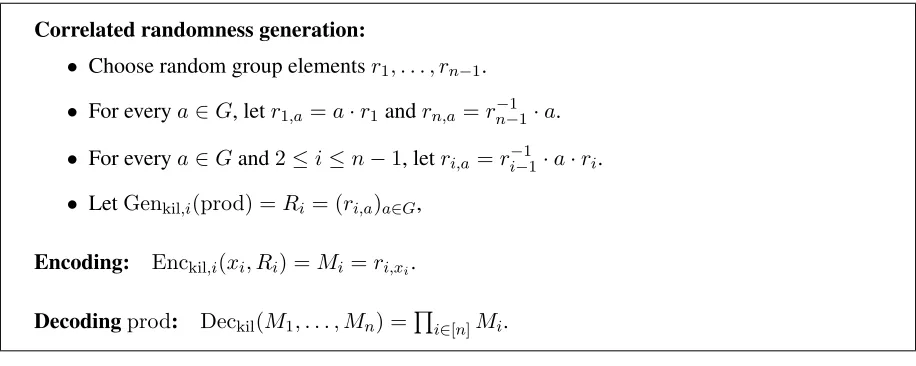
• Group products. For every (possibly non-abelian) finite group G, the iterated group product functionf(x1, . . . , xn) =x1x2. . . xnadmits an efficient, fully robust NIMPC protocol.
• Small functions. Every functionf admits a fully robust NIMPC protocol whose complexity is polynomial in the size of the input domain (i.e., exponential in the total bit-length of the inputs).
∗
• Symmetric functions. Every symmetric functionf :Xn → Y, whereX is an input domain of
constant size, admits at-robust NIMPC protocol of complexitynO(t). For the case wheref is a w-out-of-nthreshold function, we get a fully robust protocol of complexitynO(w).
On the negative side, we show that natural attempts to realize NIMPC using private simultaneous mes-sages protocols and garbling schemes from the literature fail to achieve even 1-robustness.
Keywords: secure multiparty computation, obfuscation, private simultaneous messages protocols, ran-domized encoding of functions, garbling schemes, multi-input functional encryption.
1
Introduction
We introduce and study the notion ofnon-interactive secure multiparty computation(NIMPC). This notion can be viewed as a common generalization of several previous notions from the literature, including obfus-cation, private simultaneous messages protocols, and garbling schemes. It can also be viewed as a simpler and weaker variant of the recently introduced notion of multi-input functional encryption. Before we define the new notion and discuss its relations with these previous notions, we start with a motivating example.
Consider the following non-interactive scenario for secure multiparty computation. Suppose that each ofn “honest but curious” parties holds an input xi ∈ {0,1}, and the parties wish to conduct a vote by
computing the majority value of their inputs. Moreover, the parties want to minimize interaction by each
independentlysending only asinglemessage to each other party.1 It is clear that in this scenario, without any setup, no meaningful notion of security can be achieved: each party can efficiently extract the inputxi
from the message of the corresponding party by just simulating incoming messages from all other parties on inputsxj such thatPj6=ixj =bn/2c.
The question we ask is whether it is possible to get better security by allowing acorrelated randomness
setup. That is, the parties get correlated random strings(R1, . . . , Rn)that are drawn from some
predeter-mined distribution. Such a setup is motivated by the possibility of securely realizing it during an offline preprocessing phase, which takes place before the inputs are known (see, e.g. [27], for further motivation). The above attack fails in this model, since a party can no longer simulate messages coming from the other parties without knowing their randomness. On the other hand, it is still impossible to prevent the following generic attack: any set of partiesT can simulate the messages that originate from parties inT on any given inputs. This allows the parties ofT to learn the output on any set of inputs that is consistent with the other parties’ inputs. In the case of computing majority, this effectively means that the parties inTmust learn the sum of the other inputs whenever it is in the interval[bn/2c − |T|,bn/2 + 1c]. WhenTis small, this would still leave other parties with a good level of security. Hence, our goal is to obtain protocols that realize this “best possible” security while completely avoiding interaction.
The above discussion motivates the following notion ofnon-interactive secure multiparty computation
(NIMPC). An NIMPC protocol for a function f(x1, . . . , xn) is defined by a joint probability distribution R = (R1, . . . , Rn)and local encoding functions Enci(xi, Ri), where 1 ≤ i ≤ n. For a setT ⊆ [n], the
protocol is said to beT-robust(with respect tof) if revealing the messages(Enci(xi, Ri))i6∈T together with
the randomness(Ri)i∈T, where(R1, . . . , Rn)is sampled fromR, gives the same information about(xi)i6∈T
as an oracle access to the functionf restricted to these input values. For0≤t≤n, the protocol is said to bet-robustif it isT-robust for everyT of sizeat mostt, and it is said to befully robustif it isn-robust.
1Alternative motivating scenarios include each party broadcasting a single message, posting it on a public bulletin board such
Recent work on multi-input functional encryption [14] implies that the existence of a fully robust NIMPC protocol for general functions, with indistinguishability based security, is equivalent to indistin-guishability obfuscation (assuming the existence of one-way functions). Combined with the recent break-through on the latter problem [12], this gives candidate NIMPC protocols for arbitrary polynomial-time computable functions (see Section 1.2 for discussion of these and other related works). The above positive result leaves much to be desired in terms of the underlying intractability assumptions and the potential for being efficient enough for practical use. Motivated by these limitations, we consider the goal of realizing NIMPC protocols withinformation-theoretic securityfor special cases of interest.
1.1 Our results
We obtain the following unconditional positive results on NIMPC.
GROUP PRODUCTS. For every (possibly non-abelian) finite groupG, the iterated group product function
fG(x1, . . . , xn) =x1x2. . . xnadmits an efficient, fully robust NIMPC protocol. The construction makes a
simple use of Kilian’s randomization technique for iterated group products [29]. While the security analysis in the case of abelian groups is straightforward (see Example 2.7), the analysis for the general case turns out to be more involved and is deferred to Section 5. We note that this resultcannot be combined with Barrington’s Theorem [5] to yield NIMPC for NC1. For this, one would need to assign multiple group elements to each party and enforce nontrivial restrictions on the choice of these elements. In fact, efficient information-theoretic NIMPC for NC1 is impossible, even with indistinguishability-based security, unless the polynomial-time hierarchy collapses [16] (see Section 1.2).
SMALL FUNCTIONS. We show thateveryfunctionfadmits a fully robust NIMPC protocol whose complex-ity is polynomial in the size of the input domain (i.e., exponential in the total bit-length of the inputs). This result can provide a light-weight solution for functions defined over an input domain of a feasible size. This result is described in Section 3. The technique used for obtaining this result also yieldsefficientprotocols for computing OR ofnbits and, more generally, w-out-of-nthreshold functions where either worn−w
are constant.
SYMMETRIC FUNCTIONS. Finally, we show that every symmetric functionh : Xn → Y, where X is an
input domain of constant size, admits at-robust NIMPC of complexitynO(t). Thus, we get a polynomial-time protocol for any constant t. More generally, our solution applies to any branching program over an abelian groupG, that is, a functionh:X1× · · · × Xn→ Yof the formh(x1, . . . , xn) =f(Pni=1xi)for an
arbitrary functionf :G→ Y(the complexity in this case is|G|O(t)). Useful special cases include the above voting example, its generalization to multi-candidate voting (where the output is a partially ordered list such as “A > B=C > D”), as well as natural bidding mechanisms. We note that while this construction is only
t-robust, larger adversarial setsT can only learn the sumP
i6∈Txi(e.g., the sum of all honest votes in the
majority voting example) as opposed to all the inputs of honest parties. This construction is more technically involved than the previous constructions. A high level overview of a special case of the construction and a formal treatment of the general case appear in Section 4. A more efficient variant of the construction for a constant tis described in Section 7. As a byproduct of our more efficient protocol, we get private simultaneous messages protocols (i.e., 0-robust NIMPC protocols) for symmetric functions in which each party sends justO(nlogn)bits.
Applications. Our main motivating application is for scenarios involving secure computations without interaction, such as the one described above. While in the motivating discussion we assumed the parties to be honest-but-curious, offering protection against malicious parties in the above model is in some sense easier than in the standard MPC model. Indeed, malicious parties pose no additional risk to the privacy
of the honest parties because of the non-interactive nature of the protocol. Moreover, a reasonable level ofcorrectnessagainst malicious parties can be achieved via the use of pairwise authentication (e.g., in the case of binary inputs, the correlated randomness setup may give each party MAC-signatures on each of its two possible messages with respect to the verification key of each other party). In the case where multiple parties receive an output, adversarial parties can use their rushing capabilities to make their inputs depend on the information learned on other inputs, unless some simultaneous broadcast mechanism is employed. For many natural functions (such as the majority function) this type of rushing capability in the ideal model is typically quite harmless, especially whenT is small. Moreover, this issue does not arise at all in the case where only one party (such as an external server) receives an output.
The goal of eliminating simultaneous interaction in secure MPC protocols was put forward by Halevi, Lindell, and Pinkas (HLP) [21, 18]. In contrast to the HLP model, which requires the parties to sequentially interact with a central server, our protocols are completely non-interactive and may be applied with or without a central server. While HLP assume a standard PKI and settle for computational security, we allow general correlated randomness which, in turn, also allows for information-theoretic security.
The NIMPC primitive can also be motivated by the goal of obtaining garbling schemes [33, 6] or ran-domized encodings of functions [25, 1] that are robust to leakage of secret randomness. Indeed, in Yao’s garbled circuit construction, the secrecy of the input completely breaks down if a pair of input keys is re-vealed. In Section 6 we show that this is also the case for other garbling schemes and randomized encoding techniques from the literature. The use oft-robust NIMPC can give implementations of garbled circuits and related primitives that are resilient to up totfully compromised pairs of input keys.
While we did not attempt to optimize the concrete efficiency of our constructions, they seem to be reasonably practical for some natural application scenarios. To give a rough idea of practical feasibility, consider a setting of non-interactive MPC where there arenclients, each holding a single input bit, who send messages to a central server that computes the output. Forn= 20, our fully robust solution for small functions requires each client to send roughly 6MB of data and store a comparable amount of correlated randomness. In the case of computing a symmetric function, such as the majority function from the above motivating example, one can use an optimized protocol, which appears in Section 7, to get a 1-robust solution with the same message size forn≈1100clients (offering full protection against the server and single client and partial protection against larger collusions). In contrast to the above, solutions that rely on general obfuscation techniques are currently quite far from being efficient enough for practical use. We leave open the question of obtaining broader or stronger positive results for NIMPC, either in the information-theoretic setting or in the computational setting without resorting to general-purpose obfuscation techniques.
1.2 Related work
In the following, we discuss connections between NIMPC and several related notions from the literature.
Concretely,UCtakes two types of inputs: input bits specifying a circuitC ∈ C, and input bits specifying an
input to this circuit. An NIMPC protocol forUC, in which each bit is assigned to a different party, gives rise
to the following obfuscation scheme. The obfuscation of a circuitCconsists of the message of each party holding a bit ofC, together with the randomness of the parties holding the input bits forC. By extending the notion of NIMPC to apply to a class of functions (more accurately, function representations), as we do in the technical sections, it provides a more direct generalization of obfuscation that supports an independent local restriction of each input bit.
In contrast to obfuscation, NIMPC is meaningful and nontrivial to realize even when applied to a single function f (rather than a class of circuits), and even when applied to efficiently learnable functions (in particular, finite functions). Indeed, the requirement of hiding the inputs of uncorrupted parties is hard to satisfy even in such cases.
The relation with obfuscation implies limitations on the type of results on NIMPC one can hope to achieve, as it rules out fully robust protocols with simulation-based security for sufficiently expressive cir-cuit classes [4]. Moreover, it follows from the results of [16] that some functions in NC1(in fact, even some families of CNF formulas) do not admit an efficient and fully robust information-theoretic NIMPC protocol, even under an indistinguishability-based definition, unless the polynomial-time hierarchy collapses. How-ever, these negative results on obfuscation do not rule out general solutions with indistinguishability-based security or with a small robustness thresholdt, nor do they rule out fully robust solutions with simulation-based security for simple but useful function classes.
Multi-input functional encryption. NIMPC can be viewed as a simplified and restricted form of multi-input functional encryption, a generalization of functional encryption [32, 19, 31, 7] that was very recently studied in [14]. Multi-input functional encryption is stronger than NIMPC in several ways, the most impor-tant of which is that it requires the correlated randomness to bereusablefor polynomially many function evaluations. It was shown in [14] that multi-input functional encryption for general circuits can be obtained from indistinguishability obfuscation and a one-way function. Combined with the recent breakthrough on obfuscation [12], this gives plausible candidates for indistinguishability-based multi-input functional en-cryption, and hence also fully robust NIMPC, for general circuits. This general positive result can only achieve computational security under strong assumptions. In contrast, by only requiring a one-time use of the correlated randomness, the notion of NIMPC becomes meaningful even in the information-theoretic setting considered in this work.
Private simultaneous messages protocols.A 0-robust NIMPC protocol forf coincides with a protocol for
f in the private simultaneous messages (PSM) model of Feige, Kilian, and Naor [11, 24]. In this model for non-interactive secure computation, the nparties share acommon source of randomness that is unknown to an external referee, and they wish to communicatef(x1, . . . , xn)to the referee by sending simultaneous
the class of boolean functions known to have efficient information-theoretic PSM protocols (or 0-robust NIMPC protocols) and those known to have efficient 1-robust NIMPC protocols. The former class contains the circuit complexity class NC1 as well as different types of log-space classes [11, 24], whereas the latter only covers a very restricted subclass containing symmetric functions and other special types of functions.
Bounded-collusion functional encryption. In the related context of (single-input) functional encryption, Gorbunov et al. [17] have shown how to achieve security against bounded collusions by combining MPC protocols and randomized encoding techniques. Similarly, bounded-collusion identity-based encryption is easier to construct than full-fledged identify-based encryption [10, 15]. We do not know how to apply similar techniques for realizingt-robust NIMPC. The difference is likely to be inherent: while the positive results in [17, 10, 15] rely on standard intractability assumptions and apply even for collusion boundstthat are bigger than the security parameter, a similar general result for NIMPC would suffice to imply general (indistinguishability) obfuscation.
2
Preliminaries
Notation 2.1. For a setX =X1× · · · × XnandT ⊆[n]we denoteXT ,Qi∈T Xi. Forx∈ X, we denote byxT the restriction ofxtoXT, and for a functionh:X →Ω, a subsetT ⊆[n], andxT ∈ XT, we denote byh|T ,x
T :
XT →Ωthe functionhwhere the inputs inXT are fixed toxT.
An NIMPC protocol for a family of functions H is defined by three algorithms: (1) a randomness generation algorithmGen, which given a description of a functionh ∈ Hgeneratesncorrelated random inputsR1, . . . , Rn, (2) a local encoding functionEnci (where1 ≤i ≤ n), which takes an inputxi and a
random inputRiand outputs a message, and (3) a decoding algorithmDecthat reconstructsh(x1, . . . , xn)
from thenmessages. Formally:
Definition 2.2(NIMPC: Syntax and Correctness). LetX1, . . . ,Xn,R1, . . . ,Rn, M1, . . . ,Mn andΩbe finite domains. LetX ,X1× · · · × Xnand letHbe a family of functionsh :X →Ω. Anon-interactive secure multiparty computation (NIMPC) protocol forHis a tripletΠ = (Gen,Enc,Dec)where
• Gen :H → R1× · · · × Rnis a randomized function,
• Encis ann-tuple of deterministic functions(Enc1, . . . ,Encn), whereEnci :Xi× Ri→ Mi,
• Dec :M1× · · · × Mn→Ωis a deterministic function satisfying the following correctness require-ment: for anyx= (x1, . . . , xn)∈ X andh∈ H,
Pr[R= (R1, . . . , Rn)←Gen(h) : Dec(Enc(x, R)) =h(x)] = 1,
whereEnc(x, R),(Enc1(x1, R1), . . . ,Encn(xn, Rn)).
Thecommunication complexityof Πis the maximum oflog|R1|, . . . ,log|Rn|,log|M1|, . . . ,log|Mn|.
We next define the notion of t-robustness for NIMPC, which informally states that everytparties can only learn the information they should. Note that in our setting, a coalitionT of sizetcan compute many outputs from the messages ofT, namely, they can repeatedly encode any inputs for the coalition T and decodehwith the new encoded inputs and the original encoded inputs ofT. In other words, they have oracle access toh|T ,x
Definition 2.3(NIMPC: Robustness). For a subsetT ⊆[n], we say that anNIMPCprotocolΠforHisT -robustif there exists a randomized functionSimT (a “simulator”) such that, for everyh∈ HandxT ∈ XT, we haveSimT(h|T ,x
T) ≡ (MT, RT),whereR andM are the joint randomness and messages defined by
R←Gen(h)andMi ←Enci(xi, Ri).
For an integer0 ≤t≤ n, we say thatΠist-robustif it isT-robust for everyT ⊆[n]of size|T| ≤t. We say thatΠisfully robust(or simply refer to Πas anNIMPCforH) ifΠisn-robust. Finally, given a concrete functionh:X →Ω, we say thatΠis a (t-robust)NIMPC protocol forhif it is a (t-robust)NIMPC
forH={h}.
As the same simulator SimT is used for every h ∈ H and the simulator has only access to h|T ,xT,
NIMPC hides bothhand the inputs ofT (to the extent possible).
Remark 2.4(0-robust NIMPC and PSM). AnNIMPCprotocolΠis0-robustif it is∅-robust. In this case, the only requirement is that the messages(M1, . . . , Mn)revealh(x)and nothing else. A0-robustNIMPC forh corresponds to aprivate simultaneous messages (PSM) protocol in the model of [11]. Note that in a 0-robustNIMPCone can assume, without loss of generality, that thenoutputs ofGenare identical. In contrast, it is easy to see that in a 1-robustNIMPCof a nontrivialhmore general correlations are required.
While the above definitions treat functions has finite objects and do not refer to computational com-plexity, our constructions are computationally efficient in the sense that the total computational complexity is polynomial in the communication complexity. Furthermore, with the exception of the protocol from Lemma 3.2, the same holds for the efficiency of the simulator SimT (viewing the latter as an algorithm
having oracle accessto h|T ,x
T). When taking computational complexity into account, the function Gen should be allowed to depend not only onhitself but also on its specific representation (such as a branching program computingh).
Remark 2.5(Statistical and computational variants). In this work, we considerNIMPCprotocols with per-fect security, as captured by Definition 2.3. However, one could easily adapt the above definitions to capture statistical security and computational security. In the statistical case, we let Genreceive a security pa-rameterκ as an additional input, and require that the two distributions in Definition 2.3 be (2−κ)-close in statistical distance, rather than identical. In the computational case, we have two main variants corre-sponding to the two main notions of obfuscation from the literature. In both cases, we require that the two distributions in Definition 2.3 be computationally indistinguishable. The difference is in the power of the simulator. If the simulator is unbounded, we get an indistinguishability-basedNIMPCfor which a general construction is implied by indistinguishability obfuscation [12, 14]. If the simulator is restricted to proba-bilistic polynomial time, we get the stronger “virtual black-box” variant to which the impossibility results from [4] apply and one can only hope to get general positive results in a generic model [8, 3] or using tamper-proof hardware [20]. We note, however, that the latter impossibility results only apply to function classes that are rich enough to implement “cryptographically nontrivial” functions such as pseudo-random functions. In particular, they do not apply to efficiently learnable classes for which obfuscation is trivial. In contrast,NIMPCis meaningful and nontrivial even in the latter case.
The value ofR0 is given as an additional input to the decoder and should be correctly simulated bySim
(namely, the random variableRT should be redefined to always includeR0). An example for the usefulness
of the offline-online model is in the context of computationally 0-robust NIMPC protocols, where the offline communication of a garbled circuit can be used to make the online communication complexity close to the input length, regardless of the complexity ofh[33, 2].
As a simple example, we present an NIMPC protocol for summation in an abelian group.
Example 2.7(NIMPC for sum). LetGbe an abelian group, and defineh:Gn→Gbyh(X1, . . . , Xn) = X1 +· · ·+Xn (where the sum is in G). We next define a fully robust NIMPC for h. Algorithm Gen chooses n−1 random elements R1, . . . , Rn−1 in G, where each element is chosen independently with
uniform distribution, and computesRn =−Pn−i=11Ri. The output ofGenis(R1, . . . , Rn). AlgorithmEnc computesEnci(xi, Ri) =xi+Ri,Mi. AlgorithmDecsimply sums thenoutputs ofEnc, that is, computes Pn
i=1Mi. As Pn
i=1Mi =
Pn i=1xi+
Pn
i=1Ri, and
Pn
i=1Ri = 0, correctness follows. We next show that this
construction is fully robust. Fix a setT ⊆[n]and define the simulatorSimT forT. On inputsxT, it queries h|T ,x
T(0
|T|)and getssum = P
i∈T xi. The simulator then choosesn−1random elementsρ1, . . . , ρn−1
inG, each element is chosen independently with uniform distribution, and computesρn= sum−Pn−i=11ρi. The output of the simulator is((ρi)i∈T,(ρi)i∈T).
The following easily verifiable claim states that for functions outputting more than one bit, we can compute each output bit separately. Thus, from now on we will mainly focus on boolean functions.
Claim 2.8. LetX ,X1× · · · × Xn, whereX1, . . . ,Xnare some finite domains. Fix an integerm >1. Sup-poseHis a family of boolean functionsh:X → {0,1}admitting anNIMPCprotocol with communication complexityS. Then, the family of functionsHm={h:X → {0,1}m|h=h
1◦. . .◦hm, hi ∈ H}admits anNIMPCprotocol with communication complexityS·m.
2.1 NIMPCwith an output server
While an NIMPC protocolΠas defined above can be viewed as an abstract primitive, in the following it will be convenient to describe our constructions in the language of protocols. Such a protocol involvesnplayers
P1, . . . , Pn, each holding an inputxi ∈ Xi, and an external “output server,” a playerP0 with no input. The protocol may have an additional input, a functionh ∈ H. We will letP(Π)denote a protocol that proceeds as follows.
ProtocolP(Π)(h)
• Offline preprocessing:Each playerPi,1≤i≤n, receives the random inputRi,Gen(h)i ∈ Ri.
• Online messages:On inputRi, each playerPi,1≤i≤n, sends the messageMi ,Enci(xi, Ri)∈
MitoP0.
• Output:P0computes and outputsDec(M1, . . . , Mn).
We informally note the relevant properties of protocolP(Π):
• FixT ⊆ [n]. Then, ΠisT-robust if inP(Π)the set of players {Pi}i∈T ∪ {P0} can simulate their view of the protocol (i.e., the random inputs{Ri}i∈T and the messages{Mi}i∈T) given oracle access
to the functionhrestricted by the other inputs (i.e.,h|T ,x T).
• Πis0-robust if and only if inP(Π)the output serverP0learns nothing buth(x1, . . . , xn).
In Appendix A we give a more general treatment of non-interactive MPC, including security definitions and extensions to the case where multiple parties may have different outputs and to the case of security against malicious parties.
3
An inefficient
NIMPC
for arbitrary functions
The main purpose of this section is to present an NIMPC protocol for the set of all functions. The commu-nication complexity of the protocol is polynomial in the size of the input domain, namely it is exponential in the bit-length of the inputs. It will be useful to first present an NIMPC protocol forindicatorfunctions. For reasons to be clarified later on, it will be convenient to include the zero-function.
Definition 3.1. LetX be a finite domain. Forn-tuplea = (a1, . . . , an) ∈ X, letha :X → {0,1}be the function defined byha(a) = 1, andha(x) = 0for alla6=x∈ X. Leth0 :X → {0,1}be the function that
is identically zero onX. LetHind,{ha}a∈X ∪ {h0}be the set of all indicator functions together withh0.
Note that every function h : X ← {0,1}can be expressed as the sum of indicator functions, namely,
h=P
a∈X,h(a)=1ha.
Lemma 3.2. Fix finite domainsX1, . . . ,Xnsuch that|Xi| ≤dfor all1≤i≤nand letX ,X1× · · · × Xn. Then, there is anNIMPCprotocolΠindforHindwith communication complexity at mostd2·n.
Proof. Fori∈[n], denote|Xi|=di. Lets= Pn
i=1di. Fix a functionh∈ Hthat we want to compute. The
NIMPCΠind(h)is as follows.
Correlated randomness generation: If h = h0, then choose s linearly independent random vectors {mi,b}i∈[n],b∈XiinF
s
2. Ifh=hafor somea= (a1, . . . , an)∈ X, choosesrandom vectors{mi,b}i∈[n],b∈Xi in Fs2 under the constraint that
Pn
i=1mi,ai = 0 and there are no other linear relations between them (that is, choose all the vectorsmi,b, exceptmn,an, as random linear independent vectors and setmn,an = −Pn−1
i=1 mi,ai). Now defineGenind(h) =R= (R1, . . . , Rn), whereRi ={mi,b}b∈Xi.
Encoding:Encind(x, r) = (M1, . . . , Mn), whereMi ,mi,xi.
Decodingh(x1, . . . , xn): Decind(M1, . . . , Mn) = 1ifPni=1Mi =0.
For the correctness, note thatPn
i=1Mi =Pni=1mi,xi.Ifh =ha, fora∈ X, this sum equals0if and only ifx=a. Ifh=h0, this sum is never zero, as all vectors were chosen to be linearly independent in this case.
To prove robustness, fix a subsetT ([n]andxT ∈ XT. The encodingsMT ofT consist of the vectors {mi,xi}i∈T. The randomnessRT consists of the vectors{mi,b}i∈T ,b∈Xi. Ifh|T ,xT ≡0, then these vectors
are uniformly distributed inFs2 under the constraint that they are linearly independent. Ifh|T ,xT(xT) = 1,
for somexT ∈ XT, thenPni=1mi,xi = 0and there are no other linear relations between them. Formally, to prove robustness, we describe a simulatorSimT: the simulator queriesh|T ,x
such thath|T ,x
T(xT) = 1, and the simulator outputs random vectors under the constrains described above, that is, all vectors are independent with the exception thatPn
i=1mi,xi = 0.
As for communication complexity, the correlated randomness is composed ofdi ≤ dbinary vectors of
lengths≤dnand the encoding is one of them. Hence, the communication complexity is at mostd2n.
We next present an NIMPC for all boolean functions with domainX =X1× · · · × Xn. The idea is to express anyh : X → {0,1}as a sum of indicator functions, that is,h = P
a∈X,h(a)=1ha, and construct
an NIMPC forh by using the NIMPC protocols for eachha. A naive implementation of this idea has two
problems. First, it will disclose information on how many 1’s the functionhhas. To overcome this problem, we defineh0a = haifh(a) = 1andh0a = h0 otherwise (this was the motivation of includingh0 inHind).
Thus, h = P
a∈Xh0a. The second problem is that if, for example, h(x) = 1and a coalition learns that h0a(x) = 1, then the coalition learns thatx =a. To overcome this problem, in the correlated randomness generation, we permute the domainX.
Theorem 3.3. Fix finite domainsX1, . . . ,Xnsuch that|Xi| ≤dfor all1≤i≤nand letX ,X1×· · ·×Xn. Let H be the set of all functions h : X → {0,1}m. There exists an NIMPC protocol Π
Γ for H with
communication complexity|X | ·m·d2·n.
Proof. LetΠind = (Genind,Encind,Decind)be the NIMPC forHinddescribed in Lemma 3.2. Fixh∈ H. Assume for simplicity thatm= 1(see Claim 2.8). ProtocolΠΓ(h)is as follows.
Correlated randomness generation:
• LetI ⊆ X be the set of ones of h (i.e.,I = h−1(1)). For eacha ∈ I, let ra = (ra1, . . . , ran) ←
Gen(ha). Fora∈ X \I, letra←Gen(h0).
• Choose a random permutation π ofX and define a matrix R, where Ri,b , r π(b)
i for i ∈ [n]and b∈ X. Now defineGenΓ(h) = (R1, . . . , Rn), whereRi= (Ri,b)b∈X (that is, theith row ofR).
Encoding:Define a matrixM, whereMi,b ,Encind,i(xi, Ri,b)for everyi∈[n]andb∈ X. The encoding
isEncΓ,i(xi, Ri) =Mi,(Mi,b)b∈X for eachi.
Decodingh:DecΓ(M1, . . . , Mn) = 1if for someb∈ X,Decind(M1,b, . . . , Mn,b) = 1.
Correctness:Fixx= (x1, . . . , xn)∈ X. The decoding returns 1 if and only ifDecind(M1,b, . . . , Mn,b) = 1for some b ∈ X, namely, if and only ifDecind(Encind,1(x1, R1,b), . . . ,Encind,n(xn, Rn,b)) = 1. This
happens if and only ifDecind(Encind,1(x1, R1a), . . . ,Encind,n(xn, Ran)) = 1fora=π(b). By the
correct-ness ofΠind and the protocol description, the above happens if and only ifha(x1, . . . , xn) = 1for some a∈I, that is, if and only ifh(x1, . . . , xn) = 1.
Communication Complexity is obtained by applyingΠindfor|X |times.
Robustness: FixT ⊆ [n]andxT ∈ XT. We wish to simulate the distribution (MT, RT)given h|T ,x
T. We can think of this distribution as being composed of rows, where each rowbis of the form(Ma
T, r a T)for a=π(b), where the permutationπis random.
Observation 3.4. IfaT =xT andh(a) = 1then this row was generated for the functionha, and ifaT =xT andh(a) = 0then this row was generated forh0. Finally, ifaT 6=xT, then this row is distributed as if it
We next construct a simulator SimT for the protocol P(Π) on functionh. Simulator SimT uses the
simulatorSimΠind
T – the simulator for the set T for the NIMPCΠindof Lemma 3.2. The simulator SimT
first queriesh|T ,x
T(xT)for everyxT ∈ XT. LetI
0 ⊆ X
T be the set of ones ofh|T ,x
T. For everyxT ∈I
0,
the simulatorSimT computesSxT = Sim Πind
T (hxT)(wherehxT :XT → {0,1}is such thathxT(x) = 1if and only ifx=xT). Finally,SimT samplesSimΠTind(h0)for|X | − |I0|times (whereh0:XT → {0,1}such
thath0(x) = 0for everyx∈ XT). Altogether, it obtains|X |outputs of the simulatorSimΠTind. It randomly
permutes the order of these outputs, and returns the permuted outputs. TheT-robustness ofSimT follows
from theT-robustness ofSimΠind
T and Observation 3.4.
Remark 3.5. In the above proof, instead of looking at the set of all functions, we could have looked at the set of functions that are OR’s of a fixed subset H0 ⊂ H
ind of indicator functions. For this set of
functions, we would get anNIMPCwith communication complexity|H0| ·m·poly(d, n) (rather than the
|X | ·m·poly(d, n)communication complexity above). We could also look at a particular function of this form. Take, for example, X = {0,1}nandH0 to be the set of indicator functions of vectors of weight w. Then, we get anNIMPCfor thew-out-of-nthreshold function with communication complexitynO(w).
4
A
t
-robust
NIMPC
for abelian programs
In this section, we present an NIMPC for symmetric functions. In fact, this result is a corollary of a more general result on NIMPC for abelian group programs. In Section 4.1, we define abelian programs and symmetric functions and formally state our results. In Section 4.2, we give a high level overview of the construction. In Section 4.3, we supply a detailed description of our construction and prove its correctness.
4.1 Our results
Definition 4.1. LetGbe an abelian group,S1, . . . , Snbe subsets ofG, andHGS1,...,Snbe the set of functions
h:S1× · · · ×Sn → {0,1}of the formh(X1, . . . , Xn) =f(Pni=1Xi),for somef :G→ {0,1}. We call such functionshabelian programs.
Definition 4.2. A function h : [d]n → {0,1} is symmetric if for every(x1, . . . , xn) ∈ [d]n and every permutationπ : [n]→[n]the following equality holdsh(x1, . . . , xn) =h(xπ(1), . . . , xπ(n)).
The main positive result in this section is an efficient t-robust NIMPC for HG
S1,...,Sn whenever G is abelian of poly(n)-size andtis constant.
Theorem 4.3. Lettbe a positive integer andGan abelian group of sizem. LetS1, . . . , Snbe subsets ofG. Then, there is at-robustNIMPCprotocol forHG
S1,...,Snwith communication complexityO(d
t+2·nt+2·m3),
whered,maxi∈[n]|Si|. IfG=Zn+1andS1 =· · ·=St={0,1}, then the communication complexity of theNIMPCisO(2t·nt+4).
Corollary 4.4. Letd, tandnbe positive integers. LetHbe the set of symmetric functionsh: [d]n→ {0,1}. There is at-robustNIMPCprotocol forHwith communication complexityO(dt+2·nt+3d−1). For the class
of boolean symmetric functionsh:{0,1}n→ {0,1}, the communication complexity isO(2t·nt+4).
Proof. The corollary is proved by showing that every symmetric function can be computed by an abelian program overZdn+1. Specifically, given an inputx = (x1, . . . , xn) ∈ [d]n, the abelian program first
ofjinx). As0≤zj ≤n, we consider it as an element inZn+1. By definition of symmetric functions, the output ofhcan be computed fromz.
Specifically, define S1 = · · · = Sn = {e1, . . . , ed} ⊆ Zdn+1, whereei ∈ Zdn+1 is thei’th unit vector. Given a symmetric function h : [d]n → {0,1}, we consider a symmetric function h0 whose domain is {e1, . . . , ed}n. That is, for an inputj ∈[d], defineφ(j) ,ej and for an input(x1. . . , xn) ∈ [d]n, look at
the sumz , Pn
i=1φ(xi) ∈ Zdn+1. For any symmetric function h : [d]n → {0,1}, there exists a function
f : Zdn+1 → {0,1}such thath(x1, . . . , xn) = f( Pn
i=1φ(xi)). Defineh0 : S1 × · · · ×Sn → {0,1} by h0(y1, . . . , yn),f(Pni=1yi).Note thath0∈ HS1,...,Sn.
Thus, by first mapping the inputsxitoφ(xi), we get at-robust NIMPC ofHusing at-robust NIMPC
ofHS1,...,Sn. Theorem 4.3 gives us at-robust NIMPC ofHS1,...,Snof communication complexityO(d
t+2·
nt· |Zd
n+1|3) =O(dt+2·nt·n3d).
We can optimize the above construction by noting that in the above definition of z, it must be that
Pd
`=1zj = n. Therefore, the above function f can ignore the last coordinate of
Pn
i=1φ(xi), and we can define the abelian program over the groupZd−n+11, resulting in an NIMPC of communication complexity
O(dt+2·nt· |Zd−n+11|3) =O(dt+2·nt·n3d−3) =O(dt+2·nt+3d−3)ford >2and communication complexity
O(2tnt+4)ford= 2(i.e., for boolean symmetric functions).
Note that Corollary 4.4 is a special case of the following: Whenever we can “embed” a function h
(or a set of functions) into an abelian group program, we can get an NIMPC forhwhose communication complexity depends polynomially on the size of the group.
Corollary 4.5. Fix integerst≤n, finite domainsΩ1, . . .Ωn, an abelian groupGandS1, . . . , Sn⊆G. Let d= maxi∈[n]|Si|. Fix a functionh: Ω1× · · · ×Ωn → {0,1}. Suppose we have mappingsφi : Ωi → Si, for 1 ≤ i ≤ n, and a function f : G → {0,1} such that for every(x1, . . . , xn) ∈ Ω1 × · · · × Ωn h(x1, . . . , xn) = f(Pni=1φi(xi)).Then, there is a t-robustNIMPCofh with communication complexity O(dt+2·nt+2· |G|3).
4.2 Overview of the construction
In this section we give a high level overview of ourt-robust protocol for abelian programs. Before outlining our construction, we start with a simple approach for adding some robustness to an arbitrary PSM proto-col. (Recall that a PSM protocol is a∅-robust NIMPC protocol.) Consider a PSM protocol for a function
h(x1, . . . , xn). Suppose that we would like to make this protocol{i}-robust, in addition to being∅-robust.
To this end, the following transformation can be used. For each possible valuevofxi, all parties exceptPi
run an instance of the protocol in which the common randomness is unknown toPi, and some fixed party
(other thanPi) sends the message ofPicorresponding to the inputxi =v. In this PSM,P0cannot compute the correct output; this problem will be fixed later.
The above protocol is{i}-robust, sinceP0cannot andPitogether learn no more than the values ofhon
the inputs of the honest parties with each possible value of xi. However, the protocol is not∅-robust. To
make it∅-robust without compromising{i}-robustness, we apply the following masking technique. First, the instances of the PSM protocol are permuted by a random permutationσ that is known to all parties, includingPi, but not toP0. The pointerσ(xi)to the correct instance is sent byPi. This allowsP0to learn the correct output without allowingP0to directly learn the correct value ofxi. However, this protocol is not
∅-robust, sinceP0 can still learn the outputs ofhon the other values of xi. To eliminate this information,
of the PSM protocol fromP0. The correct maskrxi is then sent by Pi in order to reveal only the correct instance toP0.
The above technique can be generalized to add T0-robustness to any PSM protocol, for any fixed set
T0 ⊆ [n]. However, such a protocol does not necessarily provide any security guarantee against other sets
T 6=T0. Our high level approach is to obtaint-robustness by combiningT-robust protocols for allT of size at mostt. While there are standard MPC-based techniques forcombininginstances of secure computation protocols of which a strict minority are faulty [23, 22, 17], in our case a majority of the instances will be insecure with respect to any fixedT0. This makes the problem of securely combining such instances more challenging.
To describe our solution idea, we focus here on the special case of symmetric functionshwith robustness threshold t = 1. The general case is similar. (Recall that a boolean function h : {0,1}n → {0,1} is
symmetric if there exists a functionf :{0, . . . , n} → {0,1}such thath(x1, . . . , xn) = f(Pni=1xi).) Our
protocol forhadditivelysecret-shareshinto random symmetric functionshi :{0,1}n→ {0,1},1≤i≤n,
whose mod-2 sum is h. It then invokes for each ian NIMPC protocolΠi with robustness against both∅
and{i}, where this protocol hides (to the extent possible) not only the input x but also the functionhi.
Furthermore, it is required that for eachi0 ∈ [n]\ {i}, a collusion ofPi0 andP0 can only learn from their
view inΠi limited information about(hi, x). Concretely, they should only learn the length-(n+ 1)
“truth-table” ofhi, cyclically shifted byPj∈[n]\{i0}xj. (The truth-table ofhicontains the outputs ofhion inputs
of weight0,1, . . . , nin this order.)
Overall, P0 and Pi learn from the invocation of Πi only the two outputs of hi they are allowed to
learn (corresponding to the two possible values of xi) and no additional information on hi and x. From
the invocations ofΠj, j ∈ [n]\ {i}, they can also learn, in addition to these two entries ofhj, all other
entries of the (shifted) truth-table ofhj. However, by the use ofn-out-of-nsecret sharing and the fact that
the corresponding entries in the truth-table ofhi are hidden, these additional entries reveal no additional
information onhandx.
A protocolΠias above is constructed in two steps. The first step is an ad-hoc construction (based on a
PSM protocol for branching programs from the literature) of a PSM protocol that reveals toanysetT only the shifted truth-table ofhi. The second step adds robustness againstT ={i}, namely it blocksP0, Pifrom
learning any other entry in the shifted truth-table beyond the two entries they are supposed to learn.
The following more detailed exposition of our construction consists of three steps, where the first two steps obtain the protocolΠi for evaluatinghi and the third steps combines the protocolsΠi into a single
protocol forh. We note that while the second step is general and can apply to any class of functions, both the first and the third steps rely on special properties of symmetric functions (or, more generally, abelian programs). The following three subsections describe the three steps of the construction.
4.2.1 AnNIMPCfor abelian programs with extended input domain
We start by describing the first step of our construction, which considers a variant of abelian programs where the players are allowed to choose their inputs from the entire group. Concretely, for the case of boolean symmetric functions on which we focus in this overview, we allow each partyPi to have an input xi ∈ {0, . . . , n}(rather thanxi ∈ {0,1}), which can be thought of as an element of the groupG,Zn+1. The fact that dishonest parties can learn the “shifted truth-table” of the function is captured by allowing them to pick their inputs from the entire group.
More concretely, we extend a boolean symmetric function of the form f(Pn
i=1xi) to a function h : Gn → {0,1}defined byh(x1, . . . , xn) = f(Pni=1xi), where the sum is taken inG. The first step of our
extensions of all symmetric functions. Note that here it is crucial to hide both the functionhand the inputs
xi to the extent possible, namely up to revealing the truth table off shifted by the sum of the inputs of the
honest parties. In our final protocol for symmetric functions, honest parties will invoke this protocol with inputsxi ∈ {0,1}. Thus, the following description of the protocol assumes that the input of each honest
party is from{0,1}.
The NIMPC protocol for His based on the PSM protocol for branching programs from [24], which provides an efficient solution for symmetric functions. This protocol is defined using abranching program
representation ofh. While this protocol is secure when onlyP0is corrupted, it does not remain secure when even a single other party is corrupted. Luckily, there is a simple characterization of the information available to an adversary corruptingP0 and a setT of other partiesPi: these players learn no more than the graph of
the branching program restricted to the inputsxT¯. That is, the adversary can learn the labels of all edges it owns (e.g., that such an edge is labeled by the literalx¯i or the constant1), as well as thevaluesof edges
it does not own (e.g., that such an edge evaluates to 1) but not their labels. If we apply the protocol to a standard branching program forh, this information will typically reveal to the adversary both the function
hand the inputsxT¯.
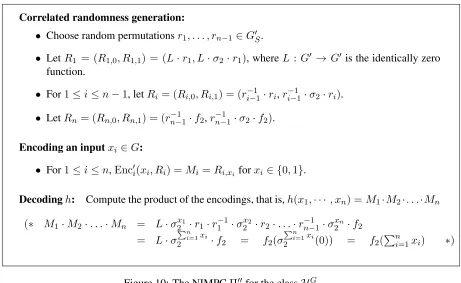
The key idea for realizing H is to randomize the branching program before applying the protocol from [24]. That is, we start with a standard layered branching program for the symmetric functionh, and then (during preprocessing) we randomize it by applying a random cyclic shift to the nodes in each layer. The protocol from [24] is applied to the randomized branching program. With this randomization in place, revealing the branching program restricted byxT¯leaks nothing about(h, xT¯)except what must be learned.
4.2.2 Limiting the inputs of one player
The previous subsection gives an NIMPC protocol for the class of (extended) symmetric functionsh, with the caveat that the players may use any input inG=Zn+1, rather than just{0,1}. Let us call this protocol
Π0(h).
As mentioned, we need to limit the parties to inputs from{0,1}. Note that for NIMPC this is relevant also in the honest-but-curious model since the robustness requirement for the extended function allows an adversary, controlling a setT, to computeh|T ,x
T on the domainG
|T|, while for the original function we
only allow the adversary to computeh|T ,x
T on the domain
{0,1}|T|.
Example 4.6. Consider the majority function maj : {0,1}n → {0,1}, where maj(x
1, . . . , xn) = 1 if and only ifPn
i=1xi ≥ n/2. In an NIMPCfor majority,P1 is allowed to learn ifPni=2xi ≥ n/2and if 1 +Pn
i=2xi ≥n/2. If we extend the domain toZn+1, partyP1is allowed to learn ifa+Pni=2xi ≥n/2 for everya∈Zn+1, that is,P1can learnPni=2xi.
In this section, as an intermediate step, we construct a protocol where a specific player, sayP1, is limited to inputs in{0,1}. The other players,P2, . . . , Pn, can still choose any inputs inG. Leth0andh1denote the functionhwhere the first input is fixed to0and1, respectively, that is,hi(X2, . . . , Xn),h(i, X2, . . . , Xn),
fori∈ {0,1}. Consider the following protocol: P2, . . . , Pn run the protocolsΠ0(h0)andΠ0(h1). At the end of this protocol, the coalition{P0, P1}– seeing the messages ofΠ0(h0) andΠ0(h1) – knowsexactly what it is supposed to know: the values h(0, x2, . . . , xn) andh(1, x2, . . . , xn). However, there are two
evident problems.
1. On one hand,P0alone knows “too much”: the same two valuesh(0, x2, . . . , xn)andh(1, x2, . . . , xn).
A possible “solution” to the second problem is forP1to send its inputx1toP0. This is, of course, insecure. Instead, we runΠ0(h0)andΠ0(h1)in a random order, known only toP1and given to it in the preprocessing stage (note thatP2, . . . , Pnneed not know which of the two protocols is running to participate). PartyP1 will then send a message stating which one corresponds to its input.
A solution to the first problem is as follows: The (symmetric) functionsh0andh1(which can be though of as(n+1)-bit strings representing their truth tables) are “masked” by ((n+1)-bit) random functionsr0and
r1 (whererb :G→ {0,1}). Let us call these masked versionsg0 andg1. Specifically,gj(X2, . . . , Xn) , hj(X2, . . . , Xn)⊕rj(Pni=2Xi), forj∈ {0,1}. In the preprocessing stage, we give the masking functions r0andr1toP1. NowP0, P2, . . . , PnrunΠ0(g0)andΠ0(g1)(in a random order). Then,P1sends toP0only the maskingri corresponding to its input. In terms of security, the problem has been solved: the protocol
not corresponding toP1’s input, i.e.,Π0(g1−x1), does not reveal any information toP0, asg1−x1 is a masked version ofh, where the mask has not been revealed. However, canP0 now computeh(x1, . . . , xn)? From
seeing the messages ofΠ0(gx1), it knowsgx1(x2, . . . , xn) =h(x1, . . . , xn)⊕rx1(
Pn
i=2xi). It also knows
rx1, which was sent byP1. So now, to “unmask”h(x1, . . . , xn)usingrx1 it needs the value
Pn
i=2xi, which
is more information than we want to give it.
Further randomization techniques are needed to solve this problem, combined with the solutions to the two problems above. Specifically, leth(x1, . . . , xn) =f(Pni=1xi)be the function we want to compute. In
the preprocessing stage we choose a random elements∈ Gas well as two random stringsr0, r1 and a bit
ρ. The stringsr0, r1 and the bitρare given toP1. We next define two masked functionsgj(X2, . . . , Xn), f((j⊕ρ) +Pn
i=2Xi)⊕rj⊕ρ(s+Pni=2Xi)forj ∈ {0,1}. Notice thatg0 andg1 are abelian programs. We next execute three NIMPCs withP2, . . . , Pn: the NIMPCΠ0(g0), the NIMPCΠ0(g1), and an NIMPC fors+Pn
i=2Xi(this shifted sum gives no information toP0). In addition,P1sendsz=ρ⊕x1andrxito
P0. PartyP0now decodes
gz(x2, . . . , xn) = f ((ρ⊕x1)⊕ρ) +
n X
i=2
xi !
⊕r(ρ⊕x1)⊕ρ(s+
n X
i=2
xi)
= h(x1, . . . , xn)⊕rx1(s+
n X
i=2
xi).
PartyP0, which knowsrx1 ands+
Pn
i=2xi, can, therefore, reconstructh(x1, . . . , xn).
4.2.3 A combiner using secret sharing
The previous section described a protocol where, for a certain fixedj ∈[n], the coalition{P0, Pj}does not
learn “too much” – specifically, it could evaluate the functionhonly on inputs in{0,1}(while a coalition of
P0with one of the other players is still not restricted to inputs in{0,1}). Call this protocolΠ1. Note thath is of the formh(X1, . . . , Xn) =f(Pni=1Xi)for a functionf :G→ {0,1}. We now bootstrap the protocol Π1 to create one in whichallplayers can evaluateh only on inputs in{0,1}. For this, we use an additive secret sharing off. Namely, we choosenrandom functionsf1, . . . , fn:G→ {0,1}, such thatPni=1fi = f, where the sum is a xor of |G|-bit vectors. For1 ≤ i ≤ n, define hi(X1, . . . , Xn) , fi(Pnj=1Xj).
Note that for anyx1, . . . , xn ∈ G, we have h(x1, . . . , xn) = Pin=1hi(x1, . . . , xn). For 1 ≤ i ≤ n, we
runΠ1 on the functionhi withPi chosen to be the player that can only use inputs in{0,1}. After these
protocols are run we have that, on the one hand, P0 knows h1(x1, . . . , xn), . . . , hn(x1, . . . , xn) and can
computeh(x1, . . . , xn) = Pni=1hi(x1, . . . , xn). On the other hand, for anyi ∈ [n]anda ∈ G\ {0,1},
4.3 The construction and its proof
In the rest of this section we prove our main positive result – Theorem 4.3. We begin by introducing some notation that will be convenient for the proof.
Notation 4.7. Fixx = (x1, . . . , xn) ∈ S1× · · · ×Sn. We denotesum(x) , Pni=1xi, and for a subset T ⊆ [n] we denote sum(xT) , Pi∈T xi (if T = ∅, then sum(xT) , 0). We also use the notation ST ,Qi∈T Si.
The proof of Theorem 4.3 follows the outline described in Section 4.2, and is divided into subsections in a similar way. Section 4.3.1 describes an NIMPC for the case thatSi =Gfor everyi. Section 4.3.2 describes
an NIMPC where a fixed subset of a players is limited to smaller input domains. Finally, Section 4.3.3 gives the desired protocol for proving Theorem 4.3, i.e., an NIMPC where every subset of players of bounded size is limited to small input domains.
4.3.1 AnNIMPCfor abelian programs with extended input domain
We next describe an NIMPC for the case thatSi = Gfor everyi(recall that in the general caseSi ⊆ G).
This NIMPC uses the PSM protocol of [24], which, in turn, uses branching programs.
Definition 4.8. A deterministic branching program B over a group G on n inputs is a directed acyclic graph, containing a source vertexsand a target vertext. Each edge has a label of the formXi = afor somei∈[n]anda∈G. For any vertexvthere exits a uniquei∈[n]such that every outgoing edge fromv
is labeledXi =afor somea∈G, and, furthermore, fora∈G, there is at most one outgoing edge fromv labeledXi=a. For an inputx= (x1, . . . , xn), letBxbe the subgraph ofB containing precisely the edges labeledXi =xi for alli ∈ [n]. The branching programB computes a functionf :Gn → {0,1}, where f(x1, . . . , xn) = 1if and only ifB(x1,...,xn)contains a path fromstot.
We assume, w.l.o.g., thatshas no incoming edges andthas no outgoing edges, and fix a topological order on the vertices of the branching program, where s is the first and t is the last. We represent the branching program by n· |G| matrices, where for every i ∈ [n]and a ∈ G, we define B0i,a to be the adjacency matrix of the subgraph ofBcontaining only the edges labeledXi =a, that is, we label the rows and columns of the matrix by the vertices of the branching program according to the fixed topological order and entryi, jof the matrix is one if there is an edges fromvi tovj labeled byXi =aand the entry is zero otherwise. For everyi∈[n−1]anda∈Gwe defineBi,aas the matrix obtained fromB0i,aby removing the first column (labeled bys) and the last row (labeled byt). For everya∈G, we defineBn,aas the matrix obtained fromB0n,a−Iby removing the first column and the last row.
The “strange” definition ofBn,afollows from its use in [24]. Specifically, using this notation, for every
inputx1, . . . , xn: iff(x1, . . . , xn) = 1then the matrixPni=1Bi,xi has full rank, and otherwise the matrix has rankN −1(where the matrix is anN ×N matrix). The following theorem follows directly from [24].
Theorem 4.9 (Ishai and Kushilevitz [24]). Fix an abelian group G, and an integer n. LetH be the set of functions computable by a branching program overG on ninputs with N + 1vertices. The NIMPC
ΠIK = (GenIK,EncIK,DecIK) described in Figure 1 is a 0-robust NIMPCof Hwith communication complexityO(|G| ·N2).
The NIMPCΠIK is only 0-robust as, for example,Ricontains information on the branching program.
Correlated randomness generation:
• Choose random non-singularN ×N matricesPandU overF2.
• Choose randomN ×N matricesZ1, . . . , ZnoverF2such thatPni=1Zi = 0.
• GenIK(B) =R= (R1, . . . , Rn), whereRi = (P, U, Zi,{Bi,a}a∈G)for everyi∈[n].
Encoding:
• For i ∈ [n]and a ∈ G, we consider the N ×N matrixBi,a as a matrix over F2. Let
EncIK(x, R) = (M1, . . . , Mn), where fori∈[n], the encodingMiis theN ×N matrix P·Bi,xi·U +Zi.
Decoding:
• DecIK(M1, . . . , Mn) = 1if and ifPni=1Midoes not have a full rank.
Figure 1: The 0-robust NIMPCΠIK(B)of [24] computing a branching programB.
functionsh : Gn → {0,1}of the formh(x1, . . . , xn) = f(Pni=1xi) = f(sum(x))for somef : G →
{0,1}. We use a “randomization” of a branching programB computing such a function h. For this, the following definition and claim are useful.
Definition 4.10. Fix an abelian groupG. For a functionf :G→ {0,1}, and elementsr1, . . . , rn−1 ∈G,
we define a branching programBr1,...,rn−1
f as follows.
• The program containsn+ 1layers{0, . . . , n}.
• For0 ≤i ≤n−1, thei’th layer contains|G|vertices that we identify with the elements ofG. The vertex0(identified with the zero ofG) in the0’th layer is the start vertexs. Then’th layer contains only the end vertext.
• There are edges only between adjacent layers:
1. For 1 ≤ i ≤ n−1, and a, b ∈ G, the vertexbin the(i−1)’th layer is connected to vertex
b+a+riin thei0thlayer with an edge labeledXi =a.
2. Definern,−Pn−i=11ri. Fora, b∈G, iff(b+a+rn) = 1, then the vertexbin the(n−1)’th layer is connected to the end vertextwith an edge labeledXn=a.
The “natural” branching program forh(X1, . . . , Xn) =f(Pni=1Xn)is obtained by takingr1 =· · ·=
rn = 0 in the branching program described in Definition 4.10. Roughly speaking, this natural branching
program first computes Pn
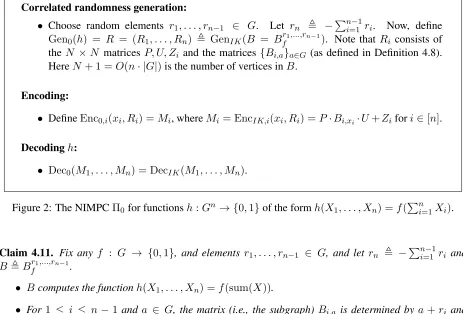
Correlated randomness generation:
• Choose random elements r1, . . . , rn−1 ∈ G. Let rn , − Pn−1
i=1 ri. Now, define Gen0(h) = R = (R1, . . . , Rn) , GenIK(B = Bfr1,...,rn−1). Note that Ri consists of
theN ×N matrices P, U, Zi and the matrices{Bi,a}a∈G (as defined in Definition 4.8).
HereN+ 1 =O(n· |G|)is the number of vertices inB.
Encoding:
• DefineEnc0,i(xi, Ri) =Mi, whereMi= EncIK,i(xi, Ri) =P·Bi,xi·U+Zifori∈[n].
Decodingh:
• Dec0(M1, . . . , Mn) = DecIK(M1, . . . , Mn).
Figure 2: The NIMPCΠ0for functionsh:Gn→ {0,1}of the formh(X1, . . . , Xn) =f(Pni=1Xi).
Claim 4.11. Fix any f : G → {0,1}, and elements r1, . . . , rn−1 ∈ G, and let rn , −Pn−i=11ri and B ,Br1,...,rn−1
f .
• Bcomputes the functionh(X1, . . . , Xn) =f(sum(X)).
• For1 ≤ i ≤ n−1 anda ∈ G, the matrix (i.e., the subgraph)Bi,a is determined by a+ri and is independent off. Fori = nanda ∈ G, the matrix Bn,a is determined by the shifted function f0(j),f(j+rn).
Proof. For the first item, note thatB(x1,...,xn) contains a path from sto the vertex
Pn−1
i=1(xi+ri) in the
(n−1)’th level, and this is the only vertex in the(n−1)’th level that is reachable froms. There is an edge from vertexPn−1
i=1(xi+ri)in the(n−1)’th level totiff
1 =f n−1
X
i=1
(xi+ri) +xn+rn !
=f n X
i=1
xi !
(the latter equality follows from the fact thatPn
i=1ri= 0). Thus,f(Pni=1xi) = 1iff there is a path froms
totinB(x1,...,xn).
To see that the second item in the claim holds, note that for1≤i≤n−1, the suma+ridetermines
all edges between the(i−1)’th andi’th layer labeledXi =a. Similarly, there is an edge labeledXn=a
from vertexbin the(n−1)’th layer tot, ifff(a+b+rn) =f0(a+b) = 1.
Theorem 4.12. TheNIMPCΠ0 = (Gen0,Enc0,Dec0)described in Figure 2 is a fully robustNIMPCfor HG
G,...,Gwith communication complexityO(|G|2·n2).
Proof. For the correctness of the NIMPCΠ0, note that, by Claim 4.11, the branching programBfr1,...,rn−1 computesh(X1, . . . , Xn) =f(sum(X)). Thus, by Theorem 4.9,
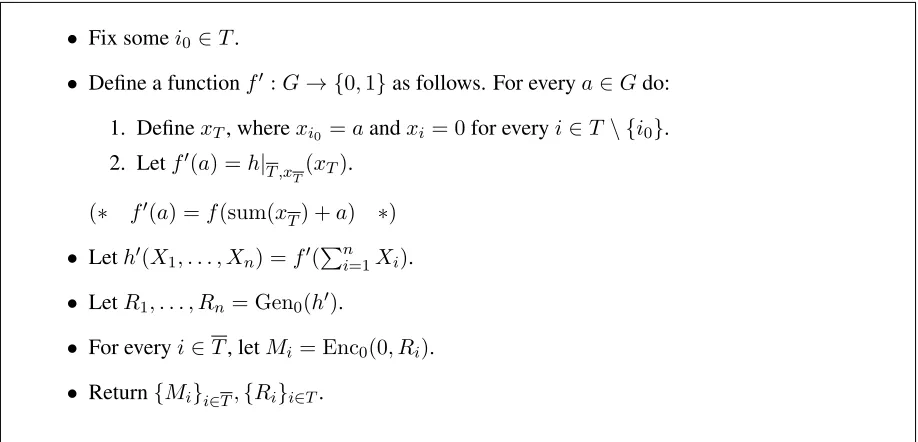
• Fix somei0 ∈T.
• Define a functionf0 :G→ {0,1}as follows. For everya∈Gdo:
1. DefinexT, wherexi0 =aandxi = 0for everyi∈T \ {i0}.
2. Letf0(a) =h|T ,x T(xT).
(∗ f0(a) =f(sum(xT) +a) ∗)
• Leth0(X1, . . . , Xn) =f0(Pni=1Xi).
• LetR1, . . . , Rn= Gen0(h0).
• For everyi∈T, letMi = Enc0(0, Ri).
• Return{Mi}i∈T,{Ri}i∈T.
Figure 3: The simulator for the NIMPCΠ0for a setT 6=∅.
The 0-robustness of Π0 follows from the 0-robustness of ΠIK. We next prove the T-robustness of Π0 for a non-empty subsetT, that is, we construct a simulatorSimT(h|T ,x
T) whose output distribution is as required. For the construction, we first identify which functionsh, h0and inputsxT satisfyh|T ,x
T(XT) =
h0|T ,0
T(XT), that is, when the simulator gets the same answers to its queries. For such pairs h, xT and
h0,0T, we show that the messages ofT and the correlated randomness ofT are equally distributed inΠ0. Thus, the simulator will findh0 such thath|T ,x
T =h
0|
T ,0T and executeΠ0onh
0andx
T = 0T.
Observation 4.13. Leth(X1, . . . , Xn) =f(Pni=1Xi)andh0(X1, . . . , Xn) =f0(Pni=1Xi). Then,
1. The restricted functionh|T ,x
T is equivalent to the functionf restricted to inputs in
XT and shifted by
s,sum(xT), that is,h|T ,x
T(XT) =f(s+ sum(XT)).
2. Fix a setTand inputsxT ∈G|T|. Then,h|T ,x
T(XT) =h
0|
T ,0T(XT)ifff(a) =f
0(a−sum(x T))for everya∈G, that is,f0 is a shift off bysum(xT).
The simulator for the NIMPC Π0 is described in Figure 3. Let h(X) = f(sum(X))andXT be the function and the inputs ofT in the execution of the simulator. The simulator, which has only access to
h|T ,x
T, chooses inputsx
0
T = 0and anh
0 such that, by Observation 4.13,h|
T ,xT(XT) = h 0|
T ,0T(XT). It then executes the randomness generation of Π0 with h0 and the encoding in Π0 with x0T = 0. We next prove that the messages ofT and the randomness ofT in the execution ofΠ0 onhandxT are identically
distributed as the output distribution of the simulator, namely, as the messages ofT and the randomness ofT
in the execution ofΠ0onh0and0T (we will refer to these executions as the first and the second executions). The randomness in both distributions is only the randomness ofGen0.
To show the equivalence of the distributions, we show a bijection between the random strings used by
of T are the same under this bijection. The randomness of Gen0 is composed of r1, . . . , rn−1 used to construct the branching program and the matricesP, U, Z1, . . . , Zn used byGenΠIK. The bijection maps this randomness tor10, . . . , r0n−1, P, U, Z1, . . . , Zn, where
ri0 =
ri iffi∈T, xi+ri iffi∈T .
Note that for everyi∈T∩[n−1], the joint randomnessRiis the same in both executions ofGen0asRionly
depends onP, U, Zi, riwhich are the same in both executions. We next show that for everyi∈T∩[n−1]
the encodingMiis the same in both executions:
• In the first execution,Mi = Enc0,i(xi, ri) =P·Bi,xi·U +Zi, whereBi,xicontains edges between every vertexbin the(i−1)’th level of the branching program to vertexb+xi+riin thei’th level.
• In the second execution,Mi0 = Enc0,i(0, r0i) =P·B0i,0·U +Zi, whereB0i,0 contains edges between
every vertexbin the(i−1)’th level of the branching program to vertexb+ 0 +r0i =b+xi+riin
thei’th level.
Thus,Bi,xi =B
0
i,0and the encodingsMi, Mi0 are equal.
To complete the proof of the T-robustness, we need to consider two cases: n ∈ T andn ∈ T. In the first case, we need to show thatRnis equal in the two executions, that is,Bn,a =Bn,a0 for everya∈G.
• In the first execution with randomnessrnandf, there exists an edge labeled byXn = abetween a
vertexbin the(n−1)’th level of the branching program to vertextifff(b+a+rn) = 1, where rn=−Pn−i=11ri.
• In the second execution with randomnessr0nandf0, there exists an edge labeled byXn=abetween
a vertexbin the(n−1)’th level of the branching program to vertextifff0(b+a+rn0) = 1, where
rn0 =−
n−1
X
i=1
ri0 =−
n−1
X
i=1
ri− X
i∈T
xi =rn−sum(xT).
Recall thatf0(a) =f(a+sum(xT)), thus,f0(b+a+r0n) =f(b+a+r0n+sum(xT)) =f(b+a+rn).
Thus, in this case the joint randomnessRnis the same in both executions.
In the second case (wheren∈T), we need to show thatMnis equal in the two executions, that is,Bn,xn is equalBn,0 0. This follNws by similar arguments as above, noting that in this casern0 =rn−sum(xT) +xn.
Next we analyze the communication complexity of the NIMPCΠ0. This NIMPC uses the NIMPCΠIK
with a branching program of sizeN =O(n|G|), thus, by Theorem 4.9, the communication complexity ofΠ0 isO(|G|N2) = O(|G|3n2). However, using Claim 4.11, we can optimize the communication complexity by a slightly better implementation: the stringRi, for1 ≤ i ≤ n−1containsU, P, Zi, andri (instead
of{U ·Bi,a·P +Zi}for everya ∈ G). Similarly,Rncontains theU, P, Zi, and functionf0 defined in
Claim 4.11. Notice that in the proof ofT-robustness we allowRi to contain this additional information.
After these changes, each encoding and correlated random string contains only aconstantnumber ofN×N
matrices, rather thanO(|G|)such matrices. Hence, the communication complexity is reduced toO(N2) =
4.3.2 Limiting the inputs of one set
In this section we limit the inputs of one (special) subset of variables. We start with an NIMPC for the family of shifted sums. We will use this NIMPC in our constructions.
Lemma 4.14. Fix an abelian group Gand an integer n. For s ∈ G, let hs : Gn → Gbe the function hs(X1, . . . , Xn) ,Pni=1Xi+s= sum(X) +s, and let∆n ,{hs}s∈G. There is a fully robustNIMPC Π∆n = (Gen∆n,Enc∆n,Dec∆n)of∆nwith communication complexitylog|G|.
The NIMPCΠ∆n for∆n is a generalization of the NIMPC for the sum function described in
Exam-ple 2.7, where inGen∆n, we computern=s−Pn−i=11ri.
In Figure 4, we describe the NIMPCΠ1, in which the inputs of one set are limited. This NIMPC follows the intuition presented in Section 4.2.2, where some adaptations are needed as (1) the NIMPC presented here ist-robust (compared to 1-robust in Section 4.2.2), and (2) we limit the inputs to setsSi, which are not
binary.
InΠ1, it will be convenient to denote the special set, whose inputs are limited, by{1, . . . , t}and the corresponding variables byY1, . . . , Yt. Furthermore, we denote the rest of the inputs byXt+1, . . . , Xn. For i∈[t], we denote the set of legal inputs ofYibySi ⊆G. We assume for simplicity that0∈Sifor everyi.
As in the previous section, the set of legal inputs of any variableXiisG.
Theorem 4.15. TheNIMPCΠS1,...,St
1 described in Figure 4 is a fully robustNIMPCforHGS1,...,St,G,...,G.
The communication complexity of ΠS1,...,St
1 isO(|G| ·t·dt+2 +|G|3·n2) = O(dt+2·n2· |G|3), where
d,maxi∈[t]|Si|.
Proof. The correctness of the decoding follows from (1). The communication complexity follows since in the NIMPCΠ1there are:
• One execution of the NIMPCΠΓfor the function`with complexityO(|G| ·t·dt+2),
• Two executions of the NIMPC for shifted sum with complexityO(log|G|), and
• |G|executions of the NIMPCΠ0forgb, each with complexityO(|G|2n2).
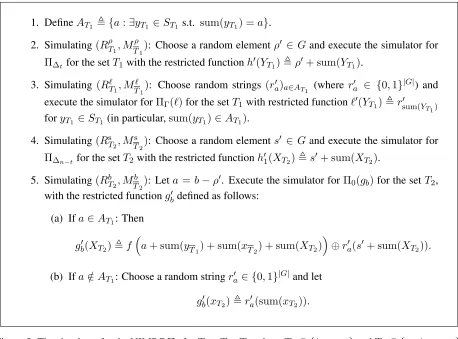
We next prove the robustness. In Figure 5, we describe a simulator for a subsetT = T1 ∪T2, where
T1⊆ {1, . . . , t}andT2 ⊆ {t+1, . . . , n}(where these sets can be empty), and the inputs ofTareyT1 ∈ST1
andxT
2 ∈ G
|T2|. The simulator forΠ
1 uses the simulators for the various NIMPC protocols used in Π1. The important task in constructing the simulator is how to answer the queries made by the simulators of these NIMPC protocols.
Inspection of Figure 5 shows that up to Step 5 the simulator only requires random values it generates by itself. For Step 5, it requires the values
f(a+ sum(yT
1) + sum(xT2)),
wherea∈AT1 ={a:∃yT1 ∈ST1 s.t. sum(yT1) =a}ifT2=∅, anda∈Gotherwise. In the first case, it is clear that it knows these values given the restricted functionh|T ,x
T(YT1) = f(sum(YT1) + sum(yT1) +
sum(xT
Correlated randomness generation:
1. Choose randomρ, s∈Gand for allb∈Gchoose a random stringrb∈ {0,1}|G|(we think
ofrbas a function fromGto{0,1}).
2. Define the function`:S1× · · · ×St→ {0,1}|G|by`(a1, . . . , at) =rPt i=1ai.
3. For everya∈G, define the functionga+ρ:Gn−t→ {0,1}by
ga+ρ(Xt+1, . . . , Xn),f(a+ n X
i=t+1
Xi)⊕ra(s+ n X
i=t+1
Xi).
4. LetRρ= (Rρ1, . . . , Rtρ),Gen∆t(hρ)(wherehρ(Y1, . . . , Yt) =ρ+Pti=1Yi).
5. LetR` = (R`1, . . . , R`t),GenΓ(`)(whereGenΓis defined in Theorem 3.3).
6. LetRs = (Rst+1, . . . , Rsn),Gen∆n−t(hs)(wherehs(Xt+1, . . . , Xn) =s+
Pn
i=t+1Xi).
7. Forb∈G, letRb= (Rtb+1, . . . , Rbn),Gen0(gb).
8. Define Gen1(h) = (R1, . . . , Rn), where Ri = (Rρi, R`i) if i ∈ {1, . . . , t} and Ri = (Rs
i,(Rbi)b∈G)ifi∈ {t+ 1, . . . , n}. Encoding:
9. For i ∈ {1, . . . , t}: Let Miρ = Enc∆t,i(yi, Riρ) and Mi` = EncΓ,i(yi, R`i), and let Enc1(yi, Ri) =Mi= (Miρ, Mi`).
10. Fori ∈ {t+ 1, . . . , n}: LetMis = Enc∆n,i(xi, Rsi)andMib = Enc0,i(xi, Rib)for every b∈G, and letEnc1,i(xi, Ri) =Mi = (Miρ,(Mib)b∈G).
Decodingh:
11. z= Dec∆t(M1ρ, . . . , M
ρ
t) (∗ z= sum(y) +ρ ∗)
12. u= Dec∆n−t(M s
t+1, . . . , Mns) (∗ u= sum(x) +s ∗)
13. v= DecΓ(M1`, . . . , Mt`) (∗ v=`(y1, . . . , yt) =rsum(y) ∗)
14. w= Dec0(Mtz+1, . . . , Mnz)
(∗ w = gsum(y)+ρ(xt+1, . . . , xn)
= f(sum(y) + sum(x))⊕rsum(y)(s+ sum(x))
= h(y1, . . . , yt, xt+1, . . . , xn)⊕v(u) ∗) (1)
15. The output is:w⊕v(u).
Figure 4: The NIMPCΠ(S1,...,St)
![Figure 1: The 0-robust NIMPC ΠIK(B) of [24] computing a branching program B.](https://thumb-us.123doks.com/thumbv2/123dok_us/7903267.1312072/17.612.82.537.66.309/figure-robust-nimpc-pik-b-computing-branching-program.webp)