ISSN(Online): 2320-9801
ISSN (Print): 2320-9798
International Journal of Innovative Research in Computer
and Communication Engineering
(An ISO 3297: 2007 Certified Organization)
Vol. 3, Issue 8, August 2015
Performance Evaluation & QoS Improvement
by the Impact of Node Mobility Analysis using
DSDV & DSR Protocols
Neha Gandotra, Dr.Rajesh Singh, Dr. Vinay Awasthi
PhD Scholar, Dept. of ECE, IFTM University, Moradabad
,
IndiaProfessor, Dept. of ECE, University of Petroleum and Energy Studies, Dehradun, India
Professor,
Dept. of
ECE,University of Petroleum and Energy Studies, Dehradun, IndiaABSTRACT: Ad hoc wireless networks can be deployed quickly anywhere and anytime as they eliminate the complexity of infrastructure setup. The main reason for degradation in mobile ad-hoc network performance as a result of node mobility due to the traffic control overhead required for maintaining routes in the case of table-driven protocol and maintaining routes in the case of on-demand protocol. Mainly the performance goes down when we considered the mobility for the network. The effect of mobility on fundamental communication and network performances metrices such as the bit error rate (BER) of multi-hop route joining a source-destination pair, and minimum required node spatial density of an ad-hoc wireless network for full connectivity. This paper discuss the impact of mobility and enlightened the importance in real scenarios for pedestrian and vehicular speed using two distance vector routing protocols namely: destination sequenced distance vector (DSDV) and dynamic source routing (DSR) protocol. Here source node movement, destination node movement and all node movement have been considered using different mobility period and also try to judge the QoS parameter for such scenario. BER of an average multi-hop route directly affects the ability of an ad-hoc network to support applications requiring a specific BER, for a given node transmission power and node spatial density.
KEYWORDS:Routing, Adhoc network, mobility, DSDV, DSR, NS-2.
I.INTRODUCTION
ISSN(Online): 2320-9801
ISSN (Print): 2320-9798
International Journal of Innovative Research in Computer
and Communication Engineering
(An ISO 3297: 2007 Certified Organization)
Vol. 3, Issue 8, August 2015
Fig1: Mobile Ad-hoc Networks (MANET )
The node mobility characteristics are very application specific. Widely varying mobility characteristics are expected to have a significant impact on the performance of the routing protocols like DSR [2], DSDV [3] and AODV [4]. We try to investigate the node mobility effect taking three different scenarios and try to judge its impact and to choose the right protocol so, it might be useful for network designing purpose. MANET routing protocols are subdivided into two categories:Reactive and Proactive and from all the concerned routing protocols of these two, we take DSDV from Reactive and DSR from Proactive category
II.ROUTING PROTOCOL
Proactive protocols: This type of protocols attempt to find and maintain consistent, up-to-date routes between all source-destination pairs regardless of the use or need of such routes and we need periodic control messages to maintain routes up to date for each nodes [5]. DSDV is a proactive protocol. Reactive protocols: Routes are created only when a source node request them. Data forwarding is accomplished according to two main techniques: I) Source routing, II) Hop-by-hop routing [5]. DSR, AODV, and TORA are reactive protocols.
Destination sequenced distance vector (DSDV) :DSDV [6] is a table-driven routing method for ad-hoc networks that is based on the Bellman-Ford algorithm. The main contribution of this algorithm was to sort out the Routing Loop problem which is present in Bellman-Ford algorithm. And to do so, this protocol makes use of sequence numbers. Here each entry in the routing table contains a sequence number; the sequence number are generally Even if a link is present else, an Odd number is used. The number is generated by the destination, and the emitter needs to send out the next update with this number. Routing information is distributed between nodes by sending full dumps infrequently and smaller incremental updates more frequently.
Dynamic Source Routing (DSR) Protocol: DSR [6] protocol is on demand which generally reduces the bandwidth especially in situations where the mobility is low. It is a simple and efficient routing protocol for using in ad-hoc networks this protocol has two important phases namely, route discovery and route maintenance. A node that desires communication with another node first searches its route cache to see if it already has a route discovery mechanism. This is done by sending Route Request message. When the node gets this message, it searches its own cache to see if it has a route to the destination. If it does not, it then appends its ID to the packet and forwards the packet to the next node. This process continuous until either a node with a route to the destination is encountered or the destination receives the packet. DSR support relatively rapid rates of mobility
III.RELATED WORK
ISSN(Online): 2320-9801
ISSN (Print): 2320-9798
International Journal of Innovative Research in Computer
and Communication Engineering
(An ISO 3297: 2007 Certified Organization)
Vol. 3, Issue 8, August 2015
model attempt to mimic the movement of individual nodes. In this model, each mobile node chooses a random destination and moves towards it with a randomly selected speed which is uniformly distributed in [Vmin, Vmax]. After reaching the destination, the node stops for a duration, and then repeats the whole process again. While entity models assume all nodes move independently, most group mobility models assume that MNs are not completely independent. A general group mobility model, Reference Point Group Mobility (RPGM) model, assumes a group of nodes always move together [8]. In this model, the path of a group is pre-defined by a series of checkpoints, and all the nodes in a group follow the movement of the logical reference centre of the group. Every node has its own pre-defined reference point that is displaced around the logical centre. Another group mobility model, called the Reference Velocity Group Mobility model [9], is an extension of Reference Point Group Mobility model. In this model, each member node in a group has a velocity that is deviated slightly from the mean group velocity. Analogous to the RPGM model, the mean group velocity serves as a reference velocity for the nodes in the group. This velocity-based group representation is the time derivative of the displacement-based group representation in the RPGM model. The advantage of this mobility model is that a clearer characterization of network partitioning is provided. The mobile nodes are scattered without clear grouping at the beginning with the network as one large physical cluster. Over time, the nodes move in several directions and are finally separated into a number of smaller groups. However, this model over-simplified the movement of nodes by having the velocity of a node deviates slightly from the mean group velocity. In reality, the velocity of each individual may change arbitrarily within the same group. The characteristic of velocity similarity of every individual is only presented during longer period time instead of instant, so this model could not reflect the scenarios of group mobility in practical deployment of ad hoc networks.
IV.TOOL USED FOR SIMULATION
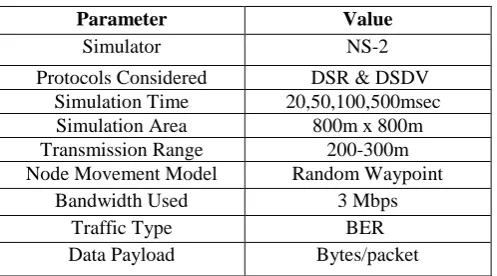
The simulations performed usingNS-2( Network Simulator-2) on a ―Intel (R) Dual Core CPU T4400 @ 2.20 GHz /RAM-1.96 GB, 1.19 GHz /HDD- 220GB computer and ―Window XP operating system. [16], which is particularly popular in the ad-hoc networking family. NS-2 is an object-oriented, discrete event driven network simulator written in C++ & OTcl [10]. NS-2 is useful for simulating local and wide area networks. Although it is easy to use once one can get to know the simulator. NS-2 interprets the simulation scripts written OTcl. The user has to set the different components libraries up in the simulation environment. The user writes his simulation program as an OTcl scripts. The main aim of choosing NS-2 as a simulation tool among the other simulation tool because it supports networking research and education. It is also suitable for designing a new protocol, and comparing different protocol in different environment. NS-2 is distributed freely and open source. A large number of institutes and people in development andresearch use maintain and develop NS-2, which increases the confidence in it. NS-2 also provides substantial support for simulation of TCP, UDP,routing and multicast protocol over wired and wireless network [11]Simulation have been done efficiently to get the result with less error and proves to be useful for future use. The simulations have been done with different mobility period so, it has been repeated many times to minimize the error level for scenario. The modal parameters that have been used in the following experiments are summarized in Table 1 below:
Table 1. Simulation parameters
Parameter Value
Simulator NS-2 Protocols Considered DSR & DSDV
Simulation Time 20,50,100,500msec Simulation Area 800m x 800m Transmission Range 200-300m Node Movement Model Random Waypoint
ISSN(Online): 2320-9801
ISSN (Print): 2320-9798
International Journal of Innovative Research in Computer
and Communication Engineering
(An ISO 3297: 2007 Certified Organization)
Vol. 3, Issue 8, August 2015
The mobility model uses (RANDAM WAYPOINT MODEL) in a rectangular area of 800m x 800m with 10 nodes. During the simulation starts its journey form a random spot to a random chosen destination and after every 0.2 second the topology of the network changed. Once the destination reached, the node takes a rest period of time in second and another random destination is chosen after that pause time the pause time is taken for this simulation is vary for 5s, 10s and 5s. This process repeats throughout the simulation, causing continuous changes in the topology of the underlying network. Different network scenario for 10 number of nodes and pause time are generated.
V. METHODOLOGY
ISSN(Online): 2320-9801
ISSN (Print): 2320-9798
International Journal of Innovative Research in Computer
and Communication Engineering
(An ISO 3297: 2007 Certified Organization)
Vol. 3, Issue 8, August 2015
ISSN(Online): 2320-9801
ISSN (Print): 2320-9798
International Journal of Innovative Research in Computer
and Communication Engineering
(An ISO 3297: 2007 Certified Organization)
Vol. 3, Issue 8, August 2015
This process is repeated until the value of „j‟ is equal to or less than the total simulation time. Finally, the program comes to an end. The same procedure is used for the destination and all node movement. The simulation has been done N number of times to get the efficient result at every instant of time. The version used for taking out the simulation result is ns 2.27 and effort has been made to get the best result. The simulation results proves to be good for network designing when the node is source node, destination node also when all nodes is in movement in the network.
VI. SIMULATION RESULTS & SCENARIO
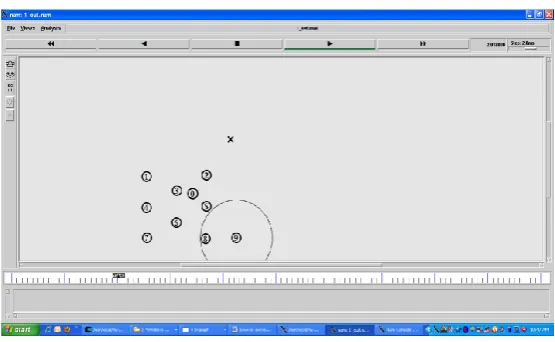
Fig 5: Screenshot of 10 nodes of DSDV & DSR for source node movement NAM (Network Animator).
Fig 6: Changed position of source node for DSDV &DSR Fig 7: Packet generated for DSDV & DSR
ISSN(Online): 2320-9801
ISSN (Print): 2320-9798
International Journal of Innovative Research in Computer
and Communication Engineering
(An ISO 3297: 2007 Certified Organization)
Vol. 3, Issue 8, August 2015
ISSN(Online): 2320-9801
ISSN (Print): 2320-9798
International Journal of Innovative Research in Computer
and Communication Engineering
(An ISO 3297: 2007 Certified Organization)
ISSN(Online): 2320-9801
ISSN (Print): 2320-9798
International Journal of Innovative Research in Computer
and Communication Engineering
(An ISO 3297: 2007 Certified Organization)
Vol. 3, Issue 8, August 2015
ISSN(Online): 2320-9801
ISSN (Print): 2320-9798
International Journal of Innovative Research in Computer
and Communication Engineering
(An ISO 3297: 2007 Certified Organization)
Vol. 3, Issue 8, August 2015
VII.CONCLUSION
For source node movement DSDV completely dominates DSR routing protocol as DSR is nearly zero throughout the simulation time. For destination node movement the throughput of DSR routing protocol increases as compared to DSDV routing protocol with increase in simulation time. Finally, for all node movement in the network DSR performance is efficient than DSDV routing protocol and the performance of DSDV completely degrades with increase in simulation time under such scenario.
REFERENCES
1. Subir Kumar Sarkar, T G Basavaraju and C Puttamadappa“Ad-hoc Mobile Wireless Network principles, protocols and applications”.
2. D. B. Johnson, D. A. Maltz, and J. Broch, “”DSR: The dynamic source routing protocol for multi-hop wireless ad hoc networks”,” in Ad Hoc Networking, C. Perkins, Ed. Addison-Wesley, pp. 139–172, 2001.
3. C. E. Perkins and P. Bhagwat, “Highly dynamic destination sequenced distance vector routing (DSDV) for mobile computers,” in ACM SIGCOMM, 1994, pp. 234–244, 1994.
4. C. Perkins, “Ad hoc on demand distance vector (AODV) routing, internet draft, draft-ietf-manet-aodv-00.txt.”
5. D. Sun, H. Man, "TCP Flow-based Performance Analysis of Two On-Demand Routing Protocols for Mobile Ad Hoc Networks", , In Vehicular Technology Conference VTC, 2001, Fall. IEEE VTS 54th, volume 1, pages 272-275, 2001.
6. Sapna S.Kaushik & P.R. Deshmukh, “Comparison of effectiveness of AODV, DSDV and DSR Routing Protocols in MANET”, International Journal of Information Technology and Knowledge Management, July-Dec.-2009, Vol. 2, No. 2, pp. 499-502.
7. T. Camp, J. Boleng, and V. Davies, "A Survey of Mobility Models for Ad Hoc Network Research," Wireless Communication & Mobile Computing (WCMC),Special issue on Mobile Ad Hoc Networking: Research, Trends and Applications, vol.2, no.5, pp.483-502, 2002. 8. X. Hong, M. Gerla, G. Pei, and C. Chiang, "A group mobility model for ad hoc wireless networks," Proceedings of the ACM International
Workshop on Modeling and Simulation of Wireless and Mobile Systems (MSWiM), August 1999.
9. Karen Wang and Baochun Li, "Group Mobility and Partition Prediction in Wireless Ad-hoc Networks," Proceedings of IEEE International Conference on Communications (ICC 2002), Vol. 2, pp. 1017-1021, New York City, New York, 2002.
10. Vijayalakshmi M, Avinash Patel, Linganagouda Kulkarnai, “ Qos Parameter Analysis on AODV and DSDV Protocols in Wireless Network”, Vol. 1, pp. 286.