A Study and Analysis of Ant phishing Schemes
in Cryptography
Rubee na Jabi , Dee pty Dubey, Dr. Punyaban Patel
M.Tech scholar, Dept of Co mputer Sc ience & Engg..CSIT, Durg (C.G.), India
Associate Professor, Dept of Co mputer Sc ience & Engg. CSIT, Durg (C.G.), India
Professor, Dept of Co mputer Sc ience & Engg., CSIT, Durg (C.G.), India
ABSTRACT:Phishing attack is a kind of attack in which a fa ke web page or website poses itself as a legal one to gain the personal informat ion of user. In Phishing attack, a phish er ma kes a fake website which e xactly looks like an original website. For a user it’s ID (user ID) and password is very sensitive information so phisher tries to gain this informat ion in illegal way. They try to access user's personal information through t he fake website or web page so it is called phishing attack and phishers use this information for fraud. This paper reviews some anti phishing techniques which are used to detect, predict and prevent the phishing attacks.
KEYWORDS: Phishing, Anti phishing, Visual Cryptography, Authentication. I.INTRO DUC TIO N
Phishing attacks are popular now days. There are numerous e-banking and e-commerce websites which are used today to fund transactions online. For online transactions security is most important asp ect and to provide security various techniques are used.
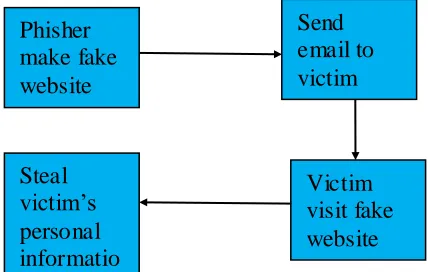
Phishing is method of attack that is completed by an individual person referred to as a Phishers, and they attack personal data of a user. Various ways are mentioned in this paper to avoid Phishing . For e xa mp le : Ph ishers sends the email to the victim “Due to some technical fault SBI database is crashed and urgently need your account related information”. The user clicks on the link contained in the email and visits the fake website that exactly looks like a original website. When users enters its personal info like user ID, password and submit this info then it is passed towards the anonymous database which is accessible to Phisher.Four ma jor steps which are involved in a Ph ishing attack are:
Phisher
make fake
website
Send
email to
victim
Victim
visit fake
website
Steal
victim’s
personal
informatio
n
2. A lin k of the phishing website is sent by the phishers via e mail to their victim.
3. Phishers victim visit web site by the fau x lin k.
4. Phishers steals the private info of users, once users enter their info on fa ke web site.[3]
Anti phishing approach is detecting and preventing the phishing computer. An anti phishing program tries to verify phishing content contained in computing machine or e ma il. It is sometimes integrated with web browsers. Anti phishing practicality might also be enclosed as an inbuilt capability of some application progra m. [1]
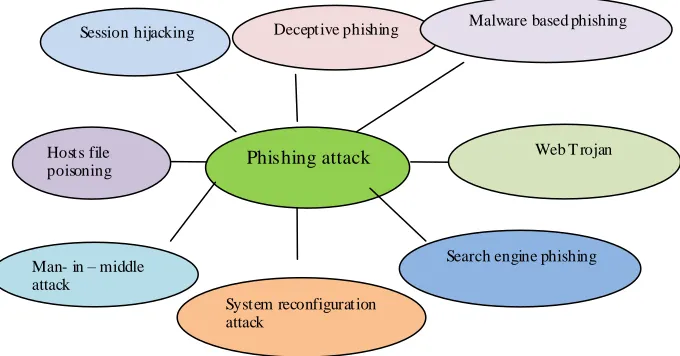
II.C LASSIFIC ATIO N O F PHISHING ATTAC KS
Dece pti ve phishing: Bulk e mails containing a message are sent to the victim by a phisher. Users are influenced to click on a link and visit the online web site where they enter their personal informat ion which is utilized by attackers for illegal activit ies.
Mal ware base d phishing: It could be a executable program that contains some kind of ma licious script or code running on user's machine which is norma lly introduced as legal ema il attachment. Once installed these programs may send information to other parties unknown to the user.
Session hijacking In this kind of phishing attack the activities of users are clea rly mon itored until a user logged in a fau x account.
We b Tr ojans: In this information of the user is collected through a popup acting as a legitimate profitable deal and the the user is influenced to enter their personal information. Internet Tro jans are invisible to user. User's credentials a re collected by internet Trojans and transmitted to the phishers.
Hosts file poisoning: Hosts file is an method for resolving names to IP addresses in absence of DNS Services. Hosts file is present by default in every windows system which is used for overriding DNS name resolution. The attacker generally drops a script on users desktop and modifies or poisons the hosts file.Whenever the IP address is accessed by userthen he/she is directed to website of attackers choice.
Figure 2: Types of Phishing attack Phishing attack
Deceptive phishing Malware based phishing Session hijacking
Web T rojan Hosts file
poisoning
System reconfiguration attack
Man- in – middle attack
Man –in-the- mi ddle phishing: It's onerous to notice than several alternative varieties of phishing. In these attack hackers sit between the user and additionally the online website or the sys tem. They record the data being entered by the user however the user dealings don't seem to be affected and also the user rema ins unaware. Later, they sell or use the data which can be master card details, checking account details.
Search engine phishing: Phishers develop e-commerce co mputing machine with attractive offers. Later these sites are lin ked complete ly to different search engines. Once user look for services. These sites fool by various scams like false banking sites that provide lower credit p rices or h igher interest rates than various banks users by influencing them to enter their in fo .[2]
III
.
RELATEDWORKIn [4] containing the steps of visual cryptography during which two phases are carried out. First is registration part and second is login part. In registration part the secret key is asked from the user for the secure web site . The server enters the key and user enters the key, then by the each key string organized in a list and image captcha is generated and divided it into two shares using visual cryptography. One key kept with user and another kept with the server. In login part user enter that share of image captcha rather than secret. Once the user's share mix with server's share then original image captcha is revealed. Through the revealed image captcha user decides its phishing website or not. If reveal image captcha is same with the generated captcha of registration part, thus it isn't phishing web site but if it isn't matched then its phishing site. Matched captcha is utilized to log in into web site. It provides authentication between user and server.
In [5] there are RSA rule is utilized for the key writ ing and secret writing of user id and password. For the authentication user choose a picture and by visual cryptography, it divides that image into shares of 2, one share unbroken with user and another share unbroken with the trusted server, these all process is done in registration phase. In login phase, user uses that image share as a password. In login phase enter user id, select image share and enter public key. The user id, image share is encrypted using the public key and sent to the server, where its is decrypted by using public key or private key. Now server's share and user's share stacked along, an the original imag e is shown which is then sent to the user's browser. A user use that image captcha for login to verify whether the website is phishing website or not. In this approach used RSA algorithm is emp loyed which has an issue of factoring of large whole nu mber.
In [6] the approach is div ided into three sections which are - reg istration phase, login phase and share recovery phase. In registration phase contain the same process as we discussed previously that the user enter the key and image captcha is displayed. It is divided into 2 shares, one kept with the user and another kept with the server .The share that is kept with the user is used by the user at the time of login. In the login section user browses the share that is kept with his/her. The share sent to server, which is stacked with the server’s share to show the original image captcha and to show the text which is then entered for the login into the web site. Once user lost his share then share recovery part is employed. If the user looses his/her own share then a new request is made for the generation of new share .For latest share sever uses share formula (t, ∞). Server generates a fresh new share on user’s request, then it's downloaded by the user to continue the login process.
In [8] study has been conducted for two types of phishing namely website and phone based phishing. The phishing web site that precisely appears like a certified web site but for the user it's troublesome to spo t the malicious website. If the user looks closely to those sites it can be observed that the pc address of every legal and phishing site are different on the basis of containing domain na me where they use IP address in place of do ma in na me and using http .Style id is poor and having spelling mistakes etc.The web site norma lly sends a link with e ma il to their v ictim that contain a message like your e -banking account is in danger owing to hacking therefore please login on the given lin k of website and check the balance, once user enter their identification(user ID, password)it hacked by phishers. In phone phishing experiment the telephonic conversation is used to gain the financia l and personal info rmation of the user for the purpose of financia l fraud. Th is paper also includes the characteristic and indicators of phishing website. A mathe matica l and neural network based model is used that contain the unreal neurons cluster. In this paper the details archived for a phishing wesite are send to the pre-processor that convert it into a fo rmat that is understood by a mach ine. The result of pre-processor the rules that are generated using neural network. . The neural network is trained with the result data. An appropriate weight is also assigned to neural network. If the we ights are matching with archived info in DB then the online web site is classified as a phishing web site.
In [9] a model is used that uses rule based approach using Genetic A lgorith m., Genetic Algorithm is used for the generation of a rule set that if matched to the rule set in DB (database), the rule set is kept and reported as a link of phishing web site In this system if sent hyperlin k matches to the rule, then the website owner is alerted and is informed to action to prevent phishing attack. Genetic algorith m is like co mputational model that include selection and evolution principles. In genetic algorithm a proble m is represented by chromosomes and problem attributes indicating the chromosome position that are encoded like a nu mbers, bits, characters. During evolution stage the chromosomes set are known as population. Chro mosomes fitness is calculated by the function of evaluation. There are mutation and crossover employed in evolution. To generate child offspring. The iteration stops if the criterion of optimisation is met. During this paper genetic formula is e mployed to generate a rule that offers the distinction between the faux web site and original web site. In this the historical data is collected. The historical data contains fake and o riginal URLs for the testing of preventing and detecting phishing system. For anti -phishing this dataset is utilized. The dataset is analysed for fitness and its results fed to the genetic algorithm. The execution of algorithm is performed and it generated rule sets are stored in database which are then used of prevention and detection of phishing websites.
In [10] the method of data e xchange between the server of phishing website and phishers victim is justified in wh ich the phishing website server asks the victim to submit the data and on submission the phishers will grab the informat ion. Once user or victim queries the informat ion to the phishing website server for retrieving information then no data is provided by the phishing website server. In this method phishing is prevented using code word technique.. It contains two phases namely sign-in phase and sign-up phase. In sign-in phase user can register by visiting original website, then after filling of registration form a user ID, passwo rd is created. By the code generation technique a novel code is generated by web site (organization) that is saved with the detail of user. The generated code is also sent to user. This code should be reme mbered by user. In sign -up phase through the email user will get the lin k of website then user go through that link, fills their user id and any 2 digits as a unique code. If the digit is correct then complete code is displayed by the server on the screen of user if the code matches the code that was gene rated at the time of registration then the user can be certain that the page is not a phishing page. The code is a combination of user ID character, password character number (it must be of 5 characters) and date and month (it should be greater than or eq ual to ten, but if it's less than in date & month's sum add 10). In the sign-up phase user will enter any random code in page and if user code is correct then the server will provide co mplete correct code on user’s screen. This verifies the site is legal.
IV.CO NC LUSION
REFERENCES
1. https://en.m.wikipedia-org/wiki/anti-phishing_software.
2. http://googleweblight.com/?lite_url=http://www.innovateus.net/science/what-are-different-types-phishing-attacks&ei=kz2jtzfh&lc=en-IN&s=1&m=864&ts=1446986267&sig=APONPFlp4Szgua3R6sDB_vANxSvfxUT5MA.
3. Gaurav, Madhuresh Mishra, Anurag Jain “Anti-Phishing T echnique: A Review”, International journal of engineering research and application, ISSN:2248-9622, vol. 2, Issue 2, Mar-Apr 2012.
4. Divya James and Mintu philip, “A Novel Anti Phishing Framework Based On Visual Cryptography”, International journal of distributed and parallel system Vol.3, No.1, January 2012.
5. Sayali Vaidya, Shreya Zarkar, Prof. Achal N. Bharambe, Arifa T advi, T anashree Chavan, “ Anti-Phishing Structure Based On Visual Cryptography and RSA algorithm” , International Journal of Engineering Trends and Technology, Volume 20 Number 4 -Fenb 2015.
6. Mangala S Wale, Anita Jadhav, Bharati Kale, Ankita Gupta,”Anti Phishing using (t, n) Visual Cryptography Scheme For Commerce Bank “, International Journal of Emerging Research in Management & Technology, ISSN:2278 -9359, Vol-4, Issue 2, February 2015.
7. A. Sarannia, U.R.Padma, “Prevention Model For Phishing Attack In Web Application Using Linkguard Algorithm”, International Jo urnal of Innovative Research in Computer and Communication Engineering, Vol.2, Issue 1, March 2014.
8. A. Martin, Na.Ba.Anutthamaa, M.Sathyavathy, Marie Manjari Saint Francois, Dr. Prasanna Venkatesan, “A Framework for Predictin g Phishing Website Using Neural Network”, International Journal of Computer Science Issue, Vol. 8, Issue 2, March 2011.
9. V.Shreeram, M.Suban, P.Shanthi, K.Manjula, “Anti-Phishing Detection of Phishing Attack Using Genetic Algorithm”, January 2010. 10. Madhuresh Mishra, Gaurav, Anurag Jain, “A Preventive Anti-Phishing Technique using Code Word”, International Journal of Computer
Science and Informational T echnologies, Vol. 3, 2012.
BIOGRAPHY
Rubee na J abi, fe ma le obtained the B.E. degree in Co mputer Sc ience & Engineering fro m Chhattisgarh Institute of Technology, Rajnandgaon, Chhattisgarh, India in 2014. Currently she is pursuing MTech from Chhatrapati Shiva ji Institute of Technology, Durg, and Chhattisgarh, India. He r current research interests are in Cryptography and Anti Phishing Techniques etc.
Mrs .Dee pty Dubey, fe ma le obtained the B.E. degree in Co mputer Sc ience & Engineering fro m Shri Shankaracharya College of Engineering & Technology, Bhila i, Chhattisgarh, India, in 2005, the MTech.degree in Co mputer Science & Engineering, Rungta College of Eng ineering & Technology, Bh ila i, Chhattisgarh, India., in 2010. She is currently an Associate Professor in Chhatrapati Shivaji Institute of Technology, Durg, and Chhattisgarh, India. Her current research interests are in Cryptography and Cloud Co mputing.