A STUDY OF CERTAIN
POLYPLOID
AND ANEUPLOID FORMS I N FRAGARIAS
.
H.
YARNELL'Harvard University. Cambridge. Massachmsetts
Received November 18. 1930
TABLE OF CONTENTS
PAGE
INTRODUCTION . . . Atetraploid family . . .
Origin . . . Reduction division i n PMC . . .
Inheritance in the tetraploid . . .
Crosses between 7- and 14-chromosome groups. . .
F
.
eZatiorX tetraploid and reciprocal . . .Octoploid and tetraploid crosses . . .
Cytology of the crosses . . . Changes in compatibility with chromosome doubling . . .
Unexpected chromosome numbers . . .
The aberrant chromosome types . . .
Origin . . . I . . . .,. . .
Descriptions . . .
3 n + l t y p e s . . .
3n- 1 types . . .
Discussion . . .
The triploid derivat . . .
Fertility in the triploid . . .
The progeny . . .
Distribution of chromosomes . . .
Causes of variation . . . Substitution of bracteuta and vesca homologs . . .
Segmental interchange between non-homologous chromosomes . . .
SUWARY . . .
LITERATURE CITED . . . . . . . . .
Frequency and distribution of types . . . .
Meiosis in the triploi . . .
Substitution of non-homologous chromosomes. . . . . .
455 456 456 457 457 460 461 461 462 463 463 465 465 465 467 469 470 471 476 480 480 480 483 485 485 485 486 486 487 INTRODUCTION
The appearance in pedigree culture of a family of plants. the progeny
of a species hybrid in which chromosome doubling had occurred. presented an opportunity for a study of the relationships of homologous chromosomes
of two closely related species
.
It was also possible to compare the tetraploidCollege Station. Texas
.
GENETICS 16: 455 S 1931456 S. H. YARNELL
form with the parental diploid types in out-crosses with a considerable number of distinct species, including representatives of the hexaploid and octoploid groups. Fertility with the parental diploid resulted in a series of types with aberrant chromosome numbers, which were distinct morpho- logically. The normal triploids resulting from diploid-tetraploid crosses were found to exhibit an unusual amount of chromosome pairing in reduc- tion division. The genetic results of this type of meiosis have been followed through a later generation in crosses between triploid and diploid.
The technique of making the crosses is that described by MANGELSDORF and EAST (1927). No evidence of contamination, with the possible excep- tion of accidental selfing, was noted in the controlled crosses. The cytolog- ical methods employed have been outlined in a companion paper, “Ge- netic and cytological studies on Fragaria,” now in press.
The tetraploid family, and the stocks of pure species utilized, were kindly supplied by Doctor E . M. EAST, under whose direction the work was carried out. Thanks are also due Mr. A. MARSHAK who assisted in col- lecting the data on flower color, and Doctor P. C. MANGELSDORF for criti- cism of the manuscript.
A TETRAPLOID FAMILY
Origin
A
family of seven plants having the tetraploid chromosome number originated as the selfed progeny of anF1
plant (122-7) of the cross F .bracteata Heller
(7)
X F . vesca rosea Rost. (7) made by Doctor A. J. MAN-GELSDORF in 1924. A cytological examination of this F1 individual, made by Mr. K. ICHIJIMA (1926) disclosed 14 bivalent chromosomes a t the heterotypic metaphase. Root tip counts were not obtained from plant
122-7 which died after setting fruit, but its progeny, family 223, was found by him to have 28 somatic chromosomes.
POLYPLOID AND ANEUPLOID FRAGARIA 457
Reduction division
in
P M C
Meiosis in the Fz tetraploid seems to be somewhat more irregular than was reported for the F1 by ICHIJIMA (1926). While the prophases were not critically examined, there was no suggestion of irregularity through dia- kinesis, although four chromosomes were occasionally found to be asso- ciated a t this stage. Whether there was any such significant association at first metaphase could not be determined. Usually 14 bivalent chromo- somes could be distinguished. The genetic evidence indicates that associa- tion among the four homologous chromosomes to form bivalents is entirely fortuitous. T h a t is, a chromosome from vesca seems to pair as readily with the corresponding one from bracteata as with its vesca homolog.
The movement of the chromosomes to the poles in the heterotypic di- vision shows an occasional lagging pair (illustrated in figure 10, plate 1).
Very rarely two lagging pairs may be seen. A large number of such cases must result in non-disjunction, as chromosomes are only rarely found in the cytoplasm until after interkinesis. Second anaphase is sometimes ini- tiated by the early division of a single chromosome. Lagging chromosomes can likewise be seen at late anaphase, as well as an occasional chromo- some in the cytoplasm. These latter do not form micronuclei. Tetrad formation is quite regular; the production of a fifth small cell is rare indeed. The amount of irregularity as described above varies somewhat among the seven Fz plants and even for different buds from the same plant.
Meiosis in the F, plants follows closely that in the Fz. Some of the F s plants exhibit an increased amount of irregularity, especially a t first ana- phase with the chromosomes greatly scattered. A majority of these plants, however, show greater regularity a t meiosis than does the Fz.
Inheritance
in
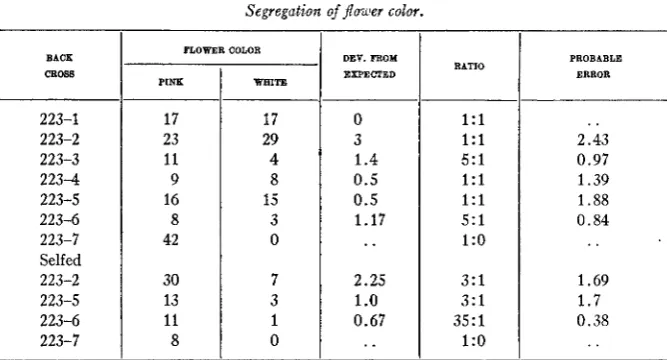
the tetraploidIt was shown by MANGELSDORF and EAST (1927) that pink in the veins of the petals is due to a single dominant factor (P). Plant 122-7 was het- erozygous for pink flower color, since in bracteata the flower is white. All seven plants of the Fz have pink flowers. I n order to determine the mode of segregation in this tetraploid Fz and to find out if these plants differ in ge- netic constitution, the plants of family 223 were crossed reciprocally with the white flowered vesca, F . americana alba (Porter), and were crossed with the white flowered parent, F . bracteata used as male. The plants were also allowed to self under conditions precluding contamination with foreign pollen. These results are to be found in table 1.
The backcross data for 223-5 represent the populations of two families of the cross F . americana alba X 223-5. A third family of similar origin has
458 S. H. YARNELL
given a segregation of 4 pink flowered to 18 white, which differs signifi- cantly from the 1: 1 ratio of the other two families. It might be assumed that the F1 plants of this cross fail to develop flower color when simplex for the dominant factor
P.
This would convert the expected 1 : 1 ratio to a 1 : 3ratio. Such an assumption is hardly plausible since this would involve the appearance by mutation of an inhibiting factor in the alba parent, a plant which behaves normally (as judged by similar crosses), when crossed with
TABLE 1
Segregation of power color.
BACK
CBOW
223-1 223-2 223-3 2 2 3 4 223-5 223-6 223-7 Selfed 223-2 223-5 223-6 223-7
FLOWER COLOR
PINK 17 23 11 9 16 8 42 30 13 11 8 WHITE 17 29 4 8 15 3 0 7 3 1 0
DEY. FROM
ElXPECTED 0 3 1.4 0.5 0.5 1.17
..
2.25 1.o
0.67RATIO
1 : l 1 : l 5 : l 1 : l 1 : l 5 : l 1
:o
3 : l 3 : l 35:l l:o PROBABLE ERROR
. .
2.43 0.97 1.39 1.88 0.84. .
1.69 1.7 0.38223-2, giving a population of 10 pink to 11 white. There is always the pos- sibility of classifying a plant of the type
Ppp
as white-flowered, but this can hardly account for the preponderance of white-flowered plants in this particular family. At present no satisfactory explanation can be given, the data being disregarded in determining the genetic composition of plant 223-5. With this single exception the families all deviate from the expected by less than two times their probable error.From these data it is assumed that plants 1, 2 , 4 and
5
of family 223 are simplex for the gene P; plants 3 and 6 are duplex(PPpp)
and plant7
has either three or four dominant factors.A doubling
of chromosomes a t some time after fertilization in the F1 of a cross between two diploid species should result in the formation of tissue with two complete genoms from each of the species involved. Where thePOLYPLOID AND ANEUPLOID FRAGARIA 459
situation postulated for the pink versus white color factors involved in the present tetraploid.
If the bivalents observed a t diakinesis in the F1 tetraploid are the result of chance association among the four homologs of each set, this plant should have given the following genotypic ratio upon selfing:
1
PPPP:8
PPPp:
18PPpp:8 Pppp:
1p p p p .
If association was not fortuitous, but only between homologous chromosomes from the same species, only plants genotypically like the mother could appear upon selfing. A study of the seven Fz plants gives the following distribution: 0PPPP:
1PPPp:
2PPpp
: 4Pppp
: 0pppp.
While the observed segregation shows considerable deviation from expectation, the numbers involved are very small. The re- sults seem to justify two conclusions, (1) pairing among the set of four homologs carrying the factors for flower color is a matter of chance, the excess of plants of the constitutionPppp
being evidence that homologs from the same species show no tendency toward preferential pairing, and (2) the F1 plant was of the constitutionPPpp.
If the F1 plant had the con- stitutionPPPp,
plants simplex forP
could not segregate out by selfing.If its genotype were
Pppp,
one would expect one-fourth of theFz
to have white flowers, and no plants triplex forP
could appear. Since such a plant was found and the Fz was devoid of white-flowered plants, it is safe to as-sume that the F1 was duplex for pink flower.
A
comparison of the data from the backcrossed and selfed progenies shows them to be mutually compatible. Plants simplex forP
should give a 1 : 1 ratio in the backcross and a 3 :1
ratio when selfed. Both types of data were obtained from two tetraploid plants. Plants duplex forP
should give a5 :
1 ratio in the backcross and a 35: 1 ratio when selfed. Plant 223-6 may be said to fulfil these requirements, although the small numbers involved conform to 3 : 1 and 15 : 1 ratios just about as well. However the 1 : 1 and 3 : 1 ratios are pretty well eliminated. Plants triplex for the dominant fac- torP
could give no white flowered plants in either the backcrossed or selfed progenies. Plant 223-7, which yielded no white flowered progeny in either case, is placed in this category since the chance for the appearance of such a plant from a duplex parent is eight times that of a plant carrying four dominant factors.The appearance of F3 plants receiving complete chromosomal comple- ments is much the same as that of the Fz. The more striking characters of the tetraploid, to be described later, seem to be due to the increase in chromosome number, and these characters appear again in the F3. The smaller number of chromosomes of the triploid resulting from the back- crosses gives the segregation of slight differences from the tetraploid a bet-
460 S. H. YARNELL
ter chance to show up. These differences include small variations in the size and shape of theleaflets and serrations,length of petioles andpetiolules, amount of pubescence, etc., largely due to the various combinations of
vesca and bracteata chromosomes.
A tendency toward irregularity a t meiosis seems to be typical of newly formed tetraploids. Thus GREGORY (1914) finds lagging chromosomes in his tetraploid Primulas; BELLING and BLAKESLEE (1924) report non-dis- junction in about 25 percent of the pollen mother cells of the tetraploid Datura. The tetraploid raspberry variety, La France, shows an “irregular distribution of chromosomes, some of which lag on the spindle and are ex- truded from the daughter nuclei” (LONGLEY and DARROW 1924). GAIRD-
NER (1926) observed considerable lagging a t first metaphase in a tetraploid Campanula. Others have found similar irregularities. Such behavior is often coexistent with a considerably reduced fertility. This is very notice- able in the tetraploid Fragaria. The fruits are much smaller than those of the diploid and exhibit a relatively large number of undeveloped achenes.
It would seem, from an examination of the pollen mother cells of family 223, that the opportunity for the formation of gametes lacking a chromo- some would be greater than for the formation of gametes carrying an extra chromosome. Where such abnormalities were due to non-disjunction, an equal number of each might be expected, without taking a modification of viability into consideration. I n addition to this, gametes lacking one or more chromosomes are formed where chromosomes are left in the cyto- plasm. This point receives further attention in a later section.
The type of chromosome association in the Fragaria tetraploid as deter- mined by the segregation of flower color follows MULLER’S expectation of random pairing in a tetraploid (MULLER 1914). It is also in agreement with segregation in the tetraploid Datura, where such adequate numbers have been obtained (BLAKESLEE, BELLING and F A R N H A M 1923). The number of chromosomes associated a t the heterotypic division seems to have no in- fluence on their manner of segregation.
Crosses b e h e e n
7-
and 14- chromosome groupsCrosses of the tetraploid family 223 with the diploid proved to be rela- tively easy when the tetraploid was used as ’male, but much less so when used as female. Most of the resulting plants had 21, the triploid number of chromosomes. Since this is an unbalanced condition, the hybrids proved to be but slightly fertile. A number of crosses were made with F . americana
alba Porter to determine the mode of segregation of flower color in the
POLYPLOID AND ANEUPLOID FRAGARIA 46 1 extra chromosome the populations were found to be relatively uniform and vigorous. They somewhat exceeded the diploid in vigor and could be dis- tinguished by their coarser serrations, which were nearer the tetraploid type than the diploid. I n addition to the above, crosses were made with the Hawaiian vesca (429), F . bracteata Heller and F . nilgerrensis Schlecht. used as female. Progeny of the first two crosses could scarcely be distinguished from that between F . americana alba and the tetraploid. The cross with
nilgerrensis gave but four plants, three showing the same type of dwarfness
found in crosses involving nilgerrensis, previously described (YARNELL
1931). The true hybrids were slightly more vigorous than the diploid hy- brids with the same species, but none have bloomed, two having already died because of lack of vigor.
Crosses were successful with F . americana alba, F .
s p .
FPI 64856 and F .collina Ehrh. used as the pollen parent. Crosses with the first were identical
with those of the reciprocal. Hybrids from crosses with the second species were quite variable. While one abnormal plant was found to have 20 somat- ic chromosomes, others just as abnormal had 21, the normal number for the cross. The cross with collina gave a uniform, vigorous population favor- ing the male parent. None set fruit either in the greenhouse or outside. Thirty-six additional pollinations of the type 4n X2n failed, 112 seeds from the same type of cross gave no plants.
F . elatior Xtetraploid and reciprocal
Sixty-five seeds were obtained when F . elatior Ehrh. was pollinated with the tetraploid, but all failed to germinate. Sixteen plants were obtained from the reciprocal cross. They were uniform and more vigorous than either parent. The leaves were large with deep serrations like the tetraploid, while pubescence and flowers were more like those of elatior. The plants were found to be entirely sterile.
Octoploid and tetraploid crosses
Although sixty pollinations were made in an attempt to get a cross be- tween the tetraploid vesca and the octoploid species, F . chiloensis L. and
F . virginiana Duchesne, not a single flower set fruit. The reciprocal, (octo-
ploidxtetraploid) was easy to make. On the whole the F1 of this type of cross was quite variable. F . chiloensisx the tetraploid gave mostly weak plants plus a few vigorous plants very dissimilar in appearance. Five fami- lies with a total population of 67 plants of the cross F . v i r g i n i a n a x t h e
tetraploid vesca were raised. Here again there was great morphological vari- ability in the F1 in regard to size of leaves and flowers, leaf shape and gen-
462 S. H. YARNELL
era1 vigor. I n no case did the ordinarily dominant pink flower color of the tetraploid appear.
This lack of color in the flowers of these F1 plants may be explained as follows: Wide difference in the intensity of corolla color has been ob- served, which seems to be correlated with the number of dominant genes in- volved. Thus in the diploid the homozygous dominant is a slightly deeper pink than those plants heterozygous for this factor. Larger differences were found among the triploids where pinks of three genotypes are possible
(PPP, PPp
andPpp).
If the octoploid may be considered as having a rep- lication of eight basically similar genoms, its gametes then carry four par- tially recessive factors for corolla color(pppp).
I n crosses with the tetra- ploid the two dominant genes(PPpppp)
would thus be unable to function normally. Both the abnormal conditions of the hybrid plants and the pos- sibility of an increased diluting or even inhibiting function of the “reces- sives” from the out-cross help to explain the results obtained.Three families of the cross pistillate commercial variety X the tetraploid were grown. They likewise showed variation in leaf shape and vigor. Most of the plants proved to be completely sterile, although one plant of the cross HunterdonX223-6 set seed when unprotected out of doors. Four plants resulted which showed considerable variation in leaf shape, size, tex- ture and coloration, in the size and type of serrations and in general vigor.
Cytology of the crosses
The cytological material obtained from these crosses, with the exception of that from the triploids, has been very limited. A single bud from the cross with elatior gave around 21 bodies a t first metaphase in the pollen mother cells. It is quite possible that this represents seven bivalents from the seven pairs of homologous chromosomes of the tetraploid and likewise autosyndesis between two of the three genoms contributed by F . elatior.
POLYPLOID AND ANEUPLOID FRACARIA 463
Changes in compatibility with chromosome doubling
The tetraploid Fragaria represents a case in which a doubling of the chromosome number has occurred without loss of fertility with the paren- tal diploid species. This does not mean, however, that the crossing rela- tionships of the tetraploid are identical with those of the diploid. There have, in fact, been changes in compatibility in two important points. Nu- merous attempts, previously reported, to obtain hybrids between F . elatior
and various diploid species resulted in complete failure, although MAN-
GELSDORF and EAST (1927) succeeded in getting four true hybrids that died in the seedling stage. I n contrast to this, when the tetraploid was used as female, in crosses with elatior, the resulting plants were more vigorous than either parent. The 65 inviable seeds obtained in the reciprocal cross indicate a possibility of fertilization, although they may have been pseu- dogamic in origin. It is also possible that sterility may be due to conditions in the stigma being unfavorable for the growth of certain types of pollen. Thus BUCHHOLZ and BLAKESLEE (1929) find that the styles of triploid Datura are a very favorable media for the growth of pollen from the diploid, but very unfavorable for the growth of pollen from tetraploid plants.
These results do not fit into the scheme recently discussed by THOMPSON
(1930) who shows that where there is a difference in the compatibility of reciprocal interspecific crosses involving different chromosome numbers, the one involving the species with the higher chromosome number as fe- male is usually more successful. This is considered to be due to the fact that in this case the extra chromosomes are present in duplicate in the endosperm, whereas in the reciprocal they would be’ single. The above Fragaria crosses are thus not only an apparent, but a real exception to this general rule.
The other striking difference between diploid and tetraploid is seen in the complete failure of the cross tetraploidx octoploid. The diploid crosses readily when used as female with the octoploid. Likewise octoploid
x
tetra- ploid is easily accomplished. Partial fertility has been observed in this last cross as is true of certain octoploidxdiploid crosses. The partial fertility in these cases may be due in part to pseudogamy but also results from the production of viable gametes with new chromosome numbers.Unexpected chromosome numbers
Three cases of plants with unexpected chromosome numbers were found.
464 S. H. YAKNELL
one of the tetraploids. This plant was very similar to one of the types lack- ing a chromosome, to be described later. It was quite weak and died after setting one or two small fruits. The leaves were small and somewhat curled, and the terminal leaflet was either greatly reduced or entirely missing. Since the chromosome number falls within the polyploid series and since its appearance is that of an aneuploid type, the one or more missing chromosomes responsible for its form must have been replaced by non- homologous chromosomes that could not restore the normal balance.
Since twenty-seven and twenty-nine or thirty chromosome plants are not rare among the selfed progeny of the tetraploid, it seems likely that the 35-chromosome plant arose through the union of a 20- or 21-chromo- some gamete, the result of some unusual distributional irregularity with a gamete carrying the diploid number or thereabouts. Five seeds from flow- ers of this 35-chromosome plant, open pollinated in the greenhouse, proved to be viable. One of the plants died at a very early stage; another of the same type as the parent died before blooming. Chromosome counts were not obtained for either of these plants. Of the remaining three, one has
27
somatic chromosomes and is unlike any of the types lacking a chromo- some to be described later. The other two have 29 chromosomes each, and seem to belong to the extra chromosome types C and E, also described in the following section.A plant from the cross F .
virginiana
No. 27, (pistillate) X223-2 was also found to have 35 somatic chromosomes. It is only moderately vigorous and exhibits characteristics from both parents. It may be the result of the union of a haploid pollen grain from the tetraploid parent with the normal egg of virginiana. The plant is entirely sterile.I n a cross with the tetraploid using another pistillate form of virginiana
as female, a plant having 38 somatic chromosomes was found. This plant, while quite vigorous, differs widely in appearance from its sibs. The leaf- lets are almost round and are very dark green. The serrations are smaller than and the leaves differ from its sibs in texture. It has not yet come into bloom. Its origin can probably be ascribed to the production of a 10 chromosome gamete by the tetraploid.
POLYPLOID AND ANEUPLOID FKAGARIA 465 THE ABERRANT CHROMOSOME TYPES
Origin
When the triploid families, grown for a study of the segregation of flower color in the tetraploid, were first transplanted from the seed pan, i t was evident that certain of the seedlings varied greatly from the normal type. As the plants developed, these differences increased. A number of such abnormal types were in evidence, and chromosome counts from the root tips disclosed that all such plants possessed either a chromosome in addition to the 21 expected, or lacked a chromosome. Since the four genoms of the tetraploid may be supposed to be quite similar genetically, the three “homologous” chromosomes of each set of the triploid might be expected to be responsible for the same abnormal appearance of the plants whenever in excess and likewise whenever deficient. On this assumption seven 3n
+
1 types are possible and also seven 3n - 1 types. Seven 3n+
1types have been recognized and four 3n - 1 types thus far. The first group has been designated by the first seven letters of the alphabet, the other by the last four. Cytological evidence already presented makes i t clear that the aberrant plants have resulted either from non-disjunction or loss
of chromosomes into the cytoplasm during meiosis in the tetraploid.
Descriptions
The two species entering into the cross producing the tetraploid are quite similar in appearance. They are interfertile and give a completely fertile F1 (MANGELSDORF and EAST 1927). The leaves of F . vesca are me- dium to large in size, varying with the cultural conditions. I n this respect individual plants of vesca and its derivatives seem to vary more than do the other species of Fragaria. The leaves in potted plants attain a maxi- mum size during the first year, those produced by the old crown in the greenhouse in subsequent seasons being materially reduced, especially dur- ing the winter months. An outline of a vesca leaf may be seen in text figure 2. All outlines are traced from a blueprint of the leaf and are reduced one- half. The serrations of v e x a range in size from medium to small, and are roughly proportional to the size of the leaf. Most terminal leaflets have from 6 to 8 serrations on each edge;. 5 and 9 are occasionally found. They are curved and slightly tipped. There is a definite pubescence on each surface of the leaf; it is somewhat heavier beneath. The petiole is heavily pubescent. The petiolules are very short. The flowers are medium to small; petals are large, either pink or white. The stamens are more conspicuous than the rather small pistil.
466 S. H. YAKNELL
While F . bracteata is very similar to F . vesca, the two can be readily dis- tinguished. The leaves are in general somewhat smaller than those of vesca,
and are narrower in proportion to the length (see text figure 1). The ser- rations are similar to those of vesca in size, number and in shape, except that the tip is longer in bracteata. The flowers of both are also similar, but the petals of bracteata are a little longer than those of vesca and are always white.’In bracteata the petiolule of the terminal leaflet is slightly elongated. This together with the narrower leaves usually gives more space between. the leaflets.
FIGURES 14.-Balsiiced chromosomal types. 1. Frdgaria bracteuta. 2. F . vesca.
3. The triploid. 4. The tetraploid.
The first generation between the above two species is intermediate in most of the characters.
The tetraploid family 223 shows uniform and rather striking character- istics. As will be noted in text figure
4
the leaves exhibit an increase in size over those of the diploid; the serrations are coarser and the petiole thicker. Instead of being flat as in the diploid, the leaves are crinkly with a con- spicuous venation. The flowers are also larger, although the fruit, evidently due to reduced fertility, is not as large as in the diploid. One of the seven plants of family 223 is much weaker than the others. I t s leaves are smaller, although otherwise similar. The flowers are slightly smaller and practically female sterile.While the triploid can be said to be intermediate between the diploid and tetraploid it more nearly approaches the latter. The outline in text figure 3 shows that the leaves are hardly as full as those of the tetraploid, but the serrations are nearly as coarse. The terminal petiolule is perhaps slightly longer than in bracteata. The flowers closely resemble those of the vesca
POLYPLOID AND ANEUPLOID FRAGARIA 461
3n
+
1 typesType
A is distinguished from the normal triploid by three striking char-
acters-length of petiolule, shape of leaflets and shape of the serrations. All three petiolules are much longer than those of either triploid or tetra- ploid (text figure5).
The leaflets are short in proportion to width b u t do not appear round. The serrations are wide and shallow, well curved and tipped. The foliage is slightly darker than in the triploid. The flowers are somewhat smaller than those of the diploid, but the pistil is large compared with the size of the stamens. The type may be divided into two groups on a basis of leaf size and length of petiole.Type B (text figure 6) is nearer the triploid than is A. It has two dis- tinguishing features however. (1) I n this case only the terminal petiolule is appreciably elongated. (2) The leaflets are nearly as broad as they are long, the terminal leaflet appearing round. Both serrations and flowers are similar in size and shape to those of the triploid.
FIGURES 5-8.-3n+1 types. 5. Type A. 6. Type B. 7. Type C. 8. Type D.
468 S. H. YARNELL
petiole is of moderate length and is thick. The petiolules are short and heavy.
Type D is by far the largest and most vigorous of any, considerably ex- ceeding the tetraploid in size. The leaves produced later in the season average hardly as large as the one illustrated in text figure 8. All, however, have serrations that are coarser and more numerous than those of the tetraploid. Many have supernumerary leaflets on the petiole. The peti- olules, in common with the other features, are large, the terminal exceed- ing the laterals in length. The petiole is stout and long. The pubescence is about that of the diploid vesca in amount. The petals are as large or larger than those of bracteata. The pistil is large, but the stamens are slightly re- duced. It is the only type to produce progeny when selfed, thus exceeding the triploid in fertility.
I n type E a number of the terminal leaflets are either much reduced or entirely absent (text figures 9 a and b). Some of the leaves show no dis- cernible reduction of the terminal leaflet. The lateral leaflets are always large. The serrations are coarse and tipped. The petiolules are very similar
to those of the preceding type, but the terminal petiolule is not as long. The petiole is long and heavy. The flower is reduced in size, especially the petals and stamens.
FIGURES 9-11.-3nfl types. 9. a and b. Type E. 10. Type F. 11. Type G.
POLYPLOID AND ANEUPLOID FKAGARIA 469 Type G (text figure ll), in common with E, may have the terminal leaflet reduced, although to a lesser extent. I n addition, one of the lateral leaflets may be partially reduced instead of the terminal. Where the termi- nal leaflet is fully developed i t is usually longer than wide. The leaves are rather stiff and glossy, dark green above and light underneath. The plants are much less vigorous and stalky than those of type E. The serrations are of medium size and tend to be acute. The petiole is only moderately heavy and is lightly pubescent. The flowers are about as in the diploid vesca and are completely sterile.
3%
-
1 typesThe petiolules are long in type Z. The plants are somewhat similar in appearance to those of type A. The serrations, however, are very different, being deep and acute, and more numerous than in A. The base of the termi- nal leaflet as shown in text figure 1 2 is typical. The petiole is heavy and long. The veins are conspicuous and the pubescence is slight on the leaves but heavy on the petiole. This type has set seed unprotected out of doors.
FIGURES 12-15.-3n-1 types. 12. Type Z. 13. Type U.
14 a and b. Type X. 15 a, b, c and d. Type W.
Type Y tends to dwarfness. The leaves are small and relatively few in number, but the serrations remain large and well formed. It grows very slowly and has been slow to bloom. The leaves produced the second season are larger than the one shown in text figure 13 and approach the normal form of type X.
470 S. H. YARNELL TETRAPLOID .SOURCE 223-1 223-2 223-3 2 2 3 4 223-5 223-6 233-7 Total
Before plants of type X had reached maturity many or most of the leaves had what appeared to be a division of one or both lateral leaflets (text figures 14 a and b). This was a very constant characteristic. Later leaves, however, have only three leaflets which show a striking similarity to the bracteata type. The serrations are deep but not especially numerous. The flowers are small, the proportions about those of vesca flowers. Viable seed has been obtained with pollen from the diploid.
Type
W
is the least vigorous of the aberrant chromosome types. The leaves are small and the terminal leaflet is often reduced or entirely absent, as may be seen in text figures 15 a, b, c andd.
The serrations are deep and almost acute. The flower is very small, although the petals are dispro- portionately large. It seldom blooms.TABLE 2
Frequency and distribution o j aberrant types.
-
A-
3 2 3 1 4 3 16 ..3 N + 1 TYPES
D
--_
.. .. . . 1 2 . . . . 3 E--
1 . . . . . . 1 .. . . 2 - F 1 1 2. .
. . . . . . 4 G- _I
1 .. . . .. 2
..
. . 3 TOTAL POPULATION 50 58 47 48 98 32 67 400Frequency and distribution of types
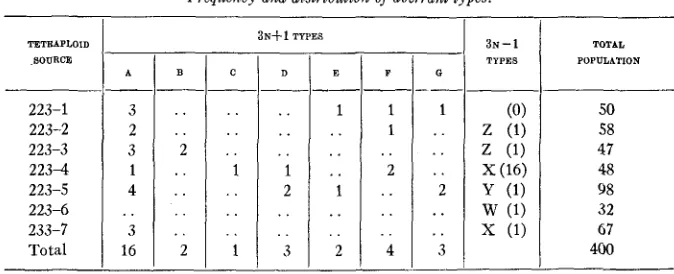
It will be observed from table 2 that one tetrasomic and one disomic type are considerably in excess of the others. It might be supposed t h a t the same chromosome was involved in each case, the result being due to the equal functioning of both gametes after non-disjunction. Type A is pretty well distributed among the progeny of the seven tetraploids while type X
appears from only two, the great majority of the type X plants (16 out of
POLYPLOID AND ANEUPLOID FRAGARIA 471 chromosome counts were made on sixteen additional plants of the same cross. Two 22-chromosome plants, identified as types F and D were found, indicating that the type X plants were the result of chromosomal loss rather than of non-disjunction. Since only four 3n - 1 types were identified, it is possible that the chromosomal balance remaining when each of four non-homologous chromosomes of the set are missing gives the same or very similar morphological results. Anything, then, increasing chromosomal
loss would increase the ratio of type X plants, especially if such pollen has the advantage postulated. This seems rather unlikely, however.
Other types appear in approximately equal numbers.
All of the extra chromosome types and all but one of those lacking a chromosome were carried through the pollen. Since most of the triploids resulted from crosses involving the tetraploid as male parent, the chance for aberrant chromosomal types occurring through the pollen was much greater than through the egg.
DiscussioB
While the effect of an unbalanced chromosomal complement is definite and specific, i t should not be overlooked that the general appearance of the plant is likewise dependent upon environmental conditions, such as water, temperature and sunlight. Age is also a factor in influencing appear- ance. The descriptions given are for plants approaching the maximum growth where conditions for light and temperature have been good. Some of the changes ordinarily found under poor conditions have been noted above, size of leaves being the most conspicuous. Under poor conditions types B, D and F approach the triploid in appearance under similar con- ditions; the others can be quite readily identified even under these cir- cumstances. Different individuals of the same type show small variations, as do the triploids, due probably to different combinations of bracteata and
vesca chromosomes which are similar but not identical.
The effect of the extra chromosomes in combination with three com- plete sets may be suLmarized as follows:
Chromosome A: an increase in length of all three petiolules, the leaflets being of medium size and nearly as broad as long, and the serrations wide and shallow.
B : an increase in the length of the terminal petiolule only; the terminal leaflet is nearly round, and the serrations are somewhat enlarged over those of the triploid.
C: the leaves are quite stiff and the number of serrations is greatly in- creased.
472 S. I-I. YARNELL
D : increased growth and fertility results.
E: the size is increased and the balance necessary for the normal de-
F: the normal balance is changed only to a very slight extent.
G: the amount of pubescence is reduced and the normal development of
With these points in mind, the particular chromosome lacking in the Type Z shows the influence of chromosomes A, B and C. The full devel- Type Y seems to lack the growth stimulation of chromosome D.
Type X shows some of the characteristics associated with chromosomes
A, B, D
and G. Chromosome C may be absent in this case.Type
W
shows the influence of chromosomes B, C, E and G. The ab- sence of chromosome A is suggested here.The above assignments of the particular chromosome absent are, of course, entirely tentative. An effort was made, by a careful study of the somatic chromosomes of the root tips, to identify cytologically the chromo- some associated with each of the above types. As explained in an earlier paper
(YARNELL
1929a), the only constant difference between the somatic chromosomes is one of relative size. Since the average range for the haploid set is only from 0.9-1.8 microns, the determination of which of the seven chromosomes was tetrasomic in a 22-chromosome plant could not be made with any degree of confidence.The loss of a chromosome from the 3n balance seems to cause more of an upset than the addition of an extra one. All seven of the extra chromosome types have been found among the tetraploid progeny, but only four types lacking a chromosome. Of the latter group two are somewhat below the normal triploid in vigor and a third
(W)
is very weak. None approaches the normal as does type F. The fact that fewer 3n-
1 types than expected ap- pear must be significant, since non-disjunction should produce equal num- bers of each type of gamete and, in addition, chromosomes lost in the cy- toplasm should increase the amount of 13-chromosome pollen. It is not known whether the lethal effect is gametic or zygotic in these cases.Certain aberrant types with higher chromosome numbers have appeared. Two plants varying only slightly from type A were found to have 23 somatic chromosomes. The identity of the second chromosome involved has not been ascertained. The characteristics of type A are not more marked; neither are the distinguishing features of any other type apparent.
It may be that the second chromosome is F or perhaps one which has its velopment of the terminal leaflet is upset.
all three leaflets is interfered with. 3n - 1 types may be considered.
POLYPLOID AND ANEUPLOID FRAGARIA 473
own characters balanced by the extra chromosome A. FROST (1927) finds two cases of combined trisomic types in Matthiola in which the character- istics of both are evident. A plant with three chromosomes extra he sup- poses to have two chromosomes of one type and one of another, since it
was derived from a 2 n + l + 1 plant showing their combined features. It is interesting that abnormal chromosome numbers in Zea m a y s range from 2 1 to as high as 28 (RANDOLPH 1928) without striking changes in appearance, although MCCLINTOCK (1929) finds a decrease in vigor and fertility with an increase in chromosome number.
I n a backcross to the diploid in which the tetraploid Fragaria was used as female, a “maternal” appeared that has 29 somatic chromosomes. It
corresponded very closely to type B. Two 29-chromosome plants were found in the progeny of one of the tetraploids selfed. One belonged to type
B, the other to type E.
NEWTON and PELLEW (1929) report the appearance of three abnormal types derived from the tetraploid P r i m u l a kewensis; two had 35 and one had 37 chromosomes. Both 35-chromosome plants produced a new form with 34 chromosomes. The first three types, when selfed, did not pro- duce normal tetraploids. This is attributed to intraspecific chromosome pairing normally, with interspecific pairing with interchange between chromosomes giving rise:to new types.
A self-fertile “maternal” of unknown chromosome number of the cross
223 - 5 X F . americana alba gave plants when selfed with the following
somatic chromosome numbers:
Chromosomenumber: 15 26 27 28 29 30 Number of plants: 1 2 2 7 5 2
Those with 28, the tetraploid number, correspond very closely to the normal type. The 15-chromosome plant is of type C. One 26-chromosome plant is very close to type
W,
but more vigorous; the other plant has not yet been identified. One of the 27-chromosome plants is small and can probably be referred to type Y ; the other is new. Of the 29-chromosome plants one is type B, two type E and two probably type G. Both 30-chro- mosome plants seem to be a combination of E and F. The above types are somewhat more vigorous than the corresponding ones of the triploid but are otherwise very similar.A backcross to the diploid of a type B 29-chromosome plant, which is a sib to the parent of the above family, includes plants of the following types: two 20-chromosome plants classified as type X, ten normal triploids, four 22-chromosome plants (one A, one B, one F and one G), and two 23-
474 S. H. YARNELL
LEGEND FOR PLATE 1
All drawings were made with the aid of the camera lucida, using a 1.5 mm Spencer apochro- matic objective, with X 18 ocular and a tube length of 160 mm. They have been reduced one fourth in publication. Figures 1-11 are of pollen mother cells.
FIGURES 1 and 2.-Tetraploid X F. collina; prophase showing two nuclei. FIGURE 3.-F. americana albaX tetraploid; diakinesis.
FIGURE 4.-F. americane albaXtetraFloid; 3n+l type B, 11 disomes. FIGURE 5.-F. americana d b a X tetraploid; 10 bivalents+ 1 univalent.
FIGURE 6.-F. americana albaX tetraploid; 3 tetrasomes, 3 disomes and 1 trisome.
FIGURE 'i.-TetraploidXF. sp F P I 64856; second metaphase showing a 10+ 11 distribution. FIGURE 8.-F. americana albaXtetraploid; early first metaphase, 3 tetrasomes, 3 disorxes and
FIGURE 9.-F. americana aZbaX tetraploid; spindle view of first metaphase showing two tetra-
FIGURE 10.-Late anaphase of the tetraploid showing chromosome lagging. FIGURE 11.-F. americana albaX tetrap!oid; lagging a t first metaphase.
FIGURE 12.-F. americana albaxtetraploid; 3n-1 type X, somatic division from root tip
FIGURE 13.--Same family as figure 12; 3 n + l type C, 22 somatic chromos-mes. 1 trisome.
somes.
S. H. YARNELL, POLYPLOID AND ANEUPLOID FRAGARIA PLATE 1
476 S. H. YARNELL
chromosome plants both having chromosome B extra, one in combination with chromosome E and the other with either E or
G.
MEIOSIS I N THE TRIPLOID
The only evidence of irregular behavior in prophase stages preceding diakinesis is found in the F1 of the cross tetraploidxF. collina, in which occasionally two nuclei can be seen in a single cell. Figures 1 and 2 of plate 1 show two pollen mother cells, evidently of common origin, each contain- ing two dividing nuclei a t diakinesis, three of the nuclei each showing a nucleolus. One is about twice the size of the other. It is possible that the chromosome set from collina is organized in the small nucleus and that two sets from the tetraploid form the larger one. While numerous similar cases have been observed a t earlier stages, there is no evidence of such a separa- tion either previous to or later than the meiotic prophases, and no evi- dence from mitosis in the root tips.
I t is often difficult to make out the precise relationships of the chromo- somes a t diakinesis, since it is not always certain that proximity has any real significance. Figure 3 illustrates what is believed to be about the maxi- mum amount of association a t this stage. It includes two pairs, one tri- valent group and three groups of four. The nucleolus, which is stained very deeply, is assumed to hide a third pair. The group in the upper left con- sists of three chromosomes of nearly equal size together with one much larger.
POLYPLOID AND ANEUPLOID FRAGARIA 477 a different shape. A number of chromosomes have been omitted from the group. Figure 11 shows lagging chromosomes, a phenomenon more fre- quent in the triploid than in the tetraploid. I n figure
7,
a 10-11 segregation has occurred during the first division and the chromosomes are lined up quite regularly on the homotypic plates. Other cases exhibit extrusion of chromosomes into the cytoplasm, lagging and reduced numbers.The tetrads appear normal for the most part; i t is only very rarely t h a t more than four microspores are formed. This is in considerable contrast t o what is found in the pentaploid hybrids; the difference may be due t o the amount of chromatin available for a micronucleus.
Complete pairing of the chromosomes has been observed in all of the material examined. Fresh aceto-carmine mounts gave the same counts as buds sectioned in paraffin. The latter were fixed for the most part in Allen’s modification of Bouin’s fixative, which gave excellent results, and also in Navashin’s chrom-acetoformaldehyde solution.
Unfortunately it was impossible to determine the stage of meiosis a t which pairing between non-homologous chromosomes begins, except t h a t it was sometimes seen a t diakinesis. This may be taken as an indication of association a t earlier stages with the concomitant possibility of crossing over between such chromosomes, or it may be more superficial. NEWTON and DARLINGTON (1929) in describing meiosis in triploid tulips say, “At the end of diplotene, and in the ensuing stages up to metaphase, associa- tion between chromosomes is thus maintained only by exchanges between their constituent halves, the chromatids” (page 6). Such a cause of associa- tion, if applicable, would seem to favor the first possibility.
Doctor KARL SAX suggests in a private communication that this pairing of non-homologous chromosomes may be of the nature of that found in
XY pairing in Drosophila. Here pairing of the X and Y chromosomes is loose and no crossing over occurs either in the male or female.
478 S. H. YARNELL
nothing in common to effect a secondary association. (If the association were AIBIBb, then Aa would remain a disome.)
Reference has been made in an earlier paper (YARNELL 192913) to a similar method of pairing generally effective in two Oenothera hybrids, re- ported by GATES (1909 and 1923). The triploids arose from crossing 0.
lata and 0. rubricalyx with 0. gigas as pollen parent. He finds considerable
irregularity, however, so that, “pollen grains will be formed having every chromosome number between 11 or 12 and
7”
(GATES 1923). GEERTS (191 1) studying an Oenothera triploid from the cross Lamarckiana-gigasfound only seven pairs plus seven univalent chromosomes at the hetero- typic metaphase. Since the cause or causes of pairing of non-homologous chromosomes are as yet unknown, there is no reason to expect triploids of unlike origin in the same genus to behave identically in this respect.
LONGLEY (1924) points out the similarity of chromosome behavior in the triploid Oenothera and in the triploid Rubus species studied by him. Both have 2 1 somatic chromosomes and both have shown 10 and 11 bodies at first metaphase.
Another case of similar association during the meiotic mitosis has been found in a triploid Citrus (LONGLEY 1926). I n this instance only a single individual was investigated. It resulted from the triple cross (Fortunella margarita X C i t r u s aurantifolia) (9) X F . hindsii (18), giving a plant with
27 somatic chromosomes. He found mostly 13 bivalents plus one univalent
at I M with 13 chromosomes a t I1 M. There was little tetrad irregularity. NISHIYAMA (1929) reports conditions in a triploid resulting from the cross
Avena barbata (14) X A . strigosa
( 7 ) .
He finds pairing between two non-homologous chromosomes in 25 percent of the 100 first metaphase plates examined. Reference is made by TISCHLER (1929) to cytological observa- tions of CHIARUGI (1926) on the triploid Artemisia nitida. Both 9 bivalents plus 9 univalents, and 9 + 4 bivalents plus 1 univalent were found a t first metaphase. Four of the bivalents in the latter case would represent pairing between non-homologous chromosomes.
There are numerous cases in which species with different chromosome numbers are crossed (often in the ratio of 2 : 1) in which complete pairing among the chromosomes a t meiosis has been observed, but the larger num- ber of chromosomes involved invites the assumption of autosyndesis be- tween two related groups rather than association between chromosomes ordinarily considered non-homologous. The instances cited above include only triploids with chromosome complements of small prime numbers. It
POLYPLOID AND ANEUPLOID FRAGARIA 479 the chromosomes of a set, but the assumption seems reasonable, especially where the haploid number is the basic one for the genus.
Such observations are significant for theories of chromosome pairing of
general application. A considerable amount of cogent evidence has accum- ulated showing not only consistency of pairing between morphologically similar chromosomes, but also showing that contact is between like ends of chromosomes that associate. Thus in the Datura 2 n + l primaries the trivalent usually forms a chain, while in the 2 n + l secondaries a closed ring of three chromosomes is found (BELLING 1927). The new configura- tion is assumed to be possible because of “reverse segmental interchange” between two homologous chromosomes, giving a new type with similar ends.
Demonstration of pairing between non-homologous chromosomes has no effect upon the validity of such observations and conclusions, but may somewhat limit their universal application.
DARLINGTON in a paper on Prunus concludes that “differences in genetic properties are associated with, if not responsible for, variations in affinity of homologous chromosomes” (1928, p. 239). H e includes single factor differences as well as more general genetic relationships. It is quite possible that factors other than the degree of genetic relationship may likewise de- crease the amount of pairing among homologous chromosomes. DARLING- TON further cites the work of HUSKINS (1928) on fatuoid oats in support of the supposition that the non-pairing of certain chromosomes may be due to a single gene. SHARP (1926, p. 280) in referring to extra chromosome forms in Zea mays cautions against “attributing lack of synapsis to ab- sence of homology.”
BEADLE (1930) has found a case of complete lack of pairing in Zea mays
due to a single recessive gene. There seems to be no possibility here of re- duced homology. GOWEN’S case of non-crossing over in Drosophila (1928) is probably of a similar nature.
In studying the cytology of progeny from X-rayed sex cells, GOODSPEED
(1929) describes five plants as showing a variable amount of conjugation, a part of the cells giving 24, the normal number of bivalents a t first meta- phase. It would seem that induced conditions other than non-homology might here be responsible for the wide variability in association.
KOSTOFF (1929) attributes irregularities in the meiotic divisions of Nico-
tiana Tabacum macrophylla and N . Langsdor-i to the influence of the stock,
when scions of these Nicotianas were grafted on Datura Wrightii and
480 S. H. YARNELL
halimifolium due to the attack of a gall mite has been observed by
KOSTOFF
and KENDALL (1929).
The fact that conditions other than homology seem to induce association of non-homologous chromosomes may also be assumed to apply to chro- mosomes of various degrees of homology as obtaining in species hybrids. Such considerations reduce confidence in an assumption of a complete positive correlation between chromosome affinity and genetic relationship. The limited experience thus far obtained indicates three possible in- fluences on the pairing of chromosomes apart from their genetic identity: (1) single gene mutations, (2) abnormal conditions due to hybridization and (3) the primary or secondary effect of a number of influences including X-rays, grafting, temperature, etc. The second appears to be of greatest importance where inferences of genetic relationship are drawn from chro- mosome behavior.
THE TRIPLOID DERIVATIVES
Fertility in the triploid
So far as is known, the triploids have never spontaneously set fruit in the greenhouse, though the pure species and the commercial types with per- fect flowers set fruit freely without artificial pollination. Small fruits have been obtained frequently on crossing the triploid reciprocally with the diploid. Open pollinated flowers will also set out of doors, although only a small number of achenes develop. Tetrasomic D and possibly E have set fruit in the greenhouse without artificial pollination, but not under condi- tions excluding pollen from other sources. When the triploid was pollinated with pollen from the diploid, 30 of the 80 pollinations, or 37.5 percent, set fruit. The 378 seeds obtained gave about 18 percent germination, a total of 71 plants being raised. From the reciprocal cross
4
out of 23 pollinations set-approximately 17 percent. The 99 seeds obtained gave about the same percentage of germination as before. Thus in spite of the fact that many more male gametes than female are involved in the crossings, with the accompanying selection of functional pollen, the triploid shows greater fertility on the female side.T h e progeny
POLYPLOID AND ANEUPLOID FRAGARIA 481 __ Ih _ _ _ . . -
of the normal diploid. Fifteen of these plants have bloomed, seven were found to be completely fertile, three were sterile and five showed evi- dence of reduced fertility. Sixteen of the plants resembling the normal diploid have been slow in coming into bloom. This is also a characteristic of the abnormal types. Of the five remaining plants with the diploid num- ber of chromosomes, three are very much alike in leaf shape and type of serrations, both of which are atypical. Two of these show considerably re- duced vigor. One of the other plants is small, and the fifth, while normal in vigor, has leaves that are thick and heavy.
TABLE 3
Frequency of types in triploid derivatives.
lo . . . . 4 3 1 3 2 6 7 . . . . . . . . CROSS ______ 2nX3n 3nX2n 2nX3n+S 3 n f l X 2 n 3 n f l selfed 3n- 1 X2n
Total . . . . . . ~ E F _ _ 1 1 4 2 1 1 2 3 9 . . . . ~ - C - . . 2 1 2 5 . . ..
-
"NORMAL" DIPLOID 8 7 3 4 2 7 31 - D - . . . . . . . . . . . . 0 - X - I I 2 . . . . . . 4 1 - 0 - . . . . . . 1 . . . . 1 - ___ A B -- . . . . . . . . . . . . . . . . . . . . . . 1 0 - - la - . . 1 . .. .
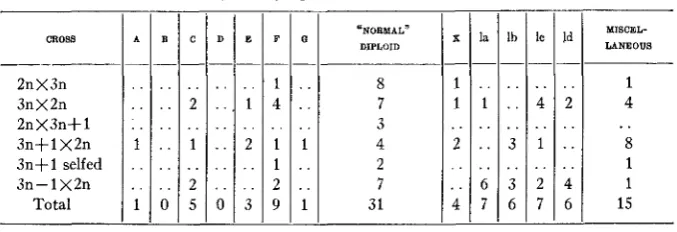
. . 6 7 - - Id - . . 2 . . .. . . 4 6 - MISCEL- LANEOUS 1 4 8 1 1 15 ..The following easily recognizable types have been found among the 15- chromosome plants: A, one plant; C, four plants; E, three plants; F, eight plants, and G, one plant. One rather weak plant was classified as a modified type F. I n addition to the above, twenty-four 15-chromosome plants could not be assigned to any previously known type. These plants will now be classified and given group numbers to distinguish them from the 3n+ 1
types already described. Twenty-one of these plants have certain char- acteristics in common, namely, leaflets that are narrow in comparison to length, and serrations that are of medium size but rather deep. There also is a tendency for the terminal leaflet to be reduced. This group, which will be referred to as number 1, can be separated into four subgroups that tend to merge. The first three have light green foliage, the leaves of the fourth being darker in color.
482 S. H. YARNELL
slight amount of pubescence on the upper surface of the leaf. The leaflets are fully developed and are' narrower than those of G. The last three groups could be considered as extremes of group 1.
Six 16-chromosome plants were found. One is of type F, four were re- ferred to group number 1 and one remains unclassified. One 17-chromo- some plant is of type C; another belongs to group number 1. Two 19-
chromosome plants form group number 5. They are very similar to type
W
but are much larger. The leaflets are very misshapen, but the plants are fairly vigorous. The four 20-chromosome plants all belong to type X.
Three normal triploids appeared. A single 22-chromosome plant was found which proved to be of type C.
A total of 80 plants have been grown from seed set on triploids out of doors without any protection from cross-pollination, Most of the types al- ready described are found in these families and, in addition, a number that appear to be new. Certain of the extra chromosome types such as A and C
appear in extreme form. Minor differences of many kinds are in evidence, and variability is the rule throughout these progenies. The chromosome number of most of these plants has not been determined.
Five of the extra chromosome types have reappeared in the progeny of the triploid. These 2n+1 plants, as might be cxpccted, are not identical with the corresponding 3 n + l types. The 2n+A plant has smaller leaves than the corresponding tetrasomic, but the distinguishing characters, leaf shape, type of serrations, and length of petiolules remain the same. The leaves of the trisomic are slightly thinner but are of about the same texture.
No well defined B or D types were identified among these plants. The trisomic type C has longer, less stocky petioles than its tetrasomic relative. The serrations are the most outstanding characteristic of the type and make recognition easy. The trisomic plants show differences in vigor and leaf texture, the less vigorous plants having stiffer foliage. The trisomic E
retains the leaf shape common to the type. The leaves are thinner and the petiole is not so heavy. The nine plants placed in type F do not differ appreciably from the normal diploid, and their classification is due entirely to their somatic chromosome number.
POLYPLOID AND ANEUPLOID FRAGARIA 483
SOMATIC CHROMOSOME NUMDERS BOMATW NUMRER MINUS 7
2nX3n 3nX2n 2 n X 3 n f l 3n+ 1 X 2n 3114-1 selfed 3n- 1 X2n
Total
tween the extra chromosome and the number of sets. The characteristics due to the extra chromosome remain about the same: the major change is in leaf size, thickness of petiole, and thickness and texture of the leaves. This is in contrast to BLAKESLEE’S findings in regard to the Globe mutant of Datura (1922). H e reports a considerable decrease in intensity of Globe characters with an increase in the number of full sets of chromosomes and finds that a 4n+2 plant is comparable to a 2n+ 1 individual in this respect. The distribution of the extra chromosome types in the triploid progeny does not follow that of the tetraploid,. I n the latter case type A is far in ex- cess, while in the former only one such plant appears. The 2n
+
1 type C is found oftener than expected in progeny from the triploid. This is also true of type F, the one nearest t o the normal. No plant was identified as having 2n-
1 chromosomes.TABLE 4
Chromosome numbers of triploid derivatives.
14 (7) 9 9 3 5 3 7 36 17 (10) . . 1 . . . . . . 1 - 15 (8) 1 11 12 1 16 41 __ . .
18 19 20
(11) ( 1 2 ) (13)
_ _ _ _ _ _ _ _ _
. . . . 1
. . . . 1
. . 2 2
. . . . . .
. . . . . .
. .
. .
. .2 0 2 4
16 (9)
__
. . . . 2
. .
. .
4 6 21 (14)..
. . .. 3 .. .. 3 22 ( 1 5 )-___ . . 1 . . . . . . . . 1
Distribution of chromosomes
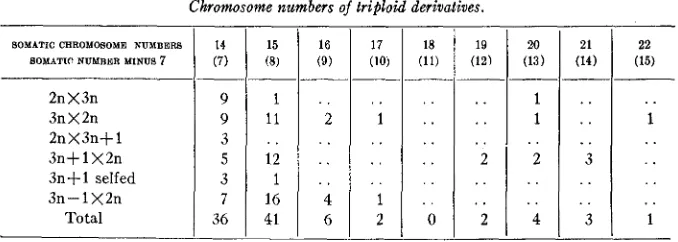
It will be observed from table 4 that different proportions of 14- and 15- chromosome plants are obtained from different crosses. Both triploid and aberrant types produce a larger number of the latter when used as female. The diploid used in the 2 n x 3 n crosses was a pistillate form of F . bracteata,
so the diploids in the progeny can hardly be due to accidental selfing. T h e chromosome numbers of the gametes received from the “ triploid” parent
(3n, 3n+ 1, 3n - 1) are listed in the second line of the table. The chromo- some numbers received by the successful gametes are obviously the result neither of a consistent 10+11 segregation nor of a chance distribution. It would appear t h a t no 11-chromosome gamete had been successful and only two 10-chromosome gametes. Since reduction division has not been in- vestigated in the egg mother cells of the triploid, i t is impossible to say
what has occurred there.
A study of meiosis in the pollen mother cells re-
484 S. H. YARNELL
vealed considerable irregularity in chromosome distribution. Unsuccessful chromosome combinations may have been eliminated during gametic de- velopment, after pollination, after fertilization and upon attempted ger- mination of the seed. FEDERLEY (1929) finds an unsuccessful chromosome combination in a species cross involving the sex chromosome. I n the cross
Metopsilus porcellus X Chaerocampa elpenor a normal sex ratio is obtained,
but in the reciprocal all of the females die in the pupa stage, individuals receiving a porcellus X-chromosome and an elpenor Y-chromosome develop- ing no farther.
Those plants with somatic chromosome numbers of 19 or higher, with the exception of a single 20-chromosome plant, may have arisen through some form of pseudogamy.
An excess of plants with complete or nearly complete sets of chromo- somes is frequently found in progeny of plants having an odd number of genoms. NAVASHIN (1929) finds large numbers of 2n, 3n and even 4n plants from the triploid Crepis capillaris selfed, whereas the aneuploid numbers are relatively scarce. I n addition, the trisomic type C did not appear at all. I n the triploid derivatives of the Raphanus sativus X Brassica oleracea cross KARPECHENKO (1928) obtained upon selfing
75
percent 2n and 2 n + l plants. Triploid X the diploid R. sativus gave only diploids. Triploid X dip- loid tomatoes produced thirty-five 2 n + l , fourteen 2n+2 and two 2n+3 plants (LESLEY 1928). Kine of the twelve primary trisomics possible were found in about equal numbers.I n contrast to the above, DARLINGTON finds that in triploid hyacinths every chromosome number between 16 and 30 seems to be equally success- ful (NEWTON and DARLINGTON 1929). The Zea m a y s triploids investigated by MCCLINTOCK (1929) when used as female with the diploid produced no diploids but only extra chromosome plants as follows: one 2 n + l , three 2n+2, one 2n+3, three 2n+4, one 2n+5 and one2n+7 plant. The recip- rocal gave 27 diploids, six 2 n + l , three 2n+2 and one triploid.
I n a study of partial sterility in the Nicotiana paniculata-rustica cross LAMMERTS (1929) concludes that, “Sterility of the F1 is evidently not pri- marily due to inviability of gametes resulting from random distribution of the univalents, inasmuch as viable gametes apparently represent a random sample, as respects the chromosome number, of the entire gametic series” (LAMMERTS 1929, p. 303).
POLYPLOID AND ANEUPLOID FRXGARIA 485 ceptibility to rust of the vztlgare parent.” THOMPSON and CAMERON (1928) report similar cytological results with another pentaploid wheat hybrid.
Causes of variation
Certain results observed in the progeny of the “triploids” require further explanation. These include the sterility found in a portion of the diploids, the unexpectedly large number of type F plants, the appearance of the twenty-one 15-chromosome plants in group one and the increased amount of variability in all groups.
Three things may be suggested as being responsible for the results in Fragaria: (1) new combinations of vesca and bracteata chromosomes, (2) the appearance of diploids lacking one chromosome and having one or two different chromosomes in excess and ( 3 ) crossing over between non-homol- ogous chromosomes in the triploid.
Substitution of bracteata and vesca homologs
Since pairing among the four homologs of the tetraploid was found to be entirely fortuitous, it is reasonable to suppose that the same thing is true of the triploid. Gametes from the triploid would thus carry a great variety of combinations of vesca and bracteata chromosomes which would find expression in the progeny. The question then arises whether or not the differences between the homologous chromosomes of these two species are large enough t o account for the new types found. Judging from their mor- phological similarity and complete interfertility, from the fact that only seven 3 n + l types appeared, and from the additional fact that the trip- loids showed no such large differences, it seems that this point alone is hardly sufficient to explain the observations.
Substitution of non-homologous chromosomes
The second possibility seems to hold greater opportunity of definite change in the appearance of a plant. A 2n