HIGHLIGHTED ARTICLE
| INVESTIGATION
Isolation of Aggressive Behavior Mutants in
Drosophila
Using a Screen for Wing Damage
Shaun M. Davis,* Amanda L. Thomas,*,1Lingzhi Liu,* Ian M. Campbell,*,2and Herman A. Dierick*,†,‡,3
*Department of Molecular and Human Genetics,†Department of Neuroscience, and
‡Program in Developmental Biology, Baylor College of Medicine, Houston, Texas 77030
ORCID ID: 0000-0003-3419-6470 (S.M.D.)
ABSTRACT Aggression is a complex social behavior that is widespread in nature. To date, only a limited number of genes that affect aggression have been identified, in large part because the complexity of the phenotype makes screening difficult and time-consuming regardless of the species that is studied. We discovered that aggressive group-housedDrosophila melanogastermales inflict damage on each other’s wings, and show that wing damage negatively affects their ability tofly and mate. Using this wing-damage phenotype, we screened males from1400 chemically mutagenized strains and found40 mutant strains with substantial wing damage. Five of these mutants also had increased aggressive behavior. To identify the causal mutation in one of our top aggressive strains, we used whole-genome sequencing and genomic duplication rescue strategies. We identified a novel mutation in the voltage-gated potassium channelShaker(Sh) and show that a nearby previously identifiedShmutation also results in increased aggression. This simple screen can be used to dissect the molecular mechanisms underlying aggression.
KEYWORDSDrosophila melanogaster;Shaker; aggression; copulation; damage; EMS mutagenesis;flight;flight assay; whole-genome sequencing
A
GGRESSIVE behavior is pervasive throughout the animal kingdom. While beneficial to help animals compete for limited resources such as food and mates, aggressive encoun-ters can also lead to physical damage and in some instances even death (Wattset al.2006; Umberset al.2012; Georgievet al.2013).Drosophila melanogasterhas recently emerged as a powerful model organism to study this trait because of the numerous genetic and neurobiological tools available in this species (Jones 2009; Venkenet al.2011; del Valle Rodriguez
et al.2012), in addition to their distinctive aggressive behav-iors first described in detail more than half a century ago
(Jacobs 1960). In the last 15, years a range of studies have explored some of the underlying mechanisms regulating ag-gression by examining the role of sensory systems (Wang and Anderson 2010; Liuet al.2011; Wanget al.2011; Andrews
et al.2014), sex-determining pathways (Lee and Hall 2000; Vrontou et al.2006; Fernandez et al.2010; Hoopfer et al.
2015; Koganezawa et al.2016), neurotransmitter systems (Baieret al.2002; Certelet al.2007; Dierick and Greenspan 2007; Hoyeret al.2008; Zhouet al.2008; Alekseyenkoet al.
2010; Andrewset al.2014), and neurosecretory cells and/or the neuropeptides they produce (Asahinaet al.2014; Davis
et al.2014). These investigations have provided great insight into fly aggression, but were driven largely by specific hy-potheses involving known or expected factors regulating var-ious aspects of this behavior. Recently, an unbiased screen was performed to identify small neuronal populations that can trigger a strong aggression response when acutely activated with a thermosensitive TrpA1 (Transient receptor potential cat-ion channel A1) channel (Hoopfer et al.2015). Conditional activation of a subset of P1 neurons induced immediate court-ship behavior and long-lasting aggressive behavior in maleflies. More recently, this circuit was further dissected and found to be a double-negative regulation involving both Doublesex (Dsx) and Fruitless (Fru) (Zampoliniet al.2012) neurons in the P1
Copyright © 2018 Daviset al.
doi:https://doi.org/10.1534/genetics.117.300292
Manuscript received September 13, 2017; accepted for publication October 30, 2017; published Early Online November 6, 2017.
Available freely online through the author-supported open access option.
This is an open-access article distributed under the terms of the Creative Commons Attribution 4.0 International License (http://creativecommons.org/licenses/by/4.0/), which permits unrestricted use, distribution, and reproduction in any medium, provided the original work is properly cited.
Supplemental material is available online atwww.genetics.org/lookup/suppl/doi:10. 1534/genetics.117.300292/-/DC1.
1Present address: Department of Pathology and Cell Biology, Columbia University
Medical Center, New York, NY 10032.
2Present address: Department of Pediatrics, The Children’s Hospital of Philadelphia,
School of Medicine, University of Pennsylvania, Philadelphia, PA 19104.
3Corresponding author: Baylor College of Medicine, One Baylor Plaza, Houston, TX
cluster, where the Dsx neurons regulate aggression and the Fru neurons control courtship (Koganezawaet al.2016).
Forward genetic chemical mutagenesis screens have been a powerful methodology to unravel the molecular components of many biological processes, including behavior. This unbiased approach led to the discovery of thefirst mutants in circadian rhythm (Konopka and Benzer 1971), courtship (von Schilcher 1977), learning and memory (Dudaiet al.1976; Quinnet al.
1979), and, more recently, identified novel components in-volved in ethanol intoxication (Singh and Heberlein 2000) and sleep (Cirelli et al. 2005; Stavropoulos and Young 2011). A similar approach to identify novel mutant alleles in genes that regulate aggression has never been reported in
Drosophilaor any other species because of the complex nature of the behavioral phenotype. Direct observation of altered ag-gression is time-consuming, which has so far made high-throughput screens challenging. To circumvent this obstacle, we explored whether an indirect and easier phenotype could be scored as a read-out of aggressive behavior. In most species, aggression can cause physical damage as a result of intensely aggressive encounters. Many examples exist within the animal kingdom of lasting scars to the head, body, or limbs after fero-cious physical combat (Umbers et al. 2012; Georgiev et al.
2013), but inflies such evidence has been lacking.
Here, we show thatflies also exhibit lasting marks of physical damage to their wings as a result offighting. Not surprisingly, this damage also results in a negative consequence to the males’ flight and mating abilities. We used this easy-to-score pheno-type to perform thefirst forward chemical mutagenesis screen to isolate mutants with increased aggression. Of the roughly 1400 lines that we screened, 41 had significant wing damage and, of those,five lines showed increased aggressive behavior. Using whole-genome sequencing and duplication mapping strategies, we identified the causal variant in one of the top aggressive lines. This variant alters an evolutionarily con-served residue in the voltage-gated potassium channel,Shaker, suggesting that regulation of neuronal activity can profoundly affect a complex behavior such as aggression. Together, these results show that aggression-induced wing damage can be used to successfully screen for novel components involved in the regulation of aggressive behavior inDrosophila.
Materials and Methods
Fly stocks and rearing conditions
The followingfly strains were obtained from the Bloomington
DrosophilaStock Center:Shmns(BL24149),Sh5(BL111),Sh14,
and the duplication stocks listed in Supplemental Material, Table S1 inFile S1. The C(1)DX,y w fstrain was a kind gift from Richard Kelley (Baylor College of Medicine, Houston, TX). The strains used to investigate the correlation between wing damage and aggression were derived from a strain that was previously se-lected for increased aggression (Dierick and Greenspan 2006). Recombinants between a third chromosome derivative strain with high aggression were generated against a low-aggression
wild-type Canton-S strain, and single-chromosome strains for the third chromosome were derived. These strains showed a range of aggressive behaviors and remained phenotypically stable through-out a 2-year period, when they were analyzed for aggressive behavior repeatedly and by independent investigators (data not shown). The isogenic SD1 line was created by crossing a single Canton-S male to multiple C(1)DX,y w f /Y females. To limit the mutation load per chromosome so that mutants would be healthy enough to show strong aggression phenotypes, the SD1 males were mutagenized with 10 mM ethyl methanesulfonate (EMS) using a similar feeding protocol as previously described (Haelterman et al. 2014). Each resulting male offspring was backcrossed to C(1)DX,y w f/Y females. Allflies were reared on yeast, cornmeal, molasses, and agar food at room tempera-ture (22.560.5°) on a 16-hr light/8-hr dark cycle.
Aggression assay
All aggression assays were performed in the arena assay as previously described (Dierick 2007) with minor modifications. On the day of eclosion, males were collected and group-housed for 4 days and then isolated for 2.5 days in individual 5 ml tubes with 0.4 ml of standardfly food. A minimum of 70 pairs offlies per genotype were tested and multiple genotypes were assessed simultaneously. Flies were recorded for 20 min and scored for aggression by observing unambiguousfighting behaviors of re-peated lunging or boxing. All data are reported as averagefi ght-ing frequencies per genotype plus SEM. For some experiments, pairs offlies from the same experiments were also analyzed using automated lunge counting analysis with the CADABRA software (Dankertet al.2009). All data were reported as box-plots of lunge number in 20 min showing medians, 25th, and 75th percentiles (first and third quartiles), and whiskers indi-catingfifth and 95th percentiles.
Wing damage assessment
On the day of eclosion, 15 males were collected and group-housed in a standardfly vial with standardfly food. Anyfly with damaged wings at this point was discarded. The flies were transferred to new vials as necessary. After 7, 14, or 21 days, theflies were anesthetized, and wings were observed for any missing piece of the wing edge or wing blade. Each wing was scored independently. For imaging, the wings were removed at the proximal end with dissection scissors and were dry mounted and imaged via brightfield microscopy on a Zeiss Axioplan2 (Zeiss [Carl Zeiss], Thornwood, NY).
Flight assays
37 mm in diameter with a 12-mm opening in the center connect-ing the funnel to the dish. The inverted small petri dish platform was centered in a large petri dish to create a 52-mm wide moat of water surrounding the small petri dish platform. A clear plastic rectangular box measuring 165 mm in width and length, and 102 mm in height, was built on top of the large petri dish. Ten flies were introduced in the bottom of the inverted funnel through a 4-mm hole by gentle aspiration. A minimum of 200flies was tested for each genotype/condition. The percentage offlies that successfully crossed the moat without touching the water was scored in each experiment. The data are presented as bar graphs of the average percentage of successful crossers plus SEM.
Copulation assay
A 100-mm diameter petri dish with damp Whatman paper on the bottom was used for the copulation arena. Ten males and 10 females were loaded into the chamber and recorded for 1 hr. Time to initiate copulation and duration of copulation were recorded. Only pairs that started mating before thefirst pair tofinish mating were included for analysis. For all assays, 3–5-day-old virgin Canton-S females were used and a total of 25–30 males were tested for all conditions. For the artificial wing damage, 3–4-day-old Canton-S males were lightly anes-thetized with CO2and their wings were cut with dissection scissors. They were allowed to recover from anesthesia for 24 hr before testing. For the naturally damaged wings, AI31d males were group-housed with 15 males per vial for 20 days, at which point the males were sorted for wing damage under CO2anesthesia. Theflies were allowed to recover for 24 hr before testing. All data are presented as boxplots that repre-sent the latencies to mate and mating durations in minutes, showing the spread of the medians andfirst and third quar-tiles as boxes and the 5th and 95th percenquar-tiles as whiskers.
Genome sequencing
Genomic DNA was isolated from SD1 males and allfive mutant strains using the DNeasy Blood and Tissue kit according to the manufacturers protocol (QIAGEN, Valencia, CA). Whole-genome sequencing was performed by Genewiz (South Plainfield, NJ) at 203coverage. Variants in the mutant strains werefiltered by removing common SD1 variants, synonymous variants, noncod-ing variants, and variants with,80% read counts.
Statistical analysis
Aggression data are typically not normally distributed, and for these data medians were statistically compared using the non-parametric Kruskal–Wallis ANOVA for unpaired groups. We used the Mann–WhitneyU-test forpost hoccomparisons to iden-tify those groups that differed to a statistically significant extent with Bonferroni correction for multiple comparison testing. Rep-licate numbers were determined to reach power.80% using G-power. Correlation analysis betweenfighting frequencies and lunge number averages, and lunge number averages and aver-age percent damaver-aged wings, were performed using Pearson’s correlation analysis and R2values, and P-values were deter-mined. Flight and copulation data were analyzed by Kruskal–
Wallis ANOVA. Statistically significantly different groups were identified using Mann–WhitneyU-tests and Bonferroni correc-tion. Wing-damage data were analyzed by ANOVA followed by Tukey–Kramer HSD (Honest Significant Difference)post hoc
tests to identify statistically significantly different groups. Be-havioral data are presented as bar graphs representing the mean percentages with SEM, or as boxplots representing the number of lunges, times toflight/copulation, or duration of copulation as medians,first and third quartiles as boxes, and 5th and 95th percentiles as whiskers to better visualize the spread of the data.
Data availability
Whole-genome sequencing data have been deposited in the Sequence Read Archive (accession number PRJNA416149). Reagents published in this manuscript will be made available upon request.
Results
Aggressive behavior promotes wing damage
In a range of animal species, aggressive encounters can lead to physical damage usually caused by biting, scratching, or clawing betweenfighting animals.Drosophilamales do not have claws, teeth, or other weaponry and obvious damage toflies has not been documented. However, duringfighting events, aggressive flies sometimes grab one or both wings of their opponent to destabilize or pull the opponent (Hoffmann 1987; Chenet al.
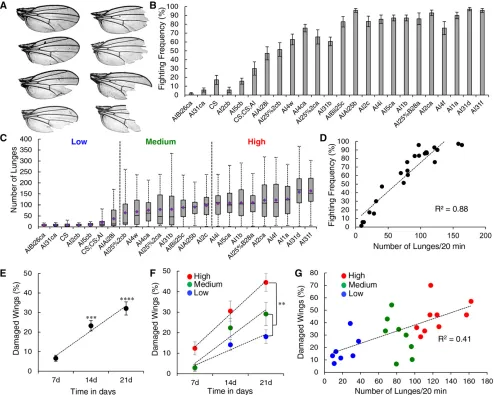
2002; Dierick and Greenspan 2006) (File S2). Such repeated holding or grabbing may eventually cause damage to theflies’ wings. Flies also sometimes tumble over the surface on which theyfight. In addition, during escalated encounters,flies stand vertically on their hind legs to reciprocally box and tussle, and their wings brush up against the surface. We anecdotally ob-served in highly aggressive strains that group-housed males incur damage to the edge of the wing blade. Some wings had minor nicks to the wing edge while others had multiple notches in the wing, and some were even missing the entire distal half of the wing (Figure 1A). To thoroughly investigate whether there is indeed a correlation between wing damage and aggressive behavior, we examined wing damage in 24 ge-netically relatedfly lines with varying levels of aggression, as determined by our previously described arena assay (Dierick 2007). The lines showed a gradient of aggressive behavior from very fewfighting pairs to nearly every pairfighting throughout the 20-min observation period (Figure 1B). We further quanti-fied the levels of aggression in these strains by analyzing the lunge number counts using automated CADABRA software (Dankertet al.2009) (Figure 1C) and found that both variables were highly correlated (Figure 1D,R2= 0.88,P,0.0001).
14 dayvs.21 day,P= 0.07). To better correlate wing damage with aggression, we used the average lunge number as a more precise quantitative measure for aggression to group the strains into low- (with lunge numbers below 40 in the 20-min observa-tion period), medium- (40–100 lunges) and high-aggressive (.100 lunges) strains (Figure 1C). When we plotted the damage per time point in these three categories, we found significantly more damage per time point for the high-aggression strains com-pared to the medium- and low-aggression strains (Figure 1F, two-way ANOVA, groups:P= 4.3e26, time:P= 3.5e210, interaction:
P= 0.3). The greatest difference occurred at 21 days, and thus this time point was chosen for a strain-by-strain correlation analysis.
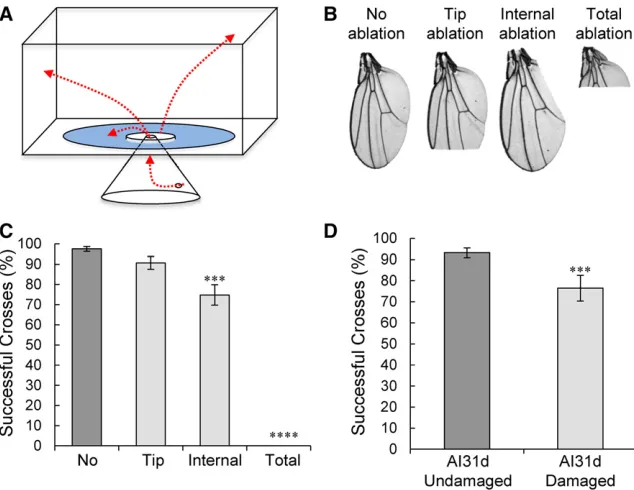
behaviors such as grooming or social interactions other than aggression, then females should show a similar phenotype as males of the same genotype. We tested this prediction on females from three different strains corresponding to the low-, medium-, and high-aggression male groups. Unlike the males, none of the females showed dramatic increases in wing damage after being group-housed for 21 days, suggest-ing that damage is indeed caused by repeated aggressive encounters (Figure S1B inFile S1, ANOVA, males: all groups differentP,0.005, females: not significant). We next tested whether artificially induced wing damage alters aggressive behavior. We used a low-aggression Canton-S strain and manually damaged their wings by removing specific portions from both wings (Figure 2A). Baseline levels of aggression were unaltered, suggesting that wing damage does not in-crease aggressive behavior (data not shown). Flies that were fed 5-HTP (5-hydroxy-tryptophan, the immediate and rate-limiting precursor to 5-HT, 5-hydroxy-tryptamine, serotonin) to increase aggression (Dierick and Greenspan 2007) also showed no behavioral difference between damaged and un-damagedflies (Figure S1C inFile S1, Kruskal–Wallis ANOVA,
P = 0.62), suggesting that their capacity to fight remains intact after wing damage. Finally, artificial damage to the wings of males from a high-aggression strain also had no significant effect on their fighting frequencies (Figure S1D inFile S1, Kruskal–Wallis ANOVA,P= 0.18). Together, these data show that increased aggression inDrosophilacan lead to permanent damage, but that damage itself does not prevent flies fromfighting or dramatically alter their aggression (up or down), as even completely wingless flies from a highly aggressive strain still have extremely highfighting and esca-lation frequencies.
Wing damage negatively affectsflight ability
We next questioned whether the damaged wings that appear to result from repeated aggressive encounters negatively impact the fly and first assessed their flight capabilities. We used a previously reported flight assay (Babcock and Ganetzky 2014) to measure flight ability in males with or without manually induced wing damage. In this assay, flies are ejected into aflight cylinder with a sticky wall and their landing height is recorded (Figure S2A inFile S1). A lower landing height suggests a defect inflight performance. Only the totally wing-ablated group had a significant difference in landing height compared to the undamagedflies (Figure S2B inFile S1, ANOVA,P= 2.13e213). Flies with curly wings also had impaired performance butflies with serrated wings did not (data not shown). Because naturally occurring wing dam-age is usually less severe than total ablation, thisflight assay is likely not sensitive enough to measure potential changes in flight ability.
wings successfully crossed the moat without touching the water (Figure 2C). Flies with tip ablations showed a slight decrease in successful crosses (Mann–WhitneyU-test,P= 0.37), andflies with internal edge ablations showed a further and significant reduction in the percentage of successful crosses (Figure 2C, Mann–Whitney U-test, P , 0.001). Flies with fully ablated wings never successfully crossed the moat without touching the water. These data suggest that the flight-choice assay is sensitive enough to pick up subtle forms of wing damage. We next testedflies with natural aggression-induced wing damage at 21 days of age after group-housing one of the high-aggression strains and found that males with damage were significantly less successful at crossing the water moat compared to undam-aged siblings (Figure 2D, Mann–Whitney-U-test,P= 1.22e24). We observed a similar but weaker effect in damaged compared to undamaged flies from group-housed medium aggression AI4w and low-aggression Canton-S strains (Figure S2, C and D in File S1, Mann–WhitneyU-tests,P= 0.023 andP= 0.048, respectively). These results show that wing damage incurred after group-housing impairs the ability of damaged males tofly compared to their undamaged siblings, and that effect is larger in more aggressive strains.
Wing damage negatively affects mating ability
Maleflies not only use their wings tofly, but also to generate a courtship song to induce females to become receptive to mating (von Schilcher 1976; Greenspan and Ferveur 2000). If song production is impaired by wing damage, we predicted that this might lead to increased latencies to cop-ulate. If wing damage would mostly affect the balance of the males as they copulate, we expected that the duration of copulation might be affected. Therefore, we tested whether wing damage altered the latency to successfully copulate and/or the duration of copulation. For the Canton-S males in which the wings were manually damaged through the ablation of specific regions (Figure 2B), the latency to mate
significantly increased with internal and total wing ablation as compared to theflies with intact wings (Figure 3A, Kruskal– Wallis ANOVA, P = 1.26e210; Mann–Whitney U-test no damagevs.internal:P= 0.0026; and no damagevs.total ablation: P = 1.19e28). However, the duration of mating remained unchanged between these groups suggesting that males with damage are not otherwise impaired in mating (Figure 3B, Kruskal–Wallis ANOVA, P = 0.63). We next tested whether naturally acquired wing damage alters the time to mate. Indeed, highly aggressive males with wing damage at 21 days old showed a significant increase in la-tency to copulate as compared to their age-matched control males that had no visible damage (Figure 3C, Mann–Whitney U, P= 5.3e25), while the duration of copulation was not significantly different between the damaged and undamaged flies (Figure 3D, Mann–Whitney U,P= 0.07). We obtained similar results with damagedvs.undamaged low-aggression Canton-S males and medium-aggression AI4W males (Figure S3, A and B in File S1). Altogether, these data suggest a negativefitness consequence forflies as a result of physically damaged wings incurred throughfighting.
Wing damage as a proxy to screen for aggression
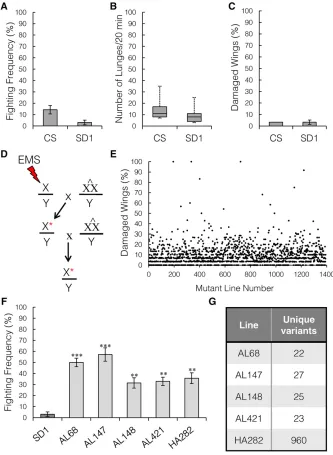
the mutation load per chromosome (Haeltermanet al.2014). All EMS-fed SD1 maleflies were crossed to attached-XX/Y females (C(1)DX,y w f), and individual male progeny were crossed again to attached-XX/Y females to generate a stock from which multi-ple males with the same mutated X chromosome could be col-lected for group-housing (Figure 4D).
In total, 1391 independent mutant strains were tested for increased wing damage. Only 41 lines had . 30% damaged wings (Figure 4E). All 41 lines were tested for aggression andfive lines had a significant increase as compared to the nonmutagen-ized parental SD1 line (Figure 4F, Kruskal–Wallis ANOVA,P= 1.35e26; Mann–WhitneyU-test SD1vs.AL147:P= 0.002; and SD1vs.AL148:P= 0.004). Of 60 control strains with,30% damage, none had significantly increased aggressive behavior compared to the parental SD1 strain (data not shown). To identify the causal mutation, we performed whole-genome sequencing on
all five mutants and the parental SD1 strain, and filtered the variants to find the unique, nonsynonymous coding mutations in each mutant strain. We decided to focus our further analysis on one of the top aggressive lines, AL68, which had 22 EMS-induced variants (Figure 4G, see also Table S1 inFile S1).
AL68 is a novel mutant in the Shaker locus
In addition to the increased aggression phenotype, AL68 also displayed a hyper-excitability or seizure-like phenotype. In isolation, theflies spontaneously hop and have short bouts of uncoordinated locomotor behavior. When placed with other flies of the same genotype, their hopping phenotype worsened, accompanied by longer bouts of uncoordinated movement. We found mutations in three strong candidates that might explain the seizure-like phenotype: open rectifier potassium channel 1 (Ork1), Shaker
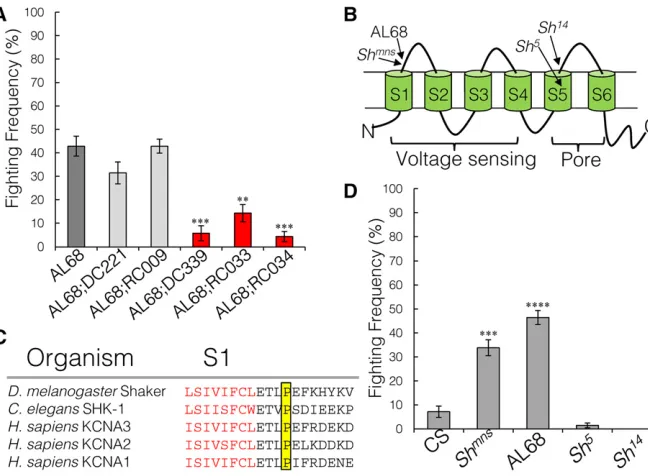
hyper-excitability phenotype would enhance the aggression phe-notype becauseflies would be more coordinated. We used X chro-mosome duplication stocks to complement the mutations inHk andShwith a wild-type allele (Venkenet al.2010). Rescue con-structs that cover the completeOrk1locus are not available. While duplications coveringHkdid not rescue either phenotype in AL68, the duplications that cover theShlocus rescued both the aggres-sion (Figure 5A, Kruskal–Wallis ANOVA,P= 7.9e28; Mann– WhitneyU-test AL68vs.AL68;DC339:P= 0.0002; and AL68vs.
AL68;RC033: P = 0.0009) and seizure-like phenotypes. The duplications that cover the remaining 19 unique variants in AL68 also did not rescue either phenotype (Figure S4 inFile S1).
Shakerencodes thea-subunit of a tetrameric voltage-dependent potassium channel involved in membrane repolarization after ac-tion potentials. Each subunit consists of six transmembrane do-mains, S1–S6, where S1–S4 form the voltage-sensing region and S5–S6 form the pore region (Figure 5B). The mutation in AL68 is a C–T transition in exon 9, resulting in an evolutionarily invariant proline to serine substitution in the extracellular side of the S1 domain (Figure 5C). It is possible that this mutation alters the voltage-dependency of neuronal repolarization.
To confirm that mutations inShakeralter aggressive behav-ior, we tested existing Sh alleles with other single-base pair mutations. A point mutation inShmns(Cirelliet al.2005), which
alters a threonine to isoleucine two residues N-terminal to the AL68 mutation, also showed increased aggression and a similar seizure-like phenotype to AL68 (Figure 5D, Kruskal–Wallis ANOVA,P= 1.27e26). However, alleles with mutations in the pore domain,Sh5andSh14(Lichtinghagenet al.1990), did not
have altered aggression or a seizing phenotype (Figure 5D).
Discussion
Our work shows that males from strains with high levels of aggression develop damage to their wings when they are
group-housed and that wing damage increases over time. We show that males with artificially induced or natural wing damage have impairedflight abilities and increased copula-tion latencies. Previous work has shown that a benefit of aggressive behavior is that males can father a greater pro-portion of offspring (Baxteret al.2015), suggesting that this advantage is a drive to maintain the behavior in the species. Our work suggests that a trade-off exists between immediate mating success and later-life copulation latencies; even small impairments resulting from aggression may keep excessive aggressive behavior inflies at bay.
We used this easy-to-screen secondary phenotype of aggres-sion to screen chemically mutagenizedflies for wing damage to potentially identify highly aggressive mutants. From 1400 screened mutant X chromosomes, we found 41 mutants with excessive wing damage andfive of these also showed increased aggression. While it is clear that not all wing damage is due to aggression, some of the strains with increased wing damage may have been caused by autosomal dominant mutations that caused increased aggression and may have been missed because the behavioral screen was performed several generations after the wing-damage screen, which would have led to the likely loss of these autosomal dominant alleles.
Using whole-genome sequencing and complementation map-ping, we identified the causal locus in one of our mutants. This is a novel allele of theShaker(Sh) locus, which encodes a voltage-gated potassium channel. Interestingly, ourShAL68mutant also
had a hyperexcitability phenotype makingflies spontaneously hop and jump. Both phenotypes also occurred inShmns, which
rather than increase aggression inflies (Kayseret al.2015). Two Shalleles with mutations in the pore domain did not exhibit either phenotype. A possible explanation for this discrepancy is that these very severe mutations induce a homeostatic compen-sation mechanism, leading to upregulation of other K+-channels that compensate for loss ofShaker(Bergquistet al.2010), thus suppressing both the aggression and seizure-like phenotypes. The mutations inShAL68andShmnsmay not be severe enough
to induce a compensation mechanism. Regardless of such ho-meostatic compensation in different classes ofShmutants, it is likely that increased excitability in different neuronal circuits may underlie both the short-sleeping phenotype and increased aggression. Further work will be needed to elucidate the precise mechanism that causes some Sh mutants to have increased aggression.
In summary, we have shown thatflies incur physical dam-age to their wings, likely from repeated aggressive encounters. We used this phenotype to perform thefirst forward genetic mutagenesis screen and identified a novel allele inSh, a gene that has so far not been implicated in aggression. How this mutation affects neuronal excitability and which neurons are affected to alter aggression remains unknown. Finally, the quick and easy screening method that we developed here can uncover the genetic components regulating the complex behavior of aggression.
Acknowledgments
We thank the Bloomington Drosophila Stock Center for fly stocks, and Christophe Herman, Hoang Nguyen, Susan Rosen-berg, and Michelle Arbeitman for helpful discussions and com-ments on the manuscript. This work was supported by a grant from the National Institutes of Health (RO1 MH-107474 to H.A.D.).
Literature Cited
Alekseyenko, O. V., C. Lee, and E. A. Kravitz, 2010 Targeted ma-nipulation of serotonergic neurotransmission affects the escala-tion of aggression in adult male Drosophila melanogaster. PLoS One 5: e10806.
Andrews, J. C., M. P. Fernandez, Q. Yu, G. P. Leary, A. K. Leung
et al., 2014 Octopamine neuromodulation regulates
Gr32a-linked aggression and courtship pathways in Drosophila males. PLoS Genet. 10: e1004356.
Asahina, K., K. Watanabe, B. J. Duistermars, E. Hoopfer, C. R. Gonzalez
et al., 2014 Tachykinin-expressing neurons control male-specific
aggressive arousal in Drosophila. Cell 156: 221–235.
Babcock, D. T., and B. Ganetzky, 2014 An improved method for accurate and rapid measurement offlight performance in Dro-sophila. J. Vis. Exp. 84: e51223.
Baier, A., B. Wittek, and B. Brembs, 2002 Drosophila as a new model organism for the neurobiology of aggression? J. Exp. Biol. 205: 1233–1240.
Baxter, C. M., R. Barnett, and R. Dukas, 2015 Aggression, mate guarding andfitness in male fruitflies. Anim. Behav. 109: 235–241. Bergquist, S., D. K. Dickman, and G. W. Davis, 2010 A hierarchy of cell intrinsic and target-derived homeostatic signaling. Neu-ron 66: 220–234.
Certel, S. J., M. G. Savella, D. C. Schlegel, and E. A. Kravitz, 2007 Modulation of Drosophila male behavioral choice. Proc. Natl. Acad. Sci. USA 104: 4706–4711.
Chen, S., A. Y. Lee, N. M. Bowens, R. Huber, and E. A. Kravitz, 2002 Fighting fruitflies: a model system for the study of ag-gression. Proc. Natl. Acad. Sci. USA 99: 5664–5668.
Cirelli, C., D. Bushey, S. Hill, R. Huber, R. Kreber et al., 2005 Reduced sleep in Drosophila Shaker mutants. Nature 434: 1087–1092.
Dankert, H., L. Wang, E. D. Hoopfer, D. J. Anderson, and P. Perona, 2009 Automated monitoring and analysis of social behavior in Drosophila. Nat. Methods 6: 297–303.
Davis, S. M., A. L. Thomas, K. J. Nomie, L. Huang, and H. A. Dierick, 2014 Tailless and Atrophin control Drosophila aggression by regulating neuropeptide signalling in the pars intercerebralis. Nat. Commun. 5: 3177.
del Valle Rodriguez, A., D. Didiano, and C. Desplan, 2012 Power tools for gene expression and clonal analysis in Drosophila. Nat. Methods 9: 47–55.
Dierick, H. A., 2007 A method for quantifying aggression in male Drosophila melanogaster. Nat. Protoc. 2: 2712–2718.
Dierick, H. A., and R. J. Greenspan, 2006 Molecular analysis offlies selected for aggressive behavior. Nat. Genet. 38: 1023–1031. Dierick, H. A., and R. J. Greenspan, 2007 Serotonin and
neuro-peptide F have opposite modulatory effects on fly aggression. Nat. Genet. 39: 678–682.
Dudai, Y., Y. N. Jan, D. Byers, W. G. Quinn, and S. Benzer, 1976 dunce, a mutant of Drosophila deficient in learning. Proc. Natl. Acad. Sci. USA 73: 1684–1688.
Fernandez, M. P., Y. B. Chan, J. Y. Yew, J. C. Billeter, K. Dreisewerd
et al., 2010 Pheromonal and behavioral cues trigger
male-to-female aggression in Drosophila. PLoS Biol. 8: e1000541. Georgiev, A. V., A. C. Klimczuk, D. M. Traficonte, and D. Maestripieri,
2013 When violence pays: a cost-benefit analysis of aggressive behavior in animals and humans. Evol. Psychol. 11: 678–699. Greenspan, R. J., and J. F. Ferveur, 2000 Courtship in Drosophila.
Annu. Rev. Genet. 34: 205–232.
Haelterman, N. A., L. Jiang, Y. Li, V. Bayat, H. Sandoval et al., 2014 Large-scale identification of chemically induced muta-tions in Drosophila melanogaster. Genome Res. 24: 1707–1718. Hoffmann, A., 1987 Territorial encounters between Drosophila
males of different sizes. Anim. Behav. 35: 1899–1901. Hoopfer, E. D., Y. Jung, H. K. Inagaki, G. M. Rubin, and D. J.
Anderson, 2015 P1 interneurons promote a persistent internal state that enhances inter-male aggression in Drosophila. Elife 4: e11346.
Hoyer, S. C., A. Eckart, A. Herrel, T. Zars, S. A. Fischer et al., 2008 Octopamine in male aggression of Drosophila. Curr. Biol. 18: 159–167.
Jacobs, M., 1960 Influence of light on mating of Drosophila mel-anogaster. Ecology 41: 182–188.
Jones, W. D., 2009 The expanding reach of the GAL4/UAS system into the behavioral neurobiology of Drosophila. BMB Rep. 42: 705–712. Kayser, M. S., B. Mainwaring, Z. Yue, and A. Sehgal, 2015 Sleep deprivation suppresses aggression in Drosophila. Elife 4: e07643. Koganezawa, M., K. I. Kimura, and D. Yamamoto, 2016 The
neu-ral circuitry that functions as a switch for courtship versus ag-gression in Drosophila males. Curr Biol. 26: 1395–1403. Konopka, R. J., and S. Benzer, 1971 Clock mutants of Drosophila
melanogaster. Proc. Natl. Acad. Sci. USA 68: 2112–2116. Lee, G., and J. C. Hall, 2000 A newly uncovered phenotype
asso-ciated with the fruitless gene of Drosophila melanogaster: ag-gression-like head interactions between mutant males. Behav. Genet. 30: 263–275.
Lichtinghagen, R., M. Stocker, R. Wittka, G. Boheim, W. Stuhmer
et al., 1990 Molecular basis of altered excitability in Shaker
Liu, W., X. Liang, J. Gong, Z. Yang, Y. H. Zhanget al., 2011 Social regulation of aggression by pheromonal activation of Or65a olfactory neurons in Drosophila. Nat. Neurosci. 14: 896–902. Nilsen, S. P., Y. B. Chan, R. Huber, and E. A. Kravitz, 2004
Gender-selective patterns of aggressive behavior in Drosophila melanogaster. Proc. Natl. Acad. Sci. USA 101: 12342–12347.
Quinn, W. G., P. P. Sziber, and R. Booker, 1979 The Drosophila memory mutant amnesiac. Nature 277: 212–214.
Singh, C. M., and U. Heberlein, 2000 Genetic control of acute ethanol-induced behaviors in Drosophila. Alcohol. Clin. Exp. Res. 24: 1127–1136.
Stavropoulos, N., and M. W. Young, 2011 Insomniac and Cullin-3 regulate sleep and wakefulness in Drosophila. Neuron 72: 964– 976.
Umbers, K. D., N. J. Tatarnic, G. I. Holwell, and M. E. Herberstein, 2012 Ferocious fighting between male grasshoppers. PLoS One 7: e49600.
Venken, K. J., E. Popodi, S. L. Holtzman, K. L. Schulze, S. Parket al., 2010 A molecularly defined duplication set for the X chromo-some of Drosophila melanogaster. Genetics 186: 1111–1125. Venken, K. J., J. H. Simpson, and H. J. Bellen, 2011 Genetic
ma-nipulation of genes and cells in the nervous system of the fruit
fly. Neuron 72: 202–230.
von Schilcher, F., 1976 The role of auditory stimuli in the court-ship of Drosophila melanogaster. Anim. Behav. 24: 18–26.
von Schilcher, F., 1977 A mutation which changes courtship song in Drosophila melanogaster. Behav. Genet. 7: 251–259. Vrontou, E., S. P. Nilsen, E. Demir, E. A. Kravitz, and B. J. Dickson,
2006 Fruitless regulates aggression and dominance in Dro-sophila. Nat. Neurosci. 9: 1469–1471.
Wang, L., and D. J. Anderson, 2010 Identification of an aggression-promoting pheromone and its receptor neurons in Drosophila. Nature 463: 227–231.
Wang, L., X. Han, J. Mehren, M. Hiroi, J. C. Billeter et al., 2011 Hierarchical chemosensory regulation of male-male so-cial interactions in Drosophila. Nat. Neurosci. 14: 757–762. Watts, D. P., M. Muller, S. J. Amsler, G. Mbabazi, and J. C. Mitani,
2006 Lethal intergroup aggression by chimpanzees in Kibale National Park, Uganda. Am. J. Primatol. 68: 161–180. Zampolini, M., B. Zaccaria, V. Tolli, A. Frustaci, M. Franceschini
et al., 2012 Rehabilitation of traumatic brain injury in Italy:
a multi-centred study. Brain Inj. 26: 27–35.
Zhou, C., Y. Rao, and Y. Rao, 2008 A subset of octopaminergic neu-rons are important for Drosophila aggression. Nat. Neurosci. 11: 1059–1067.
Zumstein, N., O. Forman, U. Nongthomba, J. C. Sparrow, and C. J. Elliott, 2004 Distance and force production during jumping in wild-type and mutant Drosophila melanogaster. J. Exp. Biol. 207: 3515–3522.