| INVESTIGATION
Mild Telomere Dysfunction as a Force for Altering the
Adaptive Potential of Subtelomeric Genes
Jennifer M. O. Mason1and Michael J. McEachern2 Department of Genetics, University of Georgia, Athens, Georgia 30605 ORCID ID: 0000-0002-3080-6190 (J.M.O.M.)
ABSTRACT Subtelomeric regions have several unusual characteristics, including complex repetitive structures, increased rates of evolution, and enrichment for genes involved in niche adaptation. The adaptive telomere failure hypothesis suggests that certain environmental stresses can induce a low level of telomere failure, potentially leading to elevated subtelomeric recombination that could result in adaptive mutational changes within subtelomeric genes. Here, we tested a key prediction of the adaptive telomere failure hypothesis—that telomere dysfunction mild enough to have little or no overall effect on cellfitness could still lead to substantial increases in the mutation rates of subtelomeric genes. Our results show that a mutant of Kluyveromyces lactis with stably short telomeres produced a large increase in the frequency of mutations affecting the native subtelomericb-galactosidase (LAC4) gene. All lac4mutants examined from strains with severe telomere dysfunction underwent terminal deletion/duplication events consistent with being due to break-induced replication. In contrast, although cells with mild telomere dysfunction also exhibited similar terminal deletion and duplication events, up to 50% oflac4mutants from this background unexpectedly contained base changes within the LAC4coding region. This mutational bias for producing base changes demonstrates that mild telomere dysfunction can be well suited as a force for altering the adaptive potential of subtelomeric genes.
KEYWORDSSubtelomere; break-induced replication; mild telomere dysfunction;b-galactosidase; yeast
T
ELOMERES are the nucleoprotein complexes found at the ends of linear chromosome that differentiate naturally occurring chromosomal ends from double-stranded breaks (DSBs) (De Langeet al.2006; Wellinger and Zakian 2012). Telomeric DNA, composed of tandem arrays of a short repeat sequence, serves as a binding site for telomere proteins re-quired for telomere capping and length regulation (Cech 2004; Wellinger and Zakian 2012). These repeats are also targets for telomerase, an enzyme that adds new telomeric repeats onto chromosome ends by copying the template re-gion of its RNA subunit, counteracting the end replication problem (Greider and Blackburn 1989; Podlevsky and Chen 2012).Mutations that alter telomere-binding protein activities or shorten telomeric repeat arrays can lead to improper telomere function (Garviket al.1995; Boothet al.2001; Cravenet al. 2002; Chan and Blackburn 2003; Hackett and Greider 2003; Mieczkowski et al.2003). In cells where telomere capping function has become compromised, chromosome ends can resemble DNA DSBs (De Langeet al.2006). DSBs are a severe form of DNA damage and are typically repaired by one of two pathways, nonhomologous end joining (NHEJ) or homolo-gous recombination (HR) (Aylon and Kupiec 2004; Krejci et al. 2012; Chiruvella et al. 2013). NHEJ is a ligase IV-dependent reaction that joins two broken ends together and is active throughout the cell cycle (Lieber 2010; Waters et al. 2014). HR, on the other hand, utilizes homologous sequence, usually supplied by a sister chromatid, but some-times by nonallelic sources of homology, as a template for repair (Pâques and Haber 1999; Mehta and Haber 2014).
Inappropriate repair of dysfunctional telomeres using NHEJ or HR can have varying effects on genomic stability. Dysfunctional telomeres repaired using NHEJ can result in telomere fusions and dicentric chromosomes, whereas repair facilitated through HR restores telomere function by means of Copyright © 2018 by the Genetics Society of America
doi:https://doi.org/10.1534/genetics.117.300607
Manuscript received November 8, 2017; accepted for publication December 8, 2017; published Early Online December 12, 2017.
Supplemental material is available online atwww.genetics.org/lookup/suppl/doi:10. 1534/genetics.117.300607/-/DC1.
1Present address: 5827 S. Miami Blvd Morrisville, NC 27560.
less deleterious copying mechanisms. Specifically, repair through break-induced replication (BIR), a homology-based repair pathway that acts when only one DNA end is available (Teng and Zakian 1999), can restore critically shortened telo-meres by copying a longer telomere (McEachern and Haber 2006). Both because it requires only a single end and because it is less likely to generate detrimental outcomes, the BIR pathway is predicted to be the preferable repair mechanism to act at dysfunctional telomeres in most circumstances (Ricchettiet al.2003; Milleret al.2011).
The effects of telomere dysfunction on overall genome stability have been well characterized (Blasco et al. 1997; Kimet al.2001; Blackburnet al.2015; Maciejowski and de Lange 2017) and can be particularly dramatic in the subtelo-meric region found immediately adjacent to the telomere. Subtelomeres in many eukaryotes are characterized by low gene density, complex repetitive structure, rapid evolution, and dy-namic epigenetic regulation (Gottschlinget al.1990; Prydeet al. 1997; Mefford and Trask 2002; Linardopoulou et al. 2005; Rudd et al. 2007). Increased rates of ectopic HR, deletions, translocations, and other rearrangement events within subtelo-meres contribute to its dynamic nature and likely facilitate rapid sequence evolution between closely related species.
Driven by these elevated rates of mutation, gene families within subtelomeric regions are often larger and more rapidly evolving than those found at more internal chromosomal locations (Brown et al. 2010). Importantly, subtelomeres are enriched for“contingency genes,”genes critical for adap-tation to novel or stressful environments (Moxonet al.1994; Barryet al.2003). Medically relevant examples include vir-ulence genes found in eukaryotic pathogens such as trypano-somes and Plasmodium falciparum (Horn 2004; Horn and Barry 2005; Glover et al. 2011). Other well-characterized examples in yeasts include genes important in carbohydrate utilization, flocculation, and arsenic resistance (Bobrowicz et al.1997; Verstrepen and Klis 2006; Brownet al.2010).
The highly dynamic nature of subtelomeres makes them unsuitable locations for essential genes, but also makes these regions ideal locations for genes that can tolerate or even benefit from complex mutations. Sequence changes affecting subtelomeric contingency genes, including duplications, de-letions, tandem repeat expansions, and chimeric gene forma-tion, have the potential to conferfitness advantages in novel environments. Although subtelomeres appear to have great potential for facilitating rapid adaptation, the cellular mech-anism responsible for such events are unclear.
The adaptive telomere failure hypothesis proposed that telomeres can play a direct role in triggering subtelomeric evolution that can result in rapid adaptation to novel envi-ronments (McEachern 2008). This hypothesis suggests that mild telomere dysfunction, defined as telomere dysfunction that does not compromise cell growth nor cause an elevation of telomere–telomere fusions from NHEJ, can still lead to increased rates of HR at telomeres. Such events could poten-tially spread into the adjacent subtelomere, increasing inci-dences of subtelomeric BIR events (Figure 1). Mutational loss
or duplication or modification of subtelomeric contingency genes could ultimately facilitate adaptation by generating novel mutants better able to survive environmental stress. This hypothesis suggests a previously unconsidered role for telomeres as an agent of adaptation through rapid evolution of subtelomeric regions and their associated genes.
We have investigated the potential of mild telomere dys-function to generate mutations in subtelomeric genes in the milk yeast Kluyveromyces lactis. Prior experiments have shown that both mild and severe telomere dysfunction can lead to highly elevated levels of recombination involving the immediately subtelomeric R element repeats ofK. lactis (McEachern and Iyer 2001). In this work, we monitored a natural subtelomericb-galactosidase gene (LAC4) for loss of function in the presence of different levels of telomere dysfunction. We found that although severe telomere dys-function led to very high levels of BIR-like deletion/dupli-cations, mild telomere dysfunction from constitutively short telomeres produced a near equal mix of BIR-like outcomes andLAC4point mutations. Our results show that mild telo-mere dysfunction can trigger an unexpectedly diverse spec-trum of mutations in subtelomeric genes, suggesting it is well suited to generate potentially adaptive mutations.
Materials and Methods
Yeast strains
All strains used are derivatives of the haploidK. lactis wild-type strain 7B520 (ura3-1 his2-2 trp1) (Wray et al.1987). Theter1-Dandter1-28C(Taq) strains were all generated pre-viously (McEachern and Blackburn 1995; Underwoodet al. 2004; Wang et al.2009) using a plasmid loop in, loop out procedure (McEachern and Blackburn 1995). Additionally the stn1-M1 and stn1-m1 ter1-D strains were made using standard yeast replacement procedures (Iyeret al.2005).
White colony detection and quantification
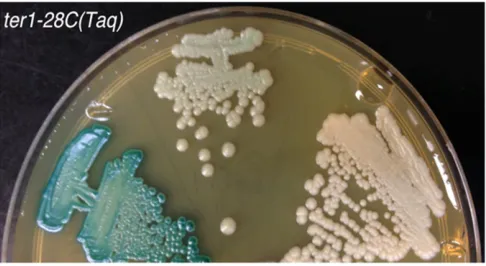
The frequency at which white colonies arises from a blue parental colony was measured in all strain backgrounds. In-dependently derived isolates were examined from all strain backgrounds including 18 7B520, 27 ter1-D, 61 ter1-Taq, 22stn1-M1, and 18stn1-m1 ter1-D. Similarly sized colonies from each background were taken from standard rich me-dium (YPD) and were resuspended in water to a concentra-tion of 1–2 3 104 cells/ml. A total of 25ml of the cell suspension was spread on YPD plates containing 0.02% 5-bromo-4-chloro-3-indolyl-b-D-galactopyranoside (X-gal). Two or three replicates were prepared simultaneously using the same cell suspension. Plates were grown at 30° for 3–4 days and scored for presence or absence ofb-galactosidase activity as judged by colony color.
averaged between replicates for each single isolate and the median was then calculated across these averages. White colony formation frequency in mutant lines were compared to the wild-type frequency using Pearson’s chi-squared test.
Growth on lactose was characterized in a subset of colo-nies, including 15ter1-D, 22ter1-28C(Taq), 5stn1-M1, and 7 stn1-m1 ter1-Dwhite colonies, as well as a corresponding blue colony from the same plate. These isolates were grown on synthetically defined (SD) minimal media containing 2% lactose (purity$97%) with only uracil, histidine, and tryp-tophan supplemented into the medium.
Southern hybridizations
Genomic DNA from white and blue colonies was isolated from overnight cultures grown in liquid YPD at 30°. Digested ge-nomic DNA was electrophoretically separated at 29 V for 15 hr on 1% agarose gels and transferred to Hybond N+ membranes. Presence or absence of sequence from the right arm of chromosome two (2R) was then assessed at intervals beginning at the telomere and extending inward toward the centromere. Oligonucleotides and primers used to generate DNA fragments for hybridization can be found in Supplemen-tal Material,Table S1. All PCR products used for hybridiza-tions were amplified from the wild-type strain 7B520.
Gene fragment probes were gel purified using the Qiagen Gel Extraction kit and were labeled using the Klenow frag-ment of DNA polymerase I. The telomere oligonucleotide probe was end labeled using the T4 polynucleotide kinase. Hybridizations were carried out overnight in 500 mM Na2 HPO4 and 7% SDS at temperatures of 25° (oligo probe) and 60°(gene fragment probes). Membranes hybridized with the oligonucleotide probe were washed three times with 50 mM Na2HPO4and 2% SDS, whereas membranes hybrid-ized with gene fragment probes were washed with 100 mM Na2HPO4and 2% SDS for 10 min.
LAC4-deficient mutant analysis
A 100-kb section of sequence from the end of the 2R chromo-some was examined for homology shared with other subtelo-meres using the Circoletto program (Darzentas 2010) set at the relaxed setting, with theE-value set to 0.1 for the BLAST run. PCR primers were designed to amplify across the predicted chimeric regions generated in a repair event utilizing the 1R homology. Control reactions were carried out to amplify the proximal KLLA0B14751 gene through the native 2R region of homeology as well as the native 1R region of homology (Table S2). Additionally, primers were designed to amplify across the chimeric regions generated in a repair event utilizing the Z and X regions of mating locus. Control reactions amplified the nongenic region proximal to the cryptic mating locus on the 2R chromosome and the native Z and X regionsflanking the left and right sides of the mating locus on 2R, respectively (Table S2). PCR products of theLAC4gene andLAC4promoter region from pale blue iso-lates from the ter1-28C(Taq) background were also examined (Table S2). Positive PCR products for predicted chimeric regions, as well as theLAC4gene andLAC4promoter region in pale blue
ter1-28C(Taq) isolates, were sequenced by MacrogenUSA and analyzed using the genome analysis program Geneious.
Sequence analysis
The genomes from theK. marxianusstrains DKMU3-1042 and K. lactisstrain NRRL Y-1140 were downloaded from the Na-tional Center for Biotechnology Information (https://www. ncbi.nlm.nih.gov/). Sequence visualization and analysis was carried out using CLC Workbench software (CLC Bio-Qiagen) and Geneious.
Data availability
The authors state that all data necessary for confirming the conclusions presented in the article are represented fully within the article. Strains are available upon request.
Results
K. lactis strains with telomere dysfunction have an increased frequency of loss of the subtelomerically encodedb-galactosidase activity
The adaptive telomere failure hypothesis proposes that telo-meres in some organisms may have evolved to fail in response to certain environmental stresses (McEachern 2008). This could result in elevated recombination in subtelomeric re-gions and subsequent duplication, deletion, or recombination of the contingency genes enriched in these regions, poten-tially leading to increases infitness (Figure 1). A prediction of the adaptive telomere failure hypothesis might be that even mild telomere dysfunction could be sufficient to produce el-evated rates of recombination, affecting subtelomeric genes. The study described here investigated sequence stability of the right arm of chromosome 2 (2R) in the dairy yeast K. lactis. The 2R subtelomere contains the naturally occurring b-galactosidase (LAC4) and lactose permease genes (LAC12) found 7 and 13 kb from the telomere, respectively (Figure 3A), both of which are required for lactose utilization (Kraepelin 1984). Hydrolysis of X-gal byb-galactosidase produces a vis-ible blue color in K. lactiscolonies, even in the presence of glucose (Dickson and Markin 1980), making the loss of blue color an effective screen for mutants with alteredLAC4 func-tion and a marker of subtelomeric sequence stability. To test the adaptive telomere failure hypothesis, subtelomeric LAC4 gene stability was examined in K. lactismutants with either mild or severe telomere dysfunction, where all telomeres in the cell are subject to elevated levels of dysfunction.
Table 1). In contrast, strains with severely dysfunctional telo-meres, including stn1-M1 and telomerase deletion mutants (ter1-D), exhibited significantly higher frequencies of white col-onies (Figure 2 and Table 1).stn1-M1andstn1-M1 ter1-D mu-tants produce chronic telomere dysfunction, leading to slower growing abnormal colonies and extremely long telomeres formed partly or entirely by recombination (Iyeret al.2005; Xu and McEachern 2012). These mutants produced white colonies at the median frequencies of 1.3 and 2.4%, respectively (Table 1). The chronic disruption in the function of a telomere binding protein produced by thestn1-M1mutation presumably underlies why that mutation is largely epistatic to theter1-Dmutation.
Telomerase deletion (ter1-D) mutants produce gradual telo-mere shortening accompanied by gradual, and eventually ex-treme growth senescence (McEachern and Blackburn 1995, 1996).ter1-Dcells plated near the point of maximal senescence
produced a median of 11.5% white colonies among the 32,500 postsenescence survivor colonies examined, a fre-quency at least 2700-fold higher than in wild-type cells.ter1 -Dcells at early stages of senescence or postsenescence survi-vors that have rebuilt telomeres using recombination showed no, or much lower frequencies of white colonies (data not shown). This is consistent with white colony formation being strongly linked to the telomere dysfunction of the highly se-nescent state rather than the lack of telomeraseper se.
The mild telomere dysfunction strain used in these studies is the ter1-28C(Taq) mutant. This mutant has little or no effect on colony growth or morphology and has telomeres that are stable in length at 75–150 bp (about a quarter of wild-type size) that arise due to a base change in the Ter1 RNA template (Underwoodet al.2004). Theter1-28C(Taq) mutant produced 90 white colonies among134,000 colo-nies inspected, at a median frequency of 0.02% (Table 1). This represents a white colony formation frequency at least 39-fold higher than in wild-type cells.
To confirm that the white colony formation inter1-28C(Taq) was the result of telomere dysfunction and not due to a random mutation in some other gene acquired during its previous growth, six newly generated independent ter1-28C(Taq) mutants were examined for white colony formation. Of15,000 total colonies examined, six (0.04%) were white (data not shown). This dem-onstrated that mild telomere dysfunction is responsible for the loss of function of a native subtelomeric gene inK. lactis.
We predicted that the inability to hydrolyze X-gal in the medium would correspond with the inability to metabolize lac-tose. To test this, 10 independent white isolates from each strain background were streaked on SD minimal medium containing 2% lactose as the sole carbon source. Although all blue isolate controls were able to grow on this medium, no white colonies were able to grow. Even after extensive passaging, none of the white clones were ever observed to revert back to blue, indicating the loss of b-galactosidase activity was not readily reversible and likely to be due to mutation rather than epigenetic change.
b-galactosidase is deleted in all LAC4-deficient isolates with severe telomere dysfunction but only in some isolates with mild telomere dysfunction
Southern hybridization studies were carried out to character-ize the LAC4-deficient colonies isolated from dysfunctional
Figure 1 Adaptive telomere failure model. The adaptive telomere failure hy-pothesis suggests that limited telomere (triangles) failure can trigger BIR-events at subtelomeric homologous or homeologous sequence (a and A boxes), poten-tially leading to contingency gene loss (box b), duplication (box C), or chimeric gene product formation (box a/A). Asterisk indicates a dysfunctional telomere.
telomere strains. All 30 independently derived white colonies from strains with severe telomere dysfunction (including 14ter1-D, 5stn1-M1, and 11stn1-M1 ter1-Dclones) showed no hybridization to theLAC4probe (Figure 3D, and data not shown) indicating the entire gene was deleted. Additional hybridizations revealed that each white isolate was also de-leted forLAC12(encoding lactose permease), located2 kb upstream fromLAC4(Figure 3C). Hybridization using a probe for the predicted gene KLLA0B14751, located23 kb from the telomere, showed 14 of the 30 isolates (11ter1-Dand 3 stn1-M1clones) were found to contain this fragment (Figure 3B). This suggested that the break point resulting in the loss of the 2R fragment containing the lactose utilization genes occurred betweenLAC12and KLLA0B14751 gene in these 14 isolates. For the 16 other white isolates where the KLLA0B14751 was deleted, we concluded that the break point was more inter-nally located. In stark contrast to the above results, the 30 blue isolates derived from the severe telomere dysfunction mutants never exhibited deletion of LAC4, LAC12, or KLLA0B14751 (Figure 3, B–D).
Southern hybridization was also used to characterize the white colonies derived from theter1-28C(Taq) mutant with mild telomere dysfunction. Of the 23 LAC4deficient white ter1-28C(Taq) mutants examined, 10 had experienced a de-letion of bothLAC4andLAC12(Figure 3, B–D and data not shown) but retained the more internal KLLA0B14751. This suggested that they may have experienced the same deletion event that predominated in severe telomere dysfunction mu-tants. Interestingly, the remaining 13 white ter1-28C(Taq) isolates were found to retain bothLAC4andLAC12(Figure 3D and data not shown). Unlike the isolates lackingLAC4and LAC12, these isolates were found to be pale blue in color once colonies had grown for a sufficient period of time on X-gal (Figure 4). However, like white isolates, these pale blue iso-lates were unable to grow on SD medium containing only lactose as a carbon source.
Southern blotting was done to examine the terminal telo-mere fragments of the blue and white clones derived from the various mutants (Figure 3E and data not shown).EcoRI diges-tion of genomic DNA from the 7B520 parental strain separates the 12 telomeric restriction fragments into six different sized bands between1 and 3.5 kb. The 2REcoRI telomeric frag-ment is the largest band, making the loss of this fragfrag-ment gen-erally easy to detect. The highly variable and heterogeneous
telomere restriction patterns in stn1-M1 and postsenescent ter1-D mutants made subtelomeric fragment identification from these strains infeasible. However, early passageter1-28C (Taq) strains maintain a wild-typeEcoRI restriction pattern and analysis of the twoter1-28C(Taq) white isolates (Figure 3E) showed that they lacked the 2R telomere fragment. This sug-gested that mutations responsible for the white colony pheno-type are terminal deletions of the 2R chromosome end. Furthermore these terminal telomere patterns showed stron-ger than expected hybridization signal to the 1R telomere fragment (Figure 3E and data not shown). Quantification of the 1R band relative to other telomeric bands showed a 2.1-fold increase in signal compared to the 1R band of a blue ter1-28C(Taq) isolate used as a control, suggesting white isolates contained duplications that included the terminal EcoRI fragment of the 1R chromosome end.
Homeology between the 2R and 1R chromosome ends facilitated BIR-like repair in many 2R terminal
deletion isolates
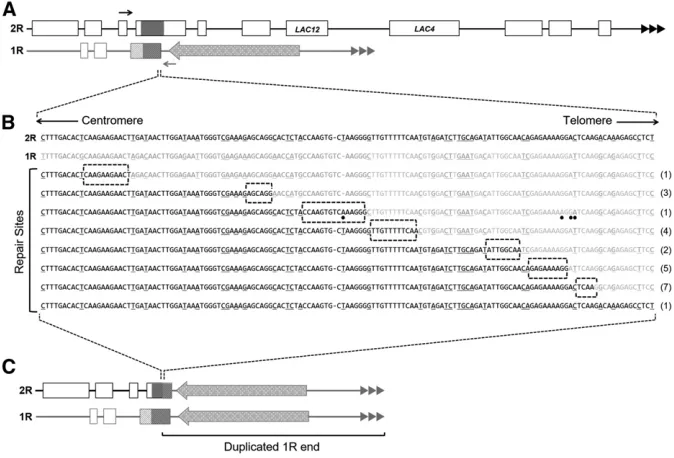
Sequence comparison of the 2R and 1R subtelomeric regions revealed an1.1 kb shared region of homeology with 76% sequence identity (Figure S1). These subtelomeric regions fall20 and 7.5 kb from the 2R and 1R chromosome end, respectively (Figure 5A). The homeologous region on the 2R chromosome end is found within an open reading frame with similarities to the Saccharomyces cerevisiae Cytochrome B2 (CYB2) gene required for lactate utilization (Alberti et al. 2000). The corresponding homeologous sequence on the 1R subtelomere is a divergentCYB2pseudogene that is pre-sumably no longer functional (Fairhead and Dujon 2006).
In order to test whether this shared region of homeology was utilized in the repair of the 2R terminal deletion in isolates that have deleted LAC4 and LAC12 but retained KLLA0B14751, a PCR experiment was carried out. A forward primer was designed to the leftflanking region of theCYB2-like homeol-ogy on the 2R chromosome and a reverse primer was designed to the rightflanking region of theCYB2-like homeology on the 1R chromosome (Figure 5A). Using this primer set, PCR anal-ysis was carried out on DNA from 14 white isolates with severe telomere dysfunction and 10 white isolates with mild telomere dysfunction. Amplification using this chimeric primer pair pro-duced a PCR product consistent with the expected size of the 2R/1R hybrid in all 24 white isolates examined. As expected,
Table 1 Strains with telomere dysfunction have increased rates of white colony formation
TER1allele Telomere length
Total colonies observed
White colonies observed
Percentage of white
colonies (%) Median
Wild-type 400–600 bp 57,983 0 ,0.002 0.00% (18)
ter1-D Variable length.100 bp at senescence 32,484 1560 4.80 11.49% (27) stn1-M1 Very long and heterogenous 55,272 173 0.31 1.30% (22) stn1-M1 ter1D Very long and heterogenous 78,187 797 1.02 2.44% (18)
taq-28C 75–150 bp 134,375 90 0.07 0.02% (30)
control experiments using a primer pair designed to amplify the nativeCYB2gene on the 2R chromosome failed to generate a PCR product in all white isolates examined. A PCR fragment of the expected size was amplified from the blue nondeleted control (data not shown). These results are consistent with the 2R deletions having recombination points with the 1R chro-mosome end within the CYB2-like sequences. Amplification across the native 1R CYB2-like homeology produced the expected PCR product size in all 24 white isolates as well as in the blue control suggesting that all white isolates still con-tained the native 1R subtelomeric region. This indicated that BIR repair duplicated the 1R end onto the truncated 2R end using theCYB2-like homeology to begin the copying reaction. The 2R/1R chimeric PCR products were sequenced and aligned to the native 2R and 1R sequences to identify the point of recombination within the region of homeology. Although the homeologous region spans 1.1 kb, the recombination points in 23 of 24 isolates mapped to seven sites within a 150 bp region on the telomeric side of the homeologous region (Figure 5B). Furthermore, each break-point junction fell within a site of microhomology spanning 5–15 nucleotides in length. Sequencing analysis also detected four point mu-tations within the region duplicated during BIR in a single ter1-Disolate (Figure 5B).
A single isolate from theter1-Dbackground did not show a distinct switch from 2R sequence to 1R sequence when aligned to these two regions (Figure 5B). Instead, the entire
length of the read was a perfect match to only the 2R region. Although the sequence information did not detect the exact point of repair, the PCR product that was sequenced was amplified using the 2R forward and 1R reverse primer set, which is specific only to the chimeric product. This suggests that this exceptional isolate uses an eighth site of microho-mology for recombination that lies outside the specific region examined by our PCR assay.
Mating type loci on 2R and 3L chromosomes facilitate repair in some 2R terminal deletion isolates with severe telomere dysfunction
Southern analysis of strains with severe telomere dysfunction indicated 16 white isolates had deletions that extended in-ternally as far as KLLA0B14751, but did not amplify the same 2R/1R junction fragment detected in the isolates described above. The 2R subtelomere was examined for additional regions of homology or homeology that could serve as alter-native sites for BIR by comparing 100 kb of sequence from each chromosome end. Because seven predicted essential genes are found between60 and 90 kb from the 2R telomere, termi-nal deletions of those sizes or larger are not likely to be sur-vivable. This also predicts that any 2R homology used for repair would likely be located closer to the telomere.
locus (MAT) were identified280 kb from the 3L telomere (Figure 6A). These two regions of perfect homology are the
“Z”region, spanning 360 bp, and the “X”region, spanning 250 bp. The Z and X regions, which are not homologous to one another, are the left and rightflanking sequences of all three mating loci and function to provide homologous blocks of sequence for recombination during mating type switching (Barsoumet al.2010). It is important to note that, unlike the telomere proximal subtelomeric sequences, these regions on the 2R chromosome are in opposite orientations to the same regions on the 3L chromosome in respect to the telomere (Figure 6A).
To determine if repair of the 2R terminal deletion was initiated at theHMRaZ region, a PCR (using primers Z1 and Z3 in Figure 6A) was designed to amplify across the potential 2R/3L chimeric junction. Of the 16 uncharacterized white isolates from severe telomere dysfunction strains, five (in-cluding two ter1-D, two stn1-M1, and one stn1-M1 ter1-D mutant) were confirmed to produce a chimeric PCR product of the expected size spanning across the Z region (data not shown). Furthermore, PCR analysis across the native 2R Z region (using primers Z1 and Z2 in Figure 6A) failed to am-plify the native sequence. Because this region of homology is a perfect match, the exact site of repair within the Z region could not be determined. Sequencing of these PCR products confirmed that the region on the left side of the Z homology was native 2R sequence, and the region on the right side of the homology was native 3L sequence in both the forward and reverse reads (Figure 6B). This indicated that a 3L Z region was used for repair, generating a 2R/3L junction.
The same strategy (using primers X1 and X3, Figure 6A) was carried out to amplify potential junctions generated from repair events that utilized the 250 bp X region of homology. However, PCR analysis was unable to amplify any chimeric fragments spanning this region from any of the remaining 11 uncharacterized white clones examined. For those 11 white clones (oneter1-Dand 10stn1-M1 ter1-Disolates), PCR reactions (using primers L1 and L2, Figure 6B) were
successful at amplifying the region1 kb upstream ofHMRa on 2R. Although this is not direct evidence of repair at either the Z or X regions, it does strongly suggest that the terminal deletion of 2R does not extend internally pastHMRain any of the analyzed white clones. The complex nature of repair events at these internal chromosomal locations and the pos-sibility that both theHMRaand the MAT loci are being uti-lized for repair make further PCR diagnostics of these repair events difficult.
ter1-28C(Taq) isolates with reduced LAC4 activity commonly contained base changes in the LAC4 gene
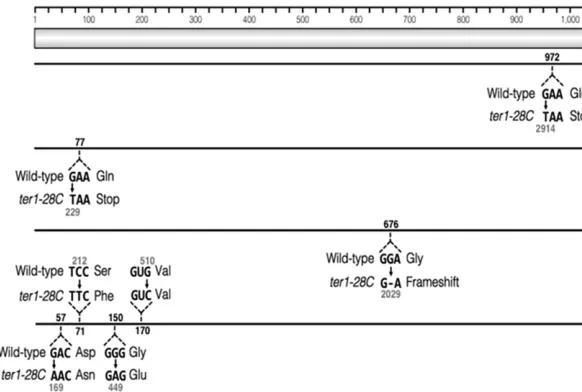
To determine whether the pale blue phenotype observed in some ter1-28C(Taq) isolates was due to mutation, we se-quenced the LAC4 gene from six such isolates. The entire LAC4locus, including 157 bp downstream of the gene and the2.8 kbLAC4regulatory region found between theLAC4 andLAC12, was sequenced. Four of the six isolates sequence contained at least one point mutation within theLAC4open reading frame (Figure 7). Two of these isolates contained single-point mutations that resulted in premature stop co-dons. A single base pair deletion resulting in a frame-shift was detected in the third isolate. Four separate mutations were identified in the fourth isolate, three of which resulted in amino acid substitutions (Figure 7). No mutations were detected in two sequenced isolates and the basis of their phenotypes remains unclear. Because X-gal is passively trans-ported into the cell, mutations within theLAC12gene are not predicted to cause the light blue phenotype observed here. We conclude that the mild telomere dysfunction ofter1-28C (Taq) can lead to high levels of base changes within the sub-telomere in the absence of any obvious BIR-like deletion/ duplication.
The K. lactis 2R telomere-adjacent region appears to be derived from K. marxianus
TheLAC4andLAC12genes are not present in all strains of K. lactisand were previously predicted to have originated from the closely related speciesK. marxianus(Naumov 2005). This was based on the high sequence identity of the genes in the two species, and on the observation that a higher percentage of natural isolates ofK. marxianusare able to assimilate lactose compared withK. lactis. To further address this issue, sequence comparisons of the 0.6–2 kb telomere-adjacent R elements (Nickles and McEachern 2004) ofK. lactisandK. marxianus subtelomeres were carried out. Although 11 of the 12K. lactis R elements share.85% sequence identity, the 2R telomere-adjacent region is unusual in sharing no more than 59% iden-tity to the other R elements. Comparison of the 500 bp telo-mere proximal sequences from the divergent 2R R element revealed that it has much greater sequence identity (80– 89%) to the telomere-adjacent regions of 15 out of 16 chromo-some ends in K. marxianusthan to the other R elements of K. lactis. High levels of sequence homology toK. marxianus, varying from 67% in the nongenic regions to as high as 98% in the coding regions, extend across the 2R terminal fragment,
through the lactose permease gene. Homologous sequence was no longer detectable100 bp upstream ofLAC12. These results suggest that the entire15 kb terminal region of theK. lactis2R end, including the R element, may have been acquired fromK. marxianus.
Discussion
Severely dysfunctional telomeres produce very high frequencies of lac4 mutations through BIR-like deletion/duplication events in subtelomeres.
By using a naturalb-galactosidase gene (LAC4) as a marker of subtelomeric stability, we characterized subtelomeric muta-tions brought about by different levels of telomere dysfunc-tion in the yeastK. lactis. We found that strains with high levels of telomere dysfunction (theter1-D,stn1-M1, and stn1-M1 ter1-D mutants) displayed frequencies of lac4 mutant formation that were minimally two orders of magnitude greater than that seen in control cells. The frequency of LAC4deletion appears to be related to the extent of telomere dysfunction in these mutants. The highestLAC4deletion fre-quency (at least 2700-fold elevated) was seen inter1-Dcells at peak senescence, which have extremely dysfunctional telo-meres and very poor growth. In contrast,ter1-D postsenes-cence survivors, which have longer telomeres and reduced telomere dysfunction, show vastly lessLAC4loss. The stn1-M1andstn1-M1 ter1-Dmutants, which exhibit chronic mod-erate telomere capping and growth defects reminiscent of moderately senescent ter1-Dcells (Iyer et al.2005; Xu and McEachern 2012), had LAC4 deletion frequencies that were minimally 180–500-fold higher than wild type,
respec-tively. A modestly higher LAC4 loss of frequency in the stn1-M1 ter1-D strain is consistent with previous work that showed deletion of telomerase in thestn1-M1 ter1-Ddouble mutant increased recombination rates within telomeric and R element sequences compared with the singlestn1-M1mutant (Xu and McEachern 2012).
The mutational events associated with LAC4deletion in strains with severe telomere dysfunction were, without ex-ception, due to terminal deletion of the 2R telomere. Two distinct classes of terminal deletions, occurring20–40 kb from the 2R chromosome end, were found. The 20 kb dele-tions were all repaired by copying the 1R chromosome end using the first region of the 2R end internal from theLAC4 sequence that shares homeology to another subtelomeric re-gion. Repair at this site replaced the 2R end through a non-reciprocal translocation duplicating the 1R end, as expected for a BIR event. Interestingly, repair junctions were isolated to small regions of microhomology clustered within the 39 telomeric-facing end of the 1.1 kb homeologous sequence. Consistent with previous studies, thisfinding suggests that limited homology within the subtelomere can still act as sub-strates for subtelomeric BIR (Anandet al.2014).
Repair of the40 kb terminal deletions was found to have been carried out by recombination initiated at the homologous Z or X regionsflanking theHMLacryptic mating locus on 3L. Such BIR events are expected to lead to the formation of di-centric chromosomes, as the homologies found on 2R and 3L are found in opposite orientation to one another in respect to the telomere. Because of their instability, it is likely that any dicentric chromosomes that formed from the 2R/3L recombi-nation would quickly have undergone further rearrangements
to restore monocentric chromosomes. Alternatively, template switching of the invading 2R strand from the donor Z or X region duplex to another site of homology could bypass dicen-tric chromosome formation and result in the repair of the 40 kb terminal deletion with less deleterious genomic re-arrangements (Smithet al.2007; Ruizet al.2009; Sakofsky et al.2015). Further analysis is required to fully understand the nature of repair of these larger terminal deletions.
Mild telomere dysfunction triggers a different spectrum of subtelomeric mutations than severe
telomeric dysfunction
Our work also found that a strain with mild telomere dys-function from stably shortened telomeres (ter1-28C(Taq)) gave rise tolac4mutants at frequencies at least 39-fold higher than a wild-type strain. This demonstrates clearly that telo-mere dysfunction inK. lactissufficiently mild to have no de-tectable detrimental effects on cell growth and viability can still induce substantially elevated rates of mutation that af-fect native subtelomeric genes. Characterization oflac4 iso-lates from ter1-28C(Taq) revealed that they also produced deletions of the 2R terminal fragment, as observed in strains with severe telomere dysfunction. Interestingly, however, re-pair of these terminal deletions in the ter1-28C(Taq) strain was only observed at the more terminally located 1R site of homeology and not at the more internalHMRacryptic mating
locus. This is consistent with a lower level of telomere dys-function being less likely to lead to more extreme terminal deletions.
Our results further showed that 50% oflac4-deficient isolates generated in theter1-28C(Taq) background had no obvious subtelomeric rearrangements. However, sequencing of theLAC4gene from six such isolates revealed that four of them contained point mutations. This result indicates that mild-telomere dysfunction inK. lactiscan produce a class of subtelomeric mutations (base changes unaccompanied by gross chromosomal rearrangements) that are not observed, or are at least are a much lower percentage oflac4isolates, in strains with severely dysfunctional telomeres. Surprisingly, pale blue colony color, indicative of residualLAC4function, was present in mutants containing premature stop codons within the LAC4 open reading frame. This suggests that LAC4may have a weak alternative translational start point or that there is a detectable level of nonsense suppression occurring.
We have not examined whether the elevated rate of base changes from telomere dysfunction that we observed to occur inLAC4is confined to subtelomeric regions. However, pre-vious work showed that telomere dysfunction, even in severe form, did not lead to a detectable increase in HR occurring at a chromosome-internal site (McEachern and Iyer 2001). As it is expected that increased rates of both HR and base changes
Figure 6 2R/3L chimeras at the common left and right flanking regions of the cryptic HMRa and HMLamating loci were detected through PCR amplification across the leftflanking region. (A) Over-view of the mating type loci in 2L and 3R. Two blocks of perfect homology that are flanking the cryptic mating loci on the 2R and 3L subtelomeres are shown as dark and light shaded boxes. The leftflanking region, or Z re-gion (dark shaded) spans 360 bp, whereas the right flanking re-gion, or X region (light shaded) spans 250 bp. The cryptic mating loci are found in opposite orien-tations with respect to their telo-meres. Enlargement of cryptic mating type loci showing PCR primer locations (arrows) referred to in the text. Using these pri-mers, PCR reactions designed to detect chimera formation across the left and rightflanking regions was carried out in strains
result from DNA ends being processed for repair, it is highly likely that elevated rates of base changes are largely
con-fined to subtelomeres or regions able to undergo HR with subtelomeres.
How the point mutations that we observed in ter1-28C (Taq)lac4mutants form is unknown. Past work in senescing S. cerevisiaecells lacking telomerase found that a 16-fold in-crease in base substitution and frameshift mutations at a sub-telomeric location was dependent upon the Rev1 and Polz translesion DNA polymerases (Meyer and Bailis 2007). More recently, it was shown that DNA synthesis during BIR is highly error prone, producing base changes at1000 times the normal frequency (Deemet al.2011). This is thought to be a consequence of the unusual, moving D-loop DNA syn-thesis that characterizes BIR (Sainiet al.2013). However, the base alterations in thelac4gene formed in theter1-28C(Taq) strain appear not to be due to classical BIR events, as there is no evidence that they are associated with nonreciprocal du-plication of 2R sequences. We instead propose that they may be due to sister chromatid BIR events that occur from telo-mere dysfunction happening at just one of a pair of replicated sister telomeres. If one sister telomere becomes uncapped and is nucleolytically processed to lose some sequence, strand invasion of the shortened end into the intact sister may result in a BIR event that replaces the lost sequences exactly, except for base alterations introduced by the error-prone D-loop synthesis.
Why base changes are a far greater proportion of lac4 mutants in the mild telomere dysfunction ter1-28C(Taq) strain compared with the severe telomere dysfunction strains remains unclear. One possibility is that telomere uncapping occurring from severe dysfunction is more likely to persist through cell division and therefore act either before replica-tion or affect both sister telomeres after replicareplica-tion. Con-sistent with this model, we note that the mild telomere dysfunction that characterizes the earliest stages of replica-tive senescence in human cells generally affects just one of a replicated pair of sister telomeres (Kaulet al.2012). Another
potential contributor to the different subtelomeric muta-tional profiles of the strains examined in our work could stem from severe telomere dysfunction tending to saturate one or more subprocesses involved in the repair of uncapped telo-meres, and thereby perturb the outcomes of the repair events. The strains used in this study are expected to lead to all telomeres in the cell having an equal chance of being tional. We therefore cannot conclude for certain that dysfunc-tion of the 2R telomere was always the cause of mutadysfunc-tion of 2R subtelomeric regions. However, dysfunctional telomeres are expected to act preferentially in cis with regard to causing mutations. This is because DNA ends that initiate HR typically act as recipients of genetic information donated or copied from another DNA molecule (Mehta and Haber 2014).
The potential of adaptive telomere failure to facilitate evolution of K. lactis subtelomeric DNA
Another major prediction of the adaptive telomere failure hypothesis, untested in the experiments presented in this work, is that many eukaryotic organisms, perhaps especially microbes, will generate occasional telomere dysfunction in certain stressful environments (McEachern 2008). This dys-function might occur through many mechanisms, including targeted alteration or degradation of a telomere protein, or induction of telomere rapid deletion (Li and Lustig 1996; Bucholcet al.2001; Bechardet al.2011). Telomere uncap-ping could, in turn, sometimes stimulate recombination in subtelomeric genes and thereby occasionally produce
bene-ficial mutations. If this type of telomere failure exists, it is unlikely to occur as simultaneous uncapping of all telomeres, but rather as failure affecting a single telomere in a cell at any given occurrence, with minimal effects on cell fitness. The mild telomere dysfunction of theter1-28C(Taq) strain used here may therefore provide a useful model for understanding the nature of subtelomeric mutations that might be possible with environmentally induced telomere failure.
The potential benefits of elevated mutation rates (whether inducible or constitutive) in subtelomeric regions are likely
related to the unusual types of genes found there. Subtelomeres are enriched in genes that exhibit copy number variation and/or function in adaptation to novel niches (Moxon et al. 1994; Barryet al.2003). They are also common locations for genes that have introgressed from other related species (Naumov 2005; Naumovaet al. 2011). We have shown here that the 2R telomere ofK. lactis, including theb-galactosidase (LAC4) and lactose permease (LAC12) genes, has been acquired from the related speciesK. marxianus, a species previously shown be capable of mating with K. lactis(Steensma et al.1988). Conceivably, the appearance of the human-created environ-ments of dairies and creameries led to selection for lactose utilization and theLAC4andLAC12genes inK. lactis. Sugar utilization genes and gene families are common in yeast sub-telomeric regions, and work on theSaccharomycesspecies has argued that some of them have evolved to have novel cleavage specificities (Brownet al.2010).
Mild telomere dysfunction might increase the likelihood of beneficial mutations in subtelomeric genes through more than one mechanism. BIR-generated terminal duplications can in-crease the copy number of subtelomeric genes. Elevated sub-telomeric recombination can also generate hybrid genes from dispersed family members. Our observation of BIR events re-peatedly utilizing CYB2 sequences with only 76% sequence match to one another is an example of the potential of such processes. Increased base change rates in the absence of clas-sical BIR deletion/duplication outcomes could obviously di-rectly modify the sequence of subtelomeric genes. It is likely that subtelomeric genes that had accumulated mutations due to rare use, or that had been introgressed from another species, would be more likely to achieve fitness benefits from base changes than would normally be the case for other genes.
Acknowledgments
This work was supported in part by a National Institutes of Health training grant (T 32 GM007103) and from a generous gift from Paul Truex and family. The authors would like to also thank Brianna Stadsvold, who helped score colony color, and Zahilys Soto, who assisted with tetrad dissections.
Literature Cited
Alberti, A., P. Goffrini, I. Ferrero, and T. Lodi, 2000 Cloning and char-acterization of the lactate-specific inducible geneKlCYB2, encoding the cytochrome b2 ofKluyveromyces lactis. Yeast 16: 657–665. Anand, R. P., O. Tsaponina, P. W. Greenwell, C. S. Lee, W. Duet al.,
2014 Chromosome rearrangements via template switching be-tween diverged repeated sequences. Genes Dev. 28: 2394–2406. Aylon, Y., and M. Kupiec, 2004 DSB repair: the yeast paradigm.
DNA Repair (Amst.) 3: 797–815.
Barry, J. D., M. L. Ginger, P. Burton, and R. McCulloch, 2003 Why are parasite contingency genes often associated with telomeres. Int. J. Parasitol. 33: 29–45.
Barsoum, E., P. Martinez, and S. U. Aström, 2010 a3, a transpos-able element that promotes host sexual reproduction. Genes Dev. 24: 33–44.
Bechard, L. H., N. Jamieson, and M. J. McEachern, 2011 Recombination can cause telomere elongations as well as truncations deep within telomeres in wild-typeKluyveromyces lactiscells. Eukaryot. Cell 10: 226–236.
Blackburn, E. H., E. S. Epel, and J. Lin, 2015 Human telomere biology: a contributory and interactive factor in aging, disease risks, and protection. Science 350: 1193–1198.
Blasco, M., H. W. Lee, M. P. Hande, E. Samper, P. M. Lansdorp et al., 1997 Telomere shortening and tumor formation by mouse cells lacking telomerase RNA. Cell 91: 25–34.
Bobrowicz, P., R. Wysocki, G. Owsianik, A. Goffeau, and S. Ułaszewski, 1997 Isolation of three contiguous genes ACR1, ACR2, andACR3, involved in resistance to arsenic compounds in the yeastSaccharomyces cerevisiae. Yeast 13: 819–828. Brown, C. A., A. W. Murray, and K. J. Verstrepen, 2010 Rapid
expansion and functional divergence of subtelomeric gene fam-ilies in yeasts. Curr. Biol. 20: 895–903.
Bucholc, M., Y. Park, and A. J. Lustig, 2001 Intrachromatid exci-sion of telomeric DNA as a mechanism for telomere size control inSaccharomyces cerevisiae. Mol. Cell. Biol. 21: 6559–6573. Chan, S. W. L., and E. H. Blackburn, 2003 Telomerase and ATM/
Tel1p protect telomeres from nonhomologous end joining. Mol. Cell 11: 1379–1387.
Cech, T. R., 2004 Beginning to understand the end of the chro-mosome. Cell 116: 273–279.
Chiruvella, K. K., Z. Liang, and T. E. Wilson, 2013 Repair of dou-ble-strand breaks by end joining. Cold Spring Harb. Perspect. Biol. 5: a012757.
Craven, R. J., P. W. Greenwell, M. Dominska, and T. D. Petes, 2002 Regulation of genome stability byTEL1andMEC1, yeast homologs of the mammalianATMandATRgenes. Genetics 161: 493–507.
Darzentas, N., 2010 Circoletto: visualizing sequence similarity with Circos. Bioinformatics 26: 2620–2621.
Deem, A., A. Keszthelyi, T. Blackgrove, A. Vayl, B. Coffey et al., 2011 Break-induced replication is highly inaccurate. PLoS Biol. 9: e1000594.
De Lange, T., V. Lundblad, and E. H. Blackburn, 2006 Telomeres. Cold Spring Harbor Laboratory Press, Cold Spring Harbor, NY. Dickson, R. C., and J. S. Markin, 1980 Physiological studies of
b-galactosidase induction in Kluyveromyces lactis. J. Bacteriol. 142: 777–785.
Fairhead, C., and B. Dujon, 2006 Structure ofKluyveromyces lactis subtelomeres: duplications and gene content. FEMS Yeast Res. 6: 428–441.
Garvik, B., M. Carson, and L. Hartwell, 1995 Single-stranded DNA arising at telomeres in cdc13mutants may constitute a specific signal for theRAD9checkpoint. Mol. Cell. Biol. 15: 6128–6138. Glover, L., J. Jun, and D. Horn, 2011 Microhomology-mediated
deletion and gene conversion in African trypanosomes. Nucleic Acids Res. 39: 1372–1380.
Gottschling, D. E., O. M. Aparicio, B. L. Billington, and V. A. Zakian, 1990 Position effect atS. cerevisiae telomeres: reversible re-pression of Pol II transcription. Cell 63: 751–762.
Greider, C. W., and E. H. Blackburn, 1989 A telomeric sequence in the RNA of Tetrahymena telomerase required for telomere re-peat synthesis. Nature 337: 331–337.
Hackett, J. A., and C. W. Greider, 2003 End resection initiates genomic instability in the absence of telomerase. Mol. Cell. Biol. 23: 8450–8461.
Horn, D., 2004 The molecular control of antigenic variation in Trypanosoma brucei. Curr. Mol. Med. 4: 563–576.
Horn, D., and J. D. Barry, 2005 The central roles of telomeres and subtelomeres in antigenic variation in African trypanosomes. Chromosome Res. 13: 525–533.
runaway recombinational telomere elongation and rapid deletion in yeast. Mol. Cell. Biol. 25: 8064–8073.
Kaul, Z., A. J. Cesare, L. I. Huschtscha, A. A. Neumann, and R. R. Reddel, 2012 Five dysfunctional telomeres predict onset of senescence in human cells. EMBO Rep. 13: 52–59.
Kim, M. M., M. A. Rivera, I. L. Botchkina, R. Shalaby, A. D. Thor et al., 2001 A low threshold level of expression of mutant-template telomerase RNA inhibits human tumor cell prolifera-tion. Proc. Natl. Acad. Sci. USA 98: 7982–7987.
Kraepelin, G., 1984 Yeasts: characteristics and identification. Z. Allg. Mikrobiol. 24: 436.
Krejci, L., V. Altmannova, M. Spirek, and X. Zhao, 2012 Homologous recombination and its regulation. Nucleic Acids Res. 40: 5795–5818. Li, B., and A. J. Lustig, 1996 A novel mechanism for telomere size control inSaccharomyces cerevisiae. Genes Dev. 10: 1310–1326. Lieber, M. R., 2010 The mechanism of double-strand DNA break repair by the nonhomologous DNA end-joining pathway. Annu. Rev. Biochem. 79: 181–211.
Linardopoulou, E. V., E. M. Williams, Y. Fan, C. Friedman, J. M. Young et al., 2005 Human subtelomeres are hot spots of in-terchromosomal recombination and segmental duplication. Na-ture 437: 94–100.
Maciejowski, J., and T. de Lange, 2017 Telomeres in cancer: tu-mour suppression and genome instability. Nat. Rev. Mol. Cell Biol. 18: 175–186.
McEachern, M. J., 2008 Telomeres: Guardians of genomic integ-rity or double agents of evolution, pp. 100–113 inOrigin and Evolution of Telomeres. Landes Bioscience, Austin, TX.
McEachern, M. J., and E. H. Blackburn, 1995 Runaway telomere elongation caused by telomerase RNA gene mutations. Nature 376: 403–409.
McEachern, M. J., and E. H. Blackburn, 1996 Cap-prevented re-combination between terminal telomeric repeat arrays (telo-mere CPR) maintains telo(telo-meres inKluyveromyces lactislacking telomerase. Genes Dev. 10: 1822–1834.
McEachern, M. J., and J. E. Haber, 2006 Break-induced replica-tion and recombinareplica-tional telomere elongareplica-tion in yeast. Annu. Rev. Biochem. 75: 111–135.
McEachern, M. J., and S. Iyer, 2001 Short telomeres in yeast are highly recombinogenic. Mol. Cell 7: 695–704.
Mefford, H. C., and B. J. Trask, 2002 The complex structure and dynamic evolution of human subtelomeres. Nat. Publ. Gr. 3: 91– 102.
Mehta, A., and J. E. Haber, 2014 Sources of DNA double-strand breaks and models of recombinational DNA repair. Cold Spring Harb. Perspect. Biol. 6: a016428.
Meyer, D. H., and A. M. Bailis, 2007 Telomere dysfunction drives increased mutation by error-prone polymerases Rev1 and zin Saccharomyces cerevisiae. Genetics 175: 1533–1537.
Mieczkowski, P. A., J. O. Mieczkowska, M. Dominska, and T. D. Petes, 2003 Genetic regulation of telomere-telomere fusions in the yeast Saccharomyces cerevisae. Proc. Natl. Acad. Sci. 100: 10854–10859.
Miller, D., G. E. Reynolds, R. Mejia, J. M. Stark, and J. P. Murnane, 2011 Subtelomeric regions in mammalian cells are deficient in DNA double-strand break repair. DNA Repair (Amst.) 10: 536–544. Moxon, E. R., P. B. Rainey, M. A. Nowak, and R. E. Lenski, 1994 Adaptive evolution of highly mutable loci in pathogenic bacteria. Curr. Biol. 4: 24–33.
Naumov, G. I., 2005 Domestication of dairy yeastKluyveromyces lactis: transfer of theb-galactosidase (LAC4) and lactose perme-ase (LAC12) gene cluster? Dokl. Biol. Sci. 401: 120–122. Naumova, E. S., G. I. Naumov, Y. V. Michailova, N. N. Martynenko,
and I. Masneuf-Pomarède, 2011 Genetic diversity study of the yeastSaccharomyces bayanus var. uvarumreveals introgressed subtelomeric Saccharomyces cerevisiae genes. Res. Microbiol. 162: 204–213.
Nickles, K., and M. J. McEachern, 2004 Characterization of Kluy-veromyces lactis subtelomeric sequences including a distal element with strong purine/pyrimidine strand bias. Yeast 21: 813–830.
Pâques, F., and J. E. Haber, 1999 Multiple pathways of recombi-nation induced by double-strand breaks inSaccharomyces cere-visiae. Microbiol. Mol. Biol. Rev. 63: 349–404.
Podlevsky, J. D., and J. J. L. Chen, 2012 It all comes together at the ends: telomerase structure, function, and biogenesis. Mutat. Res. Fundam. Mol. Mech. Mutagen. 730: 3–11.
Pryde, F. E., H. Z. Gorham, and E. J. Louise, 1997 Chromosome ends: all the same under their caps. Curr. Op. 7: 822–828. Ricchetti, M., B. Dujon, and C. Fairhead, 2003 Distance from the
chromosome end determines the efficiency of double strand break repair in subtelomeres of haploid yeast. J. Mol. Biol. 328: 847–862.
Rudd, M. K., C. Friedman, S. S. Parghi, E. V. Linardopoulou, L. Hsu et al., 2007 Elevated rates of sister chromatid exchange at chromosome ends. PLoS Genet. 3: 0319–0323.
Ruiz, J. F., B. Gómez-González, and A. Aguilera, 2009 Chromosomal translocations caused by either pol32-dependent or pol32-inde-pendent triparental break-induced replication. Mol. Cell. Biol. 29: 5441–5454.
Saini, N., S. Ramakrishnan, R. Elango, S. Ayyar, Y. Zhang et al., 2013 Migrating bubble during break-induced replication drives conservative DNA synthesis. Nature 502: 389–392. Sakofsky, C. J., S. Ayyar, A. K. Deem, W. H. Chung, G. Ira et al.,
2015 Translesion polymerases drive microhomology-mediated break-induced replication leading to complex chromosomal re-arrangements. Mol. Cell 60: 860–872.
Smith, C. E., B. Llorente, and L. S. Symington, 2007 Template switching during break-induced replication. Nature 447: 102– 105.
Steensma, H. Y., F. C. M. de Jongh, and M. Linnekamp, 1988 The use of electrophoretic karyotypes in the classification of yeasts: Kluyveromyces marxianusandK. lactis. Curr. Genet. 14: 311–317. Teng, S. C., and V. A. Zakian, 1999 Telomere-telomere recombi-nation is an efficient bypass pathway for telomere maintenance inSaccharomyces cerevisiae. Mol. Cell. Biol. 19: 8083–8093. Underwood, D. H., R. P. Zinzen, and M. J. McEachern,
2004 Template requirements for telomerase translocation in Kluyveromyces lactis. Mol. Cell. Biol. 24: 912–923.
Verstrepen, K. J., and F. M. Klis, 2006 Flocculation, adhesion and biofilm formation in yeasts. Mol. Microbiol. 60: 5–15.
Wang, Z.-R., L. Guo, L. Chen, and M. J. McEachern, 2009 Evidence for an additional base-pairing element be-tween the telomeric repeat and the telomerase RNA template in Kluyveromyces lactis and other yeasts. Mol. Cell. Biol. 29: 5389–5398.
Waters, C. A., N. T. Strande, D. W. Wyatt, J. M. Pryor, and D. A. Ramsden, 2014 Nonhomologous end joining: a good solution for bad ends. DNA Repair (Amst.) 17: 39–51.
Wellinger, R. J., and V. A. Zakian, 2012 Everything you ever wanted to know aboutSaccharomyces cerevisiaetelomeres: be-ginning to end. Genetics 191: 1073–1105.
Wray, L. V., M. M. Witte, R. C. Dickson, and M. I. Riley, 1987 Characterization of a positive regulatory gene,LAC9, that controls induction of the lactose-galactose regulon of Kluyveromy-ces lactis: structural and functional relationships toGAL4of Sac-charomyces cerevisiae. Mol. Cell. Biol. 7: 1111–1121.
Xu, J., and M. J. McEachern, 2012 Maintenance of very long telomeres by recombination in the Kluyveromyces lactis stn1– M1mutant involves extreme telomeric turnover, telomeric cir-cles, and concerted telomeric amplification. Mol. Cell. Biol. 32: 2992–3008.