IGSCC OF INCONEL 718 HOLD DOWN SPRING IN 400
OC STEAM
ENVIRONMENT
H. Jang1, J.D. Hong1, S.S. Kim2, K.B. Eom2, O.H. Kwon2, C. Jang1
1Department of Nuclear and Quantum Engineering, KAIST, Daejeon, REPUBLIC OF KOREA 2KEPCO Nuclear Fuel Company, Daejeon, REPUBLIC OF KOREA
E-mail of corresponding author: [email protected]
ABSTRACT
Stress corrosion cracking has been occurred in number of materials used in nuclear power plants. While most of attention has been focused on alloy 600, 690 and their weld materials, stress corrosion cracking of highly stressed materials in fuel assembly, such as hold down springs are a potential issue for long term fuel cycle of nuclear power plant. Alloy 718 used as hold down spring material in fuel assemblies is test materials on this study. Three points bent beam tests of alloy 718 hold down spring in 400oC steam environment at 20 MPa are being conducted to investigate stress corrosion cracking characteristic. Strain was controlled in a range of 0.15 ~ 3.5 mm corresponding to stress range of 100 ~ 280 ksi by using INSTRON 5569 and fixed with nuts. The effect of loading and shot peening on stress corrosion cracking behaviors were subject of interests in this paper. Particularly, the effects of shot peening and microstructure with changes of applied stresses on cracking mode will be investigated by fractography analysis.
INTRODUCTION
The nickel base precipitation hardening alloy, alloy 718 was used for many years in nuclear power plants because of its high mechanical properties and corrosion resistance. Until now, alloy 718 has shown generally good intergranular stress corrosion cracking (IGSCC) resistance. However, for long term fuel cycle of nuclear power plants, the highly stressed material in fuel assembly, such as hold down springs could be a potential issue. In previous testing program, various test methods have been developed to measure SCC initiation time of high strength nickel base alloys. Increasing the stress and temperature produced a limited acceleration, however, changing to doped steam environment at temperature of 400oC and pressure of 20 MPa lead to decrease in exposure time for SCC initiation [1]. In this study, the standard test method for SCC initiation test of alloy 718 was validated. And, effect of loading on SCC initiation of alloy 718 was investigated.
EXPERIMENTAL
Test Materials & Specimen
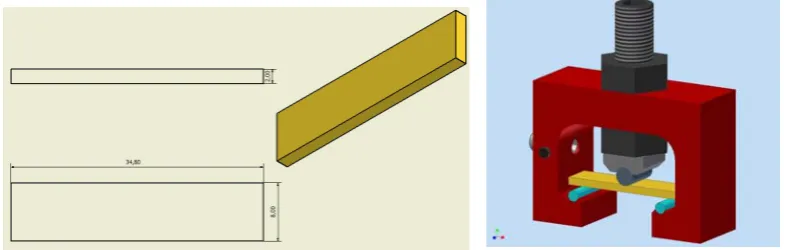
Test material was shot-peened Inconel 718 of plate type (ASTM B670) which is used as hold down spring material of nuclear fuel assembly. The test specimens were machined as shown in Fig. 1. To simulate the loading of hold down spring, 3 point bent beam specimen were chosen in this study. Finite element method (FEM) analysis was used to control the loading on specimen as shown in Fig. 2. To match FEM analysis with true stress, tensile tests were performed by using INSTRON 5569 with strain gauge.
Fig.2 : FEM analysis result of loading to specimen.
Test procedures
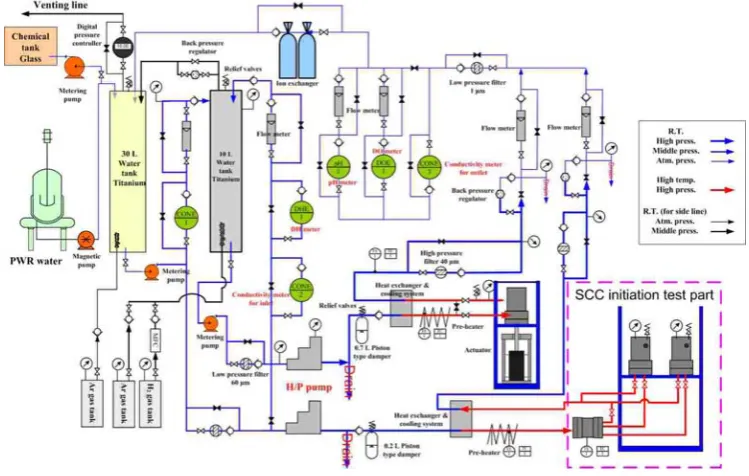
Two autoclaves with recirculation type of water loop were used for SCC test of alloy 718 as shown in Fig. 3. Autoclaves having 6L volume was used. 3 zone band heaters were used for temperature uniformity. Table 1 shows test environment. The water qualities were detected simultaneously during test. Dissolved oxygen and hydrogen were controlled below 5 ppb and 25 cc/kg. Water conductivity was maintained with 25 μS/cm. To accelerate IGSCC cracking, test environment was 400oC steam environment with 20 MPa. And then, IGSCC tests in simulated PWR environment are scheduled to convert the SCC initiation time of alloy 718 from 400oC steam to 320oC water.
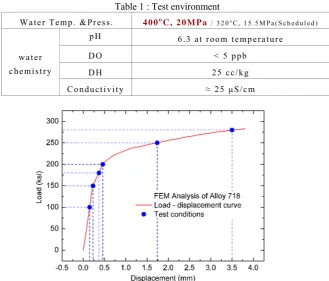
The loading of specimen were chosen by 6 loading steps : 100 ksi, 150 ksi, 180 ksi, 200 ksi, 250 ksi, and 280 ksi as shown in Fig. 4. To consider the reliability and uncertainty on the results of initiation test, eight specimens in each stress regions were tested simultaneously. To examine the existence of crack, they were removed periodically at increasing intervals (50, 100, 150, 200, 250, 500, 1000, 2000, 3600 hr). To check sensitively the existence of IGSCC cracks, the removed specimens were cleaned and inspected using fluorescent dye penetrant (ZYGLO, ZL-67) with meeting the ASTM-E1209 requirements.
Table 1 : Test environment
W a te r Te mp. & Pre s s . 4 0 0oC , 2 0 M P a / 3 2 0oC , 1 5 . 5 M P a ( S c h e d u l e d )
w a t er c he mi s t r y
p H 6 . 3 at r oo m t e m p e ra tu re
D O < 5 p pb
D H 25 cc/ kg
C o n du ct i v i t y ≈ 2 5 μS/ c m
Fig. 4 : Stress-strain curve and test conditions by FEM.
RESULTS & DISCUSSTION
Load control procedures
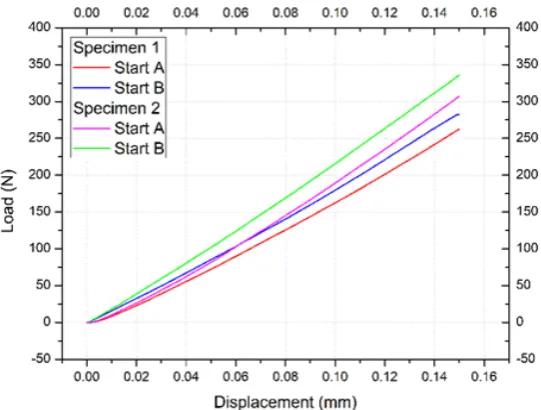
Load control procedures are established and used, because the difference of load control for each specimen could cause the considerable variation of SCC initiation time. Load control was conducted with INSTRON 5569, same equipment conducting tensile test. In the load control procedures, we select method starting from B point, because a) the link between specimen and zig could be loose, therefore, it needs compressive loads, b) considering stress relaxation after loading, higher initial loading could be better, c) as shown in Fig. 6, difference in true stress between starting from A point and starting from B is small (~30N). And it could be verified that the
difference in
true stress among the specimens about 50N.
Fig. 6 : Stress-strain curve from 2 kinds of start point.
Stress Corrosion Cracking Tests
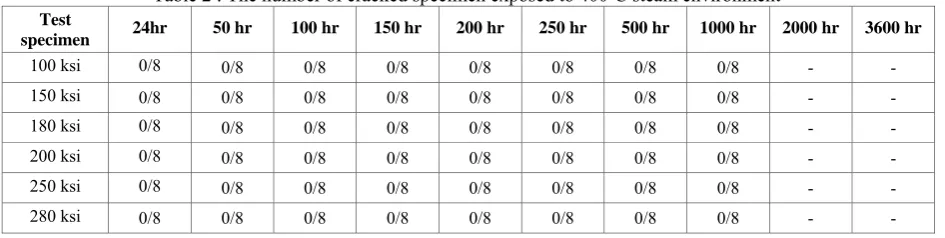
The test has still been conducting that the exposed time is about 1300 hrs. The results of the SCC testing up to now are summarized in Table 2. Fig. 7 shows the surface of high-stressed region on specimen. It is confused with the existence of cracks because of plastic deformation parts of high-stressed test specimens. But, from the results of inspection using fluorescent dye penetrant, there is no evidence of SCC initiation on the all of the test specimens against the prediction.
(a) 280 ksi (b) 250 ksi
Fig. 7: Surface observation of specimen after 100 hour exposure in 400oC steam environment.
Table 2 : The number of cracked specimen exposed to 400oC steam environment Test
specimen 24hr 50 hr 100 hr 150 hr 200 hr 250 hr 500 hr 1000 hr 2000 hr 3600 hr
100 ksi 0/8 0/8 0/8 0/8 0/8 0/8 0/8 0/8 - -
150 ksi 0/8 0/8 0/8 0/8 0/8 0/8 0/8 0/8 - -
180 ksi 0/8 0/8 0/8 0/8 0/8 0/8 0/8 0/8 - -
200 ksi 0/8 0/8 0/8 0/8 0/8 0/8 0/8 0/8 - -
250 ksi 0/8 0/8 0/8 0/8 0/8 0/8 0/8 0/8 - -
280 ksi 0/8 0/8 0/8 0/8 0/8 0/8 0/8 0/8 - -
CONCLUSION
To assess the susceptibility of alloy 718, hold down spring material in PWR, three points bent beam tests in accelerated 400oC steam environment at 20 MPa has been conducted to investigate SCC characteristic. After exposure for 1300 hrs, there is no evidence of SCC initiation on the all of the test specimens.
SCC crack initiation will occur after continuing to make an experiment. At that time, the effect of loading and shot-peening on stress corrosion cracking behaviors will be investigated, especially, the effects of shot-peening and microstructure with changes of applied stresses on cracking mode by fractography analysis. Also, to correlate the life of accelerated environment with PWR environment, the tests under PWR environment are scheduled after accelerated test. It will be very meaningful to assess the integrity of fuel assembly hold down spring in PWR environment.
REFERENCES
[1] T.R. Mager, “Fastener and Bolting Material for Westinghouse Designed Internals”, ", Proceedings: 1986 Workshop on Advanced High-Strength Materials (NP-6363), EPRI.