ISSN(Online): 2320-9801 ISSN (Print): 2320-9798
I
nternational
J
ournal of
I
nnovative
R
esearch in
C
omputer
and
C
ommunication
E
ngineering
(An ISO 3297: 2007 Certified Organization)
Vol. 4, Issue 2, February 2016
Object Tracking using P-N learning and
Background Subtraction
Archana Vilas Kshirsagar1, Kanchan Doke2
M.E Student, Dept. of Computer Engineering, Bharati Vidyapeeth College of Engineering, Mumbai University,
Assistant Professor, B.N.Bandodkar College of science, Mumbai University, Thane, Maharashtra, India1
Assistant Professor, Dept. of I.T., Bharati Vidyapeeth College of Engineering, Mumbai University, Navi Mumbai,
Maharashtra, India2
ABSTRACT: Tracking is one of the most important technique in the field of surveillance and crime detection.
Tracking and detection is the important part of in live object detection where things may constantly move in video frame. Many techniques now a days provides a tracking and detection systems but these systems cannot give satisfactory output due to the complex shapes, rapid motion and frequent movement of the objects. This paper provides tracking, learning and detection of object by dividing video frame into actual object and background. Here actual object is considered as positive type (p-type) of object and background as negative type (n-type) of object. For every frame comes into the system n-type objects are subtracted from p type objects. This technique also provides region of interest (ROI) for deciding searching region the whole video frame. This tracking-learning and detection concept can helps system more successful totrack object from frames.
KEYWORDS: P-type learning, N-type learning, Template matching, tracking, background subtraction, Region of
interest (ROI), object detection.
I. INTRODUCTION
High intensity of surveillance and object detection have created intense need of object detection and tracking. Motion detection tracking has created development into the object tracking and detection systems.
The high quality object tracking methods are expected to not to fail during object detection. When object is in camera or video frame it is detected by tracking system but when object goes out of the frame or not available into the video frame then system cannot recognize object when it reappear into the video frame. Many times there is a situation when object may change there their orientation or shape and size which can be result into tracking system failure. The targeted object may get occluded when various disturbance appear which shades the object. As shown in Fig. 1, when targeted object is part of crowded place, tracking system may get confused due to the clutter effect when more than one objectappears similar.
ISSN(Online): 2320-9801 ISSN (Print): 2320-9798
I
nternational
J
ournal of
I
nnovative
R
esearch in
C
omputer
and
C
ommunication
E
ngineering
(An ISO 3297: 2007 Certified Organization)
Vol. 4, Issue 2, February 2016
This paper initiated concept of N-type and P-type objects, where targeted object can determine as P-type object and background objects are considered as N-type objects. Here this concept can utilized for multiple object tracking. Where system can generate N-type and P-type objects for every targeted object system can learn tracking and detection for multiple objects.
II. LITERATURESURVEY
Tracking learing and detection framework has initiated by kalal[2]. This technique is effective for the situation where tracking happens for restricted scenarios, such as pedestrians, by using back ground subtraction. Where subtraction is applicable on N-type objects to provide false alarm when target is constantly under motion and can create illusion or when out of vision.
Camshift framework provides better tracking accuracies when object is under slow or constant motion, but when object is in rapid motion tracking system get confused due to background illumination and distraction. This framework can provide better performance by using object classification method using object location. [3][4]. This improved framework can judge whether targeted object has lost. This methodology works on five different parameters to recognize targeted object like, 2-D central location, width, height and orientation of selected object.
The technique called template matching is successful one. This technique is independent from shape and size of target. This technique provides template for each available video frame and extract matching elements out of it. If the matching elements are not found in frame for targeted object, then system can easily claims, object is not available in available video frame. [1], [5], [6]
Background subtraction is another technique which is use for motion segmentation. It detects moving regions by subtracting current video frame from past video frame pixel by pixel. From which average image over the time can be calculated by system. The pixels which are different than average difference threshold are classified as foreground pixels. These pixels are used for enhancing detection region for targeted object and to avoid background illusion. Every time the background gets updated which new frame over the time. [1], [7].
III.PROPOSEDSYSTEM
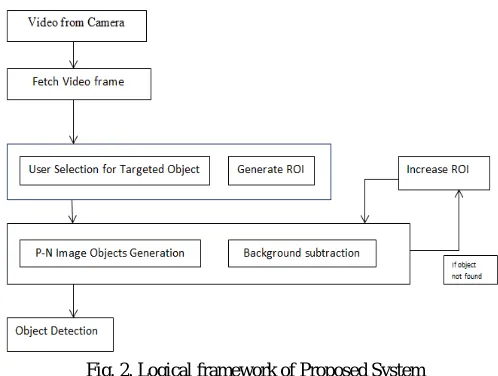
This paper has initiated the concept of tracking, learning and detection using PN learning algorithm. Where concept called region of interest (ROI) is considered to track target. This technique also uses the concept called template matching. [1]
Fig. 2. Logical framework of Proposed System
ISSN(Online): 2320-9801 ISSN (Print): 2320-9798
I
nternational
J
ournal of
I
nnovative
R
esearch in
C
omputer
and
C
ommunication
E
ngineering
(An ISO 3297: 2007 Certified Organization)
Vol. 4, Issue 2, February 2016
minimum searching area for tracking targeted object, which helps to minimize searching space. This process helps to find P-type and N-type object images. Where each received frame with ROI divides whole frame into P-type objects i.e. target and N-type objects i.e. background. Every current frame’s ROI is compared with previous frame’s ROI to learn behaviour of targeted object. If targeted object does not found in current ROI, then the ROI for targeted object is increased with 20 pixel by each side of object. This process increases search space for object and try to recognize weather object is visible into the frame or not. If ROI = frame and still no targeted object found, system will confirm that object is out of frame.
The following algorithm helps to determine systematic workflow of proposed system.
A. Proposed algorithm for overall system.
1. Take the video into the system using camera interface. 2. Select the object using rectangular selection.
3. This rectangular selection termed as Region of interest (ROI) which is initially 20 pixels away from targeted object.
4. Incoming frame is detected for grid area.
5. Store this selection as P-type image which is targeted object. 6. Calculate total grid area, N-type image.
7. Remove surrounding N-type area from P-type area which is targeted object. 8. Crop all N-type images and store into N-type array.
9. Crop all P-type images and store into P-type array. 10. Match stored N-type image with current grid area. 11. Apply template matching algorithm for selected ROI.
12. If stored image is matching with current frame with more than matching threshold then create brightest point on matched location.
13. If matching is less than threshold then reject frame.
14. If matching is less than threshold then store frame in array else find target. 15. If target not found find error rate using P-N learning.
16. Detect object in next frame.
17. Is previous template = present template (using threshold) If YES = object found
Else increase ROI with 20 pixels 18. Go to step 8.
Target may change its appearance and background due various reason and rapid motion. This concept provide P-N image separation and learning through stored array and threshold value. The learned frames compared with current frame which reduces detection error and illumination conditions and leads toward successful tracking. The object to be tracked is known as P-type of object and background is known as N-type object. This P-type objects acting as a reference object for next template. Both P-type and N-type arrays are matched with current frame to get tracker accuracy.
The above algorithm can be applicable for multi object tracking, where the one dimensional arrays in case of single object tracking can act as a two or multi- dimensional arrays. The P-type objects and N-type objects for each frame can be stored with global threshold value, where multiple targets need to be tracked.
IV.SIMULATIONRESULT
The proposed system meant to work in the field of surveillance and detection, where system can track the target using template matching for provided ROI.
ISSN(Online): 2320-9801 ISSN (Print): 2320-9798
I
nternational
J
ournal of
I
nnovative
R
esearch in
C
omputer
and
C
ommunication
E
ngineering
(An ISO 3297: 2007 Certified Organization)
Vol. 4, Issue 2, February 2016
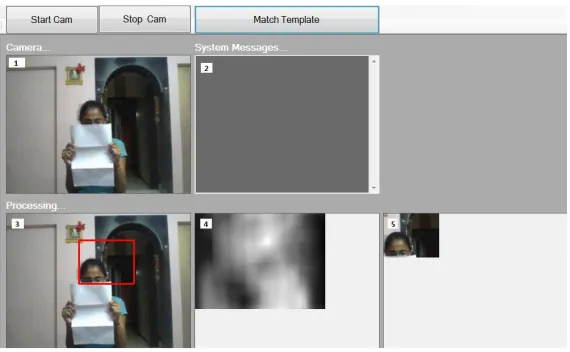
Fig. 3specifies the various control buttons to control camera interface to user. Start Cam button provides interface to camera drive, which keeps on receiving new frames from video as shown in Fig. 4. This frame fetching process doesn’t ends until Stop Cam control does not clicked by user. Matching Template button is used to fetch target selection area from incoming frames.
Fig. 4. Camera interface starts after clicking on start button.
Fig. 5. Target section and template matching for target
Fig. 5 shows the outcome for template matching. User need to select target object from camera interface, shown in picture box 1. Once targeted object is selected its grey scale image get generated which is formed using OpenCV algorithm, picture box 4. The brightest point in the grey scale image is considered as a highest possible location of targeted object in current frame. Picture box 5 shows the updated image as targeted object movies or its location changes in the current frame. Picture box 3 shows the tracked the object with changed location in the current frame. Picture box 2 is use to show system message such as object not detected on given frame and so on.
The final results for P-N learning and background subtraction are yet to be obtained as system is under development.
V. CONCLUSIONANDFUTURESCOPE
ISSN(Online): 2320-9801 ISSN (Print): 2320-9798
I
nternational
J
ournal of
I
nnovative
R
esearch in
C
omputer
and
C
ommunication
E
ngineering
(An ISO 3297: 2007 Certified Organization)
Vol. 4, Issue 2, February 2016
increase system efficiency. The learning methodology keeps on comparing current template with stored template which helps system to keep on updating object location in searching region. The initiated concept can be implemented in OpenCV library which not only works for single object tracking but for multiple objects tracking as well, which can be considered for future scope
VI.AKNOWLEDGEMENT
I sincerely express my deep sense of gratitude to my guide and PG Co-coordinator Prof. KanchanDoke for his valuable guidance, continuous encouragement and support whenever required.
I would like to give sincere thanks to our Head of Department of Computer Engineering Dr. D.R. Ingle, for valuable guidance and encouragement lead to the success of this paper.
REFERENCES
[1] BhushanNemade, Dr.VinayakashokBhardi, “Adaptive Automatic Tracking, Learning and Detection of Real Time object in the Video Stream”,
IEEE 5th International Conference- Confluence The Next Generation Information Technology Summit (Confluence), Vol. 9pp.569 – 575, 2014
[2] ZdenekKalal, KrystianMikolajczyk, and Jiri Matas , “Tracking-Learning-Detection”, IEEE TRANSACTIONS ON PATTERN ANALYSIS
AND MACHINE INTELLIGENCE, Vol. 34, Issue 7, pp.1409 – 1422, 2012
[3] xinchen, xiang Li, Hefeng Wu, taishengQiu, “Real time Object Tracking via CamShift-Based Robust Framework”, Vol. 3, pp.527 – 530,
2012
[4] Swantje Johnson, Ashley Tews, “Real time Object Tracking and classification Using a static Camera”, Proceedings of IEEE ICRA, Vol. 5,
pp.1-6, 2009
[5] Wiedo Hu, Ahemed Mohamed Gharuib. Alaa El-Din Sayed Hafez, “Template Match Object Detection for Inertial Navigation stems”,
Published Online http://www.SciRP.org/journal/pos, Vol. 2, Issue 5, pp.78-83, 2011
[6] Sanjay Kumar Sahani, G.adhikari and BK Das, “A Fast template matching algorithm for Arial object”, ICIIP International Conference On
Image Information Processing, Vol. 11, pp.1-6, 2011
[7] A. M. Mclvor, “Background subtraction Techniques”, In proc. Of Image and Vision computing, pp.1-6, 2000
BIOGRAPHY
Archana Vilas Kshirsagar is Student of M.E. Computer Engineering, BharatiVidyapeeth College of Engineering,
Mumbai University, Navi Mumbai, Maharashtra, India. She is an Assistant Professor in the Department of I.T., B.N.Bandodkar College of science, Mumbai University,Thane, Maharashtra, India. Her area of interest is Cloud computing and image processing.
Kanchan Dokeis a Professor in the Department of I.T. and computer science, BharatiVidyapeeth College of