E-Voting System using Blockchain Technology
for Distributed Environment
Rahul Rakhe1, Rahul Kale1, Pritish Bisht1, Prof. K.S.Balbudhe2
B.E. Student, Dept. of IT, PVG’s COET, Pune, India1
Asst. Professor, Dept. of IT, PVG’s COET, Pune, India2
ABSTRACT: Electronic voting (also known as e-voting) system refers to voting using electronic means and to take care of the votes given by the user and counting the votes accurately. An e-voting system must be secure, as it should not allow duplicated votes and be fully transparent, while protecting the privacy of the attendees. The disadvantages of traditional voting system are that there is no reliability of voting. No assurance that people gave the votes are not changed before they are counted on the system. There is no transparency between the voter and the system. So, to overcome all these issues we are proposing to use block chain technology as a medium in the voting system. The objective of such a scheme would be to provide a decentralized architecture to run and support a voting scheme that is open,fair, and independently verifiable. In this, we propose a potential new e-voting protocol that utilizes the block chain as a transparent ballot box. Therefore, there would be more transparency between the user and the system. The advantages that we get while using the e-voting system would be to reduce election expenses including material, logistics and salary cost. Peoples opinion would be more public and more accessible by politicians and managers. If the voter is out of station, he can vote remotely. So, it strengthens the overall attendance. E-voting can be very helpful because everyone can easily access the election and uses his/her votes and declares his/her choice. People can shareprivate hyperlinks to any created poll (as long as they know the link) and people who have the link can vote and one browser can only use one vote. E-voting is being studied extensively, and many implementations are tested and even used for a while.
KEYWORDS: Blockchain, Electronic Voting System, e-voting
I. INTRODUCTION
Technology has positive impacts on many aspects ofour social life. Designing a 24 hour globally connected architecture enables ease of access to a variety of resources and services. Furthermore, technology like the Internet has been a fertile ground for innovation and creativity. One such disruptive innovation is blockchain, a keystone of cryptocurrencies. The blockchain technology is presented as a game changer for many of the existing and emerging technologies/services. With its immutability property and decentralized architecture, it is taking center stage in many services as an equalization factor to the current parity between consumers and large corporations/governments. One potential application of the blockchain is in e-voting schemes. The objective of such a scheme would be to provide a decentralized architecture to run and support a voting scheme that is open, fair, and independently verifiable. In this work, we propose a potential new e-voting protocol that utilizes the blockchain as a transparent ballotbox.
E-voting is more preferable because e-voting is available for everyone who has a computer, or a mobile phone, every single administrative decision can be made by people and members; or at least peoples opinion will be more public and more accessible by politicians and managers. This will eventually lead humanity to the true direct democracy. Its important for us since elections can easily be corrupted or manipulated especially in small towns, and even in bigger cities located in corruptcountries.
Plus, large-scale traditional elections are very expensive in the long term, especially if there are hundreds of geograph- ically distributed vote centres and millions of voters. Also, the voters (mainly for members of organizations) might be on vacation, on a business trip or far away for any other reason, which will make impossible for that particular voter to attend the election and may lower the overall attendance. E-voting will be able solve these problems, if implemented carefully. This paper explores the potential of the block chain technology and its usefulness in the e-voting scheme, which is then implemented.
II. RELATEDWORK
System presented in the issues and effectiveness of blockchain technology on digital voting tells us thatblock chain is a technology that enables moving digital coins or assets from one individual to other individual. Blockchain concept can be understand with the concept of linked list in Data Structure, because its next key address are stored in previous key and they are linked with each other. It was first conceptualized in 2008 which implemented in the successive year as a core component of the digital currency bitcoin, which works as a public ledger of all transactions. Digital voting through block chain technology has some issues and effectiveness but their concern is to focused that how much system make this technique more effective. Here, their main focus is that how system can implement this technique i n their daily life. Our country India is deeply interested for future use and lots of efforts are being done to overcome the security issues as early as possible[1].
present a cryptographic technique for an authentication, end to end verifiable and secret ballot election. Voters should receive assurance that their vote is cast as intended, recorded as cast and tallied as recorded. The election system as a whole should ensure that voter coercion is unlikely, even when voters are willing to be influenced. System have modified the DRE-ip system so that if any recorded ballot is tempered by an adversary before the tallying phase, it will be detected during the tallying phase. In addition, system have described a method using zero knowledge based public blockchain to store these ballots so that it remains tamper proof. To the best of our knowledge, it is the first end-to end verifiable Direct-recording electronic(DRE) based e-voting system using blockchain. Their proposed system assumes that the bulletin board is insecure and an adversary as read and write access to the bulletin board. System have also added a secure biometric with government provided identity card-based authentication mechanism for voter authentication. System is able to encrypt ballot in such a way that the election tally can be publiclyverifiedwithoutdecryptingcastballotsmaintainingend-to-end verifiability and without requiring these cure bullet inboard[5].
III.PROPOSEDMETHIOD
We propose a system that highlights the implementation of e-voting using blockchain and from a practical point of view in both development/deployment and usage contexts. We are building an electronic voting system that satisfies the legal requirements of legislators has been a challenge for a long time. Distributed ledger technologies are an exciting technological advancement in the information technology world. Blockchain technologies offer an infinite range of applications benefiting from sharing economies. Here weaim to evaluate the application of blockchain as service to implement distributed electronic votingsystems.
In this we propose a potential new e-voting protocol that utilizes the blockchain as a transparent ballot box. The protocol has been designed to provide the fundamental e- voting properties as well as offer a degree of decentralization and allow the voter to give their vote in a secure manner (within the permissible voting period) using electronic means.
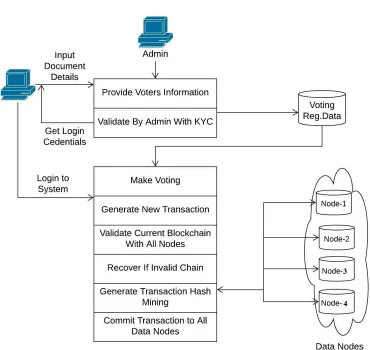
Fig. 1. Proposed System Architecture
back-office data input and maintenance costs and improve data accuracy and security.
Firstly, wecreate a multiple distributed ledger and e-voting transnational data and stored all transaction data into multiple data nodes. Each node will hold the specific block for each transaction. Same block has replaced for all the nodes, and generates a valid block chain.Now the System will retrieve data from all data nodes and commit the transaction, it should be any kind of DDL, DML as well as DCL transactional query. If any block chain invalid during the validation of data servers, then system will automatically recover whole blockchain using majority of servers. We will address and eliminate the runtime server attacks and recover it using own blockchain. System will provide the each transactional validation, for all servers.
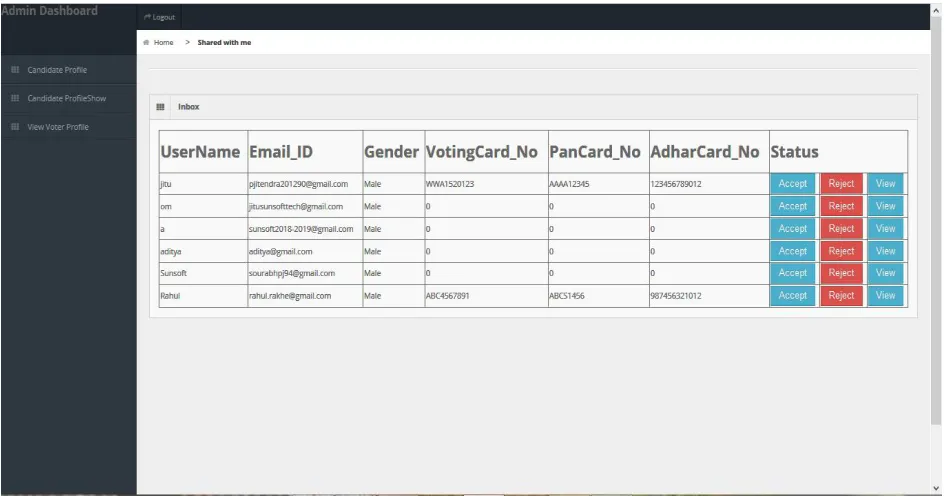
Fig. 2. Admin
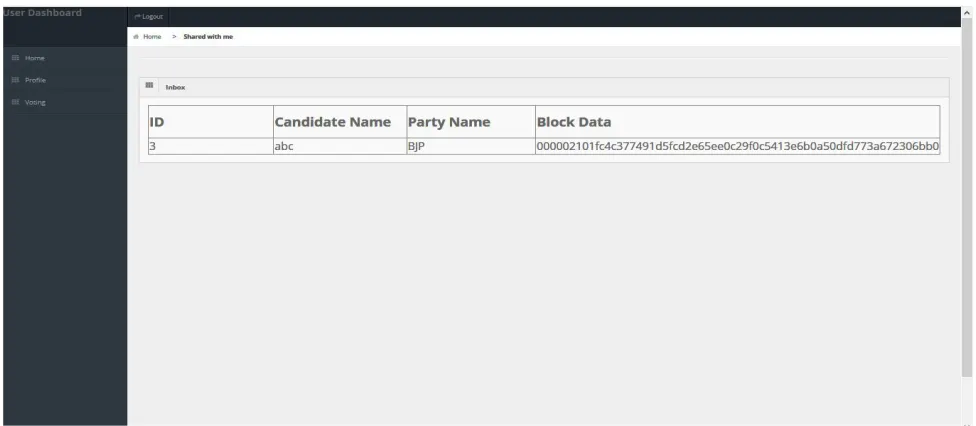
Fig. 3. Voting
In the block Generation and blockchain validation phase, the data is processed in multiple servers so that the
transactions are processed in sequencing P2P distributed network. This
illuminatesVtheVqualityVofVserviceVissueVandVtimelimits.
In the Consensus Algorithm validation and block chain recovery phase, The Consensus algorithm is used by the network which will store the data to the block that is added toblockchain and all nodes in the network admit the respective block and extend the chain base on the block. the consensus model helps us to preserve the integrity of data recorded on the blockchain. it is reported that various consensus mechanisms and issues could result when the consensus mechanism fails including blockchain forks, consensus failures, dominance issues, validating nodes and deficient performance of the blockchainVnetwork.
In the results generation phase, firstly E-voting will be done successfully and secondly if attacker attacks the system, then the system will automatically recover the blocks using blockchain technology.
V. CONCLUSION
There are many research directions in applying Blockchain technology to the voting industry due to the complexity of this domain and the need for more robust and effective information technology systems. An interoperable architecture would undoubtedly play a significant role throughout many voting use cases that face similar data sharing and communication challenges. From the more technical aspect, much research is needed to pinpoint the most practical design process in creating an interoperable ecosystem using the Blockchain technology while balancing critical security and confidentiality concerns in E-voting.
Whether to create a decentralized application leveraging an existing Blockchain, additional research on secure and efficient software practice for applying the Blockchain technology in voting is also needed to educate softwareengineers and domain experts on the potential and also limitations of this new technology. Likewise, validation and testing approaches to gauge the efficacy of Blockchain-based voting architectures compared to existing systems are also important (e.g., via performance metrics related to time and cost of computations or assessment metrics related to its feasibility). In some cases, a new Blockchain network may be more suitable than the existing Blockchains, therefore, another direction may be investigating extensions of an existing Blockchain or creating a voting Blockchain that exclusively provides e-voting services.
REFERENCES
[1]. Gupta A, Patel J, Gupta M, Gupta H., Issues and Effectiveness of Blockchain Technology on Digital Voting. International Journal of Engineering and Manufacturing Science, Vol. 7, No. 1 (2017).
[2]. Navya A., Roopini R., SaiNiranjan A. S. et. Al, Electronic voting machine based on Blockchain technology and Aadhar verification, International Journal of Advance Research, Ideas and Innovations in Technology, (Volume 4, Issue 2)
[3]. Hardwick, Freya Sheer, Raja NaeemAkram, and Konstantinos Markantonakis. E-Voting with Blockchain: An E-Voting Protocol with Decentralisation and Voter Privacy. arXiv preprint arXiv:1805.10258 (2018)
[4]. Meter, Christian. Design of Distributed Voting Systems. arXiv preprint arXiv:1702.02566 (2017).
[5]. Panja, Somnath, and Bimal Kumar Roy. “A secure end-to-end verifiable e-voting system using zero knowledge based blockchain.”
[6]. Paul Tak Shing Liu. Medical record system using blockchain, big data and tokenization. In International Conference on Information and Communications Security, pages 254261. Springer, 2016.
[7]. Christian Decker and Roger Wattenhofer. Information propagation in the bitcoin network. In Peer-to-Peer Computing (P2P), 2013 IEEE Thirteenth International Conference on, pages 110. IEEE, 2013.
[8]. Till Neudecker, Philipp Andelfinger, and Hannes Hartenstein. Timing analysis for inferring the topology of the bitcoin peer-to-peer network. In Ubiquitous Intelligence Computing, Advanced and Trusted Computing, Scalable Computing and Communications, Cloud and Big Data Computing, Internet of People, and Smart World Congress (UIC/ATC/ScalCom/CBDCom/IoP/SmartWorld),2016IntlIEEEConferences, pages358367. IEEE, 2016.
[9]. DongshengZhang. Resilienceenhancement tocontainer-basedcloudload balancingservice. Technical report, PeerJ Preprints, 2018. [10]. DongshengZhang. ResilienceEvaluationandEnhancementinMobileAdHocNetworks. PhD thesis, University of Kansas, 2015.
[11]. DongshengZhangand James P.G. Sterbenz. Modelling critical nodeattacksinMANETs. In Self-Organizing Systems, volume 8221 of Lecture Notes in Computer Science, pages 127138. Springer Berlin Heidelberg, 2014.