Evaluation of Performance & Emissions
Characteristics on Application of Palm Acid
Oil Methyl Ester and its Blends
Tejas Ingole 1, Mahir Javeri1, Tayabali Kesury1, Ahrar Ahmad2
Graduate Students, Department of Automobile Engineering, M. H. Saboo Siddik CoE, Byculla, Maharashtra, India1 Assistant Professor, Department of Automobile Engineering, M. H. Saboo Siddik CoE, Byculla, Maharashtra, India2
ABSTRACT:The world is amidst an energy crisis, with increasing fuel prices, depleting resources and excessive pollution. At this point of time electric vehicles are still under development phase where range is an issue, biodiesel can be viable alternative for diesel. This research paper deals with synthesis of biodieselfrom Palm acid oil using transesterification process and testing of its blends on a single cylinder CI engine. Performance characteristics and emissions of biodiesel blends were compared with that of diesel. It was found that 30% blend (B30) was the best among all the blends.
KEYWORDS: Palm acid oil biodiesel, transesterification, performance characteristics, emissions.
I.
INTRODUCTIONIn this new era of electric machines and automation, many automobile companies are shifting towards manufacturing electric and hybrid vehicles. This has caused a major concern regarding the existing automobiles which are still running on conventional fossil fuels. Making a world full of electric vehicles is a future concept, which might take decades. Till the time when there would be only electric vehicles on the road, we need to find an alternative fuel which will power our vehicles. This fuel should be renewable and economical as well.
It should be kept in mind the first compression ignition engine invented by Dr. Rudolf Diesel worked on Arachis (Peanut) oil. In 1911 Dr. Diesel stated, ‘‘the diesel engine can be fed with vegetable oils and would help considerably in the development of agriculture of the countries, which use it’’. And in 1912, Diesel said, “the use of vegetable oils for engine fuels may seem insignificant today. But such oils may become in course of time as important as petroleum and the coal tar products of the present time”. After the tragic death of Dr. Diesel in 1913, the engine was modified to work on petroleum fuel known as ‘Diesel’. [1]
The substitute for pure Diesel is Biodiesel, which is a blend of plant derived combusting fuel and diesel. Bio-diesel is non-toxic, contains no aromatics, has higher biodegradability than fossil fuel, and is less pollutant to water & soil. It is being used in many developed nations such as USA, UK, Malaysia, etc.
Various feedstocks such as soyabean, rapeseed, peanut, palm, coconut and many different oil seeds are used to synthesize Bio-diesel. We chose Palm acid oil for our research as the yield of biodiesel from crude palm oil per hectare is high. [2]
Palm oil was used by many researchers to synthesize bio-diesel and compared its results with pure diesel. One of such researchers, Pascal Ndayishimiye, tested the viability of palm oil biodiesel as a substitute for pure diesel. [3]
II. RELATEDWORK
1. AdeebHayyan, 10.2478/s11696-011-0102-6.
The author considered acidic crude palm oil (ACPO) produced from palm oil mills as a feedstock for biodiesel production. It was found that due to its high acid content, the conventional transesterification cannot be applied directly. He used methane sulphonic acid to reduce the acidity. After this treatment, normal base transesterification can be used. The MSA to ACPO ratio was kept in between 4:1 to 20:1, the reaction temperature was kept in between 40ºC - 80ºC. During the reaction the mixture was stirred continuously at 450rpm for a time period of 120-150 mins. Then usual base esterification was carried out for 30 mins at 60 ºC. It was seen that the FFA content was reduced from 18 mg g-1 to less than 1 mg g-1. The biodiesel produced met the EN14214 standard specifications [4].
2. M. Habibullah, 0196-8904.
This study investigated the production, characterization, and effect of biodiesel blends from two prominent feedstocks, namely, palm and coconut (PB30 and CB30), on diesel engines. Palm biodiesel has high ignition quality, while coconut oil has a higher oxygen content. So, to optimise the results, both these biofuels were blended simultaneously with pure diesel to create a 30% blend (PB15CB15). A 10 kW, horizontal, single-cylinder, four-stroke, and direct-injection diesel engine was utilized under full load and variable speed.
The maximum torque values were obtained at 1800 rpm engine speed for the blend. Beyond this speed, the torque of the engine decreased mainly because of decreased volumetric efficiency attributed to the increase in speed, and growths in the mechanical losses. Maximum engine torque was found to be 31.67N for pure diesel. With the use of biodiesel blends, the brake torque slightly dropped. For all the tested fuels, break power steadily increased with engine speed until 2400 rpm. The average BSFCs were 8.58%, 9.03%, and 8.55% higher than that of diesel fuel for PB30, CB30, and PB15CB15 respectively.
Thus, the average NOx emissions for PB30, CB30, and PB15CB15 were respectively 3.13%, 5.67%, and 4.40% higher than that of diesel fuel. The average CO emissions for PB30, CB30, and PB15CB15 were reduced by 13.75%, 17.97%, and 15.84%, respectively, compared with diesel fuel [5].
3. Pascal Ndayishimiye, 0360-5442.
Palm oil (PO) was treated using various methods to test it as a feasible replacement for pure diesel. The treatments include PO preheated and preparation of PO/diesel oil blends, using mixtures of PO with waste cooking oil (WCO), which are converted into esters by transesterification. Pascal tried to evaluate the viability of palm acid oil.
Tests were conducted in a single cylinder, four-stroke, air-cooled, direct injection diesel engine without any modifications. Experiments were initially carried out with diesel oil for providing baseline data.
The engine performances corresponding to the tested fuels were found like those of the diesel fuel with nearly the same brake thermal efficiency (25-27%) but showed higher specific fuel consumption (up to 25%). The brake thermal efficiency was slightly higher when the engine operated on the PO/Diesel blends, around 27%, and slightly lower with all the other fuels, compared to that of the engine operated with conventional diesel [6].
III.PRODUCTIONOFPALMACIDOILBIODIESEL
i)Crude Palm Oil
The largest waste generated during the production of Crude Palm Oil (CPO) is Palm Oil Mill Effluent (POME). Palm Acid Oil (PAO) is the by-product of the chemical refining of Palm Oil and it consists of Free Fatty Acid (FFA) and neutral oil, with moisture and other impurities.
ii) Pre-treatment
All the solid impurities are removed using a strainer and the moisture is removed by distillation at 110⁰C for 2 hours. It is very important to remove the moisture because it will cause saponification during the transesterifaction reaction.
Crude Palm Oil Pre-treatment Esterification Transesterificatio n Settling and Separation Washing Distillation B100 Pure Biodiesel Quality Testing Blending
It is a process of converting acid into ester. The FFA in the PAO is converted into ester by addition of methanol in presence of Sulphuric Acid. This reaction is carried out for 60mins and the temperature was maintained between 55⁰C - 65⁰C. A motor was used to stir the mixture at 650rpm.
iv) Transesterification
The ester formed after esterification is branched chain and this cannot be used in the CI Engine. Thus transesterification, the process of displacing the alkyl group from an alcohol and replacing it with an alkyl group from the ester, is carried out. Methanol is added to the branched chain ester in presence of Potassium Hydroxide. At the end of the reaction we get biodiesel and glycerol. This reaction is carried out for 80mins and the temperature was maintained between 55⁰C - 65⁰C. A motor was used to stir the mixture at 650rpm.
v) Settling and Separation
The above biodiesel contains glycerol as by-product. So, it is first allowed to settle in a separation funnel for 24 hours. Once separated, the upper layer consists of biodiesel, while the lower sedimented layer consists of glycerol. The biodiesel is separated out into a separate beaker, while the glycerol is removed from the bottom of the separating funnel.
vi) Washing
To remove any residual glycerol and soap from the biodiesel, it is washed using hot water, and then again left to stagnate in a separating funnel until clear water is seen below the biodiesel in the funnel.
vii) Distillation
After washing, the biodiesel needs to be distilled, as moisture is unacceptable. This is done by heating biodiesel at 110°C for 2 hours in order to completely vaporize all the traces of moisture present.
viii) Quality Testing
Once distillation is done, production of 100% pure palm acid oil biodiesel is complete. A quality test is conducted on pure palm acid oil according to the ASTM6751 standard to make sure it meets the engine fuel requirements.
ix) Blending
We use this biodiesel to mix with pure petroleum diesel to make percentage blends for testing. We have considered B6, B12, B18, B24, B30 and B36 blends to carry out our experiment.
Properties of Biodiesel: -
SR.NO. TEST DESCRIPTION REF.STD. ASTM 6751
REFERENCE DIESEL PALM ACID OIL BIODIESEL BLENDS
UNIT B0 B6 B12 B18 B24 B30 B36
1 DENSITY D1448 gm/cc 0.830 0.833 0.834 0.836 0.838 0.841 0.844
2 CALORIFIC VALUE D6751 MJ/Kg 42.50 42.3 42.18 41.90 41.7 41.55 41.25
3 VISCOCITY D445 mm2/sec 2.7 - - - 49.88 - -
5 FLASH POINT D93 ◦c 64 68 72 79 98 - 105
6 FIRE POINT D93 ◦c 71 - - - 111 - -
7 CLOUD POINT D2500 ◦c -4 - - - 7 - -
8 POUR POINT D2500 ◦c -9 - - - 3 - -
Table 1: - Properties of Bio-diesel and It’s Blends According to Standard ASTM6751
IV.EXPERIMENTATIONPROCEDURE&RESULTS
We used a 5HP single cylinder stationary diesel engine with a maximum speed of 1500 rpm. It was coupled to an electric generator which was used as a dynamometer. Loading was provided through resistances, and tests were performed at 25%, 50%, 75% and 100% loading. The biodiesel fuel tank was kept on a sensitive weighing scale to observe the fuel consumption per minute. 6 temperature sensors were used to log various temperatures, for further calculations. Air flow was measured using a manometer. A 4-gas analyser was used to see the percentage emissions of the exhaust gases (HC, CO, CO2, O2).
Experiment Procedure:
1.
The engine was cranked using pure diesel. It can also be cranked using biodiesel with a blend having up to 50% biodiesel. In order to avoid wastage of fuel during cranking we used pure diesel.2.
After cranking the engine, it was made to run on diesel for few minutes and then the diesel knob was closed, and biodiesel supply was turned ON.3.
25% Load was applied on the engine and time required for consumption of 10 grams of fuel was noted.4.
The current and voltage readings were noted.5.
The difference in level of water in the manometer was noted.6.
The temperatures T1 to T6 were noted.7.
Emissions readings were logged by inserting the 4-gas analyser probe into the exhaust pipe.8.
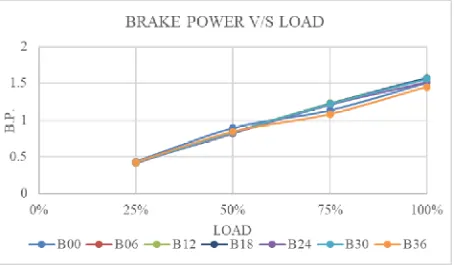
The same procedure was repeated for other loads.After significant amount on trials on each blend, the following graphs were plotted.
overall performance, considering our use of low power engine, it can be seen that pure diesel seems to retain maximum performance. This is obvious due to higher calorific value of pure diesel.
It could be observed that each blend of fuel gave us different graphs for brake thermal efficiency. Across the spectrum it was seen that pure diesel provided the lowest thermal efficiency, except at 75% loading where B12 was lowest. B30 was seen to have the most linear rise in brake thermal efficiency as loads increased, giving us the second highest value at 100% load, and highest value at 75% load. We can conclude that as we increase blend percentage, BTE increases.
We observed that brake specific fuel consumption was minimum for B24 across the spectrum of loading, while it was maximum for pure diesel. It should be noted that the readings for BSFC were fairly random and didn't follow any kind of order when it came to comparing the different blends. Previous researchers concluded that BSFC increases on increasing blend percentage, which makes sense as calorific value of pure diesel is higher than the blends. Hence, our test for BSFC was inconclusive
.
In our emissions test it was seen that through all loading, carbon dioxide emissions were lowest in B36 blend, with most noticeable difference being at maximum loading. B30 and B24 was a close second and third. B00 had maximum carbon dioxide emissions by a fairly obvious margin. Hence, we can conclude that as the percentage of palm biodiesel in pure diesel increases, carbon dioxide emissions decrease. It should be noted that as the loading on engine increases, more carbon dioxide is released. This is obvious as more fuel is being burnt as well.
Carbon monoxide emissions were found to be minimum in B30 across the loading spectrum, with B36 at a very close second. They were fairly higher in the lower blend percentages. We see that B12 and B18 didn't have much difference between them, while B24 showed a slight drop. B06 appeared to have a slightly higher output than B12. So, it can be concluded that as we increase the percentage of palm biodiesel, we can see a reduction in the overall carbon monoxide emissions across the spectrum of loading.
Oxygen content in exhaust was maximum in B30 and second highest in B24. These readings were random throughout the spectrum for all biodiesel blends and at any loading. There is no specific trend observed and readings turned out very similar and close to each other for all blends and loads. So, we can assume and conclude that oxygen levels in exhaust are affected negligibly if we use biodiesel as fuel.
V.CONCLUSIONS
The experimental investigation leads to the following conclusions.
That as the percentage of palm biodiesel in pure diesel increases, carbon dioxide emissions decrease.
Oxygen levels in exhaust shoot up for B30 and sharply drop for B06, but are fairly consistent for the rest.
As we increase the percentage of palm biodiesel, we can see a reduction in the overall carbon monoxide emissions across the spectrum of loading.
HC emissions seem to only be reduced when some optimum mixture is provided to the engine.
Power output of Diesel is higher than biodiesel blends.
The blends have a better brake thermal efficiency than diesel.
Taking economic, emission and power output factors into consideration, the blend B30 was found out to be the best blend.
REFERENCES
[1] W. Shurtleff and A. Aoyagi, “HISTORY OF BIODIESEL - WITH EMPHASIS ON SOY BIODIESEL (1900-2017): EXTENSIVELY ANNOTATED BIBLIOGRAPHY AND SOURCEBOOK”, SoyinfoCenter, pp. 17-19, 2017.
[2] E. N. Ali and C. I. Tay, “Characterization of biodiesel produced from palm oil via base catalyzed transesterification,” Procedia Eng., vol. 53, pp. 7–12, 2013.
[3] P. Ndayishimiye and M. Tazerout, “Use of palm oil-based biofuel in the internal combustion engines : Performance and emissions
characteristics,” Energy, vol. 36, no. 3, pp. 1790–1796, 2011.
[4] A. Hayyan et al., “ut ho r c op y ut ho r c op y,” vol. 66, no. 1, pp. 39–46, 2012.
[5] M. Habibullah, H. H. Masjuki, M. A. Kalam, I. M. R. Fattah, A. M. Ashraful, and H. M. Mobarak, “Biodiesel production and performance evaluation of coconut , palm and their combined blend with diesel in a single-cylinder diesel engine,” ENERGY Convers. Manag., vol. 87, pp. 250– 257, 2014.
[6] P. Ndayishimiye and M. Tazerout, “Use of palm oil-based biofuel in the internal combustion engines : Performance and emissions
characteristics,” Energy, vol. 36, no. 3, pp. 1790–1796, 2011.
[7] A. Hayyan et al., “Production of Biodiesel from Sludge Palm Oil by Esterification Process,” vol. 4, no. 1, 2010.
[8] A. A. Aziz, M. F. Said, and M. A. Awang, “Performance of Palm Oil-Based Biodiesel Fuels in a Single Cylinder Direct,” pp. 15–24, 1993. [9] A. Sanjid, H. H. Masjuki, M. A. Kalam, S. M. A. Rahman, M. J. Abedin, and S. M. Palash, “Impact of palm , mustard , waste cooking oil and Calophylluminophyllum biofuels on performance and emission of CI engine,” Renew. Sustain. Energy Rev., vol. 27, pp. 664–682, 2013.
[10] I. M. R. Fattah, H. H. Masjuki, M. A. Kalam, M. Mofijur, and M. J. Abedin, “Effect of antioxidant on the performance and emission characteristics of a diesel engine fueled with palm biodiesel blends,” Energy Convers. Manag., vol. 79, pp. 265–272, 2014.
[11]N. Vedaraman, S. Puhan, G. Nagarajan, and K. C. Velappan, “International Journal of Green Energy Preparation of Palm Oil Biodiesel and Effect of Various Additives on NO x Emission Reduction in B20 : An Experimental Study,” no. January 2015, pp. 37–41, 2011.