An Encryption Technique using Fusion of
Multi-Biometrics Data and Prim Numbers
Mr. Kadtan Mahesh Narayan1, Dr. Mrs. Sadhana Chidrawar2
M.E. Student, Department of Computer Science Engineering, MPGI SOE College, Nanded, Maharashtra, India1
Dean, Department of Computer Science Engineering, MPGI SOE College, Nanded, Maharashtra, India2
ABSTRACT: Since from last decade, there is significant attention paid by research communities on the Join Directors Laboratories (JDL) to solve the conceptual and structural problems related to the multi-sensor data fusion. We exploited the JDL concept by fusing the heterogeneous data such as multi-biometric and RSA keys for the efficient user authentication and access control in many real time applications. We used the two biometrics such as face and fingerprint biometrics to combine with the public key cryptography using the information fusion (IF) methods. The proposed method not only delivers the person identification but also perform the biometric data encryption. The novel algorithm proposed in this project to do the fusion of face biometrics, fingerprint biometrics and numerical data. This algorithm is based on hybrid information fusion called the FFIF (Face-Fingerprint Information Fusion). We use the digital face and fingerprint as biometric component and two prime numbers as the numerical components based on RSA algorithm.
KEYWORDS: Biometric sensor, multi-biometrics, cryptography multi-biometric fusion.
I.INTRODUCTION
The act of utilizing more than one biometric methodology, test, sensor, or calculation to accomplish acknowledgment, ordinarily alluded to as multi-biometrics, is a system that is quickly picking up notoriety. By joining multi-biometrics into the acknowledgment procedure, a large number of the weaknesses of conventional single-biometric frameworks can be reduced also, by and large, acknowledgment exactness can be improved.
catch biometrics as an optional capacity, for example, a high-goals camera, for face acknowledgment, iris and retina filters, a mouthpiece for voice recording, and inertial sensors for step. Obviously, these equivalent gadgets could likewise be abused to assemble individual information, requiring further thought about framework security [6], [7]. Security concerns are the second factor for the reception of multi-biometrics. In spite of the fact that there are numerous worthy ways to confirm individuals biometrics give the most grounded proof that the individual being referred to is really included, for example, a secret key could be given to another person. Generally nations have executed eIDs, which incorporate biometric components on travel papers and IDs, however, some have additionally made an interesting computerized The ID for the subject as a computerized endorsement/private key, for example, venture Stork [8], for imperative online exchanges like duty filings. Biometrics likewise offers a few extra security favourable circumstances, for example, great entropy when used to infer encryption keys, non-denial, and negative acknowledgment. A negative acknowledgment is helpful in situations where a client ought to be kept from denying being as of now taken a crack at the biometric framework, consequently recognizing endeavours at twofold enlistment utilizing a false name.
Aim of this research work is to design the security and person identification algorithm based on information fusion techniques. The objectives are:
- To present the study on various security solutions based on biometrics and public key cryptography. - To study the importance of person identification and authentication
II.LITERATURESURVEY
that the calculation is secure for the picked plaintext assault and demonstrated numerically by the key jumping method[12]. In [13] exhibited an original copy for Ordering the Encryption Calculations as per the Example Recognition technique. In this article, the writers center around the constraints of the calculations which are utilized for encryption plot and for creating the keys for the encryption procedure. Here the example recognition strategy to recognize the square figures in the encryption process. The square figure calculations like AES, DES, Thought, and RC were utilized to recognize the great arrangement method. As the outcome appeared, that the execution of RoFo (Revolution Timberland) classifier has great grouping exactness.
In[14] creator joined face, fingerprint and hand geometry at the coordinating score level. In[15]presented multimodal individual confirmation framework utilizing hand pictures by consolidating hand geometry and palm picture at the element level and match score level. The combination at the match score level had great execution when contrasted with unimodal biometric. In[16] the creator built up a multimodal biometric framework utilizing hand geometry, fingerprint, and voice at match score-level combination. In[[17] creator utilized hand veins, hand geometry, and fingerprint to give high security. In[18] joined iris and fingerprint to improve the execution. In[19] coordinated palm print and fingerprint at the element level. In[7] exhibited multimodal finger veins recognition utilizing score level melding for finger geometry and finger veins. In[14] exhibited palm and face multimodal biometrics for little example estimate issues. They utilized a Gabor channel to separate highlights of palm and face pictures. In[15] introduced multimodal iris and discourse validation framework utilizing choice hypothesis
III.PROPOSEDAPPROACHFRAMEWORKANDDESIGN
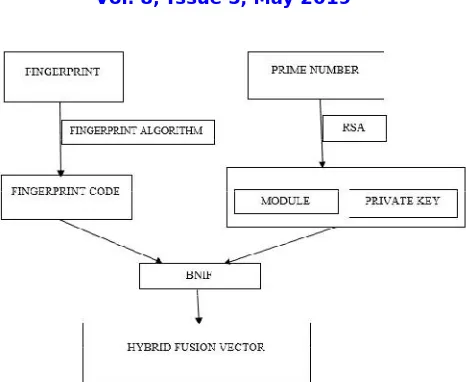
Biometric and Numerical Information Fusion
Biometric and Numerical Information Fusion (BNIF) calculation is to join the finger code and numerical fragment to make an access key for the secured trade of electronic money related benchmarks. In the going with, showing a once-over of the key times of the system which makes the mix of information possible
The arrangement is disengaged into three areas:
1. Fingerprint Calculation: it is for isolating the biometric code;
2. RSA: it is for making the number code and the private key;
3. It is for information mix articulations
Fig 1: System Architecture Using BNIF Algorithm
In BNIF calculation, fingerprint code, module and private key as the numerical vectors with different sizes. Crossbreed Fusion vector is formed by cushioning the fingerprint, module and private key vectors by BNIF calculation. For cushioning activity, need to try and out the range of the vectors.
The change two vectors into one vector by BNIF Calculation step is given underneath:
Be a and b € Z, a and b are two vectors, where a contains the biometric component and b the product of two prime numbers.
Be s € Z: s = m +n; a whole number containing s root. In order to have a square root, it is necessary that nz1= q-mod (m .q) and nz1= q-mod (m .q). So the new dimensions of the vectors will be: m1 = m+nz1 and n1 =n+nz1.
In addition, divide each vector into blocks which will be the lines of the hybrid vector, a vector containing the two vectors inserted in a proper way,
nbloocc_a1 = m1/q and nbloocc_a1 = n1/q. Be: Pad = nz1 + nz2,
In order to insert the blocks is given by the private key; value of the first component of the private key defines the no of the blocks of the face code vector to be inserted into the hybrid vector and the second component of the private key define the no of blocks of the module vector to be inserted into the hybrid vector and so on. Finally, the algorithm has to verify that the obtained matrix is really squared as,
PadTot = q2 − (m + n), Diff = P ad – PadTot
permutation matrix. This framework, whose measurements are like the ones of matrix U, is formed consolidating six 3×3 frameworks of change, got from a similar grid:
At long last, you include the result of Union Matrix U and permutation P framework: F= UP
Fusion F framework you acquire will be separated and organized along the lines to fabricate the yield V vector that is the Hybrid Finger Code.
B) Face Information Fusion:
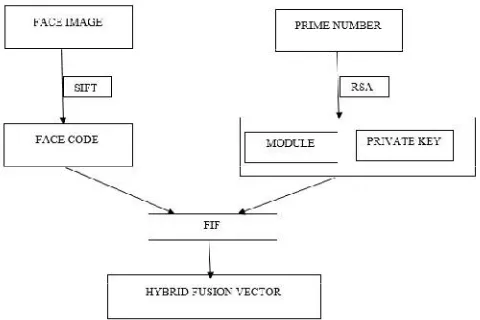
The FIF Calculation is to join the face picture of the client and a bit data to shape an exceptionally remarkable vector [3]. In the going with, you can see the piece plot showing a summary of the chief times of the system, which makes the information blend.
The arrangement is apportioned into three areas:
I. Face Calculation: it is the fragment for isolating the biometric code;
II. RSA: it is the fragment for making the number code and the private key;
III. FIF Calculation: it is the part for the information blend
Fig 2: System Architecture Using FIF Algorithm
Fig 2: exhibits the structure, here use two information sources face the picture of the genuine client and bit information. To begin with, transfer the picture of the certifiable customer, and changed over into a face code. Through the Filter, calculation separates the biometric features of the image which is used for the crossbreed face code. A filter is a calculation in PC vision to recognize and depict nearby highlights in a picture. By then, you can get the columnist of a face code, as a numerical vector. Around then, input a touch of information and getting ready by secure RSA calculation to get the private key vector and a module vector. By then, unite the face code and private key and module vector from bit information to outline the crossbreed fusion vector by Face Information Fusion (FIF) calculation. FIF calculation utilized for the change of two vectors into one lattice that blends face code, module, and private key vectors. The half breed fusion vector can in like way go about as a passageway key.
The FIF calculation steps are given beneath:
Be a, b € Z, two vectors, where a contains the biometric component and b the product of two prime numbers. Be s € Z :
s=m + n; where m and n are the sizes of the biometric vector and module vector. Be q € Z :
q= [√ s] a whole number containing s root.
To reduce the size of two vectors by, nz1 = q-mod (m. q) and nz2 = q-mod (n. q). The new size of the vectors is given by, m1 = m+nz1 and n1 =n+nz1.
In addition, divide each vector into blocks which will be the lines of the hybrid vector, a vector containing the two vectors inserted in a proper way,
nbloocc_a1 = m1/q and nbloocc_a1 = n1/q. Be: P ad = nz1 + nz2,
In order to insert the blocks is given by the private key; value of the first component of the private key defines the no of the blocks of the face code vector to be inserted into the hybrid vector and the second component of the private key define the no of blocks of the module vector to be inserted into the hybrid vector and so on. Finally, the algorithm has to verify that the obtained matrix is really squared as,
PadTot = q2 − (m + n), Diff = P ad – PadTot
Then, three cases can be distinguished: Diff < 0 =⇒ addition of a line,
Diff = 0 =⇒ no added padding, Diff > 0 =⇒ addition of a column.
The padding line or column to be added id created using the private key.
When you fabricate the squared Union U matrix, a post-result of grid U and permutation matrix P is done, henceforth you get a difference in sections. The private key of the cryptography of the calculation picks the permutation matrix. This framework, whose measurements are like the ones of matrix U, is formed consolidating six 3×3 frameworks of change, got from a similar grid:
At long last, you include the result of Union Matrix U and permutation P framework: F= UP
Fusion F framework
IV. RESULT
Then you can get the correspondent of a face code Figure 4.4 as a numerical vector:
Figure 4.4 Face Code
The product of the two prime numbers (module) 4.5 and the private key (1024 bit) 4.6 are obtained with RSA algorithm
Fig. 4.5. Product of 2 prime numbers (Module)
Fig. 4.6. Private Key
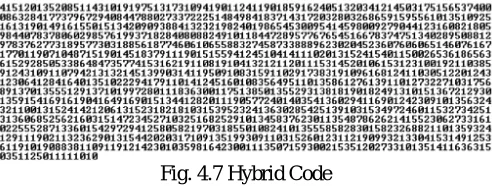
By the fusion of these data, as we have explained before, we get Hybrid Code figure 4.7 containing previous information arranged in an order which seems quite random to an intruder’s eyes.
Fig. 4.7 Hybrid Code
V.CONCLUSIONANDFUTUREWORK
We present the Hybrid Information Fusion algorithm, called FFIF. We have attempted to generate a secure cryptographic key by integrating multiple biometrics modalities of human being, so as to provide better security. An efficient approach for generation of secure cryptographic key based on multimodal biometrics (Face and fingerprint) has been presented in this paper. In this methodology fingerprint traits have been integrated in the RSA algorithm and face biometrics to develop a new asymmetric cipher system. We select fingerprint to improve efficiency because it offers accurate identification method also fingerprint are mostly accepted biometrics among the technology. A possible application of this technique of encryption is associated with the authentication of a person, for example, to guarantee the security of electronic currency transactions such as the access to very private areas, to classified and confidential documents, privileges to activate critic, military or defensive infrastructures, etc.
Future works are aimed extend the proposed approach to several distinctive biometric traits. Quality metrics and partial-face matching will be introduced, and run-time analysis will be conducted.
REFERENCES
[1]. Gerardo Iovane and Michele Nappi,” An Encryption Approach Using Information Fusion Techniques Involving Prime Numbers and Face Biometrics”, 2018.
algorithm and Fractals for secure coding”, 2015
[3]. B.V. Dasarathy, “Information fusion - what, where, why, when, and how?” Information Fusion, 2(2):75–76, 2001. [4]. E. Waltz and J Llinas, “.Multisensor Data Fusion”., Artech House, Inc., 1990.
[5]. K. I. Chang, K. W. Bowyer, S. Sarkar, and B. Victor, “Comparison and combination of ear and face images in appearance-based biometrics”, pp. 1160–1165, 2003.
[6]. M.Manzo E.Sangineto L.Cinque, G.Iovane. Face recognition using sift features and a region-based ranking. Journal of Discret Mathematical Sciences and Cryptography, 13(2):153170, 2010.
[7]. Department of Defence. Data fusion subpanel of the joint directors of laboratories, technical panel for c3. data fusion lexicon, 1991. [8]. Department of Defence. Dsto (defence science and technology organization) data fusion special interest group. data fusion lexicon, 1994. [9]. E. Waltz and J Llinas, “.Multisensor Data Fusion”., Artech House, Inc., 1990.
[10]. Chen, S., Jain, A.K., 1998. A ®ngerprint matching algorithm using dynamic programming. Technical report, Department of Computer Science and Engineering, Michigan State University.
[11]. Fabian Dreher, Tony Samuel “Continuous images of Cantor’s ternary set” arXiv: 1303.3810.
[12]. Clinton P. Curry “Irreducible Julia sets of rational functions” Journal of Difference Equations and Applications, Volume 16, Issue 5 & 6 May 2010, pages 443-450.
[13]. G.Iovane, L.Puccio, G.Lamponi, A.Amorosia. Electronic access key based on the innovative Information Fusion technique involving prime numbers and biometric data. Journal of discrete mathematical sciences and cryptography. Taru Publication, 2010.
[14]. N. Ruggeri. Principles of pseudo-random number generation in cryptography, University of Chicago, 2006
[15]. Ross A (2007) An Introduction to Multibiometrics, Proceedings of the 15th European Signal Processing Conference (Poznam, Poland) [16]. G. Mary Amirtha Sagayee, S Arumugam, and G.S.Anandha Mala(2013), Biometric Encryption using Enhanced Finger Print Image and Elliptic
Curve,IJCSNS , VOL.13 No.7, July 2013:106- 113.
[17]. L. Hong, A. K. Jain and S. Pankanti, \Can multibiometrics improve performance?," in Proceedings AutoID'99, (Summit(NJ), USA), pp. 59{64, Oct 1999.