Microbial Fuel Cell Based Wireless Sensor
Network Using Energy Neutral
Communication Protocol
J.Priya Keeshala, Dr.G.Arul Dalton
ME (Communication systems), Department of ECE, Rajas Engineering College, Raja Nagar, Vadakkangulam,
Tamil Nadu, India
Professor and Head, Department of CSE, Magna College of Engineering, Redhills, Chennai, Tamil Nadu, India
ABSTRACT: To supply power for wireless sensor networks (WSNs) from renewable energy sources. In this system
we are using renewable energy sources from microbial fuel cells (MFCs) a major challenge faced by wireless sensor networks (WSNs) for monitoring purposes is their energy supply. Renewable energy sources are useful for sustainable monitoring, but still very limited today due to variousimplementationconstraints.Fortunately, microbial fuel cells (MFCs) provide a renewable power source, which can be integrated into terrains, wetlands, and some civil structures for environmental monitoring. However, as MFCs may only provide ultralow and dynamic power, an energy-neutral communication protocol is crucial for powered WSNs. Herein a duty-cycle-based energy-neutral communication protocol is proposed for MFC-powered WSNs. Mathematical models for optimal duty-cycling that minimize the probe packet reception time are first proposed. Then, an energy-neutral joint scheduling and routing protocol in multihop MFC networks is introduced. Simulation results show that WSNs adopting the proposed protocol can achieve sustainable network operations. It is also demonstrated that the protocol enables reliable data transmission when using ultralow and time-varying MFC power inputs.
I. INTRODUCTION
II. LITERATURE REVIEW
2.1HARVESTINGAWAREPOWERMANAGEMENT FOR SENSOR NETWORKS: A. Kansal, J. Hsu.
Energy harvesting offers a promising alternative to solve the sustainability limitations arising from battery size constraints in sensor networks. Several considerations in using an environmental energy source are fundamentally different from using batteries. Rather than a limit on the total energy, harvesting transducers impose a limit on the instantaneous power available. Further, environmental energy availability is often highly variable and a deterministic metric such as residual battery capacity is not available to characterize the energy source. The different nodes in a sensor network may also have different energy harvesting opportunities. Since the same end-user performance may be achieved using different workload allocations at multiple nodes, it is important to adapt the workload allocation to the spatio-temporal energy availability profile in order to enable energy-neutral operation of the network. Platform design considerations as well as power scaling techniques at the node level and network-level are described. Which provide the ability to extract energy from the environment; they must be efficiently integrated into the design and operation of the sensor network to translate the harvested energy into increased application performance and system lifetime Compared to a battery-powered system. The two primary design goals for any harvesting module are extreme energy efficiency and high reliability. Factor and cost, as well as limitations in the underlying harvestingtechnology result in very little energy output from the transducer.
2.2 MICROBIAL FUEL CELLS: METHODOLOGY AND TECHNOLOGY: B. E. Logan.
Microbial fuel cell research is a rapidly evolving field that lacks established terminology and methods for the analysis of system performance. This makes it difficult for researchers to compare devices on an equivalent basis. The construction and analysis of MFCs requires knowledge of different scientific and engineering fields, ranging from microbiology and electrochemistry to materials and environmental engineering. Describing MFC systems therefore involves an understanding of these different scientific and engineering principles. In this paper, we provide a review of the different materials and methods used to construct MFCs, techniques used to analyze system performance, and recommendations on what information to include in MFC studies and the most useful ways to present results. Microbial fuel cells are devices that use bacteria as the catalysts to oxidize organic and inorganic matter and generate current. Electrons produced by the bacteria from these substrates are transferred to the anode and flow to the cathode linked by a conductive material containing a resistor, or operated under a load. By convention, positive current flows from the positive to the negative terminal, a direction opposite to that of electron flow. The device must be capable of having the substrate oxidized at the anode replenished, either continuously or intermittently; otherwise, the system is considered to be a bio battery. Electrons can be transferred to the anode by electron mediators or shuttles, by direct membrane associated electron transfer or by so-called nanowires produced by the bacteria, or perhaps by other as yet undiscovered means.
2.3 STUDY OF TRANSFORMER-BASED POWER MANAGEMENTSYSTEM AND ITS PERFORMANCE
OPTIMIZATION FOR MICROBIAL FUEL CELLS:F. Yang, D. Zhang, T. Shimotori, K.-C. Wang and Y. Huang.
MFC is a bio electro chemical system that generates electrical energy by the catalytic reaction of organic substrates such as waste water using microorganisms.
2.4 TECHNICAL REPORT: MATHEMATICAL MODELS FOR ENERGY NEUTRAL COMMUNICATION
PROTOCOL:F. Yang, K.-C. Wang and Y. Huang.
A major challenge faced by Wireless Sensor Networks with monitoring purposes is the energy supply. Renewable energy sources are useful for sustainable monitoring, but very limited today due to a range of reasons. The main goal of the MAC protocol design is to reduce energy consumption, while maintaining sustainable operations for packet transmissions across the network powered by ultra-low energy harvesting units. In this technical report, the focus is WSN powered by Microbial Fuel Cells (MFCs). An energy neutral communication protocol and its mathematical models are presented in detail. Each node in the network has two modes: transmitter (TX) mode and receiver (RX) mode. If a node has packets to send, it will go to TX mode; otherwise it will stay in RX mode. If a node is in TX mode, it periodically sends short probe packets and goes to power down where sensor radio is turned off for energy saving. As MFCs usually provide ultra-low harvested energy, the node will be probably running out all the stored energy after finishing sending all the probe packets, hence a deep sleep period is needed for charging purpose. When in DS, both the sensor radio and crystal oscillator are turned off, leading to further energy saving. On the other hand, if a node is in RX mode, it periodically wakes up to idle listen for probe packet and goes to power down. An additional DS period is also needed in RX mode because listening power of the sensor node is at the same order as packet transmitting/receiving power
2.5 ROBUST TOPOLOGY ENGINEERING IN MULTIRADIO MULTICHANNEL WIRELESS
NETWORKS:C. Hua and R. Zheng.
Topology engineering concerns with the problem of automatic determination of physical layer parameters to form a network with desired properties. In this paper, we investigate the joint power control, channel assignment, and radio
interface selection for robust provisioning of link
bandwidthininfrastructure multiradio multichannel wireless networks in presence of channel variability and external interference. To characterize the logical relationship between spatial contention constraints and transmit power, we formulate the joint power control and radio-channel assignment as a generalized disjunctive programming problem. The generalized Benders decomposition technique is applied for decomposing the radio-channel assignment and network resource allocation so that the problem can be solved efficiently. The algorithm is guaranteed to converge to the optimal solution within a finite number of iterations. We have evaluated our scheme using traces collected from two wireless test beds and simulation studies in Qualnet. Experiments show that the algorithm is superior to existing schemes in providing larger interference margin, and reducing outage and packet loss probabilities. Topology engineering is defined as automatic determination of physical layer parameters to generate a network with thedesired properties.With the decreasing cost and increasing programmability of wireless devices, many tunable parameters are now at our disposal in topology engineering. In this paper, we consider the choice of transmission power, channel assignment and radio interface in multi-radio multi-channel wireless networks
2.6 JOINT TOPOLOGY CONTROL AND ROUTING ASSIGNMENT FOR WIRELESS MESH WITH
DIRECTIONAL ANTENNAS:W. Wong, X. Chen, F. Long.
infrastructure is difficult or economically infeasible to deploy. One of the key factors that affect the performance of WMNs is transmission interference. In traditional mesh using Omni-directional antennas, links of the same channel within each other’s power range interfere with each other. Due to the limited number of available non-overlapping channels, reducing interference in an Omni-Mesh is a challenging problem. It has been well-known that directional antennas can reduce the interference of the network because they focus energy in only the intended direction. They also enjoy longer transmission range, leading to shorter hops in the network.
2.7 ODMAC: AN ON-DEMAND MAC PROTOCOL FOR ENERGY HARVESTING - WIRELESS SENSOR
NETWORKS:X. Fafoutis and N. Dragoni.
Energy Harvesting provides a promising solution to one of the biggest problems faced by Wireless Sensor Net- works, namely the energy supply. By harvesting energy from the surrounding environment, the sensors can have an infinite lifetime without any needs for battery recharge or replacement. Battery-powered WSNs are typically designed to maximize the energy conservation in order to postpone as much as possible the inevitable battery depletion. Instead, EH-WSNs are being designed on a different principle. The focus is on maximizing the network performance while operating at a state that is energetically sustainable. In this paper, we present ODMAC, an on demand MAC protocol for EH-WSNs which is able to support individual duty cycles for nodes with different energy profiles. Hence, each node is able to increase its energy consumption, thus its performance, to the level that the energy consumed is at the same level to the energy harvestedEnergy consumption is highly correlated to performance and guarantees that any surplus of harvested energy can be used for maximizing the performance.In this paper we present ODMAC, an On Demand Medium Access Control (MAC) protocol for EH-WSNs in which every node is able to operate as close to the ENO-Max state as possible. In brief, ODMAC has the following key features. Note that MAC protocols that depend on synchronization, such as S-MAC also need to periodically broadcast control frames, which in this case help the synchronization of the nodes. On the other hand, the transmitter wastes energy while waiting for a beacon. Nevertheless, the energy wastage at the transmitter is not significant in low traffic networks, where the transmitting queues are most of the time empty.In particular, ODMAC moves the idle listening time from the receivers to the transmitters. As a result, it is expected to yield beneficial results at low traffic conditions. Each ODMAC receiver periodically broadcasts a beacon which indicates to its receivers that it is ready to accept incoming data packet transmissions.
2.8 VERSATILE LOW POWER MEDIA ACCESS FOR WIRELESS SENSOR NETWORKS: J. Polastre, J. Hill.
III. PROPOSED SYSTEM
The sensor network is expected to be utilized for environmental monitoring purposes in forests and wetlands where solar energy is hardly available. A sensor node can either have data generated locally or receive data packets from other nodes when it acts as a relay node. Energy harvesting rate of each node is modeled after typical MFC-PMS designs, which changes randomly within a certain range with a uniform probability. Each node joins the network randomly and has a fixed number of data packets to send. Data packets, with a size denoted as D each, contain environmental information such as temperature, humidity and moisture. This only occupies several bits of a packet. There is one sink with unlimited power supply to process and store sensor data from all the nodes. Most packets forward between peer nodes rather than to the sink. A node at a certain hop relays data packet to its peer node at the next hop in the direction to the sink. Applications are expected to have a long idle duration; hence the network lifetime is critical for such applications. Microbial fuel cells (MFCs) provide a renewable power source, which can be integrated into terrains, wetlands, and some civil structures for environmental monitoring .Simulation results show that WSNs adopting the proposed protocol can achieve sustainable network operations. It is also demonstrated that the protocol enables reliable data transmission when using ultralow and time-varying MFC power inputs.
Fig1. Proposed Block Diagram
duty cycling protocols are favored in certain cases. However, the knowledge of network topology is usually not available for all nodes, and special radio infrastructures such as multi-radio devices or directional antennas are required for the protocol design.
3.1 RFID
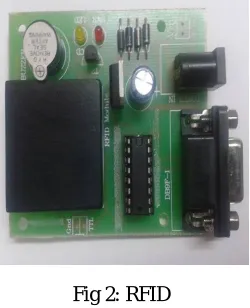
A universal asynchronous receiver/transmitter, abbreviated UART, is a computerhardwaredevice that translates data between parallel and serial forms. RFID stands for Radio-Frequency Identification. The acronym refers to small electronic devices that consist of a small chip and an antenna. The chip typically is capable of carrying 2,000 bytes of data or less.The RFID device serves the same purpose as a bar code or a magnetic strip on the back of a credit card or ATM card; it provides a unique identifier for that object. And, just as a bar code or magnetic strip must be scanned to get the information, the RFID device must be scanned to retrieve the identifying information.
Fig 2: RFID
Radio-frequency identification (RFID) is the wireless use of electromagneticfields to transfer data, for the purposes of automatically identifying and tracking tags attached to objects. The tags contain electronically stored information. Some tags are powered by electromagnetic induction from magnetic fields produced near the reader. Some types collect energy from the interrogating radio waves and act as a passive transponder. Other types have a local power source such as a battery and may operate at hundreds of meters from the reader.Unlike a barcode, the tag does not necessarily need to be within line of sight of the reader and may be embedded in the tracked object.
3.2 WORKING PRINCIPLE
3.3AVR MICROCONTROLLER
The AVR is a modified Harvard architecture machine, where program and data are stored in separate physical memory systems that appear in different address spaces, but having the ability to read data items from program memory using special instructions. The easiest way of thinking about it is to compare a microcontroller with your PC, which has a motherboard in it. On that motherboard is a microprocessor that provides the intelligence, RAM and EEPROM memories and interfaces to rest of system, like serial ports, disk drives and display interfaces. A microcontroller has all or most of these features built-in to a single chip, so it doesn’t need a motherboard and many components, LEDs for example, can be connected directly to the AVR. PC microprocessors are always at least 32-bit and commonly now 64-bit. This means that they can process data in 32-bit or 64-bit chunks as they are connected to data buses this wide. The AVR is much simpler and deals with data in 8-bit chunks as its data bus is 8-bit wide, although there is now an AVR32 with 32-bit bus. A PC has an operating system and this runs programs, such as Word or Internet Explorer or Chrome that do specific things. An 8-bit microcontroller like the AVR doesn’t usually have an operating system, although it could run a simple one if required, and instead it just runs a single program.
IV.RESULT AND DISCUSSION
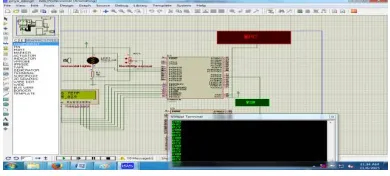
The figure 3 shows the schematic view of overall designs in Microbial fuel cell based wireless sensor network using energy neutral communication protocol
Fig 3: Overall Designs
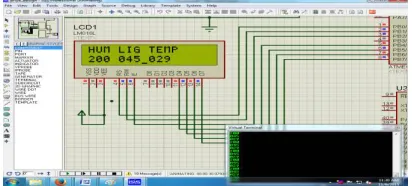
Here in a duty-cycle-based energy-neutral communication protocol is proposed for MFC-powered WSNs. Energy-neutral operation (ENO) is expected so that the long-term energy consumption by wireless sensors in a network less than the total energy harvested from its environment. A sensor node can either have data generated locally or receive data packets from other nodes to the virtual terminal. The figure 4 shows the schematic view of Analysis of Different Parameters
Fig 4: Analysis of Different Parameters
Fig 5: Analysis of Environmental Conditions
When a node is either in the TX or RX mode, it follows the energy-neutral transmitter or receiver duty cycling. The sensor data’s is transmitted by WSN with low power energy neutral consumption. The figure 6 shows the schematic view of Power Generation through MFC.
Fig 6: Power Generation through MFC
This simulation results demonstrates the communication protocol is able to provide energy efficient and reliable data transmission under low and dynamic power inputs.
V. CONCLUSION
Microbial fuel cells provide a renewable power source which can be integrated into terrains, wetlands and some civil structures for environmental monitoring. Microbial fuel cell only provides ultralow and dynamic power. Duty-cycle based energy-neutral communication protocol is proposed for microbial fuel cells powered wireless sensor networks. First mathematical models for optimal duty cycling that minimize the probe packet reception time. Second, an energy-neutral joint scheduling and routing protocol in multi-hop MFC networks is introduced. Finally, a simulation tool is developed to evaluate the protocol performance. Simulation results show that the energy neutral communication protocol is able to provide sustainable and reliable data transmission under low and dynamic power inputs.
REFERENCES
1. AMPL: A Modeling Language for Mathematical Programming. [Online]. Available: http://www.ampl.com/, accessed Oct. 25, 2014.
2. Audet, L. C. de Oliveira, N. MacMillan, D. Marinakis, and K. Wu, “Scheduling recurring tasks in energy harvesting sensors,” in Proc. IEEE Conf. Comput. Commun. Workshops, Apr. 2011, pp. 277–282.
3. Buettner, G. V. Yee, E. Anderson, and R. Han, “X-MAC: A short preamble MAC protocol for duty-cycled wireless sensor networks,” in Proc. 4th Int. Conf. Embedded Net. Sensor Syst., Boulder, Co, USA, 2006, pp. 307–320.
4. Cooke .D, M. O. Gay, S. E. Radachowsky, J. J. Guzman, and M. A. hiu, “BackyardNetTM: Distributed sensor network powered by terrestrial microbial fuel cell technology,” SPIE, Defense, Security, and Sensing, May 2010
5. Donovan, A. Dewan, H. Peng, D. Heo, and H. Beyenal, “Power management system for a 2.5 W remote sensor powered by a sediment microbial fuel cell,” J. Power Sour., vol. 196, no. 3, pp. 1171–1177, Feb. 2011.
6. El-Hoiydi and J.-D. Decotignie, “WiseMAC: An ultra low power MAC protocol for the downlink of infrastructure wireless sensor networks,” in Proc. 9th Int. Symp. Comput. Commun. vol. 2, Washington, DC, USA, Jun./Jul. 2005, pp. 244–251.
8. Iannello, O. Simeone, and U. Spagnolini, “Dynamic framed-ALOHA for energy-constrained wireless sensor networks with energy harvesting,” in Proc. IEEE Global Telecomm. Conf., Dec. 2010, pp. 1–6.
9. Joseph, V. Sharma, U. Mukherji, and M. Kashyap, “Joint power control, scheduling and routing for multicast in multihop energy harvesting sensor networks,” in Proc. 4th ACM Workshop Perform. Monitor. Meas. Heterogeneous Wireless Wired Newt. Oct. 2009, pp. 1–8.
10. Jurdak, A. G. Ruzzelli, and G. M. P. O’Hare, “Radio sleep mode optimization in wireless sensor networks,” IEEE Trans. Mobile Comput., vol. 9, no. 7, pp. 955–968, Jul. 2010