ISSN(Online): 2320-9801 ISSN (Print): 2320-9798
I
nternational
J
ournal of
I
nnovative
R
esearch in
C
omputer
and
C
ommunication
E
ngineering
(A High Impact Factor, Monthly, Peer Reviewed Journal)
Vol. 4, Issue 1, January 2016
Review on Image Emblem for Data Security
Using Reversible Mapping
Rasika L Charde1, Rajesh S Halke2
Student, Department of Electronics and Telecommunication Engineering, Dr. D Y Patil School of Engineering &
Technology, Lohagaon, Savitribai Phule Pune University, Pune, India
Professor, Department of Electronics and Telecommunication Engineering, Dr. D Y Patil School of Engineering &
Technology, Lohagaon, Savitribai Phule Pune University, Pune, India
ABSTRACT: Data hiding is still an import ant research topic dueto the design complexities involved. Steganography is the technique of hiding confidential information within any media. Steganography is often confused with cryptography because the two are similar in the way that they both are used to protect confidential information. But because of loss in quality of original image we propose a Reversible Contrast Mapping (RCM) is a simple integer transform that applies to pairs of pixels. For some pairs of pixels, RCM is invertible, even if the least significant bits (LSBs) of the transformed pixels are lost. The data space occupied by the LSBs is suitable for data hiding. The embedded information bit rates of the proposed spatial domain reversible watermarking scheme are close to the highest bit-rates reported so far. The scheme does not need additional data compression, and, in terms of mathematical complexity, it appears to be the lowest complexity one proposed up to now. A very fast lookup tab le implementation is proposed. Robustness against cropping can be ensured as well.
KEYWORDS: Lossless Image Compression; Reversible Contrast Mapping; Huffman Compression; Watermarking.
I. INTRODUCTION
MOST of the reversible watermarking approaches proposed so far incorporate a lossless data compression stage. The use of an elaborate data compression stage increases the mathematical complexity of the watermarking. There is some watermarking scheme s that do not rely on additional data compression, as for instance, the circular histogram interpretation schemes, but they have the drawback of a low embedding capacity. In this letter, we discuss a spatial domain reversible watermarking scheme that achieves high-capacity data embedding without any additional data compression stage. The scheme is based on the reversible contrast mapping (RC M), a simple integer transform defined on pairs of pixels. RCM is perfectly invertible, even if the least significant bits (LSBs) of the transformed pixels are lost. The data s pace occupied by the LSBs is suitable for data hiding.
The basic RCM watermarking scheme was introduced in. Here, a modified version that allows s robustness against cropping is proposed. The control of distortions introduced by the watermarking is investigated as well. The mathematical complexity of the RCCM watermarking is further analyzed, and a very low co implementation is proposed. Finally, the RCM scheme is compared with Tian’s difference expansion scheme with respect to the bit rate hiding capacity and to the mathematical complexity. It is shown that the RCM scheme pro vides almost similar embedding bit-rates when compared to the difference Expansion approach, but it has a considerably lower mathematical complexity.
II.RCM TRANSFORM
ISSN(Online): 2320-9801 ISSN (Print): 2320-9798
I
nternational
J
ournal of
I
nnovative
R
esearch in
C
omputer
and
C
ommunication
E
ngineering
(A High Impact Factor, Monthly, Peer Reviewed Journal)
Vol. 4, Issue 1, January 2016
Here below are two variables used for forward transform a’=2a-b, b’=2b-a (1)
To prevent overflow and under flow, the transform is restricted to below levels
0<= 2a-b<=L 0<= 2b-a<=L
INVERSE TRANSFORM
Inverse transform is define as follows a= [2/3 (a’) + 1/3(b’)] (3)
b= [1/3 (a’) + 2/3(b’)] (2)
As stated in Section I, the pair forward-inverse transform should give exact results, even if the LSBs of the transformed pixels are lost. If a’ and b’ are not changed, exactly inverts, even without the ceil functions. By watermarking, the LSBs of a’, b’ are lost. Let us set to “0” the LSBs of a’ and b’. It immediately appears that if the LSB of a’ was “1,” the values inside the ceil functions for the computation of a and b decrease with 2/3 and 1/3, respectively. Similarly, if the LSB of b’ was “1,” the corresponding values decrease with 1/3 (for the computation of a) and 2/3 (for the computation of b). Except when both LSBs are “1,” the ceil function recovers the correct results. An LSB of “1” means an o d integer number. From, it follows that (a’, b’) are both odd numbers only if (a, b) are odd numbers, too. To conclude, on D without the set of odd pairs, the inverse RCM transform performs exactly, even if the LSBs of the transformed pairs of pixels are lost. The forward transform should not introduce visual artifacts. By taking the sum and the difference of, one gets a’+b’=a=b and a’-b’=3(a-b), respectively. This means that RCM preserves the gray level averages and increases the difference between the transformed pixels. Consequently, image contrast increases.
III. RELATED WORK
A spatial domain reversible watermarking providing high data embedding bit-rate at a very low mathematical complexity has been discussed. As there is original image by steganography we Contrast Mapping (RCM) is a simple integer transform that applies to pairs of pixels. [3] The proposed scheme does no need additional data compression. In Mapping there is no loss in quality of original terms of mathematical complexity; the proposed reversible watermarking appears as being the lowest complexity scheme proposed so far. The computational complexreduced for both coding and decoding by u for each pair of pixels and some low complexity bit manipulation. This makes our scheme very appropriate for real-time applications. Finally, by distributing the location map and by storing the saved true values close to the corresponding pixel pairs, the RCM scheme provides robustness against cropping. [5] Reversiblecontrast mapping (RCM) is a flexible integer transform for pixel pairs that offers high embedding rate at low mathematical complexity and without requiring additional data compression. Mathematically, RCM technique may be interpreted as a form of intercept in straight line that controls distortion and leads to retention of structural information of the watermarked image. Effective modification over previously proposed RCM is suggested here that offers a better trade-off in visual quality-embedding rate-security of the hidden data. [4]
ISSN(Online): 2320-9801 ISSN (Print): 2320-9798
I
nternational
J
ournal of
I
nnovative
R
esearch in
C
omputer
and
C
ommunication
E
ngineering
(A High Impact Factor, Monthly, Peer Reviewed Journal)
Vol. 4, Issue 1, January 2016
capacity and to the mathematical complexity. It is shown that the RCM scheme gives almost similar embedding bit-rates when compared to the difference expansion approach, but it has a much lower mathematical complexity.[1]MOST of the reversible watermarking approaches proposed so far incorporate a lossless data stage. The use of an elaborate data compression stage increases the mathematical complexity of the watermarking. There are some watermarking schemes that do not rely on additional data compression, as for instance, the histogram interpretation schemes, but they have the drawback of a low embedding capacity. In this letter, we discuss a spatial domain reversible watermarking scheme that achieves high-capacity data embedding without any additional data compression stage. The scheme is the reversible contrast mapping (RCM), a simple integer transform defined on pairs of pixels. RCM is perfectly invertible, even if the least significant bits (LSBs) of the transformed pixels are lost.[6]The data space occupied by the LSBs is suitable for data hiding. The basic RCM watermarking scheme was introduced in. Here, a modified version that allows robustness against cropping is proposed. The control of distortions introduced by the watermarking is investigated as well. The mathematical complexity of the RCM watermarking is further analyzed, and a very low cost implementation is proposed. Finally, the RCM scheme is compared with Tian’sdifference expansion scheme with respect to the bit rate hiding capacity and to the mathematical complexity. [4]
IV. REVERSIBLE WATERMARKING
The watermark substitutes the LSBs of the transformed pairs. At detection, in order to extract the watermark and to restore the original pixels, each transformed pair should be Correctly identified. The LSB of the first pixel of each pair is used to indicate if a pair was transformed or not: “1” for transformed pairs and “0” otherwise. The inverse RCM fails to recover the pairs (a, b) composed of odd values. Such pairs can be used as well for data embedding as long as they are correctly identified at detection. This can be easily solved by setting the LSB of the first pixel to “0.” At detection, both LSBs are set to “1” an d are checked. If are fulfilled, the pair was composed of odd pixels. In order to avoid decoding ambiguities, some odd pixel pairs should be eliminated, namely, those pairs located on the borders of. The pairs subject to ambiguity are found by solving in odd numbers the equations: 2a-b=1, 2b-a= 1,2a-b=L and 2b-a=L. For L=255 there are only 170 such pairs.
ISSN(Online): 2320-9801 ISSN (Print): 2320-9798
I
nternational
J
ournal of
I
nnovative
R
esearch in
C
omputer
and
C
ommunication
E
ngineering
(A High Impact Factor, Monthly, Peer Reviewed Journal)
Vol. 4, Issue 1, January 2016
V. CODING
The coding proceeds as follows. Partition the entire image into pairs of pixels (for instance, on rows, on columns, or on any space filling curve).
1) For each pair (a,b):
a) (a, b) D If and if it is not composed of odd pixel values, transform the pair using the (1) , set the LSB of x ’to “1,” and consider the LSB of b’ a s available for data embedding.
b) If (a, b) D and if it is compose d of odd pixel values, set the LSB of a to “0,” and consider the LSB of b as available for data embedding.
c)If, (a, b) D set the LSB of a to “0,” and save the true value.
2) Mark the image by simple overwriting the bits identified in 2a and 2b with the bits of the watermark (payload and bits saved in 2c).A different marking procedure is proposed in. A map of transformed pairs and the sequence of LSBs for all non-transformed pairs are first collected. Then, the entire image LSB plane is overwritten by the payload and by the collected bit sequences. The slightly modified procedure proposed in this the embedding operation. Y-channel i s utilized for data embedding. In the first step, frame selection is performed and the selected frames are processed block-wise. For each block, only a single bit is hidden. After obtaining 8 × 8 DCT of the block, energy check is perform ed on the coefficients that are predefined in a mask. Selected coefficients ofvariable length is used to hide data bit m. m is a member of message bits or frame synchronization markers.
Message sequence of each group is obtained by using RA codes for T consecutive frame s. Each block is assigned to one of these groups at the beginning. After the inverse transform host frame is obtained.Thus, all the information needed to recover any original pixel pair is embedded into the pair itself or very close to it. In the case of cropping, except for the borders where some errors may appear, the original pixels of the cropped image are exactly recovered together with the embedded payload. For pixel pairing on row or column direction, there are no problems of synchronization. Some control codes should be inserted in the payload to validate watermark integrity V. DETECTION AND O RIGINAL RECOVERY
Watermark extraction and exact recovery of the original image is performed as follows.
1) Partition the entire image into pairs of pixels.
2) For each pair (a’, b’):
a)If the LSB of a’ is “1,” extract the LSB of b’and store it into the detected watermark sequence, set LSBs of a’, b’ to “0,” and recover original pair (a , b) by inverse transform.
b) If the LSB of a’ is “0” and pair(a’, b’) with the LSBs set to “1” belongs to D , extract the LSB of , store it into the detected watermark sequence, and restore the original pair as with the LSBs set to “1.”
c)If the LSB of a’ is “0” and the pair
(a’, b’) with the LSBs set to “1” does not belong to D, the original pair is recovered by rep lacing the LSB of a’ with the corresponding true value extracted from the Watermark sequence.
VI. STEGANOGRAPHY AND PROPOSED COMPRESSION METHOD
ISSN(Online): 2320-9801 ISSN (Print): 2320-9798
I
nternational
J
ournal of
I
nnovative
R
esearch in
C
omputer
and
C
ommunication
E
ngineering
(A High Impact Factor, Monthly, Peer Reviewed Journal)
Vol. 4, Issue 1, January 2016
network packet level. Hiding information into a media requires following elements
1)The cover media(C) that will hold the hidden data.
2)The secret message (M) ma y be plain text, cipher text or any type of data.
3)The stego function (Fe) and its inverse (Fe-1).
4) An optional stego-key (K) or password may be used to hide and unhide the message. The stego function operates over cover media and the message (to be hidden) along with a stego- key (optionally) to produce stego media(s).The schematic of steganographic operation is shown below-
The most widely technique today is hiding of secret message into a digital image. This technique exploits the weakness of human visual system. HVS cannot detect variation in luminance of color vectors at higher frequency side of visual spectrum. This technique can be directly applied on digital image on bitmap format as well as the compressed image format like JPEG. In JPEG format, each pixel of the image is digitally coded using discrete cosine transformation (DCT). The LSB of encoded DCT components can be used as the carriers of the hidden message.
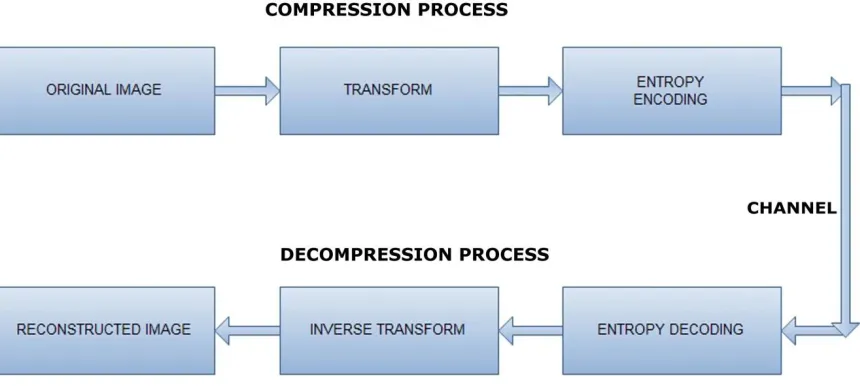
Fig. 2.Steganographic operation and proposed compression method
ISSN(Online): 2320-9801 ISSN (Print): 2320-9798
I
nternational
J
ournal of
I
nnovative
R
esearch in
C
omputer
and
C
ommunication
E
ngineering
(A High Impact Factor, Monthly, Peer Reviewed Journal)
Vol. 4, Issue 1, January 2016
will try to hide the character ‘A’ into an 8-bit color image. We are taking eight consecutive pixel s from top left corner of the image. TheEquivalent binary bit pattern of those pixels may be like this: 00100111 11101001 11001000 001001 11 11001000
11101001
11001000 00100111
Then each bit of binary equivalence of letter 'A' i.e. 01100101 are copied serially(From the left hand side) to the LSB's of equivalent binary pattern of pixels,Resulting the bit pattern will become lik e this: -
00100110 11101001 11001001 001001 10 11001000
11101001
11001000 00100111
While at the detection end extract the last bit of every pixel to get the equivalent binary pattern of hidden data.
This operation can perform by using masking operation. Mask the data with 0x1 so that we can get the last bit of each pixel. The mask operation is as follows -
00100110&00000001 = 0 11101001& 00000001 = 1
11001001& 00000001 = 1
00100110& 00000001 = 0
11001000& 00000001 = 0 11101001& 00000001 = 1
11001000& 00000001 = 0
00100111& 00000001 = 1
So this way can able to extract the hidden data 'A' i.e. 01100101.But during this process we are not able to recoverthe one bit of original image or data which cause loss of quality of original image. So the problem with this technique is that it is very vulnerable to attacks such as image compressing and formatting.
Disadvantage of this technique is that the properties of electronic media are being changed after hiding any object into that. This can result in the form of degradation in terms of quality or unusual characteristics of the media: Steg analysis techniques based on unusual pattern in the media or Visual Detection of the same.
VII. EXPERIMENTAL RESULTS
ISSN(Online): 2320-9801 ISSN (Print): 2320-9798
I
nternational
J
ournal of
I
nnovative
R
esearch in
C
omputer
and
C
ommunication
E
ngineering
(A High Impact Factor, Monthly, Peer Reviewed Journal)
Vol. 4, Issue 1, January 2016
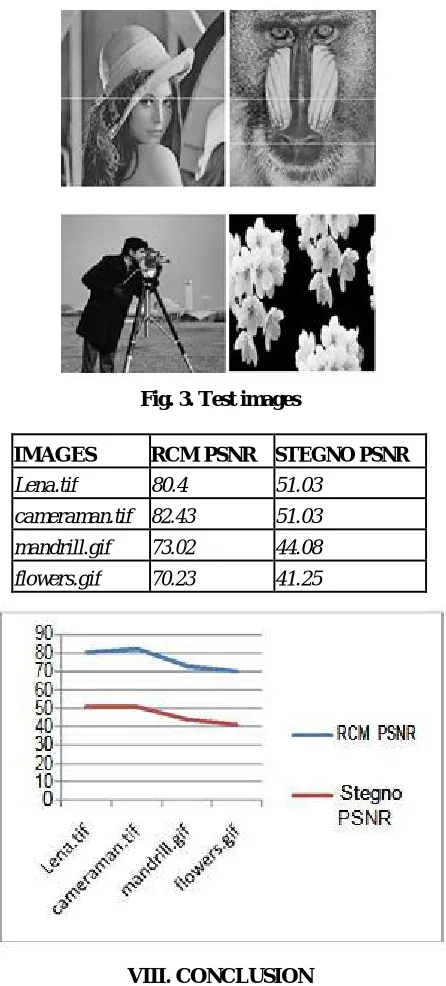
between the compressed and the original image, whereas P SNR represents a measure of the peak error. The lower the value of MSE, the lower the error. To compute the PSNR, the block first calculates the mean-squared error.
Fig. 3. Test images
IMAGES RCM PSNR STEGNO PSNR
Lena.tif 80.4 51.03
cameraman.tif 82.43 51.03
mandrill.gif 73.02 44.08
flowers.gif 70.23 41.25
VIII. CONCLUSION
ISSN(Online): 2320-9801 ISSN (Print): 2320-9798
I
nternational
J
ournal of
I
nnovative
R
esearch in
C
omputer
and
C
ommunication
E
ngineering
(A High Impact Factor, Monthly, Peer Reviewed Journal)
Vol. 4, Issue 1, January 2016
of mathematical complexity, the proposed reversible watermarking appears as being the lowest complexity scheme proposed so far. The computational complexity is reduced for both coding and decoding by using LUT access for each pair of pixels and some low complexity bit manipulation. This makes our scheme very appropriate for real-time applications. Finally, by distributing the location map and by storing the saved true values close to the corresponding pixel pairs, the RC M scheme provides robustness against cropping.
REFERENCES
[1] Very Fast Watermarking by Reversible Contrast Mapping Dinu Coltuc and Jean-Marc Chassery, JUNE 2007.
[2] Unseen Visible Watermarking: A Novel Methodology for Auxiliary Information Delivery via Visual Contents Hun-Hsiang Huang, ShangChih Chuang, Yen-Lin Huang, and Ja-Lin g Wu, Fellow, IEEE, JUNE 2009.
[3] Reversible Watermark Using the Difference Expansion of a Generalized Integer TransformAdnan M .Alattar, Member, IEEE, AUGUST 2004. Digital Image Watermarking Using Balanced Multiwavelets, APRIL 2006.
[4] Improved Watermark Payload Capacity Using DE On IPCM Macroblocks in H.264/AVC.
[5] Optimization-Intensive WatermarkingTechniques for Decision Problems Jennifer L. Wong, Student Member, IEEE, Gang Qu, Member, IEEE, and MiodragPotkonjak, Member, IEEE, JANUARY 2004.Steganography and Steganalysis: Different Approaches.