A Survey on Security Challenges in Cloud
Services
Rahul D. Khurade , Swapnil V. Khedkar.
Assistant Professor, Dept. of CSE, Datta Meghe Institute Of Engineering Technology & Research, Wardha, India Assistant Professor, Dept. of IT, Dr. Rajendra Gode Institute Of Engineering Technology & Research, Amravati, India
ABSTRACT: Cloud computing is a set of IT services that are supplied to a customer over a network and with the ability to scale up or fine-tune their service demands. Cloud computing services are rendered by a third party provider who has the infrastructure. Its advantages include scalability, resilience, flexibility, efficiency and outsourcing non-core activities. Cloud computing offers a modern business model for governing bodies to take over IT services without upfront investment. Instate of the probable gains achieved from the cloud computing, due to security events and challenges associated with the organizations are slow in accepting it. Security is one of the major events which involve the maturation of cloud. The thought of handing important data to another company is challenging, hence that the consumers ask to interpret the hazards of data violation in this new environment. This paper includes an analysis of the security problems in cloud services, mainly focusing on the cloud computing service delivery model.
KEYWORDS: Cloud Computing, Security, SPI Model, IT.
I.INTRODUCTION
Cloud computing involves a collection of computers connected through a communication network such as the Internet and means the ability to run application over network computer at same time. Network-based services, which appear to be provided by real server hardware and are in fact served up by virtual hardware, simulated by software running on one or more real machine, is often called cloud computing.
Cloud describes the use of a bundle of services, applications, data, and infrastructure comprised of pools of computing, network, information and store resources. In today‟s market the term cloud is popularized „in the cloud‟ refer to service; infrastructure and platform are sold as a service through internet. The seller install their product on a server and this service is available to consume from a remote location, so end user don‟t have to install anything, just log on to the network.
Cloud figuring refers to both the requisitions conveyed as administrations over the Internet and the fittings and frameworks programming in the data centers that give those administrations[1]. There are four essential cloud conveyance models, as delineated by NIST (Badger et al 2011) taking into account who gives the cloud administrations. The offices may utilize one model or a blending of distinctive models for proficient and upgraded conveyance of requisitions and business administrations.
These four conveyance models are:
(i) Private cloud in which cloud administrations will be given singularly to an association and will be overseen by the association cloud administrations will be given singularly to an association and will be overseen by the association or a outsider. These administrations might exist off-site.
(ii) Public cloud in which cloud administrations will be accessible to people in general and claimed by an association offering the cloud administrations, for instance, Amazon cloud administration.
(iii) Community cloud in which cloud administrations are impacted by a few associations for supporting a particular group that has imparted concerns. An extraordinary instance of group cloud is the Government or G-Cloud. This kind of distributed computing is given by one or more orgs (administration supplier part), for utilization by all, or most, government agencies (user part).
From the point of view of administration conveyance, NIST has distinguished three fundamental sorts of cloud administration offerings.
These models will be:
(i) Software as a administration (Saas) which offers leasing provision practicality from an administration supplier instead of purchasing, introducing and running programming by the user.
(ii) Platform as a administration (Paas) which gives a stage in the cloud, upon which requisitions can be created and executed.
(iii) Infrastructure as a administration (Iaas) in which the administration supplier offer registering force and storage room on interest.
II.RELATED WORK
Gartner 2008 distinguished seven security issues that need to be tended to before undertakings Think about exchanging to the distributed computing model. They are as takes after:
1. Favored client access - data transmitted from the customer through the Internet postures a certain degree of danger, since of issues of information possession; endeavors ought to invest time getting to know their suppliers and their regulations however much as could reasonably be expected before allocating some unimportant provisions first to test the water[4],
2. Administrative consistence - customers will be responsible for the security of their result, as they can pick between suppliers that permit to be examined by third party associations that check levels of security and suppliers that don't 3. Information area - depending on contracts, a few customers may never recognize what nation or what purview their information is found
4. Information isolation - encoded data from different organizations may be put away on the same hard circle, so a system to partitioned information ought to be sent by the supplier.
5. Recovery - each supplier ought to have a fiasco recuperation convention to ensure client information
6. Investigative help - if a customer suspects broken action from the supplier, it might not have numerous lawful ways seek after an examination
7. Long haul practicality - alludes to the capacity to withdraw an agreement and all information if the current supplier will be purchased out by an alternate firm.(Brodkin. 2008)
The Cloud Computing Use Case Examination Group talks about the distinctive Use Case situations and related prerequisites that may exist in the cloud model. They think about use cases from distinctive points of view including clients, designers and security engineers.(Cloud Computing Use Case Discussion Group 2010) ENISA investigated the distinctive security dangers identified with embracing distributed computing alongside the influenced holdings, the dangers probability, sways, also vulnerabilities in the cloud registering might lead to such risks. ( ENISA 2009)
Balachandra et al, 2009 talked about the security SLA's particular and objectives related to information areas, isolation also information recovery.(Balachandra et al 2009)
Kresimir et al, 2010 talked about high level security concerns in the cloud registering model, for example, information uprightness, installment and protection of touchy information.(Kresimir 2010) Bernd et al, 2010 talk about the security vulnerabilities existing in the cloud stage. The creators assembled the conceivable vulnerabilities into innovation related, cloud aspects related, security controls related.(Grobauer et al 2010)
Subashini et al talk about the security challenges of the cloud administration conveyance model, keeping tabs on the Saas model.(Subashini 2010) Ragovind et al, (2010) examined the administration of security in Cloud registering centering on Gartner's rundown on cloud security issues and the discoveries from the Worldwide Data Corporation enterprise.( Ramgovind et al 2010)
Morsy et al, 2010 researched cloud figuring issues from the cloud building design, cloud offered aspects, cloud stakeholders, and cloud administration conveyance models perspectives.(Morsy et al 2010)
come for IT however the nonattendance of a consistence environment is having memorable effect on distributed computing growth(CSA 2010).
Several studies have been done relating to security issues in cloud registering however this work presents a point by point dissection of the distributed computing security issues and tests concentrating on the distributed computing organization sorts and the administration conveyance sorts[5].
III.CLOUD SERVICE DELIVERY MODELS
Three model models and the subsidiary mixes thereof for the most part depict cloud administration conveyance. The three distinct models are regularly alluded to as the SPI MODEL, where SPI alludes to Software, Platform and Infrastructure (as an administration) individually.
A. Service as a Service (Saas)
The capacity gave to the purchaser will be to use the supplier's provisions running on a cloud foundation and available from different customer units through a slender customer interface, for example, [2] web program. As it were, in this model, a complete requisition is offered to the client as an administration on interest. A solitary example of the administration runs on the cloud and numerous end clients are administrations. [10]On the clients' side, there is no need for forthright financing in servers or programming licenses, while for the supplier, the expenses are brought down, since just a solitary requisition needs to be facilitated and upheld. In synopsis, in this model, the clients don't oversee or control the underlying cloud infrastructure, system, servers, working frameworks, capacity, or even singular requisition competencies, with the conceivable exemption of restricted client particular provision design settings. Right now, Saas is offered by organizations, for example, Google, Salesforce, Microsoft, Zoho and so on.
B. Platform as a Service (Paas)
In this model, a layer of programming or improvement environment is embodied and offered as an administration, where upon other larger amounts of administration are fabricated. The client has the opportunity to manufacture his own provisions, which run on the supplier's framework. Hence, [6]an ability will be given to the client to convey onto the cloud foundation client made provisions utilizing modifying dialects and devices underpinned by the supplier (e.g., Java, Python, .Net etc.). Although the client does not oversee or control the underlying cloud framework, system, servers, working frameworks, or capacity, yet he/she has the control over the conveyed requisitions and potentially over the requisition facilitating environment setups. To meet reasonability and versatility prerequisites of the requisitions, Paas suppliers offer a predefined blend of working frameworks and requisition servers, for example, LAMP (Linux, Apache, Mysql and PHP) stage, confined J2ee, Ruby and so forth. A few samples of Paas are: Google's App Engine, Force.com, and so forth[7].
C. Infrastructure as a Service (Iaas)
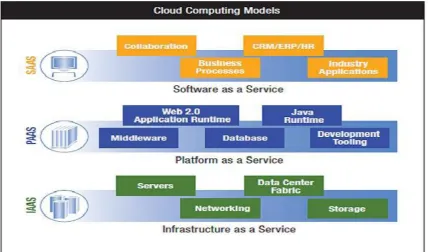
This model gives essential stockpiling and processing capacities as institutionalized administrations over the system. Servers, capacity frameworks, organizing gear, information focus space and so on are pooled and made accessible to handle workloads. [9]The proficience gave to the client is to lease handling, stockpiling, systems, and other major processing assets where the client is able to send and run self-assertive programming, which can incorporate working frameworks and provisions. The client does not oversee or control the underlying cloud base however has the control over working frameworks, capacity, conveyed requisitions, and conceivably select organizing parts (e.g., firewalls, load balancers and so on.). A few cases of Iaas are: Amazon, Gogrid, 3 Tera and so forth. Understanding the relationship and conditions between these models is basic. Iaas is the establishment of all cloud administrations with Paas building upon Iaas, and Saas-in turn – building upon Paas. A structural planning of cloud layer model is portrayed in Figure 1
IV.SECURITY PROBLEM IN CLOUD SERVICES
Following are the various security problem occurred in cloud services.
A. Software-as-a-service (SaaS) security problem
Saas gives requisition benefits on interest, for example, email, conferencing programming, and business requisitions, for example, ERP, CRM, and SCM . Saas clients have less control over security around the three central conveyance demonstrates in the cloud. The selection of Saas requisitions may raise some security concerns.
Application security: These provisions are ordinarily conveyed by means of the Internet through a Web program. Nonetheless, defects in web requisitions may make vulnerabilities for the Saas provisions. Assailants have been utilizing the web to bargain clients' workstations and perform noxious exercises, for example, taking touchy information . Security challenges in Saas requisitions are not quite the same as any web provision innovation, yet accepted security results don't adequately ensure it from strike, so new methodologies are important . [7]The Open Web Application Security Project (OWASP) has recognized the ten most discriminating web requisition security dangers . There are more security issues, yet it is a great begin for securing web requisitions.
B. Platform-as-a-service (PaaS) security problem
Paas encourages sending of cloud-based provisions without the expense of purchasing and administering the underlying fittings and programming layers. Similarly as with Saas and Iaas, Paas relies on upon a safe and dependable system and secure web program. Paas requisition security contains two product layers: Security of the Paas stage itself (i.e., Runtime motor), and Security of client requisitions conveyed on a Paas stage . Paas suppliers are answerable for securing the stage programming stack that incorporates the runtime motor that runs the client provisions. Same as Saas, Paas additionally brings information security issues and different tests that are portrayed as takes after:
Third-party relationships: In addition, Paas does give universal modifying dialects, as well as does it offer outsider web administration parts, for example, mashups. Mashups join together more than one source component into a solitary incorporated unit. In this way, Paas demonstrates likewise inherit security issues identified with mashups, for example, information and system security. Additionally, Paas clients need to rely on upon both the security of web-facilitated improvement apparatuses and outsider administrations..
Development Life Cycle: From the viewpoint of the provision improvement, engineers confront the many-sided quality of building secure provisions that may be facilitated in the cloud. The pace at which provisions will change in the cloud will influence both the System Development Life Cycle (SDLC) and security. Designers need to remember that Paas provisions ought to be overhauled regularly, so they need to guarantee that their requisition advancement methods are adaptable enough to stay aware of progressions. Notwithstanding, engineers additionally need to comprehend that any progressions in Paas parts can trade off the security of their requisitions. Also secure advancement procedures, engineers need to be instructed about information, lawful issues too, with the goal that information is not put away in wrong areas. Information may be put away on better places with distinctive lawful administrations that can bargain its security and security.
Underlying Infrastructure security: In Paas, engineers don't normally have admittance to the underlying layers, so suppliers are answerable for securing the underlying base and the provisions administrations. Actually when designers are in control of the security of their provisions, they don't have the affirmation that the improvement environment devices gave by a Paas supplier are secure. All in all, there is less material in the written works about security issues in Paas. Saas gives programming conveyed over the web while Paas offers improvement devices to make Saas provisions. Be that as it may, both of them may utilize multi-occupant structural engineering so different simultaneous clients use the same programming. Likewise, Paas requisitions and client's information are additionally put away in cloud servers which could be a security concern as examined on the past segment. In both Saas and Paas, information is connected with a requisition running in the cloud. The security of this data while it is continuously transformed, exchanged, and put away relies on upon the supplier.
C. Infrastructure as a service (Iaas) security problem
Iaas gives a pool of advantages, for instance, servers, stockpiling, frameworks, and other figuring holdings in the structure of virtualized systems, which are gotten to through the Internet. Customers are fit the bill for run any item with full control and organization on the benefits dispersed to them. With Iaas, cloud customers have better control over the security diverged from interchange shows as long there is no security opening in the virtual machine screen. They control the item running in their virtual machines, and they are careful to outline security methods faultlessly . Regardless, the underlying figure, framework, and limit base is controlled by cloud suppliers. Iaas suppliers must grasp a noteworthy effort to secure their systems remembering the deciding objective to minimize these dangers that occur due to creation, communication, monitoring, change, and adaptability. Here is a parcel of the security issues joined forces to Iaas[2].
raise security issues. An aggressor can exchange off the movement module in the VMM and trade a misused individual virtual machine to a pernicious server. In like manner, it is clear that VM development uncovered the substance of the VM to the framework, which can exchange off its data respectability and mystery. A vindictive virtual machine could be moved to an exchange host (with a substitute VMM) bartering it[11].
Virtual machine screen (VMS): The Virtual Machine Monitor (VMM) or hypervisor is responsible for virtual machines isolation; in this way, if the VMM is exchanged off, its.
Shared Asset: Vms spotted on the same server can bestow CPU, memory, I/o, and others. Bestowing possessions between Vms may reduce the security of each VM. For example, a toxic VM can assemble some information about distinctive Vms through bestowed memory or other granted possessions without need of dealing the hypervisor. Using in secret channels, two Vms can confer bypassing all the principles described by the security module of the VMM. Along these lines, a malevolent Virtual Machine can screen granted holdings without being distinguished by its VMM, so the assaulter can reason some information about other virtual machines[12].
Public VM picture vault: In Iaas circumstances, a VM picture is a prepackaged modifying organization holding the plans archives that are used to make Vms. In like manner, these pictures are essential for the general security of the cloud. One can either make her VM picture without any planning, or one can use any picture set away as a piece of the supplier's document. For example, Amazon offers an open picture vault where honest customers can download or exchange a VM picture. Vindictive customers can store pictures holding malignant code into open storage facilities exchanging off diverse customers or even the cloud schema. Case in point, an ambusher with a great record can make a picture holding noxious code, for instance, a Trojan horse. Accepting that an exchange customer uses this picture, the virtual machine that this customer makes will be ruined with the covered malware. Additionally, unintentionally data spillage could be exhibited by VM replication. Some mystery information, for instance, passwords or cryptographic keys could be recorded while a picture is, doubtlessly made. Accepting that the picture is not cleaned, this sensitive information could be exposed to other users.vm pictures are dormant curios that are challenging to alter while they are disengaged from the net.
Virtual machine rollback: Additionally, virtual machines have the ability to be moved yet again to their past states if a botch happens. Be that as it may moving back virtual machines can re-expose them to security vulnerabilities that were settled or re-enable previously weakened records or passwords. Remembering the deciding objective to give rollbacks, we need to make a copy (sneak peak) of the virtual machine, which can achieve the multiplication of setup mix-ups and diverse vulnerabilities[3].
Virtual machine life cycle: Additionally, it is vital to understand the lifecycle of the Vms and their movements in states as they go through nature's area. Vms could be on, off, or suspended which makes it harder to distinguish malware. Similarly, really when virtual machines are disengaged from the net, they could be exposed that is, a virtual machine could be instantiated using a picture that may hold toxic code. These malicious pictures could be the starting phase of the development of malware by mixing malignant code inside other virtual machines in the creation process.
Virtual frameworks: Framework fragments are conferred by different tenants in light of advantage pooling. As specified in the later past, granting stakes grants aggressors to launch cross-tenant strike. Virtual Networks extend the Vms interconnectivity, a fundamental security challenge in Cloud Computing. The most secure way is to catch each VM with its have by using submitted physical channels. Be that as it may, most hypervisors use virtual frameworks to association Vms to pass on more direct and beneficially. For example, most virtualization stages, for instance, Xen give two methodologies to orchestrate virtual frameworks: traversed and guided, yet these routines construct the probability to perform a couple of ambushes, for instance, sniffing and ridiculing virtual framework.
D.Analysis of Security Problem in Cloud Services
There are some other vulnerabilities are common to many organization that are negatively impact on security of cloud and its platform. Some of them are ( Keiko Hashizume et al 2013)
1. Cloud provide may not check their employee background and privilege use like administrator has access to cloud data
2. Almost anyone can create account with valid email attacker can create an account and perform malicious activity without being identified.
3. Many of people are unaware of information security. however, it has large impact on cloud because large number of people interact with it.
V.CONCLUSION
Cloud computing is a moderately new idea that shows a great number of profits for its clients; however it likewise raises some security issues which may ease off its utilization. Understanding what vulnerabilities exist in Cloud Services will help organizations to make the movement towards the Cloud. We have exhibited security issues for cloud models: Saas, Paas, and Iaas, which differ contingent upon the model. As describe in paper cloud computing storage, virtualization and network are most important issue related to security. Virtualization which permits various clients to shared physical server is one of the significant concerns toward cloud clients.
Finally some new security technique is required for protection of cloud services, basically for virtualization and network because most of security attacks are done on them.
REFERENCES
1. Badger, L., Grance, T., Patt-Corner, R., and Voas, J. “Draft Cloud Computing Synopsis and Recommendations” National Institute of Standards and Technology (NIST) Special Publication 800-146, 81 pages, May 2012.
2. Balachandra R. K., Ramakrishna P. V. and Rakshit A.“Cloud Security Issues” IEEE International Conference on Services Computing, pp 517-520,2009.
3. Brodkin J. Gartner: “Seven cloud-computing security risks ”Available: http://www.infoworld.com/d/security-central/gartner-seven-cloudcomputingsecurity-risks-853?page=0,1,June 2008.
4. Cloud Security Alliance (CSA)”. Available: http: // www.cloudsecurityalliance.org ,Mar.2010. 5. Cloud Computing Use Case Discussion Group” CloudComputing UseCases Version 3.0, 2010.
6. Grobauer B, Walloschek T. and Stöcker,E.“Understanding Cloud Computing Vulnerabilities” IEEE Security and Privacy, vol. 99,2010. 7. Keiko Hashizume, David G Rosado, Eduardo Fernández-Medinaand Eduardo B Fernandez.“An analysis of security issues for cloud computing
” Journal of Internet Services and Applications, 4:5,2013.
8. Klems M, Lenk A, Nimis J, Sandholm T. and Tai S.“What‟s Inside the Cloud? An Architectural Map of the Cloud Landscape” IEEE Xplore, pp 23-31,Jun 2009.
9. Kresimir P. and Zeljko H. “Cloud computing security issues and challenges” In PROC Third International Conference on Advances in Human-oriented and Personalized Mechanisms, Technologies, and Services, pp. 344-349,2010.
10. Morsy M. A., Grundy J. and Müller I.“An Analysis of the Cloud Computing Security Problem” In PROC APSEC 2010 Cloud Workshop,2010. 11. Ramgovind S. Eloff M. M, Smith E.“The Management of Security in Cloud Computing” In PROC 2010 IEEE International Conference on
Cloud Computing,2010.
12. Subashini S. and Kavitha V.“A survey on security issues in service delivery models of cloud computing”J Network Comput Appldoi:10.1016/j.jnca.2010.07.006. Jul., 2010.
13. ENISA.“Cloud computing: benefits, risks and recommendations for information security” Available: http://www.enisa.europa.eu/act/rm/files/deliverables/cloud-computingrisk-assessment,Jul.2010.
BIOGRAPHY
Rahul D. Khurade is a Assistant Professor in the Computer Science & Engineering Department, Datta Meghe Institute Of Engineering Technology & Research, Sawangi Meghe, Wardha. He received Master of Technology (CSE) degree in 2014 from VNIT, Nagpur, MS, India. His research interest is Computer Network and Security.