Performance Analysis of Hybrid DSTATCOM
with Different Type of Loads
Vidhatri
1, Dr. A.K. Bharadwaj
2M. Tech, Student, Dept. of Electrical Engineering, SSET, SHIATS, Allahabad, India1
Associate Professor, Dept. of Electrical Engineering, SSET, SHIATS, Allahabad, India2
ABSTRACT: This paper describes the performance of hybrid DSTATCOM (Distribution Static Compensator) on different loads.Hybrid DSTATCOM based on super capacitor and batteries, which improve the power quality problem like voltage Sags/Swells; harmonics and power factor must be corrected.DSTATCOM is a custom power device that is used to regulate the power quality problem. Super capacitor are used to meet the instantaneous power demand since they can store and quickly release significant amount of energy, while the batteries are used to meet the average power demand. The simulations were performed using MATLAB Simulation(R2014a).
KEYWORDS: Hybrid Distribution Static Compensators (H-DSTATCOM), Super capacitor, battery, Voltage Sags, Voltage Swells, Voltage Source Converter (VSC), Pulse Width Modulation (PWM).
I. INTRODUCTION
Power system is consisting of three levels, Generation – Transmission – Distribution of power. In earlier days Power Transmission has been faced problems like voltage variation during change in load and power transmission limitation because of reactive power unbalances. Load is very dynamic in nature it keeps changing with time and customer which make it even more difficult for forecasting. This leads to a great need of improving power utilization methods now-a-days. Maintaining power system security and reliability in highly complex & interconnected power system is one of the most challenging tasks. To achieve Optimum Power Quality, it needs perfect balance between generated capacity and its demand. Power flow in the transmission line is affected due to under loading and overloading condition, as a result of this problems regarding Voltage profile and Power system stability will increase. Power quality problem is due to nonstandard voltage, current, or frequency that results in a failure of end use equipment. The most common power quality problems are voltage sag, harmonic distortion and low power factor.
The IGBT based FACTS devices offer a fast and reliable, and increases power transfer capability control over the transmission parameter like voltage, line impedance, and phase angle between the sending end voltage and receiving end voltage. D-STATCOM is a custom power device its futures like it provides fast response, suitable for dynamic response or voltage regulation, to correct voltage surges or sags caused by reactive power demands. PWM control scheme is implemented for D-STATCOM control at the distribution level which will compensate reactive power and improve voltage profile. A DSTATCOM basically VSC based FACTS controller sharing many similar concept with that of STATCOM used at transmission.
II. RELATED WORK
Power quality problem is an occurrence manifested as a nonstandard voltage, current or frequency that results in a failure or a miss-operation of end user equipment.DSTATCOM is a shunt-connected custom power device specially designed for power factor correction, current harmonics filtering and load balancing. It is often referred to as some cases:
(a) WhenDSTATCOM is connected to weak supply system for power factor correction and load balancing. (b) Non-linear load generated harmonics DSTATCOM current balance these unbalanced load current.
(c) When three phase uncontrolled diode bridge rectifier with its dc bus,it gives the transient response of distribution system with DSTATCOM for supply voltage and supply current.
The performance of DSTATCOM system has been found to be satisfactory for improving the power quality at the consumer premises. DSTATCOM control algorithm is flexible and it has been observed to be capable of correcting power factor to unity, eliminate harmonics in supply currents and provide load balancing. It is also able to regulate voltage at PCC. The control algorithm of DSTATCOM has an inherent property to provide a self-supporting DC bus of DSTATCOM. It has been found that the DSTATCOM system reduces THD in the supply currents for non-linear loads. Rectifier-based non-linear loads generated harmonics are eliminated by DSTATCOM. When single-phase rectifier loads are connected, DSTATCOM currents balance these unbalanced load currents.
D-STATCOM to mitigate every type of voltage distortions caused by Single Line to Ground (SLG), Double Lines toGround (DLG) and ThreeLines to Ground (TLG) faults. This new method is based on two factors; firstly,integrating D-STATCOM and supercapacitor energy storage system and secondly, using of feedback in controller system and determining proportional gain of Proportional-Integral (PI) controller, intelligently. In addition, the 12-pulse DSTATCOM configuration with IGBT is designed and the graphic based models of the D-STATCOM are developed using the PSCAD/EMTDC electromagnetic transient simulation program. As a case study, a 13- bus IEEE industrial distribution system is simulated to verify operation of proposed D-STATCOM .In this paper, a new control method is proposed for mitigating the voltage sags, caused by SLG, DLG and TLG faults at the PCC bus. The proposed method is based on two factors; firstly, integrating D-STATCOM and SCESS and secondly, using feedback in controller system and determining proportional gain of PI controller, intelligently. This proposed control scheme applied in IEEE 13-bus industrial distribution system and it is tested under a wide range of operating conditions, it is observed that the proposed method is very robust in every case. In addition, the regulated VRMS voltage at the PCC bus shows a reasonably smooth profile. It was observed that the PCC bus voltage is very close to the reference value, i.e., 1pu and the voltage sags are minimized completely. Moreover, the simulation results are shown that the charge/discharge of the capacitor is rapid through this new method (due to usingSCESS) and due to using a feedback in controller system,the response of the D-STATCOM is fast.
Distribution static compensator(DSTATCOM):
The DSTATCOM is a controlled reactive source which includes a two-level voltage source converter, a dc energy storage device, a coupling transformer connected in shunt to the distribution network through coupling transformer. Fig.1 shows the basic system configuration of DSTATCOM. The VSC converts the dc voltage across the storage device into a three phase output voltages. These voltages are in phase and coupled with the ac system through the reactance of the coupling transformer. With suitable adjustment of the phase and magnitude of DSTATCOM output voltages allows effective control of active and reactive power exchange between the DSTATCOM and the ac system.
Inverter is the main component of DSTATCOM. The three basic operation mode of D-STATCOM is that output current Ioutwhich various depending upon inverter voltage Vi. If Vi is equal to system voltage Vs, the reactive is zero
and the DSTATCOM does not generate and absorb reactive power. When Vi is greater than Vs the DSTACOM shows inductive reactance connected Vs, the DSTATCOM shows an inductive reactance connected at its terminal. The current I flows through the transformer reactance from the DSTATCOM to the ac system and the device generates capacitive power. If Vs is greater than Vi, the DSTACOM shows the system as a capacitive reactance. The current flows from the ac system to the DSTATCOM and the device absorbing inductive reactive power.
The VSC connected in shunt with the ac system provides a multifunctional topology which can be used for three quite distinctpurposes.
1. Voltage regulation and compensation of reactive power 2. Correction of power factor
Fig1.schematic diagram of DSTATCOM
Voltage source converter (VSC):
A VSC as a power electronic device is most important in DSTATCOM which can generate a sinusoidal voltage with any required magnitude, frequency and phase angle. Voltage source converters are widely used in ASD (Adjustable-Speed Drives), but can also be used to mitigate voltage dips. The VSC is used completely to replace the voltage or to inject the missing voltage. The missing voltage is the difference between the nominal voltage and the actual. The converter is normally based on some kind of energy storage, which will supply the converter with a DC voltage. DC source as battery is connected parallel to the DC capacitor. It carries the input ripple current of the converter and it is the main reactive energy storage element. This DC capacitor could be charged by a battery source or could be recharged by the converter itself. The switching strategy based on a sinusoidal PWMmethod which offers simplicity and good response.
Super capacitor and battery:
DSTATCOM, however, are limited in their ability to improve system performance due to limited capability of delivering quick/instantaneous real power. From the last decade, there have been considerable developments and improvements in energy storage technologies for example, SMES, Flywheel, Fuel Cells and in the battery technologies.On the contrary, these technologies have some limitations; SMES require a lot of space, high shielding for its magnetic effect and complex auxiliary system, fuel cells quite slow initial response and limited number of charge/discharge cycle. By and large, batteries have relatively high energy density, low power density, slow dynamic characteristic. If batteries are cycled at very high current rates then batteries life detoriates very fast in case of full discharge and also may lead to safety problem due to thermal runaway. Therefore, the battery packs have to be oversized to ensure life and to avoid thermal runaway.
The recent development of Super capacitors has given new dimensions in the field of energy storage technologies, which can store a very large amount of energy and can release large amount of instantaneous power/energy in the regulated manner with the help of custom power devices, independent of number of charge and discharge cycle, very high efficiency, life about 20-25 years and charge and discharge times are fractions of a second to several minutes. Due to higher specific power density and fast dynamic characteristics, the super capacitors have been considered for transient power supply and recovery in the distribution network. Combination of super capacitors and batteries energy storage system therefore in the DSTATCOM reduce the strain on the batteries simultaneously super capacitors have capability of absorbing and supplying the large current pulses and battery can provide the average power demand. This in turn allows the DSTATCOM provide real power and reactive power in to distribution network via the inverter.
Voltage Sags/Swell:
Voltage sags is one of the most occurring power quality problems for industry voltage sags occur more often and cause severe problems and economical losses.It occurs due to equipment malfunctioning, tripping due to unbalance between the power supply and demand. DSTATCOM injects a current into the system to mitigate the voltage sag.A voltage sag or voltage dip is a short duration reduction in RMS voltage which can be caused by a short circuit, overload or starting of electric motors. Avoltage sag happens when the rms voltage decreases between 10 and 90 percent of nominal voltage for one-half cycle to one minute. Some references define the duration of sag for a period of 0.5 cycles to a few second,and longer duration of low voltage would be called “sustained sag".Voltage swell is the opposite of voltage sag. Voltage swell, which is a momentary increase in voltage, happens when a heavy load turns off in a power system. Sudden load changes or excessive loads can cause voltage sag. Depending on the transformer connections, transformers energizing could be another reason for happening voltage sags.
they can also be caused by a damaged or loose neutral connection.Figure shows some of the typical voltage disturbances.
Fig.3 Typical Voltage Disturbances
Controller:
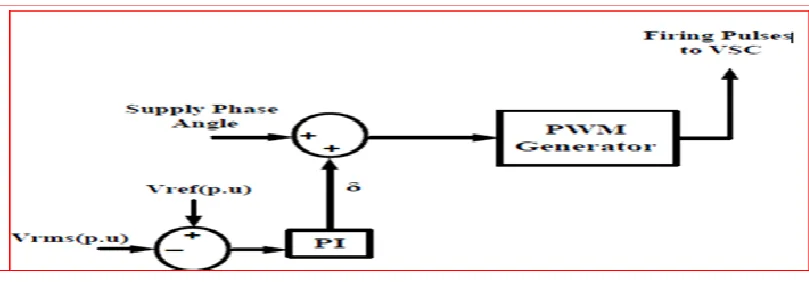
The main Aim of the control scheme is to maintain constant voltage magnitude at the point where a sensitive load is connected under system is in disturbances. In this control algorithm the voltage regulation is achieved in a DSTATCOM by themeasurement of the RMS voltage at the load point and no requirements of reactive power measurements. Here the sinusoidalPWM technique is used for the VSC switching strategy as sine PWM techniques offers simplicity and good response compare to other scheme.
.
Figure 4.PI Controller
In fig shows the input of the controller is an error signal which is obtained from the reference voltage and the value RMS of the terminal voltage measured. Now Proportional-Integral (PI) controller will process this error signal and then the output is the angle Ф, which provides to the PWM signal generator. In this case converter is exchange active and reactive power exchange with the network simultaneously. Now error signal is obtained by comparing the reference voltage with the RMS voltage measured at the load point. The error signal is processed by PI controller which in return generates the required angle to drive theerror to zero, that means the load RMS voltage is brought back to the reference voltage. It is also used to control the flow of reactive power from the DC capacitor storage circuit.The sinusoidal signal Vcontrol is phase-modulated by means of the angle Ф.
i.e.
VA = sin (ωt +Ф)
VB = sin (ωt +Ф - 120)
III.SIMULATIONANDRESULTS
Test system used to carry out the various Hybrid DSTATCOM simulations in MATLAB/SIMULINK. The test system comprises of a 25 kV,50Hz transmission system-section of 100 km long and T section of 100 km long, feeding into the primary side of 2-winding transformer connected in Yg/Yg,735 KV/315 KV,100MVA.The load is connected to 1000 V, secondary side of the transformer.
The DC voltage is applied to IGBT/Diodes of two-level inverter generating 50 Hz. The IGBT of the inverter uses pulse width modulation at 1680 Hz carrier frequency, discretised sample time of 5.8e-6 sec. The load voltage is regulated at 1 PU by PI voltage regulators of dc regulator, the input of DC regulator are voltage of PCC, current of PCC, SCESS voltage and the output is a vector containing the three modulating signals used by the discrete pulse width modulation generator to generate the 6 IGBT pulses. The harmonics generated by the inverter are filtered by 3-Ф harmonic filter. The three coupling transformer of 735KV/315 KV, 100MVA are used to connect the DSTATCOM to the distribution network. A SCESS of 558 F and BESS of 508 V are connected on the dc side to provide the energy/realpower. Theeffectiveness of this arrangement in voltage regulation can be seen on simulating the test system with and without SCESS/BESS.
After the simulation we get some unbalance waveform when RLC load is connected and DSTATCOM is not responding at this time.
Fig.5 Response of unbalance load (RLC)
The second simulation was performed when RC load is connected and DSTATCOM is not responding.
After the second simulation, DSTATCOM performed and we get finally balanced waveform,which is shown below.
Fig.7 Response after DSTATCOM connection
IV.CONCLUSION AND FUTURE WORK
Battery and super capacitor has been used as energy storage devices in DSTATCOM. Battery is used to provide average power while super capacitor to provide instantaneous charge and discharge power to the system. Combination of super capacitors energy storage and battery energy storage system allows the DSTATCOM to deliver the real power into distribution network for higher rate ofchange of dynamic conditions in case of transient conditions as well as for average power demand in case of steadyconditions.The highly developed graphic facilities available in MATLAB/Simulink were used to conductall aspects of model implementation and to carry out extensive simulation studies in the developed test systems. Different loads has been tested in the system and finally it can be concluded that there may be distortion in the voltage and current wave form due to application of unbalanced load or single phase load. This distorted waveform can be improved by connecting DSTATCOM. DSTATCOM is an efficient tool for mitigation of power quality issue. DSTATCOM has been observed to be capable for power factor improvement, can eliminate harmonics in supply current and load balancing.
REFERENCES
[1] Nasiraghdam,H., and Jalilian A., “Balanced and Unbalanced voltage sag Mitigation Using DSTATCOM with Linear and Nonlinear loads”, International Journal of Electrical, Computer and Systems Engineering 1; pp. 86-91,2007.
[2] Zhai, N.S. Yao, Y.Y. Zhang, D.L. Xu, D.G., “Design and Optimization for a Super capacitor Application System”, International Conference on Power System Technology, PowerCon 2006, Chongqing, oct 22-26 .,pp.1-4,2006.
[3] Archna M. Kadam, SatyenDhamdhere, D.S.Bankar, “Application of DSTATCOM for Improvement of Power Quality using MATLAB Simulation”, International Journal of Science and Modern Engineering (IJISME) , Vol.1,Issue-1, pp. 9-13,2012.
[4] K Hussain, J Praveen, “Voltage Sag Mitigation Using Distribution Static Compensator System”, International Journal of Engineering & Technology Volume 2 No.5,2012.
[5] MithileshkumarKanaujia, Dr. S.K. Srivastava, “Power Quality Enhancement Under Different Fault Conditions”, International Journal of Engineering Research and Applications (IJERA) , Vol.3, Issue 2,pp.828-833,2013.
[6] SaiKiran Kumar Sivakoti, Y.Naveen Kumar, D.Archana, “Power Quality Improvement In Distribution System Using D-STATCOM In Transmission Lines”, International Journal of Engineering Research and Applications (IJERA), Vol. 1, Issue 3, pp.748-752.
[7] Archana M. Kadam, SatyenDhamdhere, D.S.Bankar , “Application of DSTATCOM for Improvement of Power Quality using MATLAB Simulation”, International Journal of Science and Modern Engineering (IJISME) , Volume-1, Issue-1, pp. 9-13,2012.
[9] A. Nazarloo, S. H. Hosseini, E. Babaei, M. B. B. Sharifian, “Dynamic model of electrical double layer capacitor applied in D-STATCOM under three lines to ground fault,” in Proc. 25th Inter- national Power System Conference (PSC), Iran, pp. 1-8,2011.
[10] R. C. Dugan, M. F. McGranaghan and H. W.Beaty, “Electrical power systems quality,” Mc- Graw Hill Companies, Inc., 1996.
[11] Dharmendra Singh, Om PrakashGujela, “ Performance Analysis of Time Moments, Markov’s Parameter and Eigen Spectrum using Matching Moments”, International Journal of Innovative Research in Computer and Communication Engineering, Vol. 3, Issue 3, pp. 2435-2442,2015. [12] DarjiDhavaD,PatelSumitR,Prof.HardikH.Raval “Improving Voltage Profile of Distribution System using DSTATCOM”, International Journal
of Engineering Development and Research,Vol.2,Issue1,pp.761-771,2014.
[13] Veeraiah Kumbha,N.Sumathi“,Power Quality Improvement of Distribution lines using DSTATCOM under various loading Conditions”,International Journal of Modern Engineering Research, Vol.2,Issue 2,pp.3451-3457,2012.
[14] BattacharyaSourabh,“Application of DSTATCOM using MATLAB/Simulation in Power System”,Research Journal of Recent Sciences,Vol.1,pp.430-433,2012.
[15] Amin nazarloo,sayedhossein ,ebrahimbabaei,mohammedbagherbannaesharifian, “Integrated DSTATCOM with supercapacitor used in IEEE industrial distribution system ”,ECTI Transactions on Electrical Eng., Electronics and Communications Vol.10, No.1,pp.130-137,2012.
BIOGRAPHY
Vidhatri is a student of M. Tech Electrical Engineering (Power System) in the department of Electrical Engineering, SSET, SHIATS, Allahabad, India.She received Bachelor of Technology degree in Electrical & Electronics Engineering in 2013 from United Institute of Technology, Allahabad, India. Her research interest is Power System Analysis.