ISSN(Online): 2320-9801
ISSN (Print): 2320-9798
I
nternational
J
ournal of
I
nnovative
R
esearch in
C
omputer
and
C
ommunication
E
ngineering
(An ISO 3297: 2007 Certified Organization) Vol. 3, Issue 6, June 2015
Data Hiding in Image Using Tree Based Parity
Check with LSB Matching Revisited
Algorithm
R.Shanthakumari
1,
Dr. S.Malliga
2Assistant Professor(SLG), Department of IT, Kongu Engineering College, Perundurai, Tamilnadu, India1
Professor, Department of CSE, Kongu Engineering College, Perundurai, Tamilnadu, India2
ABSTRACT: Image steganography is a technique for embedding the data inside a cover image. It is a technique in which a stego image is sent to the intended recipient in such a way that no third party can detect the existence of the secret data. Most of the existing methods hide data inside the randomly selected pixels without considering the nearby pixel values. Therefore chances for hiding data inside the smooth regions of the image are high. In this paper, data is hidden inside the edge boundaries of an image by an edge adaptive scheme to improve the symmetry between cover image and stego image. Tree Based Parity Check (TBPC) with Least Significant Bit Matching Revisited (LSBMR)
algorithm is used to embed data inside the cover image in a secured manner. The proposed system is evaluated using
the quality metrics like Mean Squared Error, PSNR and Embedding Capacity.
KEYWORDS:Data Hiding ; Edge Adaptive Scheme; LSBMR; Steganography; Tree Based Parity Check;
I. INTRODUCTION
Steganography is a technique for information hiding. This scheme hides secret message in the communication between
the sender and receiver such that no other parties can detect the existence of the secret message. It aims to hide the
secret data inside a cover media like digital audio, image and video. A Steganography method consists of embedding and extraction algorithms. Embedding algorithm describes how to hide secret data into the cover media and the extraction algorithm illustrates how to extract the message from the stego media. Cover media has to sacrifice its originality due to hidden secret data. It means that for embedding the message, cover media has to slightly modify into stego media. Reducing distortion between cover and stego media is taken as a crucial issue for steganography methods. This paper proposes an efficient image steganography embedding and extracting algorithm that uses least number of changes over cover image to produce stego image after data embedding process. In general, image steganography is the method of data hiding into cover image and generates a stego image which can be sent to the other party by known medium, where the third party does not know that this stego image has a hidden message. At the receiver end, hidden message can be simply extracted from stego image with or without using a stego key [1].
II. RELATED WORK
ISSN(Online): 2320-9801
ISSN (Print): 2320-9798
I
nternational
J
ournal of
I
nnovative
R
esearch in
C
omputer
and
C
ommunication
E
ngineering
(An ISO 3297: 2007 Certified Organization) Vol. 3, Issue 6, June 2015
for an encrypted image, the receiver with the knowledge of encryption key can obtain a decrypted image and detect the presence of hidden data using LSB steganalytic methods. Also with the data hiding key, it is possible to extract the additional data and recover the original image. C.Tsai et al [10] proposed a scheme called Tree Based Parity Check (TBPC) with majority vote strategy to reduce distortion on a cover object based on a tree structure model. Tan [11] proposed LSBMR algorithm with edge adaptive scheme in which the histogram of the absolute difference of the pixel pairs is taken, and a pulse distortion to the long exponential tail is applied. From the above papers it is observed that the nearby pixels are not considered for data embedding, thus resulting in the distortion of the image. Here we proposed a data hiding scheme, Tree Based Parity Check with LSBMR algorithm which overcomes the above problem. The rest of the paper is organized as follows. In section 2, the proposed scheme is discussed. Experimental results is described in section 3, section 4 concludes the paper.
III.PROPOSED ALGORITHM
Reducing distortion between the cover image and the stego image is an important issue in steganography. Most of the steganography methods generally use randomly selected pixels for data embedding. These pixels are selected without considering adjacent pixel. In such cases the probability of embedding in the smooth regions will be high. In general, the sharper regions have more complicated statistical features and random characteristics than the smoother ones. It is expected that detectable and visual artifact would be left very low in the sharper regions after data embedding. It makes the detection is more difficult. In this paper, analysis is done when data is embedded in the edge boundaries using Tree Based Parity Check (TBPC) with LSBMR algorithm. The details of data embedding and data extraction algorithms are as follows.
III.1 Data Embedding Algorithm
Step 1: Location Finding Method: Hiding Secret data in edge regions of an image is more secure hence edge regions
are preferred. The Edge Region(ER) consists of a pair of pixels as an embedding unit (xi, x i+1), in which difference
between those two pixels will be greater than or equal to threshold (T) value known by the sender and receiver. The non-overlapping consecutive pixel pair in each embedding unit is found by traversing each row in the matrix representation of the cover image from left to right. Depending on number of nodes in the master tree, number of pixel
pairs is determined. ER (T) = {(xi, x i+1) || where | (xi, x i+1)|>=T, (xi, x i+1) € I}
Step 2: Tree Based Parity Check (TBPC) Method: The TBPC method is a least significant bit steganography method.
This method is used for generating stego code using the LSB of selected pixels which consist of following three steps.
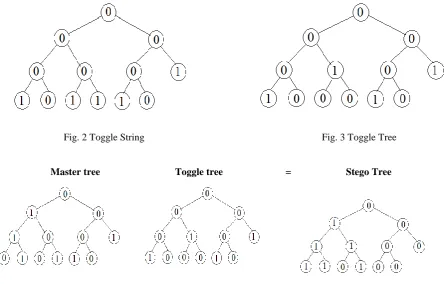
Step 2.1: Construction of master tree and create master string and toggle string: The method constructs a complete binary tree called the master tree. The number of leaf nodes of the tree is equivalent to the message length (l) .The nodes in the master tree is filled with the LSBs of the selected pixels level by level, from top to bottom and left to right. The master string is created by performing even parity check on the master tree from the root to leaves. Exclusive-OR bit wise (XOR) operation is performed between message and master string to get a toggle string. For example message
to hide is h(1 1 0 1 0 0 0).The following are the selected pixels 156,159,154,
165,160,162,165,160,161,162,165,171,166.Use the LSB of each pixel for creating the master tree. The figure 1 represents the creation of Master Tree.
ISSN(Online): 2320-9801
ISSN (Print): 2320-9798
I
nternational
J
ournal of
I
nnovative
R
esearch in
C
omputer
and
C
ommunication
E
ngineering
(An ISO 3297: 2007 Certified Organization) Vol. 3, Issue 6, June 2015
Performing the parity check from root to leaf node is called the Master String. Master String: 0 1 1 0 1 0 1 Message String:1 1 0 1 0 0 0. Toggle string(1 0 1 1 1 0 1) is obtained by performing exclusive-OR operation between the Message and the Master String. The Toggle string is shown in figure 2.
Step 2.2: Creation of toggle tree: Toggle tree is created by filling the leaf nodes with the toggle string and all the other
non-leaf nodes with 0. Then, traverse through each level, from the bottom to the root, the non-leaf node and their corresponding leaf nodes are flipped if both of its children have bits as one. The Toggle tree is shown in figure 3.
Step 2.3: Construction of stego tree: The embedding algorithm obtains the stego tree by performing XOR between the
master tree and the toggle tree. The stego code is obtained from the stego tree. The construction of the stego tree is shown in figure 4.The stego code (0 1 0 1 1 0 0 1 1 0 1 0 0) is embedded inside an image using LSBMR algorithm. The resultant stego image hides secret bits in a highly secure manner.
Fig. 2 Toggle String Fig. 3 Toggle Tree
Master tree Toggle tree = Stego Tree
Fig. 4 Construction of stego tree
Step 3: LSBMR Algorithm: LSBMR algorithm is applied to the stego code. For each embedding region (xi,xi+1),
consecutive two bits of the stego code is embedded according to the following 4 cases. Case 1: LSB (xi) = mi & LSB (f (xi, x i+1)) = mi+1 then (xi’, x i+1’) = (xi, x i+1)
ISSN(Online): 2320-9801
ISSN (Print): 2320-9798
I
nternational
J
ournal of
I
nnovative
R
esearch in
C
omputer
and
C
ommunication
E
ngineering
(An ISO 3297: 2007 Certified Organization) Vol. 3, Issue 6, June 2015
Step 3: Creation of stego Tree: Construct the complete binary tree by filling its nodes by the stego code. Original message can be extracted by performing parity check.
IV.EXPERIMENTALRESULTS
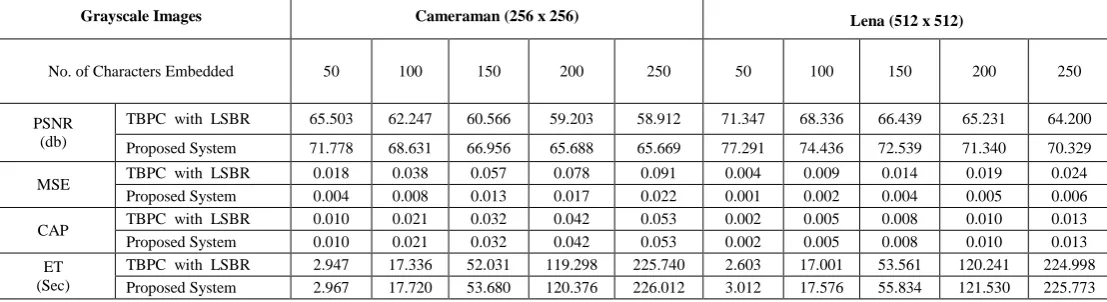
The proposed algorithm has been implemented using MATLAB 7.11. Performance of the algorithm has been evaluated in terms of Mean Squared Error, Peak Signal to Noise Ratio, Embedding Capacity and Elapsed Time. Figure 5 (a) –(d) shows the original cover(carrier) images for Cameraman, Lena, Nature and Girl , Figure 6(a) –(d) shows the stego images. Some of the images (Grayscale and RGB) from Image database and from internet were used to test the performance of the proposed algorithm. The above measures are calculated for the test images by varying the number of characters embedded. Here the results of PSNR, MSE, CAP and ET are shown in Table 1 for grayscale images and the results of RGB images are shown in Table 2.
(a) Cameraman (b) Lena (c) Nature (d) Girl
(512 x 512) (256 x 256) (512 x 640) (400 x 267) Figure 5 (a) – (d) original cover (carrier) images.
(a) Cameraman (b) Lena c) Nature (d) Girl
(512 x 512) (256 x 256) (512 x 640) (400 x 267)
ISSN(Online): 2320-9801
ISSN (Print): 2320-9798
I
nternational
J
ournal of
I
nnovative
R
esearch in
C
omputer
and
C
ommunication
E
ngineering
(An ISO 3297: 2007 Certified Organization) Vol. 3, Issue 6, June 2015
Table 1 PSNR, MSE, CAP and ET for Grayscale Images
Table 1 shows the result of the MSE value calculated for Grayscale images. From the experimental results in Table 1, it is either 0 or 0.03 which means there is no significant difference between the cover image and stego-image even after
embedding.
From the Table 1 it is observed that all our PSNR values are greater than 65 dB. The embedding capacity
is exactly same in TBPC with LSBR and TBPC with LSBMR.
Table 2 shows the result of the MSE value calculated for RGB images. From the experimental results in Table 1, it is
Grayscale Images Cameraman (256 x 256) Lena (512 x 512)
No. of Characters Embedded 50 100 150 200 250 50 100 150 200 250
PSNR (db)
TBPC with LSBR 65.503 62.247 60.566 59.203 58.912 71.347 68.336 66.439 65.231 64.200
Proposed System 71.778 68.631 66.956 65.688 65.669 77.291 74.436 72.539 71.340 70.329
MSE TBPC with LSBR 0.018 0.038 0.057 0.078 0.091 0.004 0.009 0.014 0.019 0.024
Proposed System 0.004 0.008 0.013 0.017 0.022 0.001 0.002 0.004 0.005 0.006
CAP TBPC with LSBR 0.010 0.021 0.032 0.042 0.053 0.002 0.005 0.008 0.010 0.013
Proposed System 0.010 0.021 0.032 0.042 0.053 0.002 0.005 0.008 0.010 0.013
ET (Sec)
TBPC with LSBR 2.947 17.336 52.031 119.298 225.740 2.603 17.001 53.561 120.241 224.998
Proposed System 2.967 17.720 53.680 120.376 226.012 3.012 17.576 55.834 121.530 225.773
Table 2 PSNR, MSE, CAP and ET for RGB Images
RGB Images Nature (512 x 640) Girl (400 x 267)
No. of Characters Embedded 50 100 150 200 250 50 100 150 200 250
PSNR (db)
TBPC with LSBR 77.122 74 72.398 71.110 70.042 72.505 69.004 67.450 66.294 65.208
Proposed System 78.587 75.403 73.652 72.432 71.496 73.898 70.842 69.137 67.712 66.693
MSE TBPC with LSBR 0.001 0.002 0.004 0.005 0.006 0.003 0.008 0.011 0.015 0.019
Proposed System 0.0009 0.001 0.003 0.004 0.005 0.002 0.005 0.007 0.011 0.013
CAP TBPC with LSBR 0.002 0.004 0.006 0.009 0.010 0.007 0.013 0.019 0.026 0.038
Proposed System 0.002 0.004 0.006 0.009 0.010 0.007 0.013 0.019 0.026 0.038
ET (Sec)
TBPC with LSBR 2.513 15.917 54.187 119.547 230.208 3.254 17.299 54.511 119.449 227.043
ISSN(Online): 2320-9801
ISSN (Print): 2320-9798
I
nternational
J
ournal of
I
nnovative
R
esearch in
C
omputer
and
C
ommunication
E
ngineering
(An ISO 3297: 2007 Certified Organization) Vol. 3, Issue 6, June 2015
50 100 150 200 250
0 0.005 0.01 0.015 0.02 0.025
Number of Characters Embedded
M
S
E
MEAN SQUARED ERROR
TBPC with LSBR TBPC with LSBMR
Fig.7 MSE of Lena
MSE of Lena image for different number of characters embedded is shown in Figure 7.Here distortion is reduced by 1 to 5 % compared to TBPC with LSBR.
IV.2 Peak Signal to Noise Ratio (PSNR)
The PSNR is used to measure the quality of stego image. Usually if PSNR values are greater than 30 dB then the stego image is of good quality. Peak Signal to Noise Ratio can be computed using the formula
PSNR = 10 * log 10 (255^2 / MSE) ... (2)
50 100 150 200 250
64 66 68 70 72 74 76 78
Number of Characters Embedded
P S N R ( d e c ib e l)
PEAK SIGNAL TO NOISE RATIO
TBPC with LSBR TBPC with LSBMR
Fig.8 PSNR of Lena
The PSNR of Lena image for different number of characters embedded is shown in Figure 8. Here PSNR is improved by 1 to 5 % compared to TBPC with LSBR.
IV.3 Embedding Capacity
ISSN(Online): 2320-9801
ISSN (Print): 2320-9798
I
nternational
J
ournal of
I
nnovative
R
esearch in
C
omputer
and
C
ommunication
E
ngineering
(An ISO 3297: 2007 Certified Organization) Vol. 3, Issue 6, June 2015
Here the embedding capacity is used to measure the capacity of image and it is usually expressed as bits per pixels.
50 100 150 200 250
2 4 6 8 10 12 14x 10
-3
Number of Characters Embedded
C
A
P
EMBEDDING CAPACITY
TBPC with LSBR TBPC with LSBMR
Fig.9 Embedding Capacity of Lena
The CAP of Lena image for different number of characters embedded is shown in Figure 9.The embedding capacity is exactly same in TBPC with LSBR and TBPC with LSBMR.
IV.4 Elapsed Time
The time duration that extends while some event is occurring is Elapsed Time which means time taken between starting and ending of the program. It is usually expressed in seconds. Elapsed time is slightly increased by 0.020 - 3 seconds in the proposed scheme.
V. CONCLUSION AND FUTURE WORK
By introducing tree based parity check with LSBMR algorithm using adaptive scheme, the stego image is constructed effectively under the tree structure model with minimum distortion rate. The LSBMR algorithm is used for embedding the secret data. Therefore, by this method, the problem of asymmetry between cover image and stego image is solved. In order to reduce the distortion between the cover image and the stego image, data is embedded in the edge regions and LSBMR algorithm is used for embedding stego code inside the image which helps to increase the security level. This scheme can be applied to other covers like audio and video which can be taken as the future work. Embedding capacity can also be improved by creating tree with more than two child nodes and novel steganography scheme based on multi-pixels differencing.
REFERENCES
1. N. Johnson and S. Jajodia 1998, Exploring steganography: seeing the unseen, IEEE Computer, pp. 26-34.
ISSN(Online): 2320-9801
ISSN (Print): 2320-9798
I
nternational
J
ournal of
I
nnovative
R
esearch in
C
omputer
and
C
ommunication
E
ngineering
(An ISO 3297: 2007 Certified Organization) Vol. 3, Issue 6, June 2015
9. R. Crandall 1998, Some Notes on Steganography, Posted on Steganography Mailing List,[Online].Available:
http://os.inf.tudresden.de/westeld/crandall.pdf.
10. C. Hou, C. Lu, C. Tsai and W. Tzeng 2011, An Optimal Data Hiding Scheme With Tree-Based Parity Check, IEEE Transaction on Image
Processing, vol. 20, no.3,pp.880-886
11. S. Tan 2012, Targeted Steganalysis of Edge Adaptive Image Steganography Based on LSB Matching Revisited Using B-Spline Fitting IEEE
Signal Processing Letters, Vol.19,No. 6.
12. Zhang (2010), Reversible Data hiding in Encrypted Image, IEEE Signal Processing Letters, Vol.18, No.4, pp.255-258.
BIOGRAPHY
R.Shanthakumari presently working as an Assistant Professor (Selection Grade) in the Department of Information
Technology, Kongu Engineering College, Tamilnadu, India. She received her B.E., in Computer Science and Engineering in 1997 at Bharathiar University, Coimbatore. M.E. in Computer Science and Engineering in 2007 at Anna University, Chennai. Her area of interest includes Networks, Network Security and Digital Image Processing.
Dr.S.Malliga is working as a Professor in the Department of Computer Science and Engineering, Kongu Engineering