
Operations on Digraphs and Digraph
Folding
E. EL Kholy, H Ahmed
Department of Mathematics, Faculty of Science, Tanta University, Tanta, Egypt
Department of Mathematics, Faculty of Shoubra Engineering, Banha University, Banha, Egypt
ABSTRACT: In this paper we examined the relation between digraph folding of a given pair of digraphs and digraph folding of new digraphs generated from these given pair of digraphs by some known operations like union, intersection, joins, Cartesian product and composition. We first redefined these known operations for digraphs, then we defined some new maps of these digraphs and we called these maps union, intersection, join, Cartesian and composition dimaps. In each case we obtained the necessary and sufficient conditions, if exist,for a dimap to be digraph folding. Finally we explored the digraph folding, if there exist any, by using the adjacency matrices.
KEY WORDS:Digraphs, adjacency matrices,digraph folding,union,intersection,join the Cartesian product and the composition of digraphs
I. INTRODUCTION
Graph folding is introduced by E.EL-Kholy and A.AL-Esway [3]. The notion of digraph folding is introduced by E.EL-Kholy and H.Ahmed [4]. Definitions (1.1)
(1) A digraph D consists of elements, called vertices and a list of ordered pairs of these elements, called arcs. The set of vertices is called the vertex set of D, denoted by V (D), and the list of arcs is called the arc list of D, denoted by A (D). If v and we are vertices of D, then an arc of the form vw is said to be directed from v to w. The digraph with no loops is called simple. Two or more arcs joining the same pair of vertices in the same direction is called multiple arcs [5].
(2) Let D1 and D2 be digraphs and f: D1D2a continuous function. Then f is called a digraph map if, (i)For each vertex v V (D1), f(v) is a vertex in V (D2).
(ii)For each arc e A (D1), dim (f(e)) ≤ dim (e) [4].
(3) Let D1 and D2 be simple digraphs, we call a digraph map f: D1D2 a digraph folding if f maps vertices to vertices and arcs to arcs, i.e., for each v V (D1), f(v) V (D2) and for each e A (D1), f(e) A (D2)(4) If the digraph contains loops, then the digraph folding must send loops to loops but of the same direction. Theset of digraph folding between digraphs D1 and D2 is denoted by Ð( ,D2) and from D into itself by Ð(D).
(5)Let D be a diagraph without loops, with n vertices labeled 1, 2, 3,…, n. The adjacency matrix M(D) is the nxn matrix in which the entry in row i and column j is thenumber of arcs from vertex i to vertex j [5].
A. Proposition
Let D be a connected digraph without loops with n vertices. Then a digraph folding of D into itself may be defined, if there is any, as a digraph map f of D to an image f(D) by mapping:
(i) The multiple arcs into one of its arcs.
(ii)(a)The vertex vi to the vertex vj if the numbers appearing in the adjacencymatrix in the ith and jth rows (or columns) are the same.
(b)The vertex vi to the vertex vj if the entries of the ith and jth rows are zerosandif the ith and jth columns are the same, or there exists a row k which has numbers 1 in the ith and jth columns.
(b) The arc (vi,vj) to the arc (vi, vk) if the jth and kth columns (or rows) are the same.
In general the arc (vi,vj) will be mapped to the arc (vk,vl) if vi mapped to vk and vj mapped to vl, [4].
II. UNION OF DIGRAPHS
In the following we redefine the known operation, union, given for two simple graphs [3], for digraphs. Definition (2-1)
Let D1 =(V1,A1) and D2 =(V2,A2) be simple digraphs .Then the simple digraphD = (V, A) where V=V1UV2 and A=A1UA2 is called the union of digraphs D1 and D2 and is denoted by D1UD2 .When D1 and D2 are vertex disjoint D1UD2is denoted by , D1+D2 , and is called the sum of digraphs D1and D2.
Definition (2-2)
Let D1 =(V1,A1) and D2 =(V2,A2) be simple digraphs .Let f: D1D1 andg:D2D2 be digraph maps.By the union dimap of the digraph maps f and g, fUg,we mean a digraph map from the digraph D1UD2 into itself.f Ug:D1UD2D1UD2such thatf(v) = g(v) , for all v ϵ V1∩ V2 , f(e)=g(e) , for all e ϵ A1∩ A2defined by f(v), if v V1
(i) For each v V1 U V2, (fUg)(v) =
g(v), if v V2
f(e) , ife A1
(ii) For each e A1UA2, (fUg) (e) = g(e) , if e A2
A. Theorem
Let D1=(V1,A1) and D2=(V2, A2) be simple connected digraphs .Let f:D1 D1 and g:D2 D2 be digraph maps. Then the union dimap fUg is a digraph folding if f and g are digraph foldings. In this case (fUg)(D1UD2) =f(D1) U g(D2) The proof is almost as in [2]. Example 2.4
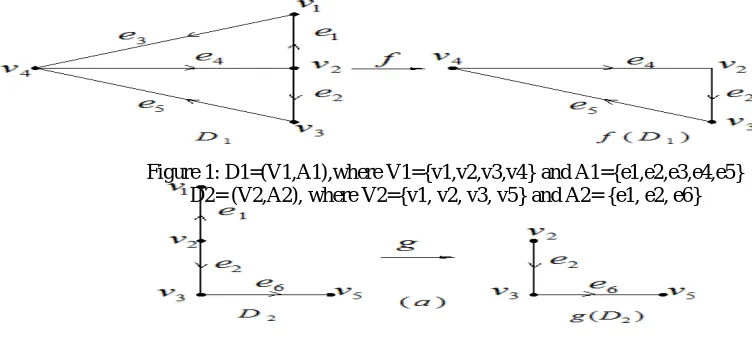
Let D1=(V1,A1),where V1={v1,v2,v3,v4} and A1={e1,e2,e3,e4,e5}.
Let D2= (V2,A2), where V2={v1, v2, v3, v5} and A2= {e1, e2, e6}, see Figure1.
Figure 2: fUg: D1UD2 D1UD2
Now let f ϵÐ(D_1) be a digraph folding defined by f{v1}={v3} and f{e1,e3}={e2,e5}, where through this paper the omitted vertices and arcs will be mapped to themselves . Also, let g ϵ Ð(D_2)be a digraph folding defined by g{v1}={v3} and g{e1}={e2} , see Figure1.The union dimapfUg: D1UD2D1UD2 defined by (fUg){v1}={v3} and (fUg){e1,e3}= {e2,e5} is a digraph folding , see Figure2.The adjacency matrices of D1,D2 and D1UD2 are as follows :
3 5
1 2 4
3 3 5
1 2 4 1 2 1
1 1 2 2 2 3
1 2 1 2
3 3 4 5 4 5
0 0 0 1 0
0 0 0 1 0 0 0 0
1 0 1 0 0
1 0 1 0 , 1 0 1 0
0 0 0 1
0 0 0 1 0 0 0 1
0 1 0 0
0 1 0 0 0 0 0 0
0 0 0 0
v v
v v v
v v v
v v v v v v
v v v v v v
M D M D and M D D
v v v v v v
10 0
By using only these adjacency matrices we can define the digraph folding .Forexample ,by using the adjacency matrix M(D1) we can easily see that the vertex v1 will be mapped to the vertex v3 since the first and third rows of M(D1) have the same entries .Also the arc (v1,v4)=e3 will be mapped to the arc(v3,v4)= e5 since the 1st and 3rd rows are the same, finally the arc (v2,v1)=e1 will be mapped to the arc (v2,v3)= e3 since the 1st and 3rd columns are the same. Again by using M(D2) and M(D1UD2) we can describe the digraph folding of both D2 and D1UD2
III. INTERSECTION OF DIGRAPHS
A. Definition
Let D1 = (V1,A1) and D2 = (V2,A2) be simple digraphs . Then the simple digraph D =(V,A) where V = V1∩V2 and A = A1∩A2 is called the intersection of digraphs D1 and D2 and is denoted by D1∩D2.
B. Definition
Let D1=(V1,A1) and D2 =(V2,A2) be simple digraphs .Let f : D1D1 andg:D2D2 be digraph maps. If f and g agree on V1∩V2 and A1∩A2 then by the intersection dimap of the digraph maps f and g , f ∩g,we mean a digraph mapf∩g: D1∩D2D1∩D2, whereV1∩V2≠ødefined by:
THEOREM
Let D1=(V1,A1) and D2=(V2,A2) be simple connected digraphs .Let f:D1 D1 and g:D2 D2 be digraph maps .Then the intersection dimapf∩g is a digraph folding if f and g are digraphfolding. Inthiscase(f∩g)(D1∩D2)=f(D1)∩g(D2). The proof is easy.
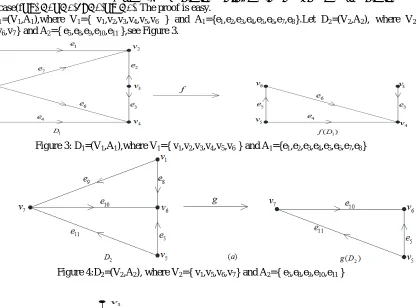
let D1=(V1,A1),where V1={ v1,v2,v3,v4,v5,v6 } and A1={e1,e2,e3,e4,e5,e6,e7,e8}.Let D2=(V2,A2), where V2={ v1,v5,v6,v7} and A2={ e5,e8,e9,e10,e11 },see Figure 3.
Figure 3: D1=(V1,A1),where V1={ v1,v2,v3,v4,v5,v6 } and A1={e1,e2,e3,e4,e5,e6,e7,e8}
Figure 4:D2=(V2,A2), where V2={ v1,v5,v6,v7} and A2={ e5,e8,e9,e10,e11 }
Figure 5: (f ∩ g){v1}={v5} and (f ∩g){e8}={e5}
3 5 6
1 2 4
5 6 7
1 5 1 1 2 1 1 3 5 5
1 2 1 2
4 6
6
5 7
6
0 1 0 0 0 1
0 0 0 0 0 0 0 0 1 1
0 0 1
0 1 0 1 0 0 0 0 1 1
,
0 0 0 0 0 0 0 0 0 0
0 0 0 1 0 1 0 0 1 0
0 1 0 1 0 0
v v v
v v v
v v v v v v v v v v v v v v
M D M D and M D D
v v v v v v
60 0 1
0 0 0
By using only these adjacency matrices we can define the digraph folding. For example, by using the adjacency matrix M(D1∩D2) we can easily see that the vertex v1 will be mapped to the vertex v5, since the first and second rows have the same entries. Also, the arc (v1,v6)=e8 can be mapped to the arc (v5,v6 )=e5 , since the first and second rows are the same. Again by using M(D1) and M(D2) we can describe the digraphfoldingof both D1 and D2.
IV. JOIN OF DIAGRAPHS
A. Definition
Let D1 and D2 be vertex dis joint diagraphs. Then we define the join digraph, D1 v D2, to be the digraph in which each vertex of D1 or D2 is adjacent to the vertices of D2 (or D1).
B. Definition
Let D1=(V1,A1), D2=(V2,A2),D3=(V3,A3) and D4=(V4,A4) be simple digraphs. Let f: D1 D3 and g: D2 D4 be digraph maps. By a join dimap, we mean a digraph map, fvg: D1vD2 D3vD4 defined by
f(v), if v ϵ V1 (i) For each vertex v ϵ V1 U V2, (fvg) (v)=
g(v) , if v ϵ V2
(ii) For each arc e =(v1,v2),v1ϵ V1 and v2ϵ V2 , (fvg){e}= {f(v1),g(v2)}ϵ A3vA4.
(iii) If e=(u1,v1) ϵ A1, then (fvg){e}=(fvg){(u1,v1)}={f(u1),f(v1)}, Also if e =(u2,v2) ϵ A2 ,then (fvg){e}= (fvg){(u2,v2)}={ g(u2),g(v2)}
Note that If f{u1}= f{v1},then the image of the join dimap (fvg){e} will be a vertex of D3 v D4 and thus is not a digraph folding.
THEOREM
Let D1, D2, D3and D4 be digraphs, let f:D1 D3 and g:D2 D4 be digraph maps .Then (fvg) ϵ Ð(D1vD2, D3vD4) is a digraph folding if f and g are digraph folding.
Proof: Suppose f and g are digraph folding.Then (fvg){ V1UV2 }= {f( V1)Ug(V2)}.But f(V1) ϵ V(D3) , g(V2) ϵ
V(D4).Thus{f(V1)Ug(V2)} ϵ V(D3vD4) , i.e., fvg maps vertices to vertices .Now, let e ϵ A( D1vD2 ).Then either e ϵ A( D1) or e ϵ A( D2 ) or e is an arc joining a vertex of D1 (or D2 ) to a vertex of D2 (or D1 ).In the first two cases and since each of f and g is a digraph folding,(fvg){e}ϵA(D3vD4).Now, if e=(v1,v2), v1 ϵ D1 and v2 ϵ D2.Then(fvg){e}=(fvg){(v1,v2)}={f(v1),g(v2)}={(v3,v4)} ϵ A(D3vD4). Thus fvg maps arcs to arcs and hence the join digraph map is a digraph folding. The converse is guaranteed by the definition of the join digraph.
C. Example
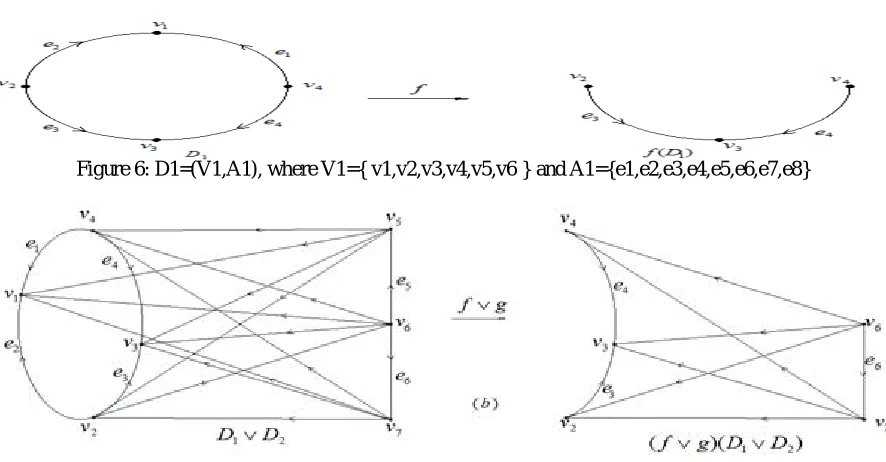
Figure 6: D1=(V1,A1), where V1={ v1,v2,v3,v4,v5,v6 } and A1={e1,e2,e3,e4,e5,e6,e7,e8}
Figure 7: D1= (V1, A1), where V1= {v1, v2, v3, v4} and A1= {e1, e2, e3, e4, e5} D2= (V2, A2), where V2= {v1, v2, v3, v5} and A2= {e1, e2, e6}
Let f ϵÐ(D_1) be defined by f{v1}={v3} and f{e1,e2}={e4,e3}.Also, let g ϵÐ(D_2) be defined by g{v5}={v7} and g{e5}={e6}.The join dimap fvg:D1v D2 D1v D2 is defined by (fvg){v1,v5}={v3,v7}and (fvg){e1}=(fvg){(v4,v1)}={(v4,v3)}={e4},also,(fvg){e5}=(fvg){(v6,v5)}={(v6,v7)}={e6}and
(fvg) {(v5,v1)}={(v7,v3)},and so on, see Figure 4.The adjacency matrices of D1, D2 and D1vD2 are as follows:
3 5 6 7
1 2 4
3
1 2 4
5 6 7
1 2 1 3 5 2 6
1 2 1 2 4
3
7 5
4
6
7
0 0 0 0 0 0 0
1 0 1 0 0 0 0
0 0 0 0
0 0 0 0 0 0 0 0 0 0
1 0 1 0 ,
1 0 1 1 0 1 0 0 0 0
0 0 0 0
0 0 0 1 1 1 1 0 0 0
1 0 1 0
1 1 1 1 1 0 1
1 1 1 1 0 0 0
v v v v
v v v
v
v v v
v v v
v v v v v v v
M D M D and M D D v
v v v v v v By using these adjacency matrices we can describe the digraph folding. The adjacency matrix M(D1) suggests that the vertex v1 can be mapped to the vertex v3 since the first and third columns of M(D1) have the same entries.Also the arc (v4,v1)= e1 can be mapped to the arc(v4,v3)=e4and the arc(v2,v1)=e2can be mapped to the arc(v2,v3)=e3 since the 1st and 3rd columns are the same.Again by using M(D2)and M(D1vD2)we can describe the digraph folding of both D2 and D1vD2.
V. THE CARTESIAN PRODUCT OF DIAGRAPH
A. Definition
(i) u1 = v1 and u2 is adjacent to v2 in D2 , or (ii) u1 is adjacent to v1 in D1 , u2 = v2.
B. Definition
Let D1, D2, D3 and D4 be simple digraphs .Let f: D1 D3 and g: D2 D4 is diagraph maps. Then by the Cartesian product dimapfxg: D1xD2 D3 x D4.
We mean a dimap defined as follows:
(i)If v=(v1,v2) ϵ V1xV2 , v1ϵ V1, v2ϵ V2,then (fxg)(v)=(fxg)(v1,v2)=(f(v1),g(v2)) ϵ V3xV4 (ii)If the arc e={({v1}i, {v2}j),({v1}i ,{v2}k)}, where {v1}i ϵ V(D1) and {v2}j ,{v2}kϵV(D2), then (fxg){e}=(fxg){({v1}i ,{v2}j) ,({v1}i,{v2}k)} ={({v1}i, g{v2}j),({v1}i, g{v2}k)}.
(iii)If the arc e={({v1}i,{v2}j),({v1}k ,{v2}j)}, where {v1}i ,{v1}kϵ V(D1) and {v2}jϵV(D2), then(fxg){e}=(fxg){({v1}I,{v2}j),({v1}k,{v2}j)}={(f{v1}i,{v2}j),(f{v1}k ,{v2}j)}.
Note that if g{v2}j=g{v2}kor f{v1}i=f{v1}k,the image of the arc will be a vertex
THEOREM
Let D1, D2, D3 and D4 be digraphs, letf:D1D3 and g :D2D4be digraph maps.Then(fxg) Ð(D1xD2,D3xD4 ) is a digraph folding iff Ð(D1,D3) and g Ð(D2,D4) are digraph foldings.In this case (fxg)(D1xD2)=f(D1) x g(D2). Proof:Suppose f and g are digraph folding. Then for each vertex (v1,v2) (D1xD2)=V1xV2,(fxg){(v1,v2)}={(f(v1),g(v2))}=(v3,v4) V(D1xD2)=V3 xV4, i.e., vertices to vertices. Now , let e A(D1 xD2) , then if e={({v1}i,{v2}j),({v1}k,{v2}j)},where {v1}i is adjacent to {v1}k in D1and {v2}j , then (fxg){e}=(fxg){({v1}i,{v2}j),({v1}k,{v2}j)}={(f{v1}i,{v2}j),(f{v1}k,{v2}j)} , since {v1}i is adjacent to {v1}k and f is a digraph folding,Then f{v1}i≠ f{v1}k.Thus (fxg){e} ϵ A(D3xD4).By the same procedure,if e={({v1}i ,{v2}j),({v1}i,{v2}k)} , where {v1}i ϵ V(D1) and {v2}j is adjacent to{v2}kin D2,then (fxg){e} ϵ A(D3xD4)i.e., fxg maps arcs to arcs and hence the Cartesian product dimap is a digraph folding.To prove the converse suppose that (fxg) is a digraph folding and for g,is not a digraph folding.In this case f or g,will maps an arc to a vertex,say f{(u1,v1)}={u3} ϵ V(D3).Then
(fxg){({u1},{v2}j),({v1},{v2}j)}={(f{u1},{v2}j),(f{v1},{v2}j)}={({u3},{v2}j),({u3},{v2}j)}ϵ V(D3xD4).This contradicts the assumption and thus each of f and g must be a digraph folding.
A. Examples
(a) Let D1=(V1,A1) , where V1={ , , , }, A={e1,e2,e3,e4}and D2=(V2,A2) , where V2 = {v1,v2,v3} , A= {e5,e6}, see Figure 4.
Figure 8: (fxg){(u4,v1),(u4,v2),(u4,v3),(u1,v1),(u2,v1),(u3,v1)}={(u2,v1),(u2,v2),(u2,v3), (u1,v3),(u2,v3),(u3,v3)}
Figure 10: (fxg){((u4,v1),(u3,v1)),((u3,v1),(u3,v2))}= {((u2,v3),(u3,v3)),((u3,v3),(u3,v2))}
Figure 11: (fxg){((u4,v1),(u3,v1)),((u3,v1),(u3,v2))}= {((u2,v3),(u3,v3)),((u3,v3),(u3,v2))}
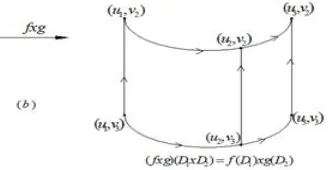
Let f Ð( ) defined by f{u4}={u2} and f{e1,e2}={e4,e3}.Also,let g Ð( )defined by g{v1} = {v3}and g{e5} = {e6}.Then the Cartesian product dimapfxg :D1xD2D3xD4is defined as follows :
(fxg){(u4,v1),(u4,v2),(u4,v3),(u1,v1),(u2,v1),(u3,v1)}={(u2,v1),(u2,v2),(u2,v3), (u1,v3),(u2,v3),(u3,v3)} .Also,
(fxg){((u4,v1),(u3,v1)),((u3,v1),(u3,v2))}={((u2,v3),(u3,v3)),((u3,v3),(u3,v2))} and so on, see Figure 4. The adjacency matrices of D1, D2 and D1xD2 are as follows:
3
1 2 4
3
1 2
1
1 2
2
1 2
3
3 4
0 1 0 1
0 1 0 0 0 1 0 ,
0 0 0
0 0 0 0
0 1 0
0 0 1 0 u
u u u
v v v
u
v u
v
M D M D and
u
v u
Once again we can describe the digraph foldings by using M(D1),M(D2) and M(D1XD2).For example, from M(D1XD2) we can see that the vertex (u4,v1) can be mapped to the vertex (u2,v1) since the second and fourth columns are the same . Also, the arc ((u1,v1),(u4,v1)) will be mapped to the arc ((u1,v3),(u2,v3)) since the vertex (u4,v1) is mapped to the vertex (u2,v3) and the vertex (u1,v1) is mapped to the vertex (u1,v3), and so on, see Figure 4.
(b)Let D1=(V1,A1), where V1={u1,u2,u3,u4}, A1={e1,e2,e3,e4} and D2=(V2,A2), where V2 = {v1,v2,v3,v4}, A2 = {e5,e6,e7,e8}, see Figure 5.
Figure 12: f{u4}={u2}, f{e1,e2} = {e3,e4}
Figure 13: (fxg){((u4,v1),(u3,v1)),((u3,v1),(u3,v2))}= {((u2,v3),(u3,v3)),((u3,v3),(u3,v2))}
Let f Ð( )be defined by f{u4}={u2}, f{e1,e2} = {e3,e4} and g Ð( ) be defined by g{v1} = { v3} , g{e6 ,e8}= {e5,e7}. Then the cartesian product dimap h = f x g : D1 x D2D1 x D2 is defined as follows:
h{(u4,v2),(u3,v1)}={(u2,v2),(u3,v3)}, and so on. Also, h{((u4,v2),(u1,v2)),((u3,v1),(u3,v2))}=
{((u2,v2),(u1,v2)),((u3,v3),(u3,v2))}, and so on, see Figure 6. The adjacency matrices of D1,D2 and D1 x D2 are as follows:
Once again we can describe the digraph foldings by using M(D1) and M(D1 xD2).For example, from M(D1 x D2) we can see that the vertex (u4,v2) can be mapped to the vertex (u2,v2) since the 6th and 8th rows have the same entries. And the vertex (u3,v1) can be mapped to the vertex (u3,v3) since the 3rd and 11th rows are the same .Also, the arcs ((u4,v2),(u1,v2))and ((u4,v2),(u3,v2)) can be mapped to the arcs ((u2,v2),(u1,v2)) and((u2,v2),(u3,v2)) ,respectively, since the 6thand 8th rows are the same.Finally the arcs ((u3,v1),(u3,v2)) and ((u3,v1),(u3,v4)) can be mapped to the arcs ((u3,v3),(u3,v2)) and ((u3,v3),(u3,v4)) ,respectively, since the 3th and 11th rows are the same.And so on, see Figure 6.
VI. THE COMPOSITION OF DIGRAPHS
A. Definition
The composition D1[D2]of two simple diagraphs is a simple diagraphs with V( D1[D2])=V1xV2. The vertices u=(u1,u2) and v=(v1,v2) are adjacent if either u1 is adjacent to v1and u2=v2or u1 = v1 and u2 is adjacent to v2.
B. Definition
Let D1,D2,D3 and D4 be simple diagraphs.Let f: D1D3 and g:D2D4be diagraph maps.By the composition dimap f[g]: D1[D2]D3[D4] we mean a map defined as follows
(i)Ifv=(v1,v2) V(D1[D2])=V1xV2,then f[g]{(v1,v2)}={(f(v1),g(v2))} V(D3[D4])
THEOREM
Let D1, D2, D3 and D4 be digraphs. letf:D1D3 and g :D2D4be digraph maps.Then the composition dimap f[g] Ð(D1[D2] , D3[D4] ) is a digraph folding if f Ð(D1,D3) and g Ð(D2,D4) are digraph foldings .
Proof:Let f and g be digraphfolding, then
(i)Foreach vertex v=(v1,v2)ϵV(D1[D2])=V1xV2, f[g]{(v1,v2)}={(f(v1),g(v2))}.But f(v1)ϵ V(D3) and g(v2) ϵ V(D4) ,then {(f(v1),g(v2))} ϵ V(D3[D4], i.e., f[g] maps vertices to vertices.
(ii)Let e={({v1}i ,{v2}j),({v1}k ,{v2}l)} and suppose {v1}iis adjacent to {v1}k , then there exists an arc {({v1}i ,{v1}k )}ϵ A1, since f is a digraph folding and {({v1}i,{v1}k )}ϵ A1, then f[g]{e} ϵ A(D3[D4]).Now, if {v1}i={v1}kand {v2}jis adjacent to {v2}l,thenf[g]{e}={({v1}i ,g{ v2}j),({v1}i ,g{v2}l)}, since {v2}jis adjacentto {v2}l, thenthere exists an arc{({v2}j ,{v2}l )}ϵ A2 such that {(g{v2}j ,g{v2}l )}ϵ A3 ,i.e., g{v2}j ≠ g{v2}l andhencef[g]{e} ϵ A(D3[D4]), i.e., f[g] maps arcs to arcs.The converse is not true since if f[g] is a digraph folding and for g,is not a digraphfolding.In this case for g,maps an arc to a vertex, say f(u1,v1)= (u3,u3), u3ϵ V(D3).
Then f[g]{(u1,{v2}i),(v1,{v2}j)}={(f(u1),g{v2}i),(f(v1),g{v2}j)}={(u3, g{v2}i),(u3, g{v2}j)} which is an arc of D3[D4].
A. Example
Let D1, D2,f and g be the digraphs and digraph foldings given in Example (A). The adjacency matrix of D1[D2] is as follows:
Nowa digraph folding f[g]: D1[D2]D1[D2] can be defined as
Figure 15: f[g]{(u4,v1),(u4,v2),(u4,v3),(u1,v1),(u2,v1),(u3,v1)}={(u2,v1),(u2,v2), (u2,v3),(u1,v3),(u2,v3),(u3,v3)}
Figure 16: f[g]{(u4,v1),(u4,v2),(u4,v3),(u1,v1),(u2,v1),(u3,v1)}={(u2,v1),(u2,v2), (u2,v3),(u1,v3),(u2,v3),(u3,v3)}
We can describe the digraph foldings by using M(D1),M(D2) and M(D1 [D2]).For example, from M(D1 [D2]) we can see that the vertex (u4,v1) can be mapped to the vertex (u2,v1) since the second and fourth rows have the same entries. Also, the arc ((u1,v1),(u4,v1)) can be mapped to the arc ((u1,v1),(u2,v1)) since the second and fourth rows are the same. Also the vertex (u1,v1) can be mapped to the vertex (u1,v3) since 1st and 9th rows have the same entries, and so on.
REFERENCES
1. Balakrishnan R, Ranganathan K, “text book of graph theory, Springer-Verlag”,Inst., New York, 2000. 2. EL-Esawy A, “Cayley folding of manifolds”, Ph.D. Thesis, Tanta University, Egypt, 2005.
3. El-Kholy E, Al-Esawy A,“Graph folding of some special graphs”,J.Math & Statistics, 1(1): 66-70, 2005. 4. El-Kholy E, Ahmed H,“Folding of Digraphs”.



![Figure 16: f[g]{(u4,v1),(u4,v2),(u4,v3),(u1,v1),(u2,v1),(u3,v1)}={(u2,v1),(u2,v2), (u2,v3),(u1,v3),(u2,v3),(u3,v3)}](https://thumb-us.123doks.com/thumbv2/123dok_us/1483444.1181483/12.595.204.401.178.364/figure-u-u-v-u-v-u-v.webp)