Mobile Data Collection in Wireless Sensor
Networks Using Bounded Relay Hop
Ms. PRABHA. N1, Mr. ASHWIN.M, M.E (PhD) 2
M.E, Department of CSE, Adhiyamaan college of engineering, Krishnagiri,Tamil nadu ,India. 1
Professor, Department of CSE, Adhiyamaan college of engineering, Krishnagiri,Tamil nadu ,India. 2
Abstract: Wireless sensor networks are used for ambient data collection in diverse environments where Energy consumption becomes a primary concern. Wireless sensor network (WSN) requires robust and energy efficient communication protocols to minimize the energy consumption as much as possible. We propose a polling-based mobile gathering approach and formulate it into an optimization problem, named bounded relay hop mobile data gathering (BRH-MDG).Centralized and Decentralized algorithm for selecting polling points that buffer locally aggregated data and upload the data to the mobile collector when it arrives. We analyze the trade-off between energy saving and data gathering latency in mobile data gathering by exploring a balance between the relay hop count of local data aggregation and the moving tour length of the mobile collector. The proposed approach shortens the data gathering latency compared with the other schemes.
Keywords: Bounded Relay Hop Method, Wireless Sensor Networks.
I.INTRODUCTION
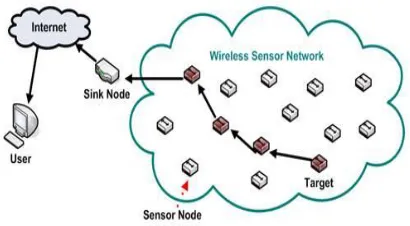
A Wireless Sensor Network (WSN) is a self-configuring network of small sensor nodes communicating among themselves using radio signals, and deployed in quantity to sense, monitor and understand the physical world. It consists of spatially distributed autonomous sensors to monitor physical or environmental conditions, such as temperature, sound, vibration, pressure, motion or pollutants and to cooperatively pass their data through the network to a main location. The more modern networks are
bi-directional, enabling also to control the activity of the sensors. The development of wireless sensor networks was motivated by military applications such as battlefield surveillance; today such networks are used in many industrial and consumer applications, such as industrial process monitoring and control, machine health monitoring and so on. Multiple sensors (often hundreds or thousands) form a network to cooperatively monitor large or complex physical environments.
Figure 1 WSN Architecture
Figure 2 Single-Hop and Multi-Hop transmission
Every sensor communicates directly with the base station. It may require large transmit powers and may be infeasible in large geographic areas. This is called as single hop transmission. A sensor, which serve as relay for other sensor nodes to transmit the data is called Multi-hop transmission. It may reduce power consumption and allows for larger coverage. It introduces the problem of routing.
The rest of the paper is organized as follows: Section 2 outlines the polling-based approach and formulates the BRH-MDG problem. Sections 3 and 4 present two algorithms to solve the BRH-MDG problem, respectively. Finally, Section 5 concludes the paper.
2. BRH-MDG PROBLEM
In this section, we first give an overview of the proposed polling-based mobile data gathering scheme and then formulate it into an optimization problem.
2.1 Overview
A large number of wireless sensor nodes are deployed over a field to extract the data. All the sensor nodes are having capability to gather the data from its neighboring nodes. To minimize the energy consumption on the forwarding path does not necessarily prolong network lifetime as some popular sensors on the path may run out of energy faster than others, which may cause non uniform energy consumption across the network. To overcome the above problem, mobile collector is employed here.
Figure 3 Illustration of polling-based mobile data gathering within two hops(d = 2).
It roams over a sensing filed, “transports” data while moving, or pauses at some anchor points on its moving path to collect data from sensors via short-range communications. Energy consumption at sensors can be greatly reduced, since the mobility of the collector effectively dampens the relay hops of each packet. To pursue the maximum energy saving, the mobile collector should traverse the transmission range of each sensor in the field so that each packet can be transmitted to the mobile collector in a single hop. Due to the low velocity of the mobile collector, it would incur long latency in data gathering, which may not meet the delay requirements of time-sensitive applications.
In order to shorten data gathering latency, it is necessary to incorporate multi-hop relay into mobile data gathering, while the relay hop count should be constrained to certain level to limit the energy consumption at sensors. Polling based approach pursues a tradeoff between the energy saving and data gathering latency. It achieves the balance between the relay hop count for local aggregation and the moving tour length of the mobile collector. A subset of sensor will be selected as the polling points (PPs), each aggregating the local data from its affiliated sensors within a certain number of relay hops. These PPs will temporarily cache the data an upload them to the mobile collector when it arrives.
Assume that the sensors located such that they are unreachable from each other via wireless transmissions, which can be achieved by reducing the transmission range below a certain level. This reduction is straightforward and can certainly be done in polynomial time. It is infeasible for the data packets of a sensor to be relayed by others. The mobile collector has to visit each sensor to gather data packets, which implies that all the sensors and the data sink are the PPs. Due to the NP hardness of the BRH-MDG problem, the centralized heuristic algorithm is developed. To find the optimal PP locations among sensors, relay routing paths and the tour of the mobile collector should be jointly considered.
3. SHORTEST PATH TREE BASED DATA GATHERING ALGORITHM (SPT-DGA)
When a mobile collector is available, the data gathering tour can be effectively shortened in two ways: First, the sensors selected as the PPs are compactly distributed and close to the data sink. Second, the number of the PPs is the smallest under the constraint of the relay hop bound. The proposed algorithm named as
shortest path tree based data gathering algorithm (SPT-DGA) based on the above observations. The basic idea of the above algorithm is to iteratively find a PP among the sensor to the root that can connect the remote sensors on the tree.
Figure 4 An example to illustrate the SPT-DGA algorithm (N=25, d=2) Iteration 1
There are 25 sensors are scattered over a field with the static data sink located in the centre of the area, and d is set to 2, which means that it is required for each sensor to forward its data to the affiliated PP within two hops. The constructed SPT among the sensors rooted at
sensor 1 denoted by T', is depicted in Fig.3a. In the first iteration, sensor 8 is found to be farthest leaf vertex on T' with five hops away from the root, that is,
v=8. Its two hop parent vertex u on current T' is sensor 3 (u=3), which will be marked as PP.
Iteration 2
All the child vertices of u, including sensors 8, 11 and 23, and their associated edges will be removed from T'. The result is depicted in above diagram, where sensor 3 is still kept on the updated SPT, and the removed vertices highlighted by the shadowed area are its affiliated sensors found in the current iteration.
In the second iteration, the farthest leaf vertex on the updated T' turns to be sensor 5 with four hops away from the root. Similarly, its two-hop parent (i.e. , sensor 15) is selected as another PP to cover the sensors in the other shadowed area in the above diagram.
Iteration 3
sensor 3s one-hop parent, i.e., w=25. Sensor 25 and all its child vertices on current T' can reach sensor 3 within two hops along the edges on T'. Therefore, the subtree rooted at sensor 25 will be pruned from T'. All the sensors on the subtree, including sensors 25, 12 and 3, will also be affiliated with sensor 3. The above figure indicates that a total of six sensors will be covered by sensor 3, which are found in iterations one and three, respectively. In this way, T' is decomposed into a set of subtree, each of which contains a selected PP and its affiliated sensors.
Final result
The final result denotes the data gathering tour is highlighted by the line segments linking the PPs and the static data sink. The Centralized SPT-DGA algorithm is applicable in finding a good data gathering tour. The distributed algorithm searches for the suitable sensors as the PPs to achieve better scalability. There are two factors greatly affect the suitability of a sensor to be a PP. One is the number of sensors within its d-hop range and the other is its distance to the data sink.
4. PRIORITY BASED PP SELECTION ALGORITHM (PB-PSA)
A sensor that can cover more sensors in its d -hop neighborhood and is close to the data sink will be more favorable to be a PP since it leads to a smaller total number of PPs and more compacted distribution among the PPs. Considering these factors, priority based PP selection algorithm or PB-PSA is proposed.
Two parameters are used to prioritize each sensor in the network, which can be easily obtained in a
distributed manner. The primary parameter is the number of d-hop neighbors, which are the sensors in its d-hop range. The secondary parameter is the minimum hop count to the data sink. The basic idea of PB-PSA is that each sensor uses the primary parameter to select an initial set of sensors as its preferred PPs, and then uses the secondary parameter to “break ties”. A tie in this context means that the preferred PPs of a sensor have the same number of d-hop neighbors.
Figure 5 An example to illustrate the PB-PSA algorithm (N=20, d=2) Network Configuration
There are a total of 20 sensors and the data sink is assumed to be located at the centre of the area. The connectivity among the sensors and the data sink is shown by the links between neighbouring nodes in the above diagram. Set the d value to be 2, which implies that each sensor needs to do two rounds of local exchange. Every sensor updates its TENTA_PP based on the received information, and the result in each round is noted.When the iterations are completed, sensors 2, 7, and 17 find that they are the TENTA_PPs for themselves and consequently send out the declaration messages to
claim to be the PPs.
During the delay period, all other sensors can receive some declaration messages. Thus, there will be no other PPs. In the next step, each sensor with “Tentative” status will choose to be affiliated with a PP among those it has heard from, which will not necessarily be constrained to the current TENTA-PP of the sensor. The final PPs, the sensors affiliation pattern and the data gathering tour are depicted in the above figure.
5. CONCLUSION
The data gathering scheme proposed in the paper minimizes delay in wireless sensor network by reducing the relay hop count of sensors for local data aggregation and the tour length of the mobile collector. We have also proposed a polling-based scheme and formulated it into the BRH-MDG problem. Extensive simulations have been carried out using two efficient algorithms (centralized and decentralized) to validate the efficiency of the scheme
REFERENCES
[1] W.C. Cheng, C. Chou, L. Golubchik, S. Khuller, and Y.C. Wan,
“A Coordinated Data Collection Approach: Design, Evaluation, and Comparison,” IEEE J. Selected Areas in Comm., vol. 22, no. 10, pp. 2004-2018, Dec. 2004.
[2] A. Manjeshwar and D.P. Agrawal, “Teen: A Routing Protocol for
Enhanced Efficiency in Wireless Sensor Networks,” Proc. IEEE Int’l Parallel and Distributed Processing Symp., Apr. 2001.
[3] A. Scaglione and S.D. Servetto, “On the Interdependence of
Routing and Data Compression in Multi-Hop Sensor Networks,” Proc. ACM MobiCom, 2002.
[4] X. Tang and J. Xu, “Adaptive Data Collection Strategies for Lifetime-Constrained Wireless Sensor Networks,” IEEE Trans. Parallel and Distributed Systems, vol. 19, no. 6, pp. 721-734, June 2008.
[5] B. Gedik, L. Liu, and P.S. Yu, “ASAP: An Adaptive Sampling
Approach to Data Collection in Sensor Networks,” IEEE Trans. Parallel and Distributed Systems, vol. 18, no. 12, pp. 1766-1783, Dec. 2007.
[6] C. Liu, K. Wu, and J. Pei, “An Energy-Efficient Data
Collection Framework for Wireless Sensor Networks by Exploiting Spatio-temporal Correlation,” IEEE Trans. Parallel and Distributed Systems, vol. 18, no. 7, pp. 1010-1023, July 2007.
[7] R. Shah, S. Roy, S. Jain, and W. Brunette, “Data MULEs:
Modeling a Three-Tier Architecture for Sparse Sensor Networks,” Elsevier Ad Hoc Networks J., vol. 1, pp. 215-233, Sept. 2003.
[8] S. Jain, R. Shah, W. Brunette, G. Borriello, and S. Roy,
“Exploiting Mobility for Energy Efficient Data Collection in
Wireless Sensor Networks,” Mobile Networks and
Applications, vol. 11, no. 3, pp. 327-339, 2006.
[9] D. Jea, A.A. Somasundara, and M.B. Srivastava, “Multiple
Controlled Mobile Elements (Data Mules) for Data Collection in Sensor Networks,” Proc. IEEE/ACM Distributed Computing in Sensor Systems (DCOSS), June 2005.
[10] P. Juang, H. Oki, Y. Wang, M. Martonosi, L. Peh, and D.
Rubenstein, “Energy-Efficient Computing for Wildlife
Tracking: Design Tradeoffs and Early Experiences with Zebranet,” Proc. Int’l Conf. Architectural Support for Programming Languages and Operating Systems (ASPLOS), 2002.
[11] T. Small and Z. Haas, “The Shared Wireless Infostation
Model—A New Ad Hoc Networking Paradigm (or Where There is a Whale, There is a Way),” Proc. ACM Int’l Symp. Mobile Ad Hoc Networking and Computing (MobiHoc), 2003.
[12] M.A. Batalin, M. Rahimi, Y. Yu, D. Liu, A. Kansal, G.S.
Sukhatme, W.J. Kaiser, M. Hansen, G.J. Pottie, M. Srivastava, and D. Estrin, “Call and Response: Experiments in Sampling the Environment,” Proc. ACM Int’l Conf. Embedded Networked Sensor Systems (SenSys ’04), 2004.
[13] R. Pon, M.A. Batalin, J. Gordon, A. Kansal, D. Liu, M.
Rahimi, L. Shirachi, Y. Yu, M. Hansen, W.J. Kaiser, M. Srivastava, G. Sukhatme, and D. Estrin, “Networked Infomechanical Systems: A Mobile Embedded Networked Sensor Platform,” Proc. ACM/ IEEE Int’l Symp. Information Processing in Sensor Networks (IPSN), 2005.
[14] A.A. Somasundara, A. Ramamoorthy, and M.B. Srivastava,
“Mobile Element Scheduling with Dynamic Deadlines,” IEEE Trans. Mobile Computing, vol. 6, no. 4, pp. 395-410, Apr. 2007.
[15] M. Ma and Y. Yang, “Data Gathering in Wireless Sensor
Networks with Mobile Collectors,” Proc. IEEE Int’l Symp.
[16] Parallel and Distributed Processing (IPDPS), 2008.
[17] M. Ma and Y. Yang, “SenCar: An Energy-Efficient Data