A Study on CBR Value of Soil Using
Admixture (Flyash)
Mohan Badiger
1, Mohammed Gouse Dhalayat
2, Mahesh Dali
3, Sharanappagouda H R
4, Kalakappa D
5Assistant professor, Department of Civil Engineering, TCE Gadag, Karnataka, India1
Assistant professor, Department of Civil Engineering, SECAB IET, Vijayapur, Karnataka, India2
U G Students, Department of Civil Engineering, TCE Gadag, Karnataka, India3,4,5
ABSTRACT: Nowadays about 200 million tonnes of flyash is generated annually because of combustion of coal in thermal plants. Present study aims at use of waste flyash in pavement subgrade and study the effectiveness of flyash on engineering properties of soil and strength of subgrade in terms of California Bearing Ratio (CBR) value on addition of flyash. Flyash is added to plain soil (subgrade) by replacing 5% to 25% of soil and laboratory tests were conducted. CBR value is commonly used to assess the strength of subgrade in pavement design. In this study, CBR unsoaked and soaked tests were conducted for different proportions of soil-flyash mixture and found the optimum dosage of flyash to be used effectively in road construction. Experimental results shows that upto 20% addition of flyash will improve the Maximum dry density and CBR value beyond that it is not significant. After the addition of flyash, CBR value is increases, this will reduce the pavement thickness.
KEYWORDS:Flyash, California Bearing Ratio, Maximum Dry Density, Optimum moisture content.
I.INTRODUCTION
The construction of embankment is very important for the design of pavement. The construction of embankment requires large quantity of soil. In some areas the availability of good soil is quite difficult and areas where expansive soil creates big problem for pavement construction. Generally to strengthen weak soils one of the approach used is to remove or replace weak soil by stronger material of crushed rock. Due to uneconomical cost of this technique, engineers find alternative techniques that are cost effective and environmentally friendly. In India, coal used power
generation is 30-40% and India ranks 4th in the world in the production of coal ash as byproduct waste. Nowadays it becomes challenges to disposal and reuse of flyash because it takes huge amount of land space. Through the chemical stabilization could develop various engineering properties of soil. Due to this field, cost effective and availability of byproducts the usage of these products is progressed. There is need to assess the effectiveness of flyash in improving strength and engineering properties of soil.
One of the main factors in construction of roads, airport pavements and embankments is compaction property of soil. For pavement subgrade, the strength is measured in terms of California bearing ratio (CBR) value. Compaction properties are conducted in laboratory for different proportions of soil- flyash mixtures and CBR test is carried out to determine the strength of mixture. After the addition of flyash, the improvement in the various engineering properties of soil is examined and the optimum dosage of flyash to be used effectively in pavement subgrade is determined.
II. RELATED WORK
Ansu Thomas et al., 2015 concluded that the addition of flyash to the soil improves the index properties and found that optimum moisture content decreases and maximum dry density increases due to the addition of flyash [1].
Mahajan and Parbat they have conducted experiments on soil-flyash mixtures. The flyash content varies from 10 to 50%. They found that swelling and plasticity properties can be reduced and maximum density is increased due to addition of flyash [3].
.
III. MATERIALS
RED SOIL
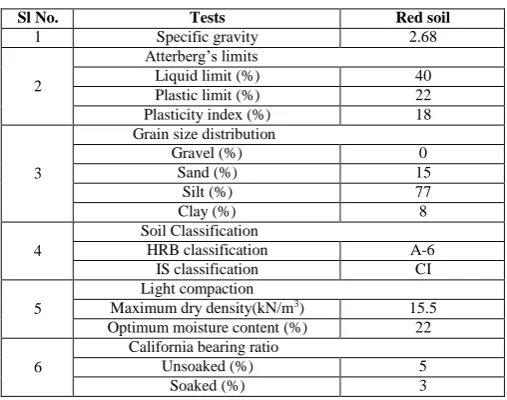
The red soil was collected near Hulakoti, Gadag district, Karnataka. By core cuter method, in-situ density and water content of soil are found to be 13.73 kN/m3 and 6.8% respectively. The various engineering properties of soil are
tested in laboratory and the results are tabulated in Table 1. Soil has dry unit weight of 15.5 kN/m3 and optimum
moisture content of 22%. Grain size analysis was carried out and soil consists of 15% of sand, 77% of silt and 8% of clay. Soil has liquid limit of 40% and plastic limit of 22%. CBR values of soil for unsoaked and soaked condition are 5% and 3% respectively.
Table 1. ENINEERING PROPERTIES OF SOIL
Sl No. Tests Red soil
1 Specific gravity 2.68
2
Atterberg’s limits
Liquid limit (%) 40
Plastic limit (%) 22
Plasticity index (%) 18
3
Grain size distribution
Gravel (%) 0
Sand (%) 15
Silt (%) 77
Clay (%) 8
4
Soil Classification
HRB classification A-6
IS classification CI
5
Light compaction
Maximum dry density(kN/m3) 15.5
Optimum moisture content (%) 22
6
California bearing ratio
Unsoaked (%) 5
Soaked (%) 3
FLYASH
Flyash is a coal combustion product composed of fine particles that are thrown out of boiler with flue gases. It is the byproduct from burning coal in thermal power plants.
For present study “class F” flyash was used. Flyash is added in different proportions to the soil. The chemical composition of flyash is tabulated in Table 2.
Table 2.CHEMICAL COMPOSITION OF FLYASH
Content % by mass
Silicon dioxide 1.30
Aluminium oxide 25.70
Ferric oxide 5.30
Calcium oxide 5.60
Potassium oxide 0.60
Sodium oxide 0.40
SOIL-FLYASH MIXTURES
Various proportions of soil-flyash mixture that are used in present investigations are tabulated in Table 3. In the present investigation we are replacing the soil by flyash percentage by weight.
Table 3.PROPORTIONS OF SOIL-FLYASH MIXTURE
Sl. No. Mixture of soil-flyash
1 Soil + 0% flyash
2 95% soil + 5% flyash
3 90% soil + 10% flyash
4 85% soil + 15% flyash
5 80% soil + 20% flyash
6 75% soil + 25% flyash
IV. EXPERIMENTAL RESULTS
ATTERBERG’S LIMITS
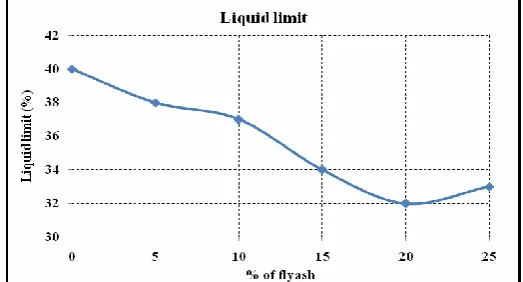
Atterberg’s limits are tested as per IS: 2720 part-V. It is observed that liquid limit and plastic limit goes on decreases upto certain addition of flyash. Due to the addition of flyash the voids in flocculated soil are filled by finer particles of flyash this will decreases the plasticity of soil. Figure 1 shows the variation of Liquid limit with the addition of flyash.
Figure 1. Variation of liquid limit
LIGHT COMPACTION METHOD
For present investigation, standard proctor method was used as per IS: 2720 part-VII. 3kg of sample is compacted in 3 layers and each layer is tamped 25 blows. The variation of maximum dry density with addition of flyash is shown in
figure 2. As the addition of flyash increases, the maximum dry density increases upto 20% addition of flyash and then
Figure 2. Variation of Maximum Dry Density
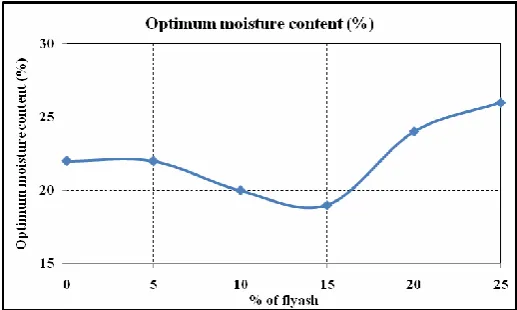
Figure 3 showsthe variation of Optimum moisture content with the addition of flyash. Optimum moisture content
decreases upto 15 % of addition of flyash and further addition will increases the optimum moisture content of the mixture. It is due to the pozzolonic activity of flyash, it absorbs more water.
Figure 3. Variation of optimum moisture content
CALIFORNIA BEARING RATIO
California bearing ratio is used to evaluate the strength of the subgrade soil. Unsoaked and soaked CBR tests are conducted for different proportions of the soil-flyash mixtures. Test was conducted as per IS: 2720 part-16.
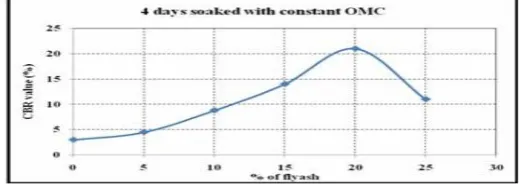
Optimum moisture content varies due to the replacement of flyash. This will affect the compaction characteristics of the mix. So, there are two series of tests were conducted for unsoaked and 4 days soaked conditions.
Constant OMC i.e., OMC of soil was taken for blending all the soil-flyash proportions.
OMC varies due to addition of flyash. The OMC of the mix is determined using light compaction and it is
used for blending soil-flyash proportions.
Table 4.SERIES OF EXPERIMENTS
Sl. No. TEST CONDITION
1 Unsoaked with constant OMC
2 4 days soaked with OMC of mix
3 Unsoaked with different OMC
4 4 days soaked with OMC of mix
Table 5 shows the CBR test results for constant optimum moisture content i.e., OMC of soil was taken for blending all the soil-flyash mixture. It is observed that upto 20% of addition of flyash will shows good improvement in CBR value.
Table 5. CBR TEST RESULTS WITH CONSTANT OMC
Soil-flyash mixture CBR unsoaked value (%) CBR soaked value (%)
Soil + 0% flyash 5.12 3
95% soil + 5% flyash 6.5 4.5
90% soil + 10% flyash 11 8.8
85% soil + 15% flyash 17 14
80% soil + 20% flyash 24 21
75% soil + 25% flyash 15 11
The variation of CBR value for unsoaked condition with constant OMC is shown in figure 4. It shows improvement
upto 20% addition of flyash. Further addition of flyash will reduce the CBR value. For 20% addition of flyash CBR value of the soil increases from 5% to 24%. This is because of the cementing property of flyash.
Figure 4. Variation of CBR unsoaked value with constant OMC
The variation of CBR value for soaked condition with constant OMC is shown in figure 5. It shows improvement
upto 20% flyash addition. Further addition of flyash will reduce the CBR value. For 20% addition of flyash CBR value of the soil increases from 3% to 21%. Soaked CBR value is considered for design of pavement as per IRC: 37 (2001) guidelines. Flyash shows good improvement in soaked condition which indicates a favorable change that flyash have good drainage property and can be used effectively in pavement subgrade.
Table 6 shows the CBR test results for optimum moisture content of the mixes. OMC varies due to addition of flyash. The OMC of the mix is determined using light compaction and it is used for blending soil-flyash proportions. It is observed that upto 15% of addition of flyash will shows good improvement in CBR value.
Table 6 CBR TEST RESULTS WITH OMC OF MIX
Soil-flyash mixture CBR unsoaked value CBR soaked value
Soil + 0% flyash 5.12 3
95% soil + 5% flyash 7 5.2
90% soil + 10% flyash 12 9.5
85% soil + 15% flyash 16 12.5
80% soil + 20% flyash 13.2 9.8
75% soil + 25% flyash 9 7
The variation of CBR value for unsoaked condition with OMC of mixes is shown in figure 6.It shows improvement
up to 15% flyash addition. Further addition of flyash will reduce the CBR value. For 15% addition of flyash CBR value of the soil increases from 5% to 16%. It is observed that the addition of flyash to the soil upto 15% to 20% is favorable.
Figure 6. Variation of CBR unsoaked value with OMC of mix
The variation of CBR value for soaked condition with OMC of mixes is shown in figure 7. It shows improvement upto 15% addition of flyash. Further addition of flyash will reduce the CBR value. For 15% addition of flyash CBR value increases from 3% to 12.5%.
Figure 7. Variation of CBR soaked value with OMC of mix
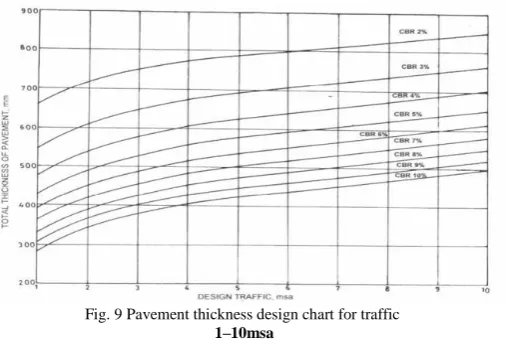
FLEXIBLE PAVEMENT DESIGN (IRC: 37-2001)
reduce the total thickness of pavement. However, as per IRC: 37 (2001) guidelines the minimum thickness of pavement should be provided.
Fig. 9 Pavement thickness design chart for traffic 1–10msa
V. CONCLUSIONS
The addition of flyash to the soil will show improvement in the engineering properties of soil. The following conclusions were made on above results and discussions.
The addition of flyash to the soil will reduce the liquid and plastic limits.
Plasticity index of the soil decreases with the addition of flyash which indicates favorable change since it
increases the workability of mix.
Addition of flyash upto 20% brings improvement in the compaction characteristics. i.e., the maximum dry
density increases and optimum moisture content decreases.
The unsoaked CBR value of soil at constant optimum moisture content is increased from 5% to 24% and
soaked CBR value of soil at constant optimum moisture content is increased from 3% to 21% by the addition of 20% flyash.
The unsoaked CBR value of soil at optimum moisture content of mixes is increased from 5% to 16% and
soaked CBR value of soil at constant optimum moisture content is increased from 3% to 12.5% by the addition of 15% flyash.
The addition of flyash will reduce the thickness of pavement. For traffic of 1msa granular sub-base thickness is reduced by 185 mm.
From experimental results, we observed that, the optimum dosage of flyash is 15 to 20% to use effectively
in pavement subgrade. Beyond 20% addition of flyash is not significant.
REFERENCES
1. Ansu Thomas, Kavindra Kumar, Leeyash Tandon, Om Prakash, “effect of flyash on the engineering properties of soil,” International Journal of
Advances in Mechanical and Civil Engineering, volume-2, issue-3, june-2015.
2. Mahesh G. Kalyanshetti, Satish Basavaraj Thalange, “Effect of fly ash on the properties of expansive soil,” International Journal of Scientific &
Engineering Research, Volume 4, Issue 5, May-2013.
3. S.M. Mahajan, D. K. Parbat, “Effects of Fly ash on Engineering Properties of BC Soil,” International journal of Research in Engineering, Science and Technologies. Volume 1, No. 5 August 2015.
4. Tanaya deb, sujit kumar pal, “effect of fly ash on geotechnical properties of local soil-fly ash mixed samples,” international journal of research
in engineering nd technology, volume: 03, issue: 05, may 2014.
6. Kiran B. Biradar, U. Arun kumar, PVV Satyanarayana, “Influence of Steel Slag and Fly Ash on Strength Properties of Clayey Soil: A Comparative Study,” International Journal of Engineering Trends and Technology (IJETT) – Volume 14 Number 2 – Aug 2014.
7. S.Bhuvaneshwari, r. G. Robinson, s. R. Gandhi, “stabilization of expansive soils using flyash,” fly ash india 2005, new delhi.
8. Karthik.S, Ashok kumar.E, Gowtham.P, Elango.G, Gokul.D, Thangaraj.S, “Soil Stabilization By Using Fly Ash” IOSR Journal of Mechanical
and Civil Engineering (IOSR-JMCE), Volume 10, Issue 6 (Jan. 2014).
9. Gyanen. Takhelmayum, Savitha.A.L, Krishna Gudi, “Laboratory Study on Soil Stabilization Using Fly ash Mixtures,” International Journal of