Available Online at www.ijcsmc.com
International Journal of Computer Science and Mobile Computing
A Monthly Journal of Computer Science and Information Technology
ISSN 2320–088X
IJCSMC, Vol. 3, Issue. 10, October 2014, pg.680 – 686
RESEARCH ARTICLE
A Clustering Framework based Multiple
Partitioning Data Gathering Scheme for WSAN
S.Meena
1, L.Devi
21
Research Scholar
2
Associate Professor Department of CS
1,2
Muthayammal College of Arts & Science, Rasipuram
1
[email protected]
2
[email protected]
ABSTRACT: The approach of using mobile sink, has been adopted in wireless sensor networks ( WSN) and wireless sensor and actor network( WSAN) to achieve higher efficiency in terms of gathering data from sensors. Mobility-assisted data collection brings in new opportunities to improve the energy efficiency sensor nodes. However, mobile sink also introduces new challenges such as large data collection tency. A lot of research efforts have been devoted to reduce this latency. Cooperated with a novel partition algorithm, a concise and a clustering framework based multiple partitioning data gathering scheme is proposed here. A given area can e divided into several zones with balanced data gathering latency. By modeling the partitioning problem as a Traveling Salesman Problem (TSP), an algorithm is designed to balance the data gathering latency among all the zones. Then mobile sinks are assigned to these zones separately. The data could be gathered by these mobile sinks parallel thereupon. Extensive simulations are carried out evaluate our proposed data gathering scheme. Different distribution patterns are considered. Fictiveness of our proposed data gathering scheme is demonstrated through the simulation results.
Keywords: Framework, mobile sink, partitioning
1. INTRODUCTION
lifetime, the hop-s pot problem still exists. Data gathering is one of the most important tasks for wireless s sensor networks (WSN) and wireless
Sensor and actor network (WSAN). Generally two approaches could be adopted by sensor nodes to upload their sensory data to the sink. Firs t: sensor nodes send the data to the sink through a single-hop Wireless link. As a result, the transmission power and energy consumption of sensors increases greatly. When sensors are remote from sinks. Second: sensor nodes collaboratively relay the data through other Sensors towards the s ink. Although the transmits s ion power of sensor nodes can be reduced with a much shorter transmission distance, the sensors located near the s inks will have to relay a large volume of data, which leads to shorter lifetime [ 4, 5, 7, 8, 9].
Another data gathering approach, i.e., mobility-as sis ted data gathering [10, 11, 12, 13], has attracted a lot of research attention recently. Employing a certain mobile device to collect data from sensor nodes. The energy efficiency of sensor nodes could be improved significantly. The lifetime of network can be prolonged consequently. However, the travel s peed of the mobile device is usually quite slow, which Brings a large data gathering latency. For the WSN with highly real- time requirement, this latency induces huge challenges for engineers. To combat this problem, we propose a novel data gathering scheme with multiple mobile s inks. A zone partitioning algorithm is employed in our proposed scheme to increase e the data gathering efficiency.
The remainder of the paper is organized as follows. In Section 2, we review related research works and discuss the shortcomings of conventional mobility-as sis t data gathering schemes. Our proposed algorithm is presented in Section 3. Experimental results are shown in Section 4. Finally, a brief conclusion is drawn in Section 5.
2. RELATED WORK
Demons trading the effectiveness s of mobility-as sis t data gathering scheme in WSN, MULEs [5] is one of the earliest schemes adopting the mobile s ink. MULEs divide the WSN into a three-tier structure including sensor nodes layer, mobile sinks layer and access point’s layer. The mobile sinks collect data from sensor nodes. The existing mobility-as sis ted data gathering can be classified into three categories [14], such as, random mobility [ 5], predictable mobility [6 ] and controlled mobility [7 ]. A random mobility model is proposed by R. Shah, S. Roy, S. Jain, and W. Brunette [5]. The model assumes two-dimensional random walk for mobility and incorporates key system variables such as number of MULEs, sensors and access points. The MULE motion is modeled as a simple symmetric random walk on the grid. At every clock tick, a MULE moves with equal probability to any of the four neighbors of its current grid position. The performance metrics observed are the data success rate (the fraction of generated data that reaches the access points) and the required buffer capacities on the sensors and the MULEs.
The modeling along with simulation results can be used for further analysis and provide certain guidelines for deployment of such systems A predictable mobility method is proposed by A. Chakr abarti[6] , they explore a novel avenue of saving power in sensor networks based on predictable mobility of the observer (or data s ink). To understand the gains due to predictable mobility, they model the data collection process as a queuing system, where random arrivals model randomness in the spatial distribution of sensors. Using the queuing model, they analyze the success in data collection, and quantify the power consumption of the network. Finally, they present a simple observer-driven communication protocol, which follows naturally from the problem formulation and can be used to achieve the predicted power savings. The mobile s ink is controlled to move in the controlled mobility. A controlled mobility method is proposed by M. Ma and Y. Yang [7]. They presented a heurist tic algorithm for planning the moving path/circle of mobile s ink and balancing the traffic load in the network. By adopting a load balancing algorithm that finds the turning points and clusters the network recursively, the network lifetime can be prolonged significantly. In the controlled mobility, to reduce packet deliver y delay and increase network.
through each grid according to the travel pattern. The single mobile s ink network is modeled as an M/G/1 queue in [15]. Several performance metrics, e.g., the average service time, the average and the distribution of the queue length, are derived and evaluated. It is shown that in order to guarantee the performance of the data gathering schemes , the s ingle round traveling distance of data gathering should not be too long [15 ].
Another method, based on the s et packing algorithm and traveling sales man problem (SPAT) is proposed by Hide his a Nakayama [16] to access all nodes in the target networks. SPAT guarantees the complete data gathering from all of the sensor nodes in the target field. Moreover, several strategies are employed in SPAT to ensure fairness in terms of data gathering frequency. Firstly, SPAT generates clusters of sensor nodes without redundant clusters. The communications between mobile s inks and all the sensors deployed in the target wireless actuator sensor networks (WSAN) are guaranteed as well. Secondly, the traveling sales man path is calculated among all the clusters ' heads in SPAT. The mobile sink travels along the path. Sensory data from all the cluster heads are collected simultaneously. This idea is derived from one of our earlier mobility methods called Set Covering Algorithm and TSP (SCAT) 17 ], which aims at achieving the same objective, but lacks fairness due to inability of the set covering algorithm to guarantee coverage of all sensor nodes without overlapping clusters.
Recently, Y. Gu [18 ] offers a general mathematical model which covers several diversified issues of mobility-as sis t data gathering scheme in WSAN, e.g. s ink mobility, routing, delay, etc. The aforementioned works all focus on optimizing the data gathering schemes in WSN/WSAN for one mobile sink. However, it is quite often that one mobile s ink might not meet the practical requirements.
2.1. Partitioning algorithm
The target area is divided into M areas, and a partition is assigned to one mobile s ink to complete the assigned task of the regional. In order to make the group work the shortest time, it is necessary to balance the task time for each mobile s ink, and as sign adjacent tasks to the same s ink to shorten the traveling distance. We use the following algorithm to partition the target area in order to achieve this purpose.
Given a quadrate target field, a group of sensor nodes are deployed across the field. All of the nodes have sensory data for the mobile sink. The left bottom of the field is s et as the origin of coordinates, M- 1 straight lines are is used from the origin coordinates to divide the field into M zones, such as
Z Z 2… Z M
One mobile s ink is assigned to each of the zones. In other words, M mobile s inks collect data in the M zones parallel. In order to minimize the time of data gathering among the whole field, the M zones should be divided balanced with respect to the data gathering latency. Since traveling time is the major part of data gathering latency, an algorithm is proposed to calculate the partitions with balance traveling time.
The straight lines which divide the field are defined as:
Where, i=1,2, …,M-1. The I Sales man Problem TSP) of the I t h zone is denoted by Z t h zone is T
1) Set the s lope k according to:
Where i =1, 2, M-1.2) Call the TSP algorithm to calculate the shortest path T m point of the TSP algorithm are set at the original point of the given field. I for each zone. The starting and the ending
2) Compute the balance rate η according to Eq.1. If η=θ, the partition algorithm will be terminated. Otherwise e go to step 4 and keep adjust ting the partitions.
3) Set the zone with the maximum T slope k I as Zmax. The zone with the minimum T (The adjusting scheme is demonstrated in the next part), then loop to step 2.
4) The end of the partition algorithm.
2.2 Partitioning Adjusting
The s lope k I need to be adjusted when the traveling time among all the zones are not balanced. A partitioning adjusting algorithm is proposed thereupon. If Zones Zmax and Zmin are neighbors, adjust the line between these two zones to the side of Zmax. Zmax and Zmin are not adjoining. Moreover, one of Zmax and Zmin locates beside the boundary (the axis x or the axis y) of the given field. Adjust the Zmax and Zmin to make Zmax smaller or to make Zmin larger. Except the above two cases, compute the traveling time of the zones neighboring to Zmax and Zmin. Find the zone with smaller traveling distance from Zmax's two neighbors, such as Zs. Adjust the line between Zs and Zmax to the side of Zmax. Similarly, find the zone with larger traveling distance from Zmin's neighbors (denoted by Zm). Then, adjust the line between Zm and Zmin to the side of Zm. Keep this adjusting process until the threshold θ is achieved.
3. Performance Evaluation
The following experiment we suppose that task execution time is not ignored, and the moving s peed of each
mobile s ink is variable. Task times in this case can be simplified to:
Figure3. Comparison of path distance under different partition number.
Figure4.Relationship of node number, partition number and average Di Clearly, the averaged iteration increase with the number of zones. It is because the more of the divided zones, the more calculation have to be carried out employing the shuffled frog leaping algorithm.
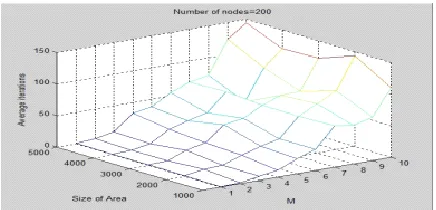
Figure 6 Relationship of area size, partition number and average iterations.
Figure7. Relations hip of area size, partition number and average Di 200 nodes are deployed in the of 5 000[m] ×5000 [m] randomly. The number of mobile sinks is set as 1,5,10. Moving speed of each mobile s ink is set as 5, 10, 15, 20, 25, 30, 35, 40, 45, 50m/s .The threshold of balanced rate θ is set to 1.18. Simulation is performed 10 times in each scene to obtain the relationship between the average delays; s peed of mobile s inks and mobile sink number.
Figure 8 Relationship of mobile s ink speed, mobile s ink number and average delay.
The relation between number of zones and path distances is illustrated in Fig. 3, Histogram is drawn to be demonstrated the averaged path distances Di among all the zones corresponding to each number.
4. CONCLUSION
REFERENCES
[1] M. Watfa, L. Yaghi, “An efficient online-battery aware geographic routing algorithm for wireless sensor networks”, International Journal of Communication System vol. 23, no. 1, pp. 41–61,
2010.
[2] Y Ma, Y Guo, M Ghanem, “RECA: Referenced energy-based CDS algorithm in wireless sensor networks”, International Journal of Communication Systems , vol. 23, no. 1, pp. 125–138 , 2010.
[3] S Fang, SM Berber, AK Swain , “Energy distribution-aware clustering algorithm for dense wireless sensor networks ”, International Journal of Communication Systems , vol. 23, no. 9 /10, pp. 1223–1251, 2010 .
[4] M. Ahmadi, L. He, J. Pan, J. D. Xu, “A Partition-based Data gathering Scheme for Wireless Sensor Networks with a Mobile Sink”, Proceeding of IEEE International Conference on Communications (IEEE ICC 2012) , pp. 508- 512, 2012.
[5] R. Shah, S. Roy, S. Jain, and W. Brunette, “Data mules: Modeling and analysis of a three-tier architecture for sparse sensor networks ”, Ad Hoc Networks , vol. 1, no. 2/3, pp. 215 –233, 2003.
[6] Chakr abarti, A. Sabharwal, B. Aazhang, “Using predictable observer mobility for power efficient design [7] M. Ma and Y. Yang, “SenCar : an energy-efficient data gathering mechanism for large-scale multihop sensor networks ”, IEEE Trans . on Parallel and Distributed Sys t, vol. 18, no. 10, pp. 1476-1488, 2007.
[8] N. Rakhshan, and M.K. Rafsanjani, “Improving Network Lifetime Using a Mobile Sink with a New Energy Eff iciency and Minimum Delay Movement Strategy for WSNs”, Journal of Basic and Applied Scientific Research, pp. 4275-4281, 2012.
[9] S. Vapputuri, K. K. Rachuri, C.R. Murthy, “Using mobile data collectors to improve network lifetime of wireless sensor networks with reliability constraints”, Journal of Parallel Distribute Computing, vol.70, no.7, pp. 767-778, 2010.
[10] Ekici E, Gu Y, Bozdag D, “Mobility-based communication in wireless sensor networks ”, IEEE Communications Magazine , vol. 44, no. 7 , pp. 56 –62 , 2006.
[11] E. M. Saad, M.H. Awadalla, R.R. Darwis h, “A data gathering algorithm for a mobile sink in large scale sensor networks ”, Proceedings of the Fourth International Conference on Wireless and Mobile Communications , pp. 207-213 , 2008.
[12] Y. Bi, L. Sun, J. Ma, N. Li, I.A. Khan, C. Chen, “HUMS: an autonomous moving strategy for mobile sinks in data-gathering sensor networks ”, EURASIP Journal on Wireless Communications and Networking, 2007.
[13] G. Wang, T. Wang, W. Jia, M. Guo, J. Li, “Adaptive location updates for mobile s inks in wireless sensor networks ”, The Journal of Supercomputing, vol. 47, no. 2 , pp. 127–145, 2009.
[14] R. Sugihara, R. Gupta, “Speed control and scheduling of data mules in sensor networks”, ACM Trans. on Sens or Networks, vol. 7, no. 1, 2010.
[15] L. He, Y. Zhuang, J. Pan, and J. Xu, “Evaluating on-demand data gathering with mobile elements. in wireless sensor networks ”, in Proc.I EEE VTC’ 10-FALL, 2010.
[16] H. Nakayama, Z.M. Fadlullah, N. Ansari, N. Kato, “A Novel Scheme for WSAN Sink Mobility Based on Clustering and Set Packing Techniques”, IEEE Transactions on Automatic Control, vol. 56, no. 10, 2011.