Scholarship@Western
Scholarship@Western
Electronic Thesis and Dissertation Repository
7-29-2016 12:00 AM
The Effects of Concurrent Cognitive Load on the Processing of
The Effects of Concurrent Cognitive Load on the Processing of
Clear and Degraded Speech
Clear and Degraded Speech
Harrison RitzThe University of Western Ontario
Supervisor
Dr. Ingrid Johnsrude
The University of Western Ontario Graduate Program in Psychology
A thesis submitted in partial fulfillment of the requirements for the degree in Master of Science © Harrison Ritz 2016
Follow this and additional works at: https://ir.lib.uwo.ca/etd
Part of the Cognitive Neuroscience Commons
Recommended Citation Recommended Citation
Ritz, Harrison, "The Effects of Concurrent Cognitive Load on the Processing of Clear and Degraded Speech" (2016). Electronic Thesis and Dissertation Repository. 4110.
https://ir.lib.uwo.ca/etd/4110
This Dissertation/Thesis is brought to you for free and open access by Scholarship@Western. It has been accepted for inclusion in Electronic Thesis and Dissertation Repository by an authorized administrator of
ii Abstract
A previous study has found that perceiving degraded speech requires attention, with compromised behavioral and neurological measures of speech processing for degraded speech, but not clear speech, when participants are distracted (Wild et al., 2012b). We extended these findings by examining behavioral and neural correlates of speech perception under different levels of cognitive load using multiple object tracking. We also investigated the role of attention in perceiving degraded speech that was as intelligible as clear speech, in order to separate perceptual outcomes (i.e., intelligibility) from the requisite processing demands. We found that the speech perception system is heterogeneous in its attentional requirements. The bilateral anterior insulae response reflected the cognitive load of the attended task, but not the unattended task, whereas activity in the anterior superior temporal gyrus reflected the cognitive load of both tasks. Under distraction, we found dissociable responses for clear and intelligibility-matched degraded speech.
iii
Acknowledgements
I am deeply grateful the guidance that Ingrid Johnsrude has provided me over these past four years. She has always been generous in her mentorship, taking the time to teach an intellectual rigor that I will draw on again and again. Thank you so much for all the time and effort you have put into helping me develop as a careful, critical, scientist.
I am also grateful for the CoNCH lab for friendship and support. I would like to thank Julia, Chris, Bjorn, Emma, and Alex for providing me with guidance and support, and Rachel, Dora, Ysi, and Alenka for being close friends, although these roles are in no way mutually exclusive. I would also like to thank Natalie for her friendship, and for helping me collect the data for this experiment, as well as Jordan and Heather for supporting me during the final leg of this project.
iv
Table of Contents
Introduction ... 1
Degraded speech perception ... 1
Dual-task Interactions ... 3
Multiple Object Tracking ... 7
Current Experiment ... 9
Predictions ... 10
Methods... 11
Participants ... 11
Experimental Design ... 12
Speech Stimuli ... 14
Multiple-Object Tracking Task ... 15
Pilot Experiment ... 16
fMRI Acquisition ... 17
fMRI Preprocessing ... 18
fMRI Model ... 18
Results ... 19
Behavioural Results ... 19
Intelligibility ... 19
Tracking Performance ... 20
Recognition Post-Test ... 20
fMRI analyses ... 21
Main Effect of Task ... 21
Simple Main Effect of Attended Speech Type ... 21
Tracking-Load Dependent Activity ... 24
Speech × Task Interaction ... 25
Speech × Task × Load Interaction ... 27
Prefrontal Speech × Task × Load Interaction ... 30
Discussion ... 33
Conclusion ... 38
References ... 39
v
vi List of Figures
Figure 1: Predicted Attention Effects ... 12
Figure 2: Trial Timecourse ... 12
Figure 3: In-Scanner Behavioral data ... 17
Figure 4: Post-scan recognition memory performance ... 21
Figure 5: Main effect of Task ... 22
Figure 6: Simple main effect of Speech Type ... 23
Figure 7: Correlation with Tracking Load ... 24
Figure 8: Speech × Task interaction ... 26
Figure 9: Speech × Task × Load Interaction ... 29
vii
List of Appendices
Appendix A: Sentence Materials ... 50
Appendix B: Coordinates for Main effect of Task ... 55
Appendix C: Coordinates for simple effect of Speech Type ... 58
Appendix D: Coordinates for tracking-load dependent activity ... 60
Appendix E: Coordinates for Speech × Task interaction ... 62
The effects of concurrent cognitive load on the processing of clear and degraded speech
In perfect listening conditions, the comprehension of speech is seemingly effortless.
However, everyday listening conditions are rarely as good as the laboratory, and speech is
commonly degraded by noisy environments, by peripheral hearing impairment, or by
low-fidelity digital communication. When speech is acoustically degraded, accurate
perception places greater demands on cognitive resources than are required for the
perception of clear speech (Heald & Nusbaum, 2014; Johnsrude & Rodd, 2016). Recent
neuroimaging studies have found that attention modulates neural and behavioural
responses to speech, and that focusing on speech is critical for comprehension in
challenging listening conditions (Wild et al., 2012; Sabri et al., 2008). The current
experiment will extend these observations by measuring neural indicators of the extent to
which attention is required for the perception of clear and highly intelligible degraded
speech.
Degraded speech perception
Degraded speech offers useful insight into the speech perception system, because it
exaggerates the existing challenge of mapping highly variable acoustics on to stable
linguistic categories (Liberman, Cooper, Shankweiler, Studdert-Kennedy, 1967; Heald &
Nusbaum, 2014). The lack of invariance in the mapping between sounds and meaning
(i.e., the bottom-up process) necessitates the use of context to help disambiguate speech
(i.e., top-down biasing of perception), although there remains controversy over when and
how context influences perception (for review, see: Heald & Nusbaum, 2014; Norris,
McQueen, & Cutler, 2016). Acoustic degradation (such as noise-vocoding, which
parametrically degrades the spectral clarity of speech, while largely preserving temporal
information; Shannon et al., 1995) increases the uncertainty of linguistic mappings (in
Bayesian terms, degradation broadens the likelihood distribution; Norris & McQueen,
2008), increasing the requirements for top-down control (i.e., a greater influence of
priors; Norris & McQueen, 2008). In this respect, the degradation of a speech signal, i.e.,
speech signal, with the latter entailing the addition of spectral energy to a speech signal,
such as masking with white noise or simultaneous speakers. This experiment primarily
degraded speech (with minor distortion artifacts) in order to avoid the additional
cognitive demands, such as stream segregation, that accompany a distortion
manipulation. With our degradation manipulation, we instead directly disrupt
participants’ ability to map the acoustic signal on to linguistic categories. There are also
methodological advantages to studying degraded speech perception. People are highly
proficient at understanding speech, and so by degrading speech, and bringing accuracy
down from near-perfect performance, researchers can make more sensitive measurements
of the underlying perceptual processes.
A body of research over the past 50+ years suggests that the top-down processes
required for accurate perception of degraded speech depend on domain-general
working-memory and attentional resources. Early work by Patrick Rabbitt (1968) found that
memory for clear speech was more disrupted by the subsequent perception of degraded
speech than it was by clear speech, suggesting that the rehearsal of earlier items was a
process that shared capacity with the perception of degraded speech. Luce, Feustel, and
Pisoni (1983) similarly found that simultaneous cognitive load disrupted the perception
of degraded speech more than clear speech. Several subsequent studies have found that
participants exhibit poorer performance on working memory tasks that involve
acoustically degraded, but intelligible, words (Pichora-Fuller, Schneider, & Daneman,
1995; Burkholder, Pisoni, & Svirsky, 2005; Wingfield, Tun, & McCoy, 2005; Francis &
Nusbaum, 2009; Piquado, Cousins, Wingfield, & Miller, 2010; Obleser et al., 2012;
Amichetti et al, 2013). Finally, studies examining individual differences in degraded
speech perception have found correlations between participants’ ability to understand
degraded speech and measures of attention and working memory (Akeroyd, 2008;
Humes, Kidd & Lentz, 2013; Besser et al., 2013).
Functional magnetic resonance imaging (fMRI) experiments of speech perception
have found a reliable set of frontal and temporal regions in which participants’
Blank, Rosen, & Wise, 2000; Davis & Johnsrude, 2003; Obleser et al., 2007; Obleser &
Kotz, 2010; Obleser, Eisner, & Kotz, 2011; Davis, Ford, Kherif, & Johnsrude, 2011;
Wild, Davis, & Johnsrude, 2012a, Wild et al., 2012b, Evans et al., 2014). Regions near
primary auditory cortex are sensitive to the acoustic features of speech (i.e., BOLD signal
depends on the manipulations used to produce degradation), whereas regions anterior and
posterior to primary auditory cortex are more sensitive to the intelligibility of speech,
largely independent of acoustic features (i.e., are form-independent; Davis & Johnsrude,
2003; Okada et al., 2010; Evans et al., 2014). Several studies have found that in the
inferior frontal gyrus, responses to speech are driven by both degradation (Giraud et al.,
2004; Hervais-Adelman, Carlyon, Johnsrude & Davis, 2012; Wild et al., 2012b) and,
critically, the interaction between degradation and contextual constraint (Obleser & Kotz,
2010; Davis, Ford, Kherif, & Johnsrude, 2011; Wild et al., 2012a), consistent with this
region having a role in top-down modulation of lower-level speech regions. Consistent
with such a modulatory role, primate anatomical research has found that frontal and
anterior temporal regions have distinct connectivity and histological profile from primary
sensory cortices and connections place them at a tertiary or quaternary level of auditory
cortical processing (Kaas, Hackett, and Tramo, 1999), Strong, reciprocal connections link
frontal regions and non-primary auditory cortices in the temporal lobe (Hackett et al.,
1999; Romanski et al., 1999).
Dual-task Interactions
A powerful way to measure the cognitive demands of a task, such as perception of
degraded speech, is to study the disruption produced by having participants perform a
simultaneous task that has cognitive processes in common with the primary task
(Kahneman, 1973). Several experimenters have found that less intelligible speech results
in poorer performance on a secondary visual target-monitoring task (Downs, 1982;
Feuerstein, 1992; Wild et al., 2012b; Pals, Sarampalis, & Baskent, 2013; for general
review on dual-tasks and speech intelligibility, see: Gosselin & Gagné, 2010). These
experimenters provide behavioral evidence that speech processes involved in
However, dual-task designs provide a coarse characterization of specific cognitive
processes, due to the limited outcome measures for an interference effect. Whereas
interference may broadly disrupt speech perception, the resultant changes often occur
across a single dimension of behavior. For example, performing a simultaneous task may
impair participants’ memory for speech, but it is difficult to determine where in the
speech perception system this disruption occurred. In order to separate the effects of
interference across the speech perception system, we can instead measure the
simultaneous changes in neural activity throughout the brain while participants perceive
clear and degraded speech under conditions of full attention or distraction.
Two recent fMRI experiments examined how perception of degraded and clear
speech proceeds under full attention to speech compared to when attention is elsewhere.
In an experiment by Sabri and colleagues (2008), participants listened to sentences,
pseudowords, or unintelligible speech-like sounds (‘rotated speech’; Blesser, 1972),
while either attending to speech, or performing a simple visual short-term memory task.
BOLD responses in many brain regions depended on the speech type, but only when
participants focused on speech. In particular, the bilateral inferior frontal gyri and the left
anterior temporal lobe differentiated between normal speech and rotated speech only
during attend-speech, and the left middle frontal gyrus and left middle temporal gyrus
differentiated between words and pseudowords only during attend-speech. This
experiment is the first to use neuroimaging to study attentionally dependent speech
processes, however, methodological concerns limit interpretation. Sabri and colleagues
(2008) did not examine the effect of degraded acoustic quality on attentional demands,
and the simultaneous scanner noise during their protocol may have imposed additional
segregation demands during speech perception.
A subsequent study in our laboratory by Wild and colleagues (2012b) provided
further evidence for attentionally dependent speech perception. In this experiment,
participants heard meaningful sentences that were either clear or degraded but still highly
intelligible (in one degraded condition, ~90% of the words in the sentences could be
concurrently presented visual or auditory stimuli and performed a simple target detection
task on these. In a subsequent recognition memory test, memory for clear sentences was
similar regardless of the locus of attention, but memory for degraded speech was worse
when participants’ attention was not on speech than when it was on speech. In regions
involved in form-independent speech perception, the BOLD response to different speech
types depended on the locus of attention. In the left inferior frontal gyrus (LIFG) and
bilateral anterior insulae, BOLD responses were elevated for degraded speech, but only
under full attention, providing further evidence for a role for the IFG in the effortful
enhancement of degraded speech. In the anterior and posterior superior temporal gyrus/
sulcus (STG/STS), the response profile mirrored participants’ memory scores, with a
decreased response under distraction for degraded, but not clear, speech.
This experiment demonstrated that attention is required for the comprehension of
even quite highly intelligible degraded speech. However, questions still remain about
how sensitive different regions in the speech perception system are to distraction. A core
theoretical distinction in the dual-task literature is between interference from a primary
task that completely obliterates performance of the secondary task (‘processing
bottleneck’), or that interferes with performance of the secondary task in a graded fashion
(‘capacity-sharing’; Kahneman, 1973; Pashler, 1984, 1994, 1998; Navon & Miller, 2002;
Tombu & Jolicœur, 2003, 2005). It is possible that the interference Wild and colleagues
(2012b) observed for degraded speech was due to a processing bottleneck in the speech
perception system, such that when participants were distracted, these regions were simply
not engaged in speech perception (c.f., Pashler, 1984, 1994, 1998). An alternative
explanation is that speech processes share cognitive resources with the distractor task,
and the allocation of cognitive resources to the visual task came at the expense of
resources that were available for speech perception. This is proposed in ‘resource pool’ or
‘effort’ models of attention, which suggest that speech processing could access critical
processes in parallel with the distractor task (c.f., Kahneman, 1973; Navon & Miller,
2002; Tombu & Jolicœur, 2003, 2005). While a bottleneck account is consistent with the
interference observed in Wild et al. (2012b), in this experiment participants were not
or to the other. However, the notionally unattended stimulus dimension may still be
processed somewhat and that is what we set out to examine (c.f., Kahneman, 1973).
In order to characterize the how different brain regions involved in speech
processing are affected by distraction, we will measure neural and behavioral responses
to clear and degraded speech either during full attention, or during the performance of a
distractor task that imposes a parametrically varied cognitive load. Speech regions that
have a processing bottleneck will be sensitive to different speech types only when speech
is the focus of attention, and will not differentiate between speech types under distraction,
regardless of the difficulty of the secondary task. These regions may also be sensitive to
the cognitive demands of the distractor task when it is the focus of attention. In such
regions, speech processing is effectively gated by attention (i.e., these regions are
processing bottlenecks). In speech regions that depend on a shared capacity, the response
to different speech types should be differentially affected by simultaneous cognitive load.
Such an interaction between the capacity demands for speech, and the capacity demands
of the distractor task, would indicate that speech processing in such a region depends on
shared cognitive resources. Both forms of interference may occur in different regions
within the greater speech perception system, and neural responses to clear or degraded
speech may be disrupted by either form of interference. However, we expect that the
perception of clear speech will not be disrupted by distraction, at least when the load is
modest: in Wild et al (2012b) manipulation of the locus of attention had little effect on
neural and behavioral responses to clear speech, but the distractor tasks were not difficult
(d′ scores on auditory and visual distractor tasks were 2.15 and 3.15 respectively; Wild et
al., 2012b).
To further test the role of attention in speech perception, we will also examine the
neural response to degraded speech matched to clear speech on intelligibility. This
manipulation will test whether we can distinguish the outcomes of speech perception, i.e.,
intelligibility (measured, for example, as number of words from each sentence reported
correctly), from the cognitive processes that are necessary to achieve this level of
perception, highly intelligible degraded speech should be more sensitive than less
intelligible degraded speech to changes in cognitive load under distraction. This is
because whatever capacity is remaining at low levels of tracking load may be insufficient
for the perception of less-intelligible speech, whereas it may leave enough capacity to
process highly intelligible speech. In addition, highly intelligible degraded speech allows
us to determine which regions are sensitive to the outcomes of speech perception (i.e.,
depend on intelligibility), and which regions are sensitive to elevated processing demands
(i.e., depend on stimulus degradation).
In order to measure whether there are speech processes that shared capacity under
distraction, our secondary task must fit several criteria. An ideal task should have
parametrically scalable attention demands, without requiring qualitatively different
cognitive processes at different levels of load, in order to provide a parsimonious
explanation for the manipulation of attentional demands. For example, in a 1-back
condition of an n-back task (a popular working-memory paradigm; Kirchner, 1958)
participants only need to remember the previous stimulus identity, whereas in a 2-back
(or greater) condition participants must also inhibit the intermediate trials, qualitatively
changing the nature of the task. An ideal task should also be non-verbal, to ensure that
interference can be inferred to be arising from shared, domain-general, capacities
(common to both speech listening and this nonverbal task). Finally, this task should also
have a stable attentional requirement over the course of the speech stimulus, in order to
minimize task-switching between modalities (c.f., Pashler, 1994). On the basis of these
criteria, multiple object tracking is ideal for characterizing attentional processes in speech
perception.
Multiple Object Tracking
Multiple Object Tracking (MOT) is a visual attention paradigm that provides some of the
best current evidence for resource-pool models of attentional capacity. This task was
originally developed to test whether a low-level form of visual attention, maintaining
object indices (i.e., tracking objects) as they change location, operated in serial or parallel
as targets, the dots move pseudorandomly across a screen while participants track the
targets, and then participants are tested on their knowledge of which dots were targets.
Pylyshyn and Storm (1988) found that participants could simultaneously track several
dots with a highly degree of accuracy, and that participants’ performance was better than
their best-case serial tracking model.
A prevailing theory of MOT is that it demonstrates attention as a flexibly
allocated cognitive resource (for review see: Scholl, 2009; Cavanagh & Alvarez, 2005;
Franconeri, Alvarez, & Cavanagh, 2013). Early models of MOT (including Pylyshyn &
Storm, 1988) had a fixed number of indices that participants could assign to objects
(typically 3-5; c.f. Cowen, 2001), framing MOT as the byproduct of a fixed set of
tracking mechanisms (usually, 3-5) that operate in parallel, rather than a flexible
cognitive resource that is sensitive to both the number of tracked objects, and the
attentional demands of the task. Several subsequent studies have provided strong
evidence for the resource-pool model of MOT (Alvarez & Franconeri, 2007; Bettencourt
& Somers, 2009; Howe, Cohen, Pinto, Horowitz, 2010; Holcombe & Chen, 2012). In a
particularly influential experiment, Alvarez and Franconeri (2007) found that the number
of dots that participants could accurately track was highly dependent on the dots’ velocity
(r2 = .996), and that participants could track up to eight items at slow velocities. The close
relationship between tracking capacity and dot velocity is incompatible with slot models
of attention, which hypothesize that attentional capacity is independent of the demands of
the tracking task.
Neural responses during MOT provide further evidence that this task imposes
parametric attentional demands. Experimenters reliably find that BOLD responses to
MOT are linearly dependent on the number of targets that participants are tracking,
particularly in the intraparietal sulcus, the superior parietal lobule, and the human frontal
eye fields (Culham et al., 1998; Culham, Cavanagh, & Kanwisher, 2001; Jovicich et al.,
2001; Tomasi, Ernst, Caparelli, & Chang, 2004; Howe et al., 2009; Tomasi, Wang, Wang,
speech perception shares cognitive resources with MOT, we should be able to detect
load-dependent interference on speech perception.
Several behavioural experiments have demonstrated that MOT interferes with
auditory attention tasks in dual-task designs. MOT appears to produce worse performance
on a simultaneous auditory target detection task, relative to single-task performance
(Alvarez et al., 2005). In another study, researchers observed that increasing the dot
velocity during MOT interferes with an auditory target detection task (Tombu & Seiffert,
2006). Finally, Allen, McGeorge, Pearson, and Milne (2006) found that MOT
performance was poorer when participants had to simultaneously categorize a tone as
‘low’ or ‘high’ compared to when MOT was performed alone. These results indicate that
common processes are engaged during MOT and during performance of a difficult
auditory perception task, suggesting that MOT may interfere with speech processing as
well.
MOT meets our criteria for a task that may characterize the attentional demands
of the speech perception system. Increasing the tracking load during MOT is thought to
involve the flexible allocation of cognitive resources (Cavanagh & Alvarez, 2005), such
that different levels of load involve qualitatively similar attentional processes. MOT is a
spatial attention task that should not interfere with speech perception on the basis of
stimulus similarity, or semantically categorizing trials as ‘target present’. Finally, the
attentional demands of MOT are consistent throughout the course of a trial, allowing for a
constant load on speech perception over the course of a sentence.
Current Experiment
This experiment aims to measure how speech processes are affected by different
attentional demands. We will measure participants’ BOLD responses to clear and
degraded sentences while they direct their attention towards either speech or MOT,
allowing us to be sensitive to how processing of different qualities of speech, even when
intelligibility is matched, changes as a function of attentional state. The structure of this
experiment, we will vary both the quality of the speech and the cognitive load of our
distractor task. We will look for regions that differentiate between clear and even highly
intelligible degraded speech in terms of attentional demands , as in Wild et al. (2012b).
Specifically, we will examine whether, when attention is focused away from speech,
processing of even highly intelligible degraded speech is completely obliterated in speech
sensitive cortex, whereas clear speech is still processed. Uniquely in this experiment, we
will also measure whether more demanding concurrent tasks can impair processing of
even clear speech, which was largely unaffected by the distractor tasks used by Wild et al.
(2012b). Finally, by comparing BOLD responses to stimuli that are matched in
intelligibility, but differ in acoustic degradation, we may highlight processing
dissociations related to the processes used to achieve high intelligibility. We predict that
highly intelligible degraded speech, although matched to clear speech on intelligibility,
will make greater attentional demands, reflecting recruitment of knowledge-guided
processes required for enhanced intelligibility, compared to clear speech.
Predictions
We can make several specific predictions for our results, depending on how performance
of a concurrent MOT task interferes with incidental processing of clear and degraded
speech. For example, we would expect to replicate the findings of Wild et al. (2012b),
who found an elevated response to degraded speech relative to clear speech in the
anterior insulae when listeners attended to speech, and no differences among speech types
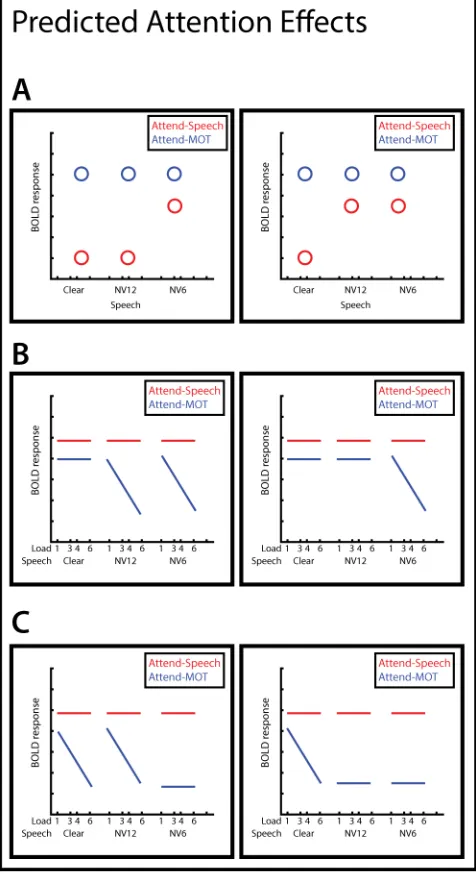
when performing distractor tasks (Figure 1A). We might find that NV12 speech elicits a
similar response as Clear (left), or NV6 (right), depending on whether the attention
effects are late or early in speech perception, respectively.
We will also look for regions where the response depends on the combination of speech
processing demands and tracking demands. We might find that the BOLD response to
degraded speech depends on tracking load (i.e., BOLD activity during this condition
negatively correlates with tracking load), but clear speech does not (no correlation
between BOLD activity and tracking load; Figure 1B), with NV12 exhibiting a similar
clear speech depends on tracking load, but degraded speech does not (Figure 1C), again
with NV12 exhibiting either a more similar response to Clear (left) or NV6 (right).
Methods
Participants
Twenty-six individuals (15 female; Mage = 21.5, SDage = 3.86) participated in the fMRI
portion of our experiment. Participants were right-handed, native English speakers
(monolingually spoke English before the age of 5), had normal (or corrected-to-normal)
vision, self-reported normal hearing, had no neurological or psychological disorders, and
did not report losses of consciousness lasting longer than one hour. Participants were also
screened on the basis of the MRI eligibility criteria at the Robarts Research Institute. We
recruited participants via word-of-mouth and posters distributed on the campus of the
University of Western Ontario. Two participants were removed before analysis, one due
to technical issues with the stimulus delivery program, and another due to substantial
movement during scanning (> 8mm translation in the z plane), leaving 24 for the
analysis.
Twenty-four different individuals (19 female; Mage = 21.1, SDage = 2.11)
participated in piloting sessions for the behavioural portion of this experiment. Inclusion
criteria and recruitment were the same as for the fMRI experiment. All participants
provided full written consent, were debriefed following their session, and received
monetary compensation for their participation. All experiments were cleared by the
Health Science Research Ethics Board of the University of Western Ontario.
Experimental Design
In this experiment, we manipulated the task that participants performed, the clarity of
speech that participants heard, and the number of dots that participants saw on a screen,
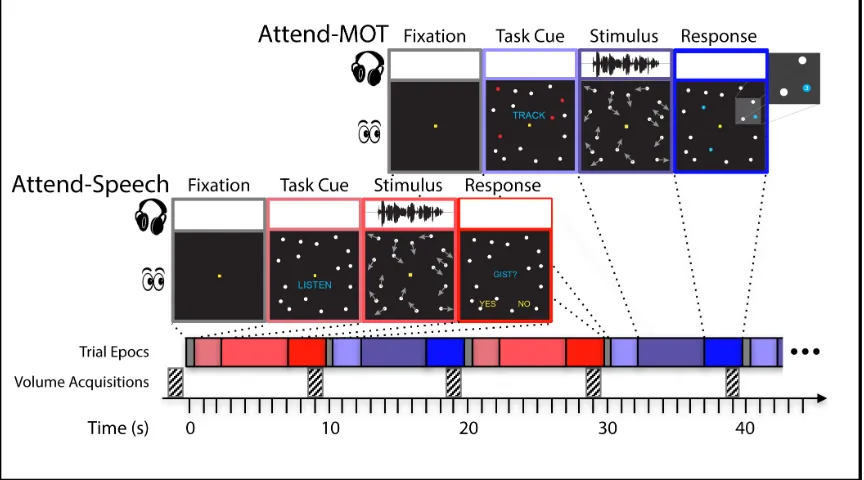
in a fully factorial design. On each trial, participants both heard a sentence and saw
moving dots. At the beginning of each trial, a word was presented on the screen,
instructing them either to try to understand the speech (‘LISTEN’), or to perform a MOT
task on the dots (‘TRACK’; see Figure 1). With three levels of speech clarity, and four
levels of load, this experiment had 2 (Task) x 3 (Speech Type) x 4 (Load) conditions.
Over 216 trials, participants experienced each condition 9 times, equally in each of the
three runs. Since the load was manipulated parametrically, this design can also be viewed
as a 6 condition (2 tasks x 3 speech clarity levels) experiment, with 36 trials in each
condition over a range of dot densities. Baseline BOLD activity was measured over 24
silent, fixation-only trials. We also measured BOLD activity over 24 Attend-Speech trials
with rotated NV speech, an acoustically matched unintelligible speech type that helps to
as though they were regular Attend-Speech trials. These two types of control trial were
randomly interspersed within runs, and occurred with equal frequency across runs.
Prior to the main experiment, participants completed two sets of training. The first
set familiarized participants with noise-vocoded (NV) speech, in order for participants’
comprehension of NV speech to approximately reach asymptote. Over 24 trials,
participants heard a sentence that was presented in NV12 or NV6 form, responded
whether they had understood the gist of the sentence, and then received feedback by
hearing the vocoded sentence again while the sentence was also written on the screen (as
in Davis et al., 2005, Experiment 3). None of the sentences used during training were
heard in the main experiment. During MOT training, participants practiced the tracking
task for 24 trials. For the first half of training, participants performed a staircase version
of the task, with the number of dots to be tracked increasing with each correct response,
and decreasing with each incorrect response (within the range encountered during the
experiment, i.e., tracking between 1 and 6 targets). In the second half of this training
session, the tracking load changed randomly on each trial, with the constraint that two
consecutive trials could not have the same tracking load.
After the 216 trials of the main experiment were completed, participants
performed a recognition memory test for the sentences that they had heard. On each trial,
participants saw a written sentence on the computer screen, and indicated with a keypress
whether they remembered this sentence from the experiment (‘OLD’), or if it was a new
sentence (‘NEW’). Participants made memory judgements on all 216 sentences from the
task, along with 108 foil sentences. Foils sentences had slightly more words on average
than target sentences (Foils: M = 10.3, SD = 2.15; Targets: M = 9.0, SD = 2.2), and
differed from target sentences in both their topic and in all the content words they
contained. Prior to the memory test, participants were unaware that memory for sentences
would be tested, providing us with a measure of participants’ incidental encoding of these
sentences when they were first heard.
Speech Stimuli
Over the course of the experiment, participants heard 216 everyday sentences (e.g., ‘His
handwriting was very difficult to read.’; see Appendix A), all recorded from the same
female speaker of Canadian English. Stimuli were presented diotically via foam-tipped
insert earphones (Sensimetrics, Belmont, USA) at a comfortable listening level. The
sentences were 6-13 words long; were 1.2 - 4.7 seconds in duration; and were split into
six lists that were closely matched on the number of words (M = 9.0, SD = 2.2), the
sentence duration (M = 2.5 sec, SD = 0.6 sec), and the logarithm of the summed word
frequency (M = 5.5, SD = 0.2; Wilson, 1988). Each list was assigned to one of the six
(two task by three speech types) conditions, counterbalanced across participants such
that, across participants, each sentence was heard in each condition the same number of
The clarity of the speech stimuli was manipulated by noise-vocoding recorded
sentences (Shannon et al., 1995). In this technique, a speech signal is partitioned into
logarithmically spaced frequency bands, with boundaries chosen to be equally spaced
along the basilar membrane (Greenwood, 1990). The amplitude envelope within each
band is extracted (fourth-order Butterworth band-pass filter) and convolved with white
band-limited noise sharing the same duration and frequency range. By changing the
number of bands used in the process, we can make speech more or less intelligible
(Shannon et al., 1995). In this experiment we used highly intelligible 12- and 6-band
(NV12 and NV6) noise-vocoded speech. Piloting and previous experiments have found
that NV12 and clear speech are closely matched at near perfect intelligibility, whereas the
intelligibility of NV6 speech is poorer, but over 90% (see Figure 2). We generated
spectrally rotated NV stimuli by reversing the order of the envelopes across frequencies,
such that the envelope from the highest frequency range was applied to the lowest
frequency range (and vice versa), and the envelope from the second highest frequency
range was applied to the second lowest frequency range, etc (Blesser, 1972). The rotated
speech samples that participants encountered in the experiment were generated using the
sentences that participants heard during training. Since rotated speech is unintelligible,
there was no expectation that participants would recognize these sentences.
Multiple-Object Tracking Task
Participants performed a multiple-object tracking task (MOT; Pylyshyn & Storm, 1988)
at four different levels of tracking load. Participants tracked a subset of pseudorandomly
moving dots, with tracking load manipulated by varying the number of dots that were
tracked (and the total number of dots). At the beginning of each MOT trial, either 1, 3, 4,
or 6 target dots amongst 12 distractor dots were highlighted for tracking by their colour
changing from white to red for 1.8 seconds. All dots had a diameter of approximately 1
degree of visual angle, and were shown against a black screen spanning 20 x 20 degrees.
After the cue, all dots started moving pseudorandomly around the screen at an
approximate speed of 1.8 deg/sec, with dots repelling in the opposite direction from other
keep their gaze fixed on a static cue in the centre of the screen, and track the dots
covertly, rather than with eye movements. After 5 seconds of tracking, dots froze in place,
and three dots (one that had been tracked, and two foils) were highlighted with a blue
colour and a number label (‘1’, ‘2’, or ‘3’). Participants had 2.8 seconds to indicate with a
3-alternative keypress which of the numbered dots was the one they had tracked, without
feedback on their performance. There were 27 trials at each level of tracking load.
Pilot Experiments
In previous work, Conor Wild (Wild, 2012; Unpublished thesis, Section 2.2) used a
subset of the stimuli used in the current experiment, and the same custom vocoder
software. Fifteen young, normally hearing participants heard sentences presented one at a
time and were asked to write down all the words they could understand from each
sentence. Wild observed that the proportion of words reported correctly was similar for
Clear sentences (M = .9802, 95% CI = [.9619 .9985]) and NV12 sentences(M = .9872,
95% CI = [.9721 1.0]), and lower for NV6 sentences (M = .9463, 95% CI = [.9248 .
9679]; see Figure 2, white circles).
A set of pilot experiments was intended to confirm these intelligibility values, and
to ensure that we were using levels of the MOT task that would result in off-ceiling
performance that also reflected changes in tracking load. In these pilots, the procedure
was similar to the fMRI experiment with both MOT and speech stimuli concurrently
present, and participants performed either the MOT task (50% of the time) or attended to
the speech. In a single-walled soundproof booth, sentence stimuli were delivered at a
comfortable listening level via headphones (Grado Labs, Brooklyn, USA). We tested a
few participants on many different versions of the MOT task, and so we will only report
the intelligibility results from the 24 participants that took part in this pilot. As in the
fMRI experiment, intelligibility was measured as the proportion of sentences that
participants reported comprehending (see Figure 2, grey circles). We found that
intelligibility was high and similar for Clear sentences(M = .9977, 95% CI = [.9879, 1.0])
and NV12 sentences (M = .9882, 95% CI = [.9762, 1.0]), and lower for NV12 sentences
word-report results of the first pilot, and provide further evidence, with a larger sample
size, that the intelligibility of all stimuli was high, that the intelligibility was similar for
Clear and NV12 speech, and that Clear and NV12 speech are more intelligible than NV6
speech. These results also suggest that our measures of intelligibility converge across
finer (word report; pilot 1) and coarser (comprehension report; pilot 2) measures of
intelligibility.
fMRI Acquisition
Participants completed the fMRI experiment in a 3.0T Siemens Prisma MRI system at the
Robarts Research Institute at the University of Western Ontario (London, Ontario,
Canada). T2*-weighted functional images were acquired using an interleaved 4-factor
multi-band EPI (field of view: 192mm x 192mm; resolution: 2.5mm isotropic; slice
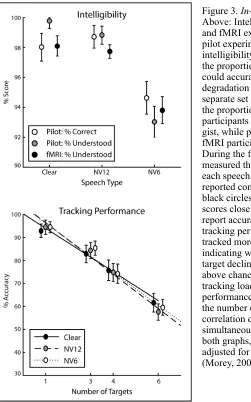
Figure 3. In-Scanner Behavioural data.
Above: Intelligibility indices across pilot and fMRI experiments. During the first pilot experiment, we measured the intelligibility of our stimuli by measuring the proportion of words that participants could accurately report at each level of degradation (n = 12; white circles). With a separate set of participants, we measured the proportion of sentences for which participants reported comprehending the gist, while performing the same task as the fMRI participants (n = 24; grey circles). During the fMRI experiment, we again measured the proportion of sentences of each speech type for which participants reported comprehending the gist (n = 22; black circles). The subjective gist report scores closely matched the objective word report accuracies. Below: In-scanner tracking performance. As participants tracked more targets, their accuracy at indicating which of three dots had been a target declined. Participants performed above chance (33%) at all levels of tracking load, and their tracking performance was highly correlated with the number of targets (rmedian = -.94). This
thickness: 2.5mm with a 10% gap; TE: 30ms; TA: 1sec per volume; TR: 10sec; flip
angle: 70°). Transverse slices were acquired in order to obtain a whole-brain volume. To
aid in spatial localization, T1-weighted structural images were collected at the beginning
of each session using a single-shot EPI (field of view: 256mm x 256mm; resolution: 1mm
isotropic; slice thickness: 1mm with a 50% gap; TE: 2.98ms; TR: 2300ms; flip angle: 9°).
Volumes were collected using a sparse acquisition protocol (Hall et al., 1999), in
which speech stimuli were presented during the silent period (9 seconds) between scans.
This protocol prevented scanner noise from stimulating auditory regions and further
degrading our speech stimuli. Scans were acquired beginning 4 seconds after the
mid-point of each sentence in order to sample the haemodynamic response close to the peak
amplitude.
fMRI Preprocessing
fMRI Data were preprocessed and analyzed using Statistical Parametric Mapping
(SPM12; Wellcome Centre for Neuroimaging, London, UK). We rigidly realigned
functional images to the mean image of each run, and then coregistered participants’
structural images to the mean functional image across runs. Next, we calculated an affine
transformation and non-linear deformation (D’Agostino, Maes, Vandermeulen, &
Suetens, 2004) for each structural image in order to match SPM12’s default tissue
probability maps (Fonov et al., 2009), segmenting and normalizing our images into MNI
space. We applied these transformations to all of our functional images, and resampled
them to a 2mm isotropic resolution. Finally, all volumes were spatially smoothed using a
3D Gaussian kernel with an 8mm FWHM.
fMRI Model
We constructed statistical parametric maps for each subject using a general linear model
(GLM). Scans were modelled as occurring in one of eight trial types, corresponding to
the six combinations of speech (3 levels) and task (2 levels), rotated speech trials, and
silent baseline trials. We also included six parametric modulators, one for each
saw on the screen. Each of the three runs was modelled separately with 14 task
predictors, six realignment parameters (to account for movement during scanning, both in
terms of translation and rotation), and a predictor to remove the mean signal in each run.
Due to the long TR (10 seconds), we did not model serial auto-correlations. Contrast
maps for each main effect and interaction were calculated for each subject, and subjected
to a group analysis using a factorial partitioned-error repeated-measures ANOVA
(Henson & Penny, 2003).
Results
Behavioural Results
Due to a technical error, behavioural responses during scanning (i.e., intelligibility reports
and tracking accuracies) were lost for 2 participants, leaving 22 participants for these
analyses. Imaging data for these participants were still analyzed.
Intelligibility
During the speech task, participants indicated whether or not they understood the gist of
each sentence with a binary ‘yes/no’ keypress with their dominant hand (see Figure 1).
There was a significant main effect of speech type (Clear, NV12, and NV6) on
intelligibility (One-way repeated-measures ANOVA: F(1.37, 27.8) = 11.44, p = .001,
partial eta-squared = .353, all ANOVAs Greenhouse-Geisser corrected; see Figure 2,
black circles). Pairwise t-tests (Šidák-corrected in order to control the family-wise type I
error rate; Šidák, 1967) did not reveal a significant intelligibility difference between Clear
and NV12 (t(21) = 0.65, p = .893), whereas participants reported significantly greater
intelligibility for Clear than NV6 (t(21) = 3.44, p = .007), and greater intelligibility for
NV12 than NV6 (t(21) = 3.81, p = .003). Thus, Clear and NV12 were similarly highly
intelligible, and although NV6 was also highly intelligible, it was less intelligible than
Clear or NV12. This pattern of intelligibility across speech types was similar to the
pattern observed in two pilot experiments using the same stimuli and noise-vocoder, both
sentence (n = 12), as well as the proportion of sentences that participants reported
understanding (n = 24; see Figure 2).
Tracking Performance
For trials on which participants performed the tracking task, they tracked either 1, 3, 4, or
6 target dots amongst 12 identical distractor dots, and subsequently chose which of 3 dots
they believed had originally been a target (see Figure 1). Participants consistently
performed above the 33% chance rate, even when tracking the maximum number of dots
(one-sample t-test against 33% for 6 dots: t(21) = 10.95, p < .001; see Figure 2).
Participants’ tracking accuracies were linearly dependent on the number of dots they
tracked (Pearson’s rmedian= -.94, rIQR = .082; one-sample t-test against 0 on Fisher
z-transformed correlation coefficients: t(21) = -11.43, p < .001). We did not observe a
significant difference in the strength of this linear dependence across speech types
(one-way repeated-measures ANOVA on z-transformed correlation coefficients: F(1.55, 32.5)
= 0.405, p = .618, partial eta-squared = .019).
Recognition Post-Test
Following the main experiment, participants performed a surprise recognition test.
Participants judged all 216 sentences from the main experiment, and 108 foils that were
matched for length but that did not overlap in content words with the targets, on whether
they were present during the experiment. Sentences were presented visually, one at a
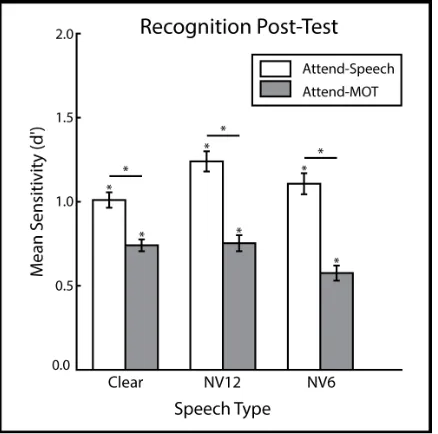
time. We calculated d' to index participants’ recognition of sentences heard previously in
each speech (Clear, NV12, NV6) and task (Attend-Speech, Attend-MOT) condition (see
Figure 3). Sensitivity (d’) was above chance for all conditions (Šidák-corrected
one-sample t-tests against 0: all ps < .001). Participants exhibited an overall conservative bias
(bias to answer ‘NEW’), likely due to the greater number of target trials than foil trials,
whereas participants may have expected there to be a 50/50 split (cmean = 0.37, cSD = 0.45;
One-sample t-test against 0: t(23) = 4.07, p = .001).
In order to examine the effects of speech type and task at encoding on subsequent
Attend-MOT) repeated-measures ANOVA on participants’ d’ scores. We observed
significant main effects for both the Speech Type (F(1.91, 44.0) = 6.00, p = .006, partial
eta-squared = .207) and Task (Attend-Speech > Attend-MOT: F(1, 23) = 85.84, p < .001,
partial eta-squared = .782). Although recognition of Clear and NV6 speech did not differ
(all post-hoc contrasts Šidák-corrected paired t-test: t(23) = .65, p = .891), NV12 speech
was recognized significantly better than both NV6 (t(23) = 3.63, p = .004) and Clear
(t(23) = 2.57, p = .048).
We also found a significant Speech Type × Task interaction (F(1.98, 45.5) = 3.97,
p = .026, = .15). Despite participants having better memory for all sentences heard during
Attend-Speech than Attend-MOT for all speech types (all ps < .001), this difference was
smaller for Clear than it was for both NV12 (t(23) = -2.31, p = .091) and NV6 (t(23) =
2.54, p = .054). Within each task, we found that during Attend-Speech, memory was
better for NV12 than Clear speech (t(23) = 2.82, p = .029), whereas during Attend-MOT,
memory was poorer for NV6 than both Clear speech (t(23) = 2.79, p = .031) and NV12
(t(23) = 2.63, p = .044, all contrasts Šidák-corrected). We did not observe correlations
between tracking load and recognition memory for any speech type (one-sample t-test on
Fisher’s z-transformed correlation coefficients, all ps > .36).
fMRI Results
Main Effect of Task
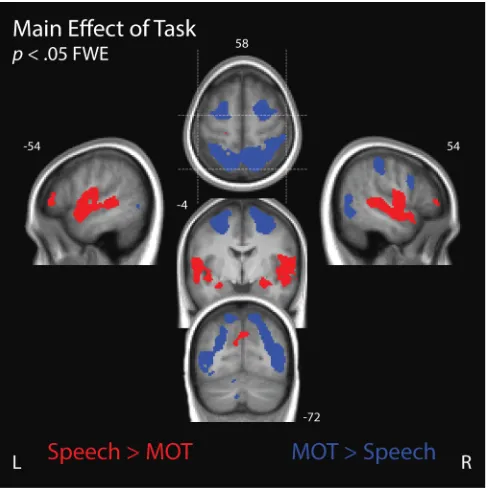
We observed widespread activity that differentiated between the speech
(‘Attend-Speech’) and tracking (‘Attend-MOT’) tasks (see Figure 4). Attend-Speech elicited
greater activity across temporal and lateral prefrontal cortices, as predicted (Wild et al.,
2012b), and Attend-MOT elicited greater activity in posterior parietal and superior frontal
cortices, as predicted (Culham, Cavanagh, & Kanwisher, 2001; Howe et al., 2009). This
activity pattern suggests that participants oriented their attention depending on the task
cue.
Simple Main Effect of Attended Speech Type
We analyzed our main effect of speech only for trials during which participants
performed the speech task (i.e., simple main effect during Attend-Speech), since we
hypothesized that focus of attention would alter speech processing; also, we wished to
include rotated speech in the contrast as a baseline, but this never occurred during
Attend-MOT (see Figure 5). Comparing the activity elicited by Clear, NV12, NV6, and Rotated
speech during Attend-Speech, we observed a simple main effect of speech type across
superior temporal and anterior insular cortices. Following Wild et al. (2012b), we
Figure 5. Main effect of Task. Voxels that exhibited a significant main effect of Task are grouped according to whether they reflect Attend-Speech BOLD activity > MOT (red) or Attend-MOT BOLD activity > Attend-Speech (α
examined intelligibility- and distortion-elevated simple effects within voxels exhibiting
this simple main effect.
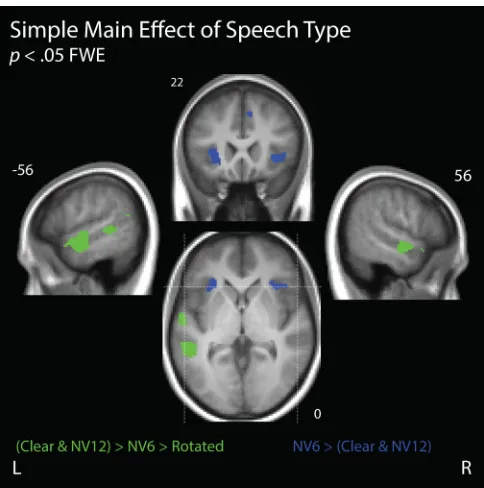
We first looked for voxels that had greater activity when speech was more
intelligible (Figure 5, green voxels). To examine this, we first ranked our speech types by
the mean gist comprehension reports across participants (combining Clear and NV12 due
to their highly similar intelligibility). We then conducted a Helmert contrast (c.f.,
Wendorf, 2004), sequentially comparing the activity elicited by a higher level of
intelligibility to the mean of all lower levels (i.e., [(Clear + NV12) > (NV6 + Rotated)] &
[NV6 > Rotated]). Similar to Wild and colleagues (2012b), we observed
intelligibility-elevated activity in bilateral superior temporal gyri.
Next we examined where activity was elevated for less intelligible (but still
comprehensible) speech, compared to more completely intelligible speech, as such
regions may be involved in compensating for stimulus degradation (Figure 5, blue
voxels). Again, we combined our two high-intelligibility speech types (Clear and NV12),
and searched for voxels where NV6 elicited greater activity than high-intelligibility
speech (i.e., NV6 > (Clear + NV12)/2). As in Wild et al., (2012b), we found
degradation-elevated activity in the anterior insulae and dorsal anterior cingulate cortex bilaterally.
Figure 6. Simple main effect of Speech Type.
Finally, we explicitly tested the prediction that, despite the highly similar
intelligibility of Clear and NV12, we would observe dissociable neural responses to these
speech types. The simple main effect of Clear vs NV12 during Attend-Speech revealed a
significant peak in the left STG (F(1, 23) = 86.49, p < .001, FWE corrected across the
whole brain) and a marginally significant peak in the right STG (F(1, 23) = 42.68, p = .
054, FWE corrected across the whole brain). These clusters partially overlapped with
voxels sensitive to intelligibility. In both STG regions, these effects were driven by a
stronger response to Clear than NV12. No voxels exhibited a significantly stronger
response for NV12 than for Clear.
Tracking-Load Dependent Activity
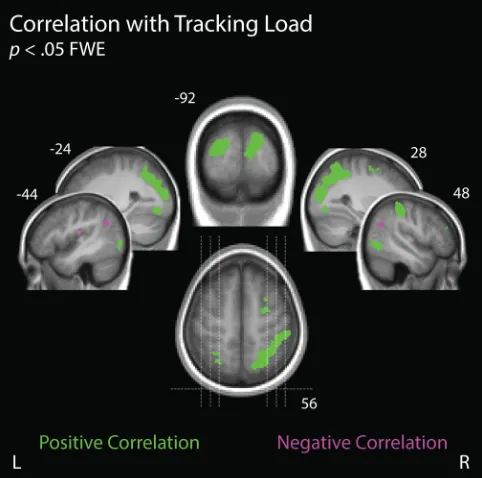
We looked for voxels in which activation was linearly dependent on the number of dots
that participants were tracking (i.e., where BOLD signal correlated with MOT level; see
Figure 6). In many of the brain regions in which there was greater activity for
attend-MOT than attend-speech (main effect of task), there were also positive correlations
between BOLD activation and the number of dots that participants tracked. These
findings are consistent with previous studies examining the effect of MOT load using
fMRI (Culham et al., 1998; Culham, Cavanagh, & Kanwisher, 2001; Jovicich et al.,
2001; Tomasi, Ernst, Caparelli, & Chang, 2004; Howe et al., 2009). We also observed
negative correlations with tracking load in the left supramarginal gyrus and angular gyri
bilaterally, regions implicated in spatial attention, speech comprehension, and audiovisual
integration (see: Seghier, 2013).
Speech × Task Interaction
Given our hypothesis that increasing attentional load would interfere with speech
perception, we constrained our interaction analyses to speech-sensitive regions, both to
aid in interpretation, and to reduce the inflation of our type II error rate by conservative
correction for multiple comparisons across the whole brain. To achieve this, we
constructed a speech perception mask using a union of the binarized masks for the main
effect of speech type, and the speech × attention interaction contrasts, from Wild et al.
(2012b), both thresholded at α = .05, corrected for multiple comparisons across the whole
brain (Worsley & Friston, 1995). This combination of masks: 1) allows us to focus our
analyses on regions that are generally sensitive to speech quality, or are sensitive to
speech quality depending on the attentional state; 2) provides a large (> 10,000 voxel)
area within which to search; and 3) uses data from an independent cohort, preventing any
dependencies between our mask and analyses (Kriegeskorte, Simmons, Bellgowan &
Baker, 2009).
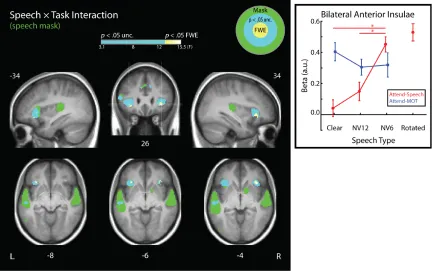
We observed a significant interaction between Task (Speech and
Attend-MOT) and Speech Type (Clear, NV12, and NV6) in anterior insulae bilaterally, consistent
with Wild et al. (2012b; see Figure 7). Two peaks within the left anterior insula were
within the effective smoothing of our preprocessing (10mm apart, with an effective
smoothing > 13mm), and so we averaged the parameter estimates across these peaks. To
compare the response profiles across hemispheres, we ran a Region × Speech × Task
mixed ANOVA on the parameter estimates from these regions. We found neither a main
effect of Region (F(1, 46) = 1.35, p = .25, partial eta-squared = .03), nor any interactions
between Region and our experimental conditions (all ps < .265). Accordingly, to simplify
In order to determine the simple effects driving the two-way interaction, we
analyzed the insular signal with a Speech Type × Task repeated-measures ANOVA.
Post-hoc analysis of the Speech Type × Task interaction revealed that activity for NV6 was
significantly greater than for NV12 or Clear speech during Attend – Speech (NV6
Attend-Speech > ClearAttend-Speech: t(23) = 6.14, p < .001; NV6Attend-Speech > NV12Attend-Speech: t(23) =
5.50, p < .001), but that activity did not differ by Speech Type under the Attend-MOT
condition (all ps > .408). This pattern of degradation-elevated activation selective to
Attend-Speech is consistent with the response profile observed in Wild et al. (2012b).
Figure 8. Speech × Task interaction. Left: Analyses were performed within a mask indicating cortex sensitive to speech. This mask was created by taking the union of the main effect of speech (Fig 4) and speech × attention interaction (Fig 6; equivalent to our speech × task contrast) maps (thresholded at α = .05, corrected family-wise across the whole brain) from Wild et al. (2012b). Cyan voxels exhibited an
Unlike Wild et al., (2012) we found elevated activity in the anterior insulae during
our distractor task, suggesting that the anterior insular response may not be selective to
speech. Consistent with this view, we observed a positive correlation with tracking load
in an 8mm search sphere centred on the right anterior insula peak (family-wise error
corrected within the sphere; t(23) = 4.79, p = .002), and a marginally positive correlation
with tracking load in the left anterior insula (t(23) = 2.83, p = .087). Given the
dependence of the anterior insular response on the load of our distractor task, a plausible
explanation for the difference between our response profile and that of Wild et al (2012)
is that our distractor task was more difficult, on average, than the ones used in this
previous experiment.
Speech × Task × Load Interaction
In the previous section, we established that processing of speech in some brain regions
depends on whether speech is the focus of attention. The next question is whether the
effect of attention is all-or-nothing, in which case the interaction would only depend on
which task participants performed, and would not be additionally modulated by different
levels of tracking load (i.e., a 2-way, but not 3-way interaction; see Figure 1A).
Alternatively, speech processing may share capacity with other cognitive processes, such
that the interaction between Speech Type and Task would also depend on tracking load
(i.e., a 3-way interaction; see Figure 1, B and C). We first looked for regions where the
relationship between tracking load and BOLD activation depended on both Speech Type
and Task, and then characterized responses in each of these regions by examining how
the difference in activation level between full attention and distraction depended on both
Speech Type and on Tracking Load. We predicted that the BOLD response would
correlate inversely with MOT load during either clear or degraded speech trials, with the
correlation during NV12 trials more similar to either Clear or NV6 speech.
During Attend-Speech, the total number of (task-irrelevant) dots on the screen
changed in order to match the number of onscreen dots in the corresponding level of
tracking load during Attend-MOT. Thus, the “tracking load” factor is present for both
the strong linear dependence of behavioural tracking performance on tracking load (rmedian
= .94), as well as our observation of widespread load-correlated activity during MOT
performance, we decided to model tracking load as a parametric modulator on the
columns modelling each of the speech types (separately for the two attentional tasks).
The three-way interaction manifests as significant effects of both Task and Speech Type
on the slope of the relationship between BOLD activity and Tracking Load.
As in our Speech Type × Task analysis, we examined the Speech Type × Task ×
Load interaction using the independently defined mask developed using two contrasts
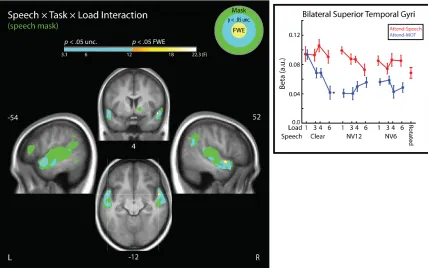
from Wild et al. (2012) described earlier. We observed a significant interaction in anterior
areas on the bilateral superior temporal gyri (aSTG; see Figure 8; graph portrays
parameter estimates extracted from each level of tracking load). We entered the extracted
parameter estimates from the peak aSTG voxel in each hemisphere into a Region ×
Speech Type × Task mixed ANOVA. We did not find a main effect of region: F(1, 46) = .
094, p = .761, partial eta-squared = .01; or any interactions involving Region and our
experimental conditions (all ps > .528). Accordingly, we averaged the parameter
estimates across these regions to produce a single aSTG response, in order to simplify
presentation.
A two-way (Speech Type × Task) repeated-measures ANOVA on the extracted
aSTG parameter estimates revealed that Speech Type markedly affected the weights for
the load parametric modulator (i.e., slopes relating BOLD to attentional load magnitude)
during Attend-MOT, but not during Attend-Speech. During Attend-MOT, Clear speech
had a more negative load-dependent slope than either NV12 (t(23) = -4.85, p < .001) or
NV6 (t(23) = -2.87, p = .025). We tested all six slopes for the three Speech Types × two
tasks against 0 (no significant relationship between load and BOLD) using one-sample
t-tests. Only Clear speech, during tracking, exhibited a significant (or even marginal)
relationship (Šidák-corrected for 6 comparisons: ClearAttend-MOT: t(23) = -4.17, p = .002),
and this condition also exhibited a slope that was significantly different from those in all
characterized by BOLD signal decreasing as load increased, but only for Clear speech,
and only when attention was on the MOT task.
We also analyzed the Speech × Task × Load interaction in these aSTG peak
coordinates, treating each load level as a separate condition, in order to understand how
the Speech by Task interaction changes as a function of tracking load during the MOT
task. (see Figure 8). Since we did not expect tracking load to affect BOLD during
Attend-Speech, and indeed we did not observe any such effect, we averaged over levels of
tracking load during Attend-Speech, separately for each speech type. We then, for each
Speech Type, subtracted the response during Attend-MOT at each level of Load from the
overall response during Attend-Speech for that Speech Type. For this measure, zero
indicated the same response for a given speech type during Speech and
MOT, and negative values indicated a weaker response for that Speech Type during
Attend-MOT compared to during Attend-Speech.
We first tested whether the peak aSTG responses differed between Attend-Speech
and Attend-MOT (i.e., one-sample t-tests against 0) for each Speech Type, at each level
of Load. Clear, at the lowest level of Load (1 dot), was the only condition that elicited
statistically indistinguishable levels of activity between Attend-Speech and Attend-MOT
states (Attend-Speech (t(23) = -0.31, p = .76 uncorrected, p = 1.00 Šidák-corrected).
Looking within the lowest level of tracking load, we found that the difference between
Attend-Speech and Attend-MOT was significantly larger for NV12 (t(23) = 5.61, p < .
001) and NV6 (t(23) = 3.11, p = .015) than it was for Clear. In other words, at the
weakest level of load, Clear speech elicits a more similar response between tasks than
was the case for NV12 or NV6, and is not significantly different from Attend-Speech. At
higher levels of load, the difference between tasks did not depend on Speech Type (all ps
> .193). Importantly, the significant decrease in activation for NV6 and NV12 between
Attend-Speech and Attend-MOT at the least challenging level of MOT did not get any
larger at more challenging levels, suggesting that activation in this region evoked by
degraded speech is already effectively at floor when even a mild (1-dot MOT) distractor
task is used.
In conclusion, we found that in the aSTG, the processing of highly intelligible
degraded speech (both NV6 and NV12) depended markedly on which task participants
performed; falling to very low values even at the least demanding level of the MOT task.
In contrast, the processing of clear speech was similar when it was attended, and when it
was heard while participants performed the least demanding MOT task, with activation
falling steadily at more challenging levels of MOT. This imaging dissociation between
NV12 and clear speech is interesting, given their similar intelligibilities.
Prefrontal Speech × Task × Load Interaction
There is a large body of work on the role of the left IFG (including ‘Broca’s Area’) in
Poldrack et al., 1999; Gold & Buckner, 2002; Davis & Johnsrude, 2003, 2007; Rodd,
Johnsrude, & Davis, 2012; Wild, Davis, & Johnsrude, 2012), and the homologous right
IFG has been implicated in domain-general attentional control (Corbetta & Shulman,
2002; Levy & Wagner, 2011; Hampshire et al., 2010; Fedorenko, Duncan, & Kanwisher,
2013), including exhibiting load-dependent activity during MOT (Tomasi, Ernst,
Caparelli, & Chang, 2004; Tomasi, Wang, Wang, & Volkow, 2014). Both of these regions
have also been implicated in dual-task interference (Herath et al, 2001; Jiang, Sae, &
Kanwisher, 2004; Sabri, Humphries, Binder, & Liebenthal, 2013), including interference
between auditory and visual tasks (Tombu et al, 2011; Wild et al., 2012; Finoia et al,
2015).
This previous work linking the IFG to attentional control in the context of speech,
MOT, and dual-task paradigms motivated our investigation of load-dependent effects in
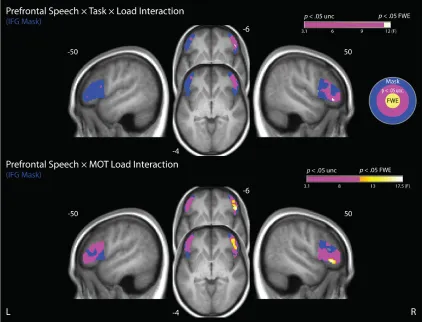
bilateral IFG regions of interest. We constructed an anatomical mask using the LONI
Probabilistic Atlas (LPBA40; Shattuck et al., 2007). This was a binary mask with voxels
that were labelled as either the left or right IFG (RIFG), with a maximum likelihood
threshold of 50%. This produced a mask with over 3800 voxels, and visual inspection
confirmed that it provided good coverage of the IFG bilaterally.
Within this mask, we looked for voxels in which the relationship between tracking
load and BOLD activity (i.e., beta weights on the parametric modulators modelling
tracking load) depended on both Speech Type (3 levels) and attentional Task (2 levels)
and found a significant peak (see Figure 9). To determine whether the pattern of the
3-way interaction was different from that in the bilateral aSTG, we ran a Region × Speech
Type × Task mixed ANOVA on the extracted parameter estimates. Although we found a
marginal Region × Task interaction (F(1,46) = 2.99, p = .091, partial eta-squared = .06),
neither the main effect of Region, nor other interactions involving the factor Region were
significant. The marginal interaction between region and task was driven by a larger
difference between tasks in the RIFG than the aSTG.
As we did in the aSTG, we examined how the Speech Type by Task interaction
response over the tracking-load factor for each Speech Type when for Attend-Speech
trials. For Attend-MOT trials, for each Speech Type, each level of load was treated
separately. We ran a Region × Speech Type × Tracking Load mixed ANOVA on the
differences between BOLD responses during Attend-MOT and the corresponding mean
speech responses during Attend-Speech. We observed neither a significant main effect of
Region nor interactions involving Region (ps > .350). As is the aSTG, the Speech Type ×
Load interaction was driven by the difference in activation between Attend-Speech and
the lowest level of tracking load being statistically nonsignificant for Clear (one-sample
t-tests against 0: t(23) = 1.46, p = .158 uncorrected, p = .873 Šidák-corrected), but