An extended abstract of this paper appears in Christian Cachin, editor, International Colloquium on Automata, Languages and Programming – ICALP 2007, Volume ?? of Lecture Notes in Computer Science, pages ??–??, Wroclaw, Poland, July 9–13, 2007. Springer-Verlag, Berlin, Germany. This is the full version.
Unrestricted Aggregate Signatures
Mihir Bellare1 University of California San Diego
[email protected], http://www-cse.ucsd.edu/users/mihir
Chanathip Namprempre2 Thammasat University
[email protected], http://chanathip.ee.engr.tu.ac.th
Gregory Neven3 Katholieke Universiteit Leuven
[email protected], http://www.neven.org
June 2006
Abstract
Secure use of the BGLS [7] aggregate signature schemes is restricted to the aggregation of distinct messages (for the basic scheme) or per-signer distinct messages (for the enhanced, prepend-public-key version of the scheme). We argue that these restrictions preclude interesting applications, make usage of the schemes error-prone and are generally undesirable in practice. Via a new analysis and proof, we show how the restrictions can be lifted, yielding the first truly unrestricted aggregate signature scheme. Via another new analysis and proof, we show that the distinct signer restriction on the sequential aggregate signature schemes of [18] can also be dropped, yielding an unrestricted sequential aggregate signature scheme. Finally, we present variants of these schemes with tight security reductions.
1
Supported by NSF grants CNS-0524765 and CNS-0627779, and a gift from Intel Corporation.
2
Supported by the Thailand Research Fund.
3
1
Introduction
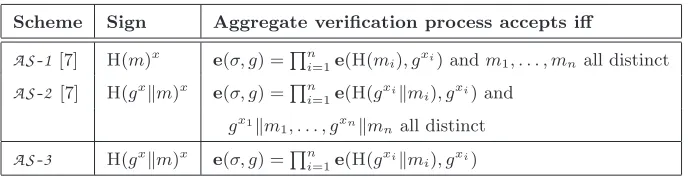
Aggregate signatures. An aggregate signature (AS) scheme [7] is a digital signature scheme with the additional property that a sequenceσ1, . . . , σn of individual signatures —hereσi is the signature, under the underlying base signature scheme, of some messagemiunder some public keypki— can be condensed into a single, compact aggregate signatureσthat simultaneously validates the fact thatmihas been signed under pki for all i = 1, . . . , n. There is a corresponding aggregate verification process that takes input (pk1, m1), . . . ,(pkn, mn), σand accepts or rejects. Aggregation is useful to reduce bandwidth and storage, and is especially attractive for mobile devices like sensors, cell phones, and PDAs where communication is more power-expensive than computation and contributes significantly to reducing battery life. Schemes. Boneh, Gentry, Lynn, and Shacham [7] present an aggregate signature scheme based on the BLS signature scheme [9]. We call it
A S
-1
and represent it succinctly in the first row of Table 1.A S
-1
,however, has some limitations. As the table shows, the aggregate verification process, on inputs (pk1, m1),
. . . ,(pkn, mn), σ, rejects if the messages m1, . . . , mn are not distinct. The restriction is crucial because, without it, as shown in [7], the scheme is subject to a forgery attack. The consequence, however, is to restrict the ability to aggregate to settings where the messages signed by the signers are all different. BGLS recognize this limitation and suggest a workaround. Specifically, they say: “It is easy to ensure the messages are distinct: The signer simply prepends her public key to every message she signs ...” [7, Section 3.2]. They stop short of specifying a scheme in full, but since it is clearly their intention to “reduce to the previous case,” our understanding is that they are advocating the modified scheme in which the signature of a messagemunder pk is the BLS signature of theenhanced message M =pkkm
underpk while aggregate verification is done by applying the aggregate verification procedure of
A S
-1
to(pk1,pk1km1), . . . ,(pkn,pknkmn), σ. However, if so, in this scheme, which we call
A S
-2
, the aggregate verification process will reject unless the enhanced messages pk1km1, . . . ,pknkmn are distinct. (Why? Because the aggregate verification process ofA S
-1
rejects unless the messages are distinct, and the role ofthe messages is now played by the enhanced messages.) The consequence is that the ability to aggregate is restricted to settings where the enhanced messages signed by the signers are all different. That is, the limitations have been reduced, but not eliminated.
Our result. We ask whether there exists a truly unrestricted proven-secure aggregate signature scheme. Namely, there should be no distinctness-based restriction of any kind, whether on messages or enhanced messages. We show that the answer is yes. Our result is a new, direct analysis of the security of enhanced-message signature aggregation which shows that the distinctness condition in the aggregate verification process of
A S
-2
—namely that this process rejects if any two enhanced messages are the same— can be dropped without compromising security. In other words, an unrestricted scheme can be obtained by the natural adaptation ofA S
-2
in which the distinctness condition in the verification is simply removed and all else is the same. This scheme, which we denoteA S
-3
, is summarized in the last row of Table 1. The fact thatA S
-3
is very close toA S
-2
is a plus because it means existing implementations can be easily patched.We clarify that the security of
A S
-3
is not proved in [7]. They prove secure onlyA S
-1
. The security ofA S
-2
is a consequence, but the security ofA S
-3
is not. What we do instead is to directly analyze security in the case that signatures are on enhanced messages. Our analysis explicitly uses and exploits the presence of the prepended public keys to obtain the stronger conclusion thatA S
-3
(not justA S
-2
) is secure.Motivation. The limitation of
A S
-2
—namely that aggregation is restricted to settings where no two enhanced messages are the same— may seem minor, because all it says is that a set of signatures to be aggregated should not contain duplicates, meaning multiple signatures by a particular signer of a particular message. However, as we now explain, there are several motivations for schemes likeA S
-3
where aggregation is possible even in the presence of duplicates.
Scheme Sign Aggregate verification process accepts iff
A S-1[7] H(m)x
e(σ, g) =Qn
i=1e(H(mi), g xi
) andm1, . . . , mnall distinct
A S-2 [7] H(gx
km)x
e(σ, g) =Qn i=1e(H(g
xik
mi), g xi) and
gx1km1, . . . , gxnkmnall distinct
A S-3 H(gx
km)x
e(σ, g) =Qn i=1e(H(g
xik
mi), g xi)
Table 1: The aggregate signature schemes we discuss. Here e: G1×G2 → GT is a bilinear map, g is a generator of G2 known to all parties, and H: {0,1}∗ → G
1 is a hash function. The second column shows the signature of a message m under public key gx, generated using secret key x. In all cases, a sequence of signatures is aggregated by simply multiplying them inG1. The third column shows under what conditions the aggregate verification algorithm acceptsσas a valid aggregate signature of messages
m1, . . . , mn under public keysgx1, . . . , gxn respectively.
to save storage. (The schemes discussed here permit on-line aggregation in which one can maintain a current aggregate and aggregate into it a received signature.) However, environmental measurements can certainly repeat over time! Indeed, especially in stable conditions, we would expect frequent repeats. Thus, a single signer (sensor) may sign the same data (measurement) many times. In general, whenever the data being signed is drawn from a small space, not just messages, but even enhanced messages can repeat and an unrestricted aggregate signature scheme is necessary.
Perhaps an even more important reason to prefer unrestricted schemes is that they are less likely to be misused or to result in unexpected errors. An application designer contemplating using
A S
-2
mustask herself whether, in her application, enhanced messages might repeat. This may not only be hard to know in advance, but might also change with time. (Experience has repeatedly shown that once a piece of cryptography is deployed, it is used for purposes or applications beyond those originally envisaged.) With an unrestricted scheme, the application designer is freed from the need to worry about whether the setting of her application meets the restrictions, reducing the chance of error. In general, application designers and programmers have a hard enough time as it is to make error-free use of cryptography. Asking them to understand message distinctness restrictions and anticipate whether their application meets them is an added burden and one more place where things can go wrong.
Possible workarounds. Various ways to get around message distinctness restrictions may come to mind, but these workarounds either do not work or tend to be more complex or restrictive than direct use of an unrestricted scheme. For example, one could have the verifier drop from its input list (pk1, m1),
. . . ,(pkn, mn), σany pairpki, mithat occured previously in the list, but then, assumingσwas a correct aggregate signature of the given list, it will not be a correct aggregate signature for the truncated list, and verification will fail. Another possibility is that the aggregator refrain from including in the aggregate any signature corresponding to a public key and message whose signature is already in the aggregate. But aggregation may be done on-line, and the aggregator may know only the current aggregate and the incoming signature, and have no way to tell whether or not it is a duplicate. Nonces (timestamps or sequence numbers) could be added to messages to render them unique, but this would complicate the application and increase cost.1 Being able to use
A S
-3
without any worries about signature or message replication is simpler, easier, and more practical.Results for SASs. A sequential aggregate signature (SAS) scheme [18] permits a more restrictive kind of aggregation in which the signers must participate in the process and use their secret keys. Imagine the signers forming a chain. In stepi, thei-th signer receives from the previous one a current aggregate, and, using its secret key, it aggregates into this its own signature, passing the new aggregate on to the
1
next signer in the chain. The output of the final signer is the aggregate signature. Although clearly less powerful than general aggregate signature (GAS) schemes —following [8] we now use this term for the BGLS-type aggregate signatures discussed above in order to distinguish them from SASs— the argument of [18] is that sequential aggregation is possible for base signature schemes other than BLS or may be done more cheaply. Specifically, Lysyanskaya, Micali, Reyzin, and Shacham [18] present a SAS scheme based on certified [5] claw-free trapdoor permutations.
However, the model and schemes of [18] also have some limitations. They require that no public key can appear more than once in a chain. That is, the signers who are part of a signing chain must be distinct. But in practice there are many reasons to prefer to allow aggregation even when a particular signer signs multiple messages, meaning when there are loops in the chain and public keys can repeat. Certainly, the previously discussed motivations are still true. Namely, in applications like signing in sensor nets or ad hoc networks, a particular signer (sensor) will be producing many signatures and it would be convenient to allow these to be aggregated. More importantly, an unrestricted SAS scheme is more misuse resistant because it does not require the application designer to try to predict in advance whether or not there will be repeated signers in a prospective chain. But in fact the restrictions in [18] are even greater than the ones for
A S
-2
, for they say not only that one cannot aggregate when a particular signer signs a particular message twice, but that one cannot aggregate even when a particular signer signs two or more messages that are distinct. This makes the number of excluded applications even larger, for it is common that a particular signer needs to sign multiple messages.Our result —analogous to the GAS case— is a new analysis and proof that shows that the restrictions imposed by [18] on their schemes can be lifted without impacting security (that is, verification can just drop the condition that one reject if there are repeated public keys, and security is preserved), yielding unrestricted schemes. Again, that only a minor modification to the scheme is needed is convenient if existing implementations need to be updated.
Tight reduction results. The security of
A S
-1
,A S
-2
, andA S
-3
is based on the coCDH problem. However, none of the security reductions —namely, those of [7] in the first two cases and ours in the last— are tight. By applying the technique of Katz and Wang [16], we obtain an alternative schemeA S
-4
with a tight security reduction to coCDH. When implemented over the same group,A S
-1
,A S
-2
,A S
-3
, andA S
-4
all have about the same computational cost, the price forA S
-4
being a slightly larger aggregate signature. (Specifically, one needs one extra bit per constituent signature.) However, due to the tight reduction,A S
-4
is actuallymore efficient than the other schemes when one compares them at the same (provable) security level. (Because to achieve a given level of security,A S
-4
needs a smaller group thanthe other schemes.) We also obtain an analogous result for the SAS case. The statements and the proofs of our tight reduction results are in Section 5.
Related work. Lu, Ostrovsky, Sahai, Shacham, and Waters [17] present a SAS scheme for which they can lift the distinct signer restriction, as follows. If a signer wishes to add its signature of a messageMnew to an aggregate S which already contains its signatureSold on some messageMold, then it removesSold from S and then adds back in a signature on the messageMnewkMold. However, their scheme is weaker than the others we have discussed —ours or those of [7, 18]— with regard to some security properties and also with regard to efficiency. Specifically, [17] uses the certified public key model [1, 6], which reflects the assumption that signers provide strong ZK proofs of knowledge of secret keys to the CA at key-registration, an assumption that we, following [7, 18], do not make. Also, in the scheme of [17], public keys are very large, namely 162 group elements, which is particularly expensive if public keys have to be transmitted along with signatures. In contrast, other schemes have short public keys. On the other hand, the proofs of [17] are in the standard model, while ours, following [7, 18], are in the random oracle model of [3].
Interestingly, in a survey paper, Boneh, Gentry, Lynn, and Shacham [8] present
A S
-3
, claiming that2
Notation and Basic Definitions
Notation and conventions. If x is a string, then |x| is the length of x. We denote by x1k · · · kxn an encoding of objects x1, . . . , xn as a binary string from which the constituent objects are uniquely recoverable. When the objects can be encoded as strings whose length is known from the context, simple concatenation will serve the purpose. If S is a finite set, then |S| is its size, and s ←$ S means that
s is chosen at random from S. We let edenote the base of the natural logarithm. An algorithm may be randomized unless otherwise indicated. An adversary is an algorithm. If A is an algorithm then
y←$ A(x1, x2, . . .) means thaty is the result of executingAon fresh random coins and inputsx1, x2, . . .. We denote by [A(x1, x2, . . .)] the set of all possible outputs ofAon the indicated inputs, meaning the set of all strings that have a positive probability of being output byAon inputsx1, x2, . . .. We letMaps(D) denote the set of all functions with domain{0,1}∗ and rangeD.
Digital signature schemes. We recall definitions for (standard) signature schemes [13] in the random-oracle (RO) model [3]. A signature scheme
DS
= (Kg,Sign,Vf) is specified by three algorithms, the last deterministic. Via (pk,sk)←$ Kg, a signer generates its public keypk and matching secret keysk, where H: {0,1}∗ →D is a random oracle whose rangeDis a parameter of the scheme. Via σ←$ SignH(sk, m) the signer can generate a signatureσon a message m. A verifier can runVfH(pk, m, σ) to obtain a bit, with 1 indicating accept and 0 reject. The consistency (or correctness) condition is thatPrhVfH(pk, m, σ) = 1 : (pk,sk)←$ Kg; H←$ Maps(D) ; σ←$ SignH(sk, m)i = 1
for all messagesm∈ {0,1}∗. To capture security (unforgeability under chosen-message attack) we define the advantage of an adversaryBas
AdvufDS-cma(B) = Pr
h
VfH(pk, m, σ) = 1 : (pk,sk)←$ Kg; H←$ Maps(D) ; (m, σ)←$ BSignH(sk,·),Hi . To make this meaningful, we only consider adversaries that are legitimate in the sense that they never queried the message in their output to their sign oracle. We say that
DS
is (t, qS, qH, ǫ)-secure if noadversary Brunning in time at most t, invoking the signature oracle at mostqS times and the random oracle at mostqHtimes, has advantage more thanǫ.
3
Unrestricted General Aggregate Signatures
GAS schemes. A general aggregate signature (GAS) scheme [7]
AS
= (Kg,Sign,Agg,AVf) consists of four algorithms, the last deterministic. The key generation and signing algorithms are exactly as for standard digital signatures. Via σ ←$ AggH((pk1, m1, σ1), . . . ,(pkn, mn, σn)), anyone can aggregate a sequence of public key, message, and signature triples to yield an aggregate signature σ. A verifier can run AVfH((pk1, m1), . . . ,(pkn, mn), σ) to obtain a bit, with 1 indicating accept and 0 reject.Security. The security requirement of [7] is strong, namely that an adversary find it computationally infeasible to produce an aggregate forgery involving an honest signer, even when it can play the role of all other signers, in particular choosing their public keys, and can mount a chosen-message attack on the honest signer. To capture this, we define the advantage of an adversaryAas
AdvaggAS -uf(A) = Pr
h
AVfH((pk1, m1), . . . ,(pkn, mn), σ) = 1
i
where the probability is over the experiment (pk,sk)←$ Kg; H←$ Maps(D) ; ((pk
1, m1), . . . ,(pkn, mn), σ) $
←ASignH(sk,·),H(pk).
To make this meaningful, we only consider adversaries that are legitimate in the sense that there must exist i ∈ {1, . . . , n} such that pki =pk but Anever queried mi to its signing oracle. Thus, the honest signer here is the one whose keys are pk,sk, and we are asking that the aggregate forgery include some message and signature corresponding to this honest signer, but the adversary never legitimately obtained a signature of this message. We say that A (t, qS, nmax, qH, ǫ)-breaks
AS
if it runs in time at most t,containing at most nmax public-key-message pairs, and has advantage strictly greater than ǫ. We say that
AS
is (t, qS, nmax, qH, ǫ)-secure if there is no adversary that (t, qS, nmax, qH, ǫ)-breaksAS
.A significant feature of this definition, highlighted in [7], is thatAcan choosepk1, . . . ,pknas it wishes, in particular as a function ofpk. Unlike [1, 6, 17], there is no requirement that the adversary “know” the secret key corresponding to a public key it produces, and this makes the system more practical since it avoids the need for strong zero-knowledge proofs of knowledge [2] of secret keys done to the CA during key-registration. Our results continue to achieve this strong notion of security.
Bilinear maps and coCDH.LetG1,G2,GT be groups, all of the same prime orderp. Lete: G1×G2→ GT be a non-degenerate, efficiently computable bilinear map, also called a pairing. Letgbe a generator of G2. Note that following [9, 7] we use the asymmetric setting (G1,G2 are not necessarily equal) and must also assume there exists an isomorphism ψ: G2→G1. (The first is in order to make signatures as short as possible, and the second is required for the security proofs.) For the rest of the paper, we regard G1,G2,GT,e, g, ψas fixed, globally known parameters, and also let texp denote the time to perform an exponentiation inG1. We define the advantage of an adversaryAin solving the coCDH problem as
Advco-cdh(A) = PrhA(g, ga, h) =ha : h $
←G1; a←$ Zpi .
We say that the coCDH problem is (t′, ǫ′)-hard if no algorithmArunning in time at mostt′has advantage strictly more thanǫ′ in solving it. Note that whenG
1=G2, the coCDH problem becomes the standard CDH problem inG1, whence the name.
The
BLS
scheme. We recall theBLS
standard signature scheme of [9]. The signer chooses a secret keyx←$ Zp and computes the corresponding public keyX ←gx. LetH:{0,1}∗ →G
1 be a random oracle. The signature of messagemisσ=H(m)x, which can be verified by checking thate(σ, g) =e(H(m), X). Regarding security, we have the following:
Lemma 3.1 [9]If the coCDH problem is(t′, ǫ′)-hard, then the
BLS
standard signature scheme is(t, qS, qH, ǫ
)-secure for any t, qS, qH, ǫsatisfying
ǫ ≥ e(qS+ 1)·ǫ′ and t ≤ t′−texp(qH+ 2qS) . (1) The GAS schemes we consider. We consider four closely related aggregate signature schemes that we denote
A S
-0
,A S
-1
,A S
-2
,A S
-3
. These schemes all use a random oracle H:{0,1}∗ →G1. The key generation algorithm of
A S
-0
andA S
-1
picks xat random from Zp, returns xas the secret key, andX =gx as the public key. The key generation algorithm of
A S
-2
andA S
-3
picks xat random fromZp, sets X =gx, returns (x, X) as the secret key, andX as the public key. ForA S
-0
andA S
-1
, the signing algorithm is theBLS
one, namely the signature on message m is σ = H(m)x. ForA S
-2
andA S
-3
, a signature on m under public key X is σ =H(Xkm)x. For all schemes, aggregation is done by simply multiplying the signatures, i.e. σ=Qni=1σi in G1. Verification is different for each scheme. On inputs (X1, m1), . . . ,(Xn, mn), σ, the verification algorithm of
A S
-0
accepts iff e(σ, g) = Qn
i=1e(H(mi), Xi). The verification algorithms of the other schemes are depicted in Table 1. In particular,
A S
-1
rejects if m1, . . . , mn are not all distinct,A S
-2
rejects if X1km1, . . . , Xnkmn are not all distinct, whileA S
-3
performs no such checks.Consistency conditions. The consistency condition (under what conditions correctly generated ag-gregates are accepted by the verifier) differs from scheme to scheme, and is in fact the place where the restrictions they make surface in a formal sense.
A S
-0
andA S
-3
meet the natural, strongest possibleconsistency requirement, namely that
PrhAVfH((pk1, m1), . . . ,(pkn, mn), σ) = 1
i
= 1
for all positive integers n, all messages m1, . . . , mn ∈ {0,1}∗ and all (pk1,sk1), . . . ,(pkn,skn) ∈ [Kg], where the probability is over the experimentH←$ Maps(D) ;σ1←$ SignH(sk1, m1) ;· · ·;σn ←$ SignH(skn,
mn);σ $
←AggH((pk1, m1, σ1), . . . ,(pkn, mn, σn)). However,
A S
-1
meets this condition only whenm1, . . . ,mn are distinct and
A S
-2
whenpk1km1, . . . ,pknkmn are distinct.Subroutine H-sim(M)
If (∃m:M =X∗km) then returnH BLS(M)
Else If HT[M] =⊥then y[M]←$ Zp; HT[M]←ψ(g)y[M] Return HT[M]
Subroutine Sign-sim(m) ReturnSignBLS(x, X∗km)
Figure 1: The subroutines for B to simulate the random oracle HA S-3(·) and the sign oracle
SignA S-3((x, X∗),·). Above, HT and y are associative arrays assumed initially to have value ⊥ every-where.
where the aggregate verification process rejects when messages repeat. They are able to show that this suffices to guarantee security, meaning that they prove
A S
-1
is secure if the coCDH problem is hard. This is their main result. Then they suggest to alleviate the message-distinctness restriction ofA S
-1
by havingeach signer prepend its public key to the message before signing. However, they appear to want to argue the security of the resulting aggregate signature scheme as a corollary of their main result on the security of
A S
-1
. If so, verification still needs to check that X1km1, . . . , Xnkmn are all distinct (otherwise, the result aboutA S
-1
does not apply), leading to theA S
-2
scheme.As we have discussed, however, for practical reasons,
A S
-3
is a preferable scheme. But the results of[7] do not prove it secure. Here is an example that helps to see what the problem is. Suppose there was an adversary A that, on inputpk =X and without making oracle query m, produced a forgery of the form (X, m),(X′, m′),(X′, m′), σ, for somem′ 6=m andX′ 6=X, that was accepted by the verification procedure of
A S
-3
. Since the output ofAcontains repeated enhanced messages, the results of [7] do not allow us to rule out the existence ofA. Yet, showing thatA S
-3
meets the notion of security that we havedefined does require ruling out the existence of such anA.
Theorem 3.2 If the coCDH problem is(t′, ǫ′)-hard, then the
A S
-3
aggregate signature scheme is (t, q S,nmax, qH, ǫ)-secure for any t, qS, nmax, qH, ǫsatisfying
ǫ ≥ e(qS+ 1)·ǫ′ and t ≤ t′−texp(2qH+ 2qS+ 3nmax+ 1) . (2) Our approach to the proof is different from the one used by [7] to prove that
A S
-1
is secure if coCDH is hard. They gave a direct reduction to coCDH, meaning, given an adversary attackingA S
-1
they construct and analyze an adversary attacking coCDH. But, in so doing, they end up duplicating a lot of the proof of the security of theBLS
scheme as given in [9]. Instead, we reduce the security ofA S
-3
tothe security of
BLS
. That is, we prove the following: Lemma 3.3 If theBLS
standard signature scheme is(t′, q′S, q′H, ǫ′)-secure then the
A S
-3
aggregatesig-nature scheme is (t, qS, nmax, qH, ǫ)-secure for any t, qS, nmax, qH, ǫsatisfying
ǫ≥ǫ′, qS≤q′S−nmax, qH≤qH′ and t≤t′−texp·(qH+nmax+ 1). (3) Theorem 3.2 follows easily from Lemma 3.3 and Lemma 3.1. Our modular approach yields a simple proof even though we obtain a somewhat stronger result.
An interesting element of the proof of Lemma 3.3 is that it involves reducing the security of one random oracle model scheme to another one. Given a forger A against
A S
-3
that queries a randomoracle, we must build a forgerB against
BLS
. ButBis itself given a random oracle. The idea is that Bwill answer some of A’s queries via its own random oracle and directly simulate the others.
Proof of Lemma 3.3: Given a forger A that (t, qS, nmax, qH, ǫ)-breaks
A S
-3
, consider the followingthere exists i∈ {1, . . . , n} such thatXi=X∗ andmi has never been queried toSignA S-3((x, X∗),·). We leti∗ denote the smallest integerifor which this happens. NowBdefines the sets:
I = {i | Xi =X∗ andmi=mi∗}
J = {i | Xi =X∗ andmi6=mi∗}
K = {i | Xi 6=X∗}.
Note that Iis non-empty sincei∗∈I. Clearly, we have thatI∪J∪K={1, . . . , n} and thatI, J, K are disjoint. Now, we can assume without loss of generality that n < p, because otherwise B can trivially forge and output a
BLS
signature under X∗ in time O(ntexp) via exhaustive search forx. This means that |I| ∈ Z∗p, and hence has an inverse modulo p that we denote by l. Now, for each i ∈ J, our adversary B executes Sign-sim(mi) to obtain σi ← SignBLS(x, X∗kmi). For each i ∈ K, it calls its subroutine H-sim(Xikmi), thereby ensuring that y[Xikmi] is defined, letsyi ←y[Xikmi], and then lets
σi←ψ(Xi)yi, which we note is the
BLS
signature ofXikmi under public keyXi. Finally,BletsM∗←X∗kmi∗ and σ∗← σ·Qi∈J∪Kσ−i 1 l
, (4)
and outputs (M∗, σ∗) as its forgery.
For the analysis, we first argue that if A’s forgery is valid then B’s forgery is valid too. Assuming the former, the verification equation of
A S
-3
tells us thate(σ, g) = n
Y
i=1
e HA S-3(Xikmi), Xi
=Y
i∈I
e HBLS(X∗kmi∗), X∗· Y
i∈J
e HA S-3(X∗kmi), X∗·
Y
i∈K
e HA S-3(Xikmi), Xi
=e HBLS(X∗kmi∗), X∗ |I|
· Y
i∈J∪K
e(σi, g) . (5)
Above, (5) is true becauseσi, as computed above byB, is the
BLS
signature ofXikmi under public keyXi, for alli∈J ∪K. We then applied the verification equation of the
BLS
scheme. Now we see that ifσ∗ is defined by (4) then, from the above and the fact that|I| ·l≡1 (modp) we have
e(σ∗, g) = e(σ, g)l· Y
i∈J∪K
e(σi, g)−l
= e HBLS(X∗kmi∗), X∗
|I|·lmodp
· Y
i∈J∪K
e(σi, g)l·
Y
i∈J∪K
e(σi, g)−l
= e HBLS(M∗), X∗
,
which means thatσ∗ is a valid
BLS
signature ofM∗ under public keyX∗.Furthermore, it is easy to see that the answers thatBprovided to the oracle queries ofAare distributed identically to the ones that Awould have obtained from its oracles in the game defining its advantage. The last thing we need to check is that B is legitimate, meaning did not query M∗ = X∗km
i∗ to its
SignBLS(x,·) oracle. But it did not do so while answeringSignA S-3((x, X∗),·) oracle queries ofAbecauseA, being legitimate itself, did not querymi∗ to itsSignA S-3((x, X∗),·) oracle. NowBalso calledSignBLS(x,·) onX∗kmi for alli∈J, but by definition ofJ, we know thatmi 6=mi∗. Putting everything together, we
getAdvufBLS-cma(B)≥Adv agg-uf A S-3 (A).
Finally, we analyze the resource usage of B. For qS, we note that B makes sign queries in only two situations: (1) whenever A makes a sign query, so doesB, and (2) once A outputs a forgery, B makes
|J| ≤nmax additional sign queries. ForqH, it is easy to see that B makes at most the same number of
random oracle queries toHBLS asA makes toHA S-3. For t, notice that B(1) answersqHrandom oracle
4
Unrestricted Sequential Aggregate Signatures
SAS schemes. A sequential aggregate signature (SAS) scheme [18]
SAS
= (Kg,SASign,SAVf) consists of three algorithms, the last deterministic. The key generation algorithm is exactly as for standard digital signatures. The first signer computes a signature on message mby calling σ←SASignH(sk, m). Subsequent signers runσ $←SASignH(sk, m, σ′,(pk
1, m1), . . . ,(pkn, mn)), wheren >0, to aggregate their signature on a message minto a given sequential aggregate signatureσ′ corresponding to a sequence of public-key-message pairs. A verifier can run SAVfH((pk1, m1), . . . ,(pkn, mn), σ), where n≥0, to obtain a bit, with 1 indicating accept and 0 reject.
Security. The security of a SAS scheme in the random oracle model requires that it be computationally infeasible for an adversary to produce a sequential aggregate forgery involving an honest signer, even when it can play the role of all other signers and can mount a chosen-message attack on the honest signer. Formally, the advantage of an adversaryAis
AdvseqSAS-agg-uf(A) = Pr
h
SAVfH((pk1, m1), . . . ,(pkn, mn), σ) = 1
i
where the probability is over the experiment (pk,sk)←$ Kg; H←$ Maps(D) ; ((pk
1, m1), . . . ,(pkn, mn), σ) $
←ASASignH(sk,···),H(pk).
To make this meaningful, we impose thatAbelegitimatein the sense that there existsi∈ {1, . . . , n}such that pki =pk and there exists no σi−1 ∈ {0,1}∗ such that A submitted query mi, σi−1,(pk1, m1), . . . , (pki−1, mi−1) to the signing oracle. Thus, the honest signer here is the one whose keys arepk,sk, and we are asking that the sequential aggregate forgery include some message and signature corresponding to this honest signer, but the adversary never legitimately obtained a sequential aggregate signature of this message. We say thatA(t, qS, nmax, qH, ǫ)-breaks
SAS
if it runs in time at mostt, invokes its signingoracle at most qS times, invokes its random oracle at most qH times, has advantage strictly greater
than ǫ, and there are at most nmax public keys involved in either its forgery or any of its queries to its signing or random oracles. We say that
SAS
is (t, qS, nmax, qH, ǫ)-secure if there is no adversary that(t, qS, nmax, qH, ǫ)-breaks
SAS
.The security requirement we are making is stronger than the one of [18]. One can view their definition as asking for the same condition but for a more restricted (smaller) class of adversaries, namely ones whose output must not contain repeated public keys and who may not submit any queries containing repeating public keys to the signing oracle. We will show that a construction proposed in [18] remains secure even under our more stringent definition.
Certified claw-free trapdoor permutations. The schemes we consider use a family of certified claw-free trapdoor permutations over a group [18]. Let us recall the definitions. LetGbe a multiplicative group. Afamily of certified claw-free trapdoor permutations Π overGis a 4-tuple (Gen,Eval,Inv,Test) of algorithms, all but the first being deterministic. Via (π, π, π−1) $
←Gen, one can generate (the descriptions of) a pair of permutationsπ, π onGand (the trapdoor information describing) the inverse permutation
π−1. For all (π, π, π−1) ∈ [Gen] and all x ∈ G, the evaluation algorithm Eval, on inputs π, x, returns
π(x) in time at most TΠ, and on inputs π, x returns π(x) in time at most TΠ, where TΠ is a number associated to Π. The inversion algorithmInv takes inputπ−1 andy ∈Gand returnsπ−1(y) in time at mostTΠ. The map Testtakes input any string π′ and, in time at mostTΠ, returns a bit, this being 1 if and only ifEval(π′,·) is a permutation onGwhose computation takes time at mostT
Π. We assume the time for multiplication, inversion, and sampling random elements inGis also at mostTΠ. We define the advantage of an algorithm Bin finding a claw in Π as
AdvclawΠ (B) = Pr
h
π(x) =π(y)| (π, π, π−1)←$ Gen; (x, y)←$ B(π, π)i .
We say that Π is (t′, ǫ′)-claw-free if there is no adversaryBthat runs in time at mostt′ yet has advantage strictly more than ǫ′. From now on we will confound the permutations and their descriptions, writing
π(x) forEval(π, x), and so on.
AlgSASignH((π, π−1), m, σ
n,(π1, m1), . . . ,(πn, mn)) Ifn= 0 thenσ0←1
IfSAVfH((π1, m1), . . . ,(πn, mn), σn)6= 1 then Return⊥
h←H(π1km1k. . .kπnkmnkπkm)
σ←π−1(h·σn) Returnσ
AlgSAVfH((π1, m1), . . . ,(πn, mn), σ) Ifπ1, . . . , πn not all different then Return 0
σn←σ
Fori=n, . . . ,1 do
IfTest(πi) = 0 then Return 0
hi ←H(π1km1k. . .kπikmi)
σi−1←πi(σi)·h−i1
Ifσ0= 1 then Return 1 else Return 0
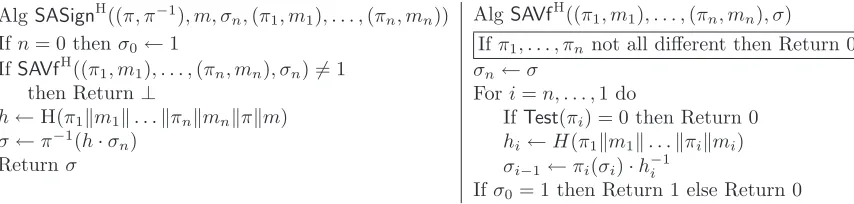
Figure 2: The sequential aggregation and verification algorithms of
S A S
-0
. Removing the framed textyields
S A S
-1
.(π, π, π−1) $
←Gen; pk ←π; sk ← (π, π−1). Let H :{0,1}∗ →G be a random oracle. The sequential aggregation and verification algorithms are described in Figure 2.
The
S A S
-0
scheme was proposed and proven secure in [18]. We consider here theS A S
-1
scheme that is identical to theS A S
-0
scheme, except that the boxed distinctness test in the verification algorithm in Figure 2 is dropped. (Note that this also affects the signing algorithm because it invokes the verification algorithm as a subroutine.)Consistency conditions. Similar to general aggregate signatures, the consistency condition for se-quential aggregate signatures differs from scheme to scheme.
S A S
-1
meets the natural, strongest possibleconsistency requirement, namely that
PrhSAVfH((pk1, m1), . . . ,(pkn, mn), σn) = 1
i
= 1
for all positive integers n and all messages m1, . . . , mn ∈ {0,1}∗, the probability being in the experi-ment where we select H ←$ Maps(D) ; (pk1,sk1), . . . ,(pkn,skn) ∈[Kg], then selectσ1 ←$ SASignH(sk1,
m1) ; σ2 $
← SASignH(sk2, m2, σ1,(pk1, m1)) ; · · · ; σn $
← SASignH(skn, mn, σn−1,(pk1, m1), . . . ,(pkn−1,
mn−1)). However,
S A S
-0
meets this condition only whenpk1, . . . ,pkn are distinct.Discussion of security. No claims were made in [18] regarding the security of the
S A S
-1
scheme. Unlike the case of theA S
-1
general aggregate signature scheme, there does not seem to be an easy attack when the distinctness condition is dropped. At the same time, the security proof of [18] clearly ceases to go through for theS A S
-1
scheme, because the simulation of signatures and the way the forgery is exploited explicitly rely on all public keys being distinct. One may therefore rightfully wonder what the reason for this restriction is, and whether it is strictly necessary.Our result. The following implies that the distinctness restriction in the
S A S
-0
scheme can be dropped:Theorem 4.1 If the family of certified claw-free trapdoor permutations Π is (t′, ǫ′)-claw-free, then the
S A S
-1
sequential aggregate signature scheme is(t, qS, nmax, qH, ǫ)-secure for anyt, qS, nmax, qH, ǫsatisfyingǫ ≥ e(2qS+ 1)·ǫ′ and t≤t′−nmax·(qH+ 2qS+ 1)·O(TΠ).
We achieve this result through a number of refinements to the security proof of [18]. As in their proof, our simulator responds to random oracle queries in such a way that it either knows the corresponding sequential aggregate signature, or embeds its own challenge into the response. It then hopes that all the forger’s signature queries correspond to hash queries of the first type, and that its forgery corresponds to one of the second type. Our refinements allow us to handle signature queries with multiple occurrences of the target public key, either by answering them correctly, or by directly exploiting the aggregate signature provided by the adversary to find a claw for the underlying permutation. The proof, written using the code-based game-playing technique [4], follows.
with an adversary A, as follows. First, Initializeexecutes, and its outputs are the inputs to A. Then the latter executes, its oracle queries being answered by the corresponding procedures of G. When A
terminates, its output becomes the input to the Finalizeprocedure. The output of the latter, denoted
GA, is called the output of the game, and we let “GA⇒y” denote the event that this game output takes
value y. The boolean flagbad is assumed initialized to false, and goodwill always denote the event that it is never set totrue. (This event is defined in all games.) GamesGi, Gj areidentical until badif their code differs only in statements that follow the setting ofbadtotrue. For examples, gamesG0, G1 of Figure 4 are identical untilbad. The following is one version of the Fundamental Lemma of [4].
Lemma 4.2 [4] Let Gi, Gj be identical until badgames, andA an adversary. Then Pr
GAi ⇒1 ∧ good
= Pr
GAj ⇒1 ∧ good
.
Proof of Theorem 4.1. We say that an adversaryAagainst
S A S
-1
issimplified if it has the following properties, whereπdenotes the public key input toAandπ−1 its inverse:1. Anever repeats a query to itsH-oracle.
2. Any H-query of A has the form π1km1k · · · kπnkmn for some n ≥ 1, some π1, . . . , πn such that
Test(πi) = 1 for all 1≤i≤n, and somem1, . . . , mn∈ {0,1}∗.
3. If A makes a query mn+1, σn,(π1, m1), . . . ,(πn, mn) to SASign
H
((π, π−1),· · ·) then it previously madeH-queryπ1km1k · · · kπnkmnkπkmn+1.
4. IfAoutputs ((π1, m1), . . . ,(πn, mn), σ) then it previously madeH-queryπ1km1k · · · kπnkmn.
5. IfA makesH-query π1km1k · · · kπnkmn then it previously made H-query π1km1k · · · kπn−1kmn−1. (And hence, inductively, has already queriedπ1km1k · · · kπikmi for all 1≤i≤n−1, in this order.)
6. IfAmakes a querymn+1, σn,(π1, m1), . . . ,(πn, mn) toSASign
H
((π, π−1),· · ·) thenSAVfH
((π1, m1),
. . . ,(πn, mn), σn) = 1.
7. If A makes a query mn+1, σn,(π1, m1), . . . ,(πn, mn) to SASign
H
((π, π−1),· · ·) then for every i ∈ {1, . . . , n}such thatπi=π, it is the case thatApreviously queriedmi, σi−1,(π1, m1), . . . ,(πi−1, mi−1) toSASignH((π, π−1),· · ·).
8. LetT denote the set of all π1km1k. . .kπlkmlkπkml+1 such that for someσl, adversary A queried
ml+1, σl,(π1, m1), . . . ,(πl, ml) to its SASign
H
((π, π−1),· · ·) oracle. Then, |T| is always exactly q S (rather than at most qS, which must be true because A makes at most qS queries to the oracle). By “always,” we mean regardless ofA’s input, coin tosses, and the answers it receives to its oracle queries.
There are two stages in our proof. First, we transform a given adversary A′ attacking
S A S
-1
into a simplified adversaryAattackingS A S
-1
without loss in advantage although at some cost in resources:Lemma 4.3 Let A′ be an adversary that (t, qS, nmax, qH, ǫ)-breaks
S A S
-1
. Then, we can construct asimplified adversary Athat (t∗,2q
S, nmax, q∗H, ǫ)-breaks
S A S
-1
wheret∗ = t+nmax(qH+ 2qS+ 1)·O(TΠ) , q∗H = nmax(qH+ 2qS+ 1).
Next, we construct an adversaryBwhich enlistsA’s help in breaking the family Π underlying
S A S
-1
:Lemma 4.4 Let A be a simplified adversary that (t∗, q
S, nmax, qH∗, ǫ)-breaks
S A S
-1
. Then, we cancon-struct an adversaryB attackingΠsuch that
AdvclawΠ (B) ≥
AdvseqS A S--agg1 -uf(A) e(qS+ 1)
, (6)
and the running time of Bis at most that of Aplus(q∗
H+ 1)·O(TΠ).
Theorem 4.1 follows directly from these two lemmas. We now proceed to prove the lemmas. A convention made in writing code is that all array elements are assumed to initially be ⊥.
Proof of Lemma 4.3: The adversaryAhas access to oracles HandSASignH. On input a public key
Subroutine H-sim(x)
If∃n , π1, . . . , πn, m1, . . . , mn such that – n≥1 andx=π1km1k · · · kπnkmn
– ∀i : 1≤i≤n : mi∈ {0,1}∗ andTest(πi) = 1 Then
Fori= 1, . . . , ndoQi←π1km1k · · · kπikmi; If HT[Qi] =⊥then HT[Qi]←H(Qi) Else If HT[x] =⊥then HT[x]←$ G
Return HT[x]
Subroutine Sign-sim(mn+1, σn,(π1, m1), . . . ,(πn, mn))
πn+1←π; σ0←1 ; T ←T∪ {π1km1k. . .kπlkmlkπkml+1}
Fori= 1, . . . , n+ 1 do IfTest(πi) = 0 then return⊥; Qi←π1km1k · · · kπikmi
y←H-sim(Qn+1)
Fori=n, . . . ,1 do σi−1←πi(σi)·HT[Qi]−1 Ifσ06= 1 then return⊥
S←S∪ {(mn+1, σn,(π1, m1), . . . ,(πn, mn))} Fori= 1, . . . , ndo
Ifπi=πand (mi, σi−1,(π1, m1), . . . ,(πi−1, mi−1))6∈S then Output ((π1, m1), . . . ,(πi, mi), σi)
σn+1←SASign
H
((π, π−1), m
n+1, σn,(π1, m1), . . . ,(πn, mn)) Returnσn+1
Figure 3: Subroutines for adversaryA.
via the subroutines H-simandSign-sim, respectively, of Figure 3. Note that these subroutines call A’s oracles. WhenA′ halts with some output ((π1, m1), . . . ,(πn, mn), σn), adversaryA
(1) makes an additionalq=|T| −qSqueries (m1′,1), . . . ,(m′q,1) toSASign
H
((π, π−1),· · ·) oracle, where
m′
1, . . . , m′q are distinct andπkmi′ 6∈T for all 1≤i≤q, (2) callsH-sim(π1km1k · · · kπnkmn),
(3) outputs ((π1, m1), . . . ,(πn, mn), σn), and halts.
Let us now explain how this ensures that Ahas the properties listed above without loss in advantage as compared to A′.
Property1is achieved becauseAstores as HT[x] the answer toH-queryxofA′, and, if this query is re-peated, returns HT[x] without re-querying the oracle. AanswersH-queryxofA′via its ownHoracle only whenxhas the formπ1km1k · · · kπnkmn withTest(πi) = 1 for all 1≤i≤n, and, otherwise, itself picks a random value to play the role of the answer. This ensures property2, yet will not decrease the advantage of
Abecause the algorithms of
S A S
-1
never invoke theHoracle on inputs not of the above form. Properties3 and 4are obtained by havingAmake the extraH-query if necessary. Property5is provided by havingAquery all appropriate un-queried prefixes of aH-queryπ1km1k · · · kπnkmn before querying the latter. AlgorithmSASignH(π−1,· · ·) returns⊥on inputm
n+1, σn,(π1, m1), . . . ,(πn, mn) unlessSAVf
H
((π1, m1),
. . . ,(πn, mn), σn) = 1, so we haveAdo this test and refrain from making the query unless the answer is one, providing property6. Property7is the most interesting, and an important element in dealing with loops in signing chains. To explain how Aprovides it, supposeA′ made a querym
n+1, σn,(π1, m1), . . . , (πn, mn) toSASign
H
((π, π−1),· · ·) such that for some 1≤i≤nit was the case thatπ
i=πbutAdid not previously querymi, σi−1,(π1, m1), . . . ,(πi−1, mi−1) toSASignH((π, π−1),· · ·). ThenA, rather than mak-ing query mn+1, σn,(π1, m1), . . . ,(πn, mn) to SASign
H
((π, π−1),· · ·), outputs ((π1, m1), . . . ,(πi, mi), σi) as its forgery and halts. Property6tells us thatSAVfH((π1, m1), . . . ,(πi, mi), σi) = 1, and the fact that
A did not previously query mi, σi−1,(π1, m1), . . . ,(πi−1, mi−1) to SASign
H
((π, π−1),· · ·) means that A remains legitimate. So this can only increase the advantage of A compared to that of A′. Property 8
Initialize GameG0 / G1
100 (π, π, π−1) $
←Gen; σ[ε]←1 ;S ← ∅
101 Returnπ
On H-queryπ1km1k · · · kπnkmn
110 Qn−1←π1km1k · · · kπn−1kmn−1; Qn←π1km1k · · · kπnkmn; σ[Qn] $
←G
111 Ifπn=πthen c[Qn]
δ
← {0,1}else c[Qn]←0
112 If c[Qn] = 0 then HT[Qn]←πn(σ[Qn])·σ[Qn−1]−1 else HT[Qn]←π(σ[Qn])·σ[Qn−1]−1
113 Return HT[Qn]
On SASignH((π, π−1),· · ·)-querym
n+1, σn,(π1, m1), . . . ,(πn, mn)
120 S←S∪ {(mn+1, σn,(π1, m1), . . . ,(πn, mn))}; πn+1←π; σ0←1
121 Fori= 1, . . . , n+ 1 doQi←π1km1k. . .kπikmi
122 σn+1←σ[Qn+1]
123 If (∃i : 1≤i≤n+ 1 : c[Qi] = 1) thenbad←true; σn+1←π−1(σn·HT[Qn+1])
124 Returnσn+1
Finalize((π1, m1), . . . ,(πn, mn), σ)
130 s←min{i | 1≤i≤n, πi=π and∀τ: (mi, τ,(π1, m1), . . . ,(πi−1, mi−1))6∈S}
131 σn←σ
132 Fori=n, . . . ,1 doQi←π1km1k · · · kπikmi; σi−1←πi(σi)·HT[Qi]−1
133 Ifσ0= 1 thend←1 elsed←0
134 If (∃i : 1≤i≤s−1 : c[Qi] = 1) thenbad←true
135 If c[Qs] = 0 thenbad←true
136 ω←(σs, σ[Qs])
137 Returnd
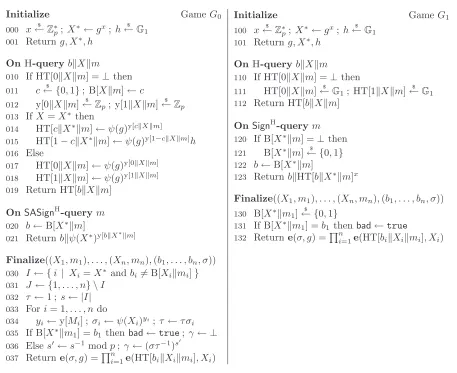
Figure 4: Game G1 includes the boxed statement, while game G0 does not. Also, notice that G1 uses
π−1, butG
0does not.
exactly qS. This does not affect the advantage of Abut does increase the number of sign-oracle queries by at most a factor of 2.
Proof of Lemma 4.4: We consider the games of Figure 4. The array entry HT[π1km1k · · · kπnkmn] plays the role of H(π1km1k · · · kπnkmn). The notation c ← {δ 0,1} means that c is assigned 0 with probability δ and 1 with probability 1−δ, where δ ∈ [0,1] is a parameter whose value will be chosen later [11]. These games rely on some of the properties of Alisted above. For example, when answering H-queryQn=π1km1k · · · kπnkmn, property5allows us to assume HT[Qn−1], and thus alsoσ[Qn−1], are already defined, where Qn−1 =π1km1k · · · kπn−1kmn−1. Similarly, property3tells us that the relevant HT[·] entries are defined at the time aSASignH((π, π−1),· · ·) query is made. Property4tell us that the relevant HT[·] entries are defined at the time Finalize is run, and the legitimacy of A tells us that s
computed at line 130 is well-defined in the sense that the set over which the minimum is taken is not empty. Notice thatG1usesπ−1 butG0 does not.
Let us say that a H-queryπ1km1k · · · kπnkmn issimulation signed if c[Qi] = 0 for all 1≤i≤n, where
Qi=π1km1k · · · kπikmi. Then line 112 tells us that, in bothG0 andG1, we have:
Claim 1. Letπ1km1k · · · kπnkmn be a simulation signed hash query, and letQi=π1km1k · · · kπikmi for
0≤i≤n. Then for all 1≤i≤nwe haveσ[Qi] =π−1
Initialize Game G2 /G3
200 (π, π, π−1) $
←Gen; S← ∅
201 Returnπ
On H-queryπ1km1k · · · kπnkmn
210 Qn←π1km1k · · · kπnkmn
211 Ifπn=πthen c[Qn]
δ
← {0,1}else c[Qn]←0
212 HT[Qn]←$ G
213 Return HT[Qn]
On SASignH((π, π−1),· · ·)-querym
n+1, σn,(π1, m1), . . . ,(πn, mn)
220 S←S∪ {(mn+1, σn,(π1, m1), . . . ,(πn, mn))}; πn+1←π; σ0←1
221 Fori= 1, . . . , n+ 1 doQi←π1km1k. . .kπikmi
222 If c[Qn+1] = 1 thenbad←true
223 If (∃i : 1≤i≤n : c[Qi] = 1) thenbad←true
224 σn+1←π−1(σn·HT[Qn+1])
225 Returnσn+1
Finalize((π1, m1), . . . ,(πn, mn), σ)
230 s←min{i | 1≤i≤n, πi=π and∀τ: (mi, τ,(π1, m1), . . . ,(πi−1, mi−1))6∈S}
231 σn←σ
232 Fori=n, . . . ,1 doQi←π1km1k · · · kπikmi; σi−1←πi(σi)·HT[Qi]−1
233 Ifσ0= 1 thend←1 elsed←0
234 If (∃i : 1≤i≤s−1 : c[Qi] = 1) thenbad←true
235 If c[Qs] = 0 thenbad←true
236 Returnd
Figure 5: GameG2 includes the boxed statements whileG3 does not.
Claim 2. Letω= (σs, σ[Qs]) be as per line 136 anddas per line 133. Then
Pr [π(σs) =π(σ[Qs]) ] ≥ Pr [d= 1 ∧ good], where both probabilties are over the execution ofG0withA.
Proof. If good holds then line 134 tells us thatπ1km1k · · · kπs−1kms−1 is simulation signed. If d= 1 then from Claim 1 and line 132 we getσi=σ[Qi] for all 1≤i≤s−1, and, in particular,σs−1=σ[Qs−1]. Ifgoodholds then line 135 implies c[Qs] = 1, and then line 112 implies HT[Qs] =π(σ[Qs])·σ[Qs−1]−1. Thus we have
π(σs) = πs(σs) = HT[Qs]·σs−1 = π(σ[Qs])·σ[Qs−1]−1·σs−1 = π(σ[Qs]). 2
Now define adversaryBagainst Π as follows. On inputsπ, π, it initializesσ[ε]←1 andS← ∅. It then runs A on inputπ, answering its oracle queries as per the code of gameG0. WhenAhalts, Bruns the
Finalizecode ofG0on input the output ofA. It outputsωand halts. Note thatBis based onG0rather thanG1 and thus does not need to knowπ−1. Then by Claim 2 we have
AdvclawΠ (B) ≥ Pr
GA
0 ⇒1 ∧ good
. (7)
However, G0 andG1 are identical-until-badgames, and so Lemma 4.2 implies that Pr
GA0 ⇒1 ∧ good
= Pr
GA1 ⇒1 ∧ good
. (8)
Initialize GameG4
400 (π, π, π−1)←$ Gen; S← ∅
401 Returnπ
On H-queryπ1km1k · · · kπnkmn
410 HT[π1km1k · · · kπnkmn] $
←G
411 Return HT[π1km1k · · · kπnkmn]
On SASignH((π, π−1),· · ·)-querym
n+1, σn,(π1, m1), . . . ,(πn, mn)
420 S←S∪ {(mn+1, σn,(π1, m1), . . . ,(πn, mn))}; σ0←1
421 σn+1←π−1(σn·HT[π1km1k · · · kπnkmnkπkmn+1])
422 Returnσn+1
Finalize((π1, m1), . . . ,(πn, mn), σ)
430 s←min{i | 1≤i≤n, πi=π and∀τ: (mi, τ,(π1, m1), . . . ,(πi−1, mi−1))6∈S}
431 σn←σ
432 Fori=n, . . . ,1 doQi←π1km1k · · · kπikmi; σi−1←πi(σi)·HT[Qi]−1
433 Ifσ0= 1 thend←1 elsed←0
434 For allπ1′km′1k · · · kπl′km ′
l such that HT[π ′
1km′1k · · · kπ′lkm ′
l]6=⊥do
435 Ifπ′l=πthen c[π′1km1′k · · · kπ′lkm′l]← {δ 0,1}else c[π′1km1′k · · · kπ′lkm′l]←0 436 For all (m′
l+1, σ′l,(π1′, m′1), . . . ,(π′l, m′l))∈S do
437 If c[π1′km1′k. . .kπl′km ′ lkπkm
′
l+1] = 1 thenbad←true
438 If c[Qs] = 0 thenbad←true
439 Returnd
Figure 6: GameG4.
Proof. First consider a H-query Qn = π1km1k · · · kπnkmn. The random choice of σ[Qn] at line 110, together with the fact that πn, π are permutations, then implies that HT[Qn] is uniformly distributed, meaning the answer to this query is exactly as would be given by a random oracle. Next consider a SASignH((π, π−1),· · ·)-query m
n+1, σn,(π1, m1), . . . ,(πn, mn). We consider two cases. If Qn+1 =
π1km1k. . .kπnkmnkπkmn+1 is simulation signed then Claim 1 tells us that the value σ[Qn+1] returned is correct. Otherwise, the value σn+1 returned is computed by the boxed statement at line 123 and is correct because it is computed just as in SASignH((π, π−1),· · ·). Here we use property 6, which tells us that σn−1 was correct. 2
Claim 3 implies that
Pr
GA
1 ⇒1 ∧ good
= Pr
GA
2 ⇒1 ∧ good
, (9)
where game G2 is in Figure 5. Game G2 directly answers all oracle queries correctly, meaning just as in the game defining the advantage ofA. Additionally it splits up the setting ofbadas done by line 123 of
G1 into lines 222, 223. Next we claim that Pr
GA2 ⇒1 ∧ good
= Pr
GA3 ⇒1 ∧ good
. (10)
To justify this, we explain why lines 223, 234 of G2 are redundant and can simply be dropped to arrive atG3. First consider line 223. Suppose c[Qi] = 1 for some 1≤i≤n. Then it must be thatπi=π, since, otherwise, due to line 211, c[Qi] can only be 0. But then property7says thatAmust have previously made
SASignH((π, π−1),· · ·)-querym
mi, τ,(π1, m1), . . . ,(πi−1, mi−1) was made.
In GameG3, the responses to oracle queries do not depend on the value of the flagbad. Thus, the choices of c[·] and the setting of badcan be postponed, meaningG3 is equivalent to gameG4 of Figure 6. Now we claim that, in the execution ofAwith GameG4, the events “GA4 ⇒1” andgoodare independent, so that
Pr
GA3 ⇒1 ∧ good
= Pr
GA4 ⇒1 ∧ good
= Pr
GA4 ⇒1
·Pr [good] = Pr
GA
4 ⇒1
·Pr
GA
4 doesn’t set bad
. (11)
Let us justify the independence claim. We observe that the random choices c[·] are made after the game output is determined. Since gooddepends only on these choices, we would like to conclude the independence claim. But there is a subtle point. We also need that the number of (biased) coins involved in determininggoodis the same in all runs. This is ensured by Property8of the simplified adversary. Now, the outputdofGA
4 is 1 exactly whenAsucceeds in forgery, meaning Pr
GA
4⇒1
= AdvseqS A S--agg1 -uf(A). (12) On the other hand
Pr
GA4 doesn’t setbad
= δqS·(1−δ). (13)
We now selectδ∈[0,1] to maximize the functionf(δ) =δqS(1−δ), which yieldsδ= 1−1/(q
S+ 1) and we have
δqS·
(1−δ) =
1− 1
qS+ 1
qS
· 1
qS+ 1 > 1
e(qS+ 1) . (14)
Putting together (7), (8), (9), (10), (11), (12), (13), and (14), we get (6). The running time ofBis that ofAplus an overhead of (q∗
H+ 1)·O(TΠ) due to line 112.
Instantiating
S A S
-1
with RSA. RSA does not directly give rise to a family of certified trapdoor permutations. (Each instance comes with its own modulus, so that different instances are over different groups. Also it is not clear in general how to test that a given number is a valid RSA exponent relative to a given modulus.) An RSA-based instantiation ofS A S
-1
can however be obtained by using the familyof certified claw-free trapdoor permutations from [14]. This comes at the cost of efficiency, however, as a permutation evaluation now takes two RSA exponentiations. Another option is to use techniques in [18], which either require the signers to be ordered by increasing moduli, or add one bit to the signature for each signer. (However, we note that requiring that the signers be ordered according to their moduli excludes some pattern in which the repeats can occur, for example, non-trivial loops, namely a loop containing at least two distinct signers.) To ensure the certification, they suggest that the encryption exponentecan be chosen to be a prime larger thanN. Alternatively, one can use an arbitrary encryption exponentesuch that gcd(e, ϕ(N)) = 1 at the cost of longer public keys as proposed in [10]. As the group operation, one must use addition (modulo 2|N|when using [14] or modulo N when using the techniques of [18]) since multiplication is only a group operation overZ∗N.
5
Tightening the security reductions
We present variants of