Algebraic Side-Channel Collision Attacks
on AES
Andrey Bogdanov1and Andrey Pyshkin2
1 Chair for Communication Security
Ruhr University Bochum, Germany [email protected]
2 Department of Computer Science
Technical University Darmstadt, Germany [email protected]
Abstract. This paper presents a new powerful side-channel cryptana-lytic method - algebraic collision attacks - representing an efficient class of power analysis being based on both the power consumption informa-tion leakage and specific structure of the attacked cryptographic algo-rithm. This can result in an extremely low measurement count needed for a key recovery.
The algebraic collision attacks are well applicable to AES, if one-byte collisions are detectable. For the recovery of the complete AES key, one needs 3 measurements with a probability of 0.42 and 4.24 PC hours post-processing, 4 measurements with a probability of 0.82 and several seconds of offline computations or 5 measurements with success probability close to 1 and several seconds post-processing.
Key words: AES, collision attacks, side-channel attacks, generalized collisions, Gr¨obner basis, algebraic attacks, Faug`ere’s F4 algorithm
1
Introduction
Power analysis based side-channel attacks have gained major importance since their introduction in [6]. Differential power analysis (DPA) is probably the most discussed side-channel attack in scientific literature due to its generic applicabil-ity to a variety of implementations. However, a number of other power analysis techniques exist that exhibit particular suitability in some special cases, side-channel collision attacks representing one of such alternative approaches.
after the key addition can be compared, see e.g. [1]. Some methods to overpass random masking of AES implementations using collision attacks can be found in [2]. However, we take another approach in this paper.
The key idea of our improvements to collision attacks is based on the notion of a generalized internal collision introduced in [3]. One can look at several instances of the same function f, if their implementations are similar enough, and try to detect equal inputs to these instances by comparing the corresponding power traces. Ideally, the several logical instances of f should share the same implementation that is executed serially, which is e.g. often the case low-end implementations in embedded systems. A generalized internal collision in an iterative cryptographic algorithmA with respect to a functionf occurs within one or several runs ofAif two inputs tof in some (possibly different) iterations ofAat some (possibly different) positions are equal.
In the case of AES, the 8-bit S-box transform can be the target functionf. The S-box remains the same for all executions, rounds and byte positions within the round (as opposed to DES and a large variety of other cryptographic al-gorithms, where different S-boxes are applied at different positions within the round). This increases the number of instances to compare and of potential col-lisions to be used afterwards for recovering key bits.
Each collision can be considered as a nonlinear equation over a finite field. The set of all detected collisions corresponds to a system of nonlinear equations with respect to the key. If the linear part of this system is considered only or a part of the system is linearized, we speak aboutlinear collision attacks (these were considered in [3]). If this system is solved nonlinearly, one deals with algebraic collision attacks which represent the main object of the present paper.
From the point of view of algebraic cryptanalysis, the treatment of nonlinear equations is natural. In our constructions we only use the collisions that result in nonlinear equation systems overGF(2) of degree≤2, since one AES round can be implicitly expressed as a system of degree 2 equations. The low degree of the equations and the special form of the system enable an efficient application of Gr¨obner basis techniques to solve such systems. However, this is not the only algebraic technique we use. Before solving the overall system using the Faug`ere F4 algorithm [5] in Magma, we first find independent subsystems on the unknowns of the first and last rounds, that we call cycles, and solve them separately overGF(28), each having a maximum of 2 solutions. This allows one to determine several variables for free, speeding up the subsequent applications of the F4 Gr¨obner base finding algorithm to the larger system overGF(2). Our algebraic collision attacks seem to be the first successful real-world cryptanalytic attacks on the full-scale AES using its weak algebraic structure [4], though being substantially based on the side-channel leakage.
detection. See also [1] and [8] for real-world side-channel collision attacks. How-ever, this is out of the scope of this paper whose purpose is to extract as much information about the key as possible from a minimal number of collisions.
Our algebraic collision techniques allow one to mount collision attacks on AES for 3 measurements with a probability of 0.42 and 4.24 PC hours post-processing, for 4 measurements with a probability of 0.82 in several seconds of offline computations or for 5 measurements with success probability close to 1 and several seconds post-processing.
The remainder of the paper is organized as follows. Section 2 recalls the known collision attacks on AES from [8] and [3]. Section 3 introduces the alge-braic description of equations enabling the complexity improvements for collision attacks. Section 4 specifies our algebraic collision attacks on AES in detail, dis-cusses some of their advanced properties and provides experimental results. We conclude in Section 5. Appendix A gives some details on the computational plat-form used to perplat-form experiments. Appendix B briefly discusses the applicability of collision attacks in practice.
2
Previous Work
2.1 Basic Collision Attack on AES
Side-channel collision attacks were proposed for the case of DES in [9] and en-hanced in [7]. AES was first attacked using collision techniques in [8]. This side-channel collision attack on AES is based on detecting internal one-byte collisions in the MixColumnstransformation in the first AES round. The basic idea is to identify pairs of plaintexts leading to the same byte value in an output byte after theMixColumnstransformation of the first round and to use these pairs to deduce information about some key bytes involved into the transform.
Let A = (aij) with i, j = 0,3 and aij ∈ GF(28) be the internal state in the first AES round after key addition, byte substitution and the ShiftRows operation. Let B = (bij) with i, j = 0,3 and bij ∈ GF(28) be the internal state after theMixColumnstransformation, B = MixColumns(A), where the MixColumnstransformation is defined for each columnj as follows:
(1)
b0j
b1j
b2j
b3j =
02 03 01 01 01 02 03 01 01 01 02 03 03 01 01 02
×
a0j
a1j
a2j
a3j
.
Here all operations are performed over GF(28). P = (pij) with i, j = 0,3,
pij ∈ GF(28), and K(1) = (kij(1)) with i, j = 0,3, k (1)
ij ∈ GF(28), denote the plaintext block and the first subkey, respectively, thenb00can be represented as:
(2)
b00= 02·a00⊕03·a10⊕01·a20⊕01·a30= = 02·S(p00⊕k(1)00)⊕03·S(p11⊕k(1)11)
For two plaintexts P and P′ with p
00 =p11=p22 =p33 =δ and p′00 =p′11=
p′
22=p′33=ǫ,δ=6 ǫ, one obtains the following, providedb00=b′00:
(3) 02·S(k (1)
00 ⊕δ)⊕03·S(k (1)
11 ⊕δ)⊕01·S(k (1)
22 ⊕δ)⊕01·S(k (1) 33 ⊕δ) = 02·S(k(1)00 ⊕ǫ)⊕03·S(k
(1)
11 ⊕ǫ)⊕01·S(k (1)
22 ⊕ǫ)⊕01·S(k (1) 33 ⊕ǫ)
Let Cδ,ǫ be the set of all key bytes k (1) 00, k
(1) 11, k
(1) 22, k
(1)
33 that lead to a collision (3) with plaintexts (δ, ǫ). Such sets are pre-computed and stored for all 216 pairs (δ, ǫ). Each set contains on average 224 candidates for the four key bytes. Actually, every setCǫ,δcan be computed from the setCǫ⊕δ,0using some relations between the sets. Due to some dependencies within the sets, this optimization reduces the required disk space to about 540 megabytes.
The attack on the single internal state byteb00 is then the following. The attacker generates random values (ǫ, δ) and inputs them to the AES module as described above. The power consumption curve for the time period, where
b00is processed, is stored. Then the attacker proceeds with other random values (ǫ′, δ′), measures the power profile, stores it and correlates it with all stored power
curves. And so on. One needs about 4 collisions (one in each output byte of a column) to recover the four bytes involved into the MixColumns transformation. The probability that after N operations at least one collisionb00 =b′00 occurs in a single byte is:
(4) pN = 1−
N−1 Y
l=0
(1−l/28).
Actually, the attack can be parallelized to search for collisions in all four columns ofB in parallel. In this case the attacker needs at least 16 collisions, 4 for each column ofB, sop16
N ≥1/2 andN ≈40. Once the required number of collisions was detected, he uses the pre-computed tables Cǫ⊕δ,0 to recover all four key bytes for each column by intersecting the pre-computed key sets corresponding to the collisions (ǫ, δ) detected. Thus, on average one has to perform about 40 measurements to obtain all 16 collisions needed and to determine all 16 key bytes. Note that since the cardinality of the intersections for the sets Cǫ,δ is not always 1, there are a number of key candidates to be tested using a known plaintext-ciphertext pair.
2.2 Linear Collision Attack on AES
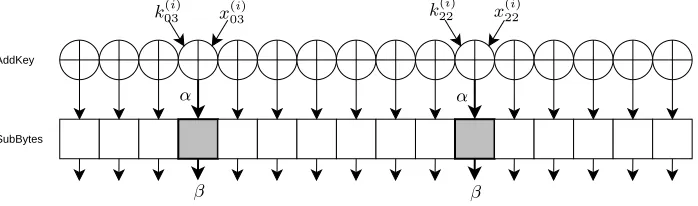
AddKey
SubBytes
α α
β β
k03(i) x(03i) k(22i) x(22i)
k03(i)⊕k22(i)=x03⊕x22
Fig. 1.Linear collisions
In Figure 1 a linear collision within a single AES roundiis illustrated.xvu,
v, u= 0,3, are plaintext bytes, if i= 1, or the output bytes from the previous roundi−1, otherwise. In this example, bytes 03 and 22 collide.
A detected collision in the S-box layer of the first round in bytes (i1, j1) and (i2, j2) withi1, j1, i2, j2= 0,3 corresponds to the following linear equation:
S(k(1)i1,j1⊕pi1,j1) =S(k (1)
i2,j2⊕pi2,j2), (5)
ki1,j1(1) ⊕k (1) i2,j2 =∆
(1)
(i1,j1),(i2,j2)=pi1,j1⊕pi2,j2 (6)
for some known plaintext bytespi1,j1 andpi2,j2. In the same way, one can write equations resulting from collisions within some other roundi= 2,10. In this case we have some unknown key- and plaintext-dependent byte variables instead of the plaintext bytespi1,j1 andpi2,j2.
mlinear equations of type (6) resulting from a number of collisions detected within the S-box layer in the first round build the following linear equation system:
(7) Sm:
k(1)i1,j1⊕k(1)i2,j2=∆(1)(i1,j1),(i2,j2) k(1)i3,j3⊕k(1)i4,j4=∆(1)(i3,j3),(i4,j4) . . .
k(1)i2m−1,j2m−1⊕k
(1)
i2m,j2m =∆
(1)
(i2m−1,j2m−1),(i2m,j2m).
Note that this system has 16 variables (bytes of the first round subkey). In system (7) the key byte numbers and the variables are not necessarily pairwise distinct. The maximal rank ofSmis 15.
It is not necessary for Sm to have the maximal rank. If there are several isolated subsystems withinSm, then each of them can be solved independently as described above. If there areqindependent subsystemsSS1
m, . . . , SSmq inSm, thenSm can be represented as a union of these subsystems:
To solveSmin this case, one has to assignqbyte values to someqvariables in the subsystems{SSi
m} q
i=1. At the end there are 28q key candidates. The correct key is identified using a known plaintext-ciphertext. In Table 1 the estimated numbers of isolated subsystems are provided.
Table 1.Offline complexity and success probabilities
Measurements,t 4 5 6 7 8 9 29
Linear equations,m 7.09 10.72 14.88 19.46 24.36 29.49 105.14 Isolated subsystems,q 8.81 5.88 3.74 2.20 1.43 1.15 1.00 Offline complexity≤24034.70 37.34 37.15 34.74 30.32 21.36 8 Success probability 0.037 0.372 0.854 0.991 0.999 1.000 1.000 Offline complexity≤24843.90 45.50 44.30 41.14 30.32 21.36 8 Success probability 0.092 0.548 0.927 0.997 0.999 1.000 1.000
The offline stage becomes feasible after 5 measurements (245.5 simple steps with a probability of 0.548). Linear systems resulting from 6 measurements are easily solvable in 237.15steps on average with a probability of 0.85, which is more realistic. After 11 measurements the expected offline attack complexity is about 212.11, practically all systems being solvable.
3
Algebraic Description of Nonlinear Collisions in AES
In this section we show how to improve the results using the algebraic cryptanaly-sis techniques developed for AES. The general idea is to exploit more information about the key available in nonlinear collisions. To extract this information we use the algebraic representation of AES and the Faug`ere F4 algorithm finding Gr¨obner bases. To make the resulting system of nonlinear equations solvable, we select the collisions in a way keeping the algebraic degree of equations low (it does not exceed 2) and the number of unknowns small (we fix a number of variables and try to use all possible low-degree dependencies on these variables in an efficient way).
In this section the basic nonlinear and linear collisions we use (FS- and FL-collisions) are described algebraically. Moreover, the notion of non-collisions is introduced and briefly discussed here.
3.1 FS-Collisions
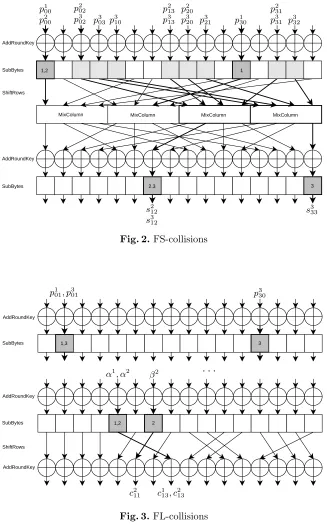
Collisions in the first two AES rounds occurring between bytes of the first two rounds are calledFS-collisions. If input bytesα1andα2 of two S-boxes collide, we have the simple linear equation overGF(28):α
S-box layer of the first round, thenαe=ki,j(1)⊕pi,j,for somei, j. Otherwise, we have
αe=k (2)
i,j ⊕mi·a0,j⊕mi+1·a1,j+1⊕mi+2·a2,j+2⊕mi+3·a3,j+3,
where m = (m0, m1, m2, m3) = (02,03,01,01), and the addition of indices is interpreted modulo 4 and ai,j = S(ki,j(1)⊕pi,j). We distinguish between the following three types of collisions: linear collisions in the first round, nonlinear collisions between the first two rounds, and nonlinear collisions within the second round. These three collision types are illustrated in Figure 2. S-boxes leading to the detection of collisions (active S-boxes) are marked with the numbers of collisions they account for. Collision 1 is between two bytes of the first round, linearly bindingk00(1)andk(1)30. Collision 2 is between the S-box number 12 of the 2nd round and the S-box 00 of the first round. It binds 6 key bytes:k00(1),k02(1),
k(1)13, k20(1), k(1)31, and k12(2). Collision 3 algebraically connects two MixColumn expressions on 8 key bytes after the S-box layer with two bytes of the second subkey in a linear manner. The explicit algebraic equations for this example are the following:
1 : k(1)00 ⊕p100=k (1) 30 ⊕p130 2 : k(1)00 ⊕p200=S−1(s212) =k
(2) 12⊕ 01S(k(1)02 ⊕p202)⊕02S(k
(1)
13 ⊕p213)⊕03S(k (1)
20 ⊕p220)⊕01S(k (1) 31 ⊕p231) 3 : s3
12=s333,
k(2)12 ⊕01S(k (1)
02 ⊕p302)⊕02S(k (1)
13 ⊕p313)⊕03S(k (1)
20 ⊕p320)⊕01S(k (1) 31 ⊕p331) =
k(2)33 ⊕03S(k (1)
03 ⊕p303)⊕01S(k (1)
10 ⊕p310)⊕01S(k (1)
21 ⊕p321)⊕02S(k (1) 32 ⊕p332)
All these relations can be described a the system of polynomial quadratic [4] and linear equations overGF(2) in key bit variables and state variables given by the output of the S-boxes of the first round. See Subsection 4.1. Note that there are mirrored collisions occurring between the S-boxes of the last round (number 10) and the round next to the last one (number 9). Such collisions are called LN-collisions.
3.2 FL-Collisions
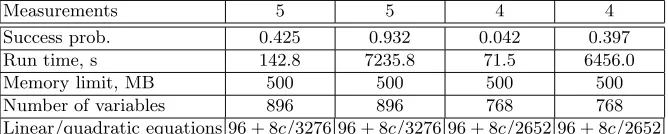
One can also detect collisions between bytes of the first and last rounds. We call collisions of this type FL-collisions. If plaintexts as well as ciphertexts are known, an FL-collision leads to a simple nonlinear equation. Linear collisions within the first round as well as those within the last round can be additionally used.
R AddRoundKey
SubBytes
ShiftRows
MixColumn MixColumn MixColumn MixColumn
AddRoundKey
SubBytes
1,2 1
2,3 3
p100
p200
p202
p302 p303 p310
p213
p313
p220
p320 p321 p130
p231
p331 p332
s212 s312
s333
Fig. 2.FS-collisions
AddRoundKey
ShiftRows
1,3
1,2
3 SubBytes
AddRoundKey
SubBytes
AddRoundKey
2
. . .
α1, α2 β2
p101, p301 p330
c211 c113, c213
c1
14(note that the bytes do not have to belong to the same input/output pair). Inputk(10)10 ⊕α1to S-box 10 in the last round can be expressed asS−1(k(11)12 ⊕c113) using the corresponding ciphertext and last subkey bytes.
Collision 2 of Figure 3 is a linear collision within the last AES round. Col-lision 3 is a standard linear colCol-lision within the first AES round. The following equations give algebraic expressions resulting from the four collisions illustrated in Figure 3:
1 : k(1)01 ⊕p101=k (10)
10 ⊕α1=S−1(k (11) 13 ⊕c113),
S(k01(1)⊕p101) =k (11) 13 ⊕c113 2 : k(10)10 ⊕α2=k
(10)
12 ⊕β2, k (11)
13 ⊕c213=k (11) 11 ⊕c211 3 : k(1)01 ⊕p301=k
(1) 30 ⊕p330
FL-collisions can be obviously expressed as a system of quadratic equations over GF(2). Now we show how to derive a system of quadratic equations over
GF(28) for these collisions. One way is to use the BES expression [4]. However we have 8 variables per one key byte in this case. We describe a simpler system, which has only 32 variables.
It is clear that linear collisions in the first or the last round can be expressed as linear equations overGF(28). Let us consider a nonlinear FL-collision of type 1 (see example above). Its algebraic expression is given by:
S(k(1)i,j ⊕pi,j) =k(11) u,v ⊕cu,v,
for some i, j, u, v = 0,3. Recall that the AES S-box is the composition of the multiplicative inverse in the finite fieldGF(28), the GF(2)-linear mapping, and the XOR-addition of the constant{63}3. TheGF(2)-linear mapping is invertible, and its inverse is given by the following polynomial overGF(28):
f(x) ={6e}x27+{db}x26+{59}x25+{78}x24+{5a}x23+{7f}x22+{f e}x2+{05}x.
Hence we have
(ki,j(1)⊕pi,j)−1=f(k(11)
u,v ⊕cu,v⊕63) =f(ku,v(11))⊕f(cu,v⊕63).
If we replacef(ku,v(11)) by a new variable ˜ku,v, we obtain the quadratic equation
(k(1)i,j ⊕pi,j)(˜ku,v⊕f(cu,v⊕63)) = 1,
which holds with probability 255256. The following proposition follows:
Proposition 1. Solutions to the equationS(ki,j(1)⊕pi,j) =k (11)
u,v ⊕cu,v coincides with solutions to the equation
(k(1)i,j ⊕pi,j)(˜ku,v⊕f(cu,v⊕63)) = 1
under the change of variables ˜ku,v=f(k(11)u,v)with a probability of 255256.
3 Here and below any byte {αβ} = α·16 +β =P7
i=0bi·2i is interpreted as the
element ofGF(28) =GF(2)[ω] using a polynomial representationP7
i=0bi·ωi, where
Moreover, ifk(11)i,j ⊕k(11)u,v =∆(i,j),(u,v)=ci,j⊕cu,v withi, j, u, v= 0,3, then we have
f(ki,j(11))⊕f(k(11)
u,v ) = ˜ki,j⊕k˜u,v=f(∆(i,j),(u,v)).
Thus we derive for FL-collisions the system S of quadratic equations over
GF(28) in 32 variablesK={k(1)
i,j,k˜i,j}0≤i,j≤3. Furthemore, each equation of the resulting systemS has only two variables. We call such equationsbinomial.
3.3 Non-Collisions
Anon-collision occurs between two S-box input bytes inside one or several AES executions if the processed bytes are not equal (no collision has been detected between these two unknown bytes). The straightforward algebraic description of non-collisions is as follows. Suppose two bytes b1 = {x7x6. . . x0} and b2 =
{y7y6. . . y0}do not collide, i.e.,b16=b2. Then bit variables satisfy the following equation overGF(2):
7 Y
i=0
(xi+yi+ 1) = 0.
Since the degree of this equation is equal to 8, and the number of the terms is exactly 38 = 6561, the equation seems to be useless for Gr¨obner basis attacks. However, there are more constructive applications of non-collisions reducing the search for several unknown bytes. These are specific for the structure of nonlinear equation systems we use and are explained in Subsection 4.4.
4
Algebraic Analysis of Collisions
In this section we construct and solve concrete systems of equations based on the ideas from the previous sections. First, we analyze the equation systems resulting from FS- and FL-collisions. Then combined systems of equations are constructed. Several ways to accelerate the process of finding the Gr¨obner bases for the combined systems are introduced and discussed, including chains of vari-ables in binomial equations, non-linear cycles and search optimization using non-collisions.
4.1 Solving Equations for FS-Collisions
The straightforward application of the Faug`ere F4 algorithm to the system con-structed in Subsection 3.1 gives results superior to those in [3]. These are are summarized in Table 2.
The system of nonlinear equations is considered over GF(2). Fort inputs (t
measurements) there are 128 variables of the first subkeyK(1), 128 variables of the second subkeyK(2) and 128·tintermediate variables for the output bits of the first round S-box layer. The collision-independent equations include 39·16·t
round S-boxes, and 4·39 = 156 quadratic and 12·8 = 96 linear equations connectingK(1) andK(2) using the key schedule relations, since the AES S-box can be implicitly expressed as 39 degree 2 equations [4]. Each of the three types of FS-collisions add 8 linear equations to the system, resulting in 8·cequations ifccollision occurred.
The system is solved in the following way. First the system is passed to the F4 algorithm without modifications. If it is not solvable, one guesses the largest connected linear component and tries to solve the system again. The memory limit for the Magma program was set to 500 MB. It can be seen from Table 2 that for 5 measurements most (>93%) instances of the FS-system can be solved within several hours on a PC. For 4 measurements, less systems are solvable (about 40%) within approx. 2 hours. These attacks work in the known plaintext scenario.
Table 2.Solving equation systems for FS-collisions overGF(2)
Measurements 5 5 4 4
Success prob. 0.425 0.932 0.042 0.397
Run time, s 142.8 7235.8 71.5 6456.0
Memory limit, MB 500 500 500 500
Number of variables 896 896 768 768
Linear/quadratic equations 96 + 8c/3276 96 + 8c/3276 96 + 8c/2652 96 + 8c/2652
4.2 Solving Equations for FL-Collisions
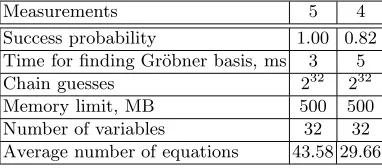
FL-collisions lead, as a rule, to more efficient results. Each equation binds only two GF(28)-variables, since one deals with binomial equations introduced in Subsection 3.2. There are 32 variablesK overGF(28). The algebraic relations on these variables are much simpler, since one has both plaintext and ciphertext bytes (more information related to the detected collisions). Moreover, there are nonlinear subsystems (cycles) solvable independently (see Subsection 4.4). On average there are 1.02 cycles covering 30.08 out of 32 GF(28)-variables for 5 measurements and 0.99 cycles covering 20.08 out of 32 GF(28)-variables for 4 measurements. Statistically there are 43.58 collisions for 5 measurements and 29.66 collisions for 4 measurements.
Table 3.Solving equation systems for FL-collisions overGF(28)
Measurements 5 4
Success probability 1.00 0.82 Time for finding Gr¨obner basis, ms 3 5
Chain guesses 232 232
Memory limit, MB 500 500
Number of variables 32 32
Average number of equations 43.58 29.66
4.3 Constructing Combined Systems of Equations
Though FS- and, first of all, FL-systems perform well for 4 and 5 measurements, their solution for 3 measurements is either extremely improbable or rather in-feasible. Here a combined approach has to be used. For combined systems of equations we use 23 quadratic equations over GF(2) instead of 39 ones to de-scribe the S-boxes [4]. This representation has the advantage that only quadratic monomials in both input and output variables are present, as opposed to the de-scription with 39 variables where more quadratic terms are used.
We performed experiments with combined systems having 512 variables for
K(1), K(2), K(10), K(11) as well as 128·t variables for outputs of the first S-box layer and 128·t variables for inputs to the S-boxes of the last round (for t
measurements). The combined systems consists of the following equations:
1. 2·23·16·t quadratic equations describing the relationship between input and output of the S-boxes at the first and last rounds;
2. Key schedule equations for subkeys 1, 2 and 10, 11 (2·4·23 quadratic and 2·12·8 linear ones);
3. 8 linear equations for each FS- or LN-collision;
4. 23 quadratic equations for each type 1 FL-collision. 8 linear equations for each of the following additional collisions:
– Collisions between the S-boxes of round 1 and 9,
– Collisions between the S-boxes of round 2 and 10.
4.4 Speed-Ups
The straightforward approach to solve the system constructed in Subsection 4.3 would be to pass it to the F4 algorithm. However, this is a rather inefficient approach. A more detailed insight into the structure of the resulting nonlinear system reveals that the system frequently possesses subsystems that can be efficiently solved independently of the remaining system.
element of the chain (say, one byte in the chain was guessed) uniquely defines all the other elements of the chain. Thus, if one identifies all (linear and nonlinear) binomial equations in the system, findshlongest chains and guesses one byte in each of them, this determines all the unknowns in thesehchains.
This system of nonlinear equations for FL-collisionsSintroduced in
Subsec-tion 3.2 can be solved in few milliseconds using Magma. However not always there is a single solution.
Let us consider a partition ofK
K=K1∪ · · · ∪ Km, Ki∩ Kj=∅, i6=j
such that
1. for anyi, j= 1, m(i6=j), and any two variablesvi∈ Ki andvj ∈ Kj there is no equation inv1, v2in S;
2. noKi has a partition that satisfies the first property.
We say that a subset of the variables is connected w.r.t.S, if this subset has no partition that satisfies the first property. Thus eachKiis connected. Then the systemS can be patitioned intom isolated subsystemSi corresponding toKi. Pairs (Ki, Si) are calledchains due to their geometric representation as vertex chains in graphs associated with these subsystems (see e.g. [3]). Obviously,Si =∅ iffKi={v}for some variablev∈ K. In this case the right value of the variable
v can only be guessed. The caseSi is a linear subsystem was considered in [3]. We have rank(Si) = #Ki−1, and if we fix some variable vi1 ∈ Ki, the other variables vij ∈ Ki are given by vij = vi1⊕∆ij with ∆ij ∈ GF(2
8). Suppose
now Si has one or more quadratic equations, i.e.,Ki∩ {k0(1),0, . . . , k (1)
3,3} 6=∅ and
Ki∩ {k˜0,0, . . . ,˜k3,3} 6=∅. Letv ∈ Ki. Since Ki is connected, there is a relation between v and any other variablex ∈ Ki. These relations can be expressed as linear or quadratic equations in two variables. Indeed, letx, y, z∈ Ki, and
x·y+α·x+β·y+γ= 0; x+z=δ,
whereα, β, γ, δ∈GF(28). Ifv+x= ¯δ, we get
v·y+α·v+ (β+ ¯δ)·y+ (γ+α·δ¯) = 0; v+z=δ+ ¯δ.
In the casex·v+ ¯α·x+ ¯β·v+ ¯γ= 0 we have
(v+ ¯α)(x·y+α·x+β·y+γ) + (y+α)(x·v+ ¯α·x+ ¯β·v+ ¯γ) = (β+ ¯β)·v·y+ (α·β¯+γ)·v+ (¯α·β+ ¯γ)·y+ (¯α·γ+α·γ¯) = 0,
and
v·z+ ¯α·z+ ( ¯β+δ)·v+ (¯γ+ ¯α·δ) = 0.
Let us now show how many solutionsSi has. As an example, ifKi={v, u}, and Si has two non-linear equations in u, v, then v is a root of a quadratic equation in one variable. ThereforeSi has two solutions in this case. If #Si ≥3, then the solution is single. Generally, we say thatKiis strongly connected w.r.t.
Si, if there is a non-linear equation e ∈ Si such that Ki is connected w.r.t.
Si\ {e}. Such chains are calledcycles. It can be shown that in this caseSi has at most two solutions. Moreover, the solution is single, ifKi is strongly connected w.r.t.Si\ {e}.
Thus the number of solutions of the whole system S is equal to Qm i=12qi, where qi ≤1, ifKi is strongly connected, and qi = 8 otherwise. Let us remark that it is not necessary to know the value of all variables. It is enough to find the key bytes of either the first or last round.
Using Non-Collisions to Recover Chains. To solve the combined system we guesshbytes defining the maximum number of variables inK. In the most practical attacks, hcan be 1 or 2. Actually, one does not have to solve all the resulting 28·hsystems. Some of these guesses can be filtered out using the notion of non-collisions introduced in Subsection 3.3. Instead of constructing implicit degree 8 nonlinear equations, we make use of the non-collisions explicitly in the following way.
LetC1, . . . , Chdenote thehlongest chains of variables induced by binomial equations in question, each being of length |Ci| = li, i = 1, h, Ci∩Cj = ∅. The variables of the chain Ci are denoted by cij for j = 1, li. Every (cij, crs) ofl(l−1)/2 pairs of variables in these chains are connected either by an equal-ity (there was a collision detected) eij,rs(cij, crs) or an inequality (no collision detected)inij,rs(cij, crs). Collisions and non-collisions (as well as the correspond-ing equations) can be either linear (e.g. between the bytes ofK(1)) or nonlinear (e.g. between the bytes of K(1) and K(11)) as illustrated in Subsection 3.2 for FL-collisions.
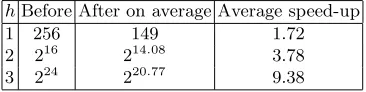
The idea behind the optimized search for chain evaluations using non-collisions is to verify connections (inequalities or equalities) for every pair of variables in thehlongest chainsC1∪ · · · ∪Chfor each candidate evaluation. The procedure can be formalized using Algorithm 1:
Table 4.Number of candidate chain evaluations before and after sieving using non-collisions (with and without nonlinear cycles) averaged over 5000 samples for 3 measurements
hBefore After on average Average speed-up
1 256 149 1.72
2 216 214.08 3.78
3 224 220.77 9.38
Algorithm 1Sieving guesses with non-collisions and non-linear cycles
Require: hchainsC1, . . . , Chof lengthsl1, . . . , lhwith 28h possible evaluations
1: foreach guess (c11, . . . , ch1)∈ {0, . . . ,28h−1}do
2: foreach chaini= 1 :hdo
3: foreach chain variablecijj= 2 :lido
4: Evaluatecijusing chain equations
5: end for
6: end for
7: foreach (cij, crs) of l(l−21) pairs of chain variables inC1∪ · · · ∪Chdo
8: Verify equalityeij,rs(cij, crs) or inequalityinij,rs(cij, crs) on variablescij, crs
9: if eij,rs(cij, crs) is inequation orinij,rs(cij, crs) is equationthen
10: Go to 1 (contradiction is detected)
11: end if
12: end for
13: Output the guess (c11, . . . , ch1) as a candidate evaluation of the chains
14: end for
ratio of systems with cycles for 3 measurements is about 0.232 averaged over 5000 samples.
4.5 Solving the Combined Systems of Equations
Algorithm 2Solving combined systems of nonlinear equations 1: if there are nonlinear cycles in the binomial chainsthen
2: Resolve the cycles overGF(28) using F4 or brute-force 3: Define bytes of the dependent chains
4: end if
5: Find thehlongest binomial chains
6: Execute Algorithm 1 for sieving chain evaluations 7: foreach non-contradicting evaluation ofhchainsdo
8: Find Gr¨obner basis for the reduced combined system of nonlinear equations with F4
9: if the Gr¨obner basis6={1} then
10: Verify the key candidates using a known plaintext-ciphertext pair
11: end if
12: end for
Table 5. Solving combined equation systems
Measurements 3 3 3
Success prob. 0.072 0.419 0.698
Run time 98.31 sec 4.24 hours 22.03 days
Memory limit, MB 500 500 500
h, number of chains guessed 0 1 2
5
Conclusion
This paper extends the known side-channel collision attacks on AES by treating generalized collisions within several rounds instead of searching for collisions in the first or last round only. This idea combined with algebraic techniques such as Gr¨obner bases provides significant advantages both in terms of measurements and post-processing complexity.
If byte collisions are detectable, the complete AES key can be recovered with 3 measurements with a probability of 0.42 and 4.24 PC hours post-processing, with 4 measurements with a probability of 0.82 in several seconds of offline computations or with 5 measurements with success probability close to 1 and several seconds post-processing. This is to be compared to 40 measurements with some non-negligible post-processing for a success probability>0.5 in [8] or to 6 measurements with approx. 237.15offline computations and a success probability of 0.85 and 5 measurements with 245.5 offline computations and a probability of 0.55 in [3].
References
1. Alex Biryukov, Andrey Bogdanov, Dmitry Khovratovich, and Timo Kasper. Col-lision Attacks on Alpha-MAC and Other AES-based MACs. InCHES’07, LNCS. Springer-Verlag, 2007.
2. Alex Biryukov and Dmitry Khovratovich. Two new techniques of side-channel cryptanalysis. InCHES 2007, volume 4727 ofLNCS. Springer-Verlag, 2007. 3. Andrey Bogdanov. Improved Collision Attacks on AES. InThe 14th Annual
Work-shop on Selected Areas in Cryptography (SAC 2007), Ottawa, Ontario, Canada, LNCS. Springer-Verlag, 2007.
4. Carlos Cid, Sean Murphy, and Matthew Robshaw. Algebraic Aspects of the Ad-vanced Encryption Standard. Springer-Verlag, 2006.
5. J.-C. Faug`ere. A New Efficient Algorithm For Computing Gr¨obner Bases (F4). Journal of Pure and Applied Algebra, 139(1):6188, June 1999.
6. Paul Kocher, Joshua Jaffe, and Benjamin Jun. Differential Power Analysis. In
CRYPTO’99, LNCS, pages 388–397. Springer-Verlag, 1999.
7. Herv´e Ledig, Fr´ed´eric Muller, and Fr´ed´eric Valette. Enhancing Collision Attacks. InCHES’04, volume 3156 ofLNCS, pages 176–190. Springer, 2004.
9. Kai Schramm, Thomas J. Wollinger, and Christof Paar. A New Class of Collision Attacks and Its Application to DES. In FSE’03, volume 2887 of LNCS, pages 206–222. Springer, 2003.
10. Andreas Wiemers. Collision Attacks for Comp128 on Smartcards. ECC-Brainpool Workshop on Side-Channel Attacks on Cryptographic Algorithms, Bonn, Germany, December 2001.
A
Details about the Computational Platform for
Experiments
We implemented all our attacks in Magma V2.13-10 (including the AES algo-rithm itself as well as its random inputs) running on a dual-core AMD Opteron processor with 1 MB cache and clocked at 2613.39 MHz under Linux. We used only one execution thread of the Opteron processor and not more than 1 GB of RAM. Thus, it is claimed that the performance figures of our attacks on a standard PC with a single-thread processor and 1 GB RAM are comparable to those given in this paper.
B
On the Practical Applicability of Collision Attacks
To make the reliable detection of byte collisions in S-boxes within AES possible, a number of conditions have to be fulfilled:
– All instances of the AES S-box have to share the same implementation:This condition is quite natural and is automatically fulfilled if the S-box is imple-mented as a separate routine, which is frequently the case on 8-bit embedded microcontrollers.
– The attacker has to precisely know when the S-boxes are executed: This is automatically fulfilled if the implementation is known to the attacker. Oth-erwise, the analysis of the timing behaviour can be performed prior to the attack using SPA. During this phase the attacker needs to know neither inputs/outputs to the cipher nor the used keys.
– Measurements of high accuracy are required: The usage of averaging tech-niques increases the signal-to-noise ratio and the probability of collision de-tection. Averaging within one trace requires a high sampling rate of the measurement device. If several traces are averaged, multiple measurements for each of the inputs are needed.
– Lengthy power traces have to be stored:As the power consumption of S-boxes in several AES rounds is analyzed in linear and algebraic collision attacks, more points have to be stored for each algorithm run. This condition can be fulfilled by long memory scopes.