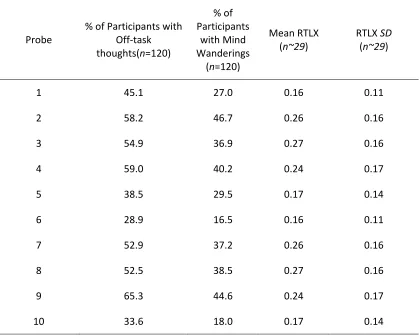
ABSTRACT
COWLEY, JENNIFER ANTONIA. Towards a Theory of Mind Wandering in Relation to Task Type, Behavioral Responses, and Respective Adverse Consequences in Piloted Vehicles. (Under the direction of Douglas Gillan.)
In critical systems, human operators are often responsible for maintaining the safe operation of systems. However, cognitive factors (e.g., affect, attentional resources, fatigue, etc.) can negatively affect the operator’s ability to stay focused on the task and make timely decisions. Although prior research has studied multiple factors that impact performance, such as
distracted driving, situation awareness, multitasking, vigilance decrements, etc., mind wandering has yet to be integrated with these factors to yield a more comprehensive theory of human performance. To address this problem, we employed a mixed method, qualitative and quantitative, approach to study performance implications of mind wandering in the context of automobile driving and aviation piloting using undergraduate students and certified pilots, respectively. Only prominent results are reviewed.
In Part I, we assessed the degree of unrelatedness required between thoughts and the current task at hand before it was subjectively classified as mind wandering with respect to four types of relatedness (e.g., functional, conceptual, temporal relatedness and thought tense). Using a factor scenario survey approach, high and low levels of each type of relatedness were correlated with participant’s perceptions of mind wandering. It was found that thoughts conceptually unrelated to the task were significantly more often identified as mind
wanderings than high functional, prospective thoughts. Also, low functional thoughts in the distant past or distant future were more likely considered mind wanderings (e.g., low temporal relatedness) than high functional thoughts in the near past or future (e.g., high temporal relatedness). In addition to these relatedness types studied in Part I, thoughts were also categorized on a continuum of task/thought decoupling with on-task thoughts at one end of the continuum (e.g., low decoupling) and mind wanderings that lack meta-awareness at the other (e.g., high decoupling) in Part IV of this research effort. Based on discussions with participants during these studies, the continuum of all thought categories is ordered from least to most decoupled as follows: on-task, off-task, mind wandering and unaware mind wandering.
In Part III, we explored whether the level of thought/task decoupling was related to performance decrements in the driving simulation environment. When participants were most frequently mind wandering without meta-awareness which is the most extreme
decoupled state, the highest mean number of lane deviations (2.26 deviations) and the second highest mean seconds of speeding (5.53 seconds) were recorded. When participants were most frequently on-task, the lowest mean seconds of speeding (1.17 seconds) and second lowest number of mean lane deviations (1.00 deviations) also resulted. A similar relationship was found in the flight simulation with general aviation pilots even though the frequencies of off-task thinking were lower. When all on-task and off-task thought contents were
involved actions/behaviors previously executed as well as thoughts about navigation. If poor performance occurred in the take-off phase of flight, thoughts about their performance often appeared during the climb phase of flight. During cruise, thinking became more decoupled from the task (e.g., thoughts about planning and strategizing) even though these thoughts were participant classified as on-task. Thus, as the pilots executed tasks from take-off to cruise, the thoughts gradually became more decoupled. Future work needs to assess performance implications of decoupling in the flight simulations.
Correlates to mind wandering were also assessed to understand when and why mind
wandering may occur. Similar to findings in the prior literature, negative mood was found to be significantly and positively related to higher frequencies of off-task thinking but not mind wandering. Yet, task load, subjective mental workload, task type and working memory capacity did not significantly correlate with frequencies of off-task thinking and mind wandering.
Lastly, this work investigated the efficacy of three mind wandering metrics used in prior literature (e.g., all probe, self-caught and probe, and clicker). Efficacy was operationally defined as a metric that from the participant’s viewpoint, facilitated quick task
This mixed method approach sought to build theory about what mind wandering is, when it arises and for what reasons. It is not clear how mind wandering fits with other research on related phenomenon like vigilance, multitasking, distracted driving, automatic/controlled processing, and novice/expert performance. Thus, a framework is needed to understand how the results reported herein overlap with other theory generated about these related
Towards a Theory of Mind Wandering in Relation to Task Type, Behavioral Responses, and Respective Adverse Consequences in Piloted Vehicles
by
Jennifer Antonia Cowley
A dissertation submitted to the Graduate Faculty of North Carolina State University
in partial fulfillment of the requirements for the degree of
Doctor of Philosophy
Psychology
Raleigh, North Carolina 2012
APPROVED BY:
_______________________________ ______________________________
Douglas J. Gillan Anne C. McLaughlin
Committee Chair
_______________________________ ________________________________
Christopher B. Mayhorn Stan Dicks
BIOGRAPHY
Jennifer Cowley received the Bachelors of Science in Animal Science from the University of Illinois at Urbana-Champaign (UIUC) in May of 1997. Her passion for research began at UIUC when she was employed at the UIUC Roy J. Carver Biotechnology Center to research transgenic livestock. During her tenure at NCSU, her research interests blossomed through her work experiences at the SAS Institute, Inc., the MITRE Corporation, and at the Software Engineering Institute at Carnegie Mellon University. Her interests include the study of human error (e.g., defining and measuring error and identifying consequences of error), warning systems design (including interface and universal design) to reduce human error, and research methods and metrics.
ACKNOWLEDGMENTS
TABLE OF CONTENTS
LIST OF TABLES ... vii
LIST OF FIGURES ...ix
1. Problem ... 1
2. Literature Review... 2
2.1. Human Error Defined ... 2
2.2. Mind wandering ... 5
2.2.1. What is mind wandering? ... 5
2.2.2. When is mind‐wandering likely to occur? ... 7
2.2.3. Task‐unrelated thinking and task type ... 8
2.2.4. Consequences of Task‐unrelated thinking ... 9
2.2.5. Mind wandering and the operation of vehicles ... 10
3. Research Overview ... 12
3.1. Research domain ... 13
3.2. Research Questions and Experimental Hypotheses ... 15
3.2.1. Exploratory Research Questions ... 15
3.2.2. Experimental Hypotheses ... 23
4. Part I. Factor Scenario Survey ... 26
4.1. Goals ... 26
4.2. Method ... 26
4.2.1. Participants ... 26
4.2.2. Apparatus and Stimuli ... 29
4.2.3. Procedure ... 32
4.3. Analyses and Results ... 33
4.4. Discussion ... 41
5. Part II. Task Analysis ... 43
5.1. Goal ... 43
5.2. Method ... 44
5.2.1. Participants ... 44
5.2.2. Apparatus and Stimuli ... 44
5.2.3. Procedure ... 46
5.3. Analyses and Results ... 48
5.4. Discussion ... 49
6. Part III. The Driving Simulation Study ... 54
6.1. Purpose ... 54
6.2. Method ... 54
6.2.1. Participants ... 54
6.2.2. Stimuli and Apparatus ... 56
6.2.3. Procedure ... 59
6.3. Analysis and Results ... 61
6.3.1. Variables ... 61
6.3.2. Hypothesis 1. ... 67
6.3.4. Research Question 1 ... 93
6.3.5. Research Question 2 ... 101
6.4. Discussion ... 109
7. Part IV. The Flight Simulation Study ... 111
7.1. Purpose ... 111
7.2. Method ... 111
7.2.1. Participants ... 112
7.2.2. Stimuli and Apparatus ... 113
7.2.3. Procedure ... 115
7.3. Analyses and Results ... 117
7.4. Discussion ... 134
8. Conclusions ... 137
8.1. Addressing the hypotheses ... 137
8.2. Building Theory ... 140
REFERENCES ... 145
APPENDICES ... 154
APPENDIX A. Aviation Safety Reporting System (ASRS) Reports of Mind Wandering By Pilots in the Cockpit ... 155
APPENDIX B. Demographics of Factor Scenario Questionnaire Sample (n=114) ... 161
APPENDIX C. Factor Scenario Questionnaire Results: Participants’ Mean Ratings for Each Dimension (Temporal, Functional, Conceptual, Tense) of Mind Wandering Construct ... 163
APPENDIX D. Series of Bar Charts Depicting the Frequencies of Mind Wandering for Each Flight Task within Each Phase of Flight ... 165
APPENDIX E. Definitions of Each Ability and Mental Process from the US Department of Labor’s O’Net Site ... 169
APPENDIX F. Table of O’Net’s Abilities and Mental Processes Required for Each Probe ... 170
APPENDIX G. Table of Demographics for Part III Driving Simulation Study Sample (n=120) ... 181
APPENDIX H. Copies of Consent Form and All Questionnaires Used in Part III Driving Simulation Study ... 183
APPENDIX I. Computer Hardware Specifications Required for Driving Simulator Software ... 202
APPENDIX J. List of Diagnostics Available to Model a Logistic Regression in 9.4 Base SAS ... 203
APPENDIX K. Table of Demographics for Part IV Flight Simulation Study Sample (n=17)... 204
APPENDIX L. Copies of Consent Form and All Questionnaires Used in Part IV Flight Simulation Study ... 206
APPENDIX M. Flight Simulation Settings and Flight Scenario Settings ... 214
LIST OF TABLES
Table 1. Definitions of Human Error ... 4 Table 2. Example Sentences Representing Each Factor Level in the Factor Scenario Survey
... 31 Table 3. A 5-Way Contingency Table with Four 2-Level Factors (tense, temporal,
functional, conceptual) and One Dichotomous Response Variable (total number of “yes” responses) ... 34 Table 4. Main Effects and Interactions of 5-Way Contingency Table Analysis (n=17) ... 36 Table 5. Two-way aggregate factor combinations and their mean % of “yes this is an
example of mind wandering” responses ... 37 Table 6. Odds Ratio Estimates and Respective Wald Confidence Intervals of Logistic
Regression Analysis Interaction Terms: Temporal, Functional, Conceptual and Tense ... 38 Table 7. Top and Bottom 10 Ranks of Flight Tasks During Which Pilots Experienced Mind
Wandering ... 39 Table 8. Total Number of Abilities and Mental Processes (e.g., Cognitive Load) Required
for Each Probe ... 49 Table 9. Means and Standard Deviations (SD) of RTLX Scores For Each Probe ... 63 Table 10. Frequency participants who experienced some number of probes out of ten that
were subjectively interpreted as off-task but not mind wandering (n=120)... 73 Table 11. Percentage of Off-Task Thoughts and Mind Wanderings as well as Mean RTLX
Scores for Each Probe ... 76 Table 12. The top and bottom three scores of working memory capacity and their percent of
off-task and wandering frequencies out of ten probes (n=6) ... 81 Table 13. Frequency of Response Categories for Three Questions About The Efficacy of
Mind Wandering Metrics (n=122) ... 90 Table 14. Means and standard deviations for off-task and mind wandering variables across
all probes. ... 95 Table 15. Estimates, Standard Errors and p-Values for Two Logistic Regressions with Probe
as the Independent Variable and Off-task and Wandering as the Dependent
Variable ... 98 Table 16. Contingency Table Abilities and Mental Processes Across 5 Probes ... 99 Table 17. Estimates and Standard Errors (SE) in the Seconds of Speeding For Each Probe
(n=590) ... 103 Table 18. Mean Differences of Seconds of Speeding Across Between Probes (n=590) ... 103 Table 19. Estimates and Standard Errors (SE) in the Number of Deviations For Each Probe
Table 20. Mean Differences of Number of Lane Deviations Between Probes (n=590) ... 105 Table 21. Characteristics of Thoughts at Each Probe in the All Probe Metric Condition ... 106 Table 22. Total number of off-task and mind wandering occurrences by probe according to
self-classifications by 17 participants... 118 Table 23. Degrees of Awareness; Thoughts grouped by degrees of awareness (n=326) ... 122 Table 24. Semantic content of thoughts collected at each probe (n=90)... 124 Table 25. Self Assessments. Frequencies and examples of self assessment thoughts (n=90)
... 127 Table 26. Thought origin. Frequencies and examples of thought origins (n=90) ... 130 Table 27. Thought origin comparison between participant self-reports and the investigator’s
classification ... 131 Table 28. Number of pilots who self report having more distractibility during the following
LIST OF FIGURES
Figure 1. The inverse relationship between task load and mind wandering frequency that is effected by working memory capacity ... 24 Figure 2. A proportional relationship between negative mood and mind wandering
frequency ... 25 Figure 3. The Driving Route with Traffic Signals, Traffic Signs, Pedestrian Events and
Probe Points (Black Stars) ... 45 Figure 4. The driving scene observed by the participant during Probe #1, which consists of
a city street with cars parked along the right-hand side and an approaching traffic light ... 51 Figure 5. The driving scene observed by the participant during Probe #2, which consists of
an open highway with no buildings or other cars ... 51 Figure 6. The driving scene observed by the participant during Probe #3, which consists of
a city street with cars driving in the lane to the right and an approaching traffic light ... 52 Figure 7. The driving scene observed by the participant during Probe #4, which consists of
a city street with no cars... 52 Figure 8. The driving scene observed by the participant during Probe #5, which consists of
an open highway with light traffic in the right lane ... 53 Figure 9. Participant is driving within their lane: the red line depicts Left Lane Deviation
Boundary ... 66 Figure 10. The participant is performing a lane deviation boundary: the red line depicts the
Right Lane Deviation Boundary, which has been crossed by the right car wheels ... 66 Figure 11. Histogram of working memory capacity scores ... 70 Figure 12. Histogram of the number of participants who experiences a particular ratio of
off-task thoughts out of 10 probes ... 71 Figure 13. Histogram of the number of participants who experienced a certain ratio of mind
wandering incidents out of 10 possible probes ... 72 Figure 14. Frequencies of participants who experienced off-task vs. on-task thinking at each
of the 10 probes. ... 74 Figure 15. Frequencies of participants who experienced mind wandering vs. non-mind
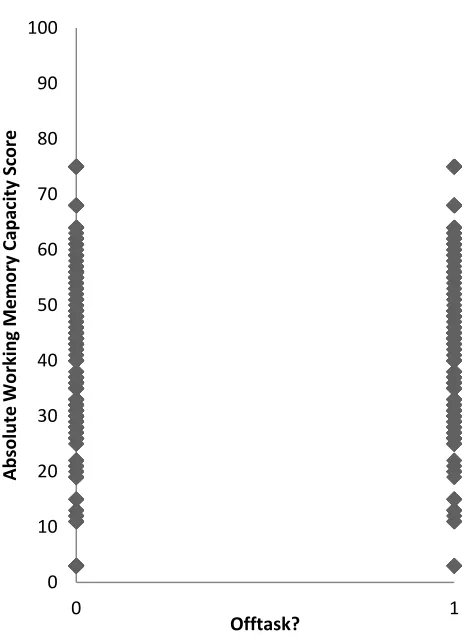
wandering at each of the 10 probes ... 75 Figure 16. Scatterplot of off-task thinking (1=yes, 0=no) and absolute WMC score (n=1200)
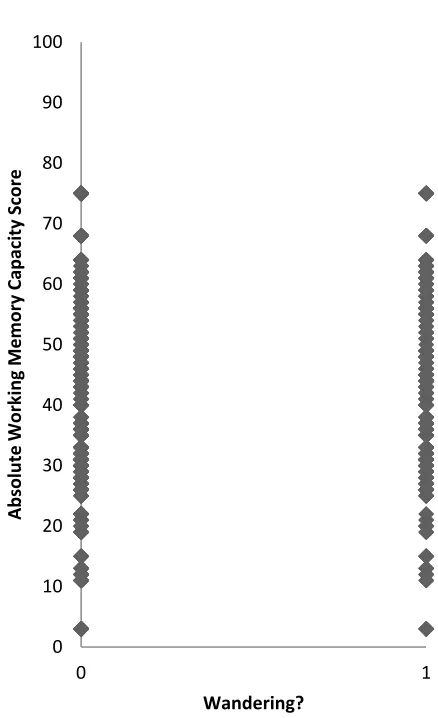
... 78 Figure 17. Scatterplot of mind wandering (1=yes, 0= no) and absolute WMC score (n=1200)
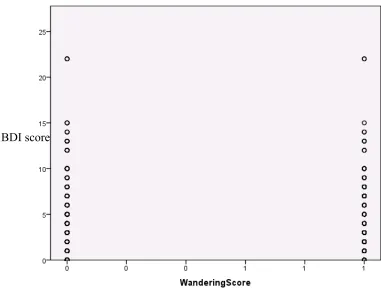
Figure 19. Scatterplot of occurrences of off-task by BDI scores ... 85
Figure 20. Regression Line and Confidence Intervals of the Probability of Each BDI Score Correlated with Off-task Thinking ... 87
Figure 21. Regression Line and Confidence Intervals of the Probability of Each BDI Score Correlated with Mind Wandering Occurrences ... 88
Figure 22. Mean of off-task thoughts by probe ... 96
Figure 23. Means of mind wandering thoughts by probe ... 96
Figure 24. The number of thoughts per probe (n=326) ... 120
Figure 25. Thought Tense; Frequencies of prospective, retrospective and thoughts about the present moment across all five probes (n=326) ... 121
1.
Problem
simulated vehicles. To achieve this goal, the following aims have been identified and will be reported:
Aim #1: To identify existing metrics for measuring mind wandering, this document surveys the literature and applies the three most favorable metrics to driving and flight simulation studies.
Aim #2: To test the efficacy of previously identified cognitive mind wandering correlates (e.g., working memory capacity and negative affect) in the transportation domain, the research reported herein measured these potential correlates in a driving simulation experiment.
Aim #3: To measure the relationship between mind wandering, task performance and error, the present research examined automobile drivers and aviation pilots in simulation. Together, these aims were selected to generate new data necessary for theory development to understand the potential implications of mind wandering in the transportation domain.
2.
Literature
Review
We now review the literature for relevant findings in the human error and mind wandering before summarizing the gaps in both areas of literature.
2.1.Human Error Defined
problem differently, the definitions are not unified into a single theory of human error. Similarly, human error has been defined through taxonomic classifications that express what factors led to such failures (Norman, 1984; Reason, 1990; Shappell, Detwiler, Holcomb, Hackworth, Boquet, Wiegmann, 2006). For example, Reason (1995) defines an error of omission as one that occurs when an intended behavior is not executed. Finally, several investigators study human error but never provide a definition (Edmondson, 2004; Leiden, Laughery, Keller, French, Warwick, & Wood, 2001; Macwan & Mosleh, 1994)
Human error may be difficult to define because caveats exist in the source of error. For example, the English Oxford Dictionary (EOD) defines error as, “the state or condition of being wrong in conduct or judgment.” The caveat with this definition is the implication that someone (an operator, an accident investigator) can identify “wrong” conduct or judgments. In regards to definitions of human error based on the failure to achieve some goal (Isaac & Ruitenberg, 1999) or failure to carry out a planned action (Reason, 1982, 1995), a caveat appears in dynamic environments, where goals may not be realized or goals may be shifting or planned actions are not appropriate in certain circumstances. Consider a scenario in which a set of planned actions are being executed to achieve a goal, when an unexpected event causes the planned actions to be modified or aborted. From the vantage point of an outside observer, this scenario may be considered an error, if the goal can no longer be achieved. However, from the vantage point of the operator, this is not an error (Dekker, 2005). Another caveat is that errors are often identified by the adverse consequences of an inaccurate behavior or judgment (e.g., incidents and accidents). However, adverse
behaviors. Adverse consequences may be slow to manifest, in which case they are difficult to correlate with system changes or other factors in dynamic environments. Therefore, because no single error definition is comprehensive (Dekker, 2005), it may be prudent to evaluate error in a manner that is as comprehensive as possible.
Table 1. Definitions of Human Error
Author, Year, Page Definition
Reason, 1982, pp.14 When a planned action fails to achieve its desired outcome, and when this
failure cannot be attributed to the intervention of some chance occurrence
Reason, 1995, pp.81 A failure of planned actions to achieve a desired goal
Isaac & Ruitenberg, 1999,
pp. 11 Intended actions which are not correctly executed
Gertman, Hallbert, Parris, Sattision, Brownson & Tortorelli, 2001
Human errors are failures, which are the inability a human or component to perform its function as required.
Pounds & Isaac, 2002 Cognitive failures that lead to incorrectly executed actions
Woods, Johannesen, Cook,
& Sarter, 1994 Human error is a specific variety of human performance that is so clearly and significantly substandard and flawed when viewed in retrospect that there is no doubt that it should have been viewed by the practitioner as substandard at the time the act was committed or omitted.
American Oxford English
Dictionary, 8th Ed. The state or condition of being wrong in conduct or judgment
One potentially comprehensive method of defining a human error is to assign probabilities to the expression of adverse consequences for each human error factor (i.e., contributing
documenting the variability of normal, daily behaviors and resultant performance. Afterward, probabilities between certain behaviors and adverse consequences may emerge.
2.2.Mind wandering
Mind wandering may be one contributing factor to task-unrelated behavior correlated with error. In this section, we present a definition of mind wandering, following by background information such as who is most susceptible to mind wandering, when is mind wandering most likely to occur, and a few documented consequences of mind wandering.
2.2.1. What is mind wandering?
absent-minded. On the contrary, William James (1890) suggests that mind wandering occurs when the individual experiences a meandering string of thoughts, some of which may not be influenced the exogenous world of stimuli at a given moment in time. Thus, an individual can mind-wander through a series of thoughts that may or may not be related to events occurring in the task environment. For the purposes of this paper, we use the terms mind wandering and task unrelated thinking interchangeably to represent a subjective experience of thinking off-task thoughts, regardless of whether the thinking was deliberate or not, conscious or not, spontaneous or not.
A few properties of task-unrelated thinking have been identified in the literature; some of which are inherent in the definitions above. First, the change in thought content has been characterized as either abrupt, wherein unrelated thoughts spontaneously “pop” into the mind (Kvavilashvili & Mandler, 2004), or more gradual, wherein thoughts gradually meander off-task (James, 1890; Smallwood, Baracaia, et al., 2003). Also, off-task-unrelated thinking can be either voluntarily- or involuntarily-initiated (Forster Lavie 1999; Smallwood & Schooler, 2006) and at the time that the unrelated thought is initiated, the person can be aware or unaware that their thinking has deviated off-task (Schooler, 2002). When the individual is unaware of off-task thinking, a phenomenon known as temporal dissociation occurs, wherein the person is said to lack meta-awareness (Schooler, 2002) or the awareness of one’s
2.2.2. When is mindwandering likely to occur?
A few explanations about why people mind wander have been provided in the literature. Some explanations are task-specific, in which the explanation is related to the task type, while others are related to individual differences of the operator, such as mood or working memory capacity. Research on reading and problem solving tasks has provided some insight into why people mind wander. For example during reading tasks, those texts that were interesting to the readers facilitate “zone-outs” because the text is thought provoking while uninteresting texts facilitate attentional shifts to more interesting topics (Schooler, Reichel, & Halpern, 2005). During problem solving tasks, mind wandering may serve as an incubation period for solutions to be brought into conscious awareness (Anderson, 1975 and 1985; Bastik, 1982; Cattell, 1971; Giambra, 1995; Helmholtz, 1896; Smith, 1995).
wherein two tasks are performed simultaneously, the investigators found that if the primary task demanded high levels of cognitive resources, then few resources were available for mind wandering; thus, the frequency of mind wandering was reduced (Teasdale, Dritschel, Taylor, Proctor, Lloyd, Nimmo-Smith, 1995). These findings paralleled other work that identified an inverse relationship between cognitive resource demand and the frequency of task-unrelated thinking (Forster & Lavie, 2009; Giambra, 1995; Teasdale, Dritschel, Taylor, Proctor, Lloyd, Nimmo-Smith, 1995; Teasdale, Proctor, Lloyd, & Baddeley, 1993; Smallwood & Schooler, 2006). This relationship may be mitigated by an individual’s working memory capacity such that when an individual with a high working memory capacity is faced with a large task load that consumes cognitive resources, more task-unrelated thinking occurs compared to low working memory capacity individuals (Kane, Brown, McVay, Silvia, Myin-Germeys, & Kwapi, 2007). This may be because high working memory capacity individuals may have extra cognitive resources available to mind wander when the task load is high, as compared to low working memory individuals with the same task load. However, it is unclear whether we would observe any differences in mind wandering frequencies among high and low working memory capacity people given the same task load.
2.2.3. Taskunrelated thinking and task type
There are some indications that mind wandering occurs when the individual is performing certain task types. First, mind wandering may occur more often when performing tasks which require high levels of engagement or attention, called vigilance, which has been observed during reading tasks (Smallwood, Fishman, & Schooler, 2007). During vigilance tasks, the frequency of task-unrelated thinking ranges from 30-55% of thought content probes
& Ballantyne, 2004; McVay & Kane, 2009, Schooler, Reichle, & Halpern, 2005). In studies where individuals were presented with targets for their attention, this effect was pronounced when the target presentation rate was comparatively slow (Antrobus, 1968; Grodsky & Giambra, 1991; Teasdale et al., 1995). These findings involved those individuals whose thinking involves meta-awareness (Schooler & Schreiber, 2004) which is awareness of the contents of conscious thoughts. Other studies found that during reading tasks, mind
wandering occurred on average of 1.6 probes out of a total of 6 probes per study and during 13% of those 1.6 probes, the participant lacked meta-awareness (Grodsky & Giambra, 1991). In addition, mind wandering occurrences may be related to certain task characteristics. For example, repetitive, familiar, long-duration, unvarying, somewhat cognitively undemanding tasks tend to be related to higher frequencies of mind wandering (Smallwood & Schooler, 2006; Antrobus, 1968; Grodsky & Giambra, 1991; Teasdale et al., 1995). Finally, automated tasks, which require little conscious effort and attention to execute, have also been correlated with higher frequencies of task-unrelated thinking compared to tasks that are not automated (Klinger, 1977; Smallwood, Obonsawin, Reid, 2003).
2.2.4. Consequences of Taskunrelated thinking
Baraciaia, Lowe, & Obonsawin, 2003; Smallwood, Davies, Heim, Finnigan, Sudberry, O’Connor, & Obonsawin, 2003; Smallwood, Fishman et al., 2007). This may be particularly true in those individuals with low working memory capacity (McVay & Kane, 2009). As a consequence of this decoupled state, the individual may develop a superficial representation of the environment (Smallwood & Schooler, 2006). For example, mind wandering seems to reduce the encoding accuracy of task relevant information (Seibert & Ellis, 1991; Smallwood et al., 2003; Smallwood, Fishman, et al., 2007; Smallwood, McSpadden, et al., 2008;
Smallwood, Obonsawin, & Heim, 2003). As a result, task-relevant memories are inaccurate (Smallwood, Baraciaia, Lowe, & Obonsawin, 2003), which can compromise mental model building (Smallwood, Fishman, et al., 2007).
Task-unrelated thinking may also adversely affect the execution of task-relevant actions. Off-task thinking has been related to response delays (Cheyne, Carriere, & Smilek, 2006;
Smallwood, McSpadden et al., 2007), as well as higher rates of incorrect response execution (Smallwood, McSpadden et al., 2007). Finally, during mind wandering, an increase in the number of action slips is observed, which is the execution of the wrong behavior when performing an automated task (Broadbent & Cooper, 1982), as well as an increase in the number of errors of commission, which are the execution of the wrong behavior when the task requires controlled processing (Cheyne, Carriere, Smilek, 2006; Helton, Kern, & Walker, 2009).
2.2.5. Mind wandering and the operation of vehicles
established rules of operation. For example, drivers must obey the laws of driving in their jurisdiction, and aircraft pilots need to obey national laws governing air traffic. The occurrence of mind wandering, to my knowledge, has never been reported in research
publications about task engagement in the cockpit flight deck; however, there is evidence that pilots do mind-wander. For example, Reason and Mycielska (1982) identified 16 different aviation accidents between the years 1955 and 1972 where the causal contributor may have been “absent-minded behaviors.” The most common absent-minded behavior, called a slip, occurs when the unintentional execution of habitual steps in a task or omissions of steps in a task that is committed to habit. Because these 16 incidents were 3rd party retrospective accounts of the accidents, the occurrence of mind wandering cannot conclusively be
ascertained. In addition, as of July 18, 2010, the Aviation Safety Reporting System (ASRS) database contained 7 reports of pilots who mind wandered in the cockpit (See Appendix A). Therefore, it is probable that mind wandering occurs in the cockpit flight deck during normal flight operations, but without a standard metric by which to measure mind wandering, we may find this phenomenon is underreported in the case of human error.
Much of the literature related to mind wandering while driving an automobile is categorized as “distracted driving” which commonly involves the use of an electronic device as a
distinction between distracted driving and mind wandering when driving and respective performance implications (Glaze & Ellis, 2003; He, Becic, Lee, & McCarley, 2011; Stutts, Reinfurt, Staplin, & Rodgman, 2001).
3.
Research
Overview
This research uses a grounded approach to studying mind wandering where hypotheses formed in one domain are applied to another. This research begins with the study of automobile drivers to understand how to best measure mind wandering and ends with the application of those identified measures to aviation pilots. The target domain is aviation because, compared to driving, flight task sequences are more standardized than driving task sequences.
operator dysphoria, operator working memory capacity, mind wandering and adverse consequences. Part IV is a flight simulation study that employs the metric identified in Part III to study mind wandering with general aviation pilots.
The remainder of this chapter begins with an overview of the research domain, followed by the four parts described above. Each part introduces the research questions and/or
hypotheses addressed, experimental design, results and discussion. An overall discussion of the study results follows the presentation of these four parts.
3.1.Research domain
Mind wandering can affect expert operators in a number of domains, such as transportation, energy and health care. Herein, the focus is predominantly on-tasks performed by aviation pilots and automobile drivers. In aviation, commercial pilots have a very tightly controlled environment in which policies and training aim to minimize variance in the flight task to which mind wandering could be a potential cause of variance. However, significant
repeated tasks to not only study incidents of mind wandering, but to also observe the variance of pilot behaviors.
3.2.Research Questions and Experimental Hypotheses
A mixed method research approach, which was exploratory and experimental, was used to create theory and to test prior research findings from other domains in the context of the aviation domain. Exploratory methods were used to develop the theoretical construct of mind wandering, to categorize domain-specific tasks in a taxonomy, to identify when mind wandering occurs and to examine potential relationships at a given point in time between the content of task-unrelated thoughts, the task type, and the proximal resultant consequences of mind wandering. Experimental methods were used to evaluate the efficacy of different mind wandering metrics for the cockpit environment and the relationship between working
memory capacity, dysphoria, task type, task load, and mind wandering. The exploratory research questions will be discussed in detail first, followed by the experimental hypotheses.
3.2.1. Exploratory Research Questions
The exploratory research sought to investigate the following research objectives: 1) how is task unrelated thinking defined; 2) what is the relationship amongst task-unrelated thinking, human error and adverse consequences; and 3) what is the efficacy of mind wandering metrics? We now review important supporting literature before discussing the exploratory study objectives and specific research questions that we defined to investigate these
objectives.
feelings and musings (Smallwood, 2006). However, we lack any measurable definition of relatedness between a two topics of thought. Thoughts can be related on many dimensions, including:
• Temporal relatedness occurs when two thoughts are about two events that occur
relatively close in time. Tense is the directionality of the temporal quality of a thought (e.g., retrospective or prospective).
• Functional relatedness occurs when one thought is built from another.
• Conceptual relatedness occurs when two thoughts belong to the same construct.
of functional relatedness, because the checklist must be done before requesting clearance for takeoff, so requesting clearances is functionally dependent upon the completion of the checklist.
Another dimension of interest is the tense (e.g., prospective, retrospective and no tense) of the off-task thought compared to the present moment when the thought occurred. For
example, if a person is experiencing an off-task thought about an ‘event’ in the future (i.e., an episodic memory), the tense is prospective. However, some abstractions (e.g., social justice, college, etc.) are not about a particular point in time but may give rise to the subjective ‘feeling’ of tense. For example, a person may see a sunset that reminds them of the generic concept of the beach. When probed further, this individual has no associations of episodic memories with the beach but the beach has an association with the past or future. Other individuals may have a different experience. When probed further about the beach, these individuals may start naming a series of episodic memory associations, triggered by the sunset that occurred at a variety of time points in the past or future. By association, the abstraction may automatically acquire a tense due to its close proximity to an array of other episodic memories. To be precise, other individuals may explain that the abstraction recalled has no temporal quality at all.
The number of ways two thoughts could be related is not well studied in the literature. Only one study classified relatedness on multiple dimensions (temporal, purpose, object,
Before any research can be executed on exactly when mind wandering occurs, we need terminology to define mind wandering. A universally agreed-upon definition of mind wandering may not exist amongst study participants; however, we may approximate a definition by developing and testing terminological criteria (e.g., degree of relatedness between thoughts and task) for including and excluding thought experiences as types of mind wandering. These thought experiences arise while the current task is being executed and some degree of thought unrelatedness to the task must be experienced before it is perceived as mind wandering. Three types of relatedness will be studied: temporal, functional and conceptual. To give directionality to temporal relatedness, we also studied the notion of thought tense, i.e., prospective, retrospective or no tense. Thus, the first research objective is to study degree of temporal, functional and conceptual relatedness required before it is classified as mind wandering.
The second research objective is to determine what task types and cognitive requirements (e.g., cognitive skills, abilities, mental processes) are significantly correlated with different types of mind wandering. Task analytic approaches (e.g., job task analysis, cognitive task analysis, hierarchical task analysis) to decomposing tasks into subtasks and their respective cognitive requirements are widely-used techniques within the social sciences (Brannick, Levine & Morgeson, 2007; Morgeson & Dierdorff, 2011; Sanchez & Levine 1999).
respective task types, task names, task cognitive requirements, etc. for multifarious job roles in the United States, including automobile drivers and aircraft pilots. In addition, O*Net™ established a taxonomy used to decompose jobs into ahierarchy of activities, sub-activities and tasks (Ammerman, Becker, Jones, & Tobey, 1987). In this taxonomy, multiple tasks comprise a sub-activity and 5-9 sub-activities comprise an activity. While definitions of activities and sub-activities are not provided, a task is defined as a “…‘concise, specific statement of one purposeful job action of a worker, generally performed by one individual within some limited period of time… tasks are intermediate in specificity between the high level activities/sub-activities and the procedural steps and actions by which they are
accomplished” (Ammerman, Becker, Jones, &Tobey, 1987, pp. 3-12).
O*Net™ is a venue for publishing the results of a series of standardized job task analyses (JTAs) conducted by researchers on behalf of the Department of Labor. The O*Net™ website provides not only the results of JTAs conducted on a wide variety of job roles, but it also provides a standardized list of defined knowledge, skills, mental processes and cognitive ability (KSMAs) requirements for each job role. During each JTA conducted by O*Net™ researchers, participants were asked to rate the importance level of identified KSMAs with respect to the job role, and researchers further tabulated the mean importance ratings (listed as a percentage) for all KSMAs. Only those KSMAs with a mean importance rating of 50% or higher were by default listed on the website
to build reliability and validity into importance ratings. In order to post the results of a job role on this site, a minimum of 15 returned questionnaires was required, but sample sizes by job roles are not provided (http://www.onetcenter.org/dl_files/omb2011/AppendixF.pdf).
Research Question 1 focuses on the relation between the type of mind wandering
experienced (e.g., temporal, functional, conceptual and tense) and the task being performed,: Are task type with a particular set of characteristics and mind wandering related? If so, are task type and the type of mind wandering related?
From the distracted driving literature, we may glean that adverse consequences result from device-dependent or device-independent distracted driving (Strayer & Drews, 2007; Strayer, Drews & Johnston, 2003). This result leads us to believe that adverse consequences may also occur with mind wandering. One explanation based on human information processing models is that task-unrelated thoughts can be a type of endogenously generated stimuli (e.g., the recall of a fantasy, musing or memory) that competes in the person’s sensory system with other representations of exogenous stimuli (e.g., visual information about task performance) for processing resources. If the endogenous stimuli or thoughts interfere with the processing of the exogenous stimuli in working memory, then behavioral errors in response to
driving literature; for example, distractions can reduce the detection and recognition of critical events (Strayer & Drews, 2007; Strayer, Drews & Johnston, 2003) and they are correlated with inappropriately delayed responses to critical events (Lee, Caven, Haake, & Brown, 2001; Strayer & Johnston, 2001). Thus, Research Question 2 concerns the relationship between mind wandering, behavioral responses or non-responses, and adverse consequences within close temporal proximity to the wandering: Are certain types of mind wandering related to certain behaviors and adverse consequences?
The third exploratory research objective is to identify a mind wandering metric that is efficacious, which means the metric that participants believed was least disruptive and most accurate at capturing the frequency of experienced mind wandering occurrences. A mind wandering metric is a technique used to measure the occurrence, characteristics and contents of a mind-wandering event. One metric published in mind wandering research is called the probe technique, also called the probe-caught method, in which the interviewer interrupts, or probes, the participant’s task execution to solicit the content of that person’s thoughts
(Antrobus, 1968; Giambra, 1995; Schooler, Reichle, & Halpern, 2005; Smallwood, Baracaia, et al., 2003; Smallwood, Davies, et al., 2004; Smallwood, Obonsawin, & Heim, 2003;
Smallwood, O’Connor, et al., 2004; Teasdale, Dritschell, et al., 1995). A probe is not a random system-generated interruption; it’s an event whose timing is predetermined and executed by the investigator. Probe techniques are typically used to learn of the participant’s thought content at a given point in task execution as well as used to assess the level of
meta-awareness. There are two types of probe techniques in the literature: the self-classification probe method (Teasdale, Dritschell, et al., 1995; Teasdale et al., 1993) and the experimenter-classification probe method (Smallwood, Obonsawin, & Reid, 2003). The self-classification probe method trains participants to self-categorize their own thought content according to a classification provided by the investigator. In contrast, the experimenter-classification probe method occurs when the investigator exclusively categorizes the participant’s thought content of the probe.
Non-probe mind wandering metrics are also used to identify the occurrence and thought content of mind wandering episodes. One such metric, called the self-caught method (Cunningham, Scerbo, & Freeman, 2000; Giambra, 1993), allows participants to self-interrupt the task to report when he/she experiences mind wandering. Another non-probe metric involves the retrospective recall of mind wandering episodes after task execution is complete (Seibert & Ellis, 1991); no task interruption occurs when using this metric. A small number of studies used a combined probe and self-caught metric to capture mind wanderings of individuals with and without meta-awareness (Schooler, Reichle, & Halpern, 2005). These non-probe mind wandering techniques rarely capture wanderings that lack meta-awareness.
wandering metric itself inflates measurement error. Furthermore, when the participant is asked to self-classify mind wandering episodes when using the self-classification probe method, this person may consequently be extra conscious of mind wandering episodes (inflating meta-awareness) than when not asked. Consequently, mind wandering frequencies as well as the occurrence of wanderings with meta-awareness, may be artificially inflated (Smallwood & Schooler, 2006).
Beyond the potential increase of measurement error given certain metrics used, another concern is that these metrics have not been validated in the driving and flight simulators. Therefore, Research Question 3 aims to assess the most efficacious metric for the cockpit domain given the types of tasks inherent to this environment: What metric or metrics exist for measuring mind wandering in the cockpit that also minimize disruption of a person’s train of thought and enhance the ability to recall the probe content?
3.2.2. Experimental Hypotheses
We now present relevant terminology before reviewing the study objectives and experimental hypotheses.
Antrobus, 1968; Grodsky & Giambra, 1991; Teasdale et al., 1995). However, there is some indication that the participant’s working memory capacity may influence the relationship between task load and mind wandering frequency (McVay & Kane, 2010). One explanation is that in light of a single pool of cognitive resources (Kahneman, 1973) needed to perform a task, individuals with more resources (i.e., high working memory capacity individuals) also have more resources on reserve during task execution to use for mind wandering as
compared to those individuals with less resources (i.e., low working memory capacity). One would expect that higher task loads during task execution would increase the likelihood that low working memory capacity individuals will not mind wander, because residual resources for mind wandering are not available. It might be expected that that for low task loads, no differences in mind wandering frequency would exist, yet as task load increases, mind wandering frequency differences should be observed. Hypothesis 1 aims to assess the expected results in high task load conditions.
Hypothesis 1: Operators with low working memory capacity will mind wander more
frequently during high task loads compared to other individuals with normal or high working memory capacity.
Another factor influencing the frequency of mind wanderings from prior literature is negative mood, also called dysphoria; however, the reasons for this relationship can only be
speculated. Negative mood and low working memory capacity could potentially be correlated. The operator with low working memory capacity may historically be aware of their own performance limitations in cognitively demanding tasks and, thus, may suffer from negative mood. Since melancholy individuals may mind wander to alleviate negative mood (Eysenck & Byrne, 1992; Eysenck & Graydon, 1989; Smallwood, Davies, Heim, Finnigan, Sudberry, O’Connor, and Obonsawin, 2004), individuals with low working memory capacity may also mind wander to alleviate the negative feelings attributed to mental strain in high task load situations. Therefore, we are interested in comparing the mind wandering frequency of low working memory capacity individuals with the mind wandering frequency of
depressed individuals. Hypothesis 2 aims to reaffirm these findings.
Hypothesis 2: Dysphoric operators will mind wander more frequently than those who have normal or positive affect.
4.
Part
I.
Factor
Scenario
Survey
We now present Part I, which describes the factor scenario survey and includes a discussion of the survey purpose, method, procedure, results and discussion respectively.
4.1.Goals
This survey has two goals: 1) to collect aircraft pilot opinions of what factors comprise the relatedness construct and how these opinions aid in operationally defining mind wandering; and 2) to collect pilot speculations about during which flight tasks their fellow pilots are most likely to experience mind wandering. The data collected for goal 2 will be used in Part IV to assist in determining probe locations in a flight simulation.
4.2.Method
We now discuss the method, including the participants, sampling, sample size, sample demographics, and the apparatus and stimuli used in the study.
4.2.1. Participants
Sampling. The target population for this research was fixed-winged aircraft pilots. A list of aviation magazines that this target population would most likely read was compiled using online search engines. Contacts for each magazine were solicited to include a study advertisement in an upcoming issue, but several contacts declined or did not respond. The following magazines advertised the study and our subjects came from their readership: Flight Training magazine, Aeroplane, AINalerts (a newsletter for corporate pilots), Aviation
Sample Size. To encourage survey participation, an Apple iPod was raffled off to a single participant with a completed survey record; however, determining the total sample size was uncertain. A total of approximately 39 out of 114 total participants who attempted the survey provided near-complete surveys; all other participants provided incomplete surveys. When a participant entered the survey, a record was created in the dataset. However, a single record could not be attributed to a single participant’s efforts due to the design of the survey software, called SurveyGizmo ™. The survey software addressed this issue by generating multiple record identifiers, such as IP addresses, geo-location data , participation time stamps, and record completion status (e.g., partial or complete), which may be used to infer similar and dissimilar response attempts. A partial record occurred when a subject did not view every page of the survey, whereas a complete record occurred when every page was viewed. However, a complete record does not indicate that every question was responded to. In fact, there were no ‘complete’ records in which all survey questions were answered. This may have resulted in part because participants were not forced to answer each question. In addition, multiple records from a single participant could not be detected in the dataset. One participant could technically use multiple IP addresses to participate in the survey and one IP address could also serve multiple participants. This is especially true with community computers serving multiple users in, for example, an airport lounge.
unique responses. Among the 114 responses, a total of 39 respondents visited all pages of the survey. The remaining 75 respondents were predominantly participants who read the consent form and left the survey. Among these 75 participants, there were participants who answered a few questionnaire items. Some of our planned analyses did not require participants to complete the entire survey; thus, for those analyses, we included responses from the 75 participants who answered the relevant questions.
from this geographical information because American pilots often fly international flights and pilots of different nationalities might be based in the United States.
4.2.2. Apparatus and Stimuli
A browser-based survey design and deployment tool, SurveyGizmo ™ was used to host the survey. There are three main parts to this survey: the factor scenario portion, the flight task portion and the demographics portion.
Factor Scenarios. Factor scenario surveys are a methodology used to measure participant’s attitudes and beliefs with respect to a variety of construct factors (Converse& Presser, 1986). This type of survey was employed to collect opinions about the type (i.e., temporal,
functional and conceptual relatedness) and level of relatedness between on-task thinking (what the participant should have been thinking about) and off-task thoughts (what the participant was actually thinking about). The benefit of using factor scenarios is that the researcher can create scenarios that reflect the factorial combinations representing a single construct and ask participants to make judgments about that construct based on factorial combinations. Three factors (temporal, functional and conceptual relatedness) with two levels (high and low) were Latin-square counterbalanced across a series of scenarios such that each scenario represents one factorial combination. In addition, the ‘tense’ of the off-task thought was also counterbalanced across scenarios to provide directionality
Each scenario was carefully constructed to clearly describe two thought experiences: one with respect to the driving task and one deviant thought. The first thought was always consistent across all 16 scenarios (e.g., “You are driving home from work when you are detoured onto another route that you are semi-familiar with. At this very moment, your thinking is focused on down shifting your manual transmission into third gear in order to make a detour-directed turn.”) followed by a statement that reflected the factorial
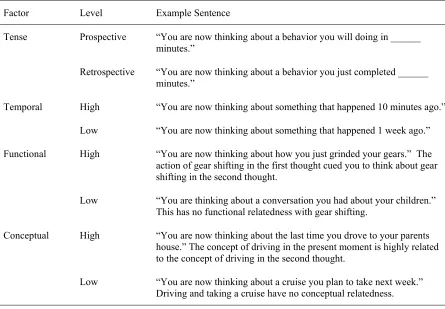
combination. Example statements for each of the following factor levels are in Table 2. Ratings on temporal, functional and conceptual relatedness were collected as well as an overall relatedness rating and a yes/no judgment on whether this factor scenario was an example of mind wandering. The response scale for each type of relatedness was an 11-point, Likert scale with “not at all related” as zero on the left-most pole and “extremely related” as a 10 on the right-most pole. Judgments of whether or not this scenario represented an example of mind wandering was captured with two “yes” / ”no” radio buttons.
All scenarios were loaded into SurveyGizmo™, but to keep the survey length manageable, each participant viewed only four selected scenarios. The survey tool randomly selected one scenario from four different scenario clusters and each cluster was devised such that each participant had an example of high and low levels of at least three of the four factors (temporal, functional, conceptual and tense).
Care was taken to assess the validity of the scenarios’ representation of the factorial
whether they reflected the high and low levels of each factor. Modifications were made based on the beta test feedback and the factor scenario portion was adjoined to the remainder of the survey and launched.
Table 2. Example Sentences Representing Each Factor Level in the Factor Scenario Survey
Factor Level Example Sentence
Tense Prospective “You are now thinking about a behavior you will doing in ______
minutes.”
Retrospective “You are now thinking about a behavior you just completed ______
minutes.”
Temporal High “You are now thinking about something that happened 10 minutes ago.”
Low “You are now thinking about something that happened 1 week ago.”
Functional High “You are now thinking about how you just grinded your gears.” The
action of gear shifting in the first thought cued you to think about gear shifting in the second thought.
Low “You are thinking about a conversation you had about your children.”
This has no functional relatedness with gear shifting.
Conceptual High “You are now thinking about the last time you drove to your parents
house.” The concept of driving in the present moment is highly related to the concept of driving in the second thought.
Low “You are now thinking about a cruise you plan to take next week.”
Driving and taking a cruise have no conceptual relatedness.
Flight Tasks. The initial flight task list portion of this survey was generated using a list provided in Loukopoulous, Dismukes & Barshi (2009). The list was reviewed by two retired cargo pilots and one passenger airline pilot and modifications were made to reflect a broader audience of pilots with a variety of certificates even though many of the tasks were
tasks were categorized into “Before Start Phase,” “Pushback,” Takeoff, Climb, and Cruise,” “Descent and Approach,” and “Landing, Taxi-in and Shutdown” phases. Participants were asked, “During which of these tasks would your colleagues be most susceptible to experience mind wandering?” Respondents selected one of the two response options, “Yes” or “N/A (not applicable to the flight certificate you hold).” A text box was provided at the end of the list to collect any comments or elaborations participants felt compelled to discuss.
Demographics. The demographics portion of this survey collected information about age and gender as well as details about their flight experience (e.g., accumulated flight hours,
certificates held, aircraft types flown, etc.).
All portions of the survey were aggregated and the entire survey was beta-tested by one retired cargo pilot and revisions were made for semantic clarity. The survey was reviewed a second time by the investigator, launched and survey advertisements were then posted in the aviation magazines. Because different publications have different circulation dates, the survey was available for 6 months to accommodate publications that are circulated biannually.
4.2.3. Procedure
Participants entered the survey using their Internet browser, read the consent form and then completed the survey. If participants did not consent, they were blocked from completing the survey. The survey ended with a small debriefing paragraph, which also provided the
4.3.Analyses and Results
No proposed hypotheses or research questions were addressed in this section. However, a brief review of the results from the factor scenario survey and the flight task checklist data are offered.
Factor Scenario Results. Appendix C includes the mean ratings for each type of relatedness for all 16 factor scenarios (n~15 participants per scenario). In theory, a well-written factor scenario will yield participant ratings that reflect the scenario factor combinations. For example, if a factor scenario was written to reflect an off-task thought that is retrospective and has a high temporal relatedness (e.g., an event that took place in the distant past), then participant ratings on tense and temporal relatedness should be retrospective and have high ratings of temporal relatedness. For scenario validation purposes, the participants’ factor ratings could not be compared to the scenario’s intended factor combinations because the total number of responses per scenario was too small for between-subjects assessments. In addition, parametric statistical analyses (e.g., logistic regression, structural equation
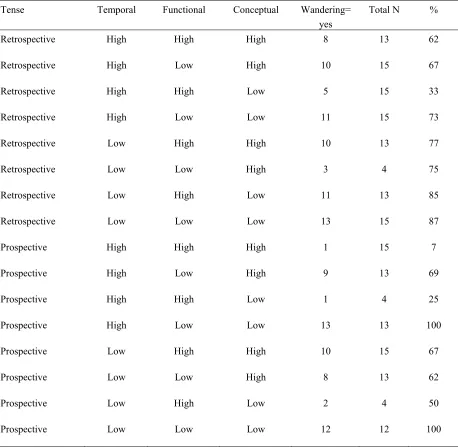
modeling) could not be used to determine the relationship between factor, their respective levels and the occurrence of mind wandering. Instead, a contingency table logit analysis was used to analyze the relationship between researcher’s factor levels for all 16 scenarios and participant’s judgment about whether the scenario was an example of mind wandering. The factor levels were not the participant ratings of each factor, but the intended scenario factor levels. A 5-way (25) contingency table was created to analyze the relationships between the
that comprise the 16 scenarios and the number of participants who judged that scenario as an example of mind wandering.
Table 3. A 5-Way Contingency Table with Four 2-Level Factors (tense, temporal, functional, conceptual) and One Dichotomous Response Variable (total number of “yes” responses)
Tense Temporal Functional Conceptual Wandering=
yes
Total N %
Retrospective High High High 8 13 62
Retrospective High Low High 10 15 67
Retrospective High High Low 5 15 33
Retrospective High Low Low 11 15 73
Retrospective Low High High 10 13 77
Retrospective Low Low High 3 4 75
Retrospective Low High Low 11 13 85
Retrospective Low Low Low 13 15 87
Prospective High High High 1 15 7
Prospective High Low High 9 13 69
Prospective High High Low 1 4 25
Prospective High Low Low 13 13 100
Prospective Low High High 10 15 67
Prospective Low Low High 8 13 62
Prospective Low High Low 2 4 50
Prospective Low Low Low 12 12 100
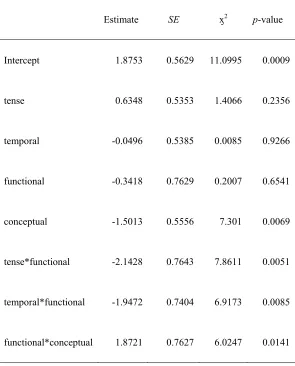
All main effects and 2-way interactions were first loaded into the model to evaluate the model fit (i.e., the maximum likelihood estimates); 3- and 4-way interactions were not considered due to interpretation difficulties of results. Three 2-way interactions were non-significant (i.e., tense*temporal, tense*conceptual and temporal*conceptual) and removed from the model to improve model fit. The deviance model fit was ӽ2(8)=11.89, p=.16, indicating a good model fit. The resultant likelihood ratio chi-square test for model fit was ӽ2 (7) =49.63 p<.0001 indicating that the model with all explanatory variables loaded was a better fitted model compared to a model without explanatory variables (intercept only) loaded. A significant likelihood ratio chi-square indicates that the model with explanatory variables is significantly better than a model with no explanatory variables at explaining the variance of the outcome variable. The Likelihood ratio Chi-Square statistics was chosen for model fit assessments, instead of the Wald Chi-Square statistics, because it is comparatively superior with small sample sizes and/or extreme data patterns (Jennings, 1986).
Table 4. Main Effects and Interactions of 5-Way Contingency Table Analysis (n=17)
Estimate SE ӽ2 p-value
Intercept 1.8753 0.5629 11.0995 0.0009
tense 0.6348 0.5353 1.4066 0.2356
temporal -0.0496 0.5385 0.0085 0.9266
functional -0.3418 0.7629 0.2007 0.6541
conceptual -1.5013 0.5556 7.301 0.0069
tense*functional -2.1428 0.7643 7.8611 0.0051
temporal*functional -1.9472 0.7404 6.9173 0.0085
functional*conceptual 1.8721 0.7627 6.0247 0.0141
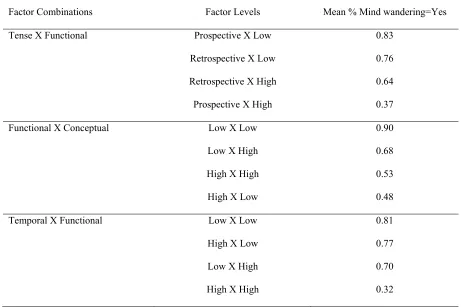
the outcome variable for all two-way combinations for these significant interactions are listed in Table 5. A score of 0 on the outcome variable indicates that the participant did not believe this scenario was an example of mind wandering and a score of 1 indicates that it was an example of mind wandering. The odds ratio estimates and the Wald confidence intervals of the three significant interaction terms (tense*functional, temporal*functional and
functional*conceptual) are listed in Table 6. An odds ratio is statistically significant if the estimate has a confidence limit that does not include the value 1. Each statistically significant interaction term will be interpreted separately below.
Tense*Functional Interaction. The estimate for prospective (tense=1), high functional
relatedness thoughts was 0.221 with Wald 95% Confidence Limits between 0.076 and 0.645. To interpret, the odds of retrospective thoughts with low functional relatedness to be
examples of mind wandering were 4.5 times higher (=1/.221) than prospective thoughts with high functional relatedness of being considered examples of mind wandering.
Functional*Conceptual Interaction. The estimates for high functional, low conceptual relatedness were 0.093 (Wald 95% Confidence Limits were 0.029 to 0.299) while the estimate for high conceptual relatedness, low functional relatedness was 0.223 (Wald 95% Confidence Limits were 0.075 to 0.662). To interpret, the odds that low functional/high conceptual thoughts would be considered examples of mind wandering by participants were 10.7 times higher (=1/.093) than high functional/low conceptual thoughts. Also, the odds of low conceptual/ high functional relatedness thoughts as examples of mind wandering were 4.5 times higher (=1/.223) than thoughts involving high conceptual/low functional
Table 5. Two-way aggregate factor combinations and their mean % of “yes this is an example of mind wandering” responses
Factor Combinations Factor Levels Mean % Mind wandering=Yes
Tense X Functional Prospective X Low 0.83
Retrospective X Low 0.76
Retrospective X High 0.64
Prospective X High 0.37
Functional X Conceptual Low X Low 0.90
Low X High 0.68
High X High 0.53
High X Low 0.48
Temporal X Functional Low X Low 0.81
High X Low 0.77
Low X High 0.70
High X High 0.32
Table 6. Odds Ratio Estimates and Respective Wald Confidence Intervals of Logistic Regression Analysis Interaction Terms: Temporal, Functional, Conceptual and Tense
95% Confidence Limits
Estimate Low bound High bound
Tense with low
functional relatedness 1.89 0.66 5.39
Tense with high functional relatedness
0.22 0.08 0.65
Temporal with low
functional relatedness 0.95 0.33 2.73
Temporal with high
functional relatedness 0.14 0.05 0.37
Conceptual with low
functional relatedness 0.22 0.08 0.66
Conceptual with high functional relatedness
1.45 0.52 4.04
Flight Task List Results. The flight tasks were clustered according to phases of flight and all frequencies of “yes, pilots experience mind wandering during this task sequence” are
Table 7. Top and Bottom 10 Ranks of Flight Tasks During Which Pilots Experienced Mind Wandering
Rank Phase of Flight Flight Task Count
Top 10 Takeoff, Climb and Cruise Monitor ATC Communications 32
Takeoff, Climb and Cruise Monitor Weather/Update Weather 26
Taxi Phase Monitor ATC Ground 26
Takeoff, Climb and Cruise Monitor Dispatch Communications 23
Before Start Phase Complete Pre-Flight Inspection of Aircraft 22
Descent and Approach Phase Monitor ATC 21
Before Start Phase Review Paperwork 21
Pushback Phase Monitor the interphone 16
Landing, Taxi-in and
Shutdown Monitor ATC Ground Communications 17
Before Start Phase Prepare/Review Chart 17
Bottom
10 Before Start Phase Obtain clearance 2
Pushback Phase Request clearance from ATC-Ground or Clearance Delivery 3
Pushback Phase Obtain engine start clearance 3
Pushback Phase Obtain pushback clearance 3
Takeoff, Climb and Cruise Call out speeds/monitor speeds 3
Takeoff, Climb and Cruise Participate in the pre-takeoff checklist 4
Takeoff, Climb and Cruise Begin or monitor take off roll 4
Takeoff, Climb and Cruise Participate takeoff procedure 4
Descent and Approach Monitor speedback 4
4.4.Discussion
The results of this factor scenario survey serves two purposes: first, to understand how aircraft pilots classify mind wanderings on four different dimensions, and second, to identify when in the flight task sequences, mind wandering was most likely and least likely to occur. Three types of relatedness dimensions were assessed (i.e., temporal, functional and
conceptual) as well as whether the off-task thought was about prospective or retrospective events (i.e., tense). The only statistically significant main effect was conceptual relatedness; low conceptual relatedness between on-task and off-task thoughts was significantly more likely to be judged as examples of mind wandering. For example, if the participant should be thinking about landing an aircraft and they were actually thinking about Christmas trees, landing and Christmas trees are not of the same concept.
Three significant interactions were also revealed that involve the “functional relatedness” dimension. First, low functional/retrospective thoughts were more likely to be considered “mind wanderings” than high functional/prospective thoughts. For example, if the
participant was getting ready to downshift a manual transmission and thoughts arose about a vacation cruise taken a year ago (low functional, retrospective thought), this was more likely to be rated as mind wandering compared to thoughts about shifting gears at work on factory machines in the future (high functional, prospective thought). Second, low functional/ low temporal relatedness thoughts were considered mind wandering more often than high functional/high temporal relatedness. Thus, if participants were having thoughts about events in the distant past or distant future (low temporal relatedness) that were not