MYERS, MARRIELLE. The Use of Learning Trajectory Based Instruction (LTBI) in Supporting Equitable Teaching Practices in Elementary Classrooms: A Multi-Case Study. (Under the direction of Dr. Paola Sztajn).
Learning trajectories (LTs) are gaining prominence in mathematics education as an empirically validated tool that details students’ mathematical growth and development over time. Research on LTs has occurred along three fronts: a) the development and validation of LTs across different mathematical domains; b) the ways in which LTs can be useful in assessment and curriculum development; and c) how LTs can be useful in instruction. While early research in each of these areas is promising, the academic field is just beginning to understand the ways in which teachers use LTs in instruction. Additionally, very little is known about how teachers’ uses of LTs in instruction support or hinder equitable instruction. Therefore, this study fills a critical gap and explores how teachers’ uses of LTs in their instruction supported four dimensions of equity: access, achievement, identity, and power (Gutierrez, 2007).
The four teachers that participated in this study were each a part of the Learning Trajectory Based Instruction (LTBI) Project, which explored the ways in which teachers use LTs in instruction. This multi-case study explored the potential benefits of LTs and the LTBI model in relation to equitable instruction. Specifically, a theoretical framework was
by Marrielle Myers
A dissertation submitted to the Graduate Faculty of North Carolina State University
in partial fulfillment of the requirements for the degree of
Doctor of Philosophy
Mathematics Education
Raleigh, North Carolina 2014
APPROVED BY:
_______________________________ ______________________________
Karen Hollebrands Allison McCulloch
________________________________ ________________________________
Ernest Stitzinger P. Holt Wilson
_______________________________ Paola Sztajn
DEDICATION
BIOGRAPHY
Marrielle Myers was born on December 24, 1981, in Durham, North Carolina. She is the proud daughter of Lewis and Cheryl Myers. In 1999, Marrielle graduated from Northern High School in Durham, North Carolina, and left home to attend Hampton University for her undergraduate studies. She graduated from Hampton University in Hampton, Virginia, with honors in May 2003. While at Hampton, she earned a B.S. in Mathematics and became a member of the Gamma Theta Chapter of Alpha Kappa Alpha Sorority, Incorporated. Upon graduation, Marrielle enrolled in graduate school at North Carolina State University (NCSU) where she studied Mathematics Education. Marrielle graduated from NCSU with her Master of Education degree in May 2007. While completing her Master’s degree, Marrielle applied to and was accepted into the doctoral program for Mathematics Education at NCSU.
During her tenure as a graduate student, Marrielle worked as a research assistant on various projects including Nurturing Mathematics Dreamkeepers (NMD), Diagnostic E-Learning Trajectories Approach (DELTA), and E-Learning Trajectories Based Instruction (LTBI). She also served as a teaching assistant for two undergraduate courses. During this time, she also taught high school mathematics at Word of God Christian Academy and Southeast Raleigh Magnet High School. Additionally, she taught academically gifted
ACKNOWLEDGEMENTS
I offer my deepest thanks to the chair of my dissertation committee, Dr. Paola Sztajn. Your patience, guidance, feedback, dedication, and encouragement have been amazing. Thank you so much for being an awesome mentor and for allowing me the opportunity to work on the LTBI Project. Thank you for pushing me to excellence and supporting me each step of the way.
I also thank the members of my dissertation committee: Dr. Allison McCulloch, Dr. Holt Wilson, Dr. Karen Hollebrands, and Dr. Ernie Stitzinger. Thank you each for your support and feedback during this process.
I also thank my colleague and fellow LTBI team member, Dr. Cyndi Edgington. Your support has been valuable throughout this dissertation study.
To my parents Lew and Cheryl Myers, thank you, thank you, and thank you! There is an expression that states, “There is no book on parenting.” Well, you two have proved the world wrong. You have been amazing parents and I would not be here today without you. Your support, provision, encouragement, and patience have been unparalleled. You have always believed in me and allowed me to pursue my dreams. Thank you for always being my rock, even in the times of storm. I stand here today because of you. I love you both and thank you from the bottom of my heart.
To my friend Ed, thank you for your friendship and encouragement throughout this process. Thanks for believing in me and for reminding me of God’s promises. I also wish to thank the many friends, family members, and church members who supported me and prayed for me during my graduate school experience. Thanks to all of the members of my dance community for your support as well. Your kindness and generosity are greatly appreciated.
Thank you to the teachers who participated in this study. I thank each of you for welcoming me into your classrooms. Thank you for allowing me to become a part of your classroom community and for partnering with me in this study.
TABLE OF CONTENTS
LIST OF TABLES ... ix
LIST OF FIGURES ...x
CHAPTER ONE ...1
Learning Trajectories in Instruction ... 2
Purpose and Significance of the Research Questions ... 4
Overview of Methodological Approach ... 5
Outline of the Dissertation ... 6
CHAPTER TWO ...7
Theoretical Perspective ... 7
Learning Trajectories ... 13
The History of Learning Trajectories ...14
Learning Trajectories in Instruction ...18
Learning Trajectories and Student Achievement ...19
Critiques of Learning Trajectories ...20
Equity ... 23
Why Equity and Not Equality ...25
Equity as a Process versus Equity as an Outcome ...28
Attention to Student Thinking as a Vehicle to Equitable Instruction ... 30
Cognitively Guided Instruction ...31
Summary ...34
Conceptual Framework ... 34
Access ...35
Achievement ...39
Identity ...40
Power ...43
A Framework for LTBI and Equity ... 45
CHAPTER THREE ...49
Study Design ... 49
Refined Research Questions ... 52
Participants and Study Context ... 59
Context ...60
LTBI Professional Development ...61
Data Sources and Data Collection ... 69
Mathematical Student Portraits ...71
Interview Protocol #1 ...73
Interview Protocol #2 ...73
Interview Protocol #3 ...74
Interview Protocol #4 ...74
Videotaped Classroom Observations ...75
Data Analysis ... 78
Ongoing Analysis ...78
Retrospective Analysis ...84
Validity and Reliability ... 89
Reliability ...89
Internal Validity ...90
External Validity ...93
Bias Disclosure ... 94
Background of the Researcher ...94
Role of the Researcher ...95
Ethical Issues ... 96
Limitations of the Study ... 97
Chapter Summary ... 97
CHAPTER FOUR ...99
Individual Case Profiles ... 99
Elsie ...99
Elizabeth ...106
Caroline ...120
Anna ...126
Cross-Case Analysis ... 142
Question 1: Access ...143
Summary of Access ...166
Question 2: Achievement ...167
Summary of Achievement ...179
Question 3: Identity ...179
Summary of Identity ...196
Question 4: Power ...197
Summary of Power ...209
Chapter Summary ... 209
CHAPTER FIVE ...211
Summary of Findings ... 211
Access ...212
Achievement ...215
Identity ...218
Power ...221
Revised LTBI-Equity framework ... 223
Discussion of Findings ... 229
Teacher Change ...230
Deficit Perspectives ...233
Implications ... 235
Scholars ...235
Limitations ...238
Next Steps ...239
Closing Remarks ...241
REFERENCES ...243
APPENDICES ...256
Appendix A: Beliefs Instrument ... 257
Appendix B: Student Portrait ... 263
Appendix C: Pre-Observation Interview Protocol ... 264
Appendix D: Classroom Observation Protocol ... 265
Appendix E: Post-Observation Interview Protocol ... 267
Appendix F: Interview Protocol for Interview #3 ... 269
Appendix G: Final Interview Protocol Additions ... 272
LIST OF TABLES
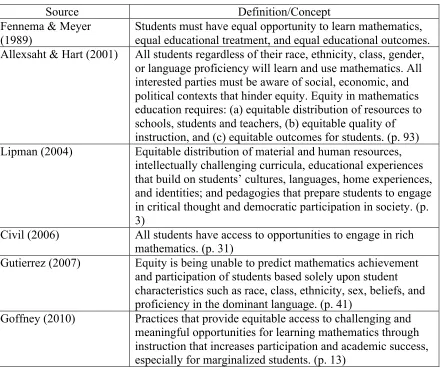
Table 1: Definitions of Equity in Mathematics Education Literature ...24
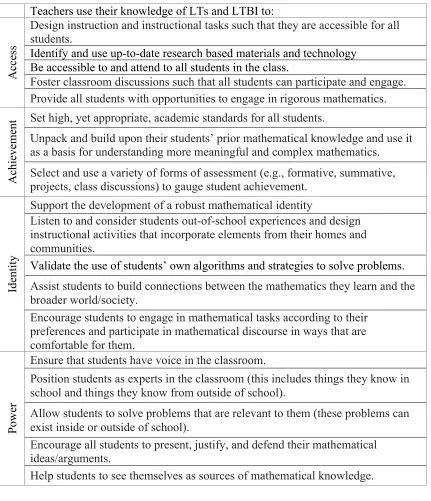
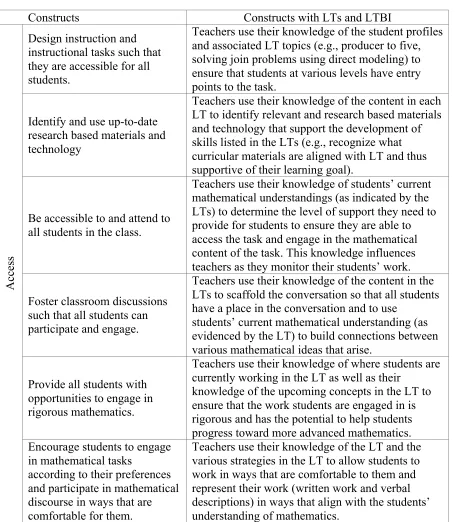
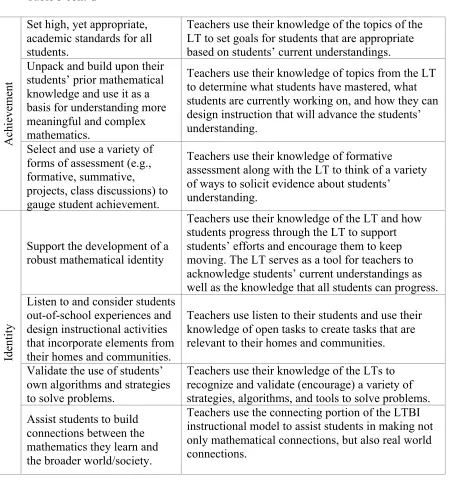
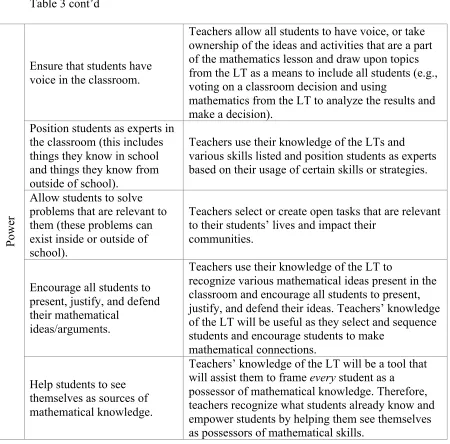
Table 2: Conceptual Framework for LTBI and Equity ...47
Table 3: Conceptual Framework Constructs/Propositions ...56
Table 4: Summary of Mathematical Knowledge for Teaching Pre/Post Test Scores ...60
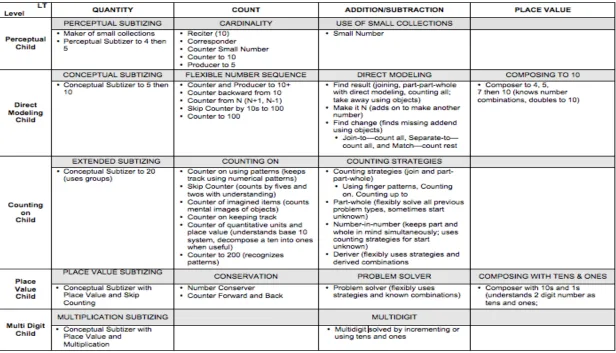
Table 5: Clements & Sarama’s (2009) LT organized into Profiles ...64
Table 6: Summary of LTBI PD Sessions...…...…...…...…...…...66
Table 7: List of Data Sources by Participant ...71
Table 8: Examples of pre-determined codes ...80
Table 9: Word Table Example ...87
Table 10: IQA Results for Elsie’s Lesson Quality ...105
Table 11: IQA Results for Elizabeth’s Lesson Quality ...116
Table 12: IQA Results for Caroline’s Lesson Quality ...125
Table 13: Anna’s Mathematics Expectations ...132
Table 14: IQA Results for Anna’s Lesson Quality ...137
Table 15: Original LTBI-Equity Framework with Notations ...225
LIST OF FIGURES
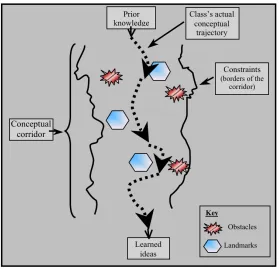
Figure 1. Conceptual Corridor (Confrey, 2006) ...16
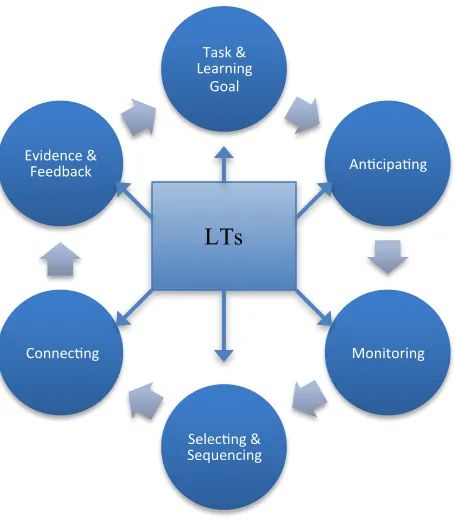
Figure 2. Placing LTs at the Center of the Five Practices (LTBI Model for Instruction) ...65
Figure 3. Data Collection Sequence ...70
Figure 4. Rek-en-rek ...114
Figure 5. Siwa’s Tens Frame Representation ...155
CHAPTER ONE
Over the past six decades, national initiatives have been developed to address mathematics reform (Grouws, 1992; National Commission for Excellence in Education, 1983; NCTM, 2000). During this time period, scholars and policy makers have debated the best approaches to teaching mathematics. Tensions brewed throughout the 1960’s and 1970’s, leading to our nation’s abandoning the efforts of the New Math dialogues and implementing a Back-to-Basics movement. The 1980’s and 1990’s were laden with dialogue about the deterioration of mathematics education in the United States and its subsequent impact on the workforce. These scathing reports (such as The National Commission on Excellence in Education’s 1983 report “A Nation at Risk: The Imperative for Educational Reform”) were a pre-cursor to the 1989 NCTM Principles and Standards, which highlighted the need for student-centered approaches to learning and the role that research on student learning could play in mathematics education. The release of these standards also spawned numerous research-based curricula. During the last 20 years, the NCTM Standards have been revised and in doing so, the NCTM made a diligent effort to seek the advice of various stakeholders in these revisions (NCTM, 2003). More recently, the NCTM released the report Curriculum Focal Points (2006) in which they outlined critical mathematics topics by grade level as well as specific skills and procedures students should demonstrate.
trajectories and interpret these two constructs as identical). From their inception, learning trajectories (LTs) have shown great promise for several reasons: a) they simultaneously attend to specific skills as well as broader concepts in a domain; b) they focus on the gradual growth and refinement of student thinking over time (NRC, 2007); c) they are empirically developed based on what students have demonstrated (Smith et al., 2006); d) they offer probable pathways of student growth and development as well as misconceptions faced along these paths (Confrey, 2006); and e) they provide a coherent picture of learning as a continual pathway as opposed to isolated events (Heritage, 2008).
Current discourse in mathematics education has transitioned from the usefulness of LTs as a construct to their potential benefits in classrooms. To this end, LTs have gained prominence as an empirically validated tool that can be used to unpack the nuances of student learning over time (Battista, 2004; Clements, 2007; Clements and Sarama, 2004; Confrey et al., 2009; Corcoran, Mosher, & Rogat, 2009). Specifically, the development of the Common Core State Standards (CCSS) drew heavily upon the research on LTs with the goal of articulating standards with more clarity and specificity of student learning over time. With the adoption of the Common Core State Standards (CCSS), teachers are being required to increase their own understanding of mathematics, understand how student knowledge of mathematics develops over time, and use this as a basis for student-centered instruction.
Learning Trajectories in Instruction
use LTs in instruction (Bardsley, 2006; Edgington, 2012; Mojica, 2010; Wilson, 2009). Regarding the latter, previous research on LTs has shown promise. Using knowledge of student thinking as represented by LTs, teachers have: a) set goals based on students’
developmental level (Clements, 2007); b) described student work with greater detail (Wilson, 2009); c) assessed students more effectively (McKool, 2009); and d) anticipated students’ strategies as well as misconceptions (Edgington, 2012).
Building from this work, the Learning Trajectories Based Instruction (LTBI) project took a direct approach to develop a conceptual model for how LTs could be used in various facets of instruction. Specifically, this research project addressed the ways in which LTs inform lesson planning, instruction, and assessment. The research team posited what each of these aspects of instruction looks like when informed by LTs and developed a 60-hour professional development program.
While initial results of LTs and the LTBI model as a tool to support student-centered mathematics practices are positive (Edgington, 2012; Wilson, 2009), this work has not focused on whether or not these outcomes are equitable. Specifically, when using LTs in instruction:
1) Do teachers set goals for all students in the same manner?
2) Do teachers describe students’ work in similar ways? Is what counts as evidence for one student the same as evidence for another?
4) How do teachers anticipate for different groups of students and use these anticipations to design meaningful instruction?
5) Do teachers use LTs to provide all students with opportunities to grow and progress over time?
The aforementioned questions are not intended to indicate that LTs are inherently
problematic; rather, they are meant to offer a rationale for the work conducted in this study and describe a critical gap that the results of this study fills. These questions highlight the need for the work conducted in this dissertation in conjunction with a framework for equity to understand the ways in which LTs can be used to support equitable instructional practices.
Purpose and Significance of the Research Questions
While many scholars praise the potential of LTs, the field has yet to move beyond teachers’ uses of LTs at the classroom level to understand if LTs are used equitably in instruction. To study this phenomenon, the first part of this research includes a detailed review of literature related to LTs and equity. Specifically, Gutierrez’ (2007) framework for equity was selected as a way to frame this study. The first part of this study was the
development of a conceptual framework, which provides indicators of how LTs could support equitable instruction along the four dimensions Gutierrez’ (2007) outlines: access, achievement, identity, and power.
1. In what ways do teachers use LTs and LTBI to provide access to students in their classrooms?
2. In what ways do teachers use LTs and LTBI to promote achievement for students in their classrooms?
3. In what ways do teachers use LTs and LTBI to help students develop their identity? 4. In what ways do teachers use LTBI to empower students in their classrooms?
This study is significant in its attempt at generating theory about how LTs can support equitable instruction. One important outcome of this work is a refined LTBI-Equity
framework. Further, the discussion of uses and tensions that arose from data analysis sheds light on critical factors that scholars must consider when designing and implementing content-only based professional development.
Overview of Methodological Approach
Outline of the Dissertation
CHAPTER TWO
In this chapter, I present the theoretical framework that guides this study. Next, I review the literature that is relevant to this work. The literature review begins with a discussion of learning trajectories including their emergence over the years as well as the benefits espoused for teachers and students. I also include a discussion of the critiques of learning trajectories both from extant literature as well as from a Critical Race Theory (CRT) perspective. Next, I present various definitions of equity that exist in the literature and
tensions that arise from a synthesis of these definitions. Afterwards, I discuss the potential for using frameworks of students’ thinking as a baseline for equitable instruction and cite
promising examples from the literature, specifically two cases from the Cognitively Guided Instruction (CGI) Project. I conclude this chapter with a presentation of the conceptual framework that will be used to direct this study along with the research that was used to assist in reinterpreting Gutierrez’ (2007) equity framework in light of its application in LTBI.
Theoretical Perspective
Various theoretical frameworks have been used to study different aspects of mathematics education. Two theoretical perspectives informed this study: social
constructivism and critical theory (specifically, critical race theory or CRT). Although they are not always discussed in tandem, I will give a brief overview of the theories followed by a discussion of why both theories are necessary for this study.
12-13). Piaget believed that any time we encounter a situation; we try to make sense of it. Individuals first attempt to make sense of a new situation by assimilating it into previous situations they have experienced. If this does not work, a modification of a current scheme must occur providing an accommodation for the new experience (Piaget, 1975). We are constantly in a state of trying to make sense of the world; therefore, assimilation and accommodation are always active processes. While Piaget’s theory did consider the
interaction between the learner and the object, it did not focus on to the social environment in which the learner and object are located.
Lev Vygotsky, a pioneer of social constructivism, posited that knowledge is
constructed in social settings. Therefore, to understand knowledge construction we must seek to understand not only the learnerobject interaction, but also the learnerobjectsetting interaction. Davis and Sumara (2002) stated that the fundamental shift social constructivism makes is “[the] departure from the Kantian/Piagetian assumption that the learner is the locus of cognition” and that human cognition is “more diffuse, distributed, and collective” (p. 414). This was a crucial distinction in theories of learning. Where Piaget (1970) argued that new situations or occurrences force us to seek equilibration, Vygotsky (1978) believed that a new experience coupled with a more experienced person (a teacher or peer) is actually the
impetus for learning. This is the cornerstone of the zone of proximal development (ZPD), which he articulated as:
problem solving under adult guidance or in collaboration with more capable peers (p. 86).
The activity and setting in a social constructivist theory now become the locus of cognition. Specifically, “learning awakens a variety of internal developmental processes that are able to operate only when the child is interacting with people in his environment and in cooperation with his peers” (Vygotsky, 1978, p. 90).
A key premise of social constructivism is that the culture we are in shapes how we think, and how we think, in turn, shapes our culture. Whereas the work of social
constructivism was a step forward in acknowledging forces outside of the learner, it did not go far in identifying oppressive facets of the social environment, specifically race and culture. Where Vygotsky and other theorists of the social constructivism paradigm loosely defined culture as the classroom, the school, and the environment in which learning takes place, critical theorists would problematize such a loose definition and argue that failing to acknowledge race and culture, particularly of those marginalized in society, disregards how learning and cognition may differ for those students. In particular, critical theory suggests that it is not sufficient to simply acknowledge that social influences exist, especially when these influences cast some students to the periphery.
Thus, the second perspective used to guide this study is critical theory. Kincheloe, McLaren, and Steinberg (2011) listed the following assumptions of critical theory:
• Facts can never be isolated from the domain of values or removed from some form of ideological inscription;
• The relationship between concept and object and between signifier and signified is never stable or fixed and is often mediated by the social relations of capitalist production and consumption;
• Language is central to the formation of subjectivity (conscious and unconscious awareness);
• Certain groups in any society and particular societies are privileged over others and, although the reasons for this privileging may vary widely, the oppression that
characterizes contemporary societies is most forcefully reproduced when subordinates accept their social status as natural, necessary, or inevitable;
• Oppression has many faces, and focusing on only one at the expense of others (e.g., class oppression versus racism) often elides the interconnections among them; and finally
• Mainstream research practices are generally, although most often unwittingly, implicated in the reproduction of systems of class, race, and gender oppression. (p. 164)
research, then, is to expose injustice and “transform existing social inequalities” (McLaren, 1994, p. 168).
Newer to the field of mathematics education is CRT. This perspective of CRT
emerged in the 1970’s with its initial articulation in the legal field (Tate, 1997). The scholars, lawyers, and social activists who defined themselves as critical race theorists set out to understand race and racism and the implications of these constructs in the post-civil rights society. The fundamental belief in CRT is that racism is not an event that occurs in isolation, nor is it anomalous, but that it is a part of American history and is predominant in this society (Ladson-Billings, 2003). Because of this, scholars from this line of thought see racism as inherent in educational contexts and seek to understand how “traditional interests and cultural artifacts serve as vehicles to limit and bind the educational opportunities of students of color” (Tate, 1997, p. 234).
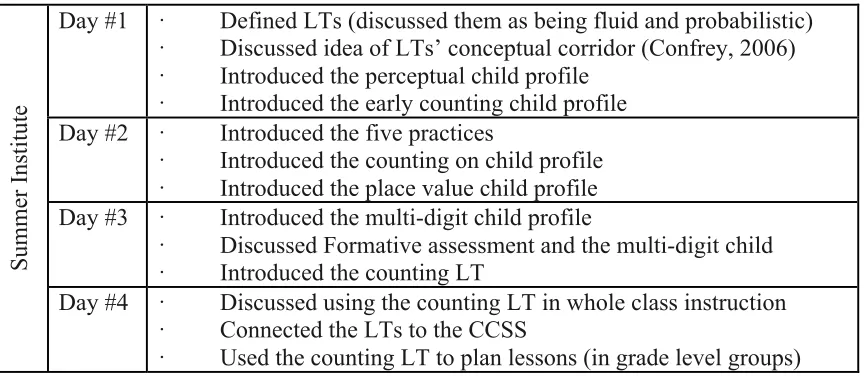
In the LTBI research project, teachers participated in a weeklong professional development institute in the summer and three monthly meetings during the fall semester on the topic of an early number and counting learning trajectory. The focus of the professional development was to introduce the LT to teachers as well as the introduction of the LTBI model which situates the LT at the center of instructional decisions and calls for explicit attention to who the individual students are as learners. The social constructivist and CRT theoretical frameworks articulated above influences this research of the LTBI professional development in two ways. First, because the focus of this study is to understand how teachers use LTBI to teach equitably in the classrooms, a social constructivist orientation warrants classroom observations to determine how teachers use the LT when interacting with their students.
Second, justice and social transformation, which are both driving forces behind a critical framework, allow me to question teachers in post-observation interviews about the ways in which they are using this new knowledge with all students. Through these
I start this review of the literature with a discussion of LTs and conclude the
discussion by raising concerns about the use of LTs and the ways in which they promote or hinder equitable instruction. After this, I discuss equity and provide a synthesis on varying definitions of equity. I then offer examples of research that have considered attention to student thinking and implications that this work has had on equity for those students. Finally, I propose a framework that draws upon LTs and equity as a potential merger of these two constructs.
Learning Trajectories
The History of Learning Trajectories
In 1990, Case and Griffin argued big ideas should guide classroom instruction. In 1996, Brown and Campione introduced the term developmental corridor. These scholars were some of the first to address learning across grades and place an emphasis on students’ knowledge increasing both in quantity (learning more concepts) and quality (refinement of those concepts). Catley, Lehrer and Reiser (2004) used the term learning performances and believed that instruction should begin by focusing on a small number of concepts and that student cognition should be explicitly aligned with objectives and standards. Brown, Sarama, and Clements (2004) built from Simon’s 1995 articulation of a hypothetical learning
trajectory to indicate that learning trajectories are comprised of three pieces: a mathematical goal, a developmental path that many children progress along, and activities/tasks that are related to each level. Duncan, Rogat, and Yarden (2009) offered a learning progression for modern genetics and highlighted three key areas that learning progressions should address: big ideas, progression across grades, and the development of learning performances and assessment for progression. More recently, Battista (2011) defined an LT as “a detailed description of the sequence of thoughts, ways of reasoning, and strategies that a student employs while involved in learning a topic, including how the student deals with all instructional tasks and social interactions during this sequence” (p. 4).
1. Student learning is not a linear process (as evidenced by the squiggled, dashed line).
2. Each student’s trajectory may be unique (the dashed lines will vary with each student). This is not a trivial conclusion. Because each student’s prior
knowledge varies, they may each begin at various places in the trajectory. 3. Students will predictably encounter certain landmarks and obstacles as they
progress through the trajectory. Because these can be anticipated based on literature and previous research, teachers can be more deliberate in their planning and instruction.
Figure 1. Conceptual Corridor (Confrey, 2006)
Confrey et al (2009) later refined her initial definition of learning trajectories and articulated the following:
[A learning trajectory is a] researcher-conjectured, empirically-supported description of the ordered network of constructs a student encounters through instruction (i.e., activities, tasks, tools, forms of interaction and methods of evaluation), in order to move from informal ideas, through successive refinements of representation, articulation, and reflection, towards increasingly complex concepts over time (p. 347).
to instruction, most recently in the articulation of the Common Core State Standards. In 2007, the National Research Council (NRC) defined learning progressions as “successively more sophisticated ways of thinking about a topic that can follow one another as children learn about and investigate a topic over a broad span of time” (p. 214). The NRC posited that the concept of progressions can be a viable tool for providing a framework for a broader vision of science education, highlighting foundational topics that students must learn and synthesizing what we know about students and how they learn. They went on to argue that progressions can provide a common language for researchers, curriculum developers, policy makers, and assessment writers (NRC, 2007, p. 214). Corcoran, Mosher, and Rogat (2009) also articulated a number of uses for LTs specifically improved instruction, curriculum, standards and assessment. Specifically, the authors argue that to bring about change in education LTs is a more “deliberate approach, one that employs scientific principles and which engineers solutions that can be tested and refined until they work” (Corcoran, Mosher & Rogat, 2009, p. 11).
independent of tasks. Student learning depends on task quality, selection, and sequencing. This is a critical component because students do not just progress on their own as a result of age or other experiences. Movement through a trajectory must have a deliberate component enacted by teachers.
Learning Trajectories in Instruction
Recently, researchers have shifted their attention from the development of learning trajectories in various content domains to thinking about how LTs can be used in
instructional settings and the positive effects they can have on students’ achievement. A number of studies have been and are currently being conducted with in-service teachers. These studies range from small case studies of one or a few teachers (Bardsley, 2006; Brown, Sarama & Clements 2007; Edgington, 2012) to large-scale studies with multiple teachers across multiple schools (Clements, Sarama, Wolfe & Spitler, 2013; Wilson, 2009). In a study of one pre-K teacher, Brown, Sarama and Clements (2007) reported that using an LT assisted the teacher in several areas: setting clear goals for students based on their developmental level; selecting and modifying tasks; and ensuring that students were engaged in tasks that would help to solidify their current understandings while building related skills. The teacher stated, “Learning trajectories permitted me to be flexible, adaptable, and responsive to the children’s changing needs” (Brown, Sarama, & Clements, 2007, p. 181). In another study, Clements and Sarama (2008) found that teachers using LTs in their instruction were more likely to monitor and be actively involved in activities as well as develop and use formative assessments that are tied to their knowledge of developmental progressions.
conversations (Clements & Sarama, 2008); deepen their own mathematical knowledge (Mojica, 2010); use student thinking to influence instructional decisions (Bardsley, 2006; Mojica, 2010); describe student work with more detail (Wilson, 2009); make sense of students’ understanding (Confrey, 1990); select developmentally-appropriate activities (Brown, Sarama & Clements, 2007); provide a shared language for teachers to discuss student thinking (Wilson, 2009); and anticipate and address students’ misconceptions (Edgington, 2012).
Learning Trajectories and Student Achievement
As we continue to learn more about LTs and their usefulness in instruction, it has become equally important for the field to consider what potential impact LTs can have on student achievement. To date, there have been few studies that explicitly relate students’ achievement to learning trajectories. There are, however, a few seminal studies that show promise.
Critiques of Learning Trajectories
Because CRT is one of the theoretical frameworks that undergird this study, it is important to consider LTs from a CRT perspective. Recall that CRT asserts that racism is an everyday facet in our society, and as such, racism undergirds the day-to-day activities in schools and educational systems. As a lens for critiquing research and practice, critical race theorists would question which students are used in the empirical research to develop LTs, what the goals of the researchers developing LTs are, and how LTs were chosen to be the basis of the Common Core standards.
While many authors do not provide demographic information detailing which students were used in the development or validation of their LTs, Szilagyi, Clements and Sarama (2013) do offer evidence that may address one concern of critical theorists. In the development of an LT for length, Szilagyi et al. worked with students from two different countries to investigate if the development of big ideas for measurement was dependent on culture. They found that students from various levels and countries followed similar paths, and thus they developed the trajectory based upon patterns that a majority of the students followed. While this work is still in the early stages, it does show promise.
reject the notion of certainty and finality, and they would argue that learning is much more unstable and cannot be bound by a trajectory. To this argument, I offer that LTs are
hypothetical and provide suggested paths that students may follow. They are probabilistic (instead of deterministic), and if implemented with fidelity, they should not limit what students and teachers do; rather, LTs provide a framework for understanding.
Another critique of LTs is that a focus on LTs “may lead us to oversimplify or ignore critical drivers of learning associated with teaching” (Empson, 2011, p. 573). Empson went on to state that while we have a vast knowledge of students’ thinking related to LTs, we have less of an understanding on how teachers gather information related to student thinking and use this information to make decisions in the moment of instruction. She argued that since teaching is a “relational act,” it should not be regulated to a list of rules. To these points I offer the following argument in rebuttal. While research studying teachers’ use and implementation of LTs is in its infancy, initial results from this work show promise for teachers. Earlier in this section, I articulated a number of findings that indicate that LTs and curriculum built on LTs can support teachers and have positive results on their students. To Empson’s second point about diminishing the relational nature of teaching, none of the existing literature reviewed for this study has indicated that LTs have a negative impact on the relationships between teachers and students. Much of the work conducted in this dissertation will actually address that concern since a focal point of this work is to enhance our understanding of how teachers use LTs and LTBI to meet the needs of and support students in their classrooms.
necessity for this study. Over the last six decades, educational reform with a specific focus on mathematics has been a topic of national publications and mathematics education interest groups. From the New Math dialogue of the 1950’s and 1960’s to the Back-to-Basics
movements of the 1970’s, American teachers and students have been required to learn more mathematics and demonstrate this knowledge on state and federally mandated assessments. Although the aforementioned programs were far-reaching and contributed to research in mathematics education, there was virtually no attention paid to issues of equity and culture in the early documents. As national calls for reform continued in the 1980’s with NCTM’s Agenda for Action and the release of A Nation at Risk, equity was still neglected or severely underdeveloped (Meyer, 1989). More recently, the Principles and Standards for School Mathematics (NCTM, 2000), National Mathematical Advisory Panel Report, and Common Core State Standards for School Mathematics have been released. Although these documents continue to challenge the field to provide all students with access to high quality mathematics and require teachers to provide better educational opportunities for their students, certain students continue to be underserved in schools (Martin, 2000; Howard & Terry, 2011). Not only are these students underserved, but also the very programs put in place to help bring this vision of reform in mathematics education to pass view these students with a deficit
As I transition into my discussion of equity, I use a quote from a widely-published research program to highlight the need for attending to equity in the context of work with LTs. In their work with LTs, Clements and Sarama (2004, 2007) have consistently observed that using an LT-based curriculum can have positive outcomes for students. In one of their most recent publications on a large-scale study, they offered the following finding:
“Interventions to address these early differences may benefit low-resource and minority children more because they have fewer educational opportunities in their homes and communities” (Clements, Sarama, Wolfe & Spitler, 2013, p. 813). The authors
acknowledged that “low-resource and minority children” out-performed their counterparts that were not in LT-based classrooms. While this statement highlights that LTs can be productive for increasing achievement (which should be an outcome in equitable
classrooms), it includes a deficit perspective because it equates minority children with having fewer opportunities in their homes. Additionally, their study addresses issues of opportunity to learn and achievement, but it fails to address a more robust notion of equity including identity and power.
Equity
others do not. Second, some of the definitions presented focus on equitable outcomes among students, while others speak to equitable access and processes. Thus, there is tension between equity as a process vs. equity as an outcome. These varying definitions lend themselves to different approaches to equity, and I explore these variances in greater detail following the table of definitions.
Table 1
Definitions of Equity in Mathematics Education Literature
Source Definition/Concept
Fennema & Meyer (1989)
Students must have equal opportunity to learn mathematics, equal educational treatment, and equal educational outcomes. Allexsaht & Hart (2001) All students regardless of their race, ethnicity, class, gender,
or language proficiency will learn and use mathematics. All interested parties must be aware of social, economic, and political contexts that hinder equity. Equity in mathematics education requires: (a) equitable distribution of resources to schools, students and teachers, (b) equitable quality of instruction, and (c) equitable outcomes for students. (p. 93) Lipman (2004) Equitable distribution of material and human resources,
intellectually challenging curricula, educational experiences that build on students’ cultures, languages, home experiences, and identities; and pedagogies that prepare students to engage in critical thought and democratic participation in society. (p. 3)
Civil (2006) All students have access to opportunities to engage in rich mathematics. (p. 31)
Gutierrez (2007) Equity is being unable to predict mathematics achievement and participation of students based solely upon student characteristics such as race, class, ethnicity, sex, beliefs, and proficiency in the dominant language. (p. 41)
Why Equity and Not Equality
One tension that exists in the equity discussion, and one that has been previously addressed (Goffney, 2010; Gutierrez, 2002; Secada, 1989), is the difference between equity and equality. Some posit that this confusion arose partly due to the civil rights movement when the phrase “separate but equal” was introduced (Tate, 1997). The thought was that if schools that served children of color had all of the same materials as those that served white students, then there would be no need to integrate schools. Thus, white students and black students could remain in separate schools as long as the schools were equal. While on the surface equality and equity may seem identical and mistakenly viewed as producing the same outcomes, consider the words of former President Lyndon B. Johnson. In his famous June 4, 1965, address to graduates at Howard University he stated, “You cannot take a man who has been in chains for 300 years, remove the chains, take him to the starting line and tell him to run the race, and think that you are being fair” (Retrieved from www.blackcommentator.com 49/49_cover.html on September 13, 2012). In effect, President Johnson addressed the
absurdity that equality and equity are one in the same. Simply allowing marginalized students to compete in the same race and with the same resources as their white counterparts is not justice. It is this premise that I use as a lens to demystify the notion that equality and equity will produce the same outcomes. I argue that a focus on equality alone is not enough, and I illustrate this argument using the role of the classroom teacher as an example.
literature refutes this notion. In her study of successful teachers of African-American students, Ladson-Billings (1995) identified characteristics of these teachers that she argues support African American students. She stated that these teachers (1) immersed themselves in the community of their students and saw themselves as members of the community, and (2) built deep relationships with these students. Teachers are members of the communities that they live in, and their experiences help them relate to the students with whom they are similar. Meeting the needs of those students and sharing common experiences can come easier if your students are members of a similar ethnic group and socioeconomic status. Because elementary schools teachers are primarily white, middle class women, their lived experiences are often times very different from the diverse classrooms in which they teach (National Center for Education Information, 2011). In order for these teachers to get to know their students, they will have to purposefully spend time getting to know about the cultures their students come from. When teachers teach students from communities that differ from their own, more time is needed to meaningfully understand the lived experiences of those students. Thus in this case, equity is not equality.
participate in the group (Cohen, Lotan, Scarloss & Arellano, 1999). Another concern was that “students who are academically low achieving or who are social isolates are [often] excluded from the interactions” (Cohen et al., 1999, p. 80). Specifically, they cited the need for students working in groups to have equal status relationships. Without this, “higher status” students will often dominate the group, participate more, and therefore have the most opportunities to learn (Cohen et al., 1999).
To ameliorate this problem, the Complex Instruction team suggested that teachers must publicly assign competence to students and that this is “especially important and
effective to focus attention on low-status students” (Cohen et al., 1999, p. 85). To do this, the teacher must first identify each student’s strengths and contributions to the group or class. By acknowledging these students publicly, the teacher changes the class’ expectations of that student which, in turn, allows that particular student more opportunities to participate in the group. An equality orientation requires that all students receive the same amount of praise and acknowledgement. An equity orientation rebuts this notion, as the argument is that to level the playing field, some students need more acknowledgement than others, and they need it publicly.
One primary difference that I see between an equity platform and an equality platform is that the goals differ significantly. An equality platform could be achieved by rewriting standards or other national documents that mandate that all students be treated the same and that we have high expectations for all students. An equality platform can be
process that begins with looking back, analyzing previous inequities, and developing a long-term plan to repair past damage.
Equity as a Process versus Equity as an Outcome
Another tension that arises across definitions of equity is whether we should view equity as a process, whether we should view it as an outcome, or whether there is some combination of both. Equity as a process focuses on what teachers should do, what schools should do, what curriculum should do, etc. The process can be very descriptive, but what is missing from this view is an explicit link between what should be done during the
teaching/learning process and how that relates to student outcomes. I argue that we must focus on equity both as a process and examine the related outcomes to determine whether we have been successful. Below, I use the “achievement gap” as an example of how focusing on equity as an outcome alone does little to move us forward.
Scholars that discuss equity as an outcome are concerned with the tangible results, most notably achievement as measured by standardized tests. When disparities in student achievement were first detected, the goal became to close the achievement gap. This “achievement gap” became the focus of research projects and continues to be the focus of research programs (Gutierrez, 2008). In fact, a large part of the No Child Left Behind Act (2001) was dedicated to acknowledging and making recommendations to close the gap. The authors included three sections devoted to addressing the needs of African-American
national priority” (NCLB, 2005, p. 1). Moreover, the authors positioned themselves as the heroes, arguing that the achievement gap has been unaddressed for too long, but with government regulation and mandates these children would now succeed.
What the authors of this document have failed to fully consider, along with others who view equity solely as an outcome, are the historical events and social constructs that have caused and continue to cause so many students of color to be under-educated. In fact, Matthews (2005) and Strutchens et al. (2012) argued that before we can truly call for equity and equitable outcomes, we must first clearly articulate the causes of the inequity. In regards to African-American students, NCLB attributes their failure to the fact that our nation has two educational systems, and that they are “separate and unequal” (NCLB, 2005, p. 1). For Hispanic students, the document notes that cultural and language barriers have not been addressed and have therefore led to the failure of these students. No specific reasons are given for the failure of American Indian students; however, the documents state that prior to NCLB, American Indian students were not tracked and compared to their peers (NCLB, 2005).
Although trivial, NCLB does highlight that low expectations for African-American and Hispanic students must no longer be tolerated. While this appears to be an equity argument, a number of scholars have criticized this act, its immense focus on the
achievement gap, and how only highlighting the gap actually further perpetuates inequities in the educational system (Gutierrez, 2008, 2011; Ladson-Billings, 2006).
is the heart of the equity as a process versus equity as an outcome debate. It is this same argument that dispels the myth that equity and equality are one in the same. Consider the following words from Robinson (2000) as cited in Ladson-Billings (2006):
No nation can enslave a race of people for hundreds of years, set them free bedraggled and penniless, pit them, without assistance in a hostile environment, against privileged victimizers, and then reasonably expect the gap between the heirs of the two groups to narrow. Lines, begun parallel and left alone, can never touch. (p. 74)
If we truly expect to see changes in the achievement of students of color and students in poor and rural communities, we must be equitable in the process of their education (e.g., funding, resources, rigorous curriculum, qualified/culturally relevant teachers, additional supports for learning after school, and parent/community involvement). In many cases, equity requires that we do more for students who have traditionally been underserved to compensate for what was lacking. If we focus on equity in the process and refine it as we move along, equitable outcomes should be a natural occurrence.
Attention to Student Thinking as a Vehicle to Equitable Instruction Although many mathematics education researchers agree that teacher content knowledge and attention to student thinking are critical for high quality mathematics
in are inseparable from the content being learned, and that the best teachers are those with strong content knowledge, precise knowledge of student thinking, and a strong sense of their students’ cultural capital (Gay, 2000; Ladson-Billings, 1994, 1995).
In the context of this study, I argue that teachers’ attention to student thinking can be used as a bridge to equitable instructional practices. In this section of the literature review, I discuss Cognitively Guided Instruction (CGI) and how researchers in two different projects have studied teachers’ implementation of CGI as a tool for equitable instruction. I also use the results from one study that used an LT-based curriculum and reported that an outcome of their work was equitable achievement outcomes.
Cognitively Guided Instruction
individual students’ thinking process, and that teachers could build from students’ informal understandings when making instructional decisions. Researchers also found that attention to students’ thinking helped teachers to reorganize their own mathematical understandings, and that this shift in pedagogy has a positive impact on student learning (Fennema et al., 1993). Despite the promise this framework of student thinking has demonstrated, only recently have scholars begun to think about how it impacts equitable classroom instruction.
Battey and Chan (2010) reported on their efforts to use CGI as a vehicle to challenge teachers’ beliefs about their students. They noted that teachers often described students by metanarratives, and that these stories positioned African-American students and other
populations as inferior to their White and Asian counterparts, casting them as “other.” In this multi-year project, they worked to counteract these metanarratives by drawing teachers’ attention to what students can do as opposed to what they cannot do. The researchers then challenged teachers to use this new way of talking to re-structure the discourse in their
professional development program. Their findings indicated that focusing on student thinking did change teachers’ discourse about students, and subsequently, teachers rooted their claims about students in evidence instead of assumptions. Additionally, they found that CGI helped teachers focus on individual students’ thinking and caused them to shift from larger notions about the group to which students belong to focus on their individual needs. The authors posited that these behaviors can help dispel the deficit orientation teachers have towards students (Battey & Chan, 2010).
mathematical thinking and learning of their students by aligning problems to these students’ cultural and linguistic backgrounds. In a similar study, Turner, Celedon-Pattichis, and Marshall (2008) also studied three kindergarten classrooms to specifically examine the following:
How young Hispanic students, including those who are ELLs learn to solve problems and communicate their mathematical thinking, and more specifically, how teachers draw upon other [emphasis original] knowledge bases, such as students’ language, culture, or home experiences, as resources to support students understanding (p. 22). Because reform-oriented mathematics programs call for an increased attention to solving open-ended tasks, writing about mathematics, and sharing mathematical thinking, students whose home culture and language are different from that of the mainstream population are often denied opportunities to participate in class. Both of these studies used CGI as a tool to think about how a focus on student thinking supported the needs of culturally and
linguistically diverse students. I argue that this approach is different from professional development that specifically addresses culture in that the researchers used students’ ways of thinking as a basis for teachers’ enacting equitable instruction.
Findings from these studies supported the conjecture that by focusing on student thinking and embedding problem solving in contexts that are familiar to students, teachers can engage students successfully. For example, Turner, Celedon-Pattichis, and Marshall (2008) found that the use of story problems invites students into mathematical problems, and that the structure of the story problem can be used to help students scaffold their
in (a) viewing students as “competent problem solver[s] who had something important to explain to members of the class” (Turner, Celedon-Pattichis & Marshall, 2008, p.31), and (b) asking both open- and closed- questions which assisted students in communicating their thinking. Finally they posited that “strategic use of questioning and explicit positioning . . . work together to support students’ participation in mathematical discourse” (Turner, Celedon-Pattichis & Marshall, p.32).
Summary
These examples indicate that by focusing on student thinking, we can have equitable outcomes for students. These examples also highlight that by drawing teachers’ attention to students’ thinking, metanarratives can be challenged and teachers can begin to counteract deficit-oriented dialogue. In the following section, I present an existing framework for equity. I provide a brief overview of literature related to each of the four constructs in the existing framework, and then I propose potential ways in which LTs and this framework can support one another. I conclude by presenting the hypothetical framework that was created in light of literature about both equity and LTs.
Conceptual Framework
To examine the potential for LTs to assist with equitable teaching practices in the classroom, I draw on the literature presented and use the work of Gutierrez (2007) as a way to frame this body of work. In contrast to themes of equality in education that arose during the civil rights movement, Gutierrez stated that “equity means fairness, not sameness” and went on to define equity as “the inability to predict mathematics achievement and
proficiency in the dominant language” (p. 4). Gutierrez described four dimensions of equity—access, achievement, identity and power—and discusses how each of these
constructs is critical to developing a robust understanding of equity. Access and achievement comprise what Gutierrez terms the “dominant axis” while identity and power comprise the “critical axis” (2007, p. 4). By naming the first dominant, the intent was not to say that one is more important, but rather to distinguish between what students will need to know to show
mastery of the content as it is valued in this society (access and achievement) compared with what students will need to know in order to maintain a sense of self and their ability to use
mathematics to critically view the world (identity and power).
Gutierrez (2007) not only framed equity, she also presented findings from different research studies she previously conducted and explicated how those findings informed her definition of equity. Gutierrez’s framework is a powerful tool for defining equity, and inherent in it are elements of both equity as a process and equity as an outcome. In what follows, l present constructs within her framework along with related research within each piece that influenced my definition of equity. I conclude with my re-interpretation of this framework based on the potential of learning trajectories as a tool to promote equity. Access
For a number of years, scholars in mathematics education conceived access as opportunity-to-learn (Elmore & Furhman, 1993; Tate, 1995). While opportunity-to-learn remains a central concept, Gutierrez argued that it alone is insufficient in defining equity. She stated that access is what students physically have or do not have and includes:
• Adequate technology and supplies in the classroom;
• A rigorous curriculum;
• A classroom environment that invites participation; • Reasonable class sizes; and
• Supports for learning outside of class hours (Gutierrez, 2007, p. 2).
There are a number of studies where researchers have demonstrated that these factors do, in fact, contribute to students’ gaining more access in mathematics classrooms
(Campbell, 1996; Flores, 2007; Silver & Stein, 1996). For example, the “Quantitative Understanding: Amplifying Student Achievement and Reasoning Project” (QUASAR) was
developed to combat the notion that lack of participation and low achievement of urban students is due to their lack of ability. Instead, researchers argued, these students are not provided with exposure to high-quality problems; in addition, the typical classroom
environment impedes their participation (Silver & Stein, 1996). Although a number of themes were present in QUASAR classrooms, researchers reported that teachers consistently
utilized tasks that “encouraged students to use rather sophisticated mathematical thinking and reasoning—either connecting problems to underlying concepts and meaning or tackling complex mathematical problems in novel ways” (Silver & Stein, 1996, p. 483). Another
salient feature of these classrooms was the focus on student discourse and collaborative problem solving. Findings from this study indicated that as a result of access to rigorous
to fully articulate and justify their solution strategies to open-ended assessment items (from
18% to 40% accuracy over three years). Thus, QUASAR began to show the importance of access to high-quality instruction and how providing that access was related to equitable
outcomes in mathematics education.
Similarly, Project IMPACT (Increasing the Mathematical Power of All Children and Teachers) was based on the premise that in order to meet the needs of all students,
particularly those who have not been successful in traditional mathematics classrooms, reform must occur on a school-wide level. The primary aim was that teachers must increase
their own content knowledge and revamp their traditional instruction to include solving meaningful problems and requiring that students “communicate their reasoning, document their approaches, and interpret the strategies of others” (Campbell, 1996, p. 454). This type
of approach provided students in these schools with access in that their teachers had stronger content knowledge, and the structure of the classroom instruction now provided space for
students to share and engage in mathematical reasoning as a group. Overall, students in IMPACT schools outperformed students in comparison schools, and although significant changes were not apparent immediately, over time, students showed significant gains on
problem solving and reasoning tasks (Campbell, 1996).
In spite of successes experienced in these mathematics classrooms and the best
practices and recommendations resulting from these studies regarding access, there are still examples that highlight the need for continual study of the importance of this construct and inequitable learning experiences that ensue when the goal of access is not explicitly
classroom, Civil and Planas (2004) found that student participation in mathematics
discussions was largely based on social and organizational structures in the classroom. They went on to state that not only do students recognize the “location” of students in the
classroom (e.g., gifted, special education), but that these labels influence how students participate in the classroom and that “high-status students may have easier access to the mathematical discourse, whereas students placed in the low-status system are still supposed
to prove their value” (Civil & Planas, p. 13). Because participation in classroom discussions is a critical component of reform-oriented mathematics programs, students must have access
to classroom discussions.
Access with LTs. In an equitable mathematics classroom, it is critical that all
students be able to share in mathematics discourse. Because language and discourse are
critical factors in learning and knowledge construction (Vygotsky, 1986), students should be provided with as many opportunities as possible to engage in math talk. Strutchens (2000)
said that students should not only have to find and justify their own solutions, but they should also be given the opportunity to question other students about their work. Thus, the definition of access for the purpose of this study includes both physical and cognitive access to
rich-tasks as well as access to mathematical discussions about ideas generated in the context of these tasks. The specific construct under evaluation in this study is how teachers use LTs and
Achievement
As Gutierrez (2007) continued to frame her definition of equity, she stated that “beyond opportunities to learn, we must also care about student outcomes” (p. 3). This is a
critical issue and refers back to the inadequacy of equity as a process as an isolated construct. If we were to provide students with all of the resources mentioned above (e.g., quality
teachers and a rigorous curriculum) and still see the same types of results we have
traditionally seen, we will still continue to underserve students. Because our educational system places a high emphasis on student outcomes, it is important that we think of them in
terms of defining equity. Gutierrez offers the following as a part of the achievement dimension:
• Participation in a Given Class • Course Taking Patterns • Standardized Test Scores
• Participation in the Mathematics Pipeline (p. 3)
In both of the studies cited for the access dimension (QUASAR and Project IMPACT),
students experienced higher assessment scores than their counterparts who did not receive the same curriculum and instructional practices. Because of these results as well as others,
Gutierrez stated that, “access is a precursor to achievement” (p. 4).
Achievement with LTs.Traditionally, achievement is measured in terms of
academic standards. States and school districts create broad standards that students must
individual learning goals for students based on their current location in the trajectory. Mosher
(2011) states:
If we expect substantially all children to meet standards, schools and teachers have to
take responsibility for monitoring students’ progress and intervening on a timely basis when needed…In order for students to get back on track, they also need feedback and supporting experiences that are responsive to the particular difficulties they are
having (Mosher, 2011, p. 1).
What we don’t know is how teachers use LT’s to set goals for individual students. An
equity approach requires that teachers set high expectations for all students. One goal of this study is to examine how teachers use LTs to set short-term and long-term goals for students, monitor their progress, diagnose their misconceptions, and provide relevant intervention
when needed. Heritage (2008) stated that LTs help teachers,
See connections between what comes before and after a specific learning goal, both in
the short and long term…this means that teachers have the opportunity to build explicit connections between ideas for students that thread the development of increasingly complex forms of a concept or skill together (p.5).
For students to achieve, it is necessary that teachers know precisely what their students do and do not understand and build on it in meaningful ways towards positive outcomes.
Identity
with success. When presented with what they viewed as a choice between maintaining friendships and popularity, through giving up what they viewed as their cultural identity and succeeding in school, some African American students chose to disengage. This is because doing well in school and speaking “proper” English are seen as something outside of their culture. To maintain their “sense of culture” and establish a clear boundary between
themselves and their white classmates, African American students participate in athletics, act out in class, or fly under the radar (Fordham & Ogbu, 1986). This behavior, which still exists among students today, is an important part of an equity framework. Gutierrez (2007) stated that,
Because there is a danger of students having to downplay some of their personal, cultural, or linguistic capacities in order to participate in the classroom or the math
pipeline…issues of identity have started to play a larger role in equity research in mathematics education (p. 3)
She went on to identify the following as indicators of what it looks like for students to maintain and develop their identity in a mathematics classroom. She offers the following:
• Maintain and draw upon cultural and linguistic capacity • A balance between self and others
• Students see themselves in the curriculum (mirror)
• Students use the curriculum as a tool to view and analyze the world (window) • Students find mathematics meaningful to their lives
• Students sense that they have become a better person (Gutierrez, 2007, p. 3)
to education literature. This theory asserts that when an individual is placed in a situation
where a known stereotype exists about them, their potential to perform is hindered for fear of confirming the negative stereotype. This was particularly important in his studies of African
American students. Because race and culture are arguably the most salient portions of the identity each student brings to school, stereotype threat can arise in the classroom. Numerous studies have confirmed the validity of stereotype threat among women in mathematics
(Spencer, Steele & Quinn, 1999) and African Americans on standardized achievement tests (Steele & Aronson, 1995). Steele and his colleagues also sought to understand differences in
stereotype threat and why some members of a population are affected while others are not. Because everyone belongs to at least one group that is subject to being stereotyped (e.g., race, culture, religion, sexual orientation), it was important for them to understand how these
played out in various settings. What they discovered was that:
A person has to care about a domain in order to be disturbed by the prospect of being
stereotyped in it. That is the whole idea of disidentification—protecting against stereotype threat by ceasing to care about the domain in which the stereotype applies. (Steele, 2003, p. 255)
Scholars that attribute student failure to a deficit orientation argue that some portion of a student’s identity is deficient; therefore, they should change it to adapt to mainstream
traditions. Steele (2003) posited that we can reduce this phenomenon by developing an atmosphere of trust such that students do not feel like their performance is going to be judged in accordance to a set of stereotypes, but rather their performance will only be used to
Identity with LTs. This line of work has major implications for instruction in
classrooms. Students should not have to “dis-identify” with whom they are or where they come from to compete on a level playing field in schools. Therefore, teachers should work to
understand who their students are and value what they bring to the classroom. Teachers must also work to build instruction around the lived experiences of their students and allow them to work on and solve tasks in ways that are meaningful to them. This does not negate their
responsibility to teach the curriculum and introduce “formal” mathematics, but it does challenge the one-size-fits-all approach to mathematics teaching and learning. Because LTs
often highlight a variety of strategies and approaches to solving problems, one focal point here is whether teachers are able to harness this awareness to support and encourage a variety of algorithms that might be observed among different students. Another point of
investigation is whether teachers can extend the LTBI definition of open tasks to include tasks that are relevant to students’ out-of-school experiences and use those experiences to
draw connections between school mathematics and the broader society. Power
provide students with access, achieve at high levels, and maintain their identities if “mathematics as a field and/or our relationships on this planet do not change” (p. 3). She defines identifies different ways this social transformation may occur including:
• Who gets to talk in the classroom (voice) • Who decides on curriculum
• Alternative notions of knowledge
• Rethinking the field of mathematics as a humanistic enterprise
• Opportunities for students to use math as an analytical tool to critique society (Gutierrez, 2007, p. 3-4).
Many scholars that argue for social justice as an outcome of school instruction have rooted their arguments in the work of Paulo Freire. Most notably recognized for his book Pedagogy of the Oppressed, Freire (1970) argued that the oppressed are prime candidates for a liberatory pedagogy because they suffer the effects of their oppressors and an oppressive society. Much of the research on teaching for social justice or critical pedagogy examines the role of the teacher in the classroom. In many traditional classrooms, the teacher is viewed as the keeper of knowledge, and his/her primary function is to take what they know and pour it into the less knowledgeable students. Gutstein (2003) further expounded on this by noting that at the start of his study of teaching mathematics for social justice with Mexican