CHROMOSOME INTERACTIONS AFFECTING MATING SPEED
IN DROSOPHILA ROBUSTA1
SATYA PFL4KASH2
Deparimeni of Biology, Washingion University, St. Louis, Missouri 63130
Received March 1, 1968
GEOGRAPHICALLY central populations of D. robusta maintain a large amount of inversion polymorphism in their three major
V
shaped chromo- somes X L X R , 2 L 2R, and 3 L 3R. In studies on a highly polymorphic population ofD.
robusta from the locality of Creve Coeur, St. Louis County, Missouri, heterokaryotypes showed no evidence of overdominance for viability in both sexes and mating speed and fertility in the male. Evidence of interactions betweenXR
and second chromosome, affecting male mating activity was obtained. While there were no differences in the mating activity and fertility of X R (standard gene arrangement in the right arm of the X chromosome) and XR-1 (alternate gene arrangement in the right arm of the X chromosome) males which are homo- karyotypic in the second chromosome, XR-1 males which are heterokaryotypic in the second chromosome have greater mating activity and fertility than the corresponding X R males (PRAKASH 1967a).Experiments to be reported here were conducted with the derived strains to ascertain if interactions between second and third chromosomes affecting male and three strains of were obtained by single pair mating of homokaryotypic wild
X L X R 2 L
2R
3RX L
X R 2L 2R 3Rmating activity exist. Four strains of
X L X R 2L-12R 3R X L X R 2L-1 2R 3R
flies. Interstrain and interkaryotype crosses resulted in flies of 2L/2L, 2L/2L-1,
and 2L-1/2L-I karyotypes. However, no differences in the mating speed of homo- karyotypes and heterokaryotypes on the 12th day of age were observed. (Table 7) . - . -
-
X L
X R
2L 2 R 3R-i' flies2L-12R 3R-1
The experiments were then designed to check if
show any evidence of heterosis for mating speed. PRAKASH (196713) has shown
that a positive correlation exists among speed of mating, number of
flies
insemi- nated and fertilityin
D. robusta males. Fast mating females did not show these correlations, but it was shown that fast mating provides the female with an ad- vantage of having received more sperm than a slow mater. The study of mating speed then is a very important indicator of fertility.X L X R 2 L 2R 3R-1 2L-12R 3R-1
In this paper, evidence of heterosis for mating speed of
flies is presented. Data which show heretofore undescribed female interactions are given. Certain homokaryotypic female combinations, in male choice experi- ments, raise the mating speed of the homokaryotype males so that it is nearly equal to that of the heterokaryotype males. Since different homokaryotypic female combinations differ only with respect to their cytoplasms, these female interactions show the role of cytoplasmic inheritance in mating behavior of these insects. (Table 6). No statement can be made at present regarding the physio- logical and behavioral mechanisms of these female interactions.
METHODS
Flies for these experiments were obtained by interstrain and interkaryotype crosses of the following selected homokaryotypic strains: . -
X L X R 2L 2R 3R-I X L X R 2L 2R 3R-I
Two strains, viz., a1 and a2 of karyotype and
X L X R 2L-I 2R 3R-1
two strains, viz., 'a3 and a4 of karyotype. X L X R 2L-I 2R 3R-I
All four strains were derived by single pair matinis of F, homokaryotype flies which were X L X R 2L 2R 3R-I X L X R i L 2R 3R-1.-
wild pairs of flies
caught in August I964 at Creve Coeur, St. Louis, Missouri. The strains had been kept in bottles 2L-I 2R 3R-I obtained by crossing X
X L X R 2L-I 2R 3R-I
i n mass cultures for 5 generations before being crossed 'for these experiments. The experiments were conducted on flies of the 6th to the 10th generations. No change was observed in the mating activity of the flies during this period. Flies f o r experimental use were obtained from crosses described below.
CTOSS
Female Male obtained Karyotype from of these crosses the flies Designation
a, x a2 and X L X R 2L 2R 3R-I a2 x a1 X L X R 2L 2R 3R-I a3
x
a., anda4
x
a3A and B
X L X R 2L-I 2R 3R-I X L X R 2L-1 2R 3R-I
C and D
X L X R 2L 2R 3R-I X Y X T Z L - I 2R 3R-I
Hereafter, the karyotype of the flies shall be abbreviated as 2L/2L, 2L-1/2L-I, and 2L/2L-I. Approximately 30 pairs of virgin flies were used as parents for each cross. Flies were changed to fresh food bottles every 4 to 5 days. Developing larvae were heavily yeasted. Newly emerged flies were collected and sexed every 24 hours. Twelve flies of one sex were left in a well-yeasted fresh food vial for a period of three days and were changed to fresh food every third day. Male choice experiments were done with ten day old virgin unetherized flies. Five males of one karyotype were allowed to mate for a period of one hour with 15 marked females, five each of the three different karyotypes, in a plexiglass chamber with wet blotting paper (PRAKASH 1967a).
MATING SPEED IN
D.
robusta TABLE 1Possible homo- and heterokuryotype female combinations
591
I Ieterokaryotypes
Homokaryotypes e f g h Class
AC AD BD BC
A c e ACf ACg ACh ADe ADf ADg ADh BDe BDf BDg BDh BCe BCf BCg BCh
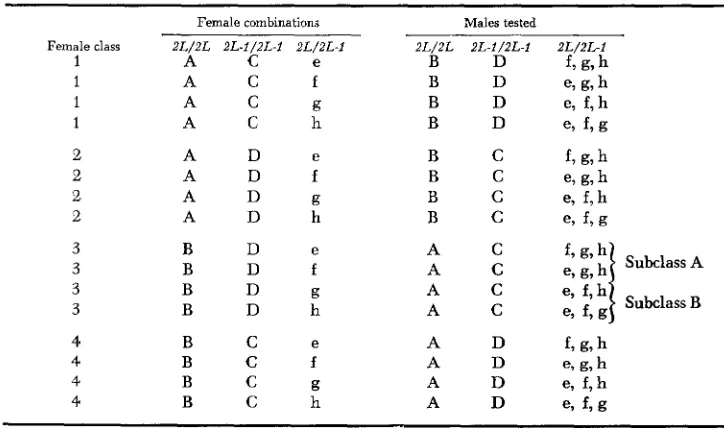
karyotype female combinations, that is, AC, AD, BD, and BC, which will give 16 possible female combinations with four heterokaryotype females, e, f, g, and h. (See Table 1). For convenience, hereafter, females of classes 1, 2, 3, and 4 will be referred to as AC htk, AD htk, BD htk, and BC htk, respectively.
The manner in which the mating experiments were run is given in Table 2. In order to understand this table, let us consider the A c e female combination of Class 1. Fifteen marked females, five each of the three karyotypes represented by A, C, and e, were allowed to mate with five males of the 2L/2L karyotype of the B group. Three such independent mating runs were tested. In another mating run, 15 marked Ace females were given five males of the 2L-1/2L-I karyotype of the D group. T h r e e mating runs of this type were tested. In another mating run, 15 A c e females were tested with five 2L/ZL-I males of the f group and with males of the g and h groups in two other independent mating runs. As can be seen lfrom Table 2, the females were always mated to males of different groups. This was done to avoid any preferential mating of flies which were reared in the same bottle. In other words, each female combination was tested in independent mating trials with males of 2L/2L, 2L-l/2L-l, and 2L/2L-1 karyotypes. Three mating runs with males of one karyotype were tested for each female combination. 240 males of
TABLE 2
Scheme of the mating experiment (For explanation, see text)
Female combinations Males tested
Female class 2L/2L 2L-1/2L-I 2L/2L-l 2 L / 2L 2L-1/2L-f 2L/2L-l 1 A C e B D f, g, h
1 A C f B D e, g, h 1 A C g B D e, f, h
1 A C h B D e> f, g
2 A D f B C e, g, h 2 A D g B C e, f, h 2 A D h B C e, f, g
2 A D e B C f , g7 h
e
3 B D A C
3 B D f A C
3 B D g A C e, f , h
each karyotype and thus 720 males in total were tested with a total of 2160 females. The experi- ments were run between 11 AM and 5 PM. The copulatory pairs were aspirated out and each pair was left i n a n empty shell vial. After the mating experiment was over, the karyotype of the female was noted down by looking at the wing mark with a binocular microscope.
RESULTS
The data of mating speed of males of similar karyotypes when mated to differ- ent female combinations of the same class were pooled if the
x 2
heterogeneity test indicated no significant difference at P = 0.05. However, in practice, the pooled data (presented in Tables 3 to 7 ) indicated homogeneity at P = 0.10.Mating speed of homo- and heterokaryotype males: The data were classified into four groups: ( 1 ) total mating in 10 min, (2) total mating in 10.01 to 30.00
min, (3) total mating in 30.01 to 60.00 min,
(4)
total not mating.x 2
tests with3 df 'were performed. In cases where no differences in the mating speed of differ- ent karyotypes were observed, the adjacent groups were pooled. The pooling results in lowering the degrees of freedom.
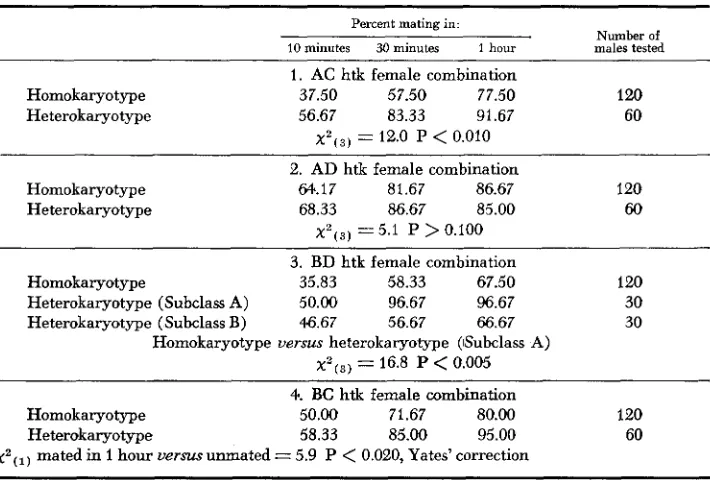
In all of the classes there were no differences in the mating speeds of 2L/2L and 2L-1/2L-1 males. The two homokaryotypes were, therefore, pooled in each class. Table 3 presents the data of mating speed of homo- and heterokaryotype males with different female combinations. Heterokaryotype males show a faster mating speed than homokaryotypes when tested with the AC htk female combina-
TABLE 3
Mating speed of homo- and heterokaryotype males with different female combinations
Percent mating in:
Number of
10 minutes 30 minutes 1 hour males tested 1. AC htk female combination
Homokaryotype 37.50 57.50 77.50 120 Heterokaryotype 56.67 83.33 91.67 60
x*(3)
= 12.0 P<
0.010 2. AD htk female combinationHomokaryotype M.17 81.67 86.67 120 Heterokaryotype 68.33 86.67 85.00 60
x * ( ~ ) = 5.1 P
>
0.100 3. BD htk female combinationHomokaryotype 35.83 58.33 67.50 120 Heterokaryotype (Subclass A) 50.00 96.67 96.67 30 Heterokaryotype (Subclass B) 46.67 56.67 66.67 30
Homokaryotype versus heterokaryotype (ISubclass A) x * ( ~ ) = 16.8 P
<
0.005 4. BC htk female combinationHomokaryotype 50.00 71.67 80.00 120 Heterokaryotype 58.33 85.00 95.00 60
MATING SPEED IN
D.
robusta593
tion. With the
AD
htk female combination, the heterokaryotypes seem to have a higher mating speed; the differences, however, are not significant. WithBD
htk females, the data of mating speed of heterokaryotype males were very hetero- geneous and had to be classified into two subclasses, A andB
(see Table 2). The heterokaryotype males in subclass A maintain a higher mating speed(P
<
0.005) throughout the one hour period than the homokaryotypes. The differences in the mating speed of heterokaryotype males of subclassB
and the homokaryotype males are not significant. The heterokaryotype males have a higher mating speed than the homokaryotype males when tested with the BC htk female combination.In all four classes tested, the heterokaryotype males show a greater mating speed than the homokaryotypes (see Figure 1 )
.
In order to find out if in the entire experinlent the heterokaryotype males have a greater mating speed than the homokaryotypes, values of
x
were calculated fromx2
with 3 df for the differences in the mating speed of homo- and heterokaryotype males. Since in all cases the heterokaryotype males perfonn better, the values ofx
are positive. The standardized normal deviate was then calculated. As can be seen from Table4,
the test establishes that heterokaryotypes have a faster mating speed than the homokaryotype males. Figure 2 presents the cumulative percentage curves of mating speed of heterokaryotypes and homokaryotypes. Ascan be seen from the figure, heterokaryotypes maintain a faster mating speed throughout the one hour period.
Mating speed of homo- and heterokaryotype females: I n all female combina- tions, slightly more heterokaryotype females mate than homokaryotype females by the end of 10 min, 30 min, and 1
hr.
There is no evidence of assortative mating. All three male karyotypes “choose” heterokaryotype females more often than homokaryotype females. Table 5 shows the number of homo- and hetero- karyotype females which mated by the end of 1 hr. The mating speed of the three types of females can be summarized as 2L/2L-I > 2L-1/2L-Z>
2L/2L. Female interactions: Mating speed of males which are of the same karyotypeTABLE 4
xLs of mating speed of homo- and heterokaryotype males in the entire male-choice experiment
Group Female combination X Z a , X
1 AC htk 12.010
+
3.4652 AD htk 5.102 2.258
3 BD htk
Subgroup A 16.800
+
4.098 Subgroup B 2.636+
1.623 4 BC htk 7.430 -k 2.72514.169
+
14.169x
= 14.2, d.f. = 15, Normal deviate =-
= 3.7 P 0.0004d
15594 PRAKASH
'7
90 -
80
-
70 ~
60 -
II)
0
f
-4
s
5 0 -
I- z Y I
-U
M YI 40-
FIGURE l.-~umuIative percentage curves for the matings of homokaryotype and hetero- karyotype males (male choice experiments) during a period of one hour.
0
-
- -
-
'AC HTK 0 X HMK 8- - - -
AC HTK 0 XHTK 8. - - - - B C H T K O X H T K 8
A
-
-
-
-
BD HTK 0 XHMK 8A
-
- - -
BD HTK 0x
HTK 8 (Subgroup A) n - - - - A D H T K O X H M K dO - - - - B C H T K Q X H M K $
W - - - - A D HTK 0 XHTK 8
and group was compared, when tested with different female combinations. 2L/2L males of B group show a faster mating speed with the AD htk female combination
MATING SPEED IN
D.
robusta 595FIGURE 2.-Cumulative percentage curves for the matings of homokaryotype and hetero- karyotype males (male choice experiments) during a period of one hour. These curves have been obtained by pooling the data of 480 homokaryotype males and 244) heterokaryotype males.
= heterokaryotype males
0 = homokaryotype males
in that 2L-1/2L-I females, viz., D and C, were obtained by reciprocal crosses. Comparison of AD htk and
BD
htk female combinations when tested with 2L-1/2L-i males of the C group shows that the males exhibit higher mating with the AD htk female combination (see part B of Table 6 ) . These two mating l u n sdiffer in that 2L/2L females, uiz., A and B, 'were obtained by reciprocal crosses,
596
TABLE 5
Mating speed of homo- and heterokaryotype females in 1 hour
Female karyotype 2L 2L-1
2L
2 L
-
2L-I 2L-I-
-
TotalObserved number 170 197 224 591
Expected number 197 197 197 591
~ ' ( 2 ) = 7.4 P
<
0.025Tables 3, 1 and 2). These results, then, lead to the conclusion that interactions between homokaryotypic A and D females are of such a nature as to raise the mating speed of homokaryotype males to a level nearly equal to that of hetero- karyotype males. It should be emphasized, however, that these homokaryotypic females do not raise the mating speed of homokaryotype males by directly par- ticipating in more matings, since in the AD htk female combination, as in all others, proportionately more heterokarypotype females mate with all three karyo- types of males than the homokaryotype females. The presence of A and D females in some way, then, raises the mating speed of homokaryotypic males.
If
the mating speed of 2L/2L males of the A group with BD htk and BC htk females is compared, it is seen that males have a slightly higher mating speed with BC htk females (see part C, Table 6 ) . Comparison of mating speed ofTABLE 6
Mating speed of homokaryotype males of the 2L/2L or 2L-1/2L-1 karyotypes, each of which is from the same group, with different female combinations
Female combination
Percent mating in:
Number of
10 minutes 30 minutes 1 hour males tested
AC htk AD htk
A. 2L/2L males of the B group with:
38.33 56.67 73.33 60 68.33 86.67 93.30 60
x2(s)
= 14.8 P<
0.005B. 2L-1/2L-i males of the C group with:
AD htk 60.00 76.67 80.00 60
BD htk 38.33 61.67 75.00 60
xz(l)
mating in 10 min uersus not mating in 10 min = 5.6 P<
0.02C . 2L/ZL males of the A group with:
BD htk 33.33 55.00 60.m 60
BC htk 48.33 65.00 75.00 60
x 2 ( 3 ) = 5.1 P
>
0.10D. ZL-1/2L-I males of the D group with:
AC htk 36.67 58.33 81.67 60
BC htk 51.67 78.33 85.00 60
MATING SPEED I N
D.
robusta 597 2L-1/2L-1 males of theD
group withAC
htk and BC htk females shows that males have a faster speed with BC htk females (partD,
Table 6). There are no differences in the mating speed of heterokaryotype males when tested with these female combinations. I t then seems that BC female interactions raise the mating speed of homokaryotype males. Here again, the BC females themselves do not participate in more matings.In summary, then, the mating speed of homokaryotype males is altered greatly by the homokaryotype female combinations, whereas the heterokaryotype males perform more uniformly with different female combinations.
EfJect of age on m a t i n g speed: Since the male choice experiments were done on the tenth day of age, it could be that the differences in the mating speed of homo- and heterokaryotypes are due to a faster rate of sexual maturity in the hetero- karyotypes. If the differences are due to early maturity of heterokaryotypes, it would be expected that at later age levels the differences in the mating speed would disappear. The mating experiments were then done at various age levels to ascertain if heterokaryotypes maintain a faster mating speed throughout life.
M a t i n g speed of homo- and heterokaryotypes at various age levels: The flies were matured to 9, 10, 11. 12, 13, 14, 18, 21, and 25 days of age, at which ten pairs of homogamic homo- and heterokaryotypic flies were allowed to mate in a plexiglass chamber for a 1 h r period. The pairs which copulated were removed by aspiration. Groups of flies of different karyotypes were obtained by interstrain and interkaryotype crosses in the manner described in the METHODS section. Heterokaryotypes from reciprocal crosses like a3 X al, a4 X a,, a3 x a2, and a4 x a,
were obtained. Data for reciprocal heterokaryotypes were collected on the 1 Oth, 1 lth, 13th, 14th and 18th day of age. Nearly equal numbers of flies obtained from different strain crosses were tested. The data were analyzed independently for each karyotype and age level. I n total 2000 pairs each of homokaryotypes and the heterokaryotypes were tested. No differences were found in the mating speed of the two homokaryotypes, but the heterokaryotypes have a faster mating speed, at all age levels, than the homokaryotypes
(P<
0.01, except on the 18th day when the differences in the mating speed of homokaryotypes and heterokaryo- types were not statistically significant). The heterokaryotypes start mating earlier in life and continue their faster mating speed throughout the age levels tested.(Figure 3)
.
DISCUSSION
Table 7 presents the mating speed data of second chromosome homokaryotypes and heterokaryotypes with homokaryotypic X R and 3R background. There is no
X L X R 2 L
2R 3R-1 flies shovv X L X R 2L-12R 3R-1
evidence of overdominance. The evidence that
flies show no over-
X L X R 2 L 2 R 3 R X L X R 2L-12R 3R
overdominance for mating speed, while
A G E - D A Y S
FIGURE 3.-Average percent homogamic homokaryotype and homogamic heterokaryotype matings during a one hour period with age of flies. Ten pairs of flies per mating chamber.
0 - - - - homogamic homokaryotype matings
- - - - homogamic heterokaryotype matings.
chromosome observed by
PRAKASH
(1967a) also point out that X R and XR-I gene arrangements differ with respect to their gene content.In
this study, it was observed that XR-I males which are heterokaryotypic in their second chromo- some have greater mating activity and fertility than the corresponding X R males. This then means that the m a w speed of 2L/ZL-l heterokaryotypes is greatly affected by the X R and 3R karyotype and that the genes which affectTABLE 7
XR 2L 2R 3R XR 2L-1 2R 3R XR 2L 2R 3R 2L 2R 3R 2L-1 2R 3R 2L-1 2R 3R
Mating speed of homokaryotypes and
heterokaryotypes on t h 12th day of age
Cross
Percent mating in:
Number of
lominutes Mminutes 1 hour males tested
HMK
x
HMK HTKx
HTKMATING SPEED IN
D.
robusta 599mating speed are distributed on all three major chromosomes.
In
D.
pseudo- obscura andD.
persimilis the third chromosome gene arrangements have been found to exert an influence on the mating propensity (SPIES andLANGER
1964a,b). It is very likely that in these two species, as in D. robusta, genes for mating speed are located on all of the chromosomes.
One would like to know the kind and extent of genetic differentiation between different gene arrangements such as XR, XR-1 and 3R, 3R-1. Obviously XR-1
and 3R-1 gene arrangements must have at a certain proportion of their loci quite different alleles than those in X R and 3R gene arrangements. The crucial question is: At what proportion of loci do the alternate gene arrangements carry entirely
or mostly different alleles? I n a study of two third chromosome electrophoretic loci Pt-10 and Amy in
D.
pseudoobscura, it was found that the ST phylad gene arrangements are generally characterized by the alleles P t - 1 P 0 4 andwhile the SC phylad is generally Pt-lO1 O6 and Amyo 84. While in D. pseudo-
obscura the allelic frequencies for these two loci were not very different in various gene arrangements of a phylad, in D. persimilis, strong associations of A m y alleles with different gene arrangements were observed, e..g, KL gene arrange- ment has mainly and the
WT
gene arrangement has a high frequency of Amyl O9 (PRAKASH and LEWONTIN 1968). With gene frequency values oppositeto each other on the two gene arrangements, as in the A m y locus in D. persimilis the heterokaryotypes will be more heterozygous than the homokaryotypes. Given
such associations of genes with gene arrangements and not much genetic diver- gence in the central and marginal populations of D. robusta, the central popula- tions which are more polymorphic f o r the gene arrangements should also be more polymorphic at the genic level than the marginal populations. However, it is also likely that at most of the loci the differentiation between gene arrangements is of the sort observed in different gene arrangements of a phylad in D. pseudoobscura (PRAKASH and LEWONTIN, 1968). When the gene frequencies in the two alternate gene arrangements are different but in the same direction (e.g., if p and q are 1 .O and 0.0 in one gene arrangement and 0.80 and 0.20 in the other arrangement) then the heterokaryotypes are less heterozygous than one of the corresponding homokaryotypes. I n such a case there will be no correlation between gene arrangement and genic polymorphism in the central and marginal populations of D. robusta. Let us, for the sake of illustration, consider that 3R gene arrange- ment carries 100% of allele A and 3R-1 gene arrangement is segregating for the alleles A and a at frequencies of 0.80 and 0.20. The monomorphic populations for 3R and 3R-1 gene arrangements will have, respectively, 0.0% and 32% heterozygotes at that locus, whereas the central population segregating for 3R
and 3R-1 gene arrangements at frequencies of 0.70 and 0.30 will have about 11.2% of the individuals heterozygous at that locus.
600
SUMMARY
Evidence of interactions between second and third chromosome karyotypes affecting mating speed of
D.
robusta males has been presented.X R
males hetero- karyotypic in the left arm of the second chromosome which at the same time were homokaryotypic for the frequent 3R gene arrangement showed no overdominancefor mating speed; however, overdominance for mating speed 'was observed in
X R
males which are heterokaryotypic in the left arm of the second chromosome but at the same time homokaryotypic for the rare 3R-I gene arrangement.
LITERATURE CITED
PRAKASH, S., 1967a Chromosome interactions in Drosophila robusta. Genetics 57: 385-400.
-
1967b Association between mating speed and fertility in Drosophila robusta. Genetics 57 : 655-663.PRAKASH, S., and R. C. LEWONTIN, 1968 A molecular approach to the study of genic heterozy- gosity in natural populations. 111. Direct evidence of coadaptation in gene arrangements of Drosophila. Proc. Natl. Acad. Sci. U. S. 59: 398-405.
Mating speed control by gene arrangements in Drosophila pseudoobscuru homokaryotypes. Proc. Natl. Acad. Sci. U.S. 51: 1015-1019.
-
1964bMating speed control by gene arrangement carriers in Drosophila persim'lis. Evolution 18:
4304M.