ISOLATION, GENETIC MAPPING AND SOME CHARACTERIZATION O F A MUTATION I N ESCHERZCHZA COLZ THAT AFFECTS THE
PROCESSING O F RIBONUCLEIC ACID
DAVID APIRION
Department of Microbiology and Immunology, Division of Biology and Biomedical Sciences, Washington University School of Medicine,
St. Louis, Missouri 63110
Manuscript received March 30, 1978 Revised copy received June 5, 1978
ABSTRACT
Temperature-sensitive mutants were isolated from a n m c (RNase 111-) strain of Escherichia coli, and their rRNA metabolism was analyzed on 3% polyacrylamide gels. One of these mutants was unable to produce 23s and 5s
rRNAs at the nonpermissive temperature. When an m c + allele was intro- duced to this strain, it remained temperature sensitive. At the nonpermissive temperature, this strain could then produce 23s rRNA but was unable to make normal levels of 5 s rRNA. In matings and transduction experiments, the defect in rRNA metabolism and temperature sensitivity behaved as a syn- drome caused by a single point mutation, which was mapped at min 23.5 on the E. coli chromosome. This mutation probably affects a n enzyme, ribo- nuclease E (RNase E), which introduces a cut i n the nascent rRNA transcript between the 23s and the 5 s rRNA cistrons. T h e mutation m e is recessive with respect to temperature sensitivity and the pattern of rRNA. Revertants able to grow at 43" and with normal metabolism of rRNA were isolated; genetic analysis showed that they do not contain the original m e mutation, suggesting that they were true revertants. By combining the m e mutation with an m c mutation, double m c m e strains were synthesized, which behaved very similarly to the original m c strain froin which the m e mutation was iso- lated. Such strains have RNA metabolism that is similar to that of rnc strains at permissive temperatures, but at the nonpermissive temperature they fail to synthesize p23, m23 and 5s rRNAs. Thus, the experiments reported here, together with previous studies, suggest the existence of a new processing ribo- nuclease activity in Escherichia colz, which is called ribonuclease E.
TUDIES with strains of Escherichia coli lacking the enzyme RNase
I11
(GEGENHEIMER and APIRION 1975; APIRION, NEIL and WATSON 1976; GEGENHEIMER,WATSON
and APIRION 1976, 1977) suggested that maturation ofrRNA is a complex process of events involving a fairly large number of enzymatic cleavages, two of which are carried out by RNase 111. These cleavages can be
classified as to primary or secondary processing events; primary processing events occur during transcription, while the secondary processing events occur after transcription ( GEGENHEIMER, WATSON and APIRION 1977; APIRION and LASSAR 1978).
660 D. A P I R I O N
In rnc (RNase III-) strains, two of the primary maturation cuts, which remove p23 and p16 from the growing transcript, do not occur, and the matura- tion of rRNA is carried out by the remaining primary and secondary processing enzymes ( GEGENHEIMER, WATSON and APIRION 1977; APIRION and LASSAR
1978). Consequently, one observes, in addition to the customary stable 23s and 16s ribosomal RNAs, a number of transitory RNA species referred to as 30S, 25S, 18s and 17s. The final mature rRNAs in rnc and rnc+ strains seem to be identical (GEGENHEIMER,
WATSON
and APIRION 1977). I n rnc strains, the dif- ferent types of rRNA molecules are formed under all conditions in which the strains grow and are all caused by a single mc-205 mutation, since true rever- tants, which regain normal levels of RNase 111, synthesize only the customary 23S, 17s and 16s rRNA molecules (APIRION, NEIL andWATSON
1976).It was evident that RNase I11 is not involved in the maturation of 5 s rRNA since in rnc cells the metabolism of
5s
rRNA was normal (GEGENHEIMER, WATSON and APIRION 1977). Therefore, it was proposed that a cut is introduced between the 23s and the5s
rRNA cistrons by a putative enzyme that was named RNase "E" (see Figure 12 in GEGENHEIMER,WATSON
and APIRION 1977). These findings and considerations suggested that in rnc cells the remaining primary cuts would be indispensible. Therefore, I set out to isolate temperature-sensitive mutants from RNase III- strains and to examine their rRNA metabolism. I shall report here on the genetics of one temperature-sensitive mutant in which a cleavage between the 23s and the 5 s cistrons does not seem to occur at elevated temperatures.MATERIALS A N D METHODS
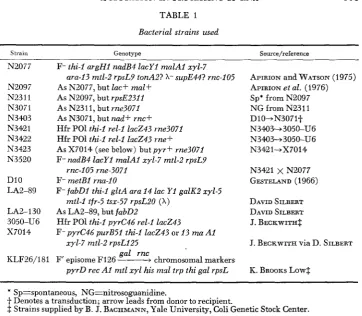
AI1 procedures used are published and will be referred to at the appropriate places. Strains used are described in Table 1.
RESULTS
Isolation of ts- mutants defective
in
r R N A metabolism from a n rnc strain: Strains carrying the rnc-205 mutation can grow at almost all temperatures at which m c + strains can grow, albeit at a slower rate (APIRION and WATSON 1974, 1975). They grow well at 43" in minimal medium or enriched medium. and therefore we isolated temperature-sensitive mutants that fail to grow at 43". I n order to isolate ts- mutants, two rnc strains (N2097 and N2311) were treated with N-methyl-N-nitro-N/-nitrosoguanidine (40 pg/ml at 30" for 40 min) in broth at pH 6.5 and the treated cells were plated on broth agar medium (APIRION 1966) at 30" to give rise to about 200 colonies per Petri dish (85 mm diameter). After three days, the colonies were replica plated to the same medium and incubated at 43". Colonies that failed to grow at 43" were picked, purified (twice) and retested. Only the mutants that did not acquire any mutations to auxotrophy were kept for further analysis.A M U T A T I O N IN PROCESSING O F R N A
TABLE 1
Bacterial strains used
661
Strain Genotype Source/reference
N2077 N2097 N23 11 N3071 N3403 N3421 N3422 N3423 N3520 D10 LA2-89 LA2130 3050-U6 X7014
F- thi-I argH1 nadB4 lacY1 mulA1 xyl-7
As N2077, but lac+ mal+
As N2097, but rpsE2311 As N2311, but me3071 As N3071, but nad+ rncf
Hfr PO1 thi-1 rel-I lacZ43 me3071 Hfr PO1 thi-I rel-1 lacZ43 m e +
As X7014 (see below) but pyr+ me3071 F- nudB4 lacy1 malA1 xyl-7 mtl-2 rpsL9
F- metBl r a - I O
F- fabDl thi-I gltA ara 14 lac Y1 galK2 xyl-5 mtl-1 tfr-5 tsx-57 rpsL2O (1)
As LA2-89, but fubD2
Hfr PO1 thi-I pyrC46 rel-I lacZ43
F- pyrC46 purB51 thi-1 lacZ43 or 13 ma A1 ara-13 mtl-2 rpsL9 tonA2? 1- supE44? rnc-105
rnc-105 rne-3071
xyl-7 mtl-2 rpsL125
gal rnc
KLF26/181 F' episome F126
--
chromosomal markers pyrD rec AI mtl xyl his mal trp thi gal rpsLAPIRION and WATSON (1975) APIRION et al. (1976) Sp' from N2097 NG from N2311 D10+N3071+ N3403-+3050-U6
N3421+X7014 N3403+3050-U6
N3421 x N2077 GESTUAND (1966)
DAVID SILBERT DAVID SILBERT
J. BECKWITH$
J. BECKWITH via D. SILBERT
K. BROOKS Low$
* Sp=spontaneous, NG=nitrosoguanidine.
j- Denotes a transduction; arrow leads from donor to recipient.
$ Strains supplied by B. J. BACHMANN, Yale University, Coli Genetic Stock Center.
30". At an absorbancy of about 0.4 (at 560 nm), the cultures were transferred t o
43" for one hour, and then to each culture 18 pCi of
32Pi
were added. Labeling was terminated 40 min later by addition of ethanol and diethylpyrocarbonate (to 80% and1%,
respectively). The cultures were centrifuged and the pellets opened in a hot sodium dodecyl containing buffer, as described by GEGENHEIMER,WATSON
and APIRION (1977). Samples containing about 100,000 CPM were applied in 5 to 20 pl volumes to thin slab 3% polyacrylamide gels. Samples from 20 strains were applied to each gel and electrophoresis was carried out, and the gels were dried and autoradiographed ( GEGENHEIMER, WATSON and APIRION 1977).In
this manner, 380 strains were screened and the analysis of one of these: designated N3071, is described here.Genetic analysis of strain N3071: While the parental strain of N3071, strain N2311, synthesized 23S, 16S, 30S, 2 5 S , "p23", 18s and
5s
rRNAs at all tempera- tures, strain N3071 synthesized all these molecules at permissive temperatures such as 30" or 37", but failed to produce either "p23", 23s or 5s rRNA at 43",662 D. A P I R I O N
The m c gene is co-transduced with the nudB gene (APIRION and WATSON 1975). Since strain N3071 is nudB. it was infected with P I bacteriophage
(LENNETTE and APIRION 1971) grown in strain D10 (nad+ m c + ) , and selection was carried out for Nad+ transductants at 37". All the Nad+ transductants (40 tested) remained ts- since they still failed to grow at 43". The rRNA metabolism of ten transductants was analysed o n a 3% polyacrylamide gel as explained above. Six of the ten transductants became m c + . This was evident since they did not produce 30S, 25s and 18s rRNAs. The other four transductants retained the rnc-105 allele. All the abnormal features of rRNA metabolism observed in RNase III- strains are caused by a single point mutation, rnc-105 (APIRION and
WATSON
1975; APIRION, NEIL and WATSON 1976). The strains that retained thernc mutation grew somewhat more slowly than the strains that did not.
RNA metabolism in the rnc+ transductants at the permissive and nonpermis- sive temperatures was analysed on 3% and 5 %/12% tandem polyacrylamide gels (GEGENHEIMER,
WATSON
and AFTRION 1977;LEE,
BAILEY and APIRION1978). I n a 3% gel, large RNAs can be observed, while in the other gel small RNAs such as tRNA and 5 s rRNA can be analysed. At the permissive tempera- ture, RNA metabolism of large and small molecules was normal, while at the nonpermissive temperature (43" ) large rRNAs were synthesized as in regular strains, but the small RNAs were not normal (see Figures 1, 2 and 3). At the nonpermissive temperature a number of new species of RNA appear (see Figure 1 arrows) and
5s
rRNA did not accumulate to any appreciable extent. Since these six strains all behaved in a similar fashion. one of them was designated N3403, and the analysis was continued with this strain. To ascertain whether or not the temperature sensitivity and the ncw pattern of RNA metabolism were caused by the same mutation, ts+ revertants for growth at 43" were isolated, and analysed. Their RNA metabolism was normal (see below),
suggesting that these two characteristics are indeed caused by the same mutation.I n order to localize the ts mutation on the chromosome, strain N3403, which is SpcR (spectinomycin resistant), and Arg (urgH) were crossed (LENNETTE and APIRION 1971) to ten different Hfr's with different points of origin and which are sensitive to spectinomycin and are Arg+. About 60 SprR Arg+ recombinants were analysed for their ability to grow at 43". Crosses that yielded ts+ recombi- nants suggested that the ts mutation is between the point of origin of the
Hfr
strain and argH. These experiments suggested that the t s mutation is located between minutes 21 and 28 of the E . coli map (BACHMANN, Low and TAYLOR 1976).A M U T A T I O N I N PROCESSING O F R N A
663
a b c d e
f g h
i
j
k
Pb
6s
55
4.5:
tRNA
P I
Frcun~ 1.-Analysis of recombinants from a transduction invol\ing an rnc strain as a donor and a n m r f strain as the recipient. Strains containing an rnr mutation are temperature sensi- tive, and when shifted to a nonpermissive tcmpcraturc such as 13", thev fail to mature a variety of RNA molecules, including 5 s rRNA, 6s RNA and somr IRNAs. Instcad, one observes the accumulation of larger precursor molccules (arrows on the left). Thc pattern of the RNA syn- thesized in m e + strains can be seen in lanw a, h, e, f, h, i, and k, while the pattern of RNA spnthesizcd in me strains at the restrictive temperature can be seen in lanes c, d, g, and j. Since the mr mutation is very closely linked to the pyrC locus, a transduction was carried out i n which an me pyr+ (N3403) strain was the donor and a n r n r f p y r C (3050-U6) was the recipient. Selection was carried out for the ability to grow without uracil. A large proportion
GG44 D. A P I R I O N
-_n-
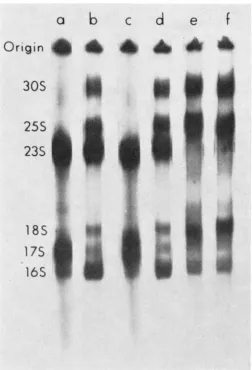
FIGURE 2.-ts+ revertants. Strain N3421 m e (lane c ) and four ts+ revertants (lanes a, b,
d, e ) were grown at 30", transfrrred to 43", lahelrd with :t"p, and analyzed as described in the legend to Figure 1.
N3403, while all the ts+ transductants behaved like the parental recipient strain
(3050-UG) . At the permissive temperature, RNA metabolism was normal in all strains, while at 43" RNA metabolism was abnormal in the ts- transductants. The result of the analysis of some of the transductants is shown in Figure 1. I t can be seen that when these ts- strains are labeled at 43", they accumulate some larger molecules, while they fail to accumulate 5 s rRNA and normal levels of tRNA. One of these larger molecules (the top one indicated by the second arrow on the left in Figure I ) contains 5s rRNA sequences
(R.
GHORA and D. APIRION, unpublished).A MUTATION I N PROCESSING O F R N A 665
FIGURE 3.--Recombinants from a cross m ~ x r n c . The parental strains N3121 ( m e ) and Ne077
( r n c ) and some of their recombinants were labeled as described in Figure 1 and analyzed on a 3% gel. a, N3421 me; b, N2077 m c ; c, a wild-type recombinant; d, an m c recombinant; e, f, rnc me recombinants.
contain a mutation which affects rRNA processing, and that a t the nonpermissive temperature they fail to cut the nascent rRNA chain betwern the 23s and the
5s
cistrons. Such a cut was previously predicted on the basis of studies with (RNase
111-) m c mutants, and the enzyme responsible for this cut was designated RNase E (GEGENHEIMER, WATSON and APIRION 1977). Therefore the t s mutation in strain N3421 is designated me-3071, and it is assumed that such strains contain a temperature-sensitive RNase E. (Preliminary experiments by RASANTA
GHORA
support such an assumption. (For the nomenclature of RNase genes, see APIRION666 D. A P I R I O N
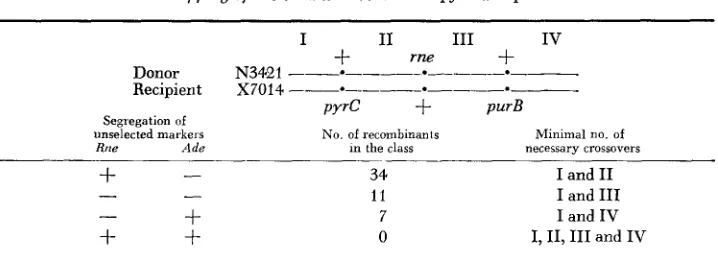
TABLE 2
Mapping of rne-3071 with relation to pyrC and purB
~ ~~~~~ ~ ~
I I1 I11 I V
+
m e+
Donor N 3 4 2 1 _ ~ . _ ~ - _ . _ _ ~ . _ - Recipient X7014 --e_---.
____
- mPYrC
+
purBSegiegation of
unselected markeis No of recombinants Minimal no of
Rne Ade In the class necessary crossovers
-
+
+
+
+
-
34 1 1
7
0
I and I1 I and I11 I and I V I, 11, I11 and I V
Selection was carried out for Pyr+, by plating P1-infected recipient cells in minimal medium plates containing adenine at 30".
I n order to assess the orientation of the rne gene with respect to pyrC and purB, three point transduction experiments were carried out involving mutations in the genes rne, W r C and purB (Table 2). It can be seen from the results in Table 2 that the rne gene is located between pyrC and purB, closer to pyrC. In a cross similar to that shown in Table 2, when selection was carried out for Pur+ Pyr+, all 84 transductants tested were ts-, again indicating that m e is located between pyrC and purB. Since fabD maps in this region of the chromosome (SEMPLE and SILBERT 1975)
,
linkage of fabD to m e was tested. I n this case both parental strains are ts-. but the rne-4071 strains can grow at 40", while fabD strains cannot. For this reason N3421 ( m e ) was used as donor, and LA2-89 or LA2-130 (both are fabD) were used as recipients. Selection was carried out for transductants able to grow at 40" on rich medium. The results from both experi- ments were similar; therefore, the data from both experiments were pooled. From a total of 52 ts+ transductants tested, 25 were ts+ even at 45", indicating that they do not carry either the m e or the fabD alleles, and indicating a 52% co-transduc- tion of these two genes. Since the co-transduction frequency of rne and purB is about 10% and o€ pyrC and fnbD is at most 13% (SEMPLE and SILBERT 1975), I deduced that the order of the genes studied here is pyr'c rne fabD purB. Thus, the rne gene was located at about 23.5 minutes of the E. coli map (BACHMANN, Low and TAYLOR 1976).A M U T A T I O N IN PROCESSING O F R N A 667
are merozygotes and not recombinants, they were tested for the ability to donate the
F'
126 plasmid. In crosses they could donate the purB+ m e + and w r C + genes to F- strains at high frequency, as compared to other genes that are not carried on the plasmid.Analysis of revertants: From strain N3421, ts+ revertants with the ability to grow at 43" were isolated. In five independent experiments, the frequency of revertants was between 6 and 8.8 x indicating a frequency commensurate with me-3071 being a single point mutation. RNA metabolism at 43" was analysed in some of these revertants, (Figure 2).
In
all the revertants tested, RNA metabolism was normal. To determine if these are true revertants, seven of them were further studied; they included at least one revertant from each of the five experiments. Strain 3050-U6, which is pyrC, was infected with P1 phage prepared from these seven strains. In each case Pyr+ recombinants were selected for at 37". From each cross 60 Pyr+ transductants were analysed, and in no case was a ts- recombinant found, indicating that none of these seven ts+ revertants harbors a ts mutation. I therefore conclude that these seven strains are true revertants.Building rnc m e double-mutant strains: To verify our hypothesis that the original strain N3071, which was isolated by mutagenesis from strain N2311 ( m c - 1 0 5 ) , contains two mutations that affect RNA processing, mc-105 and
me-3071, and that all the abnormalities in RNA metabolism observed in this strain were caused by these two mutations, rnc me double-mutant strains were constructed. For this experiment a prolonged mating was set up between strain N3421, which is an Hfr (Pol) me-3071 and which should be able to mobilize the m e gene, and an F- strain N2077 ( m c - 1 0 5 ) . Selection was carried out for StrR Arg+ recombinants. Thirty such recombinants were purified, and their RNA metabolism was analysed on gels, at 37" and 43". The results observed with some of them at 43" are shown in Figure 3 (on a 3% gel). Of the 30 recombinants analyzed, 15 had the wild-type phenotype, ten had the m c phenotype, while five had the m c rne phenotype, as indicated by failure to produce p23 or
23s
rRNA at 43". The recombinant class. which numbered 15 strains, contained m eparental types and wild-type recombinants; on a 3% gel they are not easy to distinguish from one another. This experiment indicates that the original N3071 strain does contain only two mutations that affect its RNA metabolism, rnc and
m e . One of the double-mutant strains was kept and designated N3520 (Table 1).
DISCUSSION
668 D. A P I R I O N
between these two possibilities or point to another avenue, they clearly establish the existence of a new gene that affects RNA processing events not affected by other genes governing RNA processing, such as rnc or m p . The results suggest rather strongly that an enzyme is affected, since the cells carrying the me-3071 mutation are thermolabile, the appearance of the abnormal RNA metabolism is confined to the nonpermissive temperature and the mutation is recessive.
Two other genes that govern RNA processing (cleaving) enzymes have been identified in E. coli K12; one is rnp, which affects RNase P (SCHEDL and PRIMA-
KOFF 1973), and the other is m c , which affects RNase I11 (DUNN and STUDIER 1973; APIRION, NEIL and
WATSON
1976; GEGENHEIMER, WATSON and APIRION 1977). Each of the three genes defined by the mutations (rnc, m e , m p ) affects a different set of reactions since the patterns of RNA metabolism observed in each of these mutants are very different. The m e mutation affects production of 5 s rRNA, and the putative enzyme RNaseE
seems to introduce a cut in the nascent rRNA chain somewhere between the 23s and the 5 s rRNA cistrons, exactly as predicted from previous experiments ( GEGENHEIMER, WATSON and APIRION 1977; APIRION and LASSAR 1978).Thus far, RNase I11 has been shown to affect mainly rRNA metabolism (DUNN and STUDIER 1973; GEGENHEIMER, WATSON and APIRION 1977), while RNase P affects mainly tRNA metabolism (SCHEDL and PRIMAKOFF 1973; ALT- M A N 1975; SEIDMAN and MCLAIN 1975). RNase E, however, seems to affect the metabolism of rRNA, tRNA and other RNA molecules. For instance, in Figures 1 and 2 it can be seen that while normal levels of 5 s do not accumulate at the nonpermissive temperature (most of the RNA accumulating at the 5 s region is not
5s
rRNA, B. GHORA andD.
APIRION, unpublished observations), a num- ber of larger molecules accumulate but not all of them contain 5 s rRNA sequences (B. GHORA and D. APIRION, unpublished). It can be seen clearly in Figures 1 and 2 that the amount of tRNA that accumulates in m e mutants at the nonpermissive temperature is rather diminished, and some of the larger molecules are most probably tRNA precursors (different size tRNA precursors accumulate in m p strains). There is a third class of small stable RNA molecules, 4.5s 6s and 10s (LEE, BAILEY and APIRION 1978), which are neither tRNA nor 5 s rRNA, and the maturation of two of these molecules is also affected in rnemutants at the nonpermissive temperature. While the maturation of 4.5s rRNA (see Figures
1
and 2) does not seem to be affected, the maturation of 6s and 1 OS is. (The maturation of 4.5s RNA is affected by RNase P according to BOTH- WELL, GARBER and ALTMAN 1976.)The amount of label analysed in Figures 1 and 2 is not sufficient to permit a clear observation of the 6s RNA species, but a careful examination of these gels shows that while both p6 and m6 RNAs can be observed in m e + strains, only p6 is observed in m e strains. For clear observation of the 10s region, less con- centrated gels have to be used.
A MUTATION IN PROCESSING OF R N A 669 is interesting that while the original strain, N3071, into which the rne-3071 mutation was introduced and the rrre rnc strains synthesized from the single mutants are very similar, there is at least one difference between them. Strain N3071 fails to mature 16s rRNA at the elevated temperature (see APIRION and
LASSAR 1978, Figure 1 )
,
while the synthesized rnc m e strains do accumulate 1 6 s rRNA, albeit at a reduced rate (Figure 3, lanes e and f). This difference is most likely due to another mutation that is responsible for some of the tempera- ture sensitivity of strain N3071. When strain N3403 was crossed to the different Hfrs (see RESULTS), it became apparent that besides the rne mutation there was another mutation unlinked to rne-3071 that did not affect the major features of RNA metabolism, but that caused some temperature sensitivity. Since the m emutation was transferred from the original genetic background to a completely different genetic background in transduction experiments (Figure 1 ), and since revertants from such strains were analyzed (Figure 2),
I
feel confident that all the effects on RNA metabolism and temperature sensitivity observed in strains such as N3421 are caused by the rne-3071 mutation.While primary processing of rRNA in
E.
coli, i.e., processing occurring during transcription, is not affected by protein synthesis, secondary processing is, e.g.,formation of m16 from p16 (FACE 1973; GEGENHEIMER, WATSON and APIRION
1977). Therefore, changes observed in the pattern of primary processing cuts usually means that a n enzyme involved in primary processing is affected, while changes observed in secondary processing, in particularly a failure to mature 16s rRNA, do not necessarily indicate that an enzyme involved in secondary processing is affected.
In
the case of formation of 16s from 17S, many factors that influence protein synthesis can affect this step. It is most unlikely, therefore, that the mutation which affects formation of 16s in strain N3071 is directly related to processing of rRNA. Indeed, the level of protein synthesis is rather negligible in strain N3071 after it is shifted to 43" for 40 min (less than 2% of the 30" level), while the level of protein synthesis in the rnc rne strains syn- thesized from the two single parental strains is appreciable, about 50% of the normal rate at 30".SEMPLE and SILBERT (1975) encountered certain anomalies in their transduc- tion experiments using strain X7014. We encountered similar difficulties in obtaining pur+ transductants, using strain N3421 as donor and X7014 or its derivatives as recipients, which suggests that there might be some chromosomal nonhomology between the two strains in this region. Yet, all the data obtained, together with former studies on co-transduction frequencies in this region
(SEMPLE and SILBERT 1975), are in agreement with the suggested order pyrC m e fabD purB. I n the absence of any evidence t o the contrary, this should be the preferred order. At present a number of genes that affect ribonucleases, processive and degradative, have been mapped, but in no case has a cluster of such genes been found (BACHMAN, Low and TAYLOR 1976).
670 D. APIRION
fair number of nitrosoguanidine-induced mutations, and while it is clear that nitrosoguanine can induce multiple mutations, in no case were these mutations clustered. For instance in the analyses of strain N4752, sts-4752 (LENNETTE and APIRION 1971) and N4721,
rimH
4721(JOHNSON,
WATSON and APIRION 1976),and in the case studied here, me-3071 (N3071), it is clear from the genetic analysis that the strains do not contain many mutations and that the particular mutations of interest are not co-transduced (by
PI)
with any other new muta- tion. Even in strain AB301-105, which was isolated i n another laboratory (KINDLER, KEIL andHOFSCHNEIDER
1973) and analyzed in mine (APIRION andWATSON
1974, 1975), we found a large number of mutations (at least eight) only one of which was co-transduced (byP1)
with the mc-105 mutation. I t is possible that our handling of nitrosoguanidine mutagenesis, i.e., lower concen- tration of the drug, shorter time and higher pH, reduced multiple clustered mutations.
Continued studies with the new
RNA
processing mutant described here, as well as with other processing mutants, should help us understandRNA
processing in the cell.This work was supported by National Science Foundation grant PCM 76-81665. The help of NED WATSON, ANDREW B. LASSAR and JOEL ANDERSON with various phases of these studies
is highly appreciated. I am most grateful to BARBARA BACHMANN and DAVID SILBERT for pro- viding bacterial strains.
LITERATURE CITED
ALTMAN, S., 1975
APIRION, D., 1966
APIRION, D. and A. B. LASSAR, 1978
APIRION, D., J. NEIL and N. WATSON, 1976 Revertants from RNase 111 negative strains of
APIRION, D. and N. WATSON, 1974 Analysis of an Escherichia coli strain carrying physio- logically compensating mutations one of which causes an altered ribonuclease 111. Molec. Gen. Genet. 132: 89-104. -, 1975 Mapping and characterization of a mutation in Escherichia coli that reduces the level of ribonuclease I11 specific for double-stranded ribonucleic acid. J. Bacteriol. 124: 317-324.
BACHMANN, B. J., K. B. Low and A. L. TAYLOR, 1976 Recalibrated linkage map of Escherichia
BOTHWELL, A. L., R. L. GARBER and S. ALTMAN, 1976 Nucleotide sequence and in vitro process- ing of a precursor molecule to Escherichia coli 4.5s RNA. J. Biol. Chem. 251 : 7709-7716. CERDIOLMEDO, E., P. C. HANAWALT and N. GUEROLA, 1968 Mutagenesis of the replication
point by nitrosoguanidine: map and pattern of replication of the Escherichia coli chromo- some. J. Mol. Biol. 33: 705-719.
DUNN, J. J. and W. STUDIER, 1973 T7 early RNAs and Escherichia coli ribosomal RNAs are cut from large precursor RNAs in uivo by ribonuclease 111. Proc. Nat. Acad. Sci. U.S. 7 0 :
3296-3271.
Biosynthesis of transfer RNA in Escherichia coli. Cell 4: 21-29.
Altered ribosomes i n a suppressor strain of Escherichia coli. J. Mol. Biol.
A conditional lethal mutant of Escherichia coli which 16: 285-301.
affects the processing of ribosomal RNA. J. Biol. Chem. 253: 1738-1742.
Escherichia coli. Molec. Gen. Genet. 149: 201-210.
A M U T A T I O N IN PROCESSING O F R N A 671
GEGENHEIMER, P. and D. APIRION, 1975
GEGENHEIMER, P., N. WATSON and D. APIRION, 1976
Escherichia coli ribosomal RNAs are not cut from an intact precursor molecule. J. Biol. Chem. 250: 2407-2409.
Processing of ribosomal RNA in E . coli. pp. 405410. In: ICN/UCLA Symposium on Molecular and Cellular Biology. Molecular Mechanism in the ControZ of Gene Expression. Edited by D. P. NIERLICH, W . J. RUTTER and C. F. Fox. Vol. 5. Academic Press, New York. __ , 1977 Multiple pathways for primary processing of ribosomal RNA in Escherichia coli. J. Biol. Chem. 252 : 3064-3073. GESTELAND, R. F., 1966 Isolation and characterization of ribonuclease I mutants of Escherichia
coli. J. Mol. Biol. 16: 67-84.
JOHNSON, S. C., N. WATSON and D. APIRION, 1976 tion of ribosomes. Molec. Gen. Genet. 147: 29-37.
KINDLER, P., T. U. KEIL and P. H. HOFSCHNEIDER, 1973 Isolation and characterization of a ribonuclease I11 deficient mutant of Escherichia coli. Molec. Gen. Genet. 126: 53-69. LEE, S. Y., S. C. BAILEY and D. APIRION, 1978 Small stable RNAs from Escherichia coli: evi-
clence for the existence of new molecules and for a new ribonucleoprotein particle containing 6 s RNA. J. Bacteriol. 133: 1015-1023.
LENNETTE, E. T. and D. APIRION, 1971 Genetic analysis of an Escherichia coli syndrome. J. Bacteriol. 108: 1322-1328.
MEYHACK, B., I. MEYHACK and D. APIRION, 1973 Colicin E3: a unique endoribonuclease. Proc. Natl. Acad. Sci. U.S. 70: 156-160.
PACE, N. R., 1973 The structure and synthesis of the ribosomal ribonucleic acid of prokaryotes. Bacteriol. Rev. 37: 562-603.
SCHEDL, P. and P. PRIMAKOFF, 1973 Mutants of Escherichia coli thermosensitive for the syn- thesis of transfer RNA. Proc. Nat. Acad. Sci. U.S. 7 0 : 2091-2095.
SEMPLE, K. S. and D. F. SILBERT, 1975 Mapping of the fabD locus for fatty acid biosynthesis in Escherichia coli. J. Bacteriol. 121 : 1036-1046.
SEIDMAN, J. G. and W. H. MCCLAIN, 1975 Three steps i n conversion of large precursor RNA into serine and proline transfer RNAs. Proc. Nat. Acad. Sci. U.S. 72: 1491-1495.