The Program Counter Security Model: Automatic Detection and
Removal of Control-Flow Side Channel Attacks
David Molnar1, Matt Piotrowski1, David Schultz2, and David Wagner1
1 UC-Berkeley {dmolnar, pio, daw}@eecs.berkeley.edu 2 MIT
Abstract. We introduce new methods for detecting control-flow side channel attacks, transforming C source code to eliminate such attacks, and checking that the transformed code is free of control-flow side channels. We model control-flow side channels with aprogram counter transcript, in which the value of the program counter at each step is leaked to an adversary. The program counter transcript model captures a class of side channel attacks that includes timing attacks and error disclosure attacks.
We further show that the model formalizes previousad hoc approaches to preventing side channel attacks. We then give a dynamic testing procedure for finding code fragments that may reveal sensitive information by key-dependent behavior, and we show our method finds side channel vulnerabilities in real implementations of IDEA and RC5, in binary modular exponentiation, and in the lsh implementation of the ssh protocol. Further, we propose a generic source-to-source transformation that produces programs provably secure against control-flow side channel attacks. We implemented this transform for C together with a static checker that conservatively checks x86 assembly for violations of program counter security; our checker allows us to compile with optimizations while retaining assurance the resulting code is secure. We then measured our technique’s effect on the performance of binary modular exponentiation and real-world implementations in C of RC5 and IDEA: we found it has a performance overhead of at most 5×and a stack space overhead of at most 2×. Our approach to side channel security is practical, generally applicable, and provably secure against an interesting class of side channel attacks.
1 Introduction
The last decade has seen a growing realization that side channel attacks pose a significant threat to the security of both embedded and networked cryptographic systems. The issue of information leakage via covert channels was first described by Lampson [29] in the context of timesharing systems, but the implications for cryptosystem implementations were not recognized at the time. In his seminal paper, Kocher showed that careful timing measurements of RSA operations could be used to discover the RSA private key through “timing analysis” [26]. Kocher, Jaffe, and Jun showed how careful power measurements could reveal private keys through “power analysis” [27]. Since then, side channel attacks have been used to break numerous smart card implementations of both symmetric and public-key cryptography [11, 32, 31, 33]. Later, Boneh and Brumley showed that a timing attack could be mounted against a remote web server [10]. Other recent attacks on SSL/TLS web servers make use of bad version oracles or padding check oracles; remote timing attacks can reveal error conditions enabling such attacks even if no explicit error messages are returned [30, 6, 43, 7, 24, 25, 35].
Our main technical contribution is an exploration of one simple but useful contract, the program counter transcript model, where the only information the hardware leaks is the value of the program counter at each step of the computation. The intuition behind our model is that it captures an adversary that can see the entire control flow behavior of the program, so it captures a non-trivial class of side-channel attacks. This paper develops methods for detecting such attacks on C programs and shows how to secure software against these attacks using a C-to-C code transformation.
First, we show the program counter model captures an interesting class of attacks, including timing analysis, a form of simple power analysis, and error disclosure attacks. For example, the model captures an adversary attempting network timing attacks of the type demonstrated by Boneh and Brumley [10]. We give a formal definition ofprogram counter security, which expresses the requirement that the control flow behavior of the program contains no information of use to the attacker. We motivate our model by illustrating how previously proposed ad hoc countermeasures against error disclosure side channel attacks produce software that is program counter secure.
The program counter model enables testing for potential side channel vulnerabilities. The side chan-nel behavior of a code fragment may leak information about the secret; therefore we would like to find and eliminate such fragments. We demonstrate a dynamic testing tool that searches for vulnerabilities in C code, and we show how the tool discovers real vulnerabilities in implementations of the RC5 and IDEA block ciphers, in binary modular exponentiation, and the lsh implementation of the ssh protocol. Once we have found a potential vulnerability, we want to eliminate it in a principled way.
We introduce a source-to-source program transformation that takes a program P and produces a transformed program P0 with the same input-output behavior and with a guarantee that P0 will be
program counter secure. We built a prototype implementation of this transformation that works on C source code. We applied our implementation to implementations of RC5 and IDEA written in C, as well as an implementation of binary modular exponentiation. The resulting code is within a factor of at most 5 in performance and a factor of 2 in stack usage of untransformed code (§5.2).
Because our transform works at the C source level, we must be careful that the compiler does not break our security property. We build a static analysis tool that conservatively checks x86 assembly code for violations of program counter security. For example, we were able to show that our transformed code, when compiled with the Intel optimizing C compiler, retains the security properties.
The program counter model does not cover all side channel attacks. In particular, data dependent side channels (such as DPA or cache timing attacks [5]) are not eliminated by our transform. Nevertheless, we still believe the model is of value. We do not expect software countermeasures alone to solve the problem of side channels.
Instead, the program counter model states a contract: given that the hardware leaks only program counters, we can use our software transform to obtain security against side channel attacks. Designing hardware that meets this contract becomes itself an intriguing open problem, which can draw on the growing library of hardware side channel countermeasures. Furthermore, our framework is more general that the program counter transcript model. By varying the transcript model, we can shift more of the burden to hardware or software as needed. In Appendix A we sketch alternative transcript models.
Our transform for the program counter model provides a principled and pragmatic foundation for defending against an interesting class of side channel attacks. Our results show that, for all but the most performance-conscious applications, it may be possible to defend against control-flow side channels using a generic and automatic transformation instead of developing application-specific defenses by hand. Furthermore, we give static and dynamic methods for discovering side channel attacks in the program counter model. These methods generalize to alternative transcript models, as well.
formalized by different transcript models. As such, our work is a first step towards efficient, principled countermeasures against side channel attacks.
2 A Transcript Model for Side Channel Attacks
We formalize the notion of side information by atranscript. We view program execution as a sequence of nsteps. A transcript is then a sequenceT = (T1, . . . , Tn), whereTirepresents the adversary’s observation of the side channel at the ith step of the computation. We will then write P
k(x) to mean the program P running on secret input k and non-secret input x. Informally, a program is secure if the adversary “learns nothing” about k even given access to the side-channel transcript produced during execution of Pk(x) for x values of its choice. Our model can be thought of as a “single-program” case of the Micali-Reyzin model, in which their “leakage function” corresponds to our notion of a transcript [34].
The transcript is the way we formalize the contract between hardware and software. It is the job of hardware designers to ensure that the hardware leaks nothing more than what is specified in the transcript, and the rest of this paper assumes that this has been done.
We write D∼ D0 if D and D0 have the same distribution (perfect indistinguishability). Programs
will take two inputs, a key k and an input x; we write Pk(x) for the result of evaluating P on key k and inputx. Define #Pk(x)#
def
= (y, T), where y =Pk(x) is the result of executing P on (k, x) andT denotes the transcript produced during that execution. If P is randomized, Pk(x) and #Pk(x)# are random variables. We abuse notation and write #Pk# for the map #Pk#(x) = #Pk(x)#.We can then definetranscript security as follows:
Definition 1 (transcript security). A program P is said to be transcript-secure (for a particular choice of transcript) if for all probabilistic polynomial time adversariesA, there exists a probabilistic polynomial time simulator S, which for all keys k satisfiesSPk ∼A#Pk#.
Remark 1. In our model, the attacker is assumed to know the text of the program P. In fact, we allow the adversary A to depend on P in any way whatsoever. Thus, we do not consider any security that might be obtained through use of secret programs (“security through obscurity”); security must instead be obtained through the secrecy of the keyk[23].
Remark 2. We could weaken the definition by letting ∼ denote statistical or computational indistin-guishability, instead of perfect indistinguishability (as used in the formulation above). Because our schemes satisfy the stronger notion, our formulation above uses perfect indistinguishability, but the weaker notions are also meaningful. Further, the definition stated above requires that the simulation suc-ceed for all keysk. Alternately, one could consider a weaker notion that requires only that simulation suc-ceed for all but a negligible fraction of keys: e.g., for allAthere existsSsuch that (k, SPk)∼(k, A#Pk#).
This weaker notion would also be meaningful; however, since our schemes achieve the strong definition given above, we focus on the definition in its strongest form.
3 Program Counter Security: Security Against Certain Side-Channel Attacks
The notion of program counter security (PC-security) is motivated by the following side channel attacks:
Timing attacks. In a timing attack, the attacker learns the total time taken by the computation. Thus, the side-channel transcriptT seen by the adversary might contain a single value representing the time taken during execution of the program. Any program that is transcript-secure with this definition of transcript will then be secure against timing attacks.
consume more power than an XOR instruction; a LD (load) instruction might have a different pattern of power consumption than a CMP (comparison). This suggests a model of security where the adversary is permitted to see the opcode (type of instruction) executed at each step, but not the value of its operands.
We observe that these models are concerned mainly with the control-flow behavior of the program. In each case, the side channel leaks partial information about the path the processor takes through the program, but nothing about the data values. Consequently, these models can be subsumed by a single, more general model of security, which we call the program counter model orPC model.
In the PC model, the transcriptT conveys the sequence of values taken on by the processor’s program counter during the computation. To be specific, our concrete notion of security is as follows:
Definition 2 (PC-security). A program P is PC-secure if P is transcript-secure when the transcript
T = (T1, . . . , Tn) is defined so that Ti represents the value of the program counter at the ith step of the execution.
Consequently, in the PC model, the attacker learns everything about the program’s control-flow be-havior but nothing about other intermediate values computed during execution of the program. In the remainder of this work, we make two assumptions about the hardware used to execute the program: first, that the the program text is known to the attacker. This implies that the program counter at timei reveals the opcode that was executed at timei. Second, the side-channel signal observed by the attacker depends only on the sequence of program counter values, e.g., on the opcode executed. For example, we assume that the execution time of each machine instruction can be predicted without knowledge of the values of its operands, so that its timing behavior is not data-dependent in any way. Warning: This is not true on some architectures, due to, among other things, cache effects [5], data-dependent instruction timing, and speculation.
We stress that our transcript model is intended as an idealization of the information leaked by the hardware; it may be that no existing system meets the transcript precisely. Nonetheless, we believe these assumptions are reasonable for some embedded devices, namely those which do not have caches or sophisticated arithmetic units. With these assumptions, PC-security subsumes the attacks mentioned above. Given a transcript of PC values, the attacker can infer the total number of machine cycles used during the execution of the program, and thus the total time taken to run this program; consequently, any program that is PC-secure will also be secure against timing attacks.
3.1 Justifying Previous Ad Hoc Countermeasures
It is interesting to note that many heuristic defenses that have been previously proposed in the literature can be formally justified using the notion of PC-security. We give some examples.
Coron’s table-lookup method. The simple square-and-multiply exponentiation algorithm shown in Fig. 1(a) is insecure against power analysis, because squaring leaves a different pattern of power con-sumption than multiplication. Coron proposed a method using table lookups to defend against this attack [15]; see Fig. 1(b). The security of Coron’s method rests on similar assumptions to those formal-ized in PC-security: the power consumption of all operations must be independent of their operands.
We note that Coron’s method can be readily justified by our notion of PC-security. Indeed, Coron’s modified exponentiation algorithm is PC-secure (given an appropriate implementation of the multipli-cation and squaring subroutines), since the sequence of program counter values is independent of the keyk.
Exponentiate(k, x): 1.y←1;`←len(k) 2.fori←`−1, . . . ,0: 3. ifki= 1
4. then y←y2×x 5. else y←y2 6.returny
(a) The insecure version.
Coron-Exp(k, x): 1.y←1;`←len(k) 2.fori←`−1, . . . ,0: 3. A[1]←y2×x 4. A[0]←y2 5. y←A[ki]
6.returny
(b) Coron’s method.
Universal-Exp(Γ, x): 1. ParseΓ as (Γ1, . . . , Γ`)
2. Parse eachΓias (γi:αi, βi)
3.R[α1]←x;R[β1]←x 4.fori←1, . . . , `: 5. R[γi]←R[αi]×R[βi]
6.returnR[γ`]
(c) Clavier-Joye’s method.
Fig. 1.Three methods for computingxkin some (unspecified) group. Method (a) is insecure, because of the key-dependent if statement. Method (b) uses a table lookup to avoid a key-dependent branch, while method (c) interprets a small program γthat takes time independent of the keyk.
a = a << 1; if (carry)
a = a ^ 0x1B;
(a) Na¨ıve.
a = a << 1; b = a;
a = a - (a + carry); a = a & 0x1B; a = a ^ b;
(b) SKKS.
b = a; b = b << 1; a = a / 128; a = a * 0x1B; a = a ^ b;
(c) BS #1.
f = a >> 7; a = a << 1; x[0] = a ^ 0x00; x[1] = a ^ 0x1B; a = x[f];
(d) BS #2.
Fig. 2.Four implementations of the AESxtimeoperation, intended for 8-bit microprocessors. The first is insecure against timing and DPA attacks. The next three have been used by implementors to defend against such attacks. Note: the instruction ‘a << 1’ sets thecarrybit if the most significant bit of ais set.
there are m registers R[1], . . . , R[m], and every instruction has the form Γi = (γi : αi, βi), which is interpreted as R[γi]← R[αi]×R[βi]. See Fig. 1(c). They, too, assume that power consumption is not data-dependent in any way. Because the sequence of program counter values depends only on`and not onΓ, the Clavier-Joye algorithm is PC-secure assuming that`is public and that the multiplication and squaring subroutines are implemented appropriately.
In other words, their algorithm takes as input an addition chainΓ(k) (for exponentiation to thekth
power) and a basex and applies the exponentiation chain securely to compute xk in a way defined so that side channels will not reveal k. See Fig. 1(c). Assuming that `, the length of the addition chain, is public, their algorithm is PC-secure (given an appropriate implementation of the multiplication and squaring subroutines), since the sequence of program counter values depends only on`and not on Γ.
The AES xtime primitive. One of the main operations used in AES is the xtime function, which corresponds to shifting a 8-bit LFSR left one bit (or, equivalently, multiplying by ’02’ in GF(28)). It is
well-known that the straightforward implementation ofxtime(see Fig. 2(a)) is susceptible to timing and differential power analysis (DPA) attacks, because it uses a conditional jump instruction [28]. Sano, et al., proposed an alternate implementation that runs in constant time and hence is secure against timing attacks [40] (See Figure 2(b)), and Bl¨omer and Seifert described two more [9] (See Figure 2(c) and (d)). We note that all three alternate implementations can be readily shown to be PC-secure, providing further justification for these countermeasures.
OAEP-Insecure(d, x):
1. (e, y)←IntToOctet(xdmodn) 2.ife then returnError
3. (e0, z)←OAEPDecode(y) 4.ife0 then returnError 5.returnz
(a) Na¨ıve code (insecure).
OAEP-Secure(d, x):
1. (e, y)←IntToOctet(xdmodn) 2.y←Cond(e,dummy value, y) 3. (e0, z)←OAEPDecode(y) 4.return Cond(e∨e0,Error, z)
(b) A transformed version (PC-secure).
Fig. 3.Two implementations of OAEP decryption. We assume that each subroutine returns a pair (e, y), where e is a boolean flag indicating whether any error occurred, and yis the value returned by the subroutine if no error occurred. The code on the left is insecure against Manger’s attack, because timing analysis allows to distinguish an error on Line 2 from an error on Line 3. The code in the right is PC-secure and hence not vulnerable to timing attacks, assuming that the subroutines are themselves implemented in a PC-secure form.
Na¨ıvely, one might expect that attacks can be avoided if the implementation always returns the same error message, no matter what kind of decryption failure occurred. Unfortunately, this simple countermeasure does not go far enough. Surprisingly, in many cases timing attacks can be used to learn which kind of failure occurred, even if the implementation does not disclose this information explicitly [6, 43, 7, 24, 25, 35, 30]. See, for instance, Fig. 3(a). The existence of such attacks can be viewed as a consequence of the lack of PC-security. Thus, a better way to defend against error disclosure attacks is to ensure that all failures result in the same error message and that the implementation is PC-secure.
Suppose we had a subroutine Cond(e, t, f) that returns t or f according to whether e is true or false. Using this subroutine, we propose in Fig. 3(b) one possible implementation strategy for securing the code in Fig. 3(a) against error disclosure attacks. If there is an error in Line 1, we generate a dummy value (which can be selected arbitrarily from the domain of OAEPDecode) to replace the output of Line 1. If all subroutines are implemented in a PC-secure way and we can generate a dummy value in a PC-secure way, then our transformed code will be PC-secure and thus secure against error disclosure attacks. There is one challenge: we need a PC-secure implementation ofCond. We propose one way to meet this requirement through logical masking:
Cond(e, t, f): 1.m←Mask(e)
2.return (m∧t)∨(¬m∧f)
Here ¬,∨,∧ represent the bitwise logical negation, OR, AND (respectively). This approach requires a PC-secure subroutineMasksatisfyingMask(false) = 0 andMask(true) = 2`−1 = 11· · ·12, assumingt andf are`-bit values. TheMasksubroutine can be implemented in many ways. For instance, assuming true and false are encoded as values 1 and 0, we could useMask(e) = (2`−1)×e;Mask(e) =−e(on two’s-complement machines); Mask(e) = (e (`−1))≫ (`−1) (using a sign-extending arithmetic right shift); or several other methods. With the natural translation to machine code, these instantiations ofMask and Condwill be PC-secure.
3.2 Straight-Line Code is PC-Secure
The key property we have used to show PC-security of code in the previous section is that the code is
straight-line, by which we mean that the flow of control through the code does not depend on the data in any way. We now encapsulate this in a theorem.
Theorem 1. (PC-security of straight-line code). Suppose the program P has no branches, i.e., it has
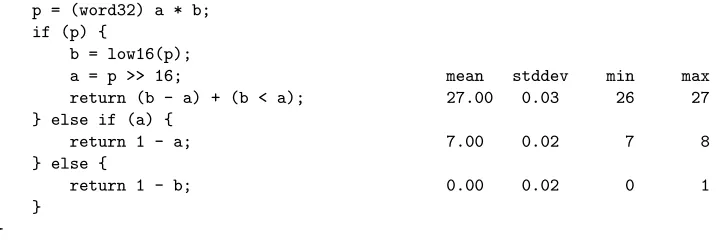
CONST static uint16 mul(register uint16 a, register uint16 b) { register word32 p;
p = (word32) a * b; if (p) {
b = low16(p);
a = p >> 16; mean stddev min max return (b - a) + (b < a); 27.00 0.03 26 27 } else if (a) {
return 1 - a; 7.00 0.02 7 8
} else {
return 1 - b; 0.00 0.02 0 1
} }
Fig. 4.PGP’s implementation of multiplication mod 216+ 1. This routine is called a total of 34 times per IDEA operation. The numbers on the right show the mean, standard deviation, minimum, and maximum number of times each of the corresponding source code lines is visited per IDEA call over 10,000 random keys and a fixed plaintext. The non-zero standard deviation indicates these lines as potential trouble spots, since it means the number of times these lines are executed varies as the secret input varies. Therefore, measuring a program’s behavior on these lines may reveal information about the secret input.
Proof. SinceP is branch-free, for all inputsxand all keys kthe program counter transcriptT ofPk(x) will be the same. For any adversaryA, consider the simulatorSthat runsA, outputting whateverAdoes and answering each queryx thatA makes to its oracle with the value (Pk(x), T). ThenSPk ∼A#Pk# for all k.
In fact, it suffices for P to be free of key-dependent branches. We can use this to show that some looping programs are PC-secure.
Theorem 2. (PC-security of some looping programs). Suppose the program P consists of straight-line
code and loops that always run the same code body for a fixed constant number of iterations in the same order (i.e., the loop body contains no break statements and no assignments to the loop counter; there are no if statements). Then P is PC-secure.
Proof. As before, for all inputsx and all keysk, the program counter transcriptT of Pk(x) will be the same, so we can use the same simulation strategy.
4 Finding Side Channel Attacks With Run-time Profiling
Not only does PC-security give us a way to prove the security of code, but it can also guide us to potential attacks. By looking at the transcripts of programs on many different secret inputs, we can search for key-dependencies in the transcripts. In particular, if we find any inputxand any pair of keys k, k0 so that Pk(x) yields a different program counter transcript than Pk0(x), we can conclude thatP
is not PC-secure. Our algorithm, then is simple: pick an input x; pick many random keys k1, . . . , kn; and look for any variation whatsoever in the resulting program counter transcripts. Variations indicate potential side channel vulnerabilities and thus demand further investigation.
This tool is fairly crude, in several respects. First, it does not gather entire program counter tran-scripts, so it could in principle miss some violations of PC-security. Second, gcov does not handle optimized C code very well, so we focus mainly on unoptimized code. We could work around these limitations by using an emulator, such as Bochs or Valgrind, but we leave this for future work [13]. Still, as we will see, our tool gives us a simple yet powerful test for potential side channel vulnerabilities.
Case Study: IDEA. To gain experience with this approach, we applied our tool to the implementation of the International Data Encryption Algorithm (IDEA) block cipher in PGP, Inc.’s version of PGP 2.6.2. IDEA relies heavily on multiplication modulo 216+ 1. However, this operation is tricky to implement in
a constant-time way, because multiplying by zero must be treated as a special case. Others have shown the existence of timing attacks against some IDEA implementations based on this observation [22].
We decided to apply our tool to PGP’s IDEA implementation. It quickly found several lines of code that were executed more times for some keys than others, indicating the possibility of a side-channel attack. See Fig. 4 for the tool’s output. Upon investigating these key-dependencies, we noticed that these indicate a real vulnerability. In the case where either a or b is zero, the code takes a shortcut and returns in three instructions. If neitheranorbis zero, the code takes six instructions, leading to a timing difference. Thus, our tool sufficed to discover an instance of the aforementioned timing attack, even though our tool contains no special knowledge of that attack.
Upon further investigation, we discovered that these kind of timing dependencies are common in IDEA implementations. PGP 6.58 contains similar code. PGP 2.3a has an even worse timing difference; the multiplication is only carried out if both operands are non-zero.
Other case studies. Through similar methods, we discovered that the lsh implementation of the ssh protocol has different behavior when a username corresponds to a valid user and when it does not. This allows a remote attacker to guess usernames and confirm his guess by measuring the timing behavior of the server’s response. We also found that the implementation of RC5 shipped with TinyOS is not PC-secure. TinyOS is an operating system designed for wireless sensor networks; the RC5 implementation we considered was part of the link-layer encryption scheme TinySEC, though it has since been deprecated and replaced by Skipjack due to patent concerns. These examples illustrate that violations of PC-security are easy to find with runtime profiling, and that they often correspond to side-channel vulnerabilities.
5 Code Transformation for PC-Security
The examples we have seen so far illustrate the relevance of PC-security, but enforcing PC-security by hand is highly application-dependent and labor-intensive. We describe a generic method for transforming code to be PC-secure. Given a programP, the transformed programP0 is PC-secure and has the same
input-output behavior as P on all inputs (i.e., Pk(x) ∼ Pk0(x) for all k, x). It may be surprising that almost all code can be transformed in this way, but we show in the Appendix how this can be done for loops where a fixed upper bound is known at compile time (i.e., primitive recursive function). We first explain informally how our transform works, and then we carefully prove its security.
if (n % 2) { r = r * b; n = n - 1; } else {
b = b * b; n = n / 2; }
m = -(n % 2);
r = (m & (r * b)) | (~m & r); n = (m & (n - 1)) | (~m & n); m = ~m;
b = (m & (b * b)) | (~m & b); n = (m & (n / 2)) | (~m & n);
Fig. 5.Transforming a simpleifstatement to ensure PC-security. On the left, the original, insecure version. On the right, the result of our automatic transformation.
if (n != 0) { if (n % 2) {
r = r * b; n = n - 1; } else {
b = b * b; n = n / 2; }
}
m1 = -(n != 0); m2 = m1 & (-(n % 2));
r = (m2 & (r * b)) | (~m2 & r); n = (m2 & (n - 1)) | (~m2 & n); m2 = m1 & ~m2;
b = (m2 & (b * b)) | (~m2 & b); n = (m2 & (n / 2)) | (~m2 & n);
Fig. 6.An example of our transformation applied to a nestedifstatement.
toa = Cond(m, b, a), wherem = Mask(p). Ifp represents a 0-or-1-valued boolean variable3, this
might expand to the C code m = -p; a = (m & b) | (~m & a).
Fig. 5 shows a complete transformation for part of an iterative exponentiation routine.
Many architectures have conditional instructions that support conditional assignment more natu-rally. For instance, virtually any ARM instruction can be made conditional on a processor flag, and the Pentium Pro and later IA-32 processors have a conditionalmovinstruction. On these architectures, our transform can be implemented more efficiently, but our prototype currently does not attempt to take advantage of native support for conditional assignment.
Nestedifstatements are only slightly more involved. Instead of assigning the mask based solely on the value of the predicate, we use a conditional assignment that depends on the value of the mask for the surroundingif. We conditionally invert the mask before the code for the elseclause based on the enclosing if’s mask. This means that any given statement in the program only needs to care about a single mask forifs, regardless of the level of nesting.
Loops. Loops present difficulties because the number of iterations they will perform may not be known statically, and in particular, the number of iterations may depend on sensitive data. Fortunately, in many cases a constant upper bound can be established on the number of iterations. We transform the loop so that it always executes for the full number of iterations, but the results of any iterations that would not have occurred in the original program are discarded. A specification of our entire transform may be found in Section 5.1
More generally, it would suffice to know that the number of iterations can be upper-bounded by a value that depends only on public inputs (even if this bound is not constant). A future version of our transform might work around this by performing static analysis to determine which loops actually depend on secret data and which do not. We found, however, that for the examples we looked at such an analysis was not necessary.
Fortunately, it is frequently the case, particularly in cryptographic algorithms, that the number of iterations a loop performs is known statically or depends only on non-sensitive data. In these situations, we can leave the loop unchanged. A more interesting scenario is when a loop may execute for a variable number of iterations, but we can establish a reasonably tight upper bound on the number of iterations.
C∈Com = Program E ∈Exp
B ∈BoolExp⊂Exp I ∈Identifier
arithop∈AOp ={+,-,*,&,|}
relop∈RelOp ={>,<,=}
boolop∈BoolOp ={and,or}
n∈Num
(a) Syntactic domains.
C::= I:=E | C0;C00 | if B then C0 else C00
| for I := n to n0 do C0 | break
E::= I | n | B | E0 arithop E00 | ~E0
B::= 0 | 1 | B0 boolop B00 | E0 relop E00 | !B0
(b) Grammar.
Fig. 7.The abstract syntax of IncredibL.
For instance, the loop may contain abreakstatement intended to cause it to exit early in some cases, making the program insecure in the PC model. We transform the loop so that it always executes for the full number of iterations, but the results of any iterations that would not have occurred in the original program are discarded. In essence, this can be thought of as prependingif (loop done)to every statement in the loop, and transforming breakstatements into conditional assignments to loop done.
5.1 Specifying The Transform
With these examples, we are now ready to specify the transform more precisely. As we discuss below, our implementation handles all of the C language. However, the lack of a formal semantics for C makes it difficult to prove anything about C, so we focus on a subset of C that contains most of the language features that are relevant to our analysis. For this subset, we can prove that the transform is semantically preserving and that it produces PC-secure code.
To precisely capture this subset of C, we introduce IncredibL, a simple imperative language with restricted control flow. IncredibL is our own invention, but it is derived from Hennessy’s WhileL [19]. The grammar for IncredibL can be found in Fig. 7.
Roughly, IncredibL captures a memory-safe subset of C with only bounded loops, if statements, and straight-line assignments. Note that we do not allow any forms of recursion or unstructured control flow, as these may introduce unbounded iteration. We also disallow calls to untransformed subroutines, including I/O primitives. Note that because loop bounds are known statically in IncredibL, we can in principle unroll all loops in any IncredibL program to obtain code with no branches.
Our transformationTProgram is specified in Fig. 8. We state the main theorems here. Proofs may be
found in the Appendix.
Theorem 3. TProgram is semantics-preserving: for every valid IncredibL program P and every pair of
inputsk, x, P0
k(x)∼Pk(x), where P0 def
=TProgram[[P]].
Theorem 4. TProgram outputs safe code: for every IncredibL program P, TProgram[[P]] consists only of
straight-line code and loops with straight-line code bodies that run for a fixed constant number of iterations with no assignments to induction variables.
TProgram[[C]] = I0 := -1; TCom[[C]](I0, I0) whereI0 is a fresh identifier
TCom[[I:=E]](Iif, Ibrk) = conditional-assign(I,(Iif & Ibrk), E, I)
TCom[[C;C0]](I
if, Ibrk) = TCom[[C]](Iif, Ibrk);TCom[[C0]](Iif, Ibrk)
TCom[[ifBthenCelseC0]](I
if, Ibrk) = conditional-assign(I0,(Iif&Ibrk),(0-B),0);TCom[[C]](I0, Ibrk);
conditional-assign(I0,(Iif&Ibrk),~I0,0);TCom[[C0]](I0, Ibrk)
whereI0is a fresh identifier
TCom[[forI:=nton0doC]](I
if, Ibrk) = conditional-assign(I0,(Iif & Ibrk),-1,0);
forI:=nton0doTCom[[C]](Iif, I0) whereI0is a fresh identifier
TCom[[break]](Iif, Ibrk) = conditional-assign(Ibrk,(Iif & Ibrk),0, Ibrk)
conditional-assign(I, Em, Et, Ef) = I:= (Et & Em) | (Ef & ~Em)
Fig. 8.A formal specification of our transform.
0.0 0.5 1.0 1.5 2.0 2.5 3.0 3.5 4.0 4.5 5.0
idea idea−xf idea−hand rc5 rc5−xf exp exp−xf
Relative Execution Time
Name Performance Overhead 0.0 0.5 1.0 1.5 2.0
idea idea−xf rc5 rc5−xf exp exp−xf
Relative Code Size
Code Size Overhead
0.0 0.2 0.4 0.6 0.8 1.0 1.2 1.4 1.6 1.8
idea idea−xf rc5 rc5−xf exp exp−xf
Relative Stack Size
Name Stack Size Overhead
Fig. 9.The speed, code size, and stack size overhead of our transform, as applied to modular exponentiation, IDEA, and RC5. The -xf suffix indicates the automatic application of our transform, while the -hand suffix indicates a hand-optimized application of our transform. Values are normalized: the untransformed version of a program takes unit time by definition, while the transformed version of the same program is shown with the relative multiplicative overhead compared to the untransformed version.
5.2 Transform Implementation
We applied our transform to implementations of the IDEA and RC5 block ciphers, which are known to be susceptible to timing attacks unless implemented carefully [22, 18]. We also applied our transform to a simple binary modular exponentiation implementation built on top of the GNU Multiprecision Library. We chose x86 as our reference platform due to its widespread popularity, and we used the Intel C Compiler, Version 8.1 for our performance results. Our tests were run on a 2.8 GHz Pentium 4 running FreeBSD 6-CURRENT (April 17, 2005).
We first optimized our transform by hand on IDEA’s multiplication routine to determine how fast our transform can be in principle. Our hand-optimized transformation achieves a factor of 2×slowdown compared to untransformed code, when both are compiled using the Intel C compiler with-O3.
We then implemented an automatic C source-to-source transformation using the C Intermediate Language package [36]. Our implementation was intended as an early prototype to demonstrate the fea-sibility of applying our transformation automatically. With more careful attention, better performance from an automatic transform may be possible.
Performance results. Our performance results for modular exponentiation, IDEA, and RC5 are pre-sented in Fig. 9. For IDEA, we transformed only the mul routine, which we identified as the main candidate for timing and power attacks. For RC5, we performed the transformation on the rotate rou-tine, for similar reasons. For modexp, we transformed only the main loop, but did not transform GnuMP library functions.
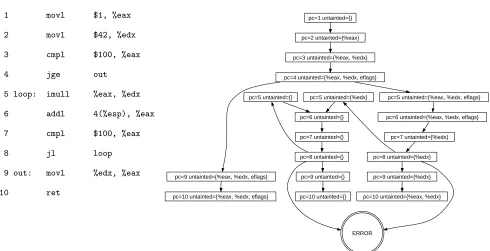
not_pc_secure:
1 movl $1, %eax
2 movl $42, %edx
3 cmpl $100, %eax
4 jge out
5 loop: imull %eax, %edx
6 addl 4(%esp), %eax
7 cmpl $100, %eax
8 jl loop
9 out: movl %edx, %eax
10 ret
pc=1 untainted={}
pc=2 untainted={%eax}
pc=3 untainted={%eax, %edx}
pc=4 untainted={%eax, %edx, eflags}
pc=5 untainted={%eax, %edx, eflags}
pc=9 untainted={%eax, %edx, eflags}
pc=6 untainted={%eax, %edx, eflags}
pc=10 untainted={%eax, %edx, eflags}
pc=5 untainted={%edx}
pc=6 untainted={} pc=5 untainted={}
pc=7 untainted={%edx} pc=7 untainted={}
pc=8 untainted={%edx} pc=8 untainted={}
pc=9 untainted={%edx}
ERROR pc=9 untainted={}
pc=10 untainted={%eax, %edx} pc=10 untainted={}
Fig. 10.Example: State space explored by the static verifier.
that our hand-transformed IDEA code took 2 times as long as untransformed code. We also found that code size increased by at most a factor of 2. Finally, we considered the stack usage of transformed code; this is the most relevant metric of memory usage for systems without dynamically allocated memory.
We can see that both our automatic transform is within a factor of 5 in performance of the optimized untransformed code in all cases. Again, our implementation is a prototype intended to test feasibility; with more work, more efficient code may be possible. Further, our stack size and code size increase by at most a factor of 2, showing that the transformed code may still be reasonable even in constrained environments. Our results suggest that a fully automatic transformation with slowdown acceptable for many applications is possible with care.
A static analysis for PC-security. We cannot guarantee that the compiler will preserve our trans-form’s straight-line + restricted-loop guarantee when it generates assembly language. We addressed this problem by building a simple static checker for x86 assembly code that detects violations of PC-security. If the compiler does introduce assembly constructs that violate PC-security, these constructs will be flagged by the checker. We can then revise the code or improve our transform. Our checker is sound, but not complete: it will catch all violations of PC-security, but may also report false positives.
to avoid the! operator, but we did not find a portable and efficient replacement. Another alternative would be to modify gcc to add an extra mode that respects the PC-security of compiled code; we found it easier, however, to simply use the Intel compiler for our tests. Our experience shows the merely turning off optimizations does not guarantee that transformed C code will be PC-secure after compilation.
The checker works by performing an information flow analysis on the control flow graph for the program. Register and memory locations are classified as either sensitive or public. A public value is one that is derived entirely from constants, whereas a sensitive value is not, and therefore may depend on secret data. The program is simulated on a nondeterministic abstract machine in which each state consists of a program counter and a set of public locations. State transitions are defined solely based on the input/output behavior of the instructions in the program, except for conditional branches, which are handled specially. For these branches, both branch directions are explored nondeterministically. Additionally, if branch predicate is sensitive, the machine transitions to an error state and flags a violation of PC-security.
For these branches, both branch directions are explored nondeterministically. Additionally, if branch predicate is sensitive, the machine transitions to an error state and flags a violation of PC-security.
This approach is sound but not complete; it identifies all actual violations of PC-security, but may also report false positives. False positives arise because some aspects of the execution environment (pointer aliasing in particular) are difficult or impossible to model accurately using our analysis, and so we adopt conservative approximations. Furthermore, the model does not capture the fact that some computations such asx⊕xproduce a public output on sensitive inputs. Nevertheless, these false positives do not appear to be a problem in practice; we encountered none in the programs we examined. Since the verifier only needs to understand data and control flow and not actual instruction semantics, our implementation is relatively simple, consisting of about 1800 lines of Java code. Fig. 10 shows the state space explored on one possible translation of the following C program to x86 assembly.
int not_pc_secure(int x) { int res = 42;
for (int i = 1; i < 100; i += x) res *= i;
return res; }
The program is not PC-secure because the execution of all loop iterations after the first are dependent upon the unknown inputx. The second branch is flagged as a violation of PC-security because it depends on the processor’sless than flag (part of the eflagsregister), which is sensitive at the branch point.
The state space diagram shows that the program is not PC-secure. We find the first branch does not violate PC-security because in the unique control path that reaches it, the flags that determine the branch direction are public. The tool considers both branch directions: the left path (which is infeasible in practice) skips the loop entirely and returns from the function, and the right path executes the loop body. In the rightmost path,4(%esp), the potentially sensitive parameter to the function, is added to %eax, so %eaxis sensitive. Hence,eflagsis made sensitive by the comparison of %eaxto 100 on line 7, and the branch on line 8 is flagged as a violation of PC-security.
6 Related Work
Many previous side channel defenses are application-specific. For example, blinding can be used to prevent timing attacks against RSA [26, 10]. The major advantage of an application-specific defense is that it can be efficient. Experimental measurements show that blinding only adds a 2–10% overhead; contrast this with the overhead we measured in§ 5.2.
Unfortunately, no proof of security for blinding against side channel attacks is known. In the absence of proof, it is difficult to assess whether the defense works. For example, defenses were designed for the five AES finalists [31]. These defenses had no formal model of information leaked to the adversary and hence no way to verify security. In fact, Coron and Goubin later pointed out a subtle flaw in one of the techniques [16]. Bl¨omer, et al., give several more examples of techniques that were thought to be secure but failed, and of cases where innocent-looking “simplifications” failed. These examples motivate their study of provably secure defenses against side channels [8]. We note that Hevia and Kiwi showed that conditional branches in some implementations of DES leak information about the secret key; this is another motivation for PC-security.
Chevallier-Mames, Ciet, and Joye show a clever construction for performing modular exponentiation without incurring undue overhead. They show that, under an appropriate physical assumption, only the Hamming weight of the exponent is leaked by their algorithm. Bl¨omer, et al., also define a model for provable security against side channel attacks and show how to implement AES securely in this model [8]. While these methods are a step forward, they still require a great deal of new effort for each new application.
The programming languages community has studied the problem of secure information flow exten-sively, but most work regarding C code has focused on detecting covert channels and side channels [39], not on eliminating them via code transformation. One exception is Agat’s work, which transforms out timing leaks by inserting dummy instructions to balance out the branches in a program’s control-flow graph [1, 2]. His work is focuses primarily on timing attacks, while our approach is more general. There are also languages such as Jif and Flowcaml that include information flow support as part of the lan-guage [44, 42].
Micali and Reyzin examine “physically observable cryptography” through a framework that is closely related to ours. Their model specifies a “leakage function” (analogous to our notion of transcript) and allows the adversary to measure the outputs of this leakage function on a “physical machine” which may be executing some number of “virtual Turing Machines.” Our model, in contrast, is simpler since we consider only a single program executing at a time. Also, Micali and Reyzin focus more on how side channel attacks affect basic theorems of cryptography, while we are interested in automatic transforms that improve security against such attacks [34]. Goldreich and Ostrovsky also proposed a transformation for RAM machines that makes the sequence of memory accesses independent of the input with polylogarithmic slowdown; this would provide security in our sense with a transcript containing such memory accesses, but we are not aware of any practical implementation [17].
The above defenses focus on software; there are also promising solutions that focus on hardware [41, 3, 4, 38]. To coordinate these defenses, we need a contract between hardware researchers and software researchers as to who will protect what. Our transcript is exactly this: a contract specifying what information the software can expect the hardware to leak to the adversary.
7 Conclusion and Open Problems
interesting class of side channels. With enough work, an even more efficient automatic transformation for PC-security may be possible.
Looking forward, it is an interesting open problem to extend these methods to handle a larger class of side-channel attacks. We have argued that specifying a transcript model as part of the hardware/software interface simplifies development of both hardware and software countermeasures. We leave it as an open problem to find the “right” contract between these two worlds.
8 Acknowledgments
We thank Nikita Borisov, Eric Brewer, Karl Chen, Evan Chang, Adam Chlipala, Rob Johnson, Chris Karlof, Arvind Narayanan, Naveen Sastry, Rusty Sears, Umesh Shankar, and Fran Woodland for dis-cussions and advice. We also thank Eric Brewer for reminding us that every problem can be solved with a supercompiler. David Molnar was supported by an Intel OCR Fellowship and a National Science Foundation Graduate Fellowship. This work supported by NSF ANI-0113941 and NSF CCR-0325311.
References
1. Johan Agat. Transforming Out Timing Leaks. In Proceedings on the 27th ACM Symposium on the Principles of
Programming Languages, 2000.
2. Johan Agat. Type Based Techniques for Covert Channel Elimination and Register Allocation. PhD thesis, Chalmers University of Technology, 2001.
3. Luca Benini, Alberto Macii, Enrico Macii, Elvira Omerbegovic, Massimo Poncino, and Fabrizio Pro. A Novel Ar-chitecture for Power Maskable Arithmetic Units. InProceedings of the 13th ACM Great Lakes symposium on VLSI, 2003.
4. Luca Benini, Alberto Macii, Enrico Macii, Elvira Omerbegovic, Massimo Poncino, and Fabrizio Pro. Energy-aware Design Techniques for Differential Power Analysis Protection. InProceedings of the 40th conference on Design au-tomation, 2003.
5. D.J. Bernstein. Cache-timing attacks on AES, 2005. http://cr.yp.to/papers.html#cachetiming.
6. John Black and Hector Urtubia. Side-Channel Attacks on Symmetric Encryption Schemes: The Case for Authenticated Encryption. InProceedings of the 11th USENIX Security Symposium, 2002.
7. D. Bleichenbacher. Chosen ciphertext attacks against protocols based on RSA encryption standard PKCS #1. In
CRYPTO, 1998.
8. Johannes Bl¨omer, Jorge Guajardo Merchan, and Volker Krummel. Provably secure masking of AES. InSAC, 2004. 9. Johannes Bl¨omer and Jean-Pierre Seifert. Fault based cryptanalysis of the advanced encryption standard (AES). In
FSE 2003, volume 2742 ofLNCS, pages 162–181. Springer-Verlag, 2003.
10. Dan Boneh and David Brumley. Remote Timing Attacks Are Practical. InProceedings of the 12th USENIX Security Symposium, 2003.
11. Suresh Chari, Charanjit Jutla, Josyula R. Rao, and Pankaj Rohatgi. A Cautionary Note Regarding Evaluation of AES Candidates on Smart-Cards. InProceedings of the Second AES Candidate Conference, 1999.
12. Suresh Chari, Charanjit S. Jutla, Josyula R. Rao, and Pankaj Rohatgi. Towards sound approaches to counteract power-analysis attacks. InCRYPTO, 1999.
13. Jim Chow, Ben Pfaff, Tal Garfinkel, Kevin Christopher, and Mendel Rosenblum. Understanding data lifetime via whole system simulation. InUsenix Security, 2004.
14. Christophe Clavier and Marc Joye. Universal exponentiation algorithm: A first step towards provable SPA-resistance.
InCHES 2001, volume 2162 ofLNCS, pages 300–308. Springer-Verlag, 2001.
15. Jean-S´ebastien Coron. Resistance against differential power analysis for elliptic curve cryptosystems. InCHES 1999, volume 1717 ofLNCS, pages 292–302. Springer-Verlag, 1999.
16. Jean-S´ebastien Coron and Louis Goubin. On Boolean and Arithmetic Masking Against Differential Power Analysis.
InProceedings of the Workshop on Cryptographic Hardware and Embedded Systems, 2000.
17. Oded Goldreich and Rafail Ostrovsky. Software protection and simulation on oblivious RAM.J. ACM, 43(3):431–473, 1996.
18. H. Handschuh and H. Heys. A timing attack on RC5. In Lecture Notes in Computer Science: Selected Areas in Cryptography, pages 306–318. Springer-Verlag, 1999.
19. Matthew Hennessy. The Semantics of Programming Languages: an Elementary Introduction using Structural
20. Y. Ishai, A. Sahai, and D. Wagner. Private circuits: Securing hardware against probing attacks. InCRYPTO 2003, 2003.
21. G. Kahn. Natural semantics. InSTACS, pages 22–39, Passau, Germany, 1987.
22. John Kelsey, Bruce Schneier, David Wagner, and Chris Hall. Side Channel Cryptanalysis of Product Ciphers.Journal of Computer Security, 8:141–158, 2000.
23. Auguste Kerckhoffs. La cryptographie militaire. Journal des sciences militaires, IX:5–38, Jan 1883.
24. Vlastimil Klima, Ondrej Pokorny, and Tomas Rosa. Attacking RSA-based sessions in SSL/TLS. InCHES, 2003. 25. Vlastimil Klima and Tomas Rosa. Side channel attacks on CBC encrypted messages in the PKCS #7 format.
Cryp-tology ePrint Archive, Report 2003/098, 2003. http://eprint.iacr.org/.
26. Paul Kocher. Timing Attacks on Implementations of Diffie-Hellman, RSA, DSS, and Other Systems. InProceedings of the 16th Annual International Cryptology Conference, 1996.
27. Paul Kocher, Joshua Jaffe, and Benjamin Jun. Differential Power Analysis. In Proceedings of the 19th Annual International Cryptology Conference, 1999.
28. Fran¸cois Koeune and Jean-Jacques Quisquater. A timing attack against Rijndael. Technical Report CG-1999/1, Universit´e catholique de Louvain, June 1999.
29. Butler W. Lampson. A Note on the Confinement Problem. Communications of the ACM, 16(10):613–615, 1973. 30. J. Manger. A chosen ciphertext attack on RSA optimal asymmetric encryption padding (OAEP) as standardized in
PKCS #1 v2.0. InCRYPTO, 2001.
31. Thomas S. Messerges. Securing the AES Finalists Against Power Analysis Attacks. InProceedings of the Fast Software
Encryption Workshop, 2000.
32. Thomas S. Messerges, Ezzy A. Dabbish, and Robert H. Sloan. Investigations of Power Analysis Attacks on Smartcards.
InProceedings of the USENIX Workshop on Smartcard Technology, 1999.
33. Thomas S. Messerges, Ezzy A. Dabbish, and Robert H. Sloan. Power Analysis Attacks of Modular Exponentiation in Smartcards. InProceedings of the Workshop on Cryptographic Hardware and Embedded Systems, 1999.
34. Silvio Micali and Leo Reyzin. Physically observable cryptography. InTheory of Cryptography, 2004.
35. Bodo M¨oller. Security of CBC ciphersuites in SSL/TLS: Problems and countermeasures, May 2004. http://www. openssl.org/~bodo/tls-cbc.txt.
36. George Necula, Scott McPeak, S.P. Rahul, and Westley Weimer. CIL: Intermediate Language and Tools for Analysis and Transformation of C Programs. InProceedings of the Conference on Compilier Construction, 2002.
37. D. Page. Theoretical use of cache memory as a cryptanalytic side-channel. Technical Report CSTR-02-003, University of Bristol, June 2002.
38. Patrick Rakers, Larry Connell, Tim Collins, and Dan Russell. Secure Contactless Smartcard ASIC with DPA Protec-tion. InProceedings of the Custom Integrated Circuits Conference, 2000.
39. Andrei Sabelfeld and Andrew C. Myers. Language-Based Information-Flow Security.IEEE Journal on Selected Areas in Communications, 21(1):5–19, 2003.
40. Fumihiko Sano, Masanobu Koike, Shinichi Kawamura, and Masue Shiba. Performance evaluation of AES finalists on the high-end smart card. InAES3: The Third Advanced Encryption Standard (AES) Candidate Conference, Apr 2000. 41. Adi Shamir. Protecting Smart Cards from Passive Power Analysis with Detached Power Supplies. InProceedings of
the Workshop on Cryptographic Hardware and Embedded Systems, 2000.
42. Vincent Simonet. Flowcaml, 2005. http://cristal.inria.fr/~simonet/soft/flowcaml/.
43. S. Vaudenay. Security flaws induced by CBC padding - applications to SSL, IPSEC, WTLS... InEUROCRYPT, 2002. 44. Lantian Zheng and Andrew Myers. End-to-end availability policies and noninterference, 2005. Computer Security
A The Transformation
We give a formal definition of our transformation and show that it preserves the semantics of the original program. Although our actual implementation transforms C code, our formal description translates programs written in the simple imperative language called IncredibL, which is based loosely on WhileL [19]. The abstract syntax of this language is given in Figure 7.
A.1 A Natural Semantics for IncredibL
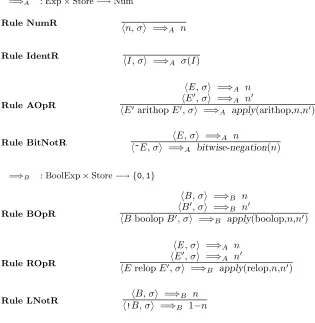
Semantic Domains:
g∈BreakGuard ={eval, skip}
σ∈Store = Identifier7→(Num∪ {unbound})
Expression Transition Relations:
=⇒A : Exp×Store−→Num
Rule NumR hn, σi =⇒
A n
Rule IdentR
hI, σi =⇒A σ(I)
Rule AOpR
hE, σi =⇒A n hE0, σi =⇒A n0
hE0arithopE0, σi =⇒A apply(arithop,n,n0)
Rule BitNotR hE, σi =⇒A n
h~E, σi =⇒A bitwise-negation(n)
=⇒B : BoolExp×Store−→ {0,1}
Rule BOpR
hB, σi =⇒B n hB0, σi =⇒B n0
hB boolopB0, σi =⇒B apply(boolop,n,n0)
Rule ROpR
hE, σi =⇒A n hE0, σi =⇒A n0
hErelopE0, σi =⇒B apply(relop,n,n0)
Rule LNotR hB, σi =⇒B n
h!B, σi =⇒B 1−n
Fig. 11.Operational Semantics of IncredibL for Arithmetic and Boolean Expressions
The IncredibL language has only three control flow constructs: if. . .then. . .else, a Pascal-style for
statement, and abreakstatement to escape from a loop. Loop bounds are required to be constant, which
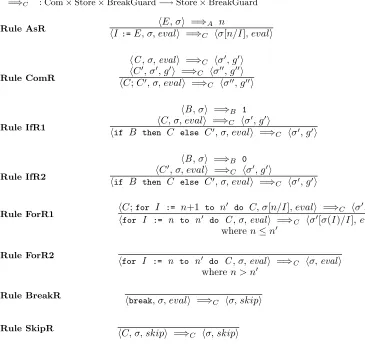
Command Transition Relation:
=⇒C : Com×Store×BreakGuard−→Store×BreakGuard
Rule AsR hE, σi =⇒A n
hI:=E, σ, evali =⇒C hσ[n/I], evali
Rule ComR
hC, σ,evali =⇒C hσ0, g0i hC0, σ0, g0i =⇒C hσ00, g00i hC;C0, σ, evali =⇒C hσ00, g00i
Rule IfR1
hB, σi =⇒B 1 hC, σ, evali =⇒C hσ0, g0i
hif B then C else C0, σ, evali =⇒C hσ0, g0i
Rule IfR2
hB, σi =⇒B 0 hC0, σ, evali =⇒C hσ0, g0i
hif B then C else C0, σ, evali =⇒C hσ0, g0i
Rule ForR1 hC;for I := n+1 to n
0 do C, σ[n/I], evali =⇒C hσ0, g0i hfor I := n to n0 do C, σ,evali =⇒C hσ0[σ(I)/I],evali
where n≤n0
Rule ForR2
hfor I := n to n0 do C, σ,evali =⇒C hσ,evali
wheren > n0
Rule BreakR h
break, σ, evali =⇒C hσ, skipi
Rule SkipR
hC, σ, skipi =⇒C hσ, skipi
In order to make the transform more concrete, our definition includes all of the bit manipulation necessary to implement it on a 2’s complement machine. Therefore, in addition to the usual definitions for addition and subtraction, we assume the following identities for bitwise operators:
∀a:
a& (−1) =a a& 0 = 0 a|0 =a
∼(−1) = 0 ∼0 = (−1)
We useσto denote astore, which can be thought of as a piece of memory where variables are stored. The notationσ[n/I] represents a new store which is the same asσ except the variable named by I now has the valuen. We denote the value of I in store σ as s(I). If I is not bound in the σ, then s(I) has the special value unbound.
The natural semantics[21] of IncredibL are given in Figures 11 and 12. As the IncredibL grammar presented in Figure 7 demonstrates, programs consist of commands, which may modify variables and induce control flow. Commands, in turn, may be composed of arithmetic and boolean expressions, which represent mappings from stores to numerical values, but do not have side-effects. We define three transition relations, =⇒A, =⇒B, and =⇒C, for arithmetic expressions, boolean expressions, and commands, respectively. Note that the image of =⇒B is a subset of the range of =⇒A, so boolean expressions are allowed in arithmetic context. This feature is crucial to the implementation of our transformation.
Our operational description is a natural way to express a simple imperative language such as Incred-ibL. Unfortunately, it does not lend itself well to modelling non-local exit constructs such as break, as
would a denotational definition. To supportbreak, we add a new component called abreak guard to the
command configuration. The guard is normally the symboleval, but it is changed toskipwhen abreak
is encountered. In configurations where it has the latter value, the corresponding command is always ignored, and when the first command in a sequence produces a skip, the skip is propagated through the rest of the sequence. The only command that ignores askipproduced by one of its subcomponents isfor.
Although we omitted the mechanics of it from the grammar of Figure 7 for simplicity, there is also a restriction that well-formed IncredibL programs do not contain anybreak statements outside of a for
loop. Therefore, the final state of any such program is always of the formhσ, evali, for some storeσ.
Subtleties Involving Errors, Loops, and Pointers The careful reader may have noticed that
syntactically well-formed programs may exhibit two types of runtime errors: arithmetic errors, such as divide-by-zero and overflow, and uninitialized variable errors. In general, we consider programs that would crash on certain inputs to be beyond the scope of our work. Note, however, that for both types of errors possible in IncredibL, the C language specifies that execution should continue, with the value of the offending expression being undefined. We could adopt similar semantics by asserting thatunbound
evaluates to0, for instance. By doing so, we can transform correct and erroneous programs alike, and
prove that the resulting code is PC-secure. In practice, it would be better to flag the occurrence of an error and take appropriate action when execution of the algorithm has completed.
side channel are beyond the scope of this paper, and are considered in [37]. Second, in many languages, dereferencing a pointer may lead to side-effects, depending on the value of the pointer. Consider the following snippet of C code, for instance.
if (p != NULL) *p = 42;
If our transformation were applied to this program, the resulting code would construct a mask m based on the value of the boolean expression p != NULL, then perform an assignment tantamount to*p = (42 & m) | (*p & ~m). Since NULL is not a valid memory location, the new program would likely generate a runtime error in cases wherepis NULL, thereby leaking information about p.
Another subtle aspect of IncredibL is the particular semantics of loop counter variables. Like Pascal and unlike C, it is not possible to alter the number of iterations the loop will take by assigning directly to the loop counter. Any such assignment will simply be ignored on the next loop iteration. This is necessary to ensure that all IncredibL programs terminate.
Furthermore, unlike other variables, loop counters are in scope only for the duration of the loop. The operational semantics encode this property by restoring the original value (even if that value is
unbound) at the end of every loop iteration. There is no fundamental reason to impose this restriction;
however, it simplifies the transform significantly. In particular, with these semantics, it is unnecessary for the transform to nullify the changes to the induction variable in cases where the loop would not have been executed in the original program. It also allows us to avoid the issue of how to ensure that the counter has the correct value if the original program uses abreak to escape from the loop.
A.2 Transformation
The transform in Figure 8 is specified in terms of three functions:
TProgram : Program7→Program
TCom : Com×Identifier×Identifier7→Com
conditional-assign: Identifier×Exp×Exp×Exp7→Com
TCom does most of the work, and it can be thought of as an internal subroutine to TProgram. The
identifiers passed as arguments to TCom name variables that will store the control context of the
cor-responding expression at runtime (in the form of masks). Com is a union type, which may represent an assignment command; a sequence of commands; or an if, for, or break command. Therefore, we
deconstruct the first argument to TCom using pattern matching, much as one would do in ML. For
example, the notation TCom[[I := E]](Iif, Ibrk) =· · · indicates that if the command argument is of the
formI := E, then the corresponding rule should be applied with I and E bound appropriately.Iif and
Ibrk, on the other hand, are ordinary formal parameters.
Theconditional-assignfunction implements an abstraction of conditional assignment, without using
if. That is, conditional-assign(I, Em, Et, Ef) produces a command that is equivalent to I := Et ifEm evaluates to-1 at runtime, and equivalent to I := Ef ifEm evaluates to0. Our transform enforces the property thatconditional-assign is never called with anEm that may evaluate to something other than 0 or -1. We prove in Lemma 1 that our implementation of conditional-assign behaves as advertised. However,conditional-assign is merely an abstraction, and it may have a more efficient implementation on particular architectures, e.g. using a conditionalmovinstruction. Admittedly, we neglected to develop an abstraction for the representation of the masks, but doing so would not be difficult.
Combined with the fact IncredibL only allows loops with a fixed constant number of iterations, we can take the above discussion as a proof sketch for the following theorem:
Theorem 5. For every IncredibL programP, TProgram[[P]] consists only of straight-line code and
(pos-sibly nested) loops with straight-line bodies that run for a fixed constant number of iterations with no assignments to induction variables.
Recall that the bounds of aforloop are lexical constants. Since the transformation is able to eliminate break statements, it would even be possible to fully unroll all loops statically, producing straight-line
code. In fact, the transition rule ForR1 effectively performs this unrolling. Therefore, we can view Theorem 5 as a simple extension of Theorem 1. We do not actually perform the unrolling as part of the transform, though, because doing so results in a worst-case exponential blowup in program size.
A.3 Proof of Semantic Preservation
The transformation introduces newfresh identifiers to model the control state of the original program. These identifers are guaranteed not to appear in the original code, so their introduction does not affect the meaning of the program. When we wish to differentiate these two types of identifiers, we will write the store as the union ofσ, which contains the variables that were present in the original program, and σT, which contains variables added by the transformation. By definition,σ and σT are disjoint.
Definition 3 C ∼σT C0 if, for all stores σ,
hC, σ, evali=⇒C hσ0, evali
if and only if
hC0, σ∪σT, evali=⇒C hσ0∪σT0 , evali.
Remark 3. Intuitively, one might try to say that two commandsC andC0 are observationally equivalent
if, for all input stores, they produce the same output store. However, to allow us to prove that the transformation is semantically preserving, the definition above excludes any new variables used internally by the transform.
Lemma 1. Correctness of conditional-assign. If σT(Em) =−1, then
(I := Et)∼σ
T conditional-assign(I, Em, Et, Ef).
If σT(Em) = 0, then
(I := Ef)∼σ
T conditional-assign(I, Em, Et, Ef).
Proof. First, note that conditional-assign(I, Em, Et, Ef) = (I := (Et & Em) | (Ef & ~Em)). Observe that by the transition rules for assignment and expressions, we can replaceEm with its value in σT to
obtain a command that is equivalent with respect to σT. If σT(Em) = −1, then by the identities for bitwise operators described previously,
I := (Et & -1) | (Ef & ~-1)∼σT I :=Et | (Ef & 0)
∼σT I :=Et | 0
∼σT I :=Et
The following lemma states that TCom[[C]](Iif, Ibrk) is essentially a no-op with respect to any store
where either Iif orIbrkis 0.
Lemma 2. For all commands C, if σT(Iif) = 0 or σT(Ibrk) = 0, then
hTCom[[C]](Iif, Ibrk), σ∪σT, evali=⇒C hσ∪σ0T, evali.
Furthermore,σT(Iif) =σT0 (Iif) andσT(Ibrk) =σ0T(Ibrk).
Proof. Consider all five possible deconstructions of C:
1. If C = I :=E, then TCom[[C]](Iif, Ibrk) = conditional-assign(I,(Iif & Ibrk), E, I). The expression
(Iif & Ibrk)evaluates to0with respect toσT, so by Lemma 1, the conditional assignment is equivalent toI :=I. Transition rulesAsR andIdentRyield
hI :=I, σ∪σT, evali=⇒∗C hσ[σ(I)/I]∪σT, evali
Observe that σ[σ(I)/I] =σ.
2. IfC =C0;C00, thenTCom[[C]](Iif, Ibrk) =TCom[[C0]](Iif, Ibrk);TCom[[C00]](Iif, Ibrk). We may assume by
structural induction that the following statements hold:
hTCom[[C0]](Iif, Ibrk), σ∪σT, evali=⇒C hσ∪σT0 , evali σT(Iif) =σ0T(Iif) and σT(Ibrk) =σ0T(Ibrk)
The second line implies that one ofσ0
T(Iif) and σT0 (Ibrk) is0, so we may also conclude by induction
that
hTCom[[C00]](Iif, Ibrk), σ∪σT0 , evali=⇒C hσ∪σT00, evali. σT(Iif) =σT0 (Iif) =σT00(Iif) andσT(Ibrk) =σT0 (Ibrk) =σ00T(Ibrk)
Then by transition rule ComR,hTCom[[C]](Iif, Ibrk), σ∪σT, evali=⇒C hσ∪σ00T, evali.
3. If C = ifB thenC0 elseC00, then TCom[[C]](Iif, Ibrk) introduces two conditional assignments of the
form conditional-assign(I0,(Iif & Ibrk),2,0), where I0 is a new identifier. Since (Iif & Ibrk) evaluates to0with respect to σT, Lemma 1 implies that both of these conditional assignments are equivalent
toI0 := 0. Therefore, by induction:
hTCom[[C0]](I0, Ibrk), σ∪σT, evali=⇒C hσ∪σT0 , evali
hTCom[[C00]](I0, Ibrk), σ∪σ0T, evali=⇒C hσ∪σT00, evali
Hence, hTCom[[C]](Iif, Ibrk), σ∪σT, evali =⇒C hσ ∪σ00T[0/I0], evali. We also note that σT(Iif) =
σ00
T(Iif) and σT(Ibrk) =σ00T(Ibrk) for the same reasons as in case 2.
4. Suppose C = forI :=nton0 doC0. Just as in case 3, the conditional assignment in the transform
of the for is reducible toI0 := 0. Hence, the evaluation of TCom[[C0]](Iif, I0) preserves σ and σT(Iif)
by structural induction. If n > n0, then rule ForR2 applies and the proof is trivial. Otherwise, rule
ForR1 applies and we assume by induction onnthat
hfor I := n+ 1 to n0 do TCom[[C0]](Iif, I0), σ[n/I]∪σ0T, evali =⇒C hσ[n/I]∪σT00, evali
where σ00T(Iif) = σT0 (Iif) = σT(Iif). Therefore, the conclusion of ForR1 asserts that the entire for
expression evaluates to hσ[n/I][σ(I)/I]∪σ00
T, evali=hσ∪σ00T, evali.
5. If C = break, then TCom[[C]](Iif, Ibrk) = conditional-assign(Ibrk,(Iif & Ibrk),0, Ibrk). By assumption,
eitherIif orIbrkis 0inσT, so by Lemma 1, the conditional assignment is equivalent toIbrk := Ibrk.