Type of the Paper (Article, Review, Communication, etc.)
1
AN ANDROID MUTATION MALWARE
2
DETECTION BASED ON DEEP LEARNING USING
3
VISUALIZATION OF IMPORTANCE FROM
4
CODES
5
Yao-Saint Yen 1 and Hung-Min Sun 2
6
1 National Tsing Hua University; [email protected]
7
2 National Tsing Hua University; [email protected]
8
9
Abstract: Using smartphone especially android platform has already got eighty percent market
10
shares, due to aforementioned report, it becomes attacker’s primary goal. There is a growing
11
number of private data onto smart phones and low safety defense measure, attackers can use
12
multiple way to launch and to attack user’s smartphones.(e.g. Using different coding style to
13
confuse the software of detecting malware). Existing android malware detection methods use
14
multiple features, like safety sensor API, system call, control flow structure and data information
15
flow, then using machine learning to check whether its malware or not. These feature provide app’s
16
unique property and limitation, that is to say, from some perspectives it might suit for some specific
17
attack, but wouldn’t suit for others. Nowadays most malware detection methods use only one
18
aforementioned feature, and these methods mostly analysis to detect code, but facing the influence
19
of malware’s code confusion and zero-day attack, aforementioned feature extraction method may
20
cause wrong judge. So, it’s necessary to design an effective technique analysis to prevent malware.
21
In this paper, we use the importance of word from apk, because of code confusion, some malware
22
attackers only rename variables, if using general static analysis wouldn’t judge correctly, then use
23
these importance value to go through our proposed method to generate picture, finally using
24
convolutional neural network to see whether the apk file is malware or not.
25
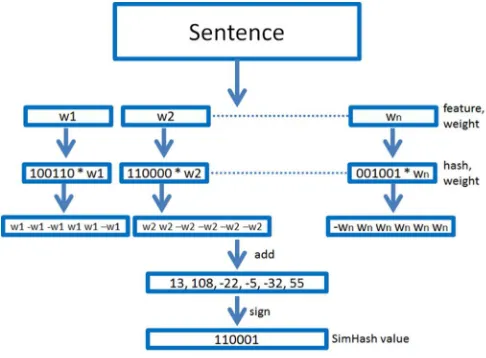
Keywords: Android; Malware; Convolutional Neural Network
26
27
1. Introduction
28
Nowadays, smart mobile device gets more popularity, many of people use mobile device instead
29
of traditional phones. According to IDC (International data corporation) website, the whole
30
worldwide smartphone market grows 1.1% every year.
31
In another side of rapid growth, this information let malware producers want to steal the private
32
information from all users. Nowadays, the mobile malware become serious issue that many
33
researches try to detect and to lower the influence of malware in smartphones[2].
34
Some research finds out that most of method that made malware is to copy similar malware
35
code or makes minor alterations and turn into similar function malware[3], so they might contain
36
similar malware code.
37
In this paper, we propose a deep learning based method to detect android malware by extracting
38
code from apk, and then find the importance of each word in total contents and then digitized it. By
39
coding confusion, some malware attackers only rename the variable, if using general static analysis
40
wouldn’t determine correctly, so we arrange the word’s order by it’s important value, then separate
41
certain quantity word’s important value into multiple groups, each group contain certain quantity
42
words, then using these groups to convert into image, finally using convolutional neural network to
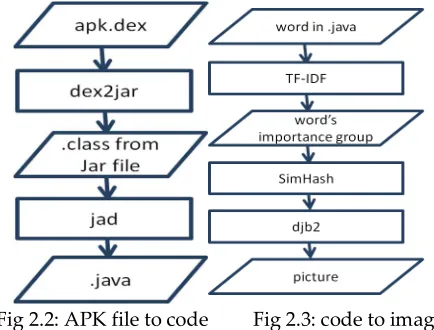
43
see whether the apk is malware or not.
44
2. Materials and Methods
45
2.1 Algorithm used in this paper
46
2.1.1 Simhash
47
In computer science, SimHash is a technique for quickly estimating two similar files. Google
48
Crawler uses this algorithm to find near duplicate pages. SimHash is made by Moses Charikar[10].
49
SimHash’s step roughly divided into five steps, participle, hash, weight, combine,
50
dimensionality reduction.
51
Participle, give a sentence, doing segment, then gets effective feature vectors, and weight each
52
feature vector set(if it is given a text, then the feature vector is the text of the word, the weight is the
53
number of times the word can appear). The importance of the numbers in parentheses represents the
54
word in the whole statement, the larger the number represents more important.
55
Hash, through hash function to compute each feature vector’s hash value. In this way, the string
56
becomes a series of numbers.
57
Weight, based on hash value, weighted all feature vector.
58
Dimensionality reduction, for cumulative results of aforementioned, which will get the SimHash
59
value from that sentence, so that we can according to different sentence’s SimHash value to judge
60
their similarity degree. In Figure: 2.1, show that the simple example how SimHash algorithm works.
61
62
63
Fig 2.1: Example of SimHash
64
65
2.1.2 Djb2
66
Djb2[11] is a non-cryptographic hash function, made by Daniel J. Bernstein. It is based on module
67
multiplication[12]. It is closely related to Rabin fingerprints[13], in fact, it can be seen as a special case
68
of that.
69
2.2 System architecture
70
This part, we will introduce our overview of architecture, from turning apk file into code to
71
generate image and through convolutional neural network to detect the result of training.
72
2.2.1 Apk file to code
73
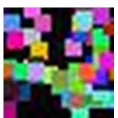
To decompile apk, most popular method on internet belongs to Apktool[19], a tool to reverse
74
engineering’s 3rd party, closed, binary Android apps. Apktool can do decode resources to nearly
75
original form and rebuild them even if making some modifications.
76
And dex2jar[20], a tool for converting Android’s .dex file, which is in turn zipped into a single
77
apk file on the device. .dex files can be created by automatically by Android translating compiled
78
applications then written in Java programming language, to Java’s .class file.
79
We use dex2jar to decompile apk file, after using dex2jar, apk file will turn into jar file(Java
80
ARchive), which is a package file format that used to aggregate many Java class files and associated
81
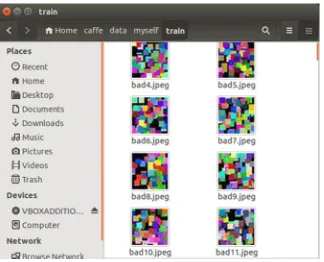
metadata and resources (text, images, etc.) into one file [21]. When getting jar file, inside jar file, we
82
extract the .class file, then we used Jad this tool to convert .class file to .java file, to complete this part.
83
2.2.2 Using code to generate image
85
We generated image from code by using the word importance from code, using method called
86
TF-IDF(term frequency-inverse document frequency) to find out the importance value of word in
87
every sample apk, when got every word’s important value in apk, we packed words into multiple
88
groups, the order of sequence inside groups and among groups is by the importance value of each
89
word, when got whole groups in apk, we used aforementioned SimHash algorithm to generate x-axis
90
and y-axis, and gjb2 algorithm to generate it’s red, green and blue value. Finally, using the
91
aforementioned data into convolutional neural network to observe how the result is, overall process
92
shown in Figure 2.3.
93
94
95
Fig 2.2: APK file to code Fig 2.3: code to image
96
97
2.2.3 TF-IDF
98
Term frequency-inverse document frequency is a commonly used weighting technique for
99
information retrieval and text mining. It is a statistical method to evaluate importance of a word to
100
one of the archives or one of the corpora. The importance of words increases in proportion to the
101
number of times they appear in the archives, but at the same time declines inversely with the
102
frequency of their occurrence in the corpus. TF-IDF weighted forms is often used by search engines
103
as a measure or rating of the degree of correlation between files and user queries.
104
TF, term frequency, refers to the frequency of a given word in the file.
105
IDF, inverse document frequency, a given term can be divided by the total number of documents
106
divided by the number of documents containing the word, and then resulting quotients is obtained
107
by logarithms.
108
The high word frequency in a particular file, and the low file frequency in the entire set of
109
documents, can produce a high weight TF-IDF. As a result, TF-IDF usually filter general words out
110
and retain most important words.
111
2.2.4 Implementation
112
In this part, we will go through flowchart of our proposed method. step by step. Figure 2.4 shows
113
the flowchart of our paper.
114
115
117
Firstly, we collected total 1440 apk files, 720 for malware, and 720 for non-malware, we
118
decompiled those apk files into codes using aforementioned method, dex2jar and jad tools, we put
119
all apk files into directory, then using python script to successive executing dex2jar and jad tools for
120
each apk file that in executed directory to generate the code we want, then put all java code that
121
belongs to this apk into one txt file.
122
After generating all txt files in that directory, we used TF-IDF method to compute the important
123
value of each word in txt file through whole txt files, in this part, we also use python script to do this
124
work, after computing the important value of each word, we arrange the order by value’s size, then
125
we divide the whole important values from apk file into several groups, then take a certain amount
126
of groups into next step, the step to produce pictures.
127
In this step to produce pictures, firstly, we take one by one group into Simhash algorithm, that
128
algorithm will see that group as sentence, and gonna generate the X-axis and Y-axis of the picture.
129
After generating the X-axis and Y-axis of the picture, then using the same group to go through djb2
130
algorithm to get red, green, blue value, forming pixel values, to provide a more convenient visual
131
analysis, we put pixels around the pixel that generated coordinates that are recorded simultaneously,
132
in Figure 2.5, shows how it works. If encounter overlap situation, we will choose the first one which
133
comes earlier as the first priority, shown in Figure 2.6.
134
After all aforementioned steps, we got the image that we need, then we used convolutional
135
neural network to train the network then test the network.
136
137
138
Fig 2.5: Nine pixels recording Fig 2.6:Overlapping pixels
139
140
The final image that go through aforementioned steps and came out like Figure 2.7 picture, we
141
used lots of these pictures to train and to test the convolutional neural networks. We used 720 normal
142
apk files, 500 for training, and 220 for testing, and 720 malware apk files, 500 for training and 220 for
143
testing.
144
145
Fig 2.7: Example of generated image
146
3. Results
147
In this part, we will show the result of our proposed method, and compare to Ajit Kumar, K
148
Pramod Sagar, K. S. Kuppusamy, and G. Aghila’s method[22], which is used machine learning
149
based method to detect android malware program that using analyze the visual representation of
150
binary format apk file into several color formats.
151
Ajit Kumar, K Pramod Sagar, K. S. Kuppusamy, and G. Aghila’s method uses several machine
152
learning algorithms, such as decision tree[23], random forest[24], and k-nearest neighbors[25]
153
algorithms to go through their proposed method. Then they observed that the best result is when
154
In this paper, we use Caffe[26], which is a convolutional neural network framework, with
156
expression, speed, and modularity, it’s developed by Berkeley AI Research. We used this tool to
157
train and to test the convolutional neural network. In Caffe, it has to divide our data into two
158
directories, training directory, and validation directory, show in Figure 3.1 and Figure 3.2.
159
160
Fig 3.1: Directory of validation
161
162
Fig 3.2: Directory of training
163
After dividing whole data into those directories, we need to tell Caffe which belongs to malware
164
apk file’s image, and which belongs to non-malware apk file’s image by creating texture files, for
165
testing, training, and validation, feed those information to Caffe.
166
After doing aforementioned steps, we start training our data, and for every 500 iterations will print
167
the result of testing accuracy. Our result show in Figure 3.4, the first 500 iterations prints the
168
accuracy is 80.33%, the second 500 iterations prints accuracy of 88.67%, and the third 500 iterations
169
prints the accuracy is 91.55%, then it will gradually converge into 92.67%, better than Ajit Kumar, K
170
Pramod Sagar, K. S. Kuppusamy, and G. Aghila’s method. Figure 3.4 shows after iterating 1000
171
time’s accuracy value, blue line is our proposed method, and orange line is Ajit Kumar’s method.
172
173
4. Discussion
175
Authors should discuss the results and how they can be interpreted in perspective of previous
176
studies and of the working hypotheses. The findings and their implications should be discussed in
177
the broadest context possible. Future research directions may also be highlighted.
178
5. Conclusions
179
This paper presented a method that can android malware using visualize the code’s importance
180
value into an image and then using convolutional neural network to train and to test the result, our
181
result presented nighty two percent of accuracy, it’s better than compared method, which using
182
machine learning based method to detect android malware program that using analyze the visual
183
representation of binary format apk file into several color formats, and it’s result presented eighty six
184
percent of accuracy..
185
186
References
187
1. M. La Polla, F. Martinelli, and D. Sgandurra, “A Survey on Security for Mobile Devices,” IEEE Commun.
188
Surv. Tutorials, vol. 15, no. 1, pp. 446–471, 2013.
189
2. Cheng, Chien-Wen, “Identifying potentially malicious behavior inside android malware by static code
190
analysis”, 2013, retrieved from http://handle.ncl.edu.tw/11296/ndltd/44175699278460400644
191
3. G. Suarez-Tangil, J. E. Tapiador, P. Peris-Lopez, and J. B. Alis, “Dendroid: A text mining approach to
192
analyzing and classifying code structures in android malware families,” Expert Systems with Applications,
193
2013, in Press.
194
4. Q. Li and X. Li. Android malware detection based on static analysis of characteristic tree. In Cyber-Enabled
195
Distributed Computing and Knowledge Discovery (CyberC), 2015 International Conference on, pages 84–
196
91. IEEE, 2015
197
5. SimHash-Wikipedia, retrieved from https://en.wikipedia.org/wiki/SimHash
198
6. DJB2-Wikipedia, retrieved from https://en.wikipedia.org/wiki/DJB2
199
7. djb2-hashfunction, retrieved from http://www.cse.yorku.ca/~oz/hash.html
200
8. Rabin fingerprint-Wikipedia, retrieved from https://en.wikipedia.org/wiki/Rabin_fingerprint
201
9. K. Han, J. H. Lim, and E. G. Im, “Malware analysis method using visualization of binary files,” Proc. 2013
202
Res. Adapt. Converg. Syst., pp. 317–321, 2013.
203
10. L. Nataraj, S. Karthikeyan, G. Jacob, and B. S. Manjunath, “Malware images: visualization and automatic
204
classification,” Proc. 8th Int. Symp. Vis. Cyber Secur., p. 4, 2011.
205
11. K. Kancherla and S. Mukkamala, “Image visualization based malware detection,” Proc. 2013 IEEE Symp.
206
Comput. Intell. Cyber Secur. CICS 2013 - 2013 IEEE Symp. Ser. Comput. Intell. SSCI 2013, pp. 40–44, 2013.
207
12. K. S. Han, J. H. Lim, B. Kang, and E. G. Im, “Malware analysis using visualized images and entropy
208
graphs,” Int. J. Inf. Secur., pp. 1–14, 2014.
209
13. S. Z. M. Shaid and M. A. Maarof, “Malware Behavior Image for Malware Variant Identification,” 2014 Int.
210
Symp. Biometric Secur. Technol., pp. 238–243, 2014.
211
14. Ajit Kumar, K Pramod Sagar, K. S. Kuppusamy, and G. Aghila, “Machine learning based malware
212
classification for Android applications using multimodal image representations”, Intelligent Systems and
213
Control (ISCO), 2016 10th International Conference on, 2016
214
15. Decision tree-Wikipedia, retrieved from:
215
https://en.wikipedia.org/wiki/Decision_tree
216
16. Random forest-Wikipedia, retrieved from:
217
https://en.wikipedia.org/wiki/Random_forest
218
17. k-nearest neighbors-Wikipedia, retrieved from :
219
https://en.wikipedia.org/wiki/K-nearest_neighbors_algorithm
220
18. Caffe-Deep Learning Framework, retrieved from:
221
http://caffe.berkeleyvision.org/