195 |
P a g e
INTRUSION DETECTION USING FEATURE SELECTION
BY OPTIMIZATION WITH ARTIFICIAL NEURAL
NETWORK
Ankita
1, Astha Gautam
21
Computer Science and Engineering, L.R. Institute of Engineering and Technology, (India)
2
Computer Science and Engineering, L.R. Institute of Engineering and Technology, (India)
ABSTRACT
The main objective of intrusion detection systems (IDS) is to discover the dynamic and the malicious form of network traffic that simply changes according to the characteristics of the network. The IDS methodology represents a prominent developing area in the field of computer network technology and its security. Different form of IDS has been developed working on distinctive approaches. One such kind of approach where it is used is the machine learning mechanism. In the proposed methodology an experiment is applied on the data-set named as KDD-99 including its subclasses such as denial of service (DOS), other types of attacks and the class without any form of attack. Depending upon the machine learning algorithms various distinct forms of IDS have been developed which further checks the optimization based potential features in connection with the neural network classifier for the various forms of IDS based attacks. This approach provides a comparative study between the ANN and the optimizer-based ANN technology. The experimental analysis shows the convolution neural network with ANN_GWO show effective analysis providing accurate forms of IDS thereby improving its detection based on individual class along with maintaining its results fundamentally.
Keywords: Intrusion detection systems, Denial of Service, Artificial Neural Network.
I.
INTRODUCTION
intrusion. The illegal hackers of the security have found a large number of ways to break the security of the system whether it is a cloud network or the wireless-based network. Many researches have been performed by the technologists to curb the security threats from distinct forms of intrusions done to the cloud computing systems and the wireless system. So, the main objective of IDS is to protect the information whether it is governmental, public or private entity [8-10].
Fig.1
Basic structure of IDSII.
LITERATURE SURVEY
197 |
P a g e
from the training set KDD Cup 99. It had been in a position to greatly shorten working out time, but also enhance the resultant SVM-based performance. The procedure of feature-based selection process was put on eliminating insignificant features coming from the set of established therefore the acquired SVM unit could sort out the network traffic info more precisely. The popular dataset i.e. KDD Cup 1999 was mainly used to judge the recommended system. Weighed against other attack detection devices that were derived from the same dataset, this technique exhibited improved performance in the discovery of Probe and DoS attacks along with best overall performance in general accuracy. Modi, et.al [4] conducted a survey on different intrusions that affected the integrity of cloud- resources, confidentiality, availability, and the services linked. The proposals of subsuming the IPS i.e. Intrusion Prevention Systems and IDS i.e. Intrusion Detection Systems in cloud technology are examined. The researcher‟srecommended the positioning of IDS/IPS in Clouded environment to acquire the needed security in the next generation future-based network developments.Muhammad Hilmi Kamarudin, et.al [5] proposed their study on technology of network security that has become a supreme method for the protection of information or the data. With the excessive growth of internet technology, various forms of attack cases are observed in a day to day life. So, to tackle such kind of attacks, a methodology of IDS is adopted and the process of Machine Learning is the most used technology in the IDS. The study based on recent years has shown that the Machine Learning Intrusion Detection system provides a good detection rate and a high accuracy. Thus this paper includes performance analysis based on Machine Learning algorithm known as Decision Tree (J48) where a comparison has been done with two of the other machine learning algorithms named as the NN and the SVM‟s. These algorithms were tested on the strategy of false alarming rate, rate
behalf of intrusion detection. Deepika P Vinchurkar, et.al [8] directed a research on Intrusion Detection Systems that consists of high-level security of networks and thus provides the system dealing with security of network and the intrusion based attacks. The ideal features of IDS includes a monitoring activity of network and the threats. The IDS is generally classified on the basis of the model and the data-source. But some of IDS techniques are more challenging in nature. The anomaly based IDS can be detected easily using various anomaly detection techniques. The process of dimension reduction is based on the analysis of principle component. The problem of construction classifier can be identified using a Support Vector Machine methodology. Nadiammai, et.al [9] focused upon the security issue of the networks and various developments in applications running on distinct platforms capturing an attention towards security of the network. This type of paradigm exploited the vulnerabilities of security that on technical basis was expensive and difficult to resolve. Hence intrusion can be used as a significant factor to compromise the confidentiality, availability, and integrity of a computer-based resources. IDS performs an essential part in discovering attacks and anomalies inside the network. In this ongoing working method, data exploration notion was usually combined with an IDS to recognize the kind of, hidden and relevant interested data for an individual efficiently and with a smaller amount execution time. Four type of problems such as for example Classification of Data, Conversation based on High Level Human, Insufficient Tagged (labelled) Data, and Efficiency of Distributed DoS (Denial of Service Attack) attack was being resolved using the suggested algorithms just like Hybrid IDS model, Semi-Supervised Method, EDADT algorithm, and HOPERAA Varied Algorithm. Our recommended algorithm continues to be tested applying dataset (KDD Cup). All of the proposed protocol (algorithms) showed improved accuracy and reduced rate of fake alarm in comparison to existing algorithms.
III.
PROPOSED METHODOLOGY
3.1 Proposed Methodology
To obtain the pre-thesis objective a methodology has been proposed which is further divided into three types of phases.
Phase 1: Collection and preprocessing Data-set collection
Extraction of features through a data i.e.“tcpdump” Converting the obtained features into binary representation Preparation of the input for its classification
Phase 2: Classification
199 |
P a g e
To test and train the tool of classification by the dataset-partitioning process.Phase 3: Result analysis
To compare the obtained results with their existing work.
The proposed working methodology is designed as below in figure.
3.2 Proposed methodology: Flowchart
Fig.6
Proposed FlowchartIV.
RESULT ANALYSIS
201 |
P a g e
4.1 Result AnalysisTable.1
KDD CUP 99 dataset based attack typeTable.2
Data used to study the effectiveness of the four approaches for above discussed attackNormal Dos R2L U2R Probe
Smurf PHF Root-kit Portsweep
Process table Xlock Eject Satan
Pod Send-mail Perl Saint
Land Guess_password Buffer overflow M-scan
Table.3
Algorithm Types vs. Types of attack in terms of precision, F-measure, accuracy and recallAlgorithm type Types of
attack
Accuracy Precision Recall F-measure
ANN Other
attack
87 84 87 83
Dos Attack
88 87 89 84
Normal Attack
90 87 86 86
ANN with GA Other attack
94 88 85 87.23
Dos Attack
89 91 86 86.23
Normal 90 90 83 89.13
Artificial Neural Network Artificial Neural Network with GA Artificial Neural Network with PSO ANN_GWO
Accuracy 89.32 93 90 96.23
Precision 88.45 91 90.38 97.33
Recall 87.12 92 92 98.33
Attack ANN with PSO Other
attack
92 90 85 84.23
Dos Attack
95 89 87 83.23
Normal Attack
91 89 90 87.34
ANN_GWO Other
attack
98.62 96.23 97.33 95.23
Dos Attack
92.23 90.23 96.33 95.13
Normal Attack
97.23 96.13 99.56 92.23
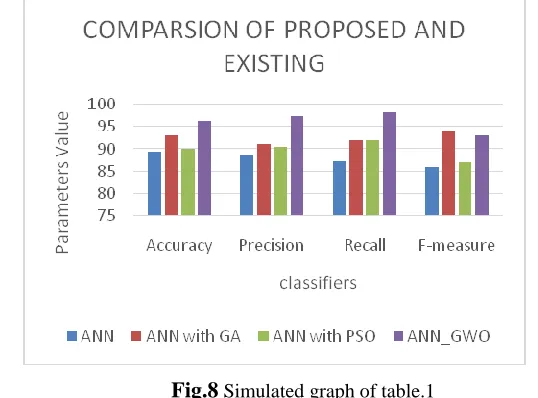
1. Simulation is used to study the statistical data in this section. Result of table.1 and 3 is given by simulation process is presented in graphical form.
Fig.8
Simulated graph of table.1203 |
P a g e
Network with both GA and PSO represented by blue colour. Evaluation exhibits that the ANN with GA and PSO provides better effect when it comes to all of the four guidelines (accuracy, accuracy, recall, F-measure).Fig.9
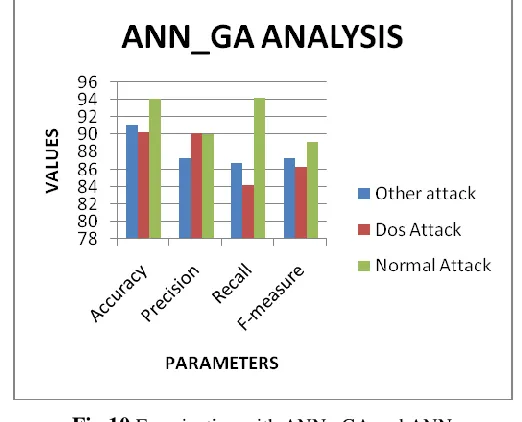
Analysis of ANNFigure 9 and 10 parameters investigation of various proposed and classifier approach. In case of investigation parameters such as exactness, review, precision and f measure fluctuate as indicated by classifier yet one examination clear about suggested approach (PSO with GA in neural system) demonstrate huge enhance all parameters. In the event that examination just proposed methodology, review demonstrate huge enhancement then different parameters so it will clear sign.
Fig.10
Examination with ANN _GA and ANNNetwork with GA. In this examination we endeavor to indicate what the criticalness of our methodology is. This exchange we proceed in perception (3) moreover. So first point which examination by typical class „n‟ with no assault
working and in the two cases Artificial Neural Network and Artificial Neural Network with GA perform well contrast with other parameter like exactness, review and f-measure yet ANN_GA still preferable precision over ANN so include weighted by enhancement by one way or another perform in view of decreasing covering data learning. On the off chance that examination through DOS assault it additionally indicate higher exactness in ANN with GA.so we can close Feature advance weight is better methodology so by what means can enhance improvement these perception talk about in next standard.
75 80 85 90 95 V al u e s Parameters
ANN_PSO Analysis
Other attack Dos Attack Normal AttackFig.11
Analysis of ANN _PSO85 90 95 100 105 V al u e s parameters
ANN_GWO ANALYSIS
Other attack Dos Attack Normal AttackFig.12
Analysis with ANN _PSO and ANN_GWO205 |
P a g e
characterization. On the off chance that investigation the both chart demonstrate the compelling review however for ordinary class so decrease the false positive rate this enhancement occurring with all classes like DOS assault and different assaults yet the viable outcome appear in other assault which increment fundamentally in proposed approach. So PSO streamlining is great however PSO with GA more enhance in other assault and ordinary class.V.
CONCLUSION
Intrusion can be characterized in terms of confidentiality, integrity, and availability. An event or action causes a breach of confidentiality if it allows to access resources, residing in a computer in an unauthorized manner. An event or action causes a breach of integrity if it allows to change the states of resources, residing in a computer in an unauthorized manner. Similarly, an event or action causes a breach of availability if it prohibits legitimate users to access resources or services, residing in a computer. Intrusion detection is the process of monitoring the events occurring in a computer system or network and analyzing them for signs of intrusions. An intrusion detection system is a software or hardware that automates the process of monitoring and analyzing of events. The present scenario experiences various forms of developments and huge growth in advanced processing technologies consisting of connectivity among different networks but the methodology is vulnerable by the activities of the intruders or the attackers of the system. These specifically smart attackers interrupt the operation with new and fascinating methods of data-breaching among large networks. Though there are various forms of available intrusion of intrusion detection systems that can detect the intrusions occurring in the network i.e. based on the false positive detection rate and the alert rates but with the detection rate of intrusions, they also have a high false-positive rate resulting in an adequate system comprising of low accuracy level of the system and are generally more prone to different kinds of attack. This usually helps the intruder to enter into the system and perform a pre-planned attack. So, this pre-thesis will propose a hybrid approach to reduce false positive alarms. The experimental analysis consists of a specified particular form of data-set and the process of feature-based selection will be done to improve the analysis. These features obtained will be used for the classification-tool training and testing the performance of the system. Finally, the result obtained will be compared with the results that already exist.
REFERENCES
[1] Wu, Shelly Xiaonan, and Wolfgang Banzhaf. "The use of computational intelligence in intrusion detection systems: A review." Applied soft computing 10, no. 1 (2010): 1-35.
[3] Horng, Shi-Jinn, Ming-Yang Su, Yuan-Hsin Chen, Tzong-Wann Kao, Rong-Jian Chen, Jui-Lin Lai, and Citra Dwi Perkasa. "A novel intrusion detection system based on hierarchical clustering and support vector machines." Expert systems with Applications 38, no. 1 (2011): 306-313.
[4] Modi, Chirag, Dhiren Patel, Bhavesh Borisaniya, Hiren Patel, Avi Patel, and Muttukrishnan Rajarajan. "A survey of intrusion detection techniques in cloud." Journal of network and computer applications 36, no. 1 (2013): 42-57.
[5] Jalil, Kamarularifin Abd, Muhammad Hilmi Kamarudin, and Mohamad Noorman Masrek. "Comparison of machine learning algorithms performance in detecting network intrusion." In Networking and Information Technology (ICNIT), 2010 International Conference on, pp. 221-226. IEEE, 2010.
[6] Elshoush, Huwaida Tagelsir, and Izzeldin Mohamed Osman. "Alert correlation in collaborative intelligent intrusion detection systems—A survey." Applied Soft Computing 11, no. 7 (2011): 4349-4365.
[7] Mohammed, Muamer N., and Norrozila Sulaiman. "Intrusion detection system based on SVM for WLAN." Procedia Technology 1 (2012): 313-317.
[8] Vinchurkar, Deepika P., and Alpa Reshamwala. "A Review of Intrusion Detection System Using Neural Network and Machine Learning." (2012).
[9] Nadiammai, G. V., and M. Hemalatha. "Effective approach toward Intrusion Detection System using data mining techniques." Egyptian Informatics Journal 15, no. 1 (2014): 37-50.
[10] Agrawal, Shikha, and Jitendra Agrawal. "Survey on anomaly detection using data mining techniques." Procedia Computer Science 60 (2015): 708-713.
[11] J. Jabez, B. Muthukumar, ”Intrusion Detection System (IDS): Anomaly Detection Using Outlier Detection Approach”,
Procedia Computer Science, Volume 48, 2015, Pages 338-346, ISSN 1877-0509,
http://dx.doi.org/10.1016/j.procs.2015.04.191.
[12] Farnaaz, Nabila, and M. A. Jabbar. "Random forest modeling for network intrusion detection system." Procedia Computer Science 89 (2016): 213-217.