ISOMORPHISM IN PLANAR KINEMATIC CHAINS-A CASE
STUDY IN GRAPH THEORY ALGORITHM
Vinjamuri Venkata Kamesh
Professor of Mechanical Engineering,Aditya Engineering College(A)
SURAMPALEM-533 437East Godavari DistrictAndhra Pradesh (India)
ABSTRACT
In structural synthesis of Planar kinematic chains(PKC), Detection of isomorphism is an interesting area since
many years. Enumeration of planar and geared kinematic chains becomes easy only when isomorphism problem
is resolved effectively. Many researchers proposed algorithms based on topological characteristics, code
based, genetic algorithm, fuzzy logic, graph theory etc. which need lot of computations and comparisons.
Graph theory is an effective tool in dealing with the structural synthesis of planar kinematic chains in an
effective manner. In this work, ‘net distance’ based algorithm developed recently is tested for the distinct
kinematic chains of 8-link single degree of freedom. All the results obtained justified the validity of the ‘net
distance’ algorithm.
Keywords: Kinematic chain, Isomorphism, Net distance, Graph
I. INTRODUCTION
Yanhuo Zou et al. proposed an automatic topological structural synthesis algorithm for planar-simple-joint-kinematic-chains [21]. Ding et al. presented computerized methods for automatic synthesis ofall the 2, 3-DOF kinematic chains [22]. Lohumi et al. [23, 24] proposed a method based on interaction effect of connecting links and computerized loop based algorithm to detect isomorphism in K-chains. Xue et al. presented a thorough review of graph theory applications in synthesis of geared K-chains [25]. In 2017, Huang et al. [26] presented an algorithm for the connectivity calculation in planar closed kinematic chains. Rizvi et al. developed an algorithm for detection of isomorphism and distinct mechanisms of kinematic chains [27]. Varadaraju and Mohankumar applied split hamming string as an isomorphism test for one degree-of-freedom planar simple-jointed kinematic chains containing sliders [28]. Kamesh et al. developed a novel method to detect isomorphism in epicyclic gear trains using adjacency of links and level of dependency over other links. He also introduced two new parameters namely „Vertex Incidence Polynomial‟ and „Rotation Index‟ to identify displacement isomorphism and
rotational isomorphism in epicyclic gear trains. He also developed another method to detect degenerate structures in planetary gear trains [29-31]. In 2017, Kamesh et al. developed an innovative method based on graph theory [32]. In that work, author proposed a new parameter called „Net distance‟ to check isomorphism in planar kinematic chains as well as geared kinematic chains.
In the present work, 8-link 1-DOF distinct kinematic chains are tested on the „Net distance‟ algorithm developed by the author earlier [32].
II. ALGORITHM TO DETECT ISOMORPHISM
The developed algorithm is based on the fundamentals of the graph theory. The steps in the algorithm are:
Step 1: For each link or vertex in a graph, calculate the „distance‟ from all other links or vertices.
Step 2: Sum of all the distances will results „total distance‟ for the link.
Step 3: Sum of total distance of all the links will result „Net distance‟ of the kinematic chain.
Step 4: Arrange the link distance components in an array or string in ascending or descending order.
Step 5: „Net distance‟ of a kinematic chain along with string of link components is used as a quantitative measure to compare with any other kinematic chain.
Step 6: If any two kinematic chains have same „Net distance‟ along with the string components, they are said to be „isomorphic‟ else „distinct ‟.
The proposed algorithm has less computational complexity. The total number of calculations needed for a kinematic chain with „n‟ links is „n (n-1)/2‟.
III. TESTING OF ALGORITHM
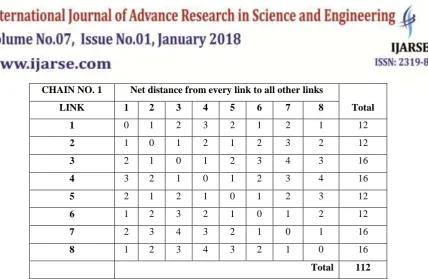
CHAIN NO. 1 Net distance from every link to all other links
Total
LINK 1 2 3 4 5 6 7 8
1 0 1 2 3 2 1 2 1 12
2 1 0 1 2 1 2 3 2 12
3 2 1 0 1 2 3 4 3 16
4 3 2 1 0 1 2 3 4 16
5 2 1 2 1 0 1 2 3 12
6 1 2 3 2 1 0 1 2 12
7 2 3 4 3 2 1 0 1 16
8 1 2 3 4 3 2 1 0 16
Total 112
The string for the Chain No. 1 is 112-4(16)-4(12). In the same way, all the 16 chains of 8-link 1-DOF are calculated the net distance and the corresponding string.
IV. RESULTS AND CONCLUSION
All the distinct kinematic chains of 8-link 1-DOF are tested on the „Net distance‟ algorithm. The results are as follows.
TABLE A: NET DISTANCE CALCULATION FOR ALL
THE DISTINCT CHAINS OF 8-LINK 1-DOF
CHAIN NO.
NET DISTANCE
STRING
1 112 112-4(16)-4(12) 2 100 100-4(14)-4(11) 3 100 100-3(14)-13-12-3(11) 4 106 106-4(14)-2(13)-2(12) 5 104 104-2(15)-2(14)-2(12)-2(11) 6 104 104-4(14)-13-2(12)-11 7 100 100-14-3(13)-3(12)-11 8 104 104-4(14)-4(12) 9 96 96-4(13)-4(11) 10 102 102-7(13)-1(11)
11 98 98-14-3(13)-2(12)-11-10 12 102 102-15-14-4(13)-11-10 13 102 102-15-2(14)-2(13)-12-11-10 14 108 108-2(16)-3(14)-2(12)-10 15 104 104-6(14)-2(10)
All the 16 distinct kinematic chains of 8-link 1-dof exhibit distinct strings of net distance.
From the above calculations, all the „Net distance‟ strings of 8-link 1-DOF kinematic chains (16 no.) are unique thus distinct, thus validating the efficiency of the developed method. „Net distance‟ concept using Graph theory
is proved its efficiency in checking of isomorphism in planar kinematic chains. The concept can be extended to validate distinct kinematic mechanisms, estimation of parallelism, compactness, rigidity etc. with necessary modifications.
REFERENCES
[1] Woo, L. S., 1967, "Type Synthesis of Planar Linkages," ASME Journal of Engineering for Industry,
Vol. 89, pp. 159-172.
[2] Mruthyunjaya T.S., 1984, “A computerized methodology for structural synthesis of kinematic chains: Part 1, 2, 3”, Mech. Mach. Theory 19(6): 487-530.
[3] Mruthyunjaya T.S and Balasubramanian H.R., 1987, “In quest for reliable and efficient test for detection of isomorphism in kinematic chains”, Mech. Mach. Theory, Vol. 10(2), pp: 131–139.
[4] Mruthyunjaya T.S., 2003, “Kinematic structure of mechanisms revisited”, Mech. Mach. Theory, Vol. 38, pp. 279–320.
[5] Tuttle, E. R., Peterson, S. W., and Titus, J. E., 1989, "Enumeration of Basic Kinematic Chains using the Theory of Finite Groups," ASME Journal of Mechanisms, transmissions, and automation in design, Vol. 111, pp. 498-503.
[6] Kui C.J., Qing C.W., 1994, “Identification of Isomorphism among Kinematic Chains and Inversions using Link‟s Adjacent Chain Table”, Mech. Mach. Theory, Vol. 29(1), pp. 53-58.
[7] Ambekar A.G., Agrawal V.P., 1986, “On canonical numbering of kinematic chains and isomorphism problem: max Code”, Proc. ASME 86-DET-169, Columbus, OH.
[8] Ambekar A.G., Agrawal V.P., 1987, “Canonical numbering of kinematic chains and isomorphism problem: min Code”, Mech. Mach. Theory, Vol. 22(5), pp. 453–461.
[9] Yadav J.N, Pratap C.R, Agrawal V.P., 1995, “Detection of isomorphism among kinematic chains using the distance concept”, ASME J. Mech. Des., Vol. 117, pp. 607–611.
[10] Yadav J.N., Pratap C.R and Agrawal V.P, 1996, “Computer Aided Detection of Isomorphism among Kinematic Chains and Mechanisms using the Concept of Modified Distance”, Mech. Mach. Theory,
Vol. 31(4), pp. 439-444.
[11] Rao A.C., Varada Raju D., 1991, “Application of the Hamming Number Technique to deduct isomorphism among kinematic chains and inversions”, Mech. Mach. Theory, Vol. 26(1), pp. 55-75.
[12] Rao A.C and Rao C.N., 1993, “Loop based pseudo hamming values-1. Testing isomorphism and rating kinematic chains”, Mech. Mach. Theory, Vol. 28(1), pp. 113–127.
[13] Rao A.C., 2000, “Application of fuzzy logic for the study of isomorphism, inversions, symmetry, parallelism and mobility in kinematic chains”, Mech. Mach. Theory, Vol. 35(8), pp. 1103–1116
chains, inversions and type of freedom in multi degree of freedom chain”, ASME ASME J. Mech. Des.,
Vol. 122, pp. 31-42.
[15] Sanyal S, 2009, “Detection of Isomorphism amongst Planar Kinematic Chains using Link Joint Connectivity Table”, International conference on Applied Mechanics and Machines, WASET09,
Bangkok.
[16] Sanyal S, Bedi G.S., 2010, “Joint Connectivity: A new approach for detection of Isomorphism and Inversions of Planar Kinematic Chains”, J. Institution of Engineers (India), Vol. 90, pp. 23 – 26.
[17] Sanyal S, Bedi G.S, 2011, “Modified Joint Connectivity approach for identification of topological characteristics of Planar Kinematic Chains”, Proc. IMechE, Part C: J. Mechanical Engineering Science,
Vol. 225, pp. 2700 – 2717.
[18] Xiao R, Tao Z and Liu Y, 2005, “Isomorphism Identification of Kinematic Chains Using Novel Evolutionary Approaches”, J. Comput. Inf. Sci. Eng., Vol. 5(1), pp. 18-24. DOI: 10.1115/1.1846057.
[19] Ashok Dargar, Ali Hasan and Khan R.A., 2009, “Identification of Isomorphism among Kinematic Chains and Inversions Using Link Adjacency Values”, IJMME, Vol. 4(3), pp. 309-315.
[20] Jaspal Singh Bal, Deshmukh P.B, Jagadeesh A., 2013, “Link Invariant Functions an Detection of Isomorphism and Inversions of Kinematic Chains”, Proceedings of iNaCoMM2013, IIT Roorkee, India,
Dec. 18-20.
[21] Yanhuo Zou, Peng He, Dawei Xu, Jun Li, 2017, “Automatic Synthesis of Planar Simple Joint Kinematic Chains by Single Kinematic Chain Adding Method”, Mechanism and Machine Science, Part V,
Proceedings of ASIAN MMS 2016 & CCMMS 2016, pp. 901-909. DOI: 10.1007/978-981-10-2875-5_74
[22] Huafeng Ding, Bin Zi, Peng Huang,Andrés Kecskeméthy, 2013, “The Whole Family of kinematic structures for planar 2-and 3-DOF fractionated kinematic chains”, Mech. Mach. Theory, Vol. 70, pp. 74-90.
[23] Lohumi M.K., Aas Mohammad and Khan I.A., 2012, “Hierarchical clustering approach for determination of isomorphism among planar kinematic chains and their derived mechanisms”, Journal
of Mechanical Science and Technology (Springer), Vol. 26(12), pp. 4041-4046.
[24] Lohumi M.K, Aas Mohammad and Khan I.A., 2015, “A computerized loop based approach for identification of isomorphism and type of mobility in planar kinematic chains”, Sadhana (Indian
Academy of Sciences), Vol. 40(2), pp. 335–350.
[25] Hui-Ling Xue, Geng Liu and Xiao-Hui Yang, 2015, “A review of graph theory application research in gears”, Proc IMechE Part C: J Mechanical Engineering Science, pp. 1–18.DOI:
10.1177/0954406215583321
[26] P. Huang, H.F. Ding, W. Yang, A. Kecskemethy, 2017, “An automatic method for the connectivity calculation in planar closed kinematic chains”, Mech. Mach. Theory, Vol. 109, pp. 195-219.
[28] Varadaraju. D., Mohankumar. Ch., 2016, “Split hamming string as an isomorphism test for one degree-of-freedom planar simple-jointed kinematic chains containing sliders”, ASME J Mech Des., Vol. 138(8), pp. 082301-082301-8.DOI: 10.1115/1.4033611.
[29] V.V. Kamesh, K. Mallikarjuna Rao, A.B.Srinivasa Rao, 2016, “A Novel Method to Detect Isomorphism in Epicyclic Gear Trains”, imanager’s Journal of Future Engineering and Technology, Vol. 12(1),
pp. 28-35.
[30] Venkata Kamesh Vinjamuri, Mallikarnuna Rao Kuchibhotla, Balaji Srinivasa Rao Annambhotla, 2017, “Topological Synthesis Of Epicyclic Gear Trains Using Vertex Incidence Polynomial”, J. Mech. Des.
ASME, Vol. 139 (6), pp. 062304(1-12). DOI: 10.1115/1.4036306.
[31] Venkata Kamesh Vinjamuri, Mallikarjuna Rao Kuchibhotla, Balaji Srinivasa Rao Annambhotla, 2017, “Detection of Degenerate structure in Single Degree-Of-Freedom Planetary Gear Trains”, J. Mech. Des.
ASME, Vol. 139 (8), pp. 083302-083302-5. DOI: 10.1115/1.4036782.