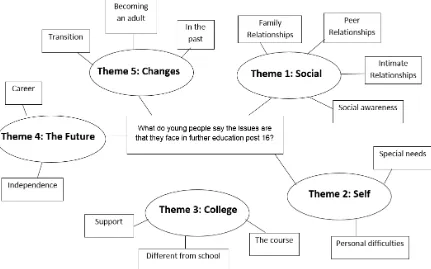
The Issues for Young People Post 16 with Additional Needs in College - A Mixed Methods Study
Alison Bell
University of East London
A thesis submitted in partial fulfilment of the requirements of the School of
Psychology, University of East London for the degree of Doctorate in Educational
and Child Psychology
i Student Declaration
University of East London
School of Psychology
Doctorate in Educational and Child Psychology
Declaration
This work has not previously been accepted for any degree and it is not being
concurrently submitted for any degree.
This research is being submitted in partial fulfilment of the requirements of the
Doctorate in Educational and Child Psychology.
This thesis is the result of my own work and investigation, except where otherwise
stated. Other sources are acknowledge by explicit references in the text. A full
reference list is appended.
I hereby give my permission for my thesis, if accepted to be available for
photocopying and for inter-library loans and for the title and summary to be made
available to outside organisations.
Alison Bell
ii Acknowledgements
First of all I would like to thank the young people who made this research possible.
Without their openness and honesty, I would not have been able to complete this
thesis. I also thank the college who let me come in and conduct interviews and give
out questionnaires. Everyone was very welcoming but in particular the Foundation
Education Department Secretary who allowed me to email her many times over the
course of 6 months setting up dates and sending off paperwork.
I would also like to thank my supervisor on placement who, although she cannot be
named in this thesis knows who she is, and always told me the end was in sight
whenever I felt less than positive. I thank also Dr Mark Fox, my UEL tutor, who has
supported all my work and has been there throughout the entire process with his many helpful suggestions, even though I couldn’t always read his writing!
I throw out a huge thank you to my cohorts at UEL as we have been able to support
each other over the last three years with messages, phone calls and many a worried
conversation. Without them, I am not sure I would have had the determination to
finish this thesis.
Thank you to my partner, Michael, who has supported me with the emotional side of
this thesis and it is his positivity that gave me the push to finish.
I dedicate this thesis to my mum, who would have been so proud of me for finishing
and handing in on time and whose only wish was to see me graduate. This is for
you mum!
To my mum, Nichola Carne,
1952- 2014
iii Abstract
The new Code of Practice (DfE, 2014) requires Educational Psychologists (EPs) to
work with young people up to the age of 25. Therefore they would need to work in
colleges with young people that have additional needs. This research asks what
issues do young people (YP) with additional needs face in college and what support
do they need?
A systematic literature review showed that very little research has been done in this
area, and most of it has come from the US. From the UK, there was some research
around transition from school to college and also transition into adulthood,
particularly in terms of medical and health services.
Mixed methods exploratory research was conducted starting with an audit of post 16
YP. Further research was then conducted within a local authority (LA) college, firstly
with seventeen adults working and living with YP with additional needs and then with
eight YP. Data collection involved questionnaires to parents and staff members
asking them about the support they would like from EPs and any issues they
believed YP faced in college. Semi-structured interviews were conducted with young
people aged 16 to 25 asking them about the issues they experience in college, the
support they are given and the support they would like.
The findings presented three main issues in college. These were personal issues,
social issues and issues with the college itself. The YP also identified two other
issues, future transition and changes in the past and future. They identified a number
of support networks already in place, such as families, tutors, friends and
themselves. Adults identified support they could be given by EPs such as training
iv
From these findings, support that college staff and EPs could provide was identified.
This included training for staff, individual work with students, helping link with
families, linking schools and colleges, enabling peer networks of support and
v Contents
Page Number
Declaration i
Acknowledgments ii
Abstract iii
List of Appendices xii
List of Tables and Figures xiv
List of Terminology, Abbreviations and Transcription Notation xv
1. Chapter 1: Introduction
1.1 Introduction to Chapter 1 1
1.2 Research Overview 1
1.3 Definitions 2
1.4 National Policy 3
1.4.1 Adolescent and Adult Development: Identity and Brain
Development 5
1.4.2 Impact of Policy Change 0-25 7
1.5 International Policies 9
1.6 Local Policy 11
1.7 Researcher Position and Rationale 13
1.8 Research Aims and Questions 14
2. Chapter 2: Literature Review
2.1 Introduction to Chapter 2 15
2.2 Voice of the Young person 15
vi
2.3.1 Systematic Search 17
2.3.2 Additional Searches 24
2.4 Previous Research Findings 25
2.4.1 Introduction to Issues Post 16 25
2.4.2 Transition to College 25
2.4.3 Issues in College and College Responsibilities 28
2.4.3.1 Self Concept 33
2.4.3.2 Peer Relationships 34
2.4.4 Transition to Adult Service 35
2.5 Conclusion 38
3. Chapter 3- Methodology
3.1 Introduction to Chapter 3 40
3.2 Research Aims 40
3.2.1 Purpose 40
3.2.2 Researcher’s Conceptual, Theoretical, Ontological
and Epistemological Position 41
3.3 Research Questions 43
3.4 Research Design 43
3.4.1 Mixed Methods Design 43
3.4.2 Single-case Design 45
2.4.3 Strategies for Data Gathering and Procedure 47
2.4.3.1 Research Question 1: Audit 47
vii
2.4.3.3 Research Question 2- Interviews 48
3.5 Participants and Sample 50
3.6 Ethics 53
3.7 Procedure Timeline 55
3.8 Data Analysis 55
3.8.1 Quantitative Data Analysis 56
3.8.1.1 The Audit 56
3.8.1.2 Questionnaire Data 56
3.8.2 Qualitative Data Analysis 57
3.8.2.1 Trustworthiness 61
4. Chapter 4- Findings
4.1 Introduction to Chapter 4 63
4.2 Research Question 1 63
4.2.1 Research Question 1 SUMMARY 65
4.3 Research Question 2a 67
4.3.1 Theme 1: Social 67
Subtheme1.1: Relationships 68
Summary of ‘SOCIAL’ 68
4.3.2 Theme 2: Self 68
Subtheme 2.1: Special Needs 69
Subtheme 2.2: Personal Difficulties 69
Summary of ‘SELF’ 70
viii
Subtheme 3.1: Staff 70
Subtheme 3.2: The course 71
Subtheme 3.3: Facilities 71
Subtheme 3.4: Support 71
Summary of ‘COLLEGE’ 72
4.3.4 Research Question 2a SUMMARY 72
4.4 Research Question 2b 73
4.4.1 Research Question 2b SUMMARY 75
4.5 Research Question 3a 76
4.5.1 Theme 1- Social 77
Subtheme 1.1Family Relationships 77
Subtheme 1.2 Peer Relationships 79
Subtheme 1.3 Intimate Relationships 82
Subtheme 1.4 Social Awareness 83
Summary of ‘SOCIAL’ 84
4.5.2 Theme 2 – Self 84
Subtheme 2.1: Special needs 85
Subtheme 2.2: Personal Difficulties 87
Summary of ‘SELF’ 90
4.5.3 Theme 3- College 91
Subtheme 3.1 Support 91
Subtheme 3.2 The course 94
Subtheme 3.3 Different from School 98
ix
4.5.4 Theme 4: The Future 100
Subtheme 4.1 Career 101
Subtheme 4.2 Independence 106
Summary of ‘THE FUTURE’ 109
4.5.5 Theme 5: Changes 109
Subtheme 5.1 Transition 110
Subtheme 5.2 Becoming an Adult 113
Subtheme 5.3 In the Past 113
Summary of ‘CHANGES’ 115
4.5.6 Research Question 3a SUMMARY 115
4.6 Research Question 3b 116
4.6.1 Theme 1: Transition Support 117
Subtheme 1.1 Previous School 117
Subtheme 1.2 Current College 118
Summary of ‘TRANSITION SUPPORT’ 118
4.6.2 Theme 2: Support in College 118
Subtheme 2.1 Friends 119
Subtheme 1.2 College Staff 119
Summary of ‘SUPPORT IN COLLEGE’ 123
4.6.3 Theme 3 Self Support 123
Subtheme 3.1 Personal Qualities 123
Subtheme 3.2 Activities 125
Summary of ‘SELF SUPPORT’ 126
x
Subtheme 4.1 Admin Support 126
Subtheme 4.2 Transport Support 128
Subtheme 4.3 Independence Support 129
Summary of ‘FAMILY SUPPORT’ 130
4.6.5 Theme 5: Outside Agency Support 130
Subtheme 5.1 Careers support 131
Subtheme 5.2 Personal Support 131
Subtheme 5.3 Medical Support 132
Summary of ‘OUTSIDE AGENCY SUPPORT’ 133
4.6.6 Research Question 3a SUMMARY 133
4.7 Chapter 4 Conclusions 134
5. Chapter 5- Discussion
5.1 Chapter 5 Introduction 135
5.2 Discussion of Findings 135
5.2.1 Issues (and can they be resolved?) 135
5.2.1.1 Social Issues/Relationships 136
5.2.1.2 Particular Needs/Personal Difficulties 137
5.2.1.3 The College 138
5.2.1.4 Transition after College
- Independence/Careers 139
5.2.1.5 Transition to College 140
5.2.1.6 Becoming an Adult 140
xi
5.2.2 Support and Implications for Practice (College/EPs) 142
5.2.2.1 Support with ‘Transition’ 142
5.2.2.2 Outside Agency Support 143
5.2.2.3 Support in College 143
5.2.2.4 Family Support 144
5.2.2.5 Self Support 145
5.2.2.6 Summary of Support and Implications
For Practice 145
5.3 Limitations of the Research and Guidelines for
Future Research 146
5.3.1 Participants 146
5.3.2 Data Collection 147
5.3.3 Data Analysis 148
5.3.4 The Young Person’s Voice 149
5.4 Reflections on Undertaking this Research 150
5.4.1 Initial Setting up of the Research 150
5.4.2 Working with Adults 151
5.4.3 Working with Young People: Where’s the Power? 153
5.4.4 Analysing Data: Am I too Close? 154
5.4.5 Finishing and Final Thoughts 154
5.5 Summary of Findings from this Research 155
References 158
xii List of Appendices
Page number
Appendix 1: Questionnaire (Parents) 170
Appendix 2: Questionnaire (Staff Member) 172
Appendix 3: Local Authority Leaflet (Anonymised) 174
Appendix 4: Semi Structured Interview Questions 175
Appendix 5: Parent Letter and Consent Form 176
Appendix 6: Staff Letter and Consent Form 178
Appendix 7: Young Person Consent Form and Letter 180
Appendix 8: Parent Consent for Young Person under 18 183
(For Research Question 3)
Appendix 9: Ethical Approval Letter 184
Appendix 10: Code Book for Research Question 2a 187
Appendix 11: Code Book for Research Question 3a 188
Appendix 12: Code Book for Research Question 3b 189
Appendix 13: Example of a Coded Transcript 191
Appendix 14: Original Thematic Map for Research Question 2a 216
Appendix 15: Original Thematic Map for Research Question 3a 217
Appendix 16: Original Thematic Map for Research Question 3b 218
Appendix 17: Themes and Subthemes with Definitions:
Research Question 2a 219
Appendix 18: Themes and Subthemes with Definitions:
Research Question 3a 220
Appendix 19: Themes and Subthemes with Definitions:
xiii
Appendix 20: Final Thematic Map: Research Question 2a 224
Appendix 21: Final Thematic Map: Research Question 3a 225
xiv List of Tables and Figures
Page number
Table 2.1 Literature Search 17
Table 2.2 Critical Review Articles from Search 18
Table 2.3 Google Scholar Articles 22
Table 2.4 Additional Critical Review Articles 22
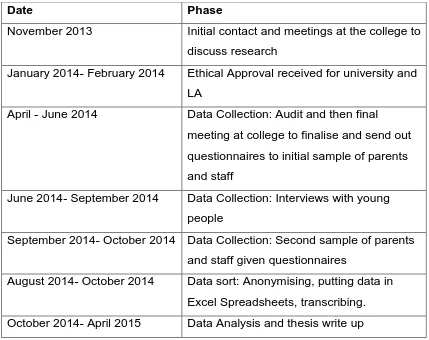
Table 3.1 Research Timeline 55
Table 4.1 Types of Special educational needs (SEN) in the LA 63
Table 4.2 Percentages of Young People going to College/
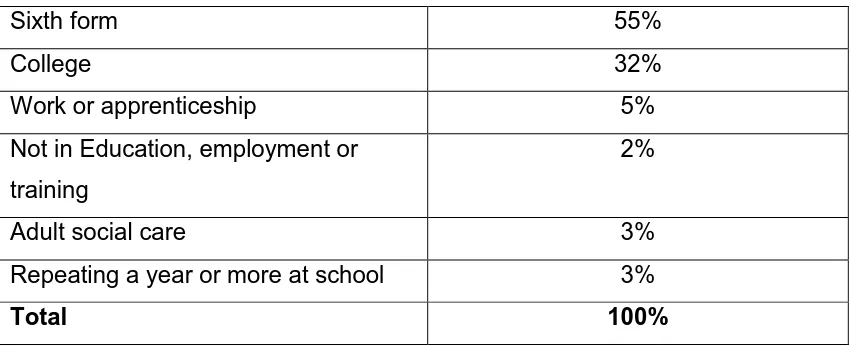
Sixth Form/Work/Other 64
Table 4.3 – Young People who Attended Special vs Mainstream School 65
Table 4.4 – Involvement with EP in the Last 5 Years. 65
Table 4.5- Means of Ratings for Activities 73
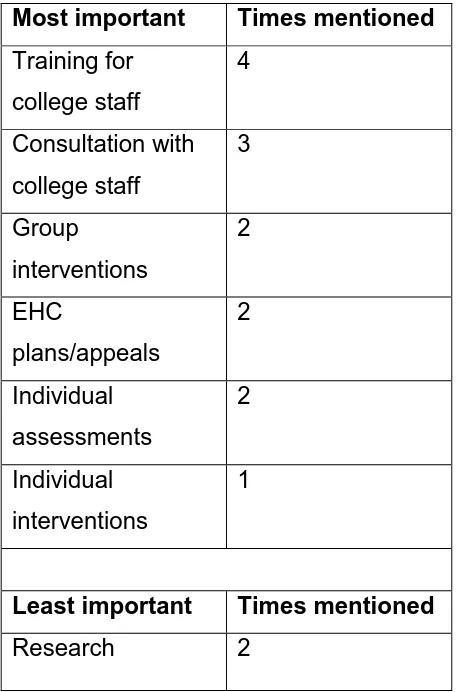
Table 4.6 – Least and Most Important Activities as Rated by Adults 74
Table 5.1- Summary of Findings 156
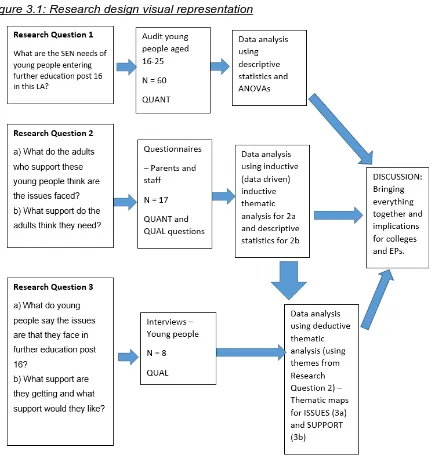
Figure 3.1: Research Design Visual Representation 45
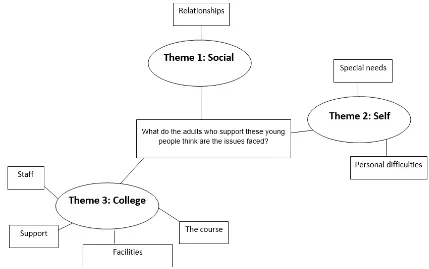
Figure 4.1: Thematic Map for Research Question 2a 67
Figure 4.2 Thematic Map for Research Question 3a 76
xv List of Terminology and Abbreviations
Terminology
This terminology refers to terms used in this thesis.
Young people- Aged 16-25
Children- Less than 16 years old
Adults- Over 25
‘Looked-After’- A child in the care of an LA
SEN appeal- When a young person or adult can appear against an EHC plan decision
EHC plan- An education health and care plan which is a document put in place for young people with additional needs who may need extra support in education in order to access the curriculum or resources (DfE, 2014)
Additional needs- Description of children/young people with special educational needs (SEN) and any other need not under the SEN bracket, for example English as an additional language (EAL).
Abbreviations
ASD - Autism Spectrum Disorder
DfE - Department for Education
EP(s) - Educational Psychologist(s)
SEN - Special educational needs
LA - Local Authority
QUAL – Qualitative Data
1 Chapter 1: Introduction
1.1 Introduction to Chapter 1
This chapter discusses the issues faced by young people with additional needs
in college and how support can be put in place for these issues, in particular the
new role for the educational psychologist (EP). It starts with a brief overview of this research followed by some definitions of particularly important policy terms.
The international position in terms of support and psychology involvement with
young people aged 16 to 25 in the USA, Australia and Scotland is outlined and
compared to the UK system. The national policy is then discussed, including
new Department for Education initiatives for young people aged 0 to 25 (DfE,
2014). Finally, the local context in which the research takes place is
summarised in order for the reader to understand where the research was
based.
Towards the end of this chapter, the researcher’s position and the research rationale are set out, including the researcher’s experiences and beliefs and an
explanation of why and how the research came about. Finally, the research
aims and questions are briefly defined in order to clarify the context of the
Literature Review in Chapter 2.
1.2 Research Overview
This research investigated a little known area of educational psychology in the
UK which will soon to be central to the EP role. EPs are now expected to work
with children and young people up to the age of 25 according to the SEN Code
of Practice (DfE, 2014). This raises a number of issues. EPs are being asked
to work with colleges and 6th form centres who may have had little experience of children with SEN and the role of the EP. EPs are also expected to be involved
with provision for children post 16 and may need to advise about further
education establishments or work placements. EPs may be asked to assess
young people post 16, which may pose difficulties as many childhood cognitive
2
age of 18. EPs may therefore need to learn new skills in the area of adult
assessment and EP services (EPSs) may need to purchase new resources. All
of these issues indicate that EPs will need to make changes in their knowledge
and skills and even some attitudes in order to work with young people in this
older age group. Some are, of course, already doing this work, so their
knowledge and skills can be used for training and support.
The special educational needs and disability code of practice (DfE, 2014)
specifically focuses on how young people should be able to,
‘Achieve successful, long-term outcomes in adult life’ (DfE, 2014, Section
1.5 p.28),
Therefore support from EPs in the area of adult education and development will
be vital as they are able to use their knowledge of developmental psychology and educational outcomes to support young people. The research in this thesis came from a local authority’s questions about what the particular issues
young people face in college are and how EPs could support such young
people. This raised issues about how and whether this support would be different from EP’s work in schools, nurseries and preschools due to the
differences with adolescent and adult development.
1.3 Definitions
Education, health and care plans (EHC plans, DfE, 2014)are central to this
thesis as they are now statutory for young people who originally would have
been given a statement of SEN. The purpose of the EHC plan is to outline
special educational provision for a young person aged 0 to 25 to meet their
needs and ensure the best outcomes for them in education, health and social
care. They are also designed to help young people prepare for adulthood.
EHC plans should have forward looking targets in order for young people to
3
A number of people can request assessment for an EHC plan for a child or
young person. These include parents, a young person aged 16-25 (for his or
her self) or a person who acts on behalf of a school or post 16 provision.
Anyone else can also bring the young person to the attention of the LA including
foster carers, health professionals and youth offending teams but should first
get the permission of the parent and/or young person.
The ‘Local Offer’ is another new term from the Code of Practice (DfE, 2014). It
is described by The Council for Disabled Children (2014) as a way for young
people and children to see more clearly what is in place in his/her area and how
to access services for children aged 0 to 25 across education, health and social
care. It is expected to support parents with their understanding, help with early
intervention, identify any gaps in provision and ensure better outcomes for
young people. It should be available for anybody to access electronically or in
paper form.
The phrase ‘additional needs’ is used within this thesis and is often used interchangeably with ‘special educational needs’ or ‘SEN.’ For the purpose of
this thesis, the term additional needs can be thought of as including all young people with needs classed as ‘SEN’ but additionally, those with other
educational needs such as English as an additional language or medical needs
such as epilepsy. The term encompasses all needs which could impact on a young person’s education, their general wellbeing or life outcomes.
1.4 National Policy
In the UK, the Department for Education Code of Practice (DfE, 2014) and its
previous drafts (DfE, 2011;DfE, 2013) suggest that high expectations, the right
support alongside joint working from local authorities and education partners is
critical for young people to achieve their long term outcomes and realise their
ambitions. The Code of Practice also recommends support through higher
education, employment, independent living, society participation and healthy
4
stresses the importance of YP making their own choices and if a young person
has an EHC plan local authorities, particularly EPs, legally have to assist in
preparing a young person for adulthood once he/she reaches Year 9 (DfE,
2014).
Within the SEN Code of Practice (DfE, 2014), there are a number of ‘first principles’ which have been highlighted and addressed in this research. The
first is that children and young people are able to participate in decision making
and discussions around their own education and provision (DfE, 2014). The
second is that they should also be involved in the planning and reviewing of
their provision each year during an annual review process. Parents and carers
will also be involved in these discussions and will be given more choice and
control around provision and support (DfE, 2014). The third principle is that
there should be collaboration between education, health and social care
services to provide support and high quality provision for young people. The aim
is to meet their needs with a focus on inclusion by removing barriers (DfE,
2014). This includes provision in higher education establishments and colleges.
The final principle is that local authorities should work together with education
providers to ensure successful preparation for adulthood for all young people
with EHC plans (DfE, 2014).
The Code of Practice (DfE, 2014) states that when preparing young people for
adulthood, the LA has a range of duties. Firstly, they must involve the young
person and parent to make sure that their views, wishes, feelings and
aspirations for adult life are ascertained. Secondly, impartial advice must be
offered free of charge to young people including advice about preparing for
adult life. Thirdly, local authorities (LAs) must ensure that they work together
and commission work with health, social care and education services. Fourthly,
they must cooperate with colleges in all forms, including their academics, as
well as residential and specialist colleges. Fifthly, they should prepare a Local
Offer for young people who are preparing for adulthood and consult with young
people around this Local Offer. Sixthly, they must prepare, implement and
5
once a young person reaches Year 9 (age 13-14). Finally, they should make
young people aware of the support available to them in higher education and pass the young person’s details on to the Disabled Students Allowance assessor with the young person’s permission.
The BBC (2013) reported the change in policy with the 25 year old cut off point
for adulthood and focused on adolescent brain development. The article
suggests that hormonal activity and brain development continue past 18 and the
way in which information is processed and learned changes throughout
childhood and early adulthood. This therefore supports the change in policy
and highlights the need for college support from outside agencies such as
psychologists who may better understand developmental psychology and how it
relates to education.
1.4.1 Adolescent and Adult Development: Identity and Brain Development
Young people of ages 16 to 25 are thought to go through two major
developmental stages which are important for professionals working with them
to understand. The two stages are adolescence and early adulthood (Erikson,
1968). Erikson (1968) suggested that adolescence occurs between the ages of
12 and 19 and is concerned with YP them asking themselves who they are and
who they want to be (Hayton, 2009). There is debate recently, however, about
whether adolescence occurs at these ages, earlier or later and this distinction
can sometimes be cultural (Atkinson, Dunsmuir, Lang and Wright, 2015)
Erikson’s (1968) description of identity development suggests that at this stage
there is a conflict between identity and confusion which can be resolved by
fidelity and is mediated by sensory, logical and aesthetic perception. Although
his stages of development are not set and identity development is dynamic
rather than static, it is thought that during adolescence physical, cognitive and
social development coincide so that young people are able to make decision
about their future and their pathway to adulthood (Marcia, 1980). However
identity involves commitment to sexual orientation, commitment to an
6
developments (Hayton, 2009). This relates highly their self-concept (Bergevin,
Bukowski and Miners, 2003).
For many adolescents these commitments may take a lot longer to make than
the age of 19 and this may be particularly true for young people with additional
needs whose cognitive, social and physical development may be delayed.
There are therefore four modes of dealing with identity in late adolescence (16
to 19) and early adulthood (20 to 25) which are as follows (Marcia, 1980). First
there is Identity Achievement which occurs when a young person is able to
pursue a chosen career. Second there is Foreclosure, where a young person's
parent or carer has chosen their career path and they are following this path.
Third is Identity Diffusion where a young person has no set occupational or
ideological direction. Finally there is Moratorium where a young person is
struggling with occupational and ideological issues and they are classed as
going through identity crisis. The young person's mode will dictate whether they
can move into development in the early adulthood stage (Erikson, 1968). This
stage tends to occur between the ages of 20 and 25 but could be later for many
young people who may have gone through crisis or diffusion.
The early adulthood stage is concerned with intimacy vs isolation and can be
resolved by feelings of love. This could be love of a partner or relationships
with close friends (Scheck, 2005). It also assumes that the young people would
have a well-developed identity (Scheck, 2005). For many young people with
additional needs, especially social communication needs, this may be a period
of great conflict and difficulty. Some may not experience love or may be
confused by it and some may have issues making and keeping friends.
In terms of adolescent and adult brain development, a number of articles
(Blakemore, 2007; Blakemore and Choudhury, 2006) have discussed the
development of adolescent to adult brains for many years. They suggest that a
variety of executive functions continue to develop into adolescence and
7
mentalising more than adults (Blakemore 2006). This is also true of
metacognitive ability, the ability to reflect on your thoughts and feelings, with
this developing late into adolescence and early adulthood (up to age 18) (Weil,
Fleming, Dumontheil, Kilford, Weil, Rees, Dolan and Blakemore, 2013). For Blakemore’s studies adults were classed as on average 24 years old.
Blakemore found that young people develop up to the age of around 24, long
before the new policies that have been discussed in recent years. The
particular developments which occur at this time are in the areas of social
cognition and executive function which are important supporters in college
education.
1.4.2 Impact of Policy Change 0-25
A number of studies have been conducted in order to investigate the possible
impact of the Green Paper changes described above. One such study by
Martin, Hart, White and Sharp (2011) looked at the transition of young people
with learning difficulties to adult services. The researcher looked at the views of
young people, parents, carers and professionals in six different authorities.
They found that transition support often happened too late and focused too
much on short term goals. They also found that a lack of opportunities and
choices were presented for young people with learning difficulties. Many have to
move away to residential settings or face difficulties with less structure in their
local college, such as three day weeks or independent study time. The
researchers mention a need for multiagency work including working with
parents and young people. This is reflected in a number of other articles
(Byrnes, 2012; Jacobson, 2012). However they also discuss the lack of knowledge professionals have about how to progress when young people’s
views differ from those of their parents and this in turn causes a conflict of
opinion. This is interesting in terms of the role parents play post 16, which is
discussed later in this thesis.
This study by Martin et al (2011) took place before the policies had changed
8
findings are interesting, this study took place before the policy changes so does
not reflect any impacts of the potential change. The researchers themselves
comment that the impact of policy changes would not be seen until several
years after the time of writing. It is now several years later and greater impact is
seen in the current research. All of the issues discussed above are mentioned
in some way in the Code of Practice (DfE, 2014) and are hoped to be resolved
as further changes in local authorities take place through training and changes
in practice.
A similar study was conducted by George, Hetherington and Sharp (2011).
Again the research was conducted before policy changes but discusses the LA
perspectives. Of the LA workers interviewed, many suggested that the Green
Paper promised more choices which was classed as a positive change.
However they noted that this would put greater pressure on the LA as parents
and young people had greater expectations from professionals and the local
council. This could impact the LAs work place causing difficulties and stresses.
These findings may need to be investigated further now that policies have been
put in place, rather than thinking about them as both negative and foreboding.
The Support and Aspiration (DfE, 2011) report mentions that young people
should have the opportunity to express a preference for where they would like
to be taught. This could cause pressure on LAs but also on colleges. Research
needs to be done to investigate this further once the policy changes have taken
place. EPs can of course help with reducing this pressure and The Wolf Report
(2011) suggests that training providers should be working this into their training
for EPs. This may already be taking place in university courses.
The importance of the EP having the ability to adapt to such changes was
discussed by Fallon, Woods and Rooney (2010). They suggest that EPs should
be able to respond flexibly to such changes in the socio-political environment.
However the EP role is becoming so broad that it can be confusing to
9
types of need or do other professionals take on more specific roles such as
early years advisers, occupational therapists or speech and language
therapists. It is therefore important that EP university training providers help
their trainee EPs understand the role themselves and for LAs to continue to
offer professional development once an EP is qualified. According to the draft
Code of Practice (DfE, 2013) the role of the EP should be the same in both
schools and colleges with responsibilities including advice on teaching and
learning, counselling, staff training, behaviour management and practical
evidence based interventions. However in practice there may be some
differences due to the nature of the settings and young people.
Finally, funding is an important part of the change in policy (Jacobson, 2012;
National Audit Office, 2011). Although EPs may not be directly influenced by
the funding change for young people up to 25, their role may develop as children’s services will include provision for young people up to the age of 25.
Colleges will also be responsible for using the money given for the young
people with special needs or a disability in their college (Jacobson, 2012). It
could be that the colleges may wish to seek advice from EP about how to use
this new funding. EPs may therefore need to have more knowledge about the
funding system.
1.5 International Policies
Although the national policy has been outlined, a number of other countries
have similar and more long standing policies with young people up to the age of
25 with additional needs. A number of studies discussed in Chapter 2, The
Literature Review, look at research influenced by international policy and
practice, in particular policies from the United States of America (USA).
In the USA, a number of policies help prepare students with disabilities for
transition from school to further education or work (Levinson and Palmer, 2005).
The Carl D. Perkins Vocational Education Act (2002) and the Individuals with
10
details) both state that young people with disabilities are entitled to an
assessment of their interest, abilities and special needs as well as a career
assessment before leaving high school. These acts require a transition plan to
be set out in their Individual Education Plan (IEP) by the age of 14. A
transdisciplinary vocational assessment has to be carried out by a number of
professionals, including psychologists, in order to clarify strengths and needs in a student’s transition plan. The aim of the assessment is to allow planning to
ensure students make a successful adjustment to work, post-secondary
education and the community.
In transition, the role of the school psychologist (USA version of the EP) is to
conduct psycho-educational assessments, explain results of assessments and
make recommendations to the school team (Levinson and Palmer, 2005). They also assist in the collection of information about a student’s academic,
interpersonal and cognitive skills. In contrast to the role of the EP in the UK, the
role of the psychologist in the USA is set out more clearly. In the UK, the role of
the EP within the transitive process is less well explained.
In the USA, there is an emphasis on the role of the parent in transition, in a
similar way to the UK. Schools and professionals are expected to help to
engage parents and support them as much as possible especially in high school
transition (Levinson and Palmer, 2005).
In Scotland, a similar picture is seen to England and Wales (The Scottish
Government, 2012). In the documents Education (Additional Support for
Learning) (Scotland) Act 2009 (Scottish Government, 2009) and Support and
Aspiration (DfE, 2011) timescales for supporting transition are given. There is a requirement to take into account the young person’s view as well as the views
of the parents. Consultations with post- school providers must also take place to
ensure support during transition and other agencies must be involved as they
11
tracked. There is also a legal duty that anyone who is between16-19 must be
eligible for an offer of learning or training until he/she turns 20 years old. We
can assume that this system is therefore similar to the UK system but set out
differently in their documents.
In Australia, the Australian Psychological Society (2014) suggests that the EP
role should extend from childhood into late adolescence and even through to
adulthood. In adolescence, the focus of the EP in schools is to work on
transitions as well as regular EP work. In adulthood the focus of the EP is on
parenting, identity issues, aging, and grief management (Athanasou, 2008).
Athanasou (2008) believes that the EP role can extend into any education
setting including adult education and training. According to the Australian
Psychological society website the role of the EP is wide ranging from birth to
late adulthood (APS, 2014). This seems to be a very different system from both
the UK and US systems.
In some countries such as the USA and Scotland, there are similar themes to
the UK. These include working with parents and young people and aiding
transition from school to work or school to college. Some countries have been
focusing on these themes for a number of years and therefore have more
research around the success of such programmes. The role of the EP is
developing in many countries to the point where there is not just a focus on
education in schools but also in the community. This is not outlined in the
current UK policy but could become a role for the EP as the role changes and
develops.
1.6 Local policy
The Code of Practice (DfE, 2014) outlines the national policy but it is also
important to discuss the local policy that this research was based on. As a ‘pathfinder’ LA, the LA in which this research was based had already
implemented and tested a number of the new policies from the Code of Practice
12
new practices were, prior to the research, starting to be developed in the LA
with some of the implications for EPs.
This research took place in a college where some recent EP input had taken
place though none prior to that. It was a college with a large, separate SEN
support department and the EP work was mainly being done within this
department. Some young people did take part in college wide activities and
these were managed and supported by the support department.
In the academic year 2013/2014, many young people aged 0 to 25 in the LA
were assessed for EHC plans rather than statements. By 2014, many other
statements were in the process of being converted. Policies had been written in
the LA around how EPs could work with young people aged 16-25 and much of the work was being done in collaboration with other teams in the LA, such as
advisory teachers and social care.
Working with young people and their parents and involving them in discussions
was central to the work of EPs in the LA both in schools and colleges. This was
reflected in all work not just when writing EHC plans. It was also reflected in the
LA wide Local Offer. It was felt during team discussions that post 18 years of
age, working with parents was more difficult but not impossible and should
therefore be tried as much as possible alongside consultation with the young
person. When discussing with young people, many of them mentioned that this
was because some were starting to live away from home and they often wanted
to make their own decisions away from their parents.
EPs were involved with setting EHC outcomes which extended into adulthood
and person centred plans focused on these long term goals as much as
possible. This was achieved by meeting with parents, YP and other
professionals which enabled them to gain all perspectives and set outcomes all
together. The LA was keen to develop the EHC plan layout which extended
13
college reviews where they could discuss YP with difficulties with an EP in the
same way that schools in the LA were running termly school reviews.
The research was therefore done within an authority with experience of the new
policies and a keenness to learn and develop new ideas about working with YP.
The EP involvement was fairly new but not overly different from involvement in
schools. There was a need to examine whether this support required by a
college was different from school support or whether the school EP system
would work well in college.
1.7 Researcher Position and Rationale
The initial rationale for this research came from conversations between the
researcher and the Principal Educational Psychologist of the LA. The
researcher had experience of working with young people up to the age of 19
with SEN and experience working with YP aged 16 to 19 transitioning from an
SEN provision to a mainstream college, university or world of work. She also
had an interest in how young people with special educational needs were
supported with statements and annual reviews throughout their education.
The researcher believed that listening to the views of the young person was
important as well as triangulating views from parents and college staff. This
was because she knew that all of these views are important in schools so must
be important in college education. The researcher found, when working as a
teacher, that transition times and times of stress needed a great deal of
planning and organising and needed the support of all parties involved including
the young person. It did not matter that the young person had additional needs,
they could still contribute to decision making and planning. This became an
important part of the research as ultimately the researcher believed that YP are
14
The researcher’s experience as an SEN teacher helped when working with
parents, staff and YP with additional needs. She hoped that as a trainee EP
and teacher, her knowledge of the primary and secondary education systems
could help her understanding and work in college systems. She did however
recognise that there are some potential differences between the competencies
an EP needs when working with school aged children and those in colleges.
1.8 Research aims and questions
The aim of this research was to explore the issues that YP with SEN face in
college and the level of support they are getting or would like to get from professionals. There was a focus on YPs’ voices so the third research
question, outlined below, is considered the most important area. The following
questions were addressed in this research:
1. What are the SEN needs of young people entering further education post 16 in this LA?
2. a) What do the adults who support these young people think are the issues faced?
b) What support do the adults think they need in terms of what EPs
can offer?
3. a) What do young people say the issues are that they face in further education post 16?
15 Chapter 2- Literature Review
2.1 Introduction to Chapter 2
This chapter discusses and critically analyses the relevant research on the
issues experienced by YP in college, the support they are given and the role of
the EP. The ideas and research around EPs working with young people post
16 is fairly new, so the research focused on issues in the transitive process from
child to adult services, the issues they face in college and the differentiation in
skills and abilities between childhood and adulthood. The implications for EP
work is highlighted throughout each section.
The chapter starts with an explanation of the systemic literature searches. It
then continues to analyse and discuss the research in the following nine
sections. It finishes with a conclusion about how the research links to the
current thesis aims and methodology.
For the purpose of clarity in this thesis, it is important to note that when the word ‘young person’ is used, it refers to someone aged 16 to 25. A ‘child’ is anyone under 16 and an ‘adult’ is anyone over 25.
2.2 Voice of the Young Person
Before starting the systematic review, it is important to note that during work on
this section, an important area was highlighted. The voice of the young person
is highly important in the new SEN Code of Practice (DfE, 2014) and there are a
number of articles discussed below which endorse this position. It is important
to briefly discuss these before moving on to the literature review.
The relationship between the interviewee and interviewer is also extremely
important in all research, especially when the research is with young people,
16
young people have so many professionals coming in and out of their lives, that
a researcher can either be thought of as another one of those professionals or
as a person who is able to listen to their views and options (Nind, 2008). The
latter is preferable when conducting qualitative research so thought needs to be
given to how this relationship can be built up. Nind (2008) suggests that being involved with the young person’s life before interviewing can be beneficial in
building rapport. As is the location in which the interviews take place. It is also
important to reflect on whether the research is for, with or on the interviewee
and the aims of the research in terms of whether the findings will impact the
interviewee in a positive or negative way in the long term (Lewis and Porter,
2004).
It has long been thought that young people, even with severe learning
difficulties, can give opinions and thoughts and be involved with decision
making (Kaufman and Burden, 2004; Redpath, Keamey, Nicholl, Mulvenna,
Wallace and Martin, 2013). This research focused on the voice of the young
person due to the importance highlighted in the policies. The voice of the young
person is a theme found throughout the literature.
Kaufamn and Burden (2004) suggest that young people with severe and
complex learning difficulties are able to reflect well and articulate their feelings.
They imply that as long as young people with such difficulties are given the
opportunity they can reflect well. Redpath et al (2013) were also able to
interview young people with disabilities in a meaningful way. These ranged
from those with mental health difficulties to those with cerebral palsy and those
who were deaf. Both studies suggest that if barriers can be overcome,
interviewing young people is the best way to get qualitative information. Such
qualitative information can also support findings which are quantitative and from
other sources.
17
from quantitative research. Secondly, young peoples’ views can add great meaning to a variability in quantitative findings. Finally, they suggest that it’s a disabled young person’s right to be heard and have greater participation in
research and education. This supports the view of new policies highlighting the importance of the child or young person’s voice.
Other articles which also use the voice of the young person will be discussed on
an individual basis during the literature review. The articles mentioned above
are more critically reviewed in later sections. How the views are gained will also
be discussed in other articles below.
2.3 Systemic Search and Other Searches 2.3.1 Systemic Search
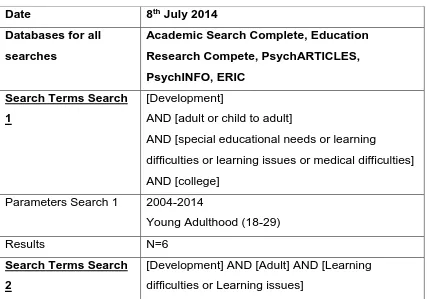
A systematic literature search was carried out on 8th July 2014 to identify
articles and previous research. Three different searches took place as outlined
[image:33.595.114.541.466.765.2]in the table below.
Table 2.1 Literature Search
Date 8th July 2014
Databases for all searches
Academic Search Complete, Education Research Compete, PsychARTICLES, PsychINFO, ERIC
Search Terms Search 1
[Development]
AND [adult or child to adult]
AND [special educational needs or learning
difficulties or learning issues or medical difficulties]
AND [college]
Parameters Search 1 2004-2014
Young Adulthood (18-29)
Results N=6
Search Terms Search 2
[Development] AND [Adult] AND [Learning
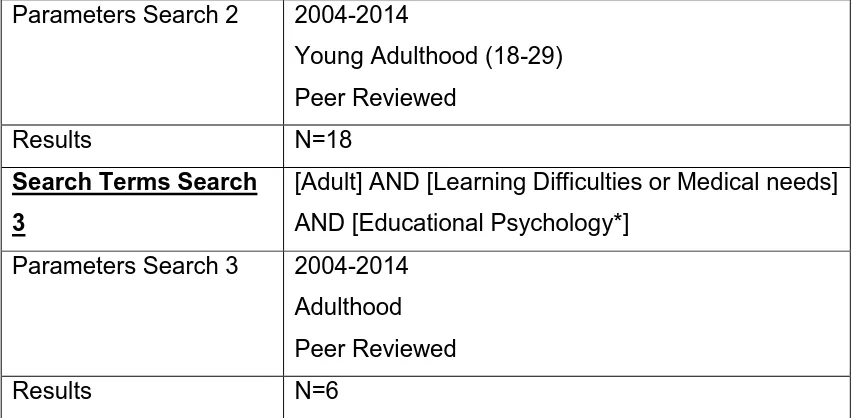
18
Parameters Search 2 2004-2014
Young Adulthood (18-29)
Peer Reviewed
Results N=18
Search Terms Search 3
[Adult] AND [Learning Difficulties or Medical needs]
AND [Educational Psychology*]
Parameters Search 3 2004-2014
Adulthood
Peer Reviewed
Results N=6
From the above searches 31 articles were identified. Many of these were
repeated articles so these were excluded. Articles were also excluded if they
were unavailable in English or English translation. Articles were also excluded
if unrelated to education, for example if they were discussing access to health
services, prison services or social care and if no full text was available. A few
were not included due to the very specific nature of the article, for example if
they discussed a rare or complex medical condition and a couple were not
included because they related only to secondary education with no relation to
college transition or adulthood post 16. There were two cases where reviews of
books were found. In one of these cases, the book is referenced rather than
the review (Bellak-Adams (2010).
After these exclusions, 14 articles were left for critical analysis from these
searches alone. These are critically reviewed in the sections which follow. A
chart of these 14 articles can be found below with some information about each
[image:34.595.113.542.57.266.2]article.
Table 2.2 Critical review articles from search
Authors (date) Journal title/ book
Description of study
Participants Findings
Froger, Sacher, Gaudouen, Canadian Journal of Looking at metacognitive 18 young adults (aged Age related
19 Isingrini and Taconnat (2011) Experimental Psychology, 65 (4), 269-276 judgement in
young adults and
older adults using
a reading encoding test 20-36) and 18 older adults (60-81)
and adapting the
allocation of study
time to perceived task
difficulty. Poslek, Ledzunska and Czarkavski, (2010) Problems of
education in the
21st Century, 22,
99-108
Discussion of the
challenges of
distance learning
for adults. Some
information about
how adults learn
and should be
taught.
n/a Elearning allows
pupils to create their
own learning
environment. Teacher can act as a ‘coach’ which complements learning. Kaufamn and Burden (2004) European Journal of Psychology of Education, XIX (1), 107-117 A year-long cognitive program of mediated learning and Instrumental Enrichment (IE)
for 178 hours
alongside
collaborative
group discussion
at the end of each
session 10 young adults (aged 18-27)- 6 with Down Syndrome, others with various disabilities including brain damage and cerebral palsy. Learning self-concept
was well above
average.
Reflections about
change showed some
deep cognitive,
emotional and social
development. Carroll and Dockrell (2012) International Journal of communication Disorders, 47 (5), 567-577 Interviews were
carried out to
explore young people with SLI’s views about what
enabled and limited their transition experiences 19 young people aged 19-23 who attended one residential special school for SLI
5 main themes were
found relating to
enablers and limiters
to transition- personal
characteristics,
parents, key
professionals and
advice, education and
qualifications and
experiences of SLI.
Gregg (2009) – referenced by E.
McNamara in his
review in Educational Book- Adolescents and Adults with Learning Difficulties and Book outlining
the US situation
surrounding
assessment and
n/a The book discusses
‘accommodation’ arrangements for
young people in
20
Psychology in
Practice, 26 (2),
205-218 ADHD, New York: Guilford Press special arrangements
highlights a need for
up to date
assessment when transitioning amongst other interesting debates. Kandel and Merrick (2008)
Journal of Policy
and Practice in
Intellectual
Disabilities, 5
(1), 75-76
A summary report
of a survey of
adults with
intellectual
disabilities (ID) in
the UK 2898 people aged between 16 and 91 Numerous findings including difficulties
with people with IDs
have in the UK, for
example being
socially excluded,
unemployed, feel
unsafe or bullied.
Wouters, Germeus, Colpin and Verschueren, 2011 Scandinavian Journal of Psychology, 52, 586-594 An investigation
of academic
self-concept in the
final year or high
school and its
influence on academic achievement in higher education. 536 twelfth grade students from 24 schools
The more positive the
academic self-concept
in high school, the
higher chance of
being successful in
the first year of higher
education. Carter, Asmus, Moss, Cooney, Weir, Vincent, Born, Hochman, Botema,-Beutel and Fesperman, 2013 Teaching Exceptional
Children, 46 (2),
51-59
Discussion about
new peer network
strategy networks
for young people
with additional
needs
21 high
schools in
two states
Discussion of the new
peer network process
with some case
studies. No
quantitative findings
outlined.
Sebastian,
Roiser, Tan,
Viding, Wood and
Blakemore (2010)
Genes, brain
and Behavior, 9,
629-637
Looking at the
neural response
to social rejection
in adolescents
and adults and
whether it matures. 35 IQ matched English speaking females – 19
adolescents
(aged 14-16)
and 16 adults
(23-28)
Adolescents did not show the adult’s
pattern of modulation
by regression stimuli
meaning there is
maturation during
adolescence.
Matson and Rivet
(2007)
Journal of
Developmental
Development of a
scale for young
27 adults
with
The ASD-BPA
21
Physical
Disabilities, 19,
557-564
people and adults
with challenging
behaviour
(ASD-BPA) and testing
with adults. intellectual disabilities and autism spectrum conditions (aged 29-87) Behavior Problems
Inventory and had
good validity.
Iacono, 2004 Augmentative
and Alternative
Communication,
20 (3), 179-190
Discussion of
development of
an Internet based
assessment and
intervention tool
for improving
reading skills in
adults with complex communication needs 15 adults from day programmes (aged 21-55) testing the AWRI an internet based single word reading programme
on a variety
of basis from
2 to 30 times.
More of a pilot study-
The final version was
not tested. This pilot
was used to help
develop the final
versions by looking at
any difficulties
experienced.
Lejeune (2011) Journal of
American
College Health,
59 (7), 666-669
Description of an
approach for
integrated
treatment for
bipolar patients in
college.
n/a Psychotherapy,
psycho-education and
medication are
discussed. No
evidence is given for
effectiveness.
Theoretical only.
Roffey, Trew and
Dunsmuir, 2010
Educational and
child
psychology, 27
(1), 6-8
Guest editorial n/a Discussion of school
experience and the
social/emotional
support given to
students by teachers
and tutors. The
impact of this on
vulnerable children is
discussed. No
evidence, just
discussion.
Bellak-Adams
(2010)
Self Help Work
Book
Looking at a diary
method for young
people with
AD/HD
For young
people aged
7 to 17.
Designed to help
promote a positive
self-image and
22
Also tools for parents
and teachers.
2.3.2 Additional Searches
A search using Google Scholar was also carried out with similar terms to the
[image:38.595.113.560.255.448.2]ones above and one additional article was found.
Table 2.3 Google scholar articles
Authors (date) Journal title/ book
Description of study
Participants Findings
DaDeppo (2009) Learning
Disabilities Research and Practice, 24 (3), 122-131
Investigation of the
impact of
academic and
social integration
on academic
success and
intention to persist.
97 freshman
and
sophomores
aged 18 to 22
with learning
difficulties.
Academic integration is
most important for
persistence but social
integration may be the
most powerful and
young people rely on
social support systems
to compensate for
academic difficulties.
Other articles including policy documents and news articles were found using a
hand search and from word of mouth. A number of EPs had attended courses
relating to this new policy of EP work with 16-25 year olds and had
recommended articles which had not been identified in the above searches (see
table 2.4). They may not have been identified in the literature search as they
[image:38.595.115.561.664.779.2]were news articles, leaflets or books.
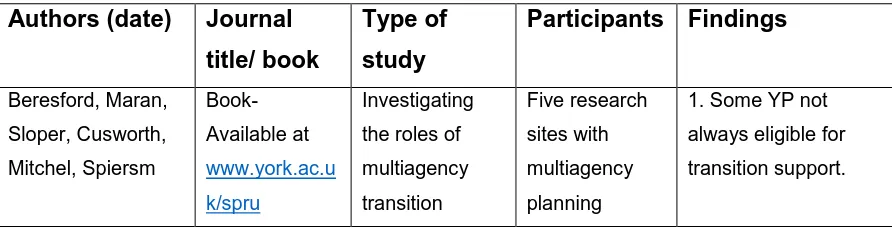
Table 2.4 Additional Critical Review Articles
Authors (date) Journal title/ book
Type of study
Participants Findings
Beresford, Maran, Sloper, Cusworth, Mitchel, Spiersm Book- Available at www.york.ac.u k/spru Investigating
the roles of
multiagency transition Five research sites with multiagency planning
1. Some YP not
always eligible for
23 Weston and Beechan (2013) services for young people with ASC processes and systems for ASC- interviews with staff, young people and parents/carers and postal surveys.
2. Lack of support in
mainstream colleges
3. Lack of support
after finishing FE
4. Transition support
often time limited.
Royal College of
Nursing, (2007) Book/ information leaflet Information leaflet with some case studies
n/a Discussion of good
practice in arranging
transitions and
gaining young peoples’ views.
Byrnes (2012) Educational
and Child
Psychology,
29 (3), 81-92
Discussing the
role of the EP
engaging parents of children with Down’s Syndrome at times of transition. One local authority – collaborative project between EPS and Down Syndrome support group
for parents and
carers
EP and parent
partnerships impacted positively on parents’ confidence. Parental
engagement is a key
element of service
delivery.
Trainor,
Morningstar,
Murray and Kim
(2013)
The
Prevention
Researcher,
20 (2), 7-10
A discussion of
how young people with high incidence disabilities are connected to social networks
as part of their
transition to
adult outcomes.
Descriptive
data from a
study of young
adults with high
incidence
disabilities
aged 19 -27-
selection of
1250
participants
with ADHD, LD
or EBD.
Some young people
are not making
successful transitions
but social capital
helps their young
people get support
and ensure quality of
life outcomes.
Redpath, Keamey,
Nicholl, Mulvenna,
Wallace and Martin
(2013) Studies in Higher Education, 38 (9), 1334-1350 Systemic analysis of interviews with disabled students
13 in depth
interviews with disabled students from universities in Three recommendations:
1. Network of
communication
24 looking at barriers and enablers to services. Northern Ireland.
3. Inclusive education
for all
Crowley, Wolfe,
Lock and McKee,
(2011) Archives of Disease in Childhood, 96(6):548-53 Systematic review of evidence of effectiveness of transitional care programmes for young people with chronic illness or disability Systematic literature review including 10 studies Successful programmes included
patient education and
specific transition
clinics but unsure of
how generalisable
studies in diabetes
mellitus were to other
conditions. Gordon, Duff, Davidson and Whitaker (2010). Journal of Applied Research in Intellectual Disability, 23, 197-200, Study exploring adult IQ assessment (WAIS III)
compared to a
childhood one
(WISC IV) in
terms of scores
for 16 year olds
with intellectual disabilities. 17 English speaking participants with moderate intellectual disabilities
aged 16 who
attended one of
four special
schools.
The WAIS III gave
results 11.82 points
higher than the WISC
IV. This however is
an old version of the
WAIS III and these
difficulties could now
be ironed out in the 4th
edition. Kaufman and Lichtenberger (2006) Book – Assessing Adolescent and Adult Intelligence Information
about adult and
adolescent
assessments in
particular the
WAIS III.
n/a Discussions about
different cognitive
tests and their
relevance to
adolescent and adult
populations.
All articles were read and critically analysed according to the research
questions. From the articles, three themes were identified as the key element
of the critical review. The themes are discussed fully in the next section (2.3)
and include:
1. Transition to College
2. Issues in College and College Responsibilities
25
- Self Concept
- Peer Relationships
3. Transition to Adult Services
There will first be an introduction to the issues found relating to post 16 which
were highlighted in a longitudinal study.
2.4 Previous Research Findings 2.4.1 Introduction to Issues Post 16
It is important to identify what the issues faced by young people post 16 appear
to be. Some of them were highlighted in a survey from 2003 to 2004 in England
of nearly three thousand (2898) people aged 16 to 91 with learning difficulties
(Kandel and Merrick, 2008). It was found that, in the main, adults aged over 16
with learning difficulties were socially excluded, did not have a paid job, lived in
a deprived area, lived in unsuitable accommodation or were bullied. There was
a lack of community based activities, limited choices for further education and
some were victims of crime. This included young people both in and out of
college and highlighted the importance of professionals involved with all young
people post 16 being aware of what they could do to help. This was especially
important if the young person was in college or just about to leave college as it
is at this point that he/she has the best opportunity for multiagency support. Kandel and Merrick’s (2008) survey gives information from over 10 years ago
but although quite an old study is a starting point for identifying which provision
needs to be changed.
2.4.2 Transition to College
Ensuring a successful transition to college is an issue that young people face
(Carroll and Dockrell, 2012) and a great deal of research has been conducted
looking at issues in transition and how professionals can support such issues.
The research outlined below helps explain how transition can be supported by
26
An American article discusses the differences between high school and further
education and the need for high schools to help with transition in order to avoid
any future issues (DaDeppo, 2009). In high school, a young person will
probably have more teacher-student contact and more support from a parent
and they are also entitled to certain services. However in college, the college must only make ‘reasonable accommodations’ and for this, the individual
usually has to self-identify and be more self-aware of his/her needs in order to
have them met. This assumes that the young person has been able to develop
their identity fully but as Erikson (1968) suggests, this could take them up to the
age of 19 to development or, if they are going through crisis, even beyond. This
study is discussed further in the section on friendships. It is worth noting the issues identified in DaDeppo’s (2009) study because although the article is 5
years old and based on a US system, there may be similarities in the old UK
system which will need to be tackled when moving to the new system.
Again when referring to the US system, Gregg (2009) pushes for up to date
assessment details when transition is taking place in order to avoid any issues
with moving to a college. Young people with learning difficulties make up the
largest proportion of those with disabilities in colleges and there is an increase
in those with learning difficulties attending two year colleges rather than four
year. His observations come from the National Centre for Education Statistics (NCES) in 2007 and data from Wagner, Newman and Cameto’s (2005)
longitudinal study of transition. Both of these sources are quoted second hand
and are fairly outdated but can be thought of as relevant to the US system.
Gregg (2009) also identifies that the most common adaption colleges make on
their entrance tests is extra time, which although not always appropriate, have
managed to make college more accessible. It is at this point that colleges may
wish to ask for help from a professional to give more up to date or relevant
information about what accommodations need to be made for this student in
college. EPs may need to do some assessment to find out this information.
Again, all of the information in this book is from reviews of studies up until 2008.
27
In four UK publications, Carroll and Dockrell (2012), Bellak-Adams (2010),
Byrnes (2012) and Redpath et al (2013) they discuss enablers of transition
across a number of groups of young people, including those diagnosed with
Attention Deficit/Hyperactivity Disorder (AD/HD), specific language impairment
(SLI), Down Syndrome (DS) and physical disabilities. For young people with
DS, transition can be a major cause for concern however a number of enablers
can help the process (Byrnes, 2012). For most young people, families are a
major enabler as they provide practical, financial and emotional support and have knowledge of the young person’s needs and interests (Carroll and
Dockrell, 2012). Young people need positive reinforcement and consistent
messages from teachers and parents (Bellak-Adams, 2010) as well as the
community (Byrnes, 2012). Young people also have to be self-determined and
have a sense of agency, motivation and initiative (Carroll and Dockrell, 2012).
They also may need adaptations or understanding of barriers in their physical
environment which includes the need for staff training and development
(Redpath et al, 2013). There are also a number of challenges during transition
including qualifications, prior education and a lack of involvement from key
professionals as well as confidence issues but these can be helped with
efficient transition support (Carroll and Dockrell, 2012).
All of these studies, although informative, have a number of limitations for to
generalisation when applied to the whole UK population. Many used small
sample sizes in order to investigate the challenges and enablers found during
transition. Redpath et al (2013), for example, interviewed thirteen participants
in Northern Ireland with a number of different learning and physical difficulties.
Each interview was in depth and made sense for those specific students.
However, due to the small, specialised population, the results may not be able
to generalise across all UK higher education institutions. Carroll and Dockrell
(2012) interviewed four female and fifteen male students with SLI from one
residential special school, so again this may not generalise across both genders
within the whole population. However their research did give more in depth