Designingfor Mod Development:
User creativity as produci development strategy on the
firm-hosted 3D software platform
Adriana Anna Cornelia Gerarda (Shenja) van der Graaf
A thesis submitted to the Department of Media and Communications in partial fulfilment of the requirement for the degree of Doctor of Philosophy
* * *
I confirm that the work presented in this thesis for the examination for the PhD degree of the London School of Economies and Politicai Science is my own. Where information lias been derived from other sources, I confimi that this lias been indicated in the thesis.
The copyright of this thesis rests with the author. Quotation from it is pennitted, provided that full acknowledgement is made.
The thesis is designed to improve our understanding of user participation in Web-based development practices in the commercial setting of the 3D software industry. It aims to investigate whether the creative capacities of users and their contributions to the online firm-hosted 3D platform are indicative of a novel configuration of production that influences the processes of product development across firm boundaries.
The thesis mobilizes the user participation literature developing in media research as its main theoretical framework. It builds on insights derived from work on user participation in media sites as seen through a cultural lens, in particular, as developed in Henry Jenkins' notions of 'participatory' and 'convergence culture'. The user participation literature is supported by a combination of insights drawn from work on communities of practice and user-centred innovation so as to offer a more robust approach to examine and appreciate the firm-hosted 3D platform as a site of user participation. More specifically, the conceptual framework for the study provides a basis for an examination of the ways a software developer finn encourages user participation in a market and of how this enables and facilitâtes particular modes of user creativity. These are shown to shape and maintain a firm-hosted platform that aids product development efforts that are expected to benefit the developer fimi. An empirical study of the platform, Second Life, provides the basis for the analysis of finn-user interactions which are shown to underpin a distinctive finn leaming process in the context of product development that occurs across permeable fimi boundaries.
Over my journey of the years it took from my first interest in pop culture and user creativity (hello LA!) to where this study now stands, numerous people have directly or indirectly guided my Second Life.
A standing ovation for Professor Robin Mansell, my wonderful Supervisor. She took me in when I was looking for a home. Her knowledge, faith, generosity, kind words, and absolute professionalism have pushed me to go the extra mile. Thank you for travelling with me.
A wann thank you to Professor Sonia Livingstone who kindly shared her intellect and experience showing me that it is ok to walk many paths. For nearly one-third of my life Professor William Uricchio has been my rock. He introduced me to the academic world and set me free. Without him this PhD might never have been written.
I am grateful for my fellowship at the Berkman Center for Internet & Society at Harvard University. The experience has been truly mind-blowing. Thank you John Palfrey and Colin Maclay for quietly accepting my quirlcy ways and allowing me to work in solitude. With openness and stimulating conversations my fellow fellows have been, ali at once, great peers and mentors. A special thank you goes to the DN team and Urs Gasser, who has been a true Virtual friend throughout.
I am also indebted to the Hakuhodo Foresight, Research Center for Information Law at the University of St. Gallen, the British Academy, MIT's Convergence Culture Consortium, Valve Inc., Linden Lab, OpenSim, and many Second Life residents. Thank you for your support.
A special thanks goes to Garrett Cobarr for oui* conversations and building a database especially for this study. Without Oliver Day the database would have remained empty, thank you.
The support, inspiration and challenges offered by my colleagues across several time zones have helped me tremendously in developing this research. Thank you Yuichi Washida and especially David Nieborg for our unorthodox metal friendship.
Words are not enough to express my gratitude towards my wonderful parents, sister and family, and friends. Thank you for always believing in me and letting me be. With the door always open-wide my dad and mom offer a home-away-from-home-away-from-home-away-from-home... Thank you all for accepting my many periods of absence and true déniai and allowing me to multi-task between several lives.
May many roads lie ahead.
For me, my Second Life has been a mixture of Kerouac's On the Road (1955), Fowles' The Magus (1965), and Auster's Travels in the Scriptorium (2006). And the road goes on, and whither it is bound, I do not know.
List of acronyms 8
List offigures 8
List of images 9
List of tables 9
I Introduction 10
1.1 Introduction 10 1.2 A playmate enters a playground 11
1.3 Approaching the playground 14 1.4 Reverse engineering the thesis 18
1.5 Playlist 21 1.6 Conclusion 23
II User creativity in the gaines and 3D software industries 24
2.1 Introduction 24 2.2 Designing for mod development 25
2.3 Ail the games that are fit to mod 27 2.4 Of toolkits, engines and interfaces 30
2.5 Conclusion 36
III The I in participation, innovation, and learning 38
3.1 Introduction 38 3.2 You're analog players in a digital world 39
3.3 You're so money and you don't even know it 53 3.4 Toolkits for Extreme Makeover: Home Edition™ 59
3.5 Conceptual framework 67
IV 'Rezzing' methodology 71
4.1 Introduction 71 4.2 Researching user participation 72
4.3 You only live twice 76 4.4 Diggin' in Second Life 82 4.5 Rezzing Second Life 98
4.6 Conclusion 101
V Participation & mod development 102
5.1 Introduction 102 5.2 Design capabilities 103 5.3 Your world. Your imagination.™ 104
5.4 Digital entrepreneurship 118
6.1 Introduction 130 6.2 Design space 131 6.3 The making of Second Life 132
6.4 Servicing Second Life 149
6.5 Conclusion 154
VII Participation, innovation, learning & mod development 158
7.1 Introduction 158 7.2 Learning by design 159
7.3 Mod development as a learning dynamic 160
7.4 Learning Second Life 165
7.5 Conclusion 185
VIII Mod development on the firm-hosted 3D platform 189
8.1 Introduction 189 8.2 User participation revisited 190
8.3 Conclusion 204
IX Conclusion 207
9.1 Introduction 207 9.2 Rolling restait 208 9.3 Hurdles 215 9.4 Feature suggestions 219
9.5 Conclusion 222
Bibliography Appendix
Table of contents
3D Three-Dimensional
AIM AOL Instant Messenger
API Application Programming Interface As &Os Achievements and Objectives
AWG Architecture Working Group
BSD Berkeley Software Distribution
BOS Bristol Online Survey
CoD Cali of Duty
CoP Communities of Practice
DMCA Digital Millennium Copyright Act
DIY Do It Yourself
EU European Union
EULA End-User License Agreement
F/OS Free and Open Source
FLOSS Free/Libre/Open Source Software
FPS First Person Shooter
GNU GNU's Not Unix
GPL General Public License
HTML HyperText Markup Language
IP Intellectual Property
IRC Internet Relay Chat
L$ Linden Dollar
LES Leading Edge Status
LPP Legitimate Peripheral Participation
LSL Linden Scripting Language
MMORPGs Massively Multiplayer Online Role-Playing Games
MUD Multi-User Dungeon
NoP Networks of Practice
NCoP Networked Communities of Practice
PC Personal Computer
PCA Principal Component Analysis
PS3 Playstation 3
RSS Really Simple Syndication
SaaS Software as a Sei-vice
SDK Source Development Kit
SL Second Life
TESC The Electric Sheep Company
ToS Terms of Service
URL Uniform Resource Locator
US United States
XML Extensible Markup Language
List of figures
Figure 2-1 Overview toolkits for mod development 31
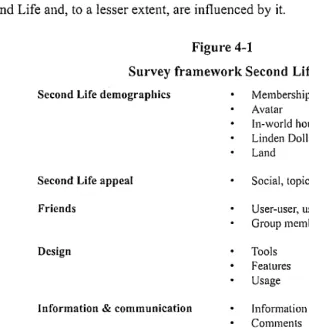
Figure 4-1 Survey framework Second Life 88 Figure 5-1 User participation profiles Second Life users 128
Figure 6-1 Distribution of Second Life respondents according to their
Figure 6-4 Distribution of Second Life toolkit usage for scripting 138 Figure 6-5 Distribution of Second Life respondents participating in
beta tests 142 Figure 6-6 Distribution of Second Life toolkit usage for modding the
Second Life Viewer 144 Figure 6-7 Distribution of Second Life respondents to their interest in
Second Life open source 146 Figure 6-8 Distribution of Second Life respondents according to their
interest to retain IP rights 150 Figure 6-9 Synthesis of design capabilities and design space 155
Figure 7-1 Blog commenters by comment count 176 Figure 7-2 Second Life forums: posters vs commenters 178 Figure 7-3 Second Life forums: posters by received comments and
self-comment behaviour 178 Figure 7-4 Mailing lists: SLDev and secondlifescripters 179
Figure 7-5 JIRA reporters and assignees 180 Figure 7-6 Mod development on the firm-hosted platform 187
List of images
Screenshot 4-1 Orientation Island (December 2008) 90 Screenshot 6-1 Second Life basic tool palette for building, texturing, and
scripting 135
List of tables
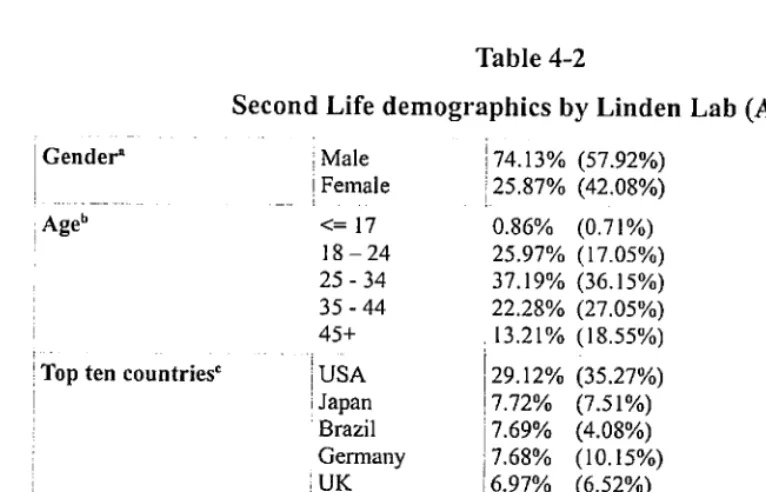
Table 4-1 Operationalization of the study 75 Table 4-2 Second Life demographics by Linden Lab (August 2007) 81
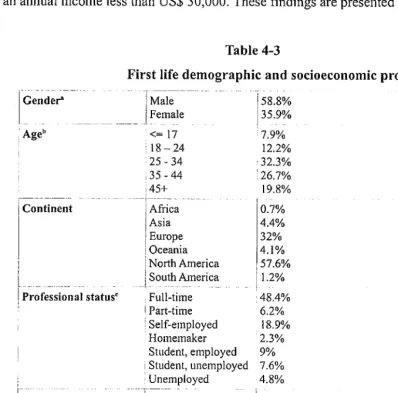
Table 4-3 First life demographic and socioeconomic profile 90
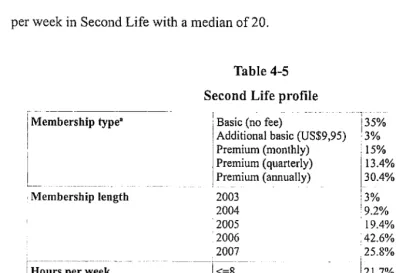
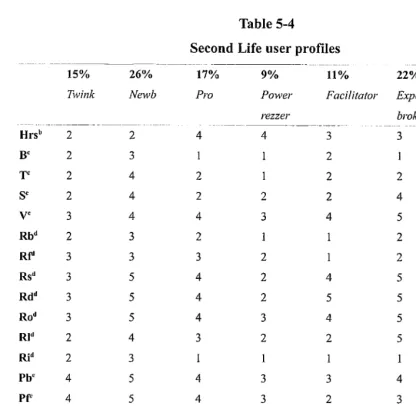
Table 4-4 First life gaming profile 91 Table 4-5 Second Life profile 92 Table 5-1 Second Life timeline 106 Table 5-2 Appeal of Second Life 108 Table 5-3 Appeal of Second Life: Rank 111 Table 5-4 Second Life user profiles 113 Table 5-5 Second Life user profiles and membership characteristics 116
Table 6-1 Correlations between measures of design features
and usage frequencies 141 Table 7-1 Overview factors, explained variance, and reliability 162
Table 7-2 Distribution of retrieval and supply of information 164
Table 7-3 Information quest 1: Rank 165 Table 7-3 Information quest 2: Rank 171 Table 9-1 Summary of the design capabilities 209
Chapter 1 Introduction
Day, my, day, my, day, my, day, my - Tomahawk1
1.1 Introduction
This chapter provides an introduction to the research which is concemed with a 'participatory turn' reflected in the claimed democratization of World Wide Web technologies. The availability of relatively cheap and easy-to-use tools and applications such as game developer toolkits and wikis encourages users to participate in Web-based development practices. This research is designed to enhance our understanding of user participation in the commercial setting of the three-dimensional (3D) software industry with the aim of highlighting the creative capacities of users and their contributions to product development on a Web-based fïrm-hosted platform. The study aims to yield insight into the development and organization of fîrm-user interactions where both commercial and non-commercial production modalities interact. It gives particular attention to the ways participation and practices are structured and organized across permeable firm boundaries.
The structure of this chapter is as follows. Section 1.2 introduces the study by describing my first encounters with, and interest in, the 3D software of Second Life. In Section 1.3 the objective of this study is outlined and contextualized in the main theoretical framework and supportive themes that underlie the present study. Section 1.4 draws out the scientific and managerial relevance of the research. In Section 1.5 the structure of the study is outlined, which is followed by a brief conclusion in Section 1.6.
1.2 A playmate enters a playground
This thesis is about user participation in Web-based 3D development practices, known as mod development, in the commercial setting of the 3D software industry, and which is part of a larger, recent phenomenon of users who increasingly participate on firm-hosted Web sites. It is designed to improve our understanding of how these users collaborate and share knowledge and ideas relevant to their participatory experiences and usage of the firm-hosted 3D platform, and how they improve, develop, and maintain new 3D platform-related products and services that may benefit the developer firm.
Research into populär sites for user participation such as YouTube have shown that users form communities in the pursuit of a shared enterprise, captured by the conceptualizations of participai'oiy and convergence culture (Jenkins, 1992, 2006). Yet, how the process of organizing practices of mod community members across firm boundaries is carried out, or how a framework can be developed for the investigation of interdependent relationships developing between multiple spheres of economic activity that underpin the firm-hosted 3D platform, have not beeil systematically investigated in the literature. By using a single-case study approach to examine Second Life (www.secondlife.com) this thesis sets out to illuminate the relationship between mod community membership and the developer finn, and offers an original account and conceptualization of user participation in the context of firm-hosted 3D platfonn development which involves a distinctive innovation and learning process.
knowledge exchanges, and the improvement and development of 3D products and services contributing new dimensions to the Second Life experience.
Moreover, Linden Lab generated quite a buzz in the room when it announced at the conference that the intellectual property rights of these user-made contributions rested in the hands of their respective creators. This was seen as a dramatic departure from what was common in the larger games industry. These strategic arrangements seemed to point to a dynamic relationship between the roles of the developer fimi and the user base underpinning the development of the 3D platform which seemed to capitalize on the integration of within-firm and external labour processes. Consequently, users appeared to be more than mere end users. Instead, they are users from whom, arguably, the developer finn could learn in the further advancement of the Second Life product.
I wanted to check it out but life took over until in 2006 Second Life gatecrashed worldwide, in the on- and offline headlines. With news headlines such as Second Life Will Save Copyright (Wired, 20/11/06), Get a (Second) Life (Financial Times,
17/11/06), Talent-Spotting in Virtual World's (BBC News, 21/6/06), and A Virtual World's Real Dollars (BusinessWeek, 28/3/06), Second Life was presented as a rather open and extensible platform for development (cf. Au, 2008; Ondrejka, 2007).2 And so,
on an early Saturday morning in London while I was still in my PJs, I installed Second Life on my Mac and created a female avatar by the name of Rocketgrrrl Tripp.3
The prefab avatar raised from the digital trenches was a rather average looking young woman dressed in jeans and a tee shirt, so I spent some time toying around with the appearance editor. After a while I had created Rocketgrrrl more to my liking by changing her into a raven-black longhaired, big blue eyed woman wearing black latex-like pants and a jacket, and knee-length black boots. Now ready to explore Second Life 1 tried to figure out how to walk the newcomer's route guided by instruction signposts in such a manner that I was actually able to read those signs. This was difficult. Impatiently I gave up trying to read them and checked out the interface menu instead. By clicking around I accidentally hit 'search' and somehow arrived in a nightclub. A very handsome punk rocker approached me and asked me whether I was interested in
2 See http://secondlife.com/news/ for Second Life news archives and press releases between 2002 and 2008.
making some Linden Dollars (L$) by 'camping' in the club. I had no idea what lie meant. I tried to sit down on a bar stool next to him, but one of my legs was not bending and my arms stood up straight as if I wanted to reach for the disco ball on the ceiling. Time to log off. Nearly six hours had past. Stili puzzled by what it was that I actually had been doing in Second Life I could not come up with anything other than 'not much'.
That same evening, however, I logged back on and found myself stili in the same nightclub and I was relieved to notice that my posture had tumed back to normal. Not knowing where to go, and knowing only that I did not feel like staying in the club, I stumbled outside and, like a drunk person, tried to walk without bumping too much into things over vast lands filled with avatars, shops, residential houses, parks, boats, and nothing but emptiness. What I encountered was mostly in a state of 'under construction'. Right there and then, I could see avatars on their land chatting using the lingo like 'rezzing' and suddenly new objects would appear from out of nowhere. I spent that evening just standing here and there to watch other avatars build. That experience would exemplify the way I was going to spend most of my Second Life. It is during those times that I encountered and talked to other Second Life users, in ail shapes and sizes, building, texturing, and scripting a living and a social life in the various corners of the platform.
From early on it was quite clear that the creative capacity of Second Life could be evidenced in these practices of development, customization, and visual socialization that were made possible by purposively firm-designed systems, the so-called editor or toolkit, that put modification activities in the hands of users. However, what constitutes user participation in the firm-hosted 3D environment, and the relation between mod communiti es with the developer finn as co-participants in product development underpinned by structures for participation and organization of practices across finn boundaries, have not been sy stemati cal ly investigated. This study, therefore, is designed to learn more about the increasing importance attributed to user participation in mod development practices, and the growing significance of social software in the context of the firm-hosted 3D environment.
1.3 Approaching the playground
Rap music, the Jubilee Debt Campaign, the Linux open source software movement and The Sims computer game have all left their mark on the world in the last decade. Rap infects all populär culture. The Jubilee campaign Ied to billions of dollars of developing world debt being written off. Linux is one of the biggest challengers to Microsoft. The Sims is one of the most populär computer games ever. These developments have one thing in common: they were all driven by Pro-Ams, innovative, committed and networked amateurs working to professional standards. This emerging group, the Pro-Ams, could have a huge influence on the shape of society in the next two decades. (Leadbeater and Miller, 2004: 9).
Say good-bye to today's experts and cultural gatekeepers - our reporters, news anchors, editors, music companies, and Hollywood movie studios. In today's cult of the amateur, the monkeys are running the show. With their infinite typewriters, they are authoring the future. And we may not like how it reads (Keen, 2007: 9).
A signifìcant paradigm shift is now underway. The rise of what is now described as social software or Web 2.0 environments stands to have a profound impact on social practices, the media, economic and legai frameworks, and democratic society itself (Bruns, 2007: 1).
From these illustrations, the overarching idea announcing the decline of the marginai productivity of the user can be heard. Facilitated by user-friendly and attractively priced (or gratis) software technologies, emerging sites for user participation are "all forms of digital culture, networked in technology [...] and collaborative in principle" (Uricchio, 2004: 86). Think Myspace profiles, YouTube videos, Wikipedia entries, and World of Warcraft avatars. In 2006 Time Magazine acknowledged this growing importance of user participation by naming 4you' Person of the Year.4 This
partìcipatory turn (OECD, 2007) is viewed as a new or, alternative, logie that seems to favour new over old production-consumption configurations that, to some degree, assume that user participation with particular attention to creative and collaborative practices on open and transparent (and often, finn-hosted) platforms, are empowering and are the way of the future. And, while some consider this a dreadful development that has a detrimental effect on our culture, others hail it as the way forward to sustain growth and innovation in society.
With this prolifération of digital technologies firm production boundaries are said to become increasingly porous as a resuit of having a growing number of users participate in copying, cutting, pasting, and adding to existing media materials. Tuming to the theoretical insights developing in work on participatory cultures in media sites (Bruns, 2007; Burgess and Green, 2009; Hartley, 2008; Jenkins, 1992, 2006) users are
well-known to engage in the production of meaning, whether of cultural texts, corporate intentions, or the technology itself. Especially since the 1990s media researchers have shown an increasing interest in this linkage between new technologies and users, looking in particular at the formation of new social collectivities and 'bottom-up' redefinitions of cultural practices5 (Baym, 2000; Consalvo, 2007; Jenkins, 1992; Klein,
1999; Livingstone, 1991). These studies have aimed to examine online sites of user participation (and dissatisfaction) that relate firm-produced/provided media content to (often unexpected kinds of) official and unofficial 'grassroots' user practices such as fansubbing, machinima, and mash-ups.6 More specifically, these studies have tended to
yield insight into aesthetic status and social power by casting the work of participating users as 'transgressive' (against the perceived economic interests of the producing/providing media firm, such as file-sharing networks) or as at least, 'unintended' (not considered by the producing/providing media firm but also not perceived as harmful, such as fan fiction). Such actions were thus seen as users taking basic materials provided by commercial media firms and actively re-appropriating and redistributing those materials as cultural practices.
While this blurring of production and consumption practices is not a new phenomenon it has become more salient in the context of digital technologies facilitating those diverse practices on a wider scale, engaging firms to look at the consequences for commercial interests.7 In many cases, participatory Web sites
represent successful illustrations of a rapidly evolving (yet often subtle) relationship of collaboration with users across firm boundaries at a time where it has become "increasingly clear that the Internet is not only embedded in people's lives but that with the rise of a more "participative web" its impacts on all aspects of economic and social organization are expanding" (OECD, 2007: 15) coinciding with a strong interest and
5 This is not new as generations of researchers have focused on the determining effects of technology, the producing corporations, and the public - the latter understood both as creators and audiences. However, the recent proliferation of digital technologies has particularly reactivated debates regarding the aesthetic status of new, technologically enabled expressive forms, and again challenges regarding the role of commerce in the production of culture have been mounted. Digital technologies have made questions regarding originality and reproducibility particularly difficult, and they have blurred the lines among producer, distributor, and consumer to a far greater extent than previous media forms (cf. Gasser and Ernst, 2006; Jenkins, 2004; Uricchio, 2004).
6 Fansabbing refers to fans that provide Japanese animation/manga with subtitles for the enjoyment of non-Japanese speakers. Machinima is a technique that typically makes use of games to create short films. Mash-up is the practice of laying the vocal/music from one song over another song.
awareness of the importance of firm-engagement with those active users.
With its focus on active media spectatorship, collaboration, and creativity, the user participation ïiterature associated with the concepts of participatoiy and convergence culture developed in the media research Ïiterature guide the main theoretical framework of this study. However, although this Ïiterature has made many valuable contributions relevant to the topics investigated in this thesis, insufficient attention has been given to the development and Organization of firm-user relationships on firm-hosted 3D platforms where both commercial and non-commercial production modalities interact underpinning product development. This may be due to a rather functional understanding of user participation which cannot fully explain the growing significance of the role of mod communities in knowledge production and innovation in the context of the developer firm.
A first supporting theme in the main theoretical framework is offered by the
communities of practice perspective which assists us in the investigation of learning relationships between the developer finn and users underpinning product development across finn boundaries (Lave and Wenger, 1991). Participation in mod communities can be approached in tenns of enculturation practices such as apprenticeship and mastery. On the basis of shared beliefs and common interests communities are formed, and work towards enculturating newcomers into communal belief systems, skills, and practices from those who have already mastered the group's social and material practices. In addition, such Web-based communities have been found to be effective in enabling and facilitating (voluntary) knowledge sharing (Scarbrough and Swan, 2001). Through these networked communities of practice people are said to develop and share the capacity to create and employ knowledge which can assist in advancing user creativity that underlies the Organization of product development (Brown and Duguid, 1991; Nonaka, Toyama, and Nagata, 2000). More specifically, through participation and practices, users can exchange infonnation and are regarded as being part of the finn's dynamic knowledge base, arguably providing the firm with opportunités to leam (Grant, 1996; Wenger, 1998). This infonnation- and practice-based perspective is therefore expected to yield insight into the underlying dimensions of the growth of knowledge and sharing practices across finn boundaries with the aim of highlighting knowledge contributions as a potential source of competitive advantage (Benkler, 2006; Foray, 2004; Freeman,
The literature concerning user-centred innovation provides a second supporting theme (von Hippel, 2005). In a more traditional view of innovation, fìrms talee 011 most, if noi ali, product development, while, in the users-as-innovators model, users are viewed as valuable innovators in the stages of idea generation and the process of product development (Jeppesen, 2004; Liithje, 2004). Following the line of argument associated with rapidly expanding user participation and enhanced networked connectivity, consulting with users has become an important focal point for firms. Consequently, firms appear to be actively encouraging and facilitating user participation in the innovation process which may be evidenced in purposively designed and provided toolkits. Providing toolkits for innovation and (co-)design is a means of systematically outsourcing certain design and innovation tasks from the firm to the user, assisting users in improving and developing new producís and services (von Hippel, 2005). In tfais way, users are presented with a broader palette to particípate, better equipping them to advance and develop producís according to their own inieresis and needs, while coniribuling io produci developmení (Thomke and von Hippel, 2002). From this theoreíical lens, íhe developer firm may be seen ío benefií from a relaiively low cosí approach io acquiring user-provided informaíion such as user-contribuied ideas, improvements and developments of producís and services underpinning íhe overall knowledge base of the finn (Allen, 1977; Foray, 2004).
In the light of this discussion and my primary interest in the dynamics or the iterative firm-user interactions undei-pinning Second Life, this thesis aims to investigate:
Q How is user participation constituted and maintained on the firm-hosted 3D platfonn, and with what implications for product development across firm boundaries?
The research design for this study involves using a mixture of quantitative and qualitative data and methods. An online survey was conducted among Second Life users, resulting in 434 responses. The survey asked respondents about général Second Life characteristics such as length and type of membership and about particular features and uses of the platform such as motivations, design, information and communication behaviour. First life demographics of users such as gender, income, and employment status were also collected. Semi-structured interviews were conducted with eight Linden Lab employees and thirteen Second Life users. The interviews with Linden Lab employees highlighted aspects of their rôles within Linden Lab, their interactions with users, and their perceptions of leaming opportunities. The interviews with Second Life users addressed their interests, usage pattems, contributions to the platform, and their interactions with other users and Linden Lab employees. In addition, online documents were collected and examined thematically drawing from the Second Life blog, forums, mailing lists, and public bug tracker (JIRA). The documents were used to examine the ways in which the developer firm and users interact in ways which are shown to further product development. The analysis of the data pointed to interesting relationships between the distinctive creative capacities of users and the range of capabilities afforded by the firm-provided 3D platform which underpin the advancenient of Second Life.
1.4 Reverse engineering the thesis
democratization of Web technologies. With the availability of affordable and accessible tools for content production and distribution, user participation is emerging as a creative infrastructure that is associated with pervasive knowledge-intensive and information-rich user-created content activities. An important thread in discussions concem the dynamics of user participation as a significant aspect of the knowledge-based economy (OECD, 2005; United Nations, 2008) or of ambiguous ternis such as network society (Castells, 2001), learning economy (Lundvall and Johnson, 1994), or the information society (cf. Crawford, 1983; Foray, 2004; Fuchs, 2007; Robins and Webster, 1999). Ail these concepts emphasize the prominent rôle of information/knowledge and the use of digital information and communication technologies associated with new opportunities for user participation in digital content development.
How is user participation conceptualized in the scholarly literature? Perhaps the most dominant discourse concerning user participation is associated with the notion of Web 2.0. O'Reilly (2005) lias coined this terni to refer to businesses that seek ways to understand and make use of new technologies such as the Internet to capture 'the wisdom of crowds' (Surowiecki, 2004), or 'collective intelligence' (Lévy, 1997) of users. Many, fully-fledged and not so fully-fledged, ternis, concepts, and models have been coined to capture this 'participatory turn' associated with Web 2.0, among which the most prominent are convergence culture (Jenkins, 2006; cf. 'participatory culture', Jenkins, 1992), democratizing innovation (von Hippel, 2005), produsage (Bruns, 2007), wealth of networks (Benkler, 2006), and wikinomics (Tapscott and Williams, 2006).
User participation in creative (or, creation) practices appears to be an increasingly large-scale phenomenon at least in the Western world where user creativity is largely informal, occurring in contexts where there appears to be no (apparent) authoritative entity and users voluntarily perform unassigned 'work tasks' (cf. Van Wendel de Joode, 2005; Raymond, 1999). These users that make, often voluntary, contributions may well be experts in certain areas yet they tend to be approached as 'amateurs', 'hobbyists', and 'fans' as user participation tends to occur outside the professional realm (Jeppesen, 2004; Keen, 2007; Postigo, 2008). Within this context, user participation has evoked debates in the social, economic, and policy domains which may be associated with increased user autonomy and diversity, new forms of media, different ways of doing business, and the need to address policy issues such as broadband access, privacy protection, and intellectual property protection (Benkler, 2006; Green, 2008; Leadbeater and Miller, 2004; OECD, 2007).
In addition, some studies suggest the ubiquity of opportunities for user participation that are accessible to 'all' and which empower the users (Burgess, 2007). While others see the linkage of Web tools and applications to user positions as "a brave new world where the spirits of commonality are finally merged with the interests of capitalism" (van Dijck and Nieborg, forthcoming: 12). The idea of a participatory Web seems to have become attached to a certain 'magic' or 'hype' and concrete claims and instances of such empowerment are implied rather than manifest in the empirical evidence (cf. Woolgar, 2002). Little attention has been given, for example, to the factors and distinctive relationships involved in different participatory modalities. Differences between more active and passive users are often assumed away, and the adoption of various technical and social designs is claimed to lead 'magically' to building a critical mass of participation (Burgess, 2007; Li and Bernoff, 2008; Tapscott and Williams, 2006).
Consequently, this study aims to yield insight into the dynamics between the developer firm and users with particular attention to the ways the developer fïrm develops user participation into a market and the ways in which that market enables and facilitâtes particular modes of mod development that are shown to shape and maintain a firm-hosted platform as a site at which the developer firm can be seen to leam.
In addressing some of the aspects that have remained largely unexplored in the user participation literature, the main theoretical framework is supported by several insights developed in work on communities of practice and user-centred innovation. However, this study's focus is not about the aesthetic and social qualities of user participation or the technological characteristics of software modularity, interoperability or the wider innovation system that underpins such developments. Rather, it is about specific aspects of product development across firm boundaries illuminating the growing significance of mod communities in knowledge production and innovation which are associated with the emerging knowledge-based economy.
From the perspective of the firm, the study contributes insight into the challenges faced by a developer firm that seeks to structure and organize user participation. The study highlights specific ways in which the developer firm may benefit or learn from user creativity through motivating, integrating, and coordinating particular tasks of employees and users which are shown to foster a particular fimi-user dynamic in the labour market. In particular, the study yields insight into the ways a firm can leam from user participation in development practices across its boundaries, guided by firm-designed toolkits as a potential leaming resource. As a resuit of this focus, this study offers some rich insights for practitioners who are involved in the phenomenon of user participation on firm-hosted 3D platforms.
1.5 Playlist
The 'playlist' supporting this study is organized into nine chapters.
worlds, and 3D collaborative platforms.
Chapter 3 présents the theoretical background and conceptual framework for this study. Theories focusing on user participation, user-driven innovation, and networked communities of practice are discussed and applied to modification practices in the setting of a firm-hosted 3D platform. The conceptual framework for the study is developed to explicate the underlying dynamics of firms that encourage and facilitate user contributions guided by an understanding of user Outputs as extemal resources on the 'demand side' of innovation.
Chapter 4 présents the research methodology. The firm-hosted 3D platform Second Life is introduced as the research site for data collection. The chapter sets out the research methods used to collect the quantitative and qualitative data that are the basis for the analysis in this study, i.e. an online survey, semi-structured interviews, and online documents. The data collection procedure and methods of data analysis are outlined and the strengths and drawbacks of the approach are discussed.
Chapter 5 présents the empirical findings concerning the design capabilities of Second Life users. The results focus on the analysis of disparities between the capabilities of Second Life users. Attention is drawn to the différent participation patterns and communication behaviours associated with Second Life membership. Différent modes of user participation are related to the organizational characteristics and culture of the developer finn.
Chapter 6 présents the empirical findings with respect to the design space. The design space is the area for user participation in mod development practices. The analysis examines the characteristics of the Second Life platform yielding insight into the functionalities of the design space associated with the firm-provided toolkit that enables and facilitâtes user participation.
Chapter 7 présents the empirical analysis of knowledge contributions made by users and employees of Linden Lab. The analysis yields insight into user participation on the firm-hosted platfomi by linking the design capabilities and design space to various communication practices. The findings demonstrate that Second Life is a site where various contributions by both users and the developer finn generate ideas about discovering, developing, and refining creative practices associated with firm learning that contribute to ongoing produci development.
modalities underlying the finn-user interactions on the firm-hosted platform and considers this in the Iight of the conceptual framework for this study and the broader theoretical implications.
Chapter 9 concludes this study with a contemplation of the main research findings about user participation on firm-hosted 3D platforms summarizing the principal theoretical, methodological, and empirical contributions of this study. The chapter discusses some of the limitations of the study and outlines opportunités foi-future research.
1.6 Conclusion
Chapter 2 User creativity in the games and 3D software industries
A perfect place
- Mike Patton*
2.1 Introduction
As a 3D platform Second Life can, in its execution, be positioned in the domains of the games and the larger 3D software industry. This chapter provides a basic background on user participation in modification practices which is considered to be one of the most rapidly evolving features of present-day game development. Without setting out to achieve a complete overview of these emerging practices (which would be a thesis in itself), this chapter draws on several prominent instances where 3D software developer firms invite users to participate in product development serving as a stepping stone to interpret, assess, and appreciate the conceptual framework presented in Chapter 3. In this chapter, the modification practices of computer-based First Person Shooters, Virtual worlds, and 3D collaborative platforms, are discussed.9
The structure of this chapter is as follows. Section 2.2 focuses on various aspects of user creativity (or, mod development) in the commercial setting of the games and 3D software industries that increasingly seek to engage and facilitate user participation. Section 2.3 describes the characteristics of computer-based First Person Shooters, virtual worlds, and 3D collaborative platforms. Section 2.4 yields insight into the rôles of toolkits, engines, and interfaces in the context of generating opportunités for mod development in game/3D design. Section 2.5 offers some concluding remarks.
8 Mike Patton, A Perfect Place, A Perfect Place (Ipecac Recordings, 2008).
2.2 Designing for mod development
At the inception of computer gaming (Spacewar!, 1962), programming consisted of tens of Unes of code that, roughly fifty years Iater, lias evolved into a social significarli and high risk, technologically advanced, capital intensive, proprietary practice and billion dollar industry (cf. Malliet and de Meyer, 2005; Postigo, 2003). Millions of people worldwide regularly play games. Currently, the average gamer is 35 years old (25% were younger than 18, 49% were between 18 and 49, and 26% were over 50). More than half of the gamers are maie (60% vs. 40% female). However, 33% of 18+ women in comparison to 18% of boys aged 17 or younger, play games (ESA, 2008).10 Games are played on consoles, such as Xbox 360 (e.g. Halo 3 by Bungie
Studios) and PlayStation 3 (PS3) (e.g. Guitar Hero III by Harmonix Music Systems); handhelds, such as PlayStation Portable and Nintendo DS; computer games (e.g. Call of Duty 4 by Infinity Ward); and, engage in online massively multiplayer online role-playing games (MMORPGs) (e.g. World of Warcraft by Blizzard Entertainment).11
Many, if not all, of contemporary game devices offer online gaming services like Xbox Live allowing gamers to compete online and download content such as game demos, TV shows, and movies fitting the participatory Web phenonienon.
User creativity within the gaming context lias enthusiasts and amateur developers toying and tinkering with their favourite games despite the inherent complexity of game development. Such user modification practices can be located along with the emergence of, for example, the radio industry (Hartley and Notley, 2005; Takahashi, 2000), scientific equipment (Letti, Herstatt, and Gemuenden, 2006), and automobile industry (Franz, 2005). For games it is commonly referred to as modding. This is short for the practice to modify a game executed by a modder (or, in this study, mod developer)n with a modification or mod as outcome13 (cf. 'hacker' in Levy, 2001;
Raymond, 1999). Within the domain of computing, both hardware and software can be modified. Examples of hardware modifications are 'computer case modding' such as by
10 See Entertainment Software Association (ESA) for more information: http://www.theesa.com/ (accessed 16/10/08).
11 See for a further breakdown Kerr (2006).
12 In this study, mod developer refers to ail users participating in creative endeavours involving mod development unless it is specifically stated how the term should be interpreted.
adding light (Sotamaa, 2005), and 'modchips' that are typically used to circumvent région codes of game consoles (Doinke, 2006).14 There exist many variants of game
software modifications varying from partial conversions like gameplay mods, such as slightly altered maps or skins, to game-additions (or, 'add-ons') such as server tools or single player missions, and to total conversion modifications.15
In this study, user participation in mod development is understood as an act of user creativity in a cultural, social, and economic context. More specifically, mod development constitutes a domain consisting of a "set of symbolic iules and procédures," a field of "gatekeepers" of the domain, and the mod developer him/herself (Csikszentmihaly, 1996: 23). Or, in other words, "creativity is any act, idea, or produci that changes an existing domain, or that transforms an existing domain into a new one" and a creative individuai is "someone whose thoughts or actions change a domain, or establish a new domain" (Csikszentmihaly, 1996: 25-26). Modding can also be conceptualized as a non-zero-sum collaborative effort. It refers to the emergent attribute of collaboration witnessed in various mod teams (Nieborg and van der Graaf, 2008). This means that "a new whole is forming" by contributions made by mod developers that "could not have been generated if the efforts had been individualistic" and subsequently "the 'non-zero-sumness' of collaboration therefore does not stipulate that such an outcome is greater or better, but rather différent" (Elliott, 2007: 33).
Rather than "imagined conceptualizations" mod developers are increasingly approached as important components of game/3D development suggesting a co-constructión of game/3D development occurring between developer firm and mod developers (Taylor, 2006a). Developer firms that seek to engage users in participatory ways can, for example, provide access to software and tools; open up (parts of) the underlying technology; disperse information via wikis and manuals, and so forth; and, provide a (semi-)legal framework to facilitate and condition user-generated contributions (Frederiksen, 2006; Jeppesen and Molin, 2003; Nieborg and van der Graaf, 2008). In doing so, these fimi practices render modification activities of existing games and other 3D environments to users from which the developer firm can potentially benefit (see Chapter 3). In these instances, an emerging mod culture and the
democratization of innovation appear to go hand-in-hand (von Hippel, 2005). From this viewpoint, it is important to stress that mod development is not used in a technologically deterministic way where, for example, the toolkit or game engine, impact upon the developer firm and user base. Rather, mod development is investigated in reciprocai firm-user dynamics evolving in practice-based communities that appear to encapsulate users-as-developers in différent stages of the product life cycle for which the theoretical framework is developed in the next chapter.
The next section addresses the lcinds of game and 3D environments that allow for user participation.
2.3 Ali the games that are fit to mod
We spent a lot of time bringing people from the mod community out and people who liad websites for Cali of Duty 1 and 2 [CoD] which both had a heavy PC component to it. We went through and had exhausted meetings with those guys on what they wanted and I think we really opened up [CoD4] for modders and they should be really excited to get their hands on it. They were pleasantly surprised to see a lot of the things that we had already added to the game. And some of them were saying 'you know you are putting modders oui of business here'. [...] I really cannot wait for [...] our PC fans to crack up a copy of [CoD 4: Modem Warfare] and have add il with their buddies (Grant Collier, Studio Head at Infmity Ward, 2007).16
For over fifteen years modding has been mainly a PC-centred affair. This in contrast to the console-based multiplayer mode that only made its entry in the early 2000s and where user-generated content and (with a few exceptions) mod communities have yet to blossom. For example, only as recently as November 2007, the PC-version of the shooter game Unreal Toumament III (Epie Games) was dropped with the Unreal Engine 3 toolset that as 'an unique feature' allowed user-created content to be exported to PS3.17 For this reason, the remainder of this chapter will mainly concentrate on those
PC-based areas where mod development has been prevalent, namely, First Person Shooters (FPS), virtual worlds, and 3D collaborative platforms.
Among the most popular market-based genres developed for PC games are strategy games (33.9%), MMORPGs (18.8%), family entertainment (14.3%), and shooters (11.6%) (ESA, 2008: 5; cf. 'game genres' in Apperley, 2006). About half of the gamers reported to play online games (56% maie vs. 44% female) of which 16%
reported to play action/sports/strategy/role-play games and 11% engaged in 'persistent'18 and multiplayer universes (ESA, 2008: 9). Although substantial evidence
is lacking, it seems that of these PC-based genres FPS and role-playing games are most frequently modified (Jeppesen, 2004; Postigo, 2008). In particular, FPS modding has "a strong history of fan involvement in modification" (Postigo, 2008: 60). Also, it has been suggested that FPS mod culture has become "institutionalized" and the interest of both the developer firm and mod deveiopers in technologically advancing FPS games "may well contribute to the ongoing teclinological interplay between both parties" (Nieborg, 2005: 3). So for example, Infinity Ward, the developer finn of the shooter CoD4, implemented the gameplay mode that is refened to as 'hardcore' and typically constitutes the first mod that modders create (that is, a 'realism mod', such as having no 'head-up display"9, and no 'regenerative health'20) in the game. Infinity Ward had not
only learned and picked it up from the mod community of previous CoD series, the firm had also hoped with this mode in place to encourage mod deveiopers to "think of whole différent kinds of mods."21
Another, more recent and rapidly increasing PC-based mod format is associated with 3D developments that appear to be less game-like, or not games at all. Virtual worlds and especially 3D collaborative platfonns seem to move away from more FPS game-like attributes towards an architecture or operating system that is more similar to the Internet (and in particular, its Web 2.0 features) but with 3D simulation features, of which Second Life is the most extreme example (see Section 4.3). In other words, those virtual environments where user experiences arise mostly from user-generated content rather than from the more structured experiences associated with many PC games. The popularization of persistent, open-ended, and 3D online environments, commonly referred to by the terms MMORPGs, or virtual worlds, is seen as the vanguard of a new generation of gaming. They take advantage of accessibility, relatively cheap and fast Internet connections, and advanced graphical standards of current computers (Castronova, 2005; Steinkuehler, 2005). Such environments are generally characterized
18 Persistence refers to an already existing 3D environment before and after the user logs on/off. This implies that events and interactions driven by other users through their avatars, occur even when the user is not logged on and that may impact upon the next sessions.
19 This refers to the visual display of information on the game's user interface.
20 This means that when the player is losing strength or is about to die in-game, s/he cannot use in-game tricks such as eating candy to strengthen her/his health in order to continue to play.
in terms of:
Persistence;
Graphical (re)presentation;
Interactivity where users' interactions (through their avatar) affect the results of other users' avatars;
Adhering to the laws of physics;
Accommodating simultaneous access for a large number of avatars; and,
Utilizing an exchange system of Virtual assets, such as currency, items, and realty.
Within the confines of this thesis, I propose to moke a distinction between virtual worlds (or, MMORPGs) and 3D collaborative platforms whereby the former focuses on the game aspect in a world based on a genre such as fantasy and sci-ji, while 3D collaborative platforms are thoroughly malleable. In addition, virtual worlds tend to be motivated by quests and tasks in a narrative forai that is typically created by the developer finn, while 3D platfonns tend to be more community-based. If any narration is available it is likely to be created by users (cf. Yee, 2006). This study focuses particularly on the 3D (collaborative) platfonn Second Life (Linden Lab) that is neither genre- nor narration-bas ed in contrast to various other virtual worlds. Furthemiore, the 3D platfonn is here understood as an advanced geometrie software simulation that provides simultaneous access to a large number (50,000+) of users. It generates and sustains a mechanism for the supply and demand of user-created content. Participation on the platform is guided by using a self-created avatar to interact in real time with other avatars and simulated objects that are present in the persistent environment.
From these three perspectives, it can be gathered that there exist several formats of game designs that can be characterized by a perpetuai state of development and allow users to be creative or innovative in différent ways. Four participatory modes for user creativity, that may overlap, can be distinguished (Haddon, 2005; Sotamaa, 2005):
Involvement in creating new practices utilizing games/3D-related technologies and applications in new ways, such as new skins and maps for gaines;
Involvement in dispersed meta creative design activities concerning games/3D-related technologies and applications, such as maintaining a Web site or wiki for an avatar or game; and,
Involvement in the generation of particular (new) usage patterns, practices, and meanings surrounding games/3D-related technologies and applications within the wider community or subculture, such as norms.
Achieving mod developers to participate in creative practices is directly connected to the user's own, shared participation in mod development within the boundaries set by the developer firm (Malaby, 2006). Put aptly by Benkler (2006: 75) "the commercial provider offered a platform and tools, while the users wrote the story lines, rendered the "set," and performed the entire play." User-generated content as mod development is therefore the heart of the experience and malleable within the boundaries set by the developer firm. But what are the parameters to play with? The next section draws attention to the technological underpinnings and implications foi-certain possibilités for user participation in exemplary FPS, Virtual worlds, and 3D platforms.
2.4 Of toolkits, engines and interfaces
The internai product development process of a developer firm can be understood to operate along with (the development of) external mod development practices (Bogost, 2007). One important motivation for this argument lies in the workings and underlying logie of the game engine and, in many cases, software editors and/or game/3D development toolsets, that are employed by both the developer firm and, in a variety of modes, by mod developers. First, the rôle of toolkits is addressed which is followed by a discussion of the game engine and interface.
2.4.1 Toolkits
such as level editing and script compilation (Jeppesen, 2004; Prügl and Schreier, 2006; West and Gallagher, 2006). They come in a variety of forms. There are specific within-firm loolsets. The firm equips its developers with tools they need in order to work.
These tools may be internally designed but can also be third party developed like commercial-off-the-shelf graphics packages such as Maya, and Photoshop. End user toolkits may be developed and provided by the developer finn. These toolkits appear to vary from being completely identical to the tools used internally, to specifically designed end user tools. They may also be third party tools that come with the produci or, if allowed and compatible, used on the mod developers' own account. And lastly, again if allowed and possible, mod developers may develop their own tools to mod the game, world or platform. Furthennore, both first and third party toolkits may be located internal and exteraal to the game/3D environment.
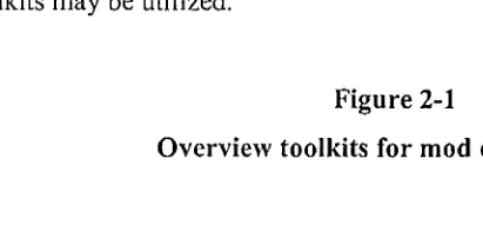
[image:31.734.168.410.646.761.2]In general, tools appear to be custom-released by the developer finn for a specific environment, albeit, those tools are frequently re-used for other games and other 3D settings (i.e. internally developed, licensed to third party developers, and mod communities). For example, game developer Valve has included its Source Development Kit (SDK) with first party tools such as Faceposer, Valve Hammer editor, Half-Life Model Viewer, and third party tool Softimage|XSI EXP which was also used internally to develop the FPS Half-Life 2. In addition, for some tools (part of) the source code is also available such as for the Half-Life Model Viewer that enables users to mod the Viewer toolkit itself as well. Figure 2-1 provides a general overview of the ways toolkits may be utilized.
Figure 2-1
Overview toolkits for mod development
Developer firm 1M party
Internai toolkit Mod developer &
Externa1 toolkit Developer firm 3rd party
Toolkits may or may not be shipped along with the game, virtual world or 3D collaborative platform. However, if tools do get released it typically is, at minimum, the level editors that are needed to develop a 'level' which, for example, can be a particular building or Street.22 An example that I have briefly touched upon in Section 2.3 is UT3
that ships the Unreal Engine 3 Editor with the PC-version and allows the produced mods to be played on PS3. Rather than mere editing levels, the toolset (or, editor) facilitâtes, for instance, the création of whole new levels and game modes. In practical terms this means that gamers have to buy both versions, namely for PC and PS3 which is quite expensive as newly released games cost between US$ 50 and US$ 60. The release of toolkits seems to be part of an industry-wide trend, coinciding with low-cost digital distribution platforms, of 'episodic games' such as Half-Life 2 episodes, and 'expansion packs' such as The Sims. These practices contribute to shorten release cycles and lower prices yet when accumulating costs of purchased content over time, it appears to disfavour the gamer and/or mod developers (Nieborg, 2008).
2.4.2 Engines and interfaces: first person shooters
Not only toolkits can facilitate mod development. Typically it is the game engine that enables and supports mod practices. For FPS, the game engine typically consists of several components and includes a graphics rendering system, modules for artificial intelligence, physics, scripting, networking, and other features (Moore and Sward, 2007). The game engine is the developer firm's intellectual property, or proprietary technology (Bogost, 2007).23 The development of the game engine is a very high risk
and costly affair and, therefore, the engine often serves as development platform for multiple games. For example, Valve's Source engine is the vanguard for the Half-Life 2 series, the sequel Team Fortress 2, and the recent developed Portai. In addition, the game engine is frequently licensed to third party developers. As game engines are portable and can be used to work and develop on multiple platforms, they are often referred to as game middleware (Mayer, Bekebrede, and Stegers-Jager, 2007). For example, the Unreal Engine 3 was used by 2K Games to develop Bioshock and the US Army used it for America's Army 3.0. These practices are facilitated by the engine's
modular design that allows other developers to, for example, build engine plug-ins for
offloading software routines (or, libraries) like Havok (Moore and S ward, 2007; Nieborg and van der Graaf, 2008; cf. Langlois, 2002).24
For only a minority of developer firms the game engine is also a 4canvas' that
enables and facilitâtes mod development.25 Not many developer firms open up their
engine for mod development nor can the engine technology itself be modded (cf. Jeppesen, 2004). Examples of developer firms that encourage and facilitate user participation in FPS modding are Valve (Source engine), id Software (id Tech), and Epie Games (Unreal engine). Mod developers tend to get access to (parts of the) game code and a firm-designed toolkit that allow them to customize and design essential parts of the game.26 For example, Valve prohibits mod developers to access the Source code
for the renderer, networking, physics, and sound system. However, for the parts that are unlocked, if compatible, third party tool sets like graphie editors and first party toolkits may also be used.27 The game engine is thus not "infinitely adaptable" nor "content
neutral" (Dovey and Kennedy, 2006: 57).
2.4.3 Engines and interfaces: Virtual worlds and 3D collaborative platforms
In August 2007 id Software expressed its interest in developing Quake Zero, a FPS based on the code base assets of Quake III: Arena, as a free Internet application; not as a stand-alone game but rather as part of a community-based service.28 This step
seems to parallel the increasing popularity of Intemet-based 3D environments such as I-Iabbo Hotel (Sulake Corporation), Runescape (Jagex Ltd.), Club Penguin (New Horizon Interactive), Webkinz (Ganz), and Guildwars (ArenaNet). Currently, World of Warcraft is by far the most populär Virtual world and Second Life seems to be the most extreme example of a 3D collaborative platform. The remainder of this section joins the previous FPS discussion by drawing on the 'under-worlds' of World of Warcraft and Second Life. Although, the rationale for the focus on Second Life in this study lias not yet been presented, this section locates the importance of Second Life in emerging firrn-hosted mod development and mod culture (see Section 4.3).
24 Within this context, modularity also means that parts of the engine can be upgraded without 'breaking
the code'.
25 See John Carmack (Doom, Quake and Wolfenstein sériés) on the importance of enabling game
technology at http://www.lup.com/do/newsStory?cId=3I61743 (accessed 6/02/08).
26 Partly facilitated by the engine's modularity the developer finn tends to close off some parts of the
engine for mod developers, this in contrast to third party licensees and first party developers.
27 Personal communication with Tom Leonard, software engineer at Valve (10/08/07).
2.4.3.1 World of Warcraft
World of Warcraft runs a client-server system architecture for which the client software needs to be purchased. Users install client software on their computers in order to connect to remote server software that continuously runs the virtual world. In order to run these environments network protocols, security (e.g. to prevent cheating; cf. Consalvo, 2007) and a (relational) database design must be in place.29 Maintenance
requires sufficient servers and bandwidth, and support. One reason for this is that insufficient resources for maintenance or an acceptable level of user populations per server may lead to lag (and frustration) among users (Esbensen, 2005). Like many other virtual worlds the system architecture of World of Warcraft is such that the world is run on separate servers. This is commonly referred to as 'shards' (McFarlane, 2005). It means that the world is split up into a number of parallel environments through clustered servers, all of which run parallel instances of the same world but with different sets of users (Ye and Cheng, 2006). The drawback of the deployment of shards is that it splits up the user base by dispersing users over separate, non-interacting environments.30
More specifically, the shard model is based on a fundamental distinction between static and dynamic content at the level of the (mostly) static environment and the (mostly) dynamic user (Rosedale and Ondrejka, 2003). As such, users cannot interact with any other potential user at any given time when s/he is exploring or playing on another server.
Mod development for World of Warcraft is enabled and facilitated by the developer firm's API-based user customization tools (Gilbert and Whitehead II, 2007; Nardi and Kallinikos, 2007). These tools can only be used to mod the user interface via so-called 'addons' (i.e. files located in the mod developer's game folder that enhance her/his interaction with World of Warcraft, such as created in XML) and 'macros' (i.e. combinations of actions that are executed in one go).31 Third party tools are not allowed.
Nor are, for example, outside-world developed macros. In fact, those are considered 'exploits' - and, against the Terms of Service (ToS) - and can lead to some kind of punishment, and even to being banned (Consalvo, 2007; Taylor, 2006b). Users have thus full control over the 'look and feel' of toolbars, hot keys, and macros that assist in making alterations to, for example, the built-in player, menu buttons, and even the entire
29 See http://vvww.gamasutra.com/resource_guide/20030916/lee_01.shtml (accessed 17/10/08). 30 See http://www.technologyreview.com/Infotech/ 19378/?a=f (accessed 4/02/08).
standard World of Warcraft interface can be modded (and thus replaced) to induce its fiinctionality. Furthermore, mods can be stand-alone, built on libraries, and can be a combination of several individually created mods.
2.4.3.2 Second Life
According to the ToS Linden Lab perceives its own rôle as that of service provider in enabling and facilitating online user interactions on a platform where users, gratis or for a subscription fee, are free to choose, develop, and modify the service environment.32 This seems to push Second Life in the direction of approaching an
advanced level of a social network service that is intertwined with 3D attributes. More specifically, Second Life is a Web-based 3D collaborative platform that constitutes the so-called Second Life Viewer, or, client application (see Section 6.3.2). The Viewer enables its user (also known as 'residents') to access and interact with the 3D platform and others.33 The Viewer is similar to a Web browser à la Firefox in that both are
software applications that connect to Web servers ('the grid') and retrieve, or render, respectively, 3D content or Web pages on the user's screen. Thus, the Viewer looks after the display and interaction of users with text, (moving) images, sound, etc., located in Second Life or a Web page.
Second Life is not operated using shards. Instead, the 3D collaborative platform is designed according to a topologically tiled grid. This means that the 'four nearest neighbours' connected Simulators look after the physics, run scripts, manage the objects and the overall land within a fixed square région of space (Rosedale and Ondrejka, 2003). So, when objects move around the physically simulated platform, their représentation is transferred (along with, for example, scripts, objects, and textures) from simulator to simulator when they cross over the 'boundaries'. More specifically, each server runs a physics simulation (recently upgraded to Havok 4) that looks after interactions among ali objects - non/moving and non/physical - in a certain part of the platform.34 Assets are digital items, such as the shape and appearance of an avatar,
textures and sound clips, and are stored in a MySQL database.35
Second Life lias also a built-in toolkit, that is, the 'browser' and 'tool'
32 See http://secondlife.com/corporate/tos.php (accessed 2/02/08).
functionalities are integrateci (cf. Forge of Halo 3 for Xbox 360), allowing users to build, script, and texture (see Section 6.3.1). For example, with a 3D modelling tool users can build buildings, vehicles, furniture, and so forth that can be used, exchanged, or sold, and with the Linden Scripting Language behaviour of in-world objects, can be managed and controlled.36 Certain graphics, animations, and sounds can also be
externally created such as with third party animation editors like Poser, and uploaded into Second Life.37 The underlying technologies used are a mixture of proprietary, free,
and open source software, such as Apache (for the operating system) and Mono (a simulator Upgrade). Since January 2007, (part of) the Second Life Viewer lias been open sourced under version 2 of the GNU General Public License with a FLOSS exception.38
As a resuit, user-modded Viewers such as a graphie Viewer 'Nicholaz Edition'39 have
been created and made available for everyone to use. In the future, Linden Lab may move towards standardizing the Second Life protocol and continue to open source its client and servers (cf. Gallagher and Park, 2003; see Sections 6.3.2 and 6.3.3).
2.5 Conclusion
This chapter lias drawn attention to the growing significance of mod development in the contemporary games and wider 3D software industries. Developer firms of several FPS, Virtual worlds, and 3D collaborative platforms actively support
mod development yet they somewhat limit access by granting access to, in most cases, certain parts of the engine (generally for technical and artificial reasons), and by providing particular toolkits, and (binding) legal agreements. World of Warcraft allows its users only to mod the interface, toying with any non-interface files is prohibited and may lead to suspension of one's account. From this perspective, FPS modding can be seen as the most innovative and sophisticated instance of modding for PC games. Yet in comparison to Second Life's seemingly open and extensible platfonn, PC-modding is legally and economically rather limited.
Developer firms seem, therefore, to work with a certain idea of users in mind. This may help them to make certain trade-offs during the development process
36 See http://en.wikipedia.org/wiki/Linden_Scripting_Language (accessed 3/02/08). 37 See http://blog.secondlife.com/2006/09/02/free-poser/ (accessed 3/02/08).
38 This is an additional clause granting its usage with several other free software packages. See http://secondlifegrid.net/programs/open_source/licensing (accessed 16/10/08).
embedding the platform with particular forms of usage that users can engage in, negotiate with, and remake and that may provide the developer fimi with input and feedback. In other words, the (strategie) position of the developer fimi towards encouraging and facilitating user participation can be viewed as a rather complex dynamic between opening up and closing off parts of the product developnient process and this may have a profound cultural, social, and economic impact.