Performance Analysis of ETTH and FTTH In Terms of
Cost and Scalability:
A Comparative Study carried out on
MATLAB
Nadia Mustaqim Ansari
Department of Telecommunications Mohammad Ali Jinnah University, Karachi
ABSTRCT
As a new access network to the home, Ethernet to the home (ETTH) and fiber to the home (FTTH) has the newest development of multimedia applications in which the end users require more and more bandwidth capacity. The main focus in this paper is to conduct a comparative study between ETTH and FTTH with the help of two parameters, these parameters are critically evaluate to find which technology is most suitable in terms of guided media. Therefore a modeled ETTH and FTTH based networks are deployed over MATLAB for acquiring the desired results through simulation to prove the hypothesis which is provide by the author. In future there is a vast ground for these technologies. The immediate future work is to analyze further parameters like downstream bit rate, upstream bit rate, generated traffic and number of ONUs which can be compared to judge the dominancy then to create a design at metropolitan level and carry out a testing phase as an expansion to the current scenario.
Keywords
ETTH, FTTH, MATLAB, cost, scalability.
1. INTRODUCTION
As a new access network to the home Ethernet to the home (ETTH) and fiber to the home (FTTH) has the newest development of multimedia applications like video on demand, fast Internet access, television and voice over IP, in which the end users require more and more bandwidth capacity. Ethernet standard is mostly used and installed in local area network (LAN). Particularly IEEE 802.3 standard used for ETTH is also known as EFM may install copper wire or fiber optic cables with active or passive networks.EP2P used in active environment and EPON create passive environment. Most enterprises use common Ethernet in their local area networks (LANs) even run storage area networks and several other applications on top of it. This attractiveness of Ethernet in corporate networks and home has led to extraordinary production of related components of Ethernet, causing in very low production costs. Furthermore Ethernet standardization has permanently been able to increase broadcast speeds when modern interfaces have become so much slow to provide accommodations all required trace. This grasps true even nowadays when Gigabit Ethernet has developed a standard domestic item. Because merging network technologies has the potential to cut down costs, enterprises are increasingly requiring much more Ethernet based site connectivity FTTH is a pure fiber installation, in this network central office directly connect with the optical fiber to subscriber home. GPON is most promising implementation of FTTH by authorized telecom operators. The traditional access network infrastructures, specifically
the coaxial cable CATV networks and twisted pair telephony networks, are having a tough t i m e t o c o n t i n u e w i t h t h e s e t r a f f i c demands. After successful the core and metropolitan network systems, fiber is now penetrating into the access domain. Its huge bandwidth and low loss allow the transfer of any current and predictable set of broadband services, and also mark it a fine match to the wireless link to the customer. The key issue for the network is cost effectiveness, and will be crucial to choose network topology. FTTH is a technological tool where in a single optic fiber provides connectivity from the service provider of a network service provider to the customer’s home. The tool of technology is also recognized at times as FTTx in which the meaning is broader and covers apartment buildings, offices, different communities, and various other structures. This tool of technology has already been certified by ITU-T as GPON and IEEE as GEPON. The ITU-T technology is known and IEEE as GE-PON. An FTTH network uses optical fiber between central offices i.e. the Optical Line Terminal (OLT) all the way to the customer’s home with optical network terminal (ONT). The purpose of this thesis is to conduct a comparative study between ETTH and FTTH. The following parameters will be critically evaluated to find which technology is most suitable in terms of guided media. Make comparison on the basis of following parameters of ETTH and FTTH technologies, will identify which is the most recommended technology for providing above mentioned services:
Cost
Scalability
The comparative study will then be used to identify weather ETTH or FTTH will be a better solution as access network to the home.
2. ETHERNET TO THE HOME
2
Fig 1: Network model of ETTH
2.1 H istory
An Ethernet to the home networks established when one or more computers are connected to each other and also the Internet. Ethernet operates hardware and software to create protocols for how computers transmit data. In 1970’s, first time Ethernet traditionally mentions to a system that use of cables to interconnect one or more computers to form a LAN (Local Area Network).One advantage of an Ethernet home network is that it allows all computers in a home to connect to the Internet at the similar time. Although the network, the computers may also share, fax, printer machines, and files. A drawback to an Ethernet to the home network is that the cables can be weighty. In large area, the cables cannot be long sufficient to reach each computer. This may be altered by hiring an electrician to connect additional Internet connection ports. Even though Ethernet usually refers to a cable connection, it could also be wireless. One of the options is Ethernet Bridge device for wireless. This tiny tabletop device uses radio waves to permits wireless equipment to also perform on an Ethernet to the home network [2].
2.2 Standards
First time IEEE 802.3ah recommend in 2004 that Ethernet used for access networks afterward, IEEE 802.3 standard included in the in 2008 and, IEEE 802.3av for higher- speed 10Gbps (EPON) Ethernet passive optical networks also called as 10G-EPON or XEPON was finally approved in 2009. We emphasis on Ethernet to the home for the time being this is one of the best wide access networks technologies [3].
2.3 Network Architecture
[image:2.595.57.267.72.239.2]Ethernet to the home (ETTH) also referred as Ethernet in the first mile (EFM) is an explanation that performs Ethernet transport protocol (ETP) amongst the network operator and client’s positions. Fiber optic cables or copper wires are the basis of ETTH, with either active or passive, for connection of active network elements (NEs) Ethernet point-to-point (EP2P) is used [1], for connection of passive network elements (NEs) Ethernet passive optical network (EPON) is used. In Ethernet passive optical network EPON, through using point-to-multipoint (P2MP) topology passive network elements (NEs) are linked by the optical fibers. Ethernet to the home (ETTH) on fiber optics permits exploiting the advantages of fibers optics as compared of copper wires, like immunity, increasing in bandwidth, electromagnetic disturbance, short space occupancy, minimize the cost decrease cables weight etc. [3].
Fig 2: EP2P Network
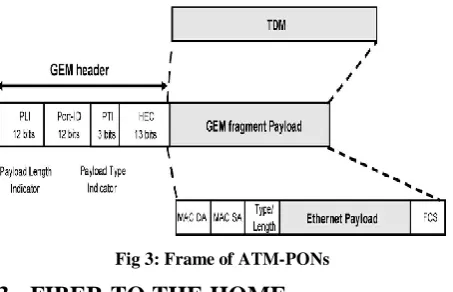
The basic network devices for Ethernet Point to point (EP2P) are composed of 2 nodes: Optical Line Terminal (OLT) and Optical Network Unit (ONU), both recognizing the same purposes described in Gigabit Passive Optical Network (GPON). Then one fiber connection is dedicated for every one user P2P (point-to-point) connection, the splitter vanishes between the CO(central office) and the clients premises as shown in Figure 2 [10].The key difference with Asynchronous Transfer Mode Passive Optical Networks (ATM-PONs) is that an Ethernet passive optical network (EPON) can transmit variable-length packets up to 1518 bytes in length, while an Asynchronous Transfer Mode Passive Optical Networks (ATM-PONs) transmits fixed-length of 53-byte cells. This capacity yields a greater efficiency for controlling internet protocol (IP) traffic. The packets are transmitted at the gigabit Ethernet 1.25-Gbit per second speed by the IEEE 802.3
Ethernet protocol is shown in figure 3[4].
Fig 3: Frame of ATM-PONs
3. FIBER TO THE HOME
As the industry chain of passive optical access network technology develops quickly and its technique improved drastically, the global deployment o f optical access network is accelerating. FTTH (Fiber to the home); it is a pure fiber installation, i.e. no copper wire is employed: the installation of optical fiber ends directly into the subscriber home. Among several FTTH implementations, the main architecture is emerging as the most promising to be implemented in the access networks by telecommunications operators i.e. GPON (gigabit passive optical network).
3.1 History
[image:2.595.317.544.416.562.2]approximately 4 years. But at this time they returns along with WISPS-CLEC's that proposed fiber optic and wireless hybrid way out. The aim of FTTH technology has been vividly opened to antagonism is advances in technology and great drop in the costing of fiber optic cable and communications hardware. There are then technologies that offer approximately 3 to 5 year "payback" on "Triple Play". Our source partners include some manufacturers as well as Telco Systems, AFL, and many more [5].
3.2 Network Architecture
If cost were no objective, the ultimate utilization of fiber to the home (FTTH) would include one or more P2P (Point- to point) fiber pairs being connected between each client’s premises and a CO (central office), complete with an energetic amplification and regeneration of signal along the fiber. Such A shape would reflect the topology of the current phone network (in which The CO (central office) is the client’s local phone exchange). A national utilization of point-to-point Fiber to the Home would include the installation of infinite of miles of optical fiber. The ordinary way to minimize this price is to use fibers according to a tree arrangement: instead of placing a cable from every property all the way towards the CO (central office), it might be just placed as per a nearest cabinet on each path or within complete large area [6].
Fig 4: Network Architecture of FTTH
This cabinet is then related to the CO (central office) or another combination cabinet via single, connection based on higher-speed fiber. This topology is used by various smaller-scales; MAN (metropolitan area networks) and also campus networks. Usually, such networks have been made up of many P2P (point-to-point) links: the cabinets dismiss the downstream links to customer properties and the upstream associates from cabinets near the CO (central office) are separate P2P (point-to-point) links. As an outcome, the cabinets must hold active visual components and interacting equipment a large number of transceiver parts connected to a network switch. This, unluckily offsets a lot of the cost kept in laying less fiber: this equipment is exclusive to buying in the capacities that would be needed and furthermore working and conserving complex network equipment circulated around cabinets all over the country causes great successively costs for the benefactor. Therefore, in pursuing to confiscate active modules from the network among the CO (central office) and the customer properties, the concept of a PON (Passive Optical Network) was born [7]. This includes the use of inactive fiber splitters which permit various customers normally 32–128 to share a single fiber couples, or certainly a single fiber for both upstream and downstream infrastructures [8]. The difficulty is th at the clients must share the size of the fiber, but later the fiber can be run at a gigabit per another in current ideals, with 10Gbit/s standards on the distance, this is not measured to be
a difficult. Almost all recent FTTH appointments, as well as those presently being intentional, use passive visual networking. Besides the vital passive splitter, the key components of a PON (passive optical network) are the OLT (Optical Line Termination) located in the CO (central office), at the basis of the tree of fibers and directing use of those fibers, and the ONUs (Optical Network Units) also known as ONTs (Optical Network Terminals), with the two positions used interchangeably placed at the leaves of the tree, in each customer’s locations (or, in the case of other FTTx variations, in the cabinet from which lead copper cables to multiple customers’ premises [9].
3.7 Advantages
Most common advantage of FTTH is to produce a high internet speed. This speed is useful for those clients or users which may be involve in practical research and legal work. Fiber to the home network can improve our routine lives if correctly and usefully deployed. Some potential advantages are as follows.
By video monitoring improve the security of your useful land.
By e-learning, u s e r learns wider range of learning or research opportunities at any location or subject.
By u s i n g streaming media y o u a l w a y s w e l l informed through news clips.
By using video conferencing, user became more attached or involved without physically present.
Tele-workers i mp r o ve t h e i r ef f e c t i v e n e s s and efficiency by accessing the network drive.
Users improve their business by the use of e- banking and trading more secure and faster.
By the use of IPTV, user increase interactive entertainment.
Cheap services used by bundling [10].
4. ANALYSIS
This part of thesis defines the analysis of simulated results which made by the MATLAB software, with the help of this software we analyze the effects of Cost and Scalability in ETTH and FTTH environment. Following are the brief analysis of afore mentioned parameters.
4.1 Cost
cost is define as usually estimated valuation of effort material, resources, time and utilities consumed, risks incurred, and opportunity forgone in production and delivery of a good or service. We simulated cost of ETTH through the standard equation:
Cost = 2*(datarate+Fiberstream^2)+2*(wavelength^2)+ time +(100*(I0+deltaz))
In which;
Data rate: Data rate in bits per second Fiber stream: Fiber data
Wavelength: Wave length of optical signal in nano meter Time: Simulation time for desired bit string
4
Fig 5: Graph of Cost for ETTH
Above Figure shows the cost gradually increases as fiber length increases from 20 to 100km.
Now in the case of FTTH, we simulated cost through the standard equation.
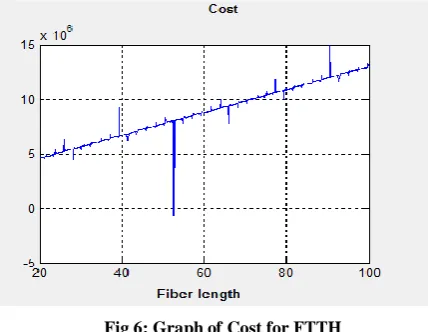
Cost= 10*tan (datarate+Fiberstream) +2*(sqrt(wavelength. ^2))+iterations+(tan(100*(I0+deltaz)))
In which
[image:4.595.317.545.175.338.2]Iterations: Length of the fiber optic in km (L)/ split step length in km (deltaz)
Fig 6: Graph of Cost for FTTH
Above figure shows the cost increases with fluctuations as fiber length increases from 20 to 100km
The cost of FTTH is increasing with fluctuations at different fiber length and in ETTH it is gradually increases as fiber length increases. So, for this parameter the ETTH is cheaper technology than FTTH.
4.2 Scalability
Scalability defines as a system, model or function that describes its capability to cope and perform under an increased or expanding workload. A system that scales well will be able to maintain or even increase its level of performance or efficiency when tested by larger operational demands.
We simulated scalability of ETTH through the standard equation:
SCA= (sqrt(P0-D-d1+c)-datarate+wavelength+L^2 +cld^(n*r0+d1+c))
In which;
SCA= Scalability
L: Length of the fiber optic in km
P0: Laser pulse power in mW (0.1 to 10 mW) cld: Cladding Diameter for Single Mode Fiber d: dispersion parameter in ps/nm.km
d1: refractive index difference of cladding c: speed of light in m/s
r0: fiber spot size in m^2
n: Refractive Index of the Fiber Optic
Fig 7: Graph of Scalability for ETTH
Figure 7 shows the scalability linearly increases with the increase in fiber length from 20km to 100km.
Now in the case of FTTH, we simulated scalability of FTTH through the standard equation:
SCA= (sqrt(P0-D)-datarate+r0*n2*wavelength+L^2 +cld^(n*r0+d1+c)+bitnum)
In which;
[image:4.595.55.270.367.533.2]n2: non-linear index coefficient in m^2/W bitnum: number of bits in data string
Fig 8: Graph of Scalability for FTTH
Figure 8 shows the scalability linearly increases with the increase in fiber length.
The scalability in ETTH is linearly increased with increase in fiber length and in FTTH it is also linearly increase with increase in fiber length. So, for this parameter the ETTH perform better as compared to FTTH.
5. CONCLUSION
[image:4.595.315.542.477.635.2]Ethernet and also implementation of different areas of the most emerging technologies i.e. Ethernet to the home and fiber to the home.
Simulated results give the conclusion the cost in FTTH is increasing with fluctuations at different fiber length and in ETTH it is gradually increases as fiber length increases. So, for this parameter the ETTH is more feasible technology than FTTH. The scalability in ETTH is linearly increased with increase in fiber length and in FTTH it is also linearly increase with increase in fiber length but with the change Y-axis. So, for this parameter the ETTH also perform well as compared to FTTH.
As far as ETTH is concerned that its implemented in internet service provider and almost everywhere easily because the equipment which is used in ETTH environment are very cheap and the standard of Ethernet implemented in all over the world ,fulfill the requirement of high bandwidth up to 1 giga bit per seconds and provide user friendly environment. Ethernet network infrastructure is simpler than FTTH because no device use between central office and client’s premises. Dynamic bandwidth allocation is not necessary in ETTH so it is easier than FTTH. The number of users in FTTH topology is limited because of its sharing architecture. ETTH present much more enhanced capacity of users and bandwidth capacity per user than FTTH. In terms of connected users and bandwidth the short term solution is FTTH but the growth of users increase and requirements are also increase than the best solution as long term is shown by ETTH.
6. FUTURE WORK
As a new access network to the home Ethernet to the home (ETTH) and fiber to the home (FTTH) has the newest development of multimedia applications like video on demand, fast internet access, television and voice over IP, in which the end users require more and more bandwidth capacity. The limitation of this research is to physically implement the ETTH and FTTH as access network to the home. Therefore a modeled ETTH and FTTH based networks are deployed over MATLAB for acquiring the desired results. In future there is a vast ground for these technologies. The immediate future work would be to create a design at metropolitan level and carry out a testing phase as an expansion to the current scenario.
7. REFERENCES
[1] Leland, W.E.; Taqqu, M.S.; Willinger, W Wilson,D.V. On the self-similar Nature of Ethernet traffic (extended version), 2012 Networking, and EEE/ACM Transactions on Volume: 2, Issue1: 1
[2] T. Koonen. "Fiber to the Home/Fiber to the Premises:What, Where, and When?" Proceedings of the IEEE, (5/2006).
[3] Zhaoqing, Wang. "Research on the Application of GPON Technologies", 2011 International Conference On Multimedia and Signal Processing, (2011).
[4] Drakulic, S. Degradation attacks on Passive Optical Networks IEEE, Optical Network Design and Modeling (ONDM), 2012 16th International Conference.
[5] Ching-Hung Chang, Noemí M. Alvarez, Pandelis Kourtessis, Member, IEEE, Rubén M.Lorenzo, and John M. Senior Full-Service MAC Protocol for Metro-Reach GPONs, Journal of light wave technology, VOL.28, NO. 7, APRIL 1, 2010.
[6] Ricciardi, Sergio, German Santos-Boada, Davide Careglio, and Jordi Domingo-Pascual. "GPON and EP2P: A techno-economic study", 2012 17th European Conference on Networks and Optical Communications, (2012).
[7] T. Orphanoudakis1, H.-C. Leligou2, E. Kosmatos2 and J.D. Angelopoulos2 Performance evaluation of GPON Vs EPON for multi-service access, international journal of mmunication systems Int. J. Commun. Syst. 2009; 22:187–202 published online 20 October 2008 in Wiley Inter Science.
[8] Yang Liu, Guoping Zhang, Qing Li,WDM/TDM Hybrid GPON Technology, IEEE, 978-1-4244-6554-5/11, 2011.
[9] Zhang Hongwu, Shan Rong Researching the EPON Technology in the Intelligent Communication Network International Conference on Information Science and Technology March 26-28, 2011 Nanjing, Jiangsu, China, IEEE, 978-1-4244-9442-2/11.