http://dx.doi.org/10.4236/jpee.2015.310002
How to cite this paper: Shang, G.Q., Ning, W. and Sun, C.H. (2015) Cymbal Structural Optimization for Improving Piezoelec-tric Harvesting Efficiency with Taguchi’s Orthogonal Experiment. Journal of Power and Energy Engineering, 3, 10-15. http://dx.doi.org/10.4236/jpee.2015.310002
Cymbal Structural Optimization for
Improving Piezoelectric Harvesting
Efficiency with Taguchi’s Orthogonal
Experiment
Guangqing Shang1, Wei Ning2, Chunhua Sun1*
1Department of Mechanic and Electronic Engineering, Suzhou Vocational University, Suzhou, China 2College of Mechanical Engineering, Shanxi University of Technology, Hanzhong, China
Email: *[email protected]
Received 9 September 2015; accepted 26 October 2015; published 29 October 2015
Copyright © 2015 by authors and Scientific Research Publishing Inc.
This work is licensed under the Creative Commons Attribution International License (CC BY). http://creativecommons.org/licenses/by/4.0/
Abstract
To improve piezoelectric harvesting efficiency of Cymbal, optimization design of Cymbal parame-ters was studied with the method of Taguchi’s orthogonal experiment. The effective factors of piezoelectric harvesting property were firstly analyzed. The orthogonal experiment schedule was then designed. The finite element model of Cymbal was built via ASPL tool in ANSYS software and static analysis was done. The experimental results were gotten with developed program. The op-timization level of each factor was gained. Under the synthetical opop-timization level of each design factor, the piezoelectric analysis was tested and the open voltage of 236.476 V was revealed with improving 35.73% than the maximum voltage of 174.228 V in the orthogonal experiment. The av-erage voltage of 229.98 V was measured with the manufactured optimized Cymbal structure de-sign. The relative error was 2.54% between simulation and measured data. It indicated that the optimization design schedule was reasonable. Cymbal harvester with the optimized parameters could scavenge larger voltage.
Keywords
Energy Harvest, Piezoelectric Effects, Cymbal Harvester, Taguchi’s Orthogonal Experiment
1. Introduction
The special structural design of piezoelectric Cymbal harvester makes it possess some special characteristics,
such as the ease of fabrication and the ability to tailor performance. The comprehensive piezoelectric effects of
d33 and d31 are easily excited for Cymbal harvester under the axial external force [1]. Besides being used as the
actuator and sensor, the piezoelectric Cymbal harvester has recently been focused to be an energy transducer. The harvesting energy properties of Cymbal have been researched via the theoretical analysis method, the finite element method and experiment [2]-[8]. The harvesting energy basic rule and effective factors of Cymbal have been mastered. So basic foundation for applying piezoelectric Cymbal harvester has laid. However, structural optimization and synthetic effect of various factors and the dominance degree of each factor have not been given a clean answer. In this study, the Taguchi experimental design is adopted for studying the synthetic effect of various factors on the output electrical characteristic of piezoelectric Cymbal harvester. The dominance degree of each factor is analyzed according to the result of Taguchi experiment. A optimized structure of Cymbal is de-termined.
2. Effective Factors of Cymbal Harvester
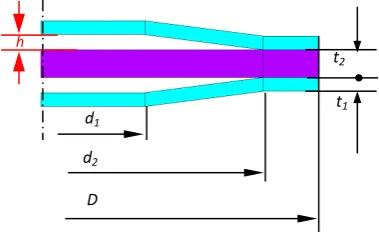
Figure 1 shows the structure of piezoelectric ceramics Cymbal harvester. The factors of a Cymbal harvester on the piezoelectric harvesting characteristics deal with two kinds: physical and geometrical ones. The physical factors include the materials of endcap, piezoelectric ceramic and binder, while the geometrical factors involve the endcap diameter D, endcap thickness t1, PZT thickness t2, cavity depth h, the dimple diameter d1 and the
cavity diameter d2. In this paper, the above five geometric factors except D are mainly discussed.
Aluminum is used as the endcap material, PZT-5A is to be piezoelectric ceramics. The diameter of the endcap
D is the same as that of the PZT piezoelectric ceramics disk and equal to 29 mm. Based on Taguchi’s orthogonal experiment design, the piezoelectric harvesting characteristic of Cymbal harvester is discussed to find out the above five optimized structural parameters.
3. The Taguchi’s Orthogonal Experiment Design
The open voltage generated by Cymbal harvester is used as optimization objective, the five above-discussed geometric parameters as factors. The aim of the orthogonal experiment is to optimize the geometric parameters of a Cymbal harvester and to obtain the highest voltage. Meanwhile, an alternative aim is to find out the domin-ance degrees and the optimal values of these factors.
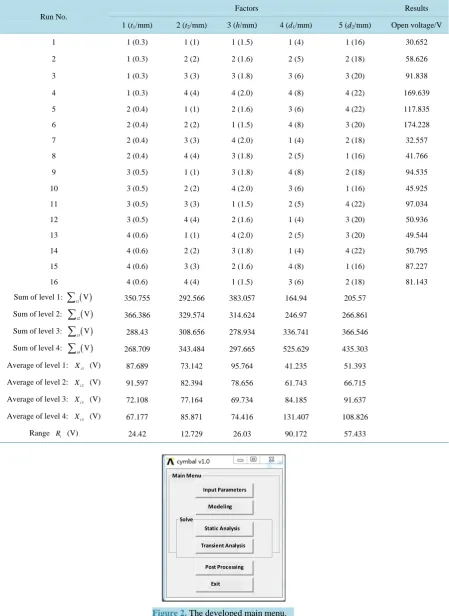
According to Taguchi parameter design methodology, a L16
( )
45 standard orthogonal array with five factorsin four levels each in 16 runs is employed [9]. The L16
( )
45 considering the five above-discussed parametersare shown in Table 1. Each row of the orthogonal array represents a specified set of factor levels to be tested.
4. The Finite Element Analysis
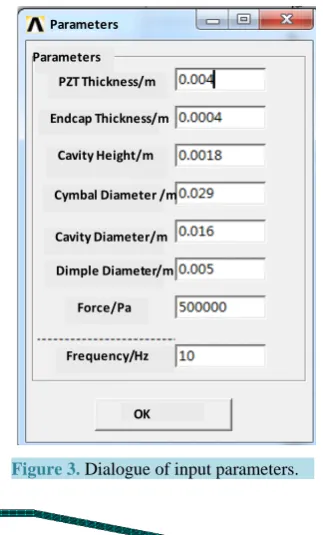
[image:2.595.218.408.584.703.2]As shown in Table 1, 16 experiments need to run for obtaining the open voltage according to the orthogonal experiment design. For saving time, manpower, material and financial resources, the finite element method is adopted. The technologies of APDL parametric modeling and command stream are used to develop the applica-tion program for Cymbal piezoelectric analysis based on two development platform of ANSYS 12.0. The de-veloped primary menu, dialogue of inputting parameters and the finite element model are shown in Figures 2-4, respectively.
Figure 1. Cymbal structural parameters. D
d2
d1
t1
Table 1.Schedule and results of Taguchi’s orthogonal experiments.
Run No.
Factors Results
1 (t1/mm) 2 (t2/mm) 3 (h/mm) 4 (d1/mm) 5 (d2/mm) Open voltage/V
1 1 (0.3) 1 (1) 1 (1.5) 1 (4) 1 (16) 30.652
2 1 (0.3) 2 (2) 2 (1.6) 2 (5) 2 (18) 58.626
3 1 (0.3) 3 (3) 3 (1.8) 3 (6) 3 (20) 91.838
4 1 (0.3) 4 (4) 4 (2.0) 4 (8) 4 (22) 169.639
5 2 (0.4) 1 (1) 2 (1.6) 3 (6) 4 (22) 117.835
6 2 (0.4) 2 (2) 1 (1.5) 4 (8) 3 (20) 174.228
7 2 (0.4) 3 (3) 4 (2.0) 1 (4) 2 (18) 32.557
8 2 (0.4) 4 (4) 3 (1.8) 2 (5) 1 (16) 41.766
9 3 (0.5) 1 (1) 3 (1.8) 4 (8) 2 (18) 94.535
10 3 (0.5) 2 (2) 4 (2.0) 3 (6) 1 (16) 45.925
11 3 (0.5) 3 (3) 1 (1.5) 2 (5) 4 (22) 97.034
12 3 (0.5) 4 (4) 2 (1.6) 1 (4) 3 (20) 50.936
13 4 (0.6) 1 (1) 4 (2.0) 2 (5) 3 (20) 49.544
14 4 (0.6) 2 (2) 3 (1.8) 1 (4) 4 (22) 50.795
15 4 (0.6) 3 (3) 2 (1.6) 4 (8) 1 (16) 87.227
16 4 (0.6) 4 (4) 1 (1.5) 3 (6) 2 (18) 81.143
Sum of level 1:
∑
i1( )V 350.755 292.566 383.057 164.94 205.57Sum of level 2:
∑
i2( )V 366.386 329.574 314.624 246.97 266.861Sum of level 3:
∑
i3( )V 288.43 308.656 278.934 336.741 366.546Sum of level 4:
∑
i4( )V 268.709 343.484 297.665 525.629 435.303Average of level 1: Xi1 (V) 87.689 73.142 95.764 41.235 51.393
Average of level 2: Xi2 (V) 91.597 82.394 78.656 61.743 66.715
Average of level 3: Xi3 (V) 72.108 77.164 69.734 84.185 91.637
Average of level 4: Xi4 (V) 67.177 85.871 74.416 131.407 108.826
[image:3.595.89.539.102.719.2]Range Ri (V) 24.42 12.729 26.03 90.172 57.433
Figure 2.The developed main menu. Main Menu
Input Parameters
Modeling
Static Analysis
Transient Analysis
Post Processing
Figure 3. Dialogue of input parameters.
Figure 4. Cymbal finite element model.
Table 1lists the simulation results calculated by using the developed program. Meanwhile, Table 1 is also shown the average and range of each level of factors.
5. Analysis of Simulation Results
From the results shown in Table 1, it can be seen that the maximum voltage of 174.228 V is obtained under the parametric conditions of No. 6. However, from the average of each factor in four levels, the optimized parame-ters are: level 2 of factor 1 (endcap thickness of t1 = 0.4 mm), level 4 of factor 2 (PZT thickness of t2 = 4 mm),
level 1 of factor 3 (cavity depth of h = 1.5 mm), level 4 of factor 4 (dimple diameter of d1 = 8 mm) and level 4 of
factor 5 (cavity diameter of d2 = 22 mm). Using the above optimized parameters, the open voltage is up to
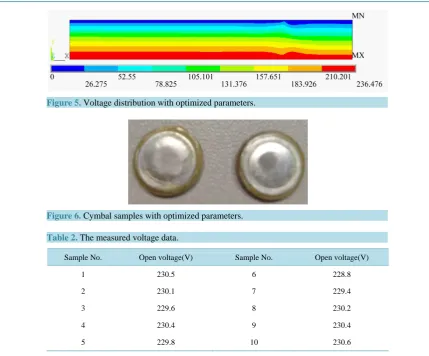
236.476 V. The optimized result increase 35.73% compared with the maximum value of 174.228 V using the orthogonal experiment in Table 1.Figure 5shows the potential distribution under the optimized conditions.
According to the range value of R, factors in order of dominance degree from big to small list as follows: dimple diameter d1, cavity diameter d2, cavity depth h, endcap thickness t1 and PZT thickness t2.
6. Test Measurement
Figure 6shows the manufactured samples according to the optimized parameters of Cymbal. During measuring, the material test system is used as the loading equipment, Tektronix oscilloscope is adopted to collect electric signal. The test results are shown in Table 2. The average of test results is 229.98 V while data processing. Compared to the simulation result of 236.476 V, the absolute error is 2.54%. The error mainly comes from the following: 1) without considering effect of binder during simulation; 2) material difference between simulation and test. It shows that the simulation and test fits well and Taguchi’s orthogonal experiment design is available for optimizing Cymbal structure.
Parameters
Parameters PZT Thickness/m
Endcap Thickness/m
Cavity Height/m
Cymbal Diameter /m
Cavity Diameter/m
Dimple Diameter/m
Force/Pa
Frequency/Hz
[image:4.595.231.393.83.351.2]Figure 5. Voltage distribution with optimized parameters.
[image:5.595.95.525.76.432.2]Figure 6. Cymbal samples with optimized parameters.
Table 2. The measured voltage data.
Sample No. Open voltage(V) Sample No. Open voltage(V)
1 230.5 6 228.8
2 230.1 7 229.4
3 229.6 8 230.2
4 230.4 9 230.4
5 229.8 10 230.6
7. Conclusions
To improve the efficiency of Cymbal harvesting energy, Taguchi’s orthogonal experiment design is adopted. The finite element program is developed to simulate the experimental conditions via ANSYS 12.0 two devel-opment platforms. Effects of synthetical factors on piezoelectric harvesting efficiency of Cymbal are analyzed. The results show that the dominance degree of each factor lists following: dimple diameter d1, cavity diameter d2,
cavity depth h, endcap thickness t1 and PZT thickness t2. The excited open voltage of Cymbal with the optimized
parameters is larger than the maximum of orthogonal experiment. It indicates that the method of the orthogonal experiment design for optimal Cymbal harvester is available and the optimized structure of Cymbal harvester can be used for savaging higher electrical potential.
The future of work will focus on the application of the optimal Cymbal and coupling with the environment.
Acknowledgements
This research was supported by the National Natural Science Foundation of China (No. 51175359) and the 4th “333 Engineering” Research Funding Project of Jiangsu Province (BRA2014086).
References
[1] Kim, H.W., Priya, S., Uchino, K. and Robert, E. (2005) Piezoelectric Energy Harvesting under High Pre-Stressed Cyc-lic Vibrations. Journal of Electroceramics, 15, 27-34. http://dx.doi.org/10.1007/s10832-005-0897-z
[2] Pan, Z.M. and Liu, B. (2006) Mathematical Model of Cymbal-Type Piezoelectric Transducers. China Mechanical
En-gineering, 17, 283-286.
[4] Lu, Y.G. and Yan, Z.F. (2013) Finite Element Analysis on Energy Harvesting with Cymbal Transducer. Journal of
Vi-bration and Shock, 32, 157-162.
[5] Sun, C.H., Shang, G.Q. and Yu, J. (2011) FEM Analysis of Cymbal Transducer for Electricity Generation. Mechanical
Science and Technology, 30, 138-141.
[6] Ochoa, P., Pons, J.L., Villegas, M. and Fernandez, J.F. (2005) Mechanical Stress and Electric Potential in Cymbal Piezoceramics by FEA. Journal of the European Ceramic Society, 25, 2457-2461.
http://dx.doi.org/10.1016/j.jeurceramsoc.2005.03.082
[7] Xing, Z.B., Sun, C.L., Liu, G.G. and Zhao, X.Z. (2007) An Experimental Study of Cymbal Transducers. Piezoelectrics
& Acoustooptics, 29, 273-275.
[8] Wu, L., Chure, M.-C., Wu, K.-K. and Tung, C.-C. (2014) Voltage Generated Characteristics of Piezoelectric Ceramics Cymbal Transducer. Journal of Materials Science and Chemical Engineering, 2, 32-37.
http://dx.doi.org/10.4236/msce.2014.210005