http://dx.doi.org/10.4236/ce.2015.616170
Process Designing Mathematical Tasks on
Addition of Teachers Using Lesson Study
Katanyuta Bangtho
1, Narumol Inprasitha
2, Maitree Inprasitha
21Centre of Excellence in Mathematics, CHE, Bangkok, Thailand
2Center for Research in Mathematics Education, Faculty of Education, Khon Kaen University, Khon Kaen,
Thailand
Email: [email protected]
Received 28 June 2015; accepted 13 September 2015; published 16 September 2015
Copyright © 2015 by authors and Scientific Research Publishing Inc.
This work is licensed under the Creative Commons Attribution International License (CC BY).
http://creativecommons.org/licenses/by/4.0/
Abstract
This research was aimed at investigating the process of designing mathematical tasks on addi-tion of teachers using lesson study. It employed the qualitative research method. An analysis was performed on data obtained from discussion protocols of the Lesson Study team during the development of lesson plan of Unit 8: Addition (2) and questionnaire on the designing of ma-thematical tasks. Results of the research indicated that the lesson study team utilized the fol-lowing processes for designing mathematical tasks: 1) determining the lesson goal; 2) inter-preting the mathematical tasks; 3) identifying the use of mathematical tasks; and 4) anticipating students’ approaches.
Keywords
Designing Mathematical Tasks, Mathematical Tasks, Lesson Study
1. Introduction
knowledge, rules, and formulas. Then, students are given a large number of exercises to practice as a means to test their knowledge obtained from the lesson earlier taught to them (Phu-Udom, 2001). It can be seen that American and Thai students are different from Japanese ones in a way that the former have to practice mathe-matical exercises, but Japanese students have the opportunity to do more than mathemathe-matical questions. They have a creative way to solve mathematical tasks by inventing new methods and presenting such creative mathe-matical tasks (Shimizu et al., 2010).
Choosing and determining appropriate tasks are considered the key to the success in mathematics class and essential for teachers when they are to design tasks (Doyle, 1988; Hiebert & Wearne, 1993; Stein & Lane, 1996; Takahashi, 2006; Martin 2007 cited in Shimizu et al., 2010). The tool that enables teachers to develop and study their own teaching practices is lesson study (Baba, 2007). Designing mathematical tasks is a key component of lesson study (Lieberman, 2009). For some teachers, it is very difficult to see that there may be more than one correct solution to a task or they may not be able to see other solution methods (Roth & Ames, 2014). Designing mathematical tasks is not an easy job for teachers and to develop good tasks, especially open-ended ones, is the most difficult; therefore, teachers have to help each other design open-ended tasks (Nohda, 1982 cited in Mai-tree Inprasitha (2004)).
2. Data Collection
The researcher collected data from the lesson study team of the first grade of KhookhamPittayasan School in the second semester of 2014 academic year for Learning Unit 8: Addition (2). The researcher conducted par-ticipant observation on three steps of lesson study. The first step collaboratively design research lesson. The second step collaboratively observing the research lesson and the third one collaboratively reflection on teaching practices. Materials used for data collection include project schoolbooks, field note, questionnaire, and video records.
3. Data Analysis
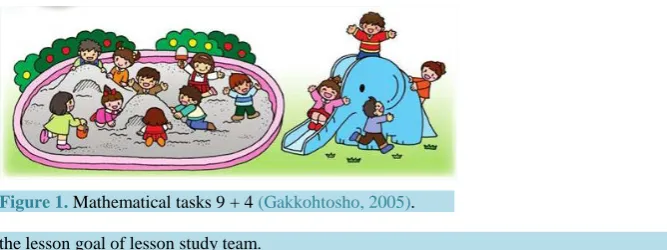
Data analysis was based on Lesson Planning Framework developed by Watanabe et al. (2008). Data used for the analysis were obtained from discussion protocols of the lesson study team during the designing process of ma-thematical tasks of Unit 8: Addition (2). The results proposed in this paper were obtained from data on Learning Unit 8: Addition (2). Examples of the mathematical tasks were presented in detail as follows: Data Analysis of Period 1: Playground (Figure 1).
3.1. Determining the Lesson Goal
The Lesson Study team began with mathematical tasks taught in the previous year, which were interpreted from Japan’s first-grade mathematics textbooks (Thai translation) by Gakkhotosho CO., LTD., Japan. The team jointly discussed the goal to be achieved by the students and scope of the lesson as shown in the protocol (Table 1).
From the protocol, the lesson study team jointly identified the lesson goal by interpreting mathematical tasks contained in the textbook and focused the discussion on what the students would learn from this period. It can be seen that with respect to the topic of addition, the first graders had to learn about two types of addition: combi-nation and supplementation. For the first period of addition topic, the students would learn about addition in the form of combination. Upon reaching mutual understanding of the lesson goal, the lesson study team set the goal for the first period as “to be able to understand and solve the addition situation”.
3.2. Interpreting Mathematical Tasks
Due to the fact that the lesson study team had experiences in teaching and designing mathematical tasks, during this process there were old tasks as the basis of the team’s thinking process. The team members used the figure on Page 77 of the project mathematics textbook to jointly discuss the tasks and try to figure out what teachers should try to communicate with students based on the tasks and picture, provided that such communication had to be consistent with the establish goal of the class period as shown in the following protocol (Table 2).
Figure 1. Mathematical tasks 9 + 4 (Gakkohtosho, 2005).
Table 1.Protocol determining the lesson goal of lesson study team.
Teacher 1 Let’s take a look at the goal of Addition 2.
Teacher 2 Addition in the forms of combination and supplementation, right? The students are able to multiply up to the sum of 10 already from the previous class.
Teacher 1
Okay. Let’s take a look at each class period. We need to use diagrams on this topic, but we will not begin with 9 + 4 yet. I think maybe the student will write this down, but we will not focus on that. We will emphasize it during the second period.
Teacher 2 That should be fine because students from last year also come. The students of this year have similar approaches. This topic will take 12 periods according to the manual. We were doing just fine from the prior years.
Teacher 1
The first period will be about sand trays and sliders. It is addition in the form of combination, meaning that we will not focus on diagrams, but we will enable students to multiply to the number of 10, which is easy. This will be a tool for the second period where there will be a problem of 8 + 3.
The students will understand that they have to keep the number of 10 before combining the rest of the number. Diagrams will be used in this period.
Teacher 2 The students were able to come up with the result of 10 from the last period. Thus, it should be used as a tool for this first period of addition topic. Then, they can use blocks to represent their approaches.
Teacher 1
During this period, there will be nine children at the sand tray and four at the slider. These two groups are engaged in different kinds of plays. There will be a two-way arrow, asking about the total number of the children. Therefore, the students have to combine the numbers of children at the sand tray and those at the slider. The focus is on combination of these numbers. The result may be represented by either a number or block, but they have to know that it is a combination. Researcher So what is the goal of the first period?
Teacher 1 Well, it is to enable students to understand the addition situation. When the solution is more than 10, the students have to come up with the number of 10 first. Is that okay?
Table 2.Protocol interpreting mathematical tasks of lesson study team.
Teacher 1 If we look at the picture, there are many ways to figure this out, but our goal is to understand the situation of addition. So, when you look at the picture, you know that we need to use ‘addition’ to get the answer.
Teacher 2
Firstly, the students have to be able to tell that there are different numbers of children playing at these two spots. Then, they have to see how many children at the sand tray and how many at the slider. Finally, if we want to know how many children there are in the playground, what can we do? Can you tell me?
Teacher 1 Yes. And the students will say put the numbers of the children at both spots together or count the total number. Is that right? But, we have to tell them that they may not count.
Teacher 2
They have to understand from the picture that it is about addition or multiplication. How can you put this into a symbolic sentence? How can you tell me how many children there are. They will use the method that they have learned before, such as counting by 2 at a time, 5 at a time, 10 at a time, or counting to 10 first.
discussed by the team showed that they tried to understand the mathematical tasks and search for the issue hid-den in the picture.
3.3. Identifying the Use of Mathematical Tasks
Accord-ing to their discussions, it was about where the students would access the problem. The mathematical task in this period was divided into two phases: understanding the task from the picture and how to get the answer on how many children in total, as shown in the protocol (Table 3).
The protocol showed that the lesson study team discussed how to present a mathematical task in order to lead the students to the established goal of understanding and solving the mathematical task. The team decided that the presentation would be divided into two phases. The first one was to help students understand that the picture shown to them suggested the situation of addition, which meant combination of two things. The second phase involved with how they would find the answer after writing down a sentence using mathematical symbols. It can be seen that the lesson study team was aware of the use of a mathematical task in the classroom to enable the students to get to the task on their own.
3.4. Anticipating the Students’ Approaches
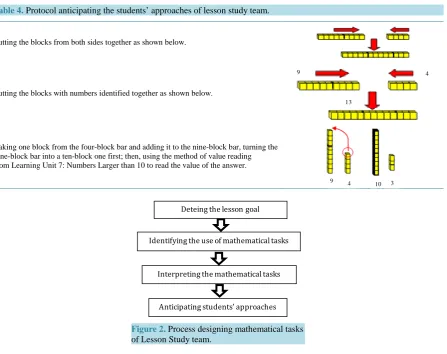
What the lesson study team always kept in mind in task design was anticipation of the students’ approaches in classroom based on the approaches of students from the past years and the students’ application of knowledge obtained in the previous class period to the picture shown to them. It can be seen that, with respect to the topic of addition (2), an important means was to base ten (make it a full amount of 10 first). According to the lesson study team’s observations, it was found that the students preferred using the number of 10 in the topic of addi-tion. This information was important for the lesson study team to anticipate the student’s approaches. The illu-strations (Table 4) were used to represent the students’ approaches.
This showed that the teachers understood that being able to understand the students’ approaches would make classroom management easier since the teachers knew how the students thought and what approaches they had. Important approaches could be used, discussed, and shared in the classroom. Anticipating different approaches used would enable the teachers to discuss similarities and differences of strategies used in classroom, which would be a means to promote the students’ comparative analysis.
4. Conclusion
The resulting data were analyzed with the design process. There are four steps that can be shown instead of the process designing mathematical of teachers using lesson study as shown in Figure 2.
5. Discussion
The outstanding attribute of the mathematical task design was that the teachers anticipated the students’ ap-proaches in advance. This did not only indicate how much the teachers knew their students’ learning nature, but also helped the teachers manage the classroom. Fujii (2013) stated that mathematical task design was not only based on appropriateness of the task, but the lesson study team was also aware of inserting a mathematical les-
Table 3. Protocol identifying the use of mathematical tasks of Lesson Study team.
Teacher 1 How should we divide the phases of our presentation to get the students understand that the picture is about addition?
Teacher 2
I think we should show them the picture and ask them to tell a story in order to get the students’ word representing addition. I mean we show them the picture and ask them how they would tell the story about this picture. There may be some of them saying that there are nine children playing at the sand try and four other children at the elephant slider. This is to show them the whole picture like this. We will not show the picture one by one because we don’t want to imply an increase in number. In my first years, I showed them one picture at a time and it took quite a long time to back them back to the topic of addition. Then, we will ask them how they know that there are nine or four children. They will absolutely answer that they count. We are not supposed to be serious about this answer. Just let them tell the story and see what they observe in the picture.
Teacher 1
So, we have to let the students see that there are two groups of children, one at the sand try and the other at the slider. They can use any terms to name these two things and we will use their terms. They will see that in order to get the answer, they need to put two numbers together.
Teacher 2 After that, we will pose the question by saying our instruction: “there are nine children playing at the sand tray and four children at the slider, how many children are there in total?”
Table 4. Protocol anticipating the students’ approaches of lesson study team.
Putting the blocks from both sides together as shown below.
Putting the blocks with numbers identified together as shown below.
Taking one block from the four-block bar and adding it to the nine-block bar, turning the nine-block bar into a ten-block one first; then, using the method of value reading from Learning Unit 7: Numbers Larger than 10 to read the value of the answer.
Figure 2. Process designing mathematical tasks of Lesson Study team.
son into the students’ fun activities. The ultimate goal of the lesson was not only to promote the students’ ma- thematical understanding, but also to give them profound understanding and freedom of thinking.
Acknowledgements
This research is (partially) supported by the Centre of Excellence in Mathematics, the Commission on Higher Education Thailand, and Graduate School of KhonKaen University, and was supported by the Center for Re-search in Mathematics Education (CRME), Faculty of Education, KhonKaen University.
References
Baba (2007). How Is Lesson Study Implemented? In M. Isoda, M. Stephens, Y. Ohara, & T. Miyakawa (Eds.), Japanese Lesson Study in Mathematics: Its Impact, Diversity and Potential for Educational Improvement. Danvers, MA: World Scientific Publishing Co. Pte. Ltd.
Clarke, D., & Roche, A. (2010). Teachers’ Extent of the Use of Particular Task Types in Mathematics and Choices behind That Use. http://files.eric.ed.gov/fulltext/ED520857.pdf
Fujii, T. (2013). Adapting and Implementing Lesson Study: Focusing on Designing Task in Lesson Study. Proceedings of 6th East Asia Regional Conference on Mathematics Education, 17-22 March 2013, Phuket, 163-172.
Gakkohtosho (2005). Study with Your Friends: Mathematics Grade 1. Tokyo: Gakkoh Tosho.
Inprasitha, M. (2004). Open Approach Instruction in Mathematics Classroom of Japan. KKU Journal of Mathematics Educa-tion, 1, 1-17.
Lieberman, J. (2009). Using Lesson Study to Develop an Appreciation of and Competence in Task Design. In B. Clark, B. Grevholm, & R. Millmand (Eds.), Task in Primary Mathematics Teacher Education: Purpose, Use and Exemplars, Ma-thematics Teacher Education (pp. 11-24). Springer Science + Business Media LLC.
Phu-Udom, J. (2001). Development of Mathematics Teaching Models with Students as Knowledge Creators. Doctor of
Phi-9 4
13
9 4
10 3
Deteing the lesson goal
Identifying the use of mathematical tasks
Interpreting the mathematical tasks
losophy Program in Curriculum and Instruction, Bangkok: Srinakharinwirot University.
Roth & Ames (2014). Beiträgezum Mathematikunterricht (pp. 1043-1046). Münster: WTM-Verlag.
Shimizu, Y., Kaur, B., Huang, R. & Clark, D. J. (Eds.) (2010). Mathematical Task in Classrooms around the World. Sense Publisher.