http://dx.doi.org/10.4236/am.2014.511161
Some Improvement on Convergence Rates
of Kernel Density Estimator
Xiaoran Xie, Jingjing Wu
Department of Mathematics and Statistics, University of Calgary, Calgary, Canada Email: [email protected], [email protected]
Received 5 March 2014; revised 10 April 2014; accepted 18 April 2014 Copyright © 2014 by authors and Scientific Research Publishing Inc.
This work is licensed under the Creative Commons Attribution International License (CC BY). http://creativecommons.org/licenses/by/4.0/
Abstract
In this paper two kernel density estimators are introduced and investigated. In order to reduce bias, we intuitively subtract an estimated bias term from ordinary kernel density estimator. The second proposed density estimator is a geometric extrapolation of the first bias reduced estimator. Theoretical properties such as bias, variance and mean squared error are investigated for both estimators. To observe their finite sample performance, a Monte Carlo simulation study based on small to moderately large samples is presented.
Keywords
Kernel Density Estimation, Geometric Extrapolation, Bias Reduction, Mean Squared Error, Convergence Rate
1. Introduction
Many efforts have been devoted to investigating the optimal performance of kernel density estimator since it has been the most widely used nonparametric method in the last decades. Suppose we use fn
( )
x to denote thekernel estimator of the true density function f x
( )
. Normally we use mean squared error (MSE) and its two components, namely bias and variance, to quantify the accuracy of an estimator. Note that the MSE of fn( )
xis decomposed into two parts:
( )
(
)
(
( )
( )
)
(
( )
( )
)
(
( )
( )
)
( )
(
)
(
( )
)
2 2 2
2
MSE
Bias Var .
n n n n n
n n
f x E f x f x Ef x f x E f x Ef x
f x f x
= − = − + −
= +
asymptotic convergence rate
2 2 1
r r O n − +
of MSE for orthogonal kernel estimators. Article [2] introduced geo-
metric extrapolation of nonnegative kernels, while [3] discussed the number of vanishing moments of kernel or-der using Fourier transformation. Variable kernel estimation in [4] successfully reduced the bias by employing larger smoothing parameters in low density regions, while [5] introduced the idea of inadmissible kernels which also results in reduced bias. On the other hand, [6] proposed an estimator using some probabilistic arguments which achieves the goal of bias reduction. Article [7] suggested a locally parametric density estimator, a semi-parametric technique, which effectively reduces the order of bias. Article [8] proposed algorithms relevant to quadratic polynomial and β cumulative distribution function (c.d.f.) which accommodates possible poles at boundaries and in consequence reduces the bias at boundaries. Article [9] introduced a bias reduction method using estimated c.d.f. via smoothed kernel transformations. Article [10] introduced a two-stage multiplicative bias corrected estimator. Article [11] developed a skewing method to reduce the bias while the variance is only increased by a moderate constant factor. In addition, some recent works discussed approaches of obtaining smaller bias of the estimator via several other methods. Article [12] worked out a bias reduced kernel relative to the classical kernel estimator via Lipschitz condition. Article [13] introduced an adjusted kernel density estima-tor in which the kernel is adapted to the data but not fixed. This method naturally leads to an adaptive-choice of the smoothing parameters which can reduce the bias.
Although the variance reduction method is not as approachable as the bias reduction method, there still have been a lot of scholars working on it. Article [14] suggested an approach to reduce the variance in local linear re-gression employing the idea of the skewing method. Article [15] also used the skewing method on bias reduc-tion and variance reducreduc-tion at the same time which in turn reduces the MSE.
Many of above mentioned bias reduction methods result in complex kernel density estimators. In this paper, we introduce a novel but intuitive and feasible bias reduced kernel density estimator. In Section 2, we present the bias reduced estimator and investigate its asymptotic bias, variance and MSE. A second estimator is pro-posed and studied in Section 3 as a geometric extrapolation of the bias reduced kernel. To examine the finite sample performance of both estimators, a simulation study is carried out in Section 4. Finally some remarks are given in Section 5.
2. A Bias Reduced Kernel Estimator
Kernel density estimator was first introduced in [16] and [17]. Suppose X1,,Xn is a simple random sample
from the unknown density function f. Let K be a function on real line, i.e. the “kernel”, and let h be a positive value, i.e. the “bandwidth”. Then the kernel density estimator of f is defined as
( )
1
1
.
n
i n
i
x X
f x K
nh = h
− =
∑
(2.1) To make the estimator meaningful, the kernel function is usually required to satisfy conditions K x( )
>0,( )
d 1K x x=
∫
and∫
x K2( )
x dx< ∞. Both [18] and [19] pointed out that if
∫
uK u( )
du=0 and f is twice con-tinuously differentiable in a neighborhood of x, then( )
(
)
(
( )
)
( )
1( )
2 2( )
( )
3Bias d
2
n n
f x =E f x −f x = f′′ x h
∫
u K u u+O h (2.2) and( )
(
)
1( )
2( )
(
( )
1)
Var fn x f x K u du o nh .
nh
−
=
∫
+ (2.3)Then from (2.2) and (2.3) we have
( )
(
)
(
( )
)
(
( )
)
( )
(
)
( )
( )
( )
2
2
2 4 2 2
MSE Bias Var
1 1
d d .
4
n x n x n x
x
f f f
f h u K u u f K u u
nh x
= +
′′
∫
+∫
We can easily see that the optimized bandwidth is
1 5
h O n −
4 5
n− .
In order to reduce the bias of ordinary kernel density estimator, we can intuitively subtract the leading bias term 1
( )
2 2( )
d
2f′′ x h
∫
u K u u in (2.2) from it. Since the leading term of the bias is unavailable due to theunknown f, we can simply use its estimation, i.e.
( )
( )
Bias(
( )
)
.n x n x n x
f = f − f
One could use any type of estimation of the bias term. We could simply replace f with the kernel estimator fn
since it is readily available. As a result, our proposed estimator is
( )
( )
2( )
2( )
2( )
1 1
1
d d .
2 2
n n
i i
n n n
i i
x X x X
h h
f x f x f x u K u u K u K u u K
nh = h n = h
− − ′′ ′′ = − = −
∑
∑
∫
∫
(2.4)
From the way of construction, this new estimator should be able to reduce the bias and thus the MSE. To see whether this is the case or not, we next calculate the bias and the variance of fn
( )
x . We make the followingregularity condition on f, K and h: 1)
∫
uK u( )
du=0.2) f is fourth differentiable in a neighbourhood of x. 3) h→0 and nh→ ∞ as n→ ∞.
Theorem 2.1. Under 1), 2) and 3),
( )
(
)
3( )
3( )
( )
4Bias d
6
n
h
f x = − f′′′ x
∫
u K u u+O h (2.5) and( )
(
)
( )
(
( )
)
2( ) ( )
2( )
2 1
1
Var d d .
2
n
f x f x u K u u K u u O n
nh
− ′′
=
∫
∫
+ (2.6)
Consequently,
( )
(
)
(
6( )
1)
MSE fn x O h nh −
= +
and the optimal MSE is of the order
6 7
O n −
with
1 7
h= O h −
.
Proof. By Taylor expansion we have
( )
(
)
( )
( ) (
)
( ) ( )
( )
( )
( )
( )
( )
( )
( )
( )
( )
( )
( )
( )
2 3 4
2 3
2 3 4
1
d d
1 1
d
2 6
d d ,
2 6
n
x t
E f K f t t K u f x hu u
h h
K u f x huf x hu f x hu f x u O h
h h
f x f x u K u u f x u K u u O h
x = − = −
′ ′′ ′′′ = − + − + ′′ ′′′ = + − +
∫
∫
∫
∫
∫
( )
(
)
( )
( )
( ) (
)
( )
( )
( )
( )
( )
( )
( )
( )
( )
( )
3 3 1 2 2 2 2 2 1 1 d 1 d d 1 d 2 d . 2 n i n ix X x t
E f x E K K f t t
h h
nh h
x t
K f t t K u f x hu u
h h
K u f x huf x hu f x u o h
h
f x f x u K u u o h
Thus we have
( )
(
)
(
( )
)
( )
( )
(
)
( )
(
( )
)
( )
( )
( )
( )
( )
(
( )
)
( )
( )
( )
( )
2 23 4 2
3 4 2 4
3 3 4 Bias d 2 d d 6 4 d . 6 n n n n
f x E f x f x
h
E f x f x E f x u K u u
h h
f x u K u u O h f x u K u u o h
h
f x u K u l u O h
= − ′′ = − − ′′′ ′′′′ = − + − + ′′′ = − +
∫
∫
∫
∫
(2.8)On the other hand,
( )
(
)
( )
( )
( )
( )
(
)
( )
( )
( )
(
)
(
( )
)
(
( )
)
2 2 2 2 4 2 2Var Var d
2
2Var 2Var d
2
2Var d Var .
2
n n n
n n
n n
h
f x f x f x u K u u
h x
x
f f x u K u u
h
f u K u u f x
′′ = − ′′ ≤ + ′′ = +
∫
∫
∫
(2.9)Note that (2.7) gives
( )
(
)
( )
( )
( )
( ) ( ) (
)
(
( )
( )
)
( ) ( ) ( )
(
( )
( )
)
( ) ( )
1 3 6 1 2 2 6 6 2 2 2 5 22 2 2
5
1 1
Var Var Var
1 1 d d 1 1 d 1 1 d 1 n i n i
x X x X
f x K K
h h
nh nh
x t x t
K f t t K f t t
h h
nh nh
K u f x hu u f x O h
n nh
h
K u f x huf x O h u f x O
n n nh n = − − ′′ = ′′ = ′′ − − ′′ ′′ = − ′′ ′′ = − − + ′′ ′ ′′ = − + − + =
∑
∫
∫
∫
∫
( ) ( ) ( )
2(
( )
1)
45 f x K u du O nh .
h
−
′′ +
∫
(2.10)
Finally (2.9) and (2.10) together with (2.3) gives (2.6).
Remark 2.1. From Theorem 2.1 we can see that if K is symmetric, i.e. K u
( )
=K( )
−u , then all the odd mo-ments of K are zero and, as a result, the bias of fn( )
x will be improved to a higher order of( )
4
O h . In this case, the optimal MSE is further reduced to
8 9
O n −
with
1 9
h= O n −
.
Remark 2.2. From the definition of fn in (2.4), this estimator could be possibly negative on some points x.
In order to make it meaningful in practice, i.e. make it a positive density estimator, one can use the following variation of the proposed bias deducted estimator
( )
( )
( ( ) )( )
( ( ) ) 0 0 ˆ , d n nn f x
n
n f x
f x I f x
f x I x
> > =
∫
where IA is an indicator function that takes value one on set A and zero otherwise. Note that the first term on
the right hand side of Equation (2.4) converges to f x
( )
in probability, while the second term is of the order( )
O h , which goes to zero as n→ ∞ under 3). Thus fn
( )
x converges to f x( )
in probability, and as a re-sult fn
( )
x is positive in probabililty at any point x∈Ω with Ω the support of f. Therefore, ˆfn has similar3. A Geometric Extrapolated Kernel Estimator with Bias Reduction
Geometric extrapolation was introduced in kernel density estimation by [2]. Consider the ordinary kernel density estimator with two different bandwidths h and 2h:
( )
1 1 , n i h i x Xf x K
nh = h
− =
∑
( )
2 1 1 . 2 2 n i h i x Xf x K
nh = h
−
=
∑
Suppose the kernel function K above is symmetric so that all the odd moments of K are zero. Article [2] pro-posed the following estimator
( )
43( )
13( )
2 4 1 3 3 1 1 1 1 . 2 2
n h h
n n
i i
i i
f x f x f x
x x x x
K K
nh h nh h
− − = = = − − = ×
∑
∑
(3.1)Note that fn
( )
x
doesn’t have integral one. In order to improve the MSE of order
4 5
O n −
of the ordinary
kernel estimator, one has to relax the constraint of integrating to one. The powers 4 3 and
1 3
− are selected to reduce the bias of the ordinary kernel estimator to O h
( )
4. Consequently, the MSE of fn
( )
x
is improved to the order of
8 9
O n −
, which is a faster convergence rate than the rate
4 5
O n −
of the ordinary kernel
estima-tor.
Instead of using the ordinary kernel estimator, we propose to use the bias reduced kernel estimator, presented in Section 2, in the construction of geometric extrapolated kernel (3.1). Denote the bias reduced kernel estimator with two bandwidths h and 2h as
( )
( )
2 2( )
1 1 1 d , 2 n i h h i x x
f x K f x h u K u u
nh = h
− ′′ = −
∑
∫
( )
( )
2 2( )
2 2
1
1 1
d .
2 2 4
n
i
h h
i
x x
f x K f x h u K u u
nh = h
− ′′ = −
∑
∫
Now the geometric extrapolated kernel estimator with bias reduction is proposed as
( )
87( )
17( )
2 .
n h h
f x = f x f− x
(3.2) Since the bias reduced kernel estimator has improved bias and MSE over the ordinary kernel estimator, espe-cially when K is symmetric, we expect that with geometric extrapolation it will achieve further improvement.
Theorem 3.1. Under 1), 2) and 3),
( )
(
)
(
( )
)
2( )
( )
(
( )
1)
2 4 4 5
2 1
Bias d d
7 21
n
f x = u K u u − u K u u f ′′′′ x h +O h + nh −
∫
∫
and
( )
(
)
( )
( )
(
1 2( )
2)
2
8 1
Var Var .
7 7
n h h
f x = f x − f x +O n h− + nh −
Consequently,
( )
(
)
(
8( )
1)
MSE fn x O h nh −
= +
and the optimal MSE is of the order
8 9
O n −
with
1 9
h= O h −
.
Proof. We calculate Bias
(
fh( )
x)
first. Similar argument to (2.8) gives( )
(
)
(
( )
)
( )
( )
( )
( )
( )
( ) ( )
( )
( )
(
( )
)
2 2 4 2 3 23 4 4 2
d 2
1 1 1
d d d .
6 4! 2 2!
h n n
h
E f x E f x E f x u K u u
h
f x f x u K u u h f x u K u u u K u u
′′ = − − − ′′′ ′′′′ = − + − +
∫
∫
∫
∫
Let Jh
( )
x =Efh( )
x , then( )
( )
1( )
3 3( )
4 4 ,h
b b
J x f x h h
f x f x
= + + +
(3.3)
where
( )
( )( )
( )
( )
( )( )
( )
( )
2(
( )( )
)
2( )
2( )
1 d , 3
!
1 d 1 d d , 4, 5, .
! 2 2 !
i
i i
i i i
i i i i
f x
u K u u i
i b
f x f x
u K u u u K u u u K u u i
i i − − − = = − − − ⋅ = −
∫
∫
∫
∫
Taking logarithm of (3.3) gives
( )
(
)
(
( )
)
( )
( )
( )
(
)
( )
( )
( )
3 4 3 4 1 3 4 3 4 1log log log 1
1 log ! h i i i b b
J x f x h h
f x f x
b b
f x h h
i f x f x
− ∞ = = + + + + − = + + +
∑
(3.4)Here we want to construct a geometric extrapolated kernel estimator of the form 1
( ) ( )
2 2t t
h h
f x f x
that possibly
reduces the bias. In another word, we need t1log
(
Jh( )
x)
+t2log(
J2h( )
x)
has term log(
f x( )
)
but has 3h
term disappear. Thus t1 and t2 have to satisfy
1 2 3 1 2 1 2 0. t t t t + = + =
The solution to above equation system is 1
8 7
t = and 2
1 7
t = − , and this gives our proposed estimator (3.2). Now
( )
(
)
(
( )
)
(
( )
)
( )
4 4( )
5 28
8 1
log log log
7 h 7 h 7
b
J x J x f x h O h
f x
− = − +
and a series expansion for exponential function gives
( )
( )
( )
( )
8 1 4 5 7 7 2 4 8 . 7 h hJ x J− x = f x − b h +O h (3.5) We rewrite
( )
( )
,h h
f x =J x +U
( )
( )
2h 2h ,
f x =J x +V
( )
( )
( )
( )
( )
( )
( )
( )
( )
( )
( )
( )
( )
( )
( )
( )
( )
( )
8 1
8 1 8 7 1 7
7 7 7 7
2 2 2 2 2 8 1 7 7 2 2 2 1
8 1 7
7 7 2 2 2 1 1 8 1 1 1 7 7 8 1 7 7
h h h h
h h
h h
h h h h
h h
h h
h h
U V
f x f x J x J x
J x J x
U U V V
J x O J x O
J x J x J x J x
J x J x
J x J x U V
J x J x
− − − − − = + + = + + ⋅ − + = + −
(
)
(
)
8 7 2 ,O U V
+ + and then
( )
(
)
( )
( )
( )
( )
(
( )
)
( )
(
)
8 1 7 7 2 1 4 5 4 1 4 5 4 Bias 8 0 0 7 8 . 7n h h
f x E f x f x f x
b h O h O nh
b h O h nh
− − − = − = − + + + + = − + +
Since
( )
( )
( )
32 1 h h J x O h
J x = + by (3.4), the variance of fn
( )
x is( )
( )
( )
( )
( )
( )
(
(
)
)
( )
( )
(
( )
)
(
( )
)
( )
( )
(
( )
)
( )
(
)
1 88 1 7 7
2 7 7 2 2 2 2 3 2 2 1 2 2 1 8 1 Var Var 7 7 8 1 Var 1 7 7 8 1 Var 7 7 . h h h h h h h h h h
J x J x
f x f x U V O U V
J x J x
f x f x O h O nh
f x f x O n h nh
O nh − − − − − = − + + = − + + = − + + = Remark 3.1. Article [2] proposed the geometric extrapolation of ordinary kernel estimator which results in optimal MSE of the order
8 9
O n −
. Though here we achieve the same order of optimal MSE, we don’t impose
the assumption that K is symmetric while [2] does.
Remark 3.2. When K is symmetric, we propose another estimator
( )
( )
16( )
115 15
2 .
n h h
f x = f x f x −
This estimator reduces the bias to
( )
6O h and has improved optimal MSE of the order
12 13
O n −
with
1 13
h= O n −
.
4. Simulation Study
bias reduced kernel estimator (GEBRK) fn
given in (3.2). Particularly, we compare their bias and MSE with the ordinary kernel density estimator (OK) fn in (2.1) and the geometric extrapolation of ordinary kernel
esti-mator (GEOK) fn
in (3.1).
Without loss of generality, we suppose f is the standard normal density. We randomly select 1000 indepen-dent samples of size n = 20, 50, 100 or 200. We choose arbitrarily the points x = 0, 0.5, 1, 1.5, 2, 2.5 and 3 at which the kernel estimators are calculated and compared. Since the properties of kernel estimators do not de-pend much on which particular kernel is used, we choose the standard normal as the kernel function K without loss of generality. For the bandwidth h, we use the optimal one for each individual kernel estimator. In another word, since here K is symmetric, by Remarks 2.1 and 3.2, we choose h=n−1 5 for OK, h=n−1 9 for both BRK and GEOK and h=n−1 13 for GEBRK. The bias, variance and MSE are estimated respectively by
( )
1000(
)
0 1
1
ˆ ˆ
Bias ,
1000i i
θ θ θ
=
=
∑
−( )
1000( )
2 10001 1
1 1
ˆ ˆ ˆ ˆ ˆ
Var with
1000 i i 1000i i
θ θ θ θ θ
= =
=
∑
− =∑
and
( )
1000(
)
20 1
1
ˆ ˆ
MSE ,
1000 i i
θ θ θ
=
=
∑
−where θ0 is the true parameter and ˆθi is the estimate value ˆθ based on the i-th sample. In our case, θ =0
( )
f x and ˆθ is either fn
( )
x , fn( )
x
, fn
( )
x or fn( )
x
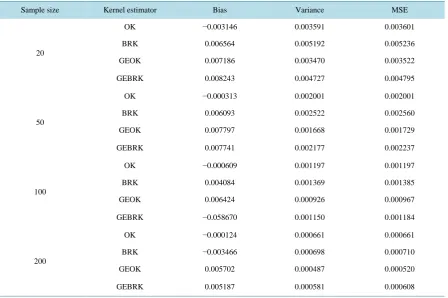
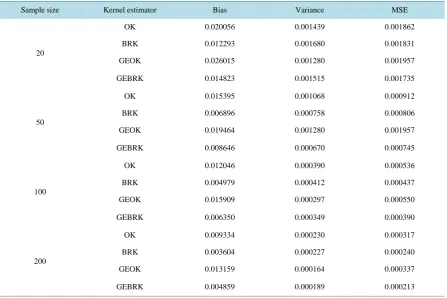
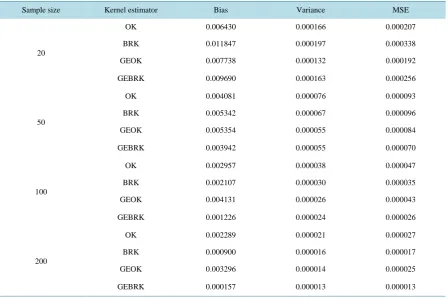
for fixed x = 0, 0.5, 1, 1.5, 2, 2.5 or 3. The simu- lation results are presented inTables 1-7.
FromTables 1-7 we can see that BRK consistently has smaller bias and MSE than OK except for x = 1. This is simply due to the fact that f′′
( )
1 =0 which in turn reduces the bias of OK to O h( )
4 . Apparently this is of the same order as the bias of BRK, however this is a special case that is only true at point x = 1 here and theTable 1.Bias, variance and MSE of different kernel density estimators evaluated at x = 0.
Sample size Kernel estimator Bias Variance MSE
20
OK −0.051923 0.003405 0.006101
BRK −0.028022 0.003849 0.004644
GEOK −0.036122 0.003106 0.004411
GEBRK −0.027881 0.003158 0.003935
50
OK −0.036192 0.002127 0.003437
BRK −0.017092 0.002105 0.002397
GEOK −0.025861 0.001686 0.002355
GEBRK −0.018000 0.001620 0.001944
100
OK −0.028514 0.001245 0.002058
BRK −0.012703 0.001132 0.001294
GEOK −0.021273 0.000885 0.001338
GEBRK −0.014114 0.000829 0.001028
200
OK −0.022334 0.000815 0.001314
BRK −0.009988 0.000691 0.000791
GEOK −0.017786 0.000531 0.000847
Table 2. Bias, variance and MSE of different kernel density estimators evaluated at x = 0.5.
Sample size Kernel estimator Bias Variance MSE
20
OK −0.035504 0.003537 0.004798
BRK −0.015563 0.004579 0.004821
GEOK −0.021755 0.003326 0.003800
GEBRK −0.015037 0.003978 0.004204
50
OK −0.022483 0.002055 0.002560
BRK −0.007345 0.002321 0.002375
GEOK −0.013747 0.001689 0.001878
GEBRK −0.007874 0.001904 0.001966
100
OK −0.017031 0.001308 0.001598
BRK −0.005084 0.001334 0.001360
GEOK −0.011120 0.000978 0.001102
GEBRK −0.006062 0.001048 0.001085
200
OK −0.013480 0.000816 0.000998
BRK −0.003789 0.000793 0.000807
GEOK −0.009041 0.000569 0.000650
GEBRK −0.004779 0.000605 0.000628
Table 3. Bias, variance and MSE of different kernel density estimators evaluated at x = 1.
Sample size Kernel estimator Bias Variance MSE
20
OK −0.003146 0.003591 0.003601
BRK 0.006564 0.005192 0.005236
GEOK 0.007186 0.003470 0.003522
GEBRK 0.008243 0.004727 0.004795
50
OK −0.000313 0.002001 0.002001
BRK 0.006093 0.002522 0.002560
GEOK 0.007797 0.001668 0.001729
GEBRK 0.007741 0.002177 0.002237
100
OK −0.000609 0.001197 0.001197
BRK 0.004084 0.001369 0.001385
GEOK 0.006424 0.000926 0.000967
GEBRK −0.058670 0.001150 0.001184
200
OK −0.000124 0.000661 0.000661
BRK −0.003466 0.000698 0.000710
GEOK 0.005702 0.000487 0.000520
[image:9.595.93.542.424.722.2]Table 4. Bias, variance and MSE of different kernel density estimators evaluated at x = 1.5.
Sample size Kernel estimator Bias Variance MSE
20
OK 0.019396 0.002676 0.003052
BRK 0.017134 0.003727 0.004021
GEOK 0.025892 0.002580 0.003250
GEBRK 0.019406 0.003468 0.003845
50
OK 0.013847 0.001334 0.001525
BRK 0.010788 0.001646 0.001763
GEOK 0.020440 0.001163 0.001581
GEBRK 0.013526 0.001486 0.001669
100
OK 0.020478 0.000747 0.000857
BRK 0.007408 0.000848 0.000903
GEOK 0.016685 0.000601 0.000879
GEBRK 0.010161 0.000745 0.000848
200
OK 0.008525 0.000441 0.000514
BRK 0.005869 0.000460 0.000494
GEOK 0.014117 0.000324 0.000523
GEBRK 0.008425 0.000389 0.000460
Table 5. Bias, variance and MSE of different kernel density estimators evaluated at x = 2.
Sample size Kernel estimator Bias Variance MSE
20
OK 0.020056 0.001439 0.001862
BRK 0.012293 0.001680 0.001831
GEOK 0.026015 0.001280 0.001957
GEBRK 0.014823 0.001515 0.001735
50
OK 0.015395 0.001068 0.000912
BRK 0.006896 0.000758 0.000806
GEOK 0.019464 0.001280 0.001957
GEBRK 0.008646 0.000670 0.000745
100
OK 0.012046 0.000390 0.000536
BRK 0.004979 0.000412 0.000437
GEOK 0.015909 0.000297 0.000550
GEBRK 0.006350 0.000349 0.000390
200
OK 0.009334 0.000230 0.000317
BRK 0.003604 0.000227 0.000240
GEOK 0.013159 0.000164 0.000337
[image:10.595.93.541.424.722.2]Table 6. Bias, variance and MSE of different kernel density estimators evaluated at x = 2.5.
Sample size Kernel estimator Bias Variance MSE
20
OK 0.016515 0.000460 0.000732
BRK 0.008864 0.000469 0.001831
GEOK 0.014181 0.000533 0.000734
GEBRK 0.010294 0.000522 0.000633
50
OK 0.011925 0.000206 0.000348
BRK 0.002861 0.000215 0.000224
GEOK 0.009428 0.000260 0.000348
GEBRK 0.003742 0.000239 0.000253
100
OK 0.009607 0.000106 0.000199
BRK 0.001155 0.000118 0.000119
GEOK 0.007231 0.000140 0.000193
GEBRK 0.001456 0.000134 0.000135
200
OK 0.007813 0.000057 0.000118
BRK 0.000254 0.000066 0.000066
GEOK 0.005655 0.000082 0.000115
GEBRK 0.000566 0.000078 0.000079
Table 7. Bias, variance and MSE of different kernel density estimators evaluated at x = 3.
Sample size Kernel estimator Bias Variance MSE
20
OK 0.006430 0.000166 0.000207
BRK 0.011847 0.000197 0.000338
GEOK 0.007738 0.000132 0.000192
GEBRK 0.009690 0.000163 0.000256
50
OK 0.004081 0.000076 0.000093
BRK 0.005342 0.000067 0.000096
GEOK 0.005354 0.000055 0.000084
GEBRK 0.003942 0.000055 0.000070
100
OK 0.002957 0.000038 0.000047
BRK 0.002107 0.000030 0.000035
GEOK 0.004131 0.000026 0.000043
GEBRK 0.001226 0.000024 0.000026
200
OK 0.002289 0.000021 0.000027
BRK 0.000900 0.000016 0.000017
GEOK 0.003296 0.000014 0.000025
[image:11.595.92.541.424.722.2]conclusion cannot be generalized. When the two estimators with geometric extrapolation are compared, GEBRK generally has smaller bias and MSE than GEOK, especially when sample size is large. When BRK and GEBRK are compared, GEBRK tends to have smaller variance and MSE but larger bias than BRK. In terms of bias, BRK and GEBRK perform much better than OK and GEOK while BRK and GEBRK are very competitive. Geometric extrapolation reduces the variance and MSE in general, i.e. GEOK and GEBRK perform better than OK and BRK in terms of variance and MSE. When MSE is concerned, GEBRK performs best and then GEOK. These observations are somehow different at point x = 1 due to the fact that f′′
( )
1 =0 as mentioned above.5. Concluding Remarks
In this paper, we first propose a very intuitive and feasible kernel density estimator which reduces the bias and MSE significantly compared with the ordinary kernel density estimator. Secondly, we construct a geometric extrapolation of the bias reduced kernel estimator which further improves the convergence rates of both bias and MSE. Our simulation study shows that for finite sample size both estimators perform competitively well and better than the ordinary kernel estimator and its geometric extrapolation.
For the bias reduced kernel density estimator presented in Section 2, we may find that part of the curve is un-der zero, especially at the tails. Taking standard normal density as an example, at point x = 4 the estimator may give a negative value. Apparently, this is unreasonable. Though in Remark 2.2 we suggest a modified version of the estimator, further work is necessary to deal with this problem.
Acknowledgements
The authors acknowledge with gratitude the support of this research by Discovery Grants from National Sciences and Engineering Research Council (NSERC) of Canada, and would like to thank the anonymous refe-rees for their constructive comments.
References
[1] Farrell, R.H. (1972) On the Best Obtainable Asymptotic Rates of Convergence in Estimation of a Density Function at a Point. The Annals of Mathematics and Statistics, 43, 170-180. http://dx.doi.org/10.1214/aoms/1177692711
[2] Terrell, G.R. and Scott, D.W. (1980) On Improving Convergence Rates for Nonnegative Kernel Density Estimators. The Annals of Statistics, 8, 1160-1163. http://dx.doi.org/10.1214/aos/1176345153
[3] Hall, P. and Marron, J.S. (1988) Choice of Kernel Order in Density Estimation. The Annals of Statistics, 16, 161-173.
http://dx.doi.org/10.1214/aos/1176350697
[4] Abramson, I.S. (1982) On Bandwidth Variation in Kernel Estimates—A Square Root Law. The Annals of Statistics, 10, 1217-1223. http://dx.doi.org/10.1214/aos/1176345986
[5] Samiuddin, M. and El-Sayyad, G.M. (1990) On Nonparametric Kernel Density Estimates. Biometrica, 77, 865-874.
http://dx.doi.org/10.1093/biomet/77.4.865
[6] El-Sayyad, G.M., Samiuddin, M. and Abdel-Ghaly, A.A. (1992) A New Kernel Density Estimate. Journal of Nonpa-rametric Statistics, 3, 1-11. http://dx.doi.org/10.1080/10485259308832568
[7] Cheng, M.Y., Choi, E., Fan, J. and Hall, P. (2000) Skewing Methods for Two-Parameter Locally Parametric Density Estimation. Bernoulli, 6, 169-182. http://dx.doi.org/10.2307/3318637
[8] Marron, J.S. and Ruppert, D. (1992) Transformations to Reduce Boundary Bias in Kernel Density Estimation. Journal of the Royal Statistical Society: Series B, 4, 653-671.
[9] Ruppert, D. and Cline, D.B.H. (1994) Bias Reduction in Kernel Density Estimation by Smoothed Empirical Transfor-mations. The Annals of Statistics, 22, 185-210. http://dx.doi.org/10.1214/aos/1176325365
[10] Jones, M.C., Linton, O. and Nielsen, J.P. (1995) A Simple Bias Reduction Method for Density Estimation. Biometrica,
82, 327-338. http://dx.doi.org/10.1093/biomet/82.2.327
[11] Kim, C., Kim, W. and Park, B.U. (2003) Skewing and Generalized Jackknifing in Kernel Density Estimation. Commu-nications in Statistics: Theory and Methods, 32, 2153-2162. http://dx.doi.org/10.1081/sta-120024473
[12] Mynbaev, K. and Martins-Filho, C. (2010) Bias Reduction in Kernel Density Estimation via Lipschitz Condition. Jour- nal of Nonparametric Statistics, 22, 219-235. http://dx.doi.org/10.1080/10485250903266058
[13] Srihera, R. and Stute, W. (2011) Kernel Adjusted Density Estimation. Statistics and Probability Letters, 81, 571-579.
[14] Cheng, M.Y., Peng, L. and Wu, S.H. (2007) Reducing Variance in Univariate Smoothing. The Annals of Statistics, 35, 522-542. http://dx.doi.org/10.1214/009053606000001398
[15] Kim, J. and Kim, C. (2013) Reducing the Mean Squared Error in Kernel Density Estimation. Journal of the Korean Statistical Society, 42, 387-397. http://dx.doi.org/10.1016/j.jkss.2012.12.003
[16] Rosenblatt, M. (1956) Remarks on Some Nonparametric Estimates of a Density Function. The Annals of Mathematical Statistics, 27, 832-837. http://dx.doi.org/10.1214/aoms/1177728190
[17] Parzen, E. (1962) On Estimation of a Probability Density Function and the Mode. The Annals of Mathematical Statis-tics, 33, 1065-1076. http://dx.doi.org/10.1214/aoms/1177704472
[18] Silverman, B.W. (1986) Density Estimation for Statistics and Data Analysis. Chapman & Hall, London.
http://dx.doi.org/10.1007/978-1-4899-3324-9
[19] Wand, M.P. and Jones, M.C. (1995) Kernel Smoothing. Chapman & Hall, London.