Tri-variate Optimization Strategies of Semi-Join
Technique on Distributed Databases
Sunita M. Mahajan,
PhD.Principal
Department of Computer Science Mumbai Education Trust, Bandra,
Vaishali P. Jadhav
Research Scholar NMIMS University Vile-Parle, Mumbai, India
ABSTRACT
The problem of finding an optimal strategy to minimize the data transmission cost in distributed database systems, even with the one join attribute is a NP-Hard problem. Determining the optimal sequence of join operations in query optimization leads to exponential complexity. To deal with such a problem, there is need to develop a heuristic approach to solve the problem in polynomial time. This paper mentioned the use of semi-join operation. Beneficial Semi-join operation reduces the amount of data transmission required to perform the join sequences. This paper addresses the optimization of queries with one and more than one join attributes.
General Terms
Query Processing, Query Optimization, Semi-Join
Keywords
Distributed Database, Query Optimization, Gainful Semi-Join, Beneficial Semi-Join.
1.
INTRODUCTION
In distributed database system, query optimization criteria can be query cost or query response time. The query cost has mainly two components: local cost and communication cost. The local cost includes the CPU and I/O cost. The CPU cost is incurred when the CPU performs the operations on data in main memory. The I/O cost is the time for disk input and output operations. Efficient use of main memory and reduction of I/O operations through fast access methods minimizes the local cost. The communication cost is the cost of transmitting data from one site to another on the communication network. In distributed system, minimization of communication cost is the important issue to solve. The data transmission cost between any two sites is a linear function defined as C0 + C1.X where C0 is the start-up cost of initiating the transmission , C1 is the cost coefficient associated with transfer of one unit of data and X is the amount of data transferred from one site to another[1-5].
For high bandwidth and low delay networks (Local Area Network), communication as well as processing cost is considered as an optimization criteria. But for higher delay network and networks with low bandwidth, processing cost is assumed to be negligible and communication cost alone is considered for optimization.
Here paper deals with fast data retrieval in response to queries, optimization of queries in distributed relational database
system and communication among sites which are connected by network with high communication costs. Considered queries are based on select, project and join (SPJ) model. To reduce the communication cost in distributed system, 3 different optimization strategies of semi-join technique are suggested.
The objective of the study is to investigate whether the semi-join approach improving the optimization of query by reducing the processing cost.
This paper is organized as follows. The literature and related work is given in section 2. The notations, definitions required are given in section 3. Semi-join strategies are given in section 4. Results and experiments are given in section 5. Finally this paper concludes with section 6.
2.
RELATED WORK
Qiuling Fu introduced the notion of a multi-attribute semi-join (MASJ) operation and checked the usefulness of this operation in distributed databases. This MASJ operation like semi-join operation does not involve the transmission of non-join attributes. MASJ is a multi-operand operation with n operands, where n>=2. In this operation, more than one attribute is sent and the size of a relation is reduced by eliminating the combinations of values of attributes. In this approach, the AHY algorithm, a well known heuristic for query processing, is modified. It is a static heuristic which combines the multi-attribute semi-join operation with AHY algorithm. In paper, 12 different categories of queries are tested and the comparison of AHY and MJ is performed. The experimental results indicate that the MJ algorithm outperforms the AHY algorithm quite significantly [1].
Tsai et al., considered the entity join queries in wide area multi-database environment. An entity join operation “integrates” tuples representing the same entities from different relations in which inconsistent data may exists. Semi-join operation cannot directly used to process entity join query so “Extended Semi-join” to reduce the cost of transmission is suggested [2].
and reduce communication cost. This paper briefly described the corresponding concepts and characteristics of distributed database system, summarized the goals of distributed database query optimization, and analyzed the query optimization process based on semi-join operation combined with the practical application [3].
Ming-Syan Chen et.al, suggested the interleaving of a join sequence with semi-joins while processing a query in distributed environment. Author suggested a heuristic approach to determine an effective sequence of semi-join and join reducers. Paper gives the concept of beneficial semi-join and gainful semi-join. In this paper, first a sequence of join reducers is obtained and then mapped it into a join sequence tree. Properties of beneficial semi-join are the applied to develop an efficient algorithm to determine the beneficial semi-join which can be inserted into join sequence. Experiments and results showed that the approach of interleaving a join sequence with beneficial semi-joins is not only efficient but also effective in reducing the total amount of data transmission required to process distributed queries [4]. Chung and Irani , suggested a approach which minimizes the inter-site data traffic incurred by a distributed query by using a sequence of semi-joins. A method is developed which accurately and efficiently estimates the size of intermediate result of a query. A heuristic algorithm is developed to determine a low cost sequence of semi-joins [5].
Bernd et.al, suggested a novel approach to relational preference query optimizer based on algebraic transformations. A few new laws of preference relational algebra are given. Results showed that extending relational algebra by strict partial order preferences one can get both: good modeling capabilities for personalization and good query run time [6]. Stocker et.al, extended a state-of-art query optimizer in order to generate good query plans with semi join reducers. They suggested two variants Access Root and Joint root which differ in their implementation complexities, running times and the quality of plans they produce [7].
Jan Zamanek et.al, used semi-join approach for optimization of SPARQL queries over disparate RDF data sources [8].
3.
PRELIMINARIES
The proposed strategies are based on semi-join operation which reduces the transmission cost. The transmission cost is the dominant factor in distributed databases. A sequence of semi- join can be used to compute distributed join for tree queries. Semi-joins are called ‘full reducers’ for tree queries. The notations, definitions and assumptions required for semi-join strategies are stated below:
3.1
Problem Definition
Given a database D of j tables D = {T1, T2,…..Tj}, distributed over n sites {site1,site2,….siten}. For optimizing the processing of a query, query is of form Ti1 join(Key1) Ti2 join(key2)………….join(keyh) Tih.
3.2
Notations
| K | Cardinality of a set K WA Width of an attribute A WRi Width of a tuple in Ri WRi |Ri| Total amount of data in Ri
ρ i,a Selectivity of attribute A in Ri = |Ri(A)| / |A| where Ri(A) :Set of distinct values
for the attribute A in Ri.
Ri---A-Rj Semijoin Operation between Ri and Rj.
3.3
Definitions
Semi-join Operation:
Ri---A-Rj is a semi join from Ri to Rj on attribute A, in which A is the joining attribute, Ri is called reducer and Rj is called the reducee of the semi-join.
Semi-join operation can be obtained by joining Ri and Rj on attribute A, then projecting the resulting relation on the all attributes of Ri. The reduction of the relation Rj by the semi-join
Ri--A--> Rj is proportional to the reduction of Rj(A).
The estimation of the size of the relation reduced by a semi-join is thus similar to estimating the reduction of projection on the semi-join attribute.
After semi join Ri—A Rj , the cardinality of Rj can be estimated as |Rj|. ρ i,a
Cost of Semi-join:
The cost of semijoin Ri—ARj is defined to be the cost of transferring Ri(A) from the site containing the relation Ri to the site containing the relation Rj.
Benefit of Semi-join:
The benefit of the semi join is the reduction in the size of R2 as a result of the operation. Profitable Semi-join:
A semi-join is profitable if its cost is less than its benefit.
3.4
Assumptions
Following are the parameters which have a significant effect on performance of query processing
Number of relations occurred in the query Number of join attributes in a relation
Ratio of number of distinct values of the attribute to the domain size of the attribute in the relation Maximum ratio of number of tuples in a relation to
the domain size of the join attribute that appear in the relation
Size of relation Resultant site
Following are the parameters which are not considered Number of non-join attributes
4.
SEMI-JOIN STRATEGIES
For the execution of the query Q: T1 join T2 join T3, the strategies works as follows:
Strategy 1: Simple SPJ query with only one joining attribute and chronological semi-join operation
Step 1: The user submits the query. The relations are arranged in the ascending order of their joining attribute size.
Step 2: Generate the sequence of semi-joins Ri+1 semi-join Ri where i = 1 to number of relations.
Step 3: Calculate the cost of operation and cardinality of reduced relation [ ].
Step 4: Move the Result to the resultant site. Step 5: Calculate the total cost of semi-join program.
Strategy 2: Simple SPJ query with only one joining attribute and last semi-join is at resultant site.
Step 1: Depending upon the join attribute size the relations are arranged.
Step2: Resultant Site is skipped from the order of relations and it considered at last semi-join operation, so transmission cost of moving resultant data to required site is saved.
Step3: Generate the sequence of semi-join (except resultant site) Ri+1 semi-join Ri where i = 1 to number of relations Step 4: Calculate the cost of semi-join operation and cardinality of reduced relation.
Step 5: Generate last semi-join operation {(resultant site relation) semi-join (previous reduced relation)}
Step 6: Calculate the total cost of semi-join program.
Strategy 3: Simple SPJ query with more than one joining attribute
Step 1: Arrange the relations in ascending order of its size. Step 2: Assume the number of joining attributes = n
Step 3: Generate the sequence of semi-join operations Ri+1 semi-join Ri where i = 1 to number of relations
Step 4: Calculate the cost of each operation and cardinality of reduced relation.
Step 5: Do step 3 and 4 for each joining attribute.
Step 6: Calculate the total cost by adding cost obtained by sequence of semi-join operations for each joining attribute.
5.
EXPERIMENTS AND RESULTS
To study whether the use of semi-join algorithm leads to a better performance, various experiments based on a large number of queries are carried out.
The objectives of test are as follows:
Test the semi-join algorithm with a query set consisting a wide variety of SPJ queries.
For each query in the query set, estimate the cost for processing the query using suggested strategies. This estimate is based on statistical information about the database.
Evaluate the cost obtained in each strategy.
Compare the cost estimations of different strategies for each query.
Following are the test parameters which are considered during experiment
For all strategies, the analysis for 10 queries is presented. Extending the analysis to any number of queries is straightforward..
Ten different queries with single join attribute is considered.
Another 10 queries with 2, 3, 4 join attributes is considered
The number of tuples in each relation is varied between 100 and 10000
Domain size of queries is varied between 100 and 900
The width of each attribute is assumed to be 1. The selectivity is varied between 0.1 and 0.9 Transmission cost =10 for strategy 1 and 2 and
Transmission cost =20 for strategy 3.
Strategy 1 and 2: Simple SPJ query with
only one joining attribute
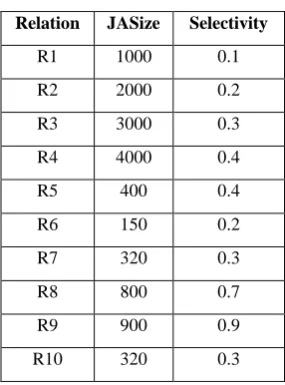
Following table 1 and 2 gives the details of relations, join attribute size and selectivities.
Table 1. Input Details
[image:4.595.324.534.92.344.2]Following table gives the details of queries.
Table 2. Query Table
Query Expression
1 (R1.A=R2.A)^(R2.A=R3.A)^(R3.A=R4.A) 2 (R5.A=R6.A) ^(R6.A=R7.A)
3 (R8.A= R9.A)^(R9.A=R10.A)^(R10.A=R1.A) 4 (R5.A=R2.A) ^(R2.A=R4.A)
5 (R3.A=R6.A)^(R6.A=R8.A) 6 (R9.A=R10.A)^(R10.A=R3.A)
7 (R6.A=R8.A)^(R8.A=R2.A)^(R2.A=R4.A) 8 (R1.A=R3.A)^(R3.A=R5.A)^(R5.A=R7.A)^(
R7.A=R9.A)
9 (R1.A=R10.A)^(R10.A=R5.A)
10 (R2.A=R7.A)^(R7.A=R8.A)^(R8.A=R3.A)
Note the results obtained by strategy2 with JAmaxsize resultant site. The result gives the minimum total cost for each query. For each query given in table, strategy2 with JAmaxsize works better. Strategy 1 uses the concept of semi-join to reduce the cost and strategy 2 uses the semi-semi-join as well as JAmaxsize for resultant site. So Strategy 2 works better than strategy 1.
Table 3. Queries with costs obtained by different strategies
Query S1 S2.1 S2.2 S2.3
1 1324 1450 2870 1290
2 268 250 460 234
3 978 2090 2090 779
4 1550 2020 2820 1220
5 760 770 2920 330
6 1430 3620 1240 610
7 742 740 2790 620
8 7384 636 738.4 696
9 590 640 820 460
10 1146 1130 2650 1010
S1: Strategy 1
S2.1 : Strategy 2 with any resultant site S2.2 : Strategy 2 with JAminsize resultant site S2.3 : Strategy 2 with JAmaxsize resultant site
Table 3 shows that strategy 2 works better for the given queries when JAmaxsize is considered as resultant site. Following Fig.1 gives the idea about better results of strategy 2: JAmaxsize resultant site. Total cost required is less than all other strategies
.
Fig 1.Cost analysis of queries
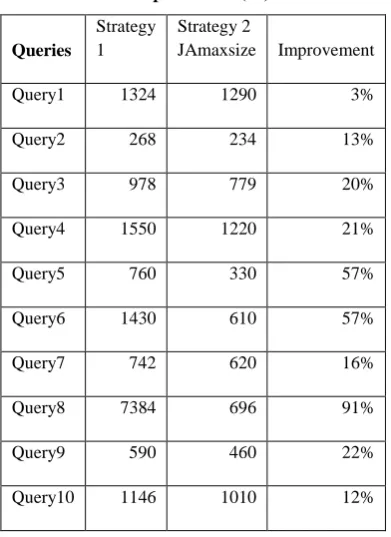
Table 4 shows the improvement of strategy2 with JAmaxsize over strategy1 in percentage
The improvement of strategy 2 over strategy 1 is calculated as
Relation JASize Selectivity
R1 1000 0.1
R2 2000 0.2
R3 3000 0.3
R4 4000 0.4
R5 400 0.4
R6 150 0.2
R7 320 0.3
R8 800 0.7
R9 900 0.9
[image:4.595.87.230.93.286.2] [image:4.595.50.274.328.597.2] [image:4.595.318.549.489.635.2]Improvement (%) = 1- (Cost of strategy 2 with JAmaxsize / Cost of Strategy 1) * 100%
Table 4: Improvement (%) Table
[image:5.595.59.272.105.551.2]Diagrammatically improvement is shown in fig 2.
Fig. 2: Improvement of strategy 2 over strategy 1
Query 1 has minimum improvement and Query 8 has maximum improvement.
5.2 Strategy 3: Simple SPJ query with more
than one joining attribute
Strategy 1 and strategy 2 are based on the simple SPJ queries with only one joining attribute. Strategy 3 considered the queries with more than one joining attributes. Input details such as relations, relation size, joining attribute size, joining attribute selectivity etc. is given in Table 5.Queries with cost analysis is given in Table 6. Bar chart in figure 3 shows the cost analysis of queries with 2 join-attribute , 3 join-attribute and 4 join-attribute[13].
[image:5.595.70.266.115.384.2]Table 5. Input Details
[image:5.595.54.279.406.549.2]Table 6. Cost of queries with more than one attribute
Fig. 3 Cost analysis with more than one attribute
6.
CONCLUSION
To study the usefulness of semi-join operation in distributed query processing, we have implemented 3 different strategies with simple SPJ queries. Strategy 1 and 2 are based only on single join attribute and strategy 3 is based on more than one join attribute. Strategy 2 with JAmaxsize as resultant site works better than all other strategies. These strategies with large number of queries are tested. Here results of some queries are given in the paper. Performance improvement of strategy 2 over strategy 1 is also calculated. Results of queries having more than one join attributes is also given in the paper. Finally conclusion is that optimization of query can be improved by taking into account all the characteristics of query as well as database profile and then applying proper strategy.
Size A#
A# sel B#
B# Sel C#
C# sel D#
D# Sel
R1 1000 100 0.1 0 0 700 0.7 0 0
R2 2000 0 0 300 0.3 800 0.8 0 0
R3 3000 100 0.2 0 0 0 0 400 0.4
R4 4000 0 0 500 0.5 0 0 200 0.2
R5 5000 200 0.3 0 0 300 0.3 100 0.1
R6 6000 0 0 700 0.7 400 0.4 0 0
R7 7000 400 0.5 800 0.8 700 0.7 500 0.5
R8 8000 0 0 900 0.9 0 0 700 0.6
R9 9000 600 0.8 0 0 0 0 900 0.3
R10 10000 0 0 100 0.1 900 0.3 0 0
Queries
Strategy 1
Strategy 2
JAmaxsize Improvement
Query1 1324 1290 3%
Query2 268 234 13%
Query3 978 779 20%
Query4 1550 1220 21%
Query5 760 330 57%
Query6 1430 610 57%
Query7 742 620 16%
Query8 7384 696 91%
Query9 590 460 22%
[image:5.595.319.536.408.551.2]7.
REFERENCES
[1] Subir Bandyopadhyay, Qiuling Fu, Joan Momssey, and A. Sengupta. A multiattribute semijoin operation for query optimization in distributed databases 1996. [2] Pauray S.M. Tsai and Arbee L.P. ChenOptimizing Entity
Join Queries by Extended Semijoins in a Wide Area Multidatabase Environment,IEEE international conference ob parallel and distributed databases 1994 [3] Lin Zhou et al., The semi-joinoptimization in distributed
databases, National Conference on Information Technology and Computer Science(CITCS 2012) [4] Chen and Yu,Interleaving a join sequence with semi
joins in distributed query processing
[5] Chung and Irani, An optimization of queries in distributed databases, Journal of parallel and distributed computing 3, 137-157 (1986).
[6] Bernd Hafenrichter, Werner Kießling.Optimization of Relational Preference Queries, 16th Australian Database Conference in Research and Practice in Information Technology,Vol. 39.
[7] Stoker et al., Integrating semi-join reducers in the state of the art query procesors, German Research Concil (DFG). [8] Zemanek et al.,Optimizing SPARQL Queries over
Disparate RDF Data Sources through Distributed Semi-joins
[9] Peter M. G. Apers, Alan R. Hevner, and S. Bing Yao. Optimization algorithmsfor distributed queries. IEEE Trans. on Sofnvare Engineering, pages 57-68,January 1983.
[10] Yan T, IacobesnM, Garcia-Mo Lina H,et al, Introduction of Query optimization of distributed database. Paris,FR: WAM Press, 1999.
[11] Agrawal R., Wimmers E. L. (2000): A Framework for Expressing and Combining Preferences. Proceedings of the 2000 ACM SIGMOD International Conference on Management of Data. Dallas, USA, 297 - 306, ACM Press.
[12] P. A. Bernstein and D.-M.W. Chiu. Using semi-joins to solve relational queries. Journal of the ACM,28(1):25– 40, January 1981.
[13] R. Braumandl, J. Claussen, and A. Kemper. Evaluating functional joins along nested reference sets in object-relational and object-oriented databases. In Proc. of the Conf. on Very Large Data Bases (VLDB), pages 110– 121, New York, USA, August 1998.
[14] P. A. Bernstein and N. Goodman. Power of natural semijoins. SIAM Journal on Computing,10(4):751–771, November 1981.
[15] P. Bernstein, N. Goodman, E. Wong, C. Reeve, and J. Rothnie. Query processing in a system for distributed databases (SDD-1). ACM Trans. on Database Systems, 6(4):602–625, December 1981.
[16] R. Braumandl, A. Kemper, and D. Kossmann. Database patchwork on the Internet (project demo description). In Proc. of the ACM SIGMOD Conf. on Management of Data, pages 550–552, Philadelphia, PA, USA, June 1999. [17] Prud'hommeaux, E., Seaborne, A.: SPARQL Query Language for RDF. W3C Recommendation (January 2008) http://www.w3.org/TR/rdf-sparql-query/
[18] Quilitz, B., Leser, U.: Querying Distributed RDF Data Sources with SPARQL. In: The Semantic Web: Research and Applications. Springer Berlin / Heidelberg (2008) 524-538
[19] Langegger, A., Wöß, W., Blöchl, M.: A Semantic Web Middleware for Virtual Data Integration on the Web. Springer Berlin / Heidelberg (2008) 493-507
[20] Dr.Sunita M.Mahajan, Ms. Vaishali P. Jadhav, Genral Framework for Optimization of Distributed Queries, International Journal of Database Management Systems(IJDMS), Vol.4, No.3,June 2012, ISSN: 0975-5705
AUTHOR’S PROFILE
Dr. Sunita M. Mahajan is currently Principal, Institute of Computer Science, MET, Mumbai. She worked in Bhabha Atomic Research Centre for 31 years. She obtained Ph.D. in parallel processing in 1997 from SNDT Women University and M.Sc. degree from Mumbai University in physics in 1966. She is a member of Indian Women Scientists Association, Vashi. Her research areas are parallel processing, distributed c omputing, d ata mining and grid computing.