Moving towards a Common External
Tariff Regime in ASEAN
Lord, Montague J.
ASEAN Secretariat
December 2008
Online at
https://mpra.ub.uni-muenchen.de/41154/
- i
-Capacity Building for the ASEAN Secretariat: Common External Tariff Regime
ASEAN E06/08
Moving towards a Common External Tariff Regime in ASEAN
Draft Final Report
Submitted to
InWEnt – International Weiterbidung und Entwicklung gGmbH and
ASEAN Secretariat
Submitted by
Montague Lord International LLC
PO Box 501197 Marathon, Florida 33050
United States
-ii
-Moving towards a Common External Tariff Regime in ASEAN
Table of Contents
Table of Contents ii
List of Acronyms and Abbreviations iii
List of Boxes, Figures and Tables vi
Executive Summary vii
1. Background and Introduction 1
1.1. Background 1
1.2. Objectives and Outputs 1
1.3. Coverage 2
2. Moving towards a CET Regime in ASEAN: An Overview 4
2.1. Regional Trade Agreements 4
2.2. Potential Benefits of a Common External Tariff 5
2.3. Historical Developments of ASEAN Trade Arrangements 6
2.4. Free Trade Agreements and Implications for CET 7
2.5. Common External Tariffs in Other Regional Trade Arrangements 10
3. Option for a Common External Tariff 21
3.1. Existing Tariff Structures 21
3.2. The Optimal Tariff 23
3.3. Alternative CET Structures 24
3.4. Revenue Sharing and Compensations 25
4. Modeling Welfare Effects of an ASEAN Common External Tariff 29
4.1. Methodology for Estimating Welfare Effects 29
4.2. Estimates of the CET Welfare Effects under Alternative Regimes 29
5. Sequencing FTAs and a Common External Tariff Regime 35
5.1. Estimates of ASEAN FTAs before versus after a CET 35
5.2. Dynamic FTAs and CET Sequencing Effects 38
6. Designing and Implementing the CET 40
6.1. Key Issues for the CET Design and Implementation 40
6.2. Transition and Adjustment Issues for CET Implementation 42
7. Recommendations for Further Studies 45
Annexes
A. The Empirical Model 47
B. Product Lines having Similar Tariffs Applied by ASEAN Member States 51
C. Welfare Effects of 6.1% CET on ASEAN Member States at HS 2-Digit Level 54
-iii
-List of Acronyms and Abbreviations
AEC ASEAN Economic Community
AFTA ASEAN Free Trade Area
APEC Asia-Pacific Economic Cooperation
ASEAN Association of Southeast Asia Nations
ASEC ASEAN Secretariat
ASEAN-6 ASEAN original signatories
ASEAN-CLMV ASEAN Cambodia, Laos, Myanmar and Vietnam
ASEM Asia-Europe Meeting
CAP Common Agricultural Policy, EC
CARICOM Caribbean Common Market
CCCA Coordinating Committee for the CEPT implementation of AFTA
CCT Common Customs Tariff
CEPT Common Effective Preferential Tariff, ASEAN
CET Common External Tariff
COMESA Common Market of Eastern and Southern Africa
CGE Computable General Equilibrium
CTS Consolidated Tariff Schedules
CU Customs Union
DDA Doha Development Agenda
DG Trade Directorate General of Trade, EC
EAC Eastern African Community
EC European Commission
ECOWAS Economic Community of Western African States
EEC European Economic Community
EPA Economic Partnership Agreement
EPZ Export Processing Zone
ESCAP United Nations Economic and Social Commission for Asia and the Pacific
EU European Union
FAO Food and Agriculture Organization
FDI Foreign Direct Investment
FTA Free Trade Agreement
FTAA Free Trade Agreement for the Americas
GATS General Agreement on Trade in Services
GATT General Agreement on Tariffs and Trade
GDP Gross Domestic Product
GNI Gross National Income
GPA Government Procurement Agreement
GSP Generalized System of Preferences
GTAP Global Trade Analysis Project
HS Harmonized System
IMF International Monetary Fund
InWEnt International Weiterbidung und Entwicklung gGmbH
IPR Intellectual Property Rights
ITA Information Technology Agreement
ITC International Trade Centre
-iv
-MERCOSUR South America’s Southern Common Market
MFN Most Favoured Nation
NGO Non-governmental Organization
NTB Non-Tariff Barriers
RoO Rules of Origin
RTA Regional Trade Agreement
SACU South African Customs Union
SADC Southern African Development Community
SEOM Senior Economic Officials Meeting, ASEAN
SME Small and Medium-Size Enterprise
SPS Sanitary and Phytosanitary Measures
TBT Technical Barriers to Trade
TOR Terms of Reference
TREATI Trans-Regional EU-ASEAN Trade Initiative
TRIPs Trade-related Intellectual Property Rights
TRTA Trade-related Technical Assistance
UNCTAD United Nations Conference on Trade and Development
UNDP United Nations Development Programme
WB World Bank
WCO World Customs Organization
-v
-List of Boxes, Figures and Tables
Boxes
2.1 Free Trade Agreements and Negotiations Involving ASEAN and the Member States 8
2.2 The 2002 SACU Revenue-Sharing Formula 14
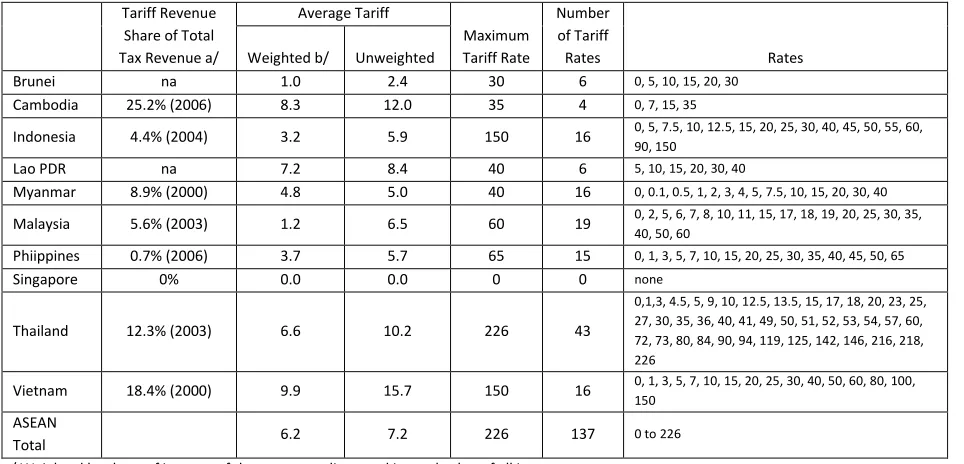
3.1 Characteristics of Member States’ Tariff Structure 22
Figures
4.1 Total Change in ASEAN Consumer Welfare and Government Revenue Changes 31
Tables
3.1 Profile of Tariffs in ASEAN Member Countries 23
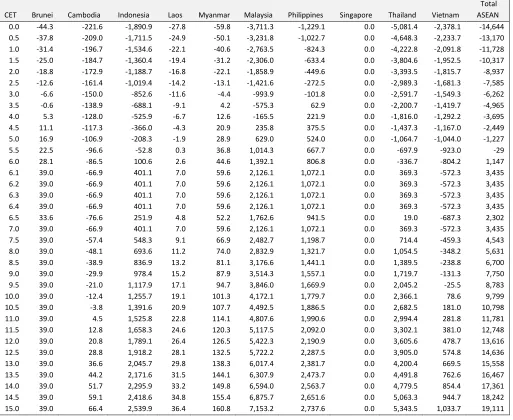
4.1 Change in Government Revenue from MFN Tariffs Applied to Non-ASEAN Imports
under Alternative Common External Tariffs 30
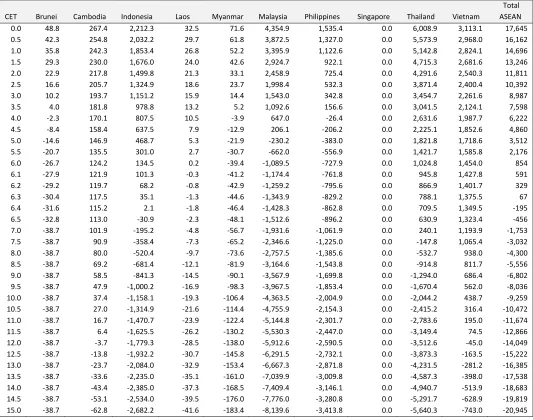
4.2 Change in Consumer Welfare from MFN Tariffs Applied to Non-ASEAN Imports
under Alternative Common External Tariffs 32
4.3 Welfare Impact of 6.1 Percent CET on ASEAN Member States 33
5.1 Percent Distribution of ASEAN Country Imports from Actual and Forthcoming ASEAN-FTAs,
ASEAN Countries and Rest-of-World, 2006 35
5.2 Welfare Impact on ASEAN Member States: Moving from Pre-CET to CET Rate 36
5.3 Welfare Impact of 4.2% CET Rate on ASEAN Member States 37
5.4 Welfare Impact of 4.2% CET Rate and FTAs on ASEAN Member States 37
5.5 Welfare Impact of FTAs on ASEAN Member States 38
5.6 Welfare Impact of FTAs and 4.2% CET on ASEAN Member States 38
C.1 Impact of Uniform CET Rate of 6.1 Percent on Government Revenue
from Non-ASEAN Country Imports 54
C.2 Impact of Uniform CET Rate of 6.1 Percent on Consumer Welfare
-vi -EXECUTIVE SUMMARY
Motivation for Study – Under the ASEAN Economic Community Blueprint signed at the 13th ASEAN Summit in November 2007 in Singapore, ASEAN Leaders agreed to the realization of a single market and production base by 2015. The Coordinating Committee for the
Implementation of the CEPT for AFTA (CCCA) was tasked by the Senior Economic Officials Meeting (SEOM) to do further work on the possibility of establishing an ASEAN common external tariff (CET), a process that is likely to involve a number of challenges since existing MFN tariffs of ASEAN Member States vary widely.
Objective – The objective of this study is to provide a preliminary analysis on a range of CET options that could be adopted by ASEAN and to quantitatively assess their implications for each ASEAN member state and the region as a whole. The results of the study are intended to assist the ASEAN Secretariat and the ASEAN member states in considering options under
deliberations by the CCCA, which will eventually be presented to the Senior Economic Officials Meeting (SEOM) for its deliberation on the application of a CET as a long term objective of economic integration in ASEAN.
A. Overview and CET Experiences in Other Regions
Stages of Regional Trade Agreements – Regional blocs are based on trading arrangements that aim to harmonize rules and regulations governing trade flows between member states and the rest of the world. The stages of these arrangements normally consist of the creation of, first, a free trade area with a zero tariff on intra-regional trade and the retention of individual member tariffs on third countries; second, a customs union with free trade between members and a common external tariff; third, a common market with unrestricted mobility of labor and capital, as well as goods and services; and finally, an economic union that harmonizes macroeconomic and sector policies.
CETs in Other Regional Trade Arrangements – There are several customs unions operating with CETs throughout the world. The European Union is undoubtedly the most well-known and has moved beyond a customs union to become a common market on a path to becoming an economic union. However, the range of existing customs unions with CETs includes several in Africa, Latin America and Central Asia.
European Union – In 1968the founding members of the European Union (EU) agreed to the common customs tariff (CCT), which was set at the unweighted average of the six member states’ tariff rates. The transition to the CCT included provisions that (a) each member state should move by three stages at least by 30 percent, 30 percent and 40 percent closer to the common external tariff rates; (b) the European Commission (EC) had the right to authorize any member states with special difficulties to postpone the adjustments of duty rates towards the common customs tariff for a limited period of time; and (c) the CCT should be applied in its entirety by the end of the transitional period. In the financing
arrangements, member states were required to transfer part of their customs revenue to the EC budget, as well as making contributions to the EC budget according to their gross national income (GNI) shares.
-vii
-duties as per the total volume of external trade; and common excise -duties based on the total production and consumption of excisable goods; (c) free movement of SACU
manufactured products within SACU, without any duties or quantitative restrictions; and (d) a revenue-sharing formula for the distribution of customs and excise revenues collected in SACU. Two additional provisions were later added: (a) the inclusion of excise tax in the revenue pool; and (b) a multiplier in the revenue sharing formula that would boost the revenue of some members. The revenue sharing formula uses three components: (1) a share of the customs pool; (2) a share of the excise pool; and (3) a share of a development pool. Other customs unions in Africa include the Economic Community of West African States (ECOWAS); the Common Market of Eastern and Southern Africa (COMESA); and the East African Community (EAC).
Latin America – In the Western Hemisphere one of the principal customs unions is that of the Southern Common Market (Mercosur). Although the common external tariff was
formally launched in Mercosur in 1995, enforcement of the CET has been quite weak, which has given rise to the need to enforce rules of origin for all trade in the region. More recently, Mercosur member states have agreed to circulate the imported goods freely if the CET was at zero in all member states or if Mercosur granted the third parties 100 percent
concessions. The other important customs union in the region is the Central American Common Market (CACM).
B. Options for a Common External Tariff
Optimal Tariff – The economic motivation for applying a tariff is base on the argument that it should improve a country’s overall well-being to the extent that any welfare improvement should exceed the losses incurred by the tariff. A large country that has the ability to impact world market prices of a product can derive welfare gains by taxing its imports. If any of the ASEAN countries were large enough that it imports a significant share of the world’s supply of a particular product, a tariff on that product could lower the price it had to pay to world suppliers, which in turn would improve its terms-of-trade. While this argument is theoretically valid, there are unlikely to be any products in ASEAN where countries possess sufficient monopsony power to influence the terms of trade of that internationally traded product. In that case, the actual tariffs in the ASEAN member states are typically larger than the values that optimal tariffs could reasonably be expected to take, and for all practical purposes, tariff policy in ASEAN can be established without reference to the theoretically optimal tariff.
-viii
-Trade Tax Dependencies –Several ASEAN members use tariffs as an important source of government revenue. In our interviews conducted with government tax authorities, it was generally recognized that trade taxes are not optimal instruments to achieve revenue objective because they significantly distort production and consumption choices. However, the use of tariffs to raise revenue is motivated by the lack of trade-neutral tax instruments, with the result that the domestic tax base is fixed either because the tax base cannot be enlarged rapidly enough or the marginal costs of increased domestic tax collection are high.
Revenue Sharing – All customs unions must establish procedures for sharing common customs revenues and those revenue sharing procedures have followed different rules in different customs unions. The revenue sharing experience of existing customs unions will be useful guides for ASEAN, but it is clear that a practical system suitable for the characteristics of the region’s countries will need to be designed in a somewhat independent manner to those of other regions. Most customs unions adopt the destination principle whereby tariff revenue accrues to the country where the import is finally consumed. This option is administratively attractive and politically appealing since it means that member states retain control over the revenue they collect. Revenue sharing arrangements can be used to compensate members for losses in revenue deriving from CET-related tariff restructuring. It would require that that revenue be collected at the point where it first enters into the ASEAN region, and that it then distributed between members countries based on additional agreements on how the revenue should be shared.
Sequencing and Implementation Arrangements - The level of effort and time horizon for an ASEAN CET depends on the types of policies being implemented. Immediate short-term initiatives, like the CET rates to be implemented, are unrelated to the operational system of the government, and they usually involve stroke-of-pen reforms of tariff structures. The more challenging measures, such as monitoring and evaluation mechanisms, often involve a strong institutional base for their successful implementation. The prioritization and phasing of the recommended tariff initiatives are based on discussions with government authorities of ASEAN member states based on the impact that specific initiatives would have on the following areas: (1) a revenue-neutral effect, (2) the promotion of private sector, market-driven development, and (3) and compensation for tariff revenue losses suffered by high tariff countries by those with low tariffs during the transition period towards a CET.
Tariff Strategy – Based on the preference structures of ASEAN member states, the recommended tariff strategy is based on complementarities and adjustments in the overall design of trade policy reforms among ASEAN member states. The approach is motivated by the empirical findings that individual policy initiatives are less effective in promoting economic growth that are a combination of tariff policies that are mutually reinforcing to one another in the AEAN region. The strategy consists of the following sequence of arrangements for the CET:
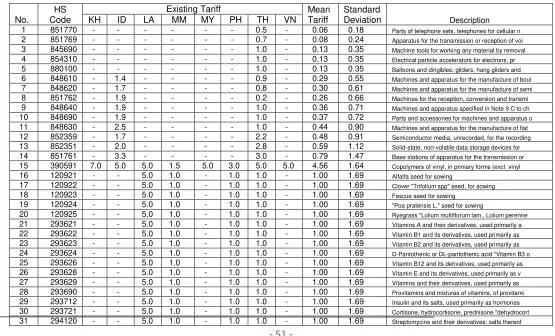
Stage I: Apply uniform tariffs to those HS 8-digit tariff lines that are most similar to one another across the ASEAN member states. Annex B shows that tariff lines that are most similar across member states under the current tariff structure of each country. No compensatory action would be required at this stage.
Stage II: Reduce the number of tariff bands to three or four rates with a small standard deviation. Revenue compensation would be provided to those countries with existing high tariff rates that would suffer substantial tariff revenue declines in moving towards the common tariff band under the CET.
-ix -C. Welfare Effects of an ASEAN CET
Model Summary –To measure CET-related welfare effects, we applied a detailed partial equilibrium model for commodity-level imports and tariffs at the level of the 6-digit Harmonized System (HS). Application of the model to the ASEAN member country imports relative to total world trade in those products implies that the import supply of each of those products is infinitely price elastic so the effect on other markets of a change in tariffs can be ignored, since both the country and the region as a whole is unlikely to be able to influence world market prices of an single imported product. Import demand is calibrated for each country and product using 2006 trade values with non-ASEAN member countries and tariffs at the 6-digit HS product level. The aggregate results for total imports of each ASEAN member state apply to both uniform and multiple tariff rates structures. They differ at the disaggregated level and it is straightforward to calculate the effects of multiple rates since the model is based on disaggregated welfare estimates at the 6-digit HS product level.
Treatment of Singapore and Brunei – Two exceptions have been made in the application of the CET to member states. First, Singapore has expressed its intent to maintain zero tariff rates on all its imports regardless of the CET adopted by other ASEAN members; the welfare impact assessment therefore maintains Singapore’s rates at zero throughout the modeling exercise. This position could be approved by ASEAN member countries under the ASEAN Minus X formula in which a member state can opt out from certain economic schemes in which it is not yet ready to participate, although it has taken part in determining and approving such economic schemes in the first place. The formula is permitted under the newly signed ASEAN Charter. Second, Brunei has indicated that it would like to maintain low tariffs and the present welfare effects are therefore only calculated for that country at rates that are near its current trade-weighted average tariff of 3.8 percent. In particular, alternative CET rates have been applied to Brunei up to a limit of 7 percent, after which the 7 percent tariff upper bound is maintained despite CET increases by other member states.
Range of CET Options – The ASEAN-level welfare effects from CET rates ranging from 0 to 15 percent are examined in detail in this study. At low CET rates the change in consumer welfare is large, while government revenue changes from their existing current levels fall sharply. The opposite occurs at high CET rates, where government revenues increase sharply from their present levels and consumer welfare falls. At a CET rate of 5.5 percent government revenue at the ASEAN regional level is nearly unchanged from the trade-weighted average of the existing tariff rates of the member states. For consumer surplus, it is a CET rate of 6.5 percent that yields no change from its regional level. At a CET rate of 6.1 percent, the net change in consumer welfare is equivalent to the change in government revenue. Above-average tariff rates exist in Cambodia, Lao PDR, Vietnam and, to a lesser extent, Thailand, while below-average rates exist in Brunei, Indonesia, Myanmar, Malaysia, Philippines and Singapore. The 6.1 percent CET rate would produce an overall contraction of ASEAN imports of 2.5 percent as a result of trade contractions in Brunei, Indonesia, Myanmar, Malaysia, Philippines and
Thailand. These imports changes refer to trade with countries other than ASEAN member states and have been calculated at the 6-digit product level for each country.
-x
-Consumer Welfare Effects – The consumer welfare effects are large in absolute dollar terms but small in percentage terms since consumer welfare is generally much larger in absolute terms than government revenue effects in a country. Tariff rate increases and the associated declines in the goods imported into Brunei, Myanmar, Malaysia and the Philippines would drive down consumer welfare in those countries. In contrast, there would be net positive consumer gains in Cambodia and Vietnam because of the larger volume of imports and the lower prices that consumers would need to pay for imported goods. While government revenue
compensatory schemes are sometimes provided to countries that experience tariff revenue shortfalls during the implementation of a CET, the fact that they benefit from consumer welfare gains also needs to be considered when designing revenue sharing mechanisms in a CET. Therefore, what matters in determining whether or not compensatory payments should be made to countries is not limited to government revenue losses from the implementation of the CET, but rather whether the overall welfare situation for any one member country is inferior to that which existed in its pre-CET situation.
Static versus Dynamic Effects of Sequencing FTAs and a CET – In this study, we compare the welfare effects of ASEAN FTAs relative to pre-CET and post-CET rates. While the static effects are unlikely to be large since, in the end, the final trade-weighted average tariff is the same, the dynamic effects could be significant and give rise to questions about revenue compensations prior to joining new FTAs. The welfare effects of the two sequencing paths can vary considerably. Implementation of a customs union and an FTA can also move forward simultaneously since the implementation of a customs union may be phased and FTA negotiations initiated during that time. In those cases, the existence of customs union commitments by the ASEAN member states can be considered as preceding the FTA, even though the customs union commitments are not fully implemented.
D. Transitional Issues
Transitional arrangements – A transitional arrangement should be considered to help move from the current tariff regimes of individual ASEAN members to an ASEAN CET. In particular, CLMV countries are likely to need more time to implement a CET. For example, if the ASEAN CET can be designed and negotiated for a specific start-up year, ASEAN-6 members could be given three years to transition their tariff rates to those of the CET, while CLMV countries could be given another three years for the adjustment. During the transitional period, each of the ASEAN members would move their national tariff schedules incrementally towards the ASEAN CET regime.
Free Trade Zones and Export Processing Zones – Singapore is a free port in ASEAN and it does not levy customs duties on its imports. Once the CET is introduced, Singapore has indicated that it would like to retain the zero tariff rates on its imports. Brunei has also applied zero tariffs on many of its imports. One of the options is to treat Singapore and possibly Brunei as free trade zones within an ASEAN Customs Union. If products come from non-ASEAN countries to Singapore and Brunei, they would not pay customs duties. However, if they were to move from Singapore and possibly Brunei to other ASEAN member states, they would then pay the ASEAN CET duty.
E. Recommendations for Further Studies
-xi
-the CET system. Country case studies could be conducted individually for each member or for sub-groups like the CLMV as a means of providing comparative analytical information for policymakers. It is recommended that additional studies be supported to address the CET impact on individual country members as a benchmark to determining the desirability of alternative implementation strategies, as opposed to the welfare analysis of a CET to the ASEAN as a whole. It is important that these studies focus on practical CET-related issues that are understandable and useful to policymakers.
Capacity Building – The CLMV countries have also requested training and capacity building programs for government officials, trade negotiators and other individuals to better understand the CET and related initiatives. Several countries have also requested capacity building in drafting and preparing legislative and regulatory procedures for the transition from current tariff regimes to a CET system.
Analytical Extensions – The following are key analytical areas that would support the interests of ASEAN member stakeholders in moving towards an ASEAN CET: (a) a set of studies on sector-level trade flow prospects under an ASEAN CET; (b) a set of studies addressing the macroeconomic consequences of an ASEAN CET; (c) a large-scale study on an ASEAN CET in the global economic context; (d) a set of studies on tariff revenue sharing rules and their
measureable consequences on the ASEAN member states; and (e) and a set of studies on modeling the political economy effects of CET determination by ASEAN member states.
Roadmap – An essential part of the (CCCA) work on the possibility of establishing an ASEAN CET will involve the preparation of a roadmap on sequencing and implementation arrangements that would be required for the establishment of a customs union and the associated common external tariff. That work should involve a detailed study of the process needed for the adoption of a common external tariff, the transition arrangements required for its eventual
- 1
-1. INTRODUCTION AND BACKGROUND
1.1. Background
Common External Tariff (CET) Initiative – The Association of Southeast Asian Nations (ASEAN) was the first regional integration arrangement in Asia. It still remains the centre for current and future economic integration in the Asia-Pacific region. At the 13th ASEAN Summit in Singapore on 20 November 2007, the ASEAN Leaders signed the Declaration on the ASEAN Economic Community Blueprint to accelerate the establishment of the ASEAN single market and production base by 2015 and to transform ASEAN into an integrated region with free movement of goods, services, investment, skilled labor and freer flow of capital. One of those initiatives involves the move from the current Common Effective Preferential Tariffs (CEPT) included in the ASEAN Free Trade Area (AFTA) to a Common External Tariff (CET) of an ASEAN Customs Union. The Coordinating Committee for the Implementation of the CEPT for AFTA (CCCA) is tasked by the Senior Economic Officials Meeting (SEOM) to advance work on the possibility of establishing a CET in ASEAN.
Motivation for Present Study: The AFTA has already achieved significant progress in the removal of tariffs among the ten ASEAN members. Through WTO tariff reductions and various free trade agreements signed by ASEAN and its member states, tariffs with the non-ASEAN members have been gradually reduced. The next step involves the analysis of options and consequences of moving towards an ASEAN CET. Process in this area is likely to involve a number of challenges since existing MFN tariffs of ASEAN member states vary widely. The present study is the first attempt to analyze a range of CET options for the region and to measure their welfare effect on each ASEAN member state.
Reconciling National Interests – Unlike the European Union and other customs union
arrangements in Africa and Latin America, the ASEAN has not applied a CET to imported goods from non-ASEAN countries. The AFTA is essentially a free trade agreement under which each ASEAN member exercises its own tariff regime. A common external tariff would require the ASEAN to move from AFTA to a custom union, which needs to reconcile diverse national interests including the large discrepancies in applied MFN tariffs. For example, Singapore does not levy import duties and Brunei applied them to only a relatively few products, while other ASEAN members levy import tariffs in a variety of rate structures and in various degrees. If a uniform common external tariff were required of all member countries, then Singapore and Brunei would have to begin applying tariffs or other member states would need to completely eliminate their tariffs. While convergence of tariffs would be difficult in the short term because of large development gaps between Brunei, Indonesia, Malaysia, the Philippines, Singapore and Thailand (ASEAN-6) and the CLMV countries, in the medium to long-run it is likely that such convergence would be both desirable and feasible.
1.2. Objective and Outputs
-2
-for its deliberation on the application of the harmonized ASEAN common external tariffs as a long term objective of economic integration in ASEAN.
Outputs – The main output of the study is the identification of a range of options of the CET scenario that could be adopted in ASEAN. The study provide an analysis on the implications of the possible CET scenarios for each member state with regard to the following factors: (a) the adjustments required; (b) the implications on the structural adjustments; (c) the ultimate welfare effects; (d) review on the issue of loss of revenue as a result of lowered customs tariffs; and (d) other issues that may be affected by the required adjustments. The study also provides
alternatives for the use of customs revenue, for example, in terms of potentially providing resources towards supporting the establishment of the ASEAN Economic Community (AEC) envisioned under the ASEAN Economic Community Blueprint. Finally, the study suggests key aspects of further trade technical support that would be required in establishing a customs union in ASEAN, especially in the form of follow-up work to the present study.
1.3 Coverage
The present study builds on the results of an in-depth review of previous CET experiences and consultations with ASEAN stakeholders to construct a modeling framework that has been able to provide quantitative estimates of the welfare effects from a CET.
Literature Review: A comprehensive review has been undertaken on (a) the historical developments of the ASEAN trade initiatives including CEPT under AFTA and FTA negotiations, and (b) comparative analysis of CET experiences in other regions, including the EU, MERCUSUR, SACU, and others.
Consultation with Stakeholders: Stakeholders were consulted during the field studies in nine ASEAN member states (except for Myanmar) by two senior consultants on revenue and competition effects, as well as export potentials in the ten ASEAN member states.
Modeling CET Welfare Effects: A partial equilibrium model is used to measure CET-related welfare effects on consumption and revenue in the ASEAN member states.
Analysis of CET Options and Their Implications: The three experts worked together to identify a range of options of the CET scenarios that could be considered by ASEAN and analyze the implications of each option for the ASEAN member states.
The present report summarizes the results of the aforementioned activities and is divided into the following chapters.
Chapter 1 provides the background to the study in terms of the evolution of ASEAN towards an economic community, summarizes the objective and outputs of the study, and highlights its coverage and limitations of the preliminary study.
Chapter 2 summarizes the historical developments of ASEAN economic integration from the AFTA/CEPT to FTAs and to CET. It also provides the comparative analysis of the CET options and practices of other customs unions.
Chapter 7 describes and evaluates the current tariff structure in ASEAN and puts forward a set of options for designing a CET for the ASEAN member states.
-3
- Chapter 5 analyzes the sequencing of the FTAs and CET and the implications that it has on member states’ welfare effects.
Chapter 6 describes a number of key architectural issues that need to be addressed as part of the CET design and implementation.
Chapter 7 provides the recommendations on the options of the CET design and implementation in ASEAN and also on further studies on the subject.
-4
-2. MOVING TOWARDS A COMMON EXTERNAL TARIFF IN ASEAN: AN OVERVIEW
2.1 Regional Trade Agreements
A common external tariff (CET) is one of the most important features of a customs union in which a single external tariff is applied by all member states to imports coming from non-member countries. After the imports clear the customs in one of the non-member states, they can move freely within the single customs territory. Along with the CET, some customs unions have also instituted other common commercial policies among the member states. However, the WTO only requires the common external tariff be created for a customs union under the WTO rules.
Stages of Regional Trade Agreements – Traditional regional blocs have been based on formal trading arrangements that aim to harmonize rules and regulations governing trade flows between member states and the rest of the world. The stages of these formal arrangements consist of the creation of, first, a free trade area with a zero tariff on intra-regional trade and the retention of individual member tariffs on third countries; second, a customs union with free trade between members and a common external tariff; third, a common market with unrestricted mobility of labor and capital, as well as goods and services; and finally, an economic union that harmonizes macroeconomic and sector policies. Each of these can be described in the following manner:
Free Trade Area (FTA) – The lowest level of economic integration is a free trade area in which the tariffs among the members’ products are lowered but the member countries retain their own tariff regimes on products from non-member countries. The ASEAN-AFTA is one of the examples of this type. Another important example is the North American Free Trade Agreement (NAFTA) which includes Canada, Mexico and the United States. ASEAN and other countries are currently negotiating many FTAs which also fall into this category.
Customs Union (CU) – The second level of economic integration is a customs union in which the member states apply free trade within their customs territory and adopt a CET and possibly other commercial policies towards non-member countries. Compared with FTAs the benefits of the customs union come primarily from the further integration of the member states, common external tariffs and collective actions towards third parties and the removal of non-tariff barriers through common commercial policies. The European Union is the most successful example of the
customs union in the world. There are other customs unions in South America (MERCOSUR) and in Africa (SADU, ECOWAS), etc. Even there are proposals in North America to move from NAFTA to a customs union between Canada and the United States.
Common Market (CM) – The third level of economic integration is a common market which is a further integration under the customs union. Under the common market, member states not only have a common external tariff, but also they will have free movement of goods, services, capital and labor. The European Union has already achieved the goal of the common market among the member states. According to the ASEAN Economic Community Blueprint, ASEAN is in fact moving towards a common market of free movement of goods, services, investment, skilled labor, and capital by 2015. In order to achieve the goal, the first step is to create a customs union with a common external tariff in ASEAN.
-5
-groupings to move towards higher level of economic integration. ASEAN member states are also moving toward that direction.
2.2 Potential Benefits of a Common External Tariff
There are six possible benefits for ASEAN member states from a CET:
(1) Substantial economic gain – Like the European Union (EU), ASEAN could derive large economy-wide gains from a common external tariff. In the case of the EU, it is estimated that when the European Single Market was first created, the effect was to expand economic activity by more than 6 percent of the EU economy.1
(2) Formalization of policy reforms and best practices – The creation of an ASEAN CET requires that the most efficient rules will prevail to become the ASEAN regional rules. Under the ASEAN Economic Community (AEC), ASEAN decisions are supposed to govern
businesses in ASEAN and supersede national policies that could otherwise contradict them. Cambodia, Lao PDR, Myanmar and Vietnam are still in the transition to become more efficient market economies. Through the creation of the ASEAN CET, these countries could learn the best practices of other ASEAN member states and lock-in more efficient policies and practices through the integration process.
The next chapter illustrates some of the effects that a CET would have on the welfare of the ASEAN member states.
(3) More Attractive Regional Market for Foreign Investors – Although the AFTA has created positive gains for the ASEAN member states, the independent national policy environment has become less attractive to multinational corporations doing business in ASEAN as their transaction costs in the segmented markets are higher than they would otherwise be in an integrated regional market. The CET or ACU could create an ASEAN Single Market that would have more positive effects in attracting FDI inflow to ASEAN, particularly given the strong competition for FDI from China and India in the region.
(4) Abolishment of Rules of Origin and Reduced Transaction Costs – The establishment of an ASEAN CET would mean that the ASEAM member states, along with the elimination of internal tariffs, would also eliminate the need for rules of origin required for the goods imported from other ASEAN member states. The AFTA rule of origin would expire after the creation of a CET. Imports from non-ASEAN member states could enter any ports of the ASEAN member states to the ASEAN customs territory. As long as importers pay the ASEAN import duties under the CET, imported goods would also be allowed to move freely within the region. The advantage eliminating rules of origin in ASEAN is that it would allow the trade and investment to move more freely in the region as otherwise sometime rules of origin can be used as non-tariff barrier (NTBs) to trade.
(5) Functional Enhancements of the ASEAN Secretariat – Enhanced functions related to the monitoring and implementation of the CET would strengthen the ASEAN Secretariat. This process would, in turn, allow ASEAN to be in a better position to harmonize, coordinate and implement the ASEAN rules, regulations and policies, as well as to monitor the
economic integration process and to resolve any disputes that may arise during the CET implementation process.
(6) Enhanced Negotiating Capacity with WTO and Other Trade Organizations – With the joint actions in the WTO and other regional trade organizations, the collective ASEAN
positions would be much more powerful than individual ASEAN members. However, ASEAN
-6
-members may have different commercial interests in multilateral and regional trade negotiations. In the long run, ASEAN member states would benefit from the collective bargaining in trade negotiations if their common trade interests could be coordinated and represented by the ASEAN trade negotiation team.
2.3 Historical Developments of ASEAN Trade Arrangements
The Association of Southeast Asia Nations (ASEAN) was established in August 1967 in Bangkok by the following five original member countries: Indonesia, Malaysia, the Philippines, Singapore, and Thailand. Initially ASEAN intended to establish a forum for discussing political and security concerns in the region. Brunei Darussalam joined the ASEAN in 1984 after its independence, and Cambodia, Laos, Myanmar, and Vietnam (CLMV) joined the ASEAN in the 1990s as part of their reform programs and regional integration process. Vietnam became a member in July 1995, Laos and Myanmar in July 1997, and Cambodia in April 1999.
Early Development – In the early years, ASEAN primarily focused on political goals, striving for peace and security in Southeast Asia. Only in the late 1970s, did ASEAN member states begin to give more thoughts on closer economic integration among the ASEAN countries. The first Preferential Trading Agreement (PTA) was signed by five original ASEAN member states in 1977. However, the impact of the PTA was limited because the tariff concessions granted by ASEAN member states only covered a small portion of the intra-ASEAN trade. Due to the large development gaps between the member states, ASEAN countries were not ready to open up to the regional economic integration at that time. In the late 1980s the ASEAN-6 became more serious with their trade liberalization and economic integration process, partly to counterweight the growing trends of other trading blocs such as the European Union and NAFTA. In January 1992, ASEAN leaders decided to establish the ASEAN Free Trade Area (AFTA). In 1995, they also concluded the ASEAN Framework Agreement on Services (AFAS). In 1998, the ASEAN Investment Area (AIA) was also created.
ASEAN Free Trade Area (AFTA) – The AFTA, which replaced the former PTA, went much further and aimed at reducing tariffs at much broader range of products and also tried to eliminate non-tariff barriers and other cross-border restrictions. In the tariff area, the Common Effective Preferential Tariff (CEPT) was introduced to implement the AFTA Agreement. Under the CEPT, ASEAN member states were required to lower down most of their tariffs to 0-5
percent gradually – for ASEAN-6 by 2002 and for ASEAN-CLMV by 2008. It was envisioned that intra-ASEAN import tariffs could be completely eliminated for ASEAN-6 by 2010 and for
ASEAN-CLMV by 2015 with some exceptions of sensitive products and general and temporary exclusion products.
Common Effective Preferential Tariff (CEPT) – The CEPT applies only to goods originated with the ASEAN member states. The general rule is that the ASEAN content must constitute at least 40 percent of the value of the goods to be qualified. The local ASEAN content can be cumulative – i.e. the value of material, labor and processing inputs from various ASEAN members that can be combined to meet the 40 percent requirement under the ASEAN rules of origin (RoO). The exporters must obtain a Form D certification from its national government confirming that the goods have met the 40 percent ASEAN RoO requirement. The Form D must be presented to the customs authorities of the importing ASEAN countries to qualify for the CEPT rate. Sometimes difficulties have arisen with regards to the proof required to support such a claim and the question of how ASEAN national customs authorities can verify Form D
submissions. In fact, the customs authority from each ASEAN member state interprets and
-7
-Remaining CEPT Issues – Although the ASEAN can officially claim that the AFTA has been virtually created, there are some problems in the implementation of the CEPT. First of all, there are a large number of sensitive products excluded from the CEPT scheme by each of ASEAN member states. For example, rice and sugar are considered by many ASEAN members as highly sensitive products and excluded from the CEPT reduction. Second, there is a quite low utility of the CEPT scheme for the intra-ASEAN trade. Local enterprises do not bother to go through the necessary formalities to be qualified for the CEPT scheme or simply do not know that their business transactions are qualified for the preferential tariff rates. Some government authorities still apply relatively high tariffs and do not bother to inform the local businesses about the CEPT as they want to meet their tariff revenue targets.
The ASEAN leaders understand that the ultimate goal of AFTA is to move the tariff rates to zero and to achieve the free movement of the goods within ASEAN. In this regard, ASEAN member states will have to make more efforts before the free movement of goods is reached in ASEAN. The ASEAN leaders are calling for the establishment of the ASEAN Economic Community (AEC) with a free movement of goods, services, investment, capital and skilled labor in ASEAN by year 2015. In fact, the AEC is a much higher level of economic integration – somewhere between a customs union and a common market.
ASEAN Economic Community Blueprint – The ASEAN Economic Community Blueprint indicates that free flow of good is one of the principal means by which the ASEAN member states can achieve the single market and production base. The following actions are being taken to eliminate tariffs within ASEAN under the CEPT:2
Eliminate import duties on all products, except for those phased in from the Sensitive and Highly Sensitive Lists by 2010 for ASEAN-6 and by 2015, with some flexibilities for some sensitive products by 2018, for CLMV in accordance with the provisions of the Protocol to Amend the CEPT Agreement for the Elimination of Import Duties;
Eliminate import duties on products in the Priority Integration Sectors 2012 for CLMV, following their elimination by the ASEAN-6 in 2007, in accordance with the provisions of the ASEAN Framework Agreement for the Integration of Priority Sectors;
Complete the phasing in of the remaining products in the Sensitive List (SL) into the CEPT Scheme and reduce tariffs on these products to 0-5 percent by 1 January 2010 for ASEAN-6, 1 January 2013 for Vietnam, 1 January 2015 for Lao PDR and Myanmar, and by 1 January 2017 for Cambodia, in accordance with the provisions of the Protocol on Special Arrangements for Sensitive and Highly Sensitive Products; and
Phase in products, which are in the General Exceptions List, in conformity with the CEPT Agreement. One of the initiatives proposed by the Senior ASEAN Officials Meeting (SEOM) as a means of promoting the free movement of goods has been to study ways in which ASEAN member states could move towards a common external tariff regime. To that end, the SEOM requested the Coordinating Committee for the Implementation of the CEPT for AFTA (CCCA) carry out an investigation of the possibility of establishing a CET regime in ASEAN.
2.4 Free Trade Agreements and Implications for CET
In addition to the various efforts being made to promote free movement of goods within the region, ASEAN and the individual ASEAN member states are also active in pursuing regional and bilateral free trade agreements (FTAs) with other countries or regional trading blocs. Box 2.1 shows that ASEAN member countries, both as a group and individually, have concluded a
-8
-Box 2.1: Free Trade Agreements and Negotiations Involving ASEAN and the Member States
Country/ASEAN FTAs Currently in Force FTAs under Negotiations
ASEAN as a Group
• ASEAN Free Trade Area (AFTA)
• China
• Korea
• Japan
• European Union
• India
• Australia and New Zealand
• ASEAN + 3 (China, Korea and Japan) Brunei
Darussalam
• ASEAN Free Trade Area (AFTA)
• Japan
• US TIFA
• New Zealand-Singapore-Chile (Strategic Economic Partnership)
Cambodia • ASEAN Free Trade Area (AFTA)
• US TIFA
Indonesia • ASEAN Free Trade Area (AFTA)
• Japan
• US TIFA
• Australia
• Pakistan
• EFTA countries Lao PDR • ASEAN Free Trade Area (AFTA)
• Asia-Pacific Trade Agreement (Bangkok Agreement) – India, Bangladesh, Sri Lanka, China and Myanmar
Malaysia • ASEAN Free Trade Area (AFTA)
• Japan
• Pakistan
• US TIFA
• Australia
• New Zealand
• United States
• Chile
• India
• Trade preferences with Organization of Islamic Conference Countries Myanmar • ASEAN Free Trade Area (AFTA)
• Bangladesh, Bhutan India Myanmar, Nepal, Sri Lanka (BIMSTEC)
• Asia-Pacific Trade Agreement (Bangkok Agreement) – India, Bangladesh, Sri Lanka, China and Lao PDR
Philippines • ASEAN Free Trade Area (AFTA)
• Japan
• US TIFA
• US
Singapore • ASEAN Free Trade Area (AFTA)
• Australia
• Japan
• EFTA countries
• New Zealand
• USA
• Jordan
• India
• Brunei, New Zealand and Chile Economic Partnership • Korea • China • Panama • Canada • Mexico
• Sri Lanka
• Peru
• Egypt
• Pakistan
• Morocco
• Ukraine
Thailand • ASEAN Free Trade Area (AFTA)
• Australia
• China
• New Zealand
• Japan
• BIMSTEC
• US TIFA
• India • Bahrain • USA • EFTA • Chile • Peru • Pakistan Vietnam • ASEAN Free Trade Area (AFTA)
• US TIFA
-9
-large number of free trade agreements, and that they are also engaging in numerous FTA negotiations with other countries or trading blocs. Singapore, Thailand and Malaysia have been most active in FTA negotiations, though all other member states have contributed to the so-called spaghetti-bowl of free trade agreements involving ASEAN and its member states. Apparently the increased FTAs in ASEAN have some important implications for the ASEAN economic integration and, in particular, for the proposed common external tariff in ASEAN. There are several characteristics that emerge from the FTA experience in ASEAN:
Trade Creation and Trade Diversion Effects – FTAs in ASEAN have both trade creation and trade diversion effects. In particular, since some bilateral FTAs contain more favorable treatments to their trade partners than the ASEAN members under AFTA, the trade
diversion effects may be greater than the trade creation effects. The proliferation of the bilateral FTAs in ASEAN can hardly contribute to the economic integration among the ASEAN members. This may also have created tension between the more advanced ASEAN members and the less developed CLMV countries. Apparently the advanced ASEAN
members are more active in pursuing the bilateral FTAs with other countries.
Negotiating Capacity of Member States – Involvement in the FTA negotiations in ASEAN has added a strain on some ASEAN member states, particularly on those less developed ones. Apparently those ASEAN members do not have the skills and capacity to conduct the FTA negotiations and they feel pressured by their trading partners or to follow the trend to negotiate the FTAs and they do not have a good understanding of the impact of the
proposed FTAs on their industries, government and the people. They also lack the capacity to implement the FTA commitments even they finally conclude the FTA negotiations. Range of Commitments – ASEAN member states have made numerous FTA
commitments with their trading partners and the implementation of these FTA commitments is scheduled to take place immediately or with certain transitional arrangements, particularly for the CLMV countries. The FTA commitments are legally binding to the ASEAN member states. In the tariff area, the ASEAN members are typically committed to reducing their tariff rates to zero on most of the products except for those sensitive products. Sometimes those FTA tariff reductions are much deeper than those in the AFTA. It is interesting to note that the ASEAN countries are conducting their FTA negotiations with their respective trading partners separately without the coordination and comparison. In reality, the ASEAN members are competing among themselves on the FTA deals with other countries. As a result, many ASEAN members have indicated that it would be good to conduct a mapping study on the FTA commitments involving ASEAN and the member states so that they will be in a better position to negotiate the FTA deals and to consider the CET in ASEAN.
Sequencing of Commitments – Undervarious FTA agreements, ASEAN member states have agreed to lower down their tariff rates to zero with most of the FTA partners by year 2010, 2012, 2015, 2018 and 2020. The best time to implement the CET could be after the key FTAs are fully implemented, probably after 2015. In particular, if those FTA in force and FTA under negotiations are being implemented in the next few years, it is likely that the bulk of the ASEAN trade will be conducted with those FTA partners. Since there is a tendency to move the tariff rates to zero for the ASEAN members with those FTA partners, the ASEAN members may eventually move to a common external tariff at zero on most of the products, at least with those FTA partners.
-10
-should replace the AFTA to move up to a higher level of economic integration in ASEAN. However, since CET only covers tariff-related issues, the FTAs may have to be in place to cover the services, investment and other issues until the ASEAN member states are
completely ready for a deeper integration – not only with the CET, but also with the common commercial policies and regional institutions. Once the ASEAN customs union is firmly formed, it is imagined that bilateral FTAs with individual ASEAN member states will no longer exist and the ASEAN will negotiate the FTAs on behalf of all the ASEAN member states.
2.5 Common External Tariffs in Other Regional Trade Arrangements
There are several customs unions operating with common external tariff throughout the world. The European Union is undoubtedly the most well-known and has moved beyond a customs union to become a common market on a path to becoming an economic union. The following section provides summarizes several customs unions with particular focus on their common external tariff so that ASEAN member states may be able to learn from their experiences and lessons in order to benefit the design and implementation of the CET in ASEAN.
2.5.1. The European Union
Common Customs Tariff (CCT) – Six founding members (Belgium, France, Germany, Italy, Luxembourg and the Netherlands) of the European Customs Union agreed to the common customs tariff (CCT) on 1 July 1968 – one and a half years earlier than planned in the 1957 Treaty of Rome. The CCT was set at the unweighted average of the six member states’ tariff rates on 1 January 1957, which implied that average rates of France and Italy would generally fall while those for Germany and the Benelux countries generally rose.3
Flexible Arrangements – Although the internal customs duties were eliminated and the
common customs tariff established for the EU, specific rules and regulations were still in force in member states on checks for safety and conformity assessment purpose on products imported from third countries. Each member state was allowed to impose restrictions or prohibitions on
Since that time EU member states have not been allowed to unilaterally carry out customs policy. Only the
European Council could waive the normal application of CCT by means of regulations adopting various tariff measures.
Transitional Arrangements – The following transitional arrangement were adopted – (a) each member state should move by three stages at least by 30 percent, 30 percent and 40 percent closer to the common external tariff rates; (b) the European Commission (EC) had the right to authorize any member states with special difficulties to postpone the adjustments of duty rates towards the common customs tariff for a limited period of time; and (c) the CCT should be applied in its entirety by the end of the transitional period. During the transitional period,
member states were to refrain from introducing any new customs duties and from increasing the tariff rates among the members. The internal customs duties should be progressively abolished. It was agreed that customs duties within the European Union (EU) were eliminated in three stages with the first reduction amounted to at least 25 percent of the basic duty and the second reduction at least 50 percent of the basic duty and the third covering the remaining percentage. The internal customs tariffs were completely eliminated on 1 July 1968 when the EU common customs tariffs officially began operational.
3 The CCT is published annually in the Official Journal of the European Union L Series. For example, the 2008 CCT
-11
-imports or exports justified on grounds of public morality, protection of health and life of humans, animals and plants, etc. This was consistent with the GATT requirement. EU member states are gradually harmonizing the practices in those areas.
Common Elements Tariff Regime – The common elements of the customs tariff regime
comprised: (a) tariff nomenclature providing a systematic way to classify the imported goods; (b) a common customs code; (c) import duty rates or duty exemption attached to the items of the tariff nomenclature. The tariff nomenclature can also be used for the purpose of foreign trade statistics, import and export restriction, rules of origin determination, VAT and excise duties, government procurement and freight tariffs and others. The Harmonized System (HS)
Convention adopted under the auspices of the World Customs Organization (WCO) provided the international basis for these nomenclatures (96 chapters, 1,244 four-digit headings, and 5,225 six-digit subheadings). The EC adopted the HS and expanded its subheadings to establish the Combined Nomenclature (CN) that is a combination of tariff and statistical subheadings. The result was a system of 10,400 eight-digit subheadings. At times, 15,000 ten-digit subheadings, supplemented by four-character additional codes in certain cases, are also used in the EEC in order to capture the statistical information on tariff preferences, tariff
suspensions, agricultural, anti-dumping and countervailing duties, import-export restrictions, and export refunds.
Monitoring and Supervision – The EC has created a supra-national system with institutions mostly headquartered in Brussels. Each member state has representation in these EU
institutions. Full membership gives the government of a member state a seat in the European Council. Similarly each state has assigned seats in the European Parliament according to their population. The European Commission, serving as a permanent executive body of the EU, has an exclusive right on common trade policy formulation, coordination and implementation. It monitors the implementation of the CCT and other instruments of the common commercial policies and makes decisions on the use of safeguards and antidumping under the EU trade remedy laws. It is also responsible for the WTO and FTA negotiations on behalf of the 27 member states. When the WTO and FTA agreements are being negotiated, the EU will consult all the member states for their positions and inputs. Once the trade agreements are reached, the obligations and commitments will apply to all the member states.
Financing Arrangements – From the beginning, member states have transferred part of their common customs revenue to the EC budget. Member states also contribute to the EC budget according to their Gross National Income (GNI) shares. A proportion of the VAT collected by member countries serves as an additional source of the Community financing to cover the increased cost of the EC operation and other adjustment costs. Since 2001, the European Communities have the following resources for its financing: (a) 1.27 percent of the GNI of the member states (maximum ceiling, about 70 percent of the revenues); (b) 75 percent of customs and agricultural duties (minus 25 percent retained by the member states as collection costs, about 15 percent of the total EC revenues); and 0.5 percent of the VAT collections from the member states (about 15 percent if the total EC revenues). In 2008 total EC budget expenditure stood at €129.1 billion, of which €7.3 billion (5.7 percent of the total) were allocated for the administrative costs of EC institutions while the remaining budget was used for regional growth, competitiveness, research, training, agricultural support, environment and development
assistance.4
4 Europedia. The Common Customs Tariff of the EU.
-12
-Compensation to Member States – During the implementation of the CCT, some extra-regional countries requested compensation because the net effect of alignment of tariffs could their diminish market access to the EU. This process also became a part of trade negotiations in the Dillon Round (1960-62) and also provided impetus for trade negotiations in the Kennedy Round (1964-67). The reductions in MFN tariff rates agreed in those trade negotiation rounds were estimated to have left the average rates of Germany and the Benelux broadly level, while imposing a double cut on France and Italy. In the subsequent enlargement of the EU, the issue of compensation was also brought up but further cuts were made to the EC’s tariffs in the Tokyo Round (1973-79) and the Uruguay Round (1986-93), thereby reducing the margin of the
discrimination against third countries. As a result, no compensation made to extra-regional countries during the EU’s formation and enlargement.
2.5.2. MERCOSUR
Membership – The Southern Common Market (Mercosur) is a regional trade agreement signed by Argentina, Brazil, Paraguay and Uruguay on 26 March 1991. There are two main instruments of Mercosur which include a four-year trade liberalization program and a commitment to
implement a common external tariff by January 1, 1995. Bolivia, Chile, Columbia, Ecuador and Peru currently hold the associate member status with Mercosur. Venezuela signed a Mercosur membership agreement on 17 June 2006. However, the Parliaments of Brazil and Paraguay have not yet approved the Venezuela’s membership. Mexico is an observer to Mercosur.
Purpose – The purpose of Mercosur is to promote trade and investment and free movement of goods, services and the people and common currency within the Southern American region. The motivation for creating Mercosur was to counterbalance the other regional trading blocs, particularly the EU and NAFTA. It was also thought that Mercosur could be a stepping stone or a collective bargaining chip for the South American countries to engage in the Free Trade Agreement for Americas (FTAA) negotiations. However, the development of Mercosur was weakened partly by the collapse of the Argentine economy in 2001. More importantly, it seems that the internal conflicts over trade policies and trade relations among the Mercosur member states still prevent them from moving to a customs union or common market. At this moment, the free movement of people remains controversial and the development of common currency for Mercosur has also met with obstacles. Nonetheless, Mercosur has also made progress towards a regional trade bloc. In the last 17 years, Mercosur has gradually moved from a substantially restricted trade structure to a practically free trade area with additional efforts in creating a customs union and moving toward a common market.
Tariff Structure – In 1995Mercosur members established a common external tariff (CET) which covered around 85 percent of the imports with the exceptions of some sensitive products (including capital goods, telecommunications, computer equipments and electronic products) which continued to be subject to the national tariff rates until the end of the transition period. The Mercosur CET includes 11 tariff bands, ranging from 0 to 20 percent and represents a real cut in overall tariffs with the non-members. It was agreed that the member states would
converge to the CET by 2001. To implement the arrangement, Mercosur created the Common Market Council (CMC) to act as the legal representative of the group. The CMC, comprising the foreign ministers and ministers of economic affairs of the four members, is the highest policy making body in Mercosur.
-13
-was allowed to have a list of exceptions (300 tariff items for each country except for Paraguay with 399) which would be phased out in five years. These exceptions would converge towards the agreed CET according to a predetermined calendar capital goods in 2001 (Paraguay was given a special waiver until 2006), telecommunication and computer products in 2006 and the items included in the national exception lists would converge by 2001 (Paraguay in 2006). The convergence process was automatic, linear and progressive. All exceptions would be eliminated as of 2006.
Enforcement – Although the common external tariff was formally launched in Mercosur in 1995, enforcement of the CET was quite weak and fragmented. In particular, the myriad of the large exceptions made it necessary to continue the enforcement of the rules of origin for all traded products within Mercosur. In fact, over a third of tariff items do not fall into the CET in Mercosur. The discretionary authorities that allow the national governments to depart de facto from the CET make things worse. Until today, there is no common customs code for Mercosur member states. Each of Mercosur members still collects its own tariff revenues and there is no customs revenue sharing among the Mercosur members. In fact, the imports from third countries cannot move freely in Mercosur. If they move from one Mercusor member state to another, they may end up paying double common external tariffs. Therefore, in a strict sense, Mercosur is not really a customs union but simply a regional trade bloc of four customs territories with the same external tariffs on most of the products.
Moving the Process Forward – Aware of the need to fine tune the Mercosur CET, the
Common Market Council highlighted three tasks in its 2004-2006 Work Program: (1) remove the double levying of CET on imports from third countries; (2) identify priority sectors for creating a common import regimes; (3) analyzing the dispersion and consistencies of the CET.
Subsequently, the Mercosur member states agreed to circulate the imported goods freely if the CET was at zero in all member states or if Mercosur granted the third parties 100 percent
concessions. They also agreed to establish a common import regime for some sectoral products such as capital goods, information technology and telecommunication goods. Mercosur member states still need to create a common customs code to apply within their respective borders. They also must agree to share the customs revenues if the imported goods are allowed to move freely within the Mercosur region. Finally, they will need to consider what common commercial policies should apply to Mercosur member states.
2.5.3. Southern African Customs Union (SACU)
Origin and Membership – Southern African Customs Union (SACU) is the oldest customs union in the world. SACU dates back to 1889 Customs Union Convention between the British Colony of Cape of Good Hope and the Orange Free State Boer Republic. An official agreement was signed on 29 June 1910 to extend to the Union of South Africa and the British High
Commission Territories of Bechuanaland (Lesotho), Bechuanaland (Botswana) and Swaziland. After the independence of these territories, the Customs Union Agreement was renewed on December 11, 1969 and signed by South Africa, Botswana, Lesotho and Swaziland. The updated customs union officially entered into force on March 1, 1970. After Namibia became independent from South Africa in 1990, it joined SACU as the fifth member.5
5 For more details, see SACU website www.sacu.int
-14
-Key Elements – The 1910 SACU Agreement, which was in effect until 1969, created the following for the SACU: (a) a common external tariff (CET) on all goods imported from the rest of the world; a common pool of customs duties as per the total volume of external trade; and common excise duties based on the total production and consumption of excisable goods; (b) free movement of SACU manufactured products within SACU, without any duties or quantitative
Box 2.2: The 2002 SACU Revenue-Sharing Formula
The revenue sharing formula of the 2002 SACU Agreement, for a given financial year, is: Ri = C (Ai/A) + (0.85) E (GDPi/GDP) + 20*(0.15) E (1-((Yi/Y)-1)/10)
where:
Ri = revenue share of SACU country i;
i = Botswana, Lesotho, Namibia, South Africa or Swaziland;
C = all customs duties actually collected on goods imported into SACU, less the cost of financing the Secretariat, the Tariff Board, and the Tribunal, less the customs duties rebated or refunded;
Ai = c.i.f. value (at the border) of imports of SACU country i from all other SACU members, less re- exports;
A = total c.i.f. value (at the border) of intra-SACU imports, less re-exports;
E = all excise duties actually collected on goods produced in the SACU area, less the cost of financing the Secretariat, the Tariff Board, and the Tribunal, less the excise duties rebated or refunded;
GDPi = Gross domestic product of SACU country i; GDP = total gross Domestic product of SACU members; Yi = Gross domestic product per capita of SACU country i;
Y = average gross domestic product per capita of all SACU members.
After some algebraic manipulations, Ri becomes: Ri = C (Ai/A) + (0.85) E (GDPi/GDP) + (0.3) E (11- Yi/Y)
The customs component: C (Ai/A). The pooled customs revenue will be distributed according to intra-SACU imports. On the basis of 1998/99 trade, South Africa would have contributed about 80% to the customs component, and its share of this component would have been 20.5% (in 1998/99 South Africa's intra-SACU imports were R7,520 million, while total intra-SACU imports amounted to R36,706 million). On the same basis, the BLNS would have contributed around 20% to the customs component, and their shares of the customs pool would have been: Botswana (26.6%), Lesotho (13.4%), Namibia (24.9%), and Swaziland (14.6%). These shares are expected to remain stable over time, though the size of the customs pool (C) will depend upon the value of imports and changes to the SACU tariff regime.
The excise component: (0.85) E (GDPi/GDP). The size of the excise component has been set initially at 85% of the excise pool, and will be distributed on the basis of the GDP of each of the SACU countries. In 1998, South Africa's GDP represented 92.8% of SACU's total GDP, and its share of this component would have been 78.9% (92.8 times 0.85). The remainder of the 85% of the excise component would have been distributed as follows: Botswana (3.0%), Lesotho (0.5%), Namibia (1.8%), and Swaziland (0.8%).
The development component: (0.3) E (11- Yi/Y). The size of the development component has been set initially at 15% of the excise pool, and will be distributed inversely to each country's GDP per capita: the smaller the GDP per capita, the greater the share of the development pool. In 1998, GDP per capita in the SACU area was: Botswana (R17,968), Lesotho (R2,395), Namibia (R9,615), South Africa (R17,578), and Swaziland (R7,024); this leads to an average GDP per capita of R10,916. On this basis, the 15% share of the development component would have been distributed as follows: Botswana (2.80%), Lesotho (3.23%), Namibia (3.04%), South Africa (2.82%), and Swaziland (3.11%).
The composition of SACU payment by component: On the basis of the previous figures, the BLNS countries would largely derive their total SACU revenues from the customs component: Namibia (83.7%), Botswana (82.1%),
Swaziland (78.9%), and Lesotho (78.2%); while South Africa would receive 20.1% from this component. South Africa would get the majority of its SACU revenue from the excise component (77.2%), followed by Botswana (9.3%), Namibia (6.1%), Swaziland (4.3%), and Lesotho (2.9%). The development component is relatively more important for Lesotho and Swaziland (18.9% and 16.8%, respectively, of their total SACU revenues), followed by Namibia (10.2%), Botswana (8.6%), and South Africa (2.7%).