A Novel Video Encryption and Decryption Scheme based
on Discrete Wavelet Transform and Fractional Fourier
Transform
Vanchhit Goyal
M.Tech ScholarDepartment of Electronics & Comm. SKIT,Ramnagariya
Jaipur, Rajasthan, India
Devesh Mishra
Lecturer - Computer EngineeringSGV Govt. Polytechnic College Bharatpur,Rajasthan
India
Ankit Agarwal
Asst.ProfessorDepartment of Electronics & Comm. SKIT,Ramnagariya
jaipur,Rajasthan, India
ABSTRACT
We propose three novel algorithms for video encryption and decryption. The algorithms insert one-level of encryption key into the existing methods. Data compression properties of the DWT (Discrete Wavelet Transform) are utilized to make the algorithm faster. The new algorithms retain the robustness of existing image encryption-decryption algorithms.
A video is a collection of frames and a frame is similar to an image i.e. it can be segregated into three primary color channels viz. R, G and B. These channels are compressed by these proposed methods by using two times DWT2 (2-D Discrete Wavelet Transform). The compressed frame-channels are encrypted using 2-D FRT (The 2-D fractional Fourier transform) and random phase masks in two successive iterations. The encrypted channels are merged by two times application of IDWT2 (2-D Inverse Discrete Wavelet Transform), generating a color encrypted frame. Decryption process is the reverse of the encryption process.
Simulations are performed and the results of these simulations verify the proposals made in the new algorithms.
Keywords
Wavelet Transform, Fractional Fourier Transform, Chaos, Random Phase Mask, Computational Complexity, video encryption.
1.
INTRODUCTION
Many efficient image encryption-decryption methods have been proposed in recent past [1] - [3]. Video encryption-decryption algorithms are also of growing interest because of their importance in surveillance systems. In the past, a number of such methods have been proposed [4] [5] [6] [7].Efficient image encryption-decryption methods can also be utilized for video (frame) encryption-decryption. As the generalization of the conventional Fourier transform, the fractional Fourier transform has recently shown its potential in the field of optical security [1] – [3].
2.
REVIEW OF FRT
The ath order fractional Fourier transform is a linear operation defined by the integral
u
K
u
,
u
'
f
u
'
du
'
f
2 2
'
cot
'
csc
2
cot
exp
'
,
u
A
i
u
uu
u
u
K
a
1
i
cot
A
a
2
When a ≠ 2 j and Ka(u, u’) Ξ
(u – u’) when a = 4j andKa(u,u’)Ξ
(u + u’) when a = 4j±2, where j is an integer. Theath order transform is sometimes referred to as the
th order transform, a practice which will occasionally be found convenient when no confusion can arise [8].3.
WAVELET TRANSFORM (HAAR
WAVELET)
The wavelet transform is a new mathematical tool developed since the 1980s. It is most efficient for local analysis of non stationary and fast transient wideband signals. The wavelet transform is a mapping of a time division signal to the timescale joint representation that is used in the short-time Fourier transform.
3.1
Two-Dimensional Wavelet Transform
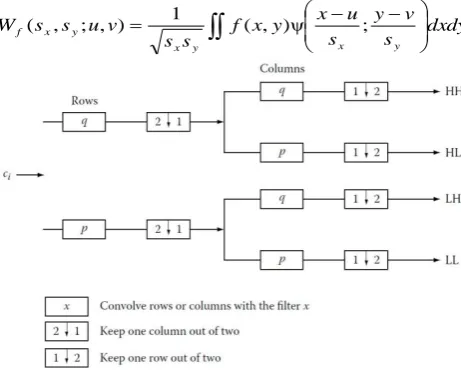
The definition of wavelet transform is modified to 2-D case for many 2-D function processing applications. The wavelet transform of a 2-D function f(x, y) is understood as a four-dimensional function.
dxdy
s v y s
u x y x f s s v u s s W
y x y
x y
x
f ( , )ψ ;
[image:1.595.312.543.453.638.2]1 ) , ; , (
Fig 1 : Schematic two-dimensional wavelet decomposition.
It is reduced to a set of two-dimension functions of (u, v) with different scales, when the scale factors sx=sy=s. When ψ(x,
23
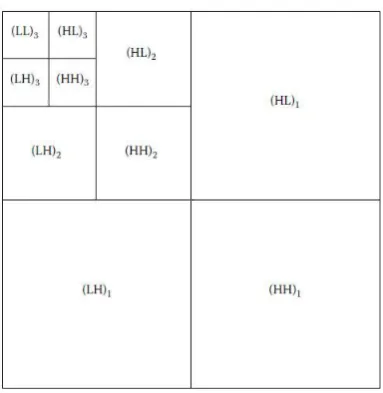
Fig 2: Presentation of the two-dimensional wavelet decomposition and high-pass filters p(n) and q(n).
Otherwise, the wavelet can have particular orientation. The wavelet can also be a combination of the 2-D wavelets with different particular orientations, so that the 2-D wavelet transform has orientation selectivity with quadrature mirror low-pass and high-pass filters p(n) and q(n)
Then the pair of the 1-D filters are applied to each column of the two horizontally filtered images. The down-sampling by two is down sampling result in four sub-band images: (LL) for the low-pass filtered both horizontally and vertically image, (HH) for the highpass filtered both horizontally and vertically image, (LH) for lowpass filtered in horizontal direction and pass filtered in vertical direction image and (HL) for high-pass filtered in vertical direction and high-high-pass filtered in horizontal direction image, as shown in Figure 2.
4.
PROPOSED FORMULAE
A video is a sequence v1v2v3v4……vm of m frames. Here we are
considering that each frame I = fq(x,y)where1x,ynand
m q
1 of size n x n consists of three primary color channels
viz. RED, GREEN and BLUE i.e.
3
1
) , ( )
, (
p q p
q x y f x y
f
3
1p and1qm, wherem=No.offramesin the video
For simplicity, the frame size can be considered to be n x n. We propose two different frame encryption and decryption algorithms. These algorithms use DWT, fractional Fourier transform and chaotic logistic-map and Kaplan-Yorke map. These algorithms follow a similar sequence of operations but they are different in their implementation. The process of encryption and decryption is shown in fig 3 and fig 4.
Fig 3: Encryption process using DWT2in proposed algorithm.
As shown in fig 3, initially, the R, G and B channels of the input frame are segregated. These channels are then concurrently processed by DWT2 (twice), CRPM & FRT (twice)
and IDWT2 as shown in fig 3. The processed channels are merged together to produce an encrypted video frame. This process is formulated as below [1].
( , ) (1)2 exp * ) , ( 2 exp * ) , ( ,
, 2 )
, ( ,
1
3
1
2 1
2 2 2
3
1
p
q p p
q p q
y x S i y
x S i y
x f DWT DWT F
F IDWT IDWT y
x g y x g
I
where α, β are the fractional orders of the second 2-D FRT. gpq(x,y) denotes an encrypted channel viz. R, G or B and gq(x,y)
denotes the encrypted frame obtained after merging these channels together.
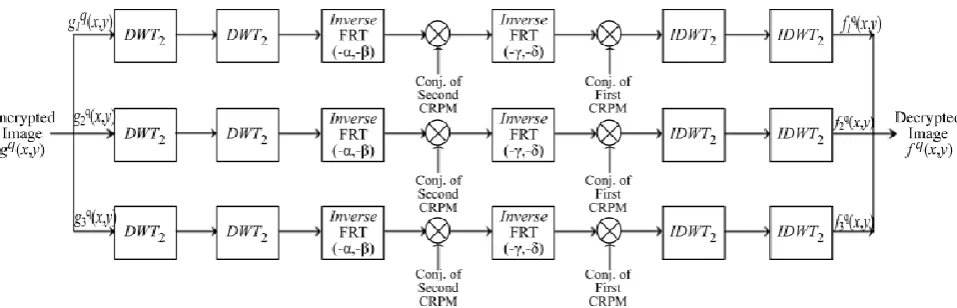
The decryption process, as shown in fig 4, is the inverse of the encryption process. The decrypted frame from gq(x,y) obtained by performing following formulae.
( , )2 exp *
) , ( 2 exp *
) , ( )
, ( '
1 2
2 2 ,
, 2 2
IDWT IDWT F F DWT DWT g x y conj i S x y conj i S x y
y x
f q
p
q
[image:2.595.62.545.368.528.2]Fig 4: Decryption process using IDWT2 in proposed algorithm.
5.
PROPOSED ALGORITHMS
Algorithm 1: Video encryption and decryption using DWT2 and FRT.
This algorithm uses DWT2 and Fα, β in encryption process and
IDWT2 and F-α,-β in decryption process as per the general
encryption and decryption schemes Both of the random phase functions are generated as a 2-D sequence of random numbers and they are not chaos based in this algorithm.
Computation complexity:
Let the input frame I be of size n x n. Analysis of the algorithm is divided into two phases viz. Encryption and Decryption.
Encryption: Frame encryption process involves following steps:
1. Application of DWT2 twice on the primary color R, G, and B channels fq(x,y)
p of original frame
2. Encoding by first CRPM. 3. First application of 2-D FRT. 4. Encoding by second CRPM. 5. Second application of 2-D FRT
6. In this last step IDWT2 is applied twice on each of the channels obtained after step 5.
In step 1, each of the primary color channels of original frame is operated twice using DWT2, The asymptotic upper bound [9] of this process is
) ( 2 )
(n O n O n
O
Thus step 1 takes O
n time and produces an output frame of size4 X 4
n
n . Therefore, steps 2 to 6 are to be applied on a
smaller sized frame than the original frame.
Computation of 2-DFRT of an frame of size n x n is a
n n n
O 2
3
log
2 process. Also, the generation and
multiplication of first and second random phase function is an
) 2 ( 2
n
O process. But now, as the input frame size for steps 2 to 6 has reduced to
4 X 4
n n ,
(i) Step 2 takes
8 4
2
2 2
n O n
O computation time.
(ii)Step 3 takes
4 log 4 4
2 2
3
n n
n O
4 log 4
32 2
3 n n
n O
Similar to step 2 and 3, step 4 and 5 also take
8
2
n O and
4 log 4
32 2
3 n n
n
O computation time, respectively. Step 6
involves computation of inverse wavelet transform, which is also a O(N)function. Therefore, the computation
complexity of encryption is:
8 4
log 4 32 8
) (
2 2
3
2 n
O n n n O n O N O encryption T
) ( 4
log 4
32 2
3
n O n n
n
O
O n n n n 2n
4 log 2 4
16 2
2 3
3
2 2
1 n
O encryption T
Decryption: Frame decryption process involves following steps:
1. Application of DWT2 twice on the primary color components gq(x,y)
p of encrypted frame.
2. Application of 2-D inverse FRT. 3. Decoding by conjugate of second CRPM. 4. Application of 2-D inverse FRT. 5. Decoding by conjugate of first CRPM.
6. In this last step IDWT2 is applied twice on each of the channels obtained after step 5.
In step 1, each of the primary color channels of encrypted frame is operated twice using DWT2, The asymptotic upper bound [9] of this process is ( )
2 )
(n O n On
O
25 step 1 takes O
n time and produces an output encryptedframe of size
4 X 4
n
n .Therefore, steps 2 to 6 are to be
applied on a smaller sized frame than the original encrypted frame.
(i) Step 2 takes
4 log 4 4 2 2 3 n n n O = 4 log 4 32 2 3 n n n O time.
(ii) Step 3 takes
8 4 2 2 2 n O n O time.
Similar to step 2 and 3, step 4 and 5 also take
4 log 4 32 2 3 n n n
O and
8 2 n
O computation time,
respectively. Step 6 involves computation of inverse wavelet transform, which is anO(n)process. Therefore, the computation complexity of decryption is:
8 4 log 4 32 8 ) ( 2 2 3 2 n O n n n O n O n O decryption T ) ( 4 log 4 32 2 3 n O n n n
O
O n n n n 2n
4 log 2 4 16 2 2 3 3 2 2 1 n O decryption T
Thus, the computation complexity of algorithm 1 is evaluated to:
3
2
1
O n
decryption T
encryption T
T
There are m frames is a video therefore the total computation time for encryption & decryption process is
8 3 1 n m O T 3 1 1 m,T n
T
Algorithm 2: Video encryption and decryption using DWT2 and FRT with logistic map.
This algorithm uses DWT2, Fα, β in encryption process and
IDWT2, F-α,-β in decryption process as per the general encryption
and decryption schemes shown in Fig. 1 and Fig. 2.
In this algorithm, both of the random phase functions are generated by using logistic map, which is a one-dimensional function.
Computational complexity
The analysis of this algorithm is also performed in two phases as in case of the Algorithm 1:
Encryption: Step 1, 3, 5 and 6 of encryption are similar to that of algorithm 1 and so are their computation times. Step 2 is Encoding by first random phase function and it takes
8 4 2 2 2 n O n
O time. Similarly step 4 is Encoding by
second random phase function and it takes
8 2 n
O time.
Therefore, the computation complexity of entire encryption phase is computed as follows:
8 4 log 4 32 8 ) ( 2 2 3 2 n O n n n O n O n O Encryption T ) ( 4 log 4 32 2 3 n O n n n
O
O n n n n 2n
4 log 2 4 16 2 2 3 3 2 2 1 n O Encryption T
Decryption: Steps 1, 2, 4, 6 and their computation times of algorithm 2 are similar to that of the Algorithm 1. Step 3 and 5 perform decoding by conjugate of second and first CRPM respectively and each of them takes
8 2 n
O time. Therefore,
8 4 log 4 32 8 ) ( 2 3 2 n O n n n O n O n O deryption T ) ( 4 log 4 32 2 3 n O n n n
O
O n n n n 2n
4 log 2 8 16 2 2 3 3 2 2 1 n O Decryption T
Thus, the computational complexity of algorithm 2 is evaluated to:
3
2
2
Tencryption Tdecryption O n T
There are m frames is a video therefore the total computation time for encryption & decryption process is
8 3 2 n m O T 3 2 2 m,T n
T
Algorithm 3 - Video encryption and decryption using DWT2 and FRT with Kaplan-Yorke map.
This algorithm is similar to the Algorithm 2; the only difference lies in the chaotic function used to generate the random phase mask which is two-dimensional Chaotic Kaplan-Yorke map The expression for the computational complexity of algorithm 3 is evaluated to:
8 3 3 n O decryption T encryption T T 8 3 3 n m O T 3 3 3 m,T n
T
6.
SIMULATION RESULTS
In order to investigate the quality of encryption, decryption and efficiency of proposed algorithms, digital simulations were performed in an environment as under:
Processor – Intel® Core™ 2 Duo CPU, [email protected].
RAM – 2.00 GB. Operating System –Windows Xp sp2.
Simulation tool – MATLAB® R2008b.
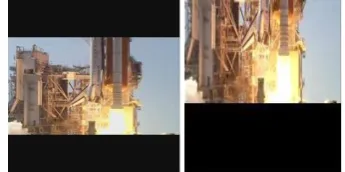
[image:5.595.342.515.72.158.2]The input video chosen for analysis is nasa_117_256.avi (AVI Video; Size = 283 KB; pixel by pixel resolution = 256X256; no. of frames = 117).The video, nasa_117_256.avi was encrypted using algorithm 1, 2 and 3 for α = β = γ = δ = 0.5 fractional orders of FRT. The frames encrypted using algorithm 2 and 3 are shown in Fig 6(a) and 6(b). These frames can be decrypted on any fractional order of FRT, but the restored frame may differ from the input frame depending on the order of FRT. The decrypted frames obtained using incorrect fractional orders of inverse FRT are shown in Fig 7(a) and 7(b).Fig. 8(a) and 8(b) show decrypted frames obtained when correct fractional orders of inverse FRT are used.
[image:5.595.325.525.245.492.2]Fig 5 : Input frame to algorithm 1, 2 and 3 (nasa_117_256.avi, 256X256, color).
Table 1: Computation times of Algo 1, Algo 2 and Algo 3 with no. of frames.
No. of frames (m)
Computation Time (in Seconds)
Algo 1 Algo 2 Algo 3
1 2.71 2.80 2.79
3 7.39 7.62 7.62
7 17.08 17.45 17.34
14 33.85 34.72 34.69 29 75.73 73.25 72.88 58 148.66 152.51 154.28
Fig 9 : Graph showing computation time of Algorithm 1.
Fig 10 :Graph showing computation time of Algorithm 2.
Fig 11: Graph showing computation time of Algorithm 3. Fig 8 : Decrypted frames of size 256X256 decrypted on
appropriate fractional order of inverse FRT by (a) Algorithm 2 and (b) Algorithm 3.The fractional orders of
[image:5.595.87.256.304.541.2]FRT are α = β = γ = δ = 0.5.
Fig 7 : Decrypted frames of size 256X256 decrypted on an incorrect fractional order of inverse FRT by (a) Algorithm 2 and (b) Algorithm 3. The fractional orders of FRT are α =
β = γ = δ = 0.4.
Fig 6: Encrypted frames of size 256X256 by (a) Algorithm 2 and (b) Algorithm 3. The fractional orders of FRT are α = β = γ
= δ = 0.5.
.
(a) (b)
(a) (b)
[image:5.595.326.526.644.738.2]27
7.
CONCLUSION
We have proposed three algorithms for video encryption and decryption and their behavior has been analyzed, based on the computation time required by the algorithms. Each of the algorithm works on a strategy that the data size (or frame size) for encryption and decryption is reduced by a factor of 16 (n x nto
4 X 4
n
n ) than the existing algorithms. For this purpose we
have efficiently utilized the data compression characteristics of the discrete wavelet transform.
On the basis of graphs shown in fig 9, 10 and 11 following claims are justified-
m T m
T m
T1 , 2 and 3
The proposed algorithms retain the robustness of the original image encryption-decryption algorithms. By this we mean that once we encrypt a video frame for a particular fractional order of FRT, decryption of this encrypted frame is only possible, when the selected fractional order for decryption is exactly the suitable for decryption. Results are verified for fractional order of 2-D FRT = 0.5 and fractional order of 2-D IFRT = 0.4, 0.5.
8.
REFERENCES
[1] Prerana Sharma, Devesh Mishra, AnkurAgarwal, “Efficient Image encryption and decryption using discrete wavelet transform and fractional Fourier transform”, Security of Information and Networks, pp 153-157,2012. [2] Prerana Sharma, Dr. Shiv Kumar, “Efficient Image
encryption and decryption using discrete wavelet transform and fractional Fourier transform”, M.Tech. Dissertation, Rajasthan Technical University, April 2013. [3] Prerana Sharma, Dr. Shiv Kumar,“A robust and efficient
scheme for image encryption-decryption”, IJAIEM, Volume 2, Issue 5, May 2013.
[4] Jolly shah, Dr. Vikas Saxena “Video Encryption : A Survey”, International Journal of computer science Issues (IJCSI) Vol. 8,Issue 2, March 2011.
[5] M. Abomhara, Omar Zakaria, Othman o. Khalifa “An Overview of Video Encryption Techniques ”, International Journal of Computer Theory and Engineering,Vol. 2,No. 1 February 2010.
[6] Narsimha Raju C, Uma Devi Ganugula, Kannan Srinathan, C.V. Jawahar “Fast and Secure Real Time Video
Encryption”, Indian Conference on Computer Vision, Graphics and Image Processing(ICVGIP),pp 257-264,December 2008.
[7] Narsimha Raju C, Uma Devi Ganugula, Kannan Srinathan, C.V. Jawahar “A Novel Video Encryption Technique Based on Secret Sharing”,ICIP, pp 3136-3139, October 2008.
[8] H. M. Ozaktas, M. AlperKutay, Z. Zalevsky, The fractional Fourier transform: with applications in optics and signal processing, New York, John Wiley & Sons, 2001.
[9] T. H. Cormen, C. E. Leiserson, R. L. Rivest, C. Stein, “Growth of Functions”, Introduction to algorithms, 3rd
Ed., Cambridge, MIT Press, 2009, pp 43 – 64
[10]Y. Zhang, F. Zhao, “The algorithm of fractional Fourier transform and application in digital image encryption”, International Conference on Information Engineering and Computer Science, 2009, pp 1 - 4.
[11]R. C. Gonzalez, R. E. Woods, S. L. Eddins, Digital Image processing using MATLAB, Delhi, Pearson Education, 2004.
[12]A. D. Poularikas, “Transforms And Applications Handbook”, 3rd
ed., New York, CRC Press, 1996.
[13]dwt2, “Wavelet Toolbox”,http://www.mathworks.in/help/ toolbox/wavelet/ref/dwt2.html, [January 2012].
[14]Y. Sheng, D. Roberge, and H. Szu, “Optical wavelet transform”, Optical Engineering, Vol. 31 Issue 9, 1992, pp 1840–1845.
[15]H. Szu, Y. Sheng, and J. Chen, “The wavelet transform as a bank of matched filters”, Applied Optics, Vol. 31 Issue 17, 1992, pp 3267–3277.
[16]M. O. Freeman, “Wavelet signal representations with important advantages”, Optics & Photonics News, Vol. 4 Issue 8, August 1995, pp 8–14.
[17]J. M. Combes, A. Grosmann, and P. Tchamitchian, “Wavelets”, 2nd
ed., Berlin,Germany, Springer-Verlag, 1990.
[18]R. C. Alligood, T. D. Sauer, J. A. Yorke, “Chaos; an introduction to dynamical systems”, New York, Sringer, 2001.