P
INTRODUCTION
■
R
isk in its more formal interpretations is a statistical concept of events that happen tosomeone or something. It is primarily concerned with threatening conditions and events, their probabilities and conse-quences. Analysis of these threats is usually followed by a search for ways of making them tolerable in some way. This basic stress on external threat and probabilistic consequences is found in most approaches to project risk analysis (for example, Chapman & Ward, 1997; Cooper & Chapman, 1987; Hertz & Thomas, 1983). But it has certain limitations, and in particular makes little room for the idea that organizations’ encounters with risk are as much encounters with their own qualities and deficiencies as they are encounters with external circumstances (Hutter & Power, 2005). Baker’s (2002) analysis of the failure of the Firefly project shows how decisions made early in the proj-ect built in a strong predisposition to breakdown, especially the choice of a commercial off-the-shelf (COTS) product, which then had to be modified. Unfortunately, because it was a COTS product, it was then inadequately test-ed. Thus, an analysis of events without an analysis of organizational capaci-ties and built-in predispositions is only half an analysis. This is related to the inherently circular nature of knowledge about risk (Adams, 1995). When risk bearers know about a risk, they generally modify their behavior, which in turn modifies the risk, so they need to look inward to their own choices and response as much as outward to external threats. And they need to see their understanding of risk at any time as needing to be continually updated.These limitations suggest that the emphasis in project risk analysis should be shifted from the exterior toward the interior. It is not just that “internally generated risks” (Barber, 2005) are important, but that even apparently external risks are risks because of interior structures, decisions, or arrangements. A project becomes vulnerable to labor unrest in a supplier, for instance, because that supplier was chosen, and that supplier was chosen because a process of choosing suppliers was decided upon, or inherited, or in some other way built into a project organization. This points to a similar line of thinking developed by Reason (1990a, 1990b), who argued that there was an analogy between the origin of biological illness and the breakdown of complex technological systems. At certain times, external circumstances combine with “resident pathogens” to overcome a system’s defenses and bring about its breakdown. The defining aspect of these metaphorical pathogens is that they predate the conditions that trigger the breakdown, and are generally more stable and more observable—if you go looking for them—than the triggering events. A decision to cut back on resources devot-ed to maintenance, for instance, may not produce an immdevot-ediate catastrophe but sets up the conditions in which a particular occurrence, such as an adverse weather event or an operator error, does produce catastrophe.
Risk Analysis
Jerry S. Busby
, Department of Management Science, Lancaster University, Lancaster,
United Kingdom
Hongliang Zhang
, Department of Industrial Engineering and Management, College of
Engineering, Peking University, Beijing, China
ABSTRACT
■
Project risk analysis has traditionally empha-sized the analysis of external threats. Here we argue that internal decisions and structures are more fundamental, because they determine which external events pose risks to project management. A “pathogen” metaphor is used to understand these internal sources of risk, in an analysis of failure in two sets of projects that lie on the border between the private and public sectors. This analysis goes beyond earlier work on organizational pathogens by treating them as subjective interpretations, not objective conditions. The study suggests that the more insidious risks to which a project is exposed involve different project members holding contradictory beliefs about what is pathogenic and what is protective
KEYWORDS: projects; risk; pathogens; fail-ure; subjectivity
A study by Busby and Hughes (2004) attempted to apply the pathogen metaphor to project failures, to charac-terize more precisely what “pathogens” amounted to in the project manage-ment context. What was pathogenic turned out to be routine elements of organization—like particular practices or conventions—that produced break-downs of some kind in particular circumstances. But the study also concluded that things appearing to be “pathogenic” could just as readily be interpreted as being adaptive or even protective. Thus, for example, the practice of ring-fencing funds for a par-ticular task can be protective in the sense that it ensures that task receives sufficient resources but pathogenic if it denies project managers the flexibility to respond to unforeseen calls for fund-ing in other tasks. Moreover, the conse-quences of failure were often ambiva-lent. Failure was disruptive and led to losses of time and money in the short term, yet it also contributed to improve-ments and sometimes innovations in the longer term. It disadvantaged some stakeholders but not others. It therefore seems unreasonable to treat “pathogens” as objective entities and better to see the “pathogen” label as a subjective interpretation. The label may be applied to an objective entity, like an organizational practice, but it repre-sents just one perspective on how that entity contributes to the working (or breakdown) of the organization. Kirby’s (1996) case study showed how quite different perspectives on failure are taken by different people.
This analysis of pathogens in proj-ects as subjective interpretations, not objective conditions, reflects a general line of thinking in the risk field. “Risk” itself is seen as an overlay on the world rather than something objectively observable about it (Jasanoff, 1993). Perceptions of risk (for example, Slovic, 1987) become as important and conse-quential as objective expert analysis. And different groups are seen as select-ing particular risks for attention based
on their cultures, not the objective properties of the risks themselves (for example, Douglas, 1992; Douglas & Wildavsky, 1983; Schwarz & Thompson, 1990). The subjectivity of pathogens in projects also fits with the idea that proj-ects are “multi-nodal” and combine many perspectives and contradictions (Ivory & Alderman, 2005). In fact, project organizations seem especially likely to experience pathogens as being subjec-tive. In permanent organizations engaged in routine activity, the various members have an indefinite amount of time, and an indefinite repetition of activity, in which to appreciate the differences in their interpretations of events. But the relative temporariness, uniqueness, and novelty of project organizations (Söderlund, 2003; Turner & Müller, 2003) make it more likely that discrepant interpretations about what is pathogenic and what is protective go unnoticed.
The purpose of this study was therefore to examine “pathogens” in project organizations as a specifically subjective concept. We wanted to find out how the same entity could be con-strued as being both pathogenic and adaptive, why different participants might have different interpretations, and how discrepancy in these interpre-tations could itself be problematic. It seemed likely that the most insidious kind of risk to a project—the least well understood and potentially the most difficult to manage if it materialized— was the kind that involved contradictory interpretations. This in turn suggested that risk analysis should not simply be a consensual analysis of threats and con-sequences. It should also involve inspecting how different actors have come up with different views on the best responses to these threats, and how some of these responses are them-selves threats in other actors’ eyes.
As there is no proper received definition of “pathogen” in this context, our working definition is that a pathogen is some entity with the following properties:
• It is inherently the cause of some rec-ognizable organizational breakdown or failure—for example, an inability to complete a project or significant conflict (perhaps litigation) among project participants.
• It is created by social actors, and not merely an intrinsic vulnerability—for example, an authority structure, con-tract or agreement, procedure, or practice.
• It only becomes clearly problematic and part of an observable breakdown after a prolonged period—for example, it may exist at the start of a project but only bring about failure in later stages.
• It only becomes problematic upon the occurrence of some triggering event or condition, which it predates— for example, a contractual agreement that impedes recovery from an error or environmental event.
P
impede the process of dealing with such risks as they materialize. We also sug-gest that this kind of analysis is com-pletely general. Even when risks are external, uncontrollable physical events like earthquakes, it is reasonable to look for entities built into the project organi-zation as the origin of the threat: a deci-sion to locate facilities in vulnerable regions of the world, the practice of allowing subcontractors to organize their own supply chains, and so on. It is such decisions and practices that can be thought of as being pathogens.Methodology
The methodology involved a case study (for example, Eisenhardt, 1989, 1991; Stake, 1995; Yin, 2003a, 2003b). A case study was particularly indicated because our interest was in a subject where the boundaries between phenomenon and context were blurred, and where there were many more variables of interest than data points (Yin, 2003a). We were interest-ed in understanding the dynamics pres-ent within single settings (Eisenhardt, 1989) and we had no opportunity for experimental control or manipulation (Benbasat, Goldstein, & Mead, 1987). Our concern was with the particularity and complexity of activity in specific circum-stances (Stake, 1995). And we needed a method that was both sensitive to social construction and also “detached” (Easterby-Smith, Thorpe, & Lowe, 2002).
The aim was to investigate “pathogens” in a setting where we hoped different perspectives on project risk would be especially stark. We there-fore looked to projects that involved some mixture of private- and public-sector organizations, in settings that were undergoing substantial structural change. In the United Kingdom, a can-didate set of cases was provided by a small number of “public-private part-nership” projects that had been investi-gated by the central government’s audit office. As large infrastructure projects, generally, they had the qualities dis-cussed by Miller and Hobbs (2005): they were visible and contestable and
raised conflicts for individual public officials who were both involved in them and attempting to preserve a role as independent guardians of the public good. In China, a candidate set of cases was provided by projects being under-taken by state-owned enterprises. These are organizations that—very broadly—are intended to act like pri-vate corporations but still suffer the constraints and cultures found in the centrally planned economy. As Boardman (2001) argued about four years before this study was undertaken,
. . . China has a relatively concen-trated industrial structure . . . domi-nated by many inefficient, badly-structured and poorly-run SOEs [state-owned enterprises]. The dis-tribution of resources is distorted in that government authorities still play a role in the allocation of investment funds, and capital does not necessarily move to sectors where it is most productive . . . SOE managers are de-facto enjoying more autonomy than otherwise formally indicated. But they are doing so largely not by design, but because property rights are poorly defined. The result is that . . . SOEs are protected from competition in product and factor markets by policy barriers to entry or similar institutional constraints. . . .
Thus in both sets of cases there were aspects of organization that essentially belonged to the public sec-tor and aspects that belonged in the private sector. And in both settings the organizations were having to become accustomed to new ways of financing projects and—in particular—
dealing with risk, while taking place in a state of continuing and incomplete readjustment.
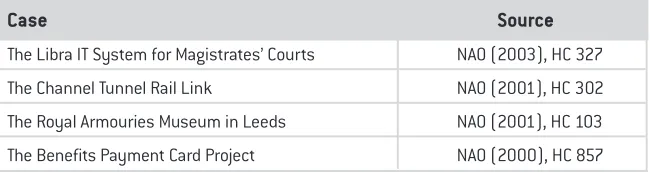
[image:3.612.235.560.102.188.2]The U.K. cases were intended as a pilot study. Our dataset consisted of four reports from the U.K. National Audit Office on the conduct of specific projects, shown in Table 1. These four were selected because they were perceived as being particularly prob-lematic. The aim in the pilot was to determine how feasible it was to identify “pathogens” from informants’ accounts (in this case, the NAO authors), and whether it was also possible to make reasonable conjectures about the per-spectives of other actors whose behav-iors were described. A particular advantage of this kind of secondary data was that it was detailed and wide-ranging. People from a number of disci-plines were involved in the investiga-tions, and the investigators had suffi-cient credibility to obtain opinions and knowledge from many actors. At the same time there were substantial limi-tations. The data seemed to emphasize the early phases of projects, provided relatively little analysis of the relation-ship between project organizations and permanent organizations, stressed decisions more than routines, and sometimes provided relatively little historical explanation. The fact that they were largely retrospective in nature also means that they might not present a satisfactory view of the uncer-tainties that confronted actors at the time. And it is possible they will project a narrow and particular version of reali-ty (see, for example, Brown, 2004, 2005). The Chinese cases were taken from a set of unstructured interviews
Table 1:National Audit Office reports used in the case studies.
Case
Source
The Libra IT System for Magistrates’ Courts NAO (2003), HC 327
The Channel Tunnel Rail Link NAO (2001), HC 302
The Royal Armouries Museum in Leeds NAO (2001), HC 103
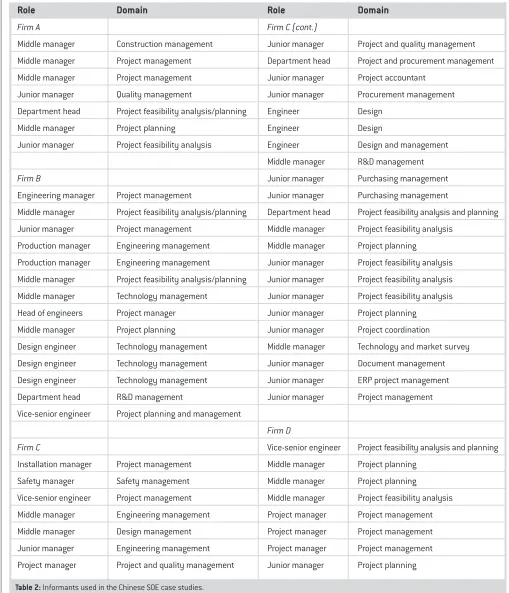
conducted in four sibling corporations, all operating in the petrochemicals industry. The choice of corporation was essentially a convenience sample. Within these corporations, a sample of 60 managers was constructed for the interviews, shown in Table 2. The sam-pling was partly convenience (those managers known to our contact) and partly stratified (we requested inter-views with people at several levels of seniority). The interviews were con-ducted by one of the authors, in Chinese, and the informants were asked to describe specific examples of what they regarded as being project failures, and to explain what they believe caused them, particularly man-agerial and organizational factors. There was no attempt to predetermine a set of criteria for objectively judging the existence of failure, so what was a failure was what the interviewee con-strued as a failure. Again the aim was to (1) identify in the interviewees’ accounts a particular construction of how breakdowns had taken place and (2) identify alternative constructions of those same events. Interviews were recorded and transcribed in Chinese, and relevant parts were translated into English before analysis.
Analysis of both datasets was grounded, involving a step-by-step inspection of each case to find descrip-tions that met the defining condidescrip-tions of a “pathogen” laid out in the Introduction. With both datasets, it was generally straightforward to identify what the informants interpreted as being pathogenic, and it was also gen-erally possible to identify contradictory interpretations of other actors. Nonetheless, these inferences have to be regarded as provisional—our inter-pretations of other people’s interpreta-tions—and the study needs to be seen as being exploratory. Finally, an attempt was made to generate tax-onomies both of the pathogens and of the factors that determined what the informants and actors interpreted as being pathogenic.
Findings
Some Examples
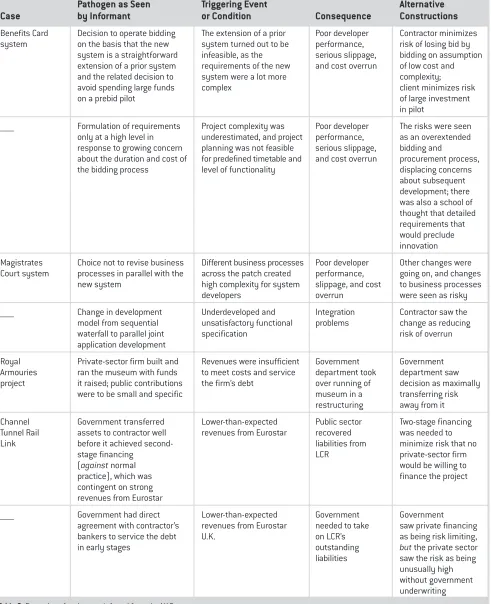
Table 3 summarizes examples of pathogens inferred from the first dataset (the National Audit Office reports) in a highly condensed form. The first column shows the project and the second column the entity that was described in such a way in the reports that it fitted our definition of pathogen. The next two columns show the trigger-ing condition and outcome. The final column indicates the alternative view-point that appeared to explain why the pathogenic entity had come into being, and why it had been interpreted as being adaptive or protective rather than pathogenic. In most cases, in fact, the pathogen reflects an adaptation to some risk otherthan the one that mate-rialized. For example, in the third entry, a choice not to revise business process-es at the time a new system was being introduced was interpreted as being pathogenic by the source. But it had been interpreted by the actors as being protective, on the basis that to have changed business processes, especially at a time other changes were going on, was itself risky.
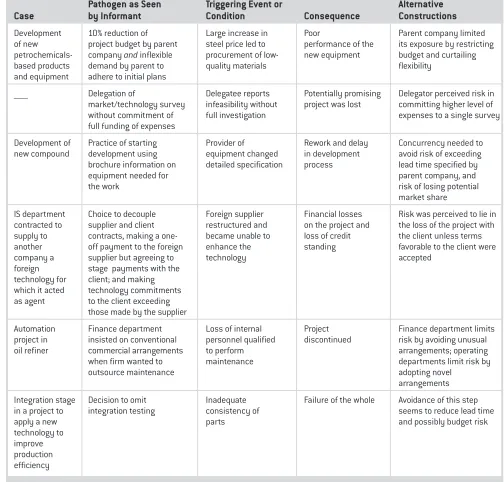
Table 4 similarly shows pathogens inferred from the Chinese SOE inter-views.
Two Taxonomies
The full set of pathogens inferred from the two datasets was used to develop taxonomies, first of the pathogens as they were described, and second of the factors that appeared to influence the interpretations of what was pathogenic and what was adaptive.
Table 5 is a basic taxonomy of the entities that were construed as being pathogenic. There was considerable latitude in deciding just what the pathogen was in any given case. Often the pathogenic entities were taken to be “artifacts”: man-made objects (not necessarily physical ones) like norms and standards. But it was equally possi-ble to say the manner in which the
artifacts were applied was what was pathogenic, or the process by which it had been designed or created, rather than the artifact itself. Similarly, some of the pathogens were task characteris-tics, like “complexity” and “novelty.” But it was equally possible to say that the decision to engage in such a task was what was really pathogenic, not the task itself. At a detailed level of analysis, therefore, the choice of what it is that is pathogenic is somewhat arbitrary.
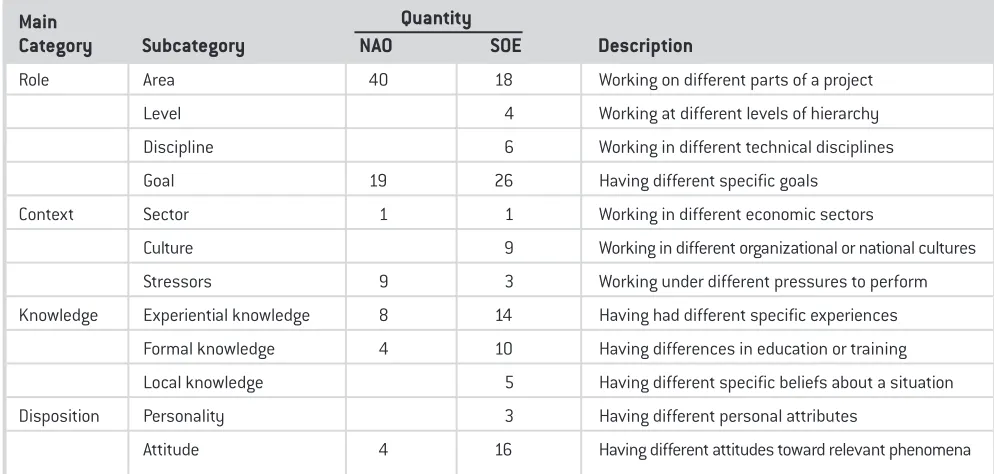
Table 6 is a taxonomy of what appears to influence the construction of pathogens. The numbers are incon-sistent with those in Table 5 because there can be multiple influences on the construction of a given pathogen. The main categories of influence are actors’ roles, their knowledge, their disposi-tions, and the context, and there are various subcategories under each. It is hard to interpret the numbers and hard to compare NAO and SOE cases because of differences in the informa-tion sources. For instance, it seems more likely personal attributions will arise in interviews than in public reports. Moreover, this is a highly sub-jective analysis. We have no obsub-jective information about why the actors con-strued a particular risk as being impor-tant and a particular entity as being pathogenic—we have only the inform-ants’ descriptions. And we have no objective information about why the informants drew theirconclusions about what was pathogenic. Nonetheless, the table indicates that there is a consider-able variety of influences on people’s constructions of what is pathogenic. A construction or interpretation of a pathogen is the result of an uncertain process in which people synthesize a diverse set of factors relevant to their perceptions of risk in projects.
Discussion
Why Protection Can Be Pathogenic and Vice Versa
P
Role
Domain
Role
Domain
Firm A Firm C (cont.)
Middle manager Construction management Junior manager Project and quality management
Middle manager Project management Department head Project and procurement management
Middle manager Project management Junior manager Project accountant
Junior manager Quality management Junior manager Procurement management
Department head Project feasibility analysis/planning Engineer Design
Middle manager Project planning Engineer Design
Junior manager Project feasibility analysis Engineer Design and management
Middle manager R&D management
Firm B Junior manager Purchasing management
Engineering manager Project management Junior manager Purchasing management
Middle manager Project feasibility analysis/planning Department head Project feasibility analysis and planning
Junior manager Project management Middle manager Project feasibility analysis
Production manager Engineering management Middle manager Project planning
Production manager Engineering management Junior manager Project feasibility analysis
Middle manager Project feasibility analysis/planning Junior manager Project feasibility analysis
Middle manager Technology management Junior manager Project feasibility analysis
Head of engineers Project manager Junior manager Project planning
Middle manager Project planning Junior manager Project coordination
Design engineer Technology management Middle manager Technology and market survey
Design engineer Technology management Junior manager Document management
Design engineer Technology management Junior manager ERP project management
Department head R&D management Junior manager Project management
Vice-senior engineer Project planning and management
Firm D
Firm C Vice-senior engineer Project feasibility analysis and planning
Installation manager Project management Middle manager Project planning
Safety manager Safety management Middle manager Project planning
Vice-senior engineer Project management Middle manager Project feasibility analysis
Middle manager Engineering management Project manager Project management
Middle manager Design management Project manager Project management
Junior manager Engineering management Project manager Project management
[image:5.612.53.562.102.695.2]Project manager Project and quality management Junior manager Project planning
Pathogen as Seen
Triggering Event
Alternative
Case
by Informant
or Condition
Consequence
Constructions
Benefits Card Decision to operate bidding The extension of a prior Poor developer Contractor minimizes systemon the basis that the new system turned out to be performance, risk of losing bid by
system is a straightforward infeasible, as the serious slippage, bidding on assumption extension of a prior system requirements of the new and cost overrun of low cost and and the related decision to system were a lot more complexity;
avoid spending large funds complex client minimizes risk
on a prebid pilot of large investment
in pilot
_______ Formulation of requirements Project complexity was Poor developer The risks were seen only at a high level in underestimated, and project performance, as an overextended response to growing concern planning was not feasible serious slippage, bidding and
about the duration and cost of for predefined timetable and and cost overrun procurement process, the bidding process level of functionality displacing concerns
about subsequent development; there was also a school of thought that detailed requirements that would preclude innovation
Magistrates Choice not to revise business Different business processes Poor developer Other changes were Court systemprocesses in parallel with the across the patch created performance, going on, and changes
new systemhigh complexity for systemslippage, and cost to business processes developers overrun were seen as risky
_______ Change in development Underdeveloped and Integration Contractor saw the model from sequential unsatisfactory functional problems change as reducing waterfall to parallel joint specification risk of overrun application development
Royal Private-sector firm built and Revenues were insufficient Government Government Armouries ran the museum with funds to meet costs and service department took department saw project it raised; public contributions the firm’s debt over running of decision as maximally
were to be small and specific museum in a transferring risk restructuring away from it
Channel Government transferred Lower-than-expected Public sector Two-stage financing Tunnel Rail assets to contractor well revenues from Eurostar recovered was needed to Link before it achieved second- liabilities from minimize risk that no
stage financing LCR private-sector firm
(againstnormal would be willing to
practice), which was finance the project
contingent on strong revenues from Eurostar
_______ Government had direct Lower-than-expected Government Government agreement with contractor’s revenues from Eurostar needed to take saw private financing bankers to service the debt U.K. on LCR’s as being risk limiting, in early stages outstanding butthe private sector liabilities saw the risk as being
[image:6.612.62.553.102.706.2]unusually high without government underwriting
P
protective. First, risks change with time over the course of a project, and man-aging risk at one time cannot be sepa-rated from risk at another. For example, an organization can minimize risk in a pilot project by making the pilot a small, limited exercise. But this tends to increase risk in the subsequent parts of
a project. Second, risks in different parts of a project cannot be completely separated. For example, in the Magistrates Court system, the client was reluctant to impose uniform busi-ness processes on the semi-independ-ent courts because other changes were going on at the time. But this then
created a complexity risk for the project. This kind of effect seems inevitable when the project organization is a net-work of actors rather than a hierarchy (Hellgren & Stjernberg, 1995). Third, actors in a project do not have arbitrary choices about how they distribute and transfer risk. For example, in some of
Pathogen as Seen
Triggering Event or
Alternative
Case
by Informant
Condition
Consequence
Constructions
Development 10% reduction of Large increase in Poor Parent company limited of new project budget by parent steel price led to performance of the its exposure by restricting petrochemicals- company andinflexible procurement of low- new equipment budget and curtailing based products demand by parent to quality materials flexibility
and equipment adhere to initial plans
_______ Delegation of Delegatee reports Potentially promising Delegator perceived risk in market/technology survey infeasibility without project was lost committing higher level of without commitment of full investigation expenses to a single survey full funding of expenses
Development of Practice of starting Provider of Rework and delay Concurrency needed to new compound development using equipment changed in development avoid risk of exceeding brochure information on detailed specification process lead time specified by
equipment needed for parent company, and
the work risk of losing potential
market share
IS department Choice to decouple Foreign supplier Financial losses Risk was perceived to lie in contracted to supplier and client restructured and on the project and the loss of the project with supply to contracts, making a one- became unable to loss of credit the client unless terms another off payment to the foreign enhance the standing favorable to the client were company a supplier but agreeing to technology accepted
foreign stage payments with the technology for client; and making which it acted technology commitments as agent to the client exceeding
those made by the supplier
Automation Finance department Loss of internal Project Finance department limits project in insisted on conventional personnel qualified discontinued risk by avoiding unusual oil refiner commercial arrangements to perform arrangements; operating when firm wanted to maintenance departments limit risk by
outsource maintenance adopting novel
arrangements
Integration stage Decision to omit Inadequate Failure of the whole Avoidance of this step in a project to integration testing consistency of seems to reduce lead time
apply a new parts and possibly budget risk
[image:7.612.57.561.108.590.2]technology to improve production efficiency
the cases the public-sector organiza-tion saw private-sector construcorganiza-tion and financing as limiting risk to the public purse, but the private sector saw the risk to them as being somehow unacceptable. So the public-sector organization had to give undertakings
that limited this risk, and these under-takings became pathogenic because— perhaps unsurprisingly—they returned the risk right back to the public sector.
Quite similar points emerged from the Chinese SOE cases. There were
cases, for instance, where an actor lim-ited his or her risk by adhering to stan-dard procedures or practices, which increased risk as seen by other actors when it created inflexibility and closed off possible lines of action. And there were cases where different parts or stages of a project interacted. So limit-ing the risk of loslimit-ing the contract with a client led to risk in implementation— for example, where undertakings had to be given to the client that could not be matched with undertakings obtained from a contractor. Similarly, avoiding certain stages of work was limiting at one level and risk-increasing at another. It is tempting to say that this kind of connection is obvi-ous, and actors are being foolish. How could anyone imagine that bypassing specification tasks or integration tasks would reduce rather than increase risk to a project? But it is unlikely that this could be clearly seen at the time. Being engaged in a particular stage of a proj-ect selproj-ects certain risks for a projproj-ect manager’s attention, and the priority becomes dealing with these risks rather than worrying about how widely the
Quantity
Chinese
Category
NAO reports
interviews
Description
Artifact 17 27 Objects such as norms and standards, salary structure, organization structure, project plans and project contract, and so on
Behavior 22 22 Observable organizational and individual actions
Routine 3 31 Recurrent patterns in activity, practice, or cognition
Task 5 7 Attributes such as novelty, distance, characteristics duration, complexity, and
completeness
Technology 3 Aspects of a technology
[image:8.612.53.382.102.322.2]such as intrusiveness and quality
Table 5:A categorization of project pathogens.
Main
Quantity
Category
Subcategory
NAO
SOE
Description
Role Area 40 18 Working on different parts of a project
Level 4 Working at different levels of hierarchy
Discipline 6 Working in different technical disciplines
Goal 19 26 Having different specific goals
Context Sector 1 1 Working in different economic sectors
Culture 9 Working in different organizational or national cultures
Stressors 9 3 Working under different pressures to perform
Knowledge Experiential knowledge 8 14 Having had different specific experiences
Formal knowledge 4 10 Having differences in education or training
Local knowledge 5 Having different specific beliefs about a situation
Disposition Personality 3 Having different personal attributes
Attitude 4 16 Having different attitudes toward relevant phenomena
[image:8.612.53.550.469.706.2]P
way of dealing with them will ramify into other stages of the project.The Origins of Different Perspectives
Table 6 indicated what appeared to influence actors’ interpretations of what was pathogenic. Much of this analysis was conjecture, because the data offered only indirect evidence in most cases. But it suggested that it was a mix of the internal and external that led people to see certain entities as being the source of risk and others as being a way of mitigating risk. The internal factors were their knowledge, understandings, training, and so on on the one hand and their dispositions and attitudes on the other. The external factors were their roles and domains, influences from the industry they worked in, and the particular circum-stances of the project. A significant pro-portion of these factors could be col-lected under the heading of “identity,” and identity then becomes the key influence that leads people to interpret certain entities as being pathogenic. It is the way in which project managers’ basic attitudes to risk and failure, their particular understanding of a project and the stage it has reached, and the role they play that all come together to form their identity and shape their view of an entity as pathogenic or protective. It is a similar argument to March’s (1994) work on how actors’ identities influence their interpretations and decision making.
These factors also converge in expectations of blame. It seems inevitable that actors’ constructions of what is “pathogenic” would be based on what they might be blamed for. Blameworthy events become highly specific risks to an individual, and the origins of these events—whether prac-tices, artifacts, decisions, and so on— become relevant pathogens. There is an argument that blame will be especially prominent in project organizations. The autonomy that managers experi-ence in projects (Bresnen, Goussevskaia, & Swan, 2004; Sydow, Lindkvist, &
DeFillippi, 2004) suggests that blame is likely to be much less equivocal than in other kinds of organization, where “sys-temic” failures are hard to link to par-ticular people. It is harder for project managers who are perceived to be autonomous to explain away failure to circumstances beyond their control. Similarly, the emphasis in project organizations on tasks (Lundin & Söderholm, 1995) indicates that task failure is more likely to be followed by blame. In permanent organizations, engaged in repetitive operations, the failure of specific tasks on specific occasions is less important than the maintenance of long-term cohesion. Thus, project managers can expect blame more than most other managers, and the prospect of blame will be more central to their judgments.
The Real Job of Risk Analysis
We suggested earlier that there is a more insidious kind of risk than the face-value risks typically identified in project risk analyses. This is the risk that problematic events become espe-cially intractable because actors’ inter-pretations of risk are contradictory. It was not just that different actors do not see the same risks, but that the risks in one actor’s eyes are the means of man-aging risk in another’s eyes. So the actors are attached to their points of view because they suit their identities, and reflect their expectations of blame, and also because they are the solutions to their problems. An actor for whom ring-fenced funding is a protection has a strong incentive to play down the extent to which that ring-fenced fund-ing is also a risk. This implies that dif-ferent actors will not automatically understand and legitimize other actors’ views about risk, and that an important part of risk analysis should be to dis-cover these discrepancies. All this is especially important in projects, because they are temporary organiza-tions that tend not to have repeated experiences. This is similar to Kirby’s (1996) point that project managers
should recognize the existence of dif-ferent perspectives before they jeop-ardize a project’s success. It is also somewhat similar to Weick and Roberts’s (1993) principle that actors should exercise “heedfulness” in their dealings with risk.
A practical way of analyzing the subjectivity of risk understandings is (1) to get the main actors in a project to identify risks, perform the kind of analysis that suits them, and plan miti-gating measures, and then (2) to get them to analyze each other’s analyses, looking not particularly for gaps in their own analysis but contradictory interpretations of the same entity. They then need to come together to explore the implications, particularly (1) whether their differences will hamper the management of risk as it material-izes and (2) whether there are alterna-tive ways of managing risks that avoid the problem of creating other risks. The most important element of this exer-cise is to avoid seeking consensus, since this will only obscure the differ-ences that would emerge if the project started to fail. At some point, the actors need to agree on how to get on with the concrete business of the project, but they should be clear not only about the risks this will create for them, but also the risks it creates for others—and the risks that will come from others trying to manage their risks. Genus (1997) remarked, in connection with his study of the Channel Tunnel project, “The adversarial nature of contractual rela-tions . . . may be said to stem from [the parties’] different perspectives and objectives.” We would argue that an understanding of different perspectives might produce less adversarial rela-tionships—not least because there is a greater appreciation of how mutually confounding actions also mean self-confounding actions.
Conclusion
much the experience of its own charac-teristics and limitations as it is of exter-nal events. We have suggested the use of the “pathogen” metaphor as a way of emphasizing those causes of organiza-tional breakdown that are built into projects at their inception. We have also suggested that different actors will sometimes have very different interpre-tations of what is pathogenic and what is adaptive, and that this kind of dis-crepancy poses particularly insidious risks. A number of cases were examined in this study based on (1) secondary data on U.K. public-private partnership projects and (2) interview data on Chinese state-owned enterprise proj-ects. These offered plenty of support for the thesis that the more fundamental causes of breakdown were typically decisions, or practices, or other basic entities within a project, not external events. It was these that turned particu-lar external events or conditions into threats or risks. The cases also support-ed the principle that pathogens existsupport-ed as such only from certain viewpoints. One person’s pathogen was sometimes another’s protection; a protection at one point in a project became a pathogen at a later point. The main practical implication was that project risk analysis should involve an analysis of how discrepancies among different actors’ constructions of the relevant “pathogens” might arise.
The study had a number of limita-tions. Although it drew on data about project organizations in the United Kingdom and China, the methods were dissimilar, and this precluded compar-isons between the two settings. A com-parison of how project managers understand risk differently in the two cultures would be a worthwhile subject for further study. The work was also exploratory and limited to particular industries, so a confirmatory study that extends across a wider range of indus-tries is suggested. It would also be interesting to include some demo-graphic analysis, assessing whether there is a particular relationship
between the experience of individual managers, for example, and their understandings of project risk. Finally, there was no attempt to assess how the principles for a better approach to risk analysis would work in practice. Nonetheless, it draws attention to the basic idea that risk originates in the way organizations see the world, rather than the world itself, and that recogniz-ing this is an important step in gettrecogniz-ing beyond the limitations of traditional risk analysis.
Acknowledgment
Many thanks are due to the reviewers of an earlier draft of this article. ■
References
Adams, J. (1995).Risk.London: UCL Press.
Baker. B. (2002).The fall of the Firefly: An assessment of a failed project strat-egy. Project Management Journal, 33, 53–57.
Barber, R. B. (2005).Understanding internally generated risks in projects.
International Journal of Project Management, 23, 584–590.
Benbasat, I., Goldstein, D. K., & Mead, M. (1987).The case research strategy in studies of information systems. MIS Quarterly, 11, 368–386.
Boardman, H. G. (2001).The busi-ness(es) of the Chinese state. World Economy, 24, 849–875.
Bresnen, M., Goussevskaia, A., & Swan, J. (2004).Embedding new man-agement knowledge in project-based organizations. Organization Studies, 25, 1535–1555.
Brown, A. D. (2004).Authoritative sensemaking in a public inquiry report. Organization Studies, 25, 95–112.
Brown, A. D. (2005).Making sense of the collapse of Barings Bank. Human Relations, 58, 1579–1604.
Busby, J. S., & Hughes, E. J. (2004).
Projects, pathogens and incubation periods. International Journal of Project Management, 22, 425–434.
Chapman, C., & Ward, S. (1997).
Project risk management: Processes, techniques, and insights.Chichester, UK: John Wiley & Sons.
Cooper, D. F., & Chapman, C. B. (1987).
Risk analysis for large projects: Models, methods and cases.Chichester, UK: John Wiley & Sons.
Douglas, M. (1992).Risk and blame.
London: Routledge.
Douglas, M., & Wildavsky, A. (1983).
Risk and culture: An essay on the selec-tion of technological and environmen-tal dangers.Berkeley, CA: University of California Press.
Easterby-Smith, M., Thorpe, R., & Lowe, A. (2002).Management research: An introduction(2nd ed.). London: Sage.
Eisenhardt, K. M. (1989).Building the-ories from case study research.
Academy of Management Review, 14, 532–550.
Eisenhardt, K. M. (1991).Better stories and better constructs: The case for rigor and comparative logic. Academy of Management Review, 16, 620–627.
Genus, A. (1997).Managing large-scale technology and inter-organizational relations: The case of the Channel Tunnel. Research Policy, 26, 169–189.
Hellgren, B., & Stjernberg, T. (1995).
Design and implementation in major investments—A project network approach. Scandinavian Journal of Management, 11, 377–394.
Hertz, D. B., & Thomas, H. (1983).Risk analysis and its application.New York: John Wiley & Sons.
Hutter, B., & Power, M. (2005).
Organizational encounters with risk: An introduction. In B. Hutter & M. Power (Eds.), Organizational encounters with risk(pp. 1–32). Cambridge, UK: Cambridge University Press.
P
Jasanoff, S. (1993).Bridging the two cultures of risk analysis. Risk Analysis, 13, 123–129.Johnson, B. B., & Covello,V. T. (1987).
The social and cultural construction of risk: Essays on risk selection and percep-tion.Dordrecht, the Netherlands: Reidel.
Kirby, E. G. (1996).The importance of recognizing alternative perspectives: An analysis of a failed project.
International Journal of Project Management, 14, 209–211.
Lundin, R. A., & Söderholm, A. (1995).
A theory of the temporary organiza-tion. Scandinavian Journal of Management, 11, 437–455.
March, J. G. (1994).A primer on deci-sion making: How decideci-sions happen.
New York: The Free Press.
Miller, R., & Hobbs, B. (2005).
Governance regimes for large complex projects. Project Management Journal, 36, 42–50.
Reason, J. (1990a).Human error.New York: Cambridge University Press.
Reason, J. (1990b).The contribution of latent human failures to the
breakdown of complex systems.
Philosophical Transactions of the Royal Society of London, Series B, 327, 475–484.
Schwarz, M., & Thompson, M. (1990).
Divided we stand: Redefining politics, technology and social choice.New York: Harvester Wheatsheaf.
Slovic, P. (1987).Perception of risk.
Science, 236, 280–285.
Söderlund, J. (2003).Building theories of project management: Past research, questions for the future. International Journal of Project Management, 22, 183–191.
Stake, R. E. (1995).The art of case study research.Thousand Oaks, CA: Sage.
Sydow, J., Lindkvist, L., & DeFillippi, R. (2004).Project-based organizations, embeddedness and repositories of knowledge (editorial). Organization Studies, 25, 1475–1489.
Turner, J. R., & Müller, R. (2003).On the nature of the project as a temporary organization. International Journal of Project Management, 21, 1–8.
Weick, K. E., & Roberts, K. H. (1993).
Collective mind in organizations:
Heedful interrelating on flight decks.
Administrative Science Quarterly, 38, 357–381.
Yin, R. K. (2003a).Applications of case study research(2nd ed.). Thousand Oaks, CA: Sage.
Yin, R. K. (2003b).Case study research: Design and methods(3rd ed.).
Thousand Oaks, CA: Sage.
Jerry S. Busby is a senior lecturer in the Department of Management Science, Lancaster University. His research interests are in risk analysis, risk management, and organizational failure. He has worked in various engineering industries, and has a PhD from Lancaster University, an MSc from Imperial College London, and an MA from Cambridge University.